



Abstract
BACKGROUND:
There is a growing interest in diets due to the high contribution to greenhouse gas emissions (GHGE).
OBJECTIVE:
The study was aimed to estimate the impact on GHGE of replacing the current diet with eight alternative diets, which would be associated with GHGE, to contribute to the discussion of how dietary changes affect the GHGE.
METHODS:
The latest National Nutrition and Health Survey was utilized to determine the nutrient composition of Turkey’s current diet, with eight dietary scenarios designed to meet the National Dietary Guidelines.
RESULTS:
The current diet had the highest GHGE with 3254.50 g CO2eq/person/day with beef, lamb, and cheese products accounting for the majority of emissions (18.61%, 17.15%, and 10.89%, respectively). The Model diet had a GHGE of 2994.18 g CO2eq/person/day, whereas vegetarian diets had the lowest (lacto-ovo vegetarian diet with 1944.95 g CO2eq/person/day and vegan diet with 1166.80 g CO2eq/person/day). Low energy efficiencies were associated with high diet-related GHGE levels.
CONCLUSION:
When evaluating future dietary guidelines for a sustainable diet, our study highlighted the need of integrating both health and environmental aspects. The present study found that dietary changes would significantly contribute to lowering GHGE. These findings will be beneficial in informing Turkey’s nutrition, agriculture, and public policymakers.
Keywords
Introduction
By end of the present century, it is estimated that the world’s population could reach a peak of about 11 billion according to the United Nations [1]. This means that the planet must be capable of feeding and sustaining 11 billion people. Global food production is expected to increase, but environmental concerns are expected to deteriorate as a result of intensive farming techniques and unsustainable food production and consumption patterns [2]. Furthermore, the limited availability of natural resources will place a strain on food production systems. Therefore, it is critical that our resources are generally used effectively and that the adverse environmental effects of manufacturing are minimized [3]. As a result, there will be greater demand for sustainable food production methods [4].
In addition to contributing to greater Greenhouse Gas Emissions (GHGE), food production systems, are key contributors to environmental impacts such as degradation, land usage, biodiversity loss, water, and fossil fuel depletion [4–6]. Food consumption is responsible for around 20–30% of the environmental impacts [7]. Thus, it is critical to reduce the negative environmental impacts of food production and consumption. One of the most difficult challenges is lowering GHGE [3, 8].
Diverse scientific fields are becoming increasingly interested in sustainable food systems and diets. A sustainable food system is one that assures food security and nutrition for everyone while not jeopardizing the economic, social, and environmental foundations for generating food security and nutrition for future generations [9]. Sustainable food systems have been found to benefit human health, economic prosperity, social equality, and the environment [10].
The Food and Agriculture Organization (FAO) defined sustainable diets as “diets protective and respectful of biodiversity and ecosystems, culturally acceptable, accessible, economically fair and affordable; nutritionally adequate, safe and healthy; while optimizing natural and human resources”. Furthermore, the FAO recommends emphasizing sustainability when developing dietary guidelines and policies [11]. Dietary guidelines vary by nation, but according to the World Health Organization (WHO) recommends that fruit, vegetables, legumes, nuts, and whole grains are important parts of a healthy diet, and free sugars, salt, and fat must be limited [12]. Additionally, evidence suggests that population-based dietary changes could improve both health and environmental sustainability [13–15]. Animal-based products are high in saturated fats, as a result, are generally related to contributing significantly more GHGE than plant-based products [3]. As a result, substituting nutritious plant-based diets with fewer animal source meals may reduce GHGE while also benefiting human health [16]. Furthermore, more than 1.9 billion adults are overweight and 600 million adults are obese in the world, resulting in a higher prevalence of non-communicable diseases (NDCs) [17]. Studies showed that healthy plant-based diets with fewer animal sources could decrease the risk of NCDs [14–16]. Additionally, Turkey has the highest obesity prevalence with 32.1% among European countries [18] and, adherence to National Dietary Guideline (NDG) is very low in Turkey [19]. Therefore, acceptable dietary changes are needed for health and sustainability.
According to the last Turkey Statistical Institute report, the total GHGE per person is 6.4 tons of CO2 equivalents (CO2eq), although it is unknown how much of this figure is attributed to the current diet [20]. Additionally, there are no current diet studies on minimizing GHGE in Turkey. The study was to aim to estimate the impact on GHGE of replacing the current diet with eight alternative diets, to contribute to the discussion of how dietary changes affect the GHGE. Indicators of nutrient efficiency were also defined as a function of GHGE for macronutrients and total energy. These findings provide an estimate of the environmental impacts of various diet scenarios.
Methods
Food consumption data
Current data on Turkey households’ diets were obtained from the last National Nutrition and Health Survey (NNHS) performed by the Turkey Ministry of Health in 2019. The NNHS was conducted in 81 provinces across Turkey, with volunteer participants were choosen using a random sampling method.
The sampling method of NNHS was based on 3-stage cluster sampling:
In the Primary Sampling Unit (Cluster), approximately 100 addresses for the settlements were clustered. At this stage, a total of 2,400 clusters were selected. The proportional probability selection method was used to select clusters. The cluster size was determined by the number of addresses in each cluster.
Secondary Sampling Unit (Address (Household)): 10 addresses were selected systematically from each selected cluster.
Tertiary Sampling Unit (individuals aged 15 and over): The selected addresses were matched with the current Family Medicine Database created by the Turkey Ministry of Health. Following that, Turkey Statistical Institute randomly chose an individual aged 15 and above from among the eligible individuals matched at each address.
Demographic characteristics of participants in NNHS included those aged 15 and over. Accordingly, most of the participants graduated primary school (27.4%); followed by high school (23%) and higher education (19%). According to the income situation, the rate of bringing the income to the end of the month is the highest prevalence at 34.3%. It was found that 38.5% of the participants had chronic diseases aged 19–64. In this study, the food intake data were used for only adults aged 19–64 (n: 9,796, 44.9% of men and 55.1% of women, aged 19–64 years) [21].
The NNHS collected data on participants’ current diets using 24-hour dietary recall and food frequency questionnaire (FFQ) methodologies by trained dietitians [21]. Both methods were conducted in two independent sessions separated by two weeks (10–14 days) as recommended by the European Food Safety Authority [22]. FFQ consisted of 91 items. There were options such as never/less than once a month, 1–3 times a month, once a week, 2–3 times a week, 4–5 times a week, every day (6–7 times), and not knowing/unanswered, according to the items. They were also asked to write the amount of nutrients they obtained at one time. The foods they consumed according to each meal, the items contained in these foods, and their amounts were taken into the 24-hour dietary recall by questioning them one by one. The “Food and Nutrition Photo Catalogue” was used to determine the portion sizes [21].
The NNHS reports daily nutrient consumption as an average, standard deviation, and minimum-maximum amount for both sexes [21]. Dietary recommendations for men and women in the 19–64 age group are similar according to the National Dietary Guideline (NDG) [19]. Therefore, common average nutrient consumption amounts for men and women were calculated from the minimum and maximum values.
The Turkish food composition database was used to evaluate food energy and macronutrient content. Nutrition Information System 8.2 was used to conduct the analysis (BeBIS 8.2, Willstaett, Germany; Turkish version). Salt, spices, sweets, and sugary food categories had very low GHGE (0.0–0.1 g CO2eq/day), and were not included; assuming them to be relatively constant throughout the scenarios. Additionally, alcoholic beverages were not included in the model diet and alternative dietary scenarios due to alcohol consumption being quite low in Turkey (84.3% do not consume alcohol) [21].
Dietary scenarios
Eight alternative dietary scenarios have been developed to compare the current diet: (1) Model diet based on the NDG; (2) diet with high dairy, (3) diet with milk products, (4) diet with cheese products, (5) non-dairy diet, (6) diet with non-ruminant meats, (7) lacto-ovo vegetarian diet, and (8) vegan diet (Table 1).
Dietary Scenarios
Dietary Scenarios
*400 ml/day milk,100 ml/day yoghurt and 40 g/day cheese products were included; and the potato, pasta and rice group were reduced to 150 g/day to provide calories and nutrients, **400 ml/day milk,100 ml/day yoghurt were included; cheese products were excluded and the oils and fats group were increased 35 g/day to provide calories and nutrients, ***120 g/day cheese products were included, and milk and milk products were excluded, §All dairy products were excluded; and the legumes and the oils and fats groups were increased 65 g/day and 50 g/day, respectively to provide calories and nutrients, ¥All the amount of red meat and meat products were changed with poultry, ɠAll the meat and meat products were excluded; and the legumes and the oils and fats groups were increased 70 g/day and 40 g/day, respectively to provide calories and nutrients, ʆAll the meat and meat products were excluded; and the legumes, the oils and fats, bread and cereals and potatoes, pasta and rice groups were increased 90 g/day, 40 g/day, 200 g/day and 200 g/day, respectively to provide calories and nutrients.
All dietary scenarios were designed for men and women aged 19–64, with a daily caloric intake of 2000 kcal. All diet scenarios were developed by consensus based on the WHO’s, FAO’s, and Turkey Ministry of Health’s recommendations for energy consumption and macronutrients [19, 23]. The NDG’s suggested consumption for each of the eight major food categories was used to develop the dietary scenarios.
According to the literature, there is conflicting advice about one way to reduce dietary GHGE, is to reduce or to avoid the consumption of red meat (such as beef and sheep meat) and dairy foods [24–28]. Therefore, we modeled diets containing high dairy products and non-ruminants meats.
According to the literature, cheese has been shown to contribute higher GHGE than milk and milk products. For this reason, in addition to the diet with high dairy products scenario, we modeled 2 different diet scenarios containing only “milk and milk products” and only “cheese” [32–34].
Total GHGE is generally assessed by the life cycle assessment (LCA) method [39]. LCA is a technique for estimating GHGEs at various food production and consumption phases. It was originally developed for industrial production and procedures, however, in the early 1990s, it was applied to food products [40]. LCA is complex and includes all phases of a product’s life such as emissions from agriculture and primary production, processing, packing, shipping, storage, retail, preparing, cooking, and waste disposal [40, 41]. GHGE related to food production consists primarily of nitrous oxide (N2O) and methane (CH4), which are the first two gases associated with the primary production, and fossil carbon dioxide (CO2). The total amount of GHGE is expressed in CO2eq, assuming a 100-year aspect where 1 kg of CO2 equals 1 kg of CO2eq, 1 kg of CH4 equals 25 kg of CO2eq, and 1 kg of N2O equals 298 kg of CO2eq [42].
Significant differences in GHGE levels are acknowledged as a result of methodological differences (for example “consequential” or “attributional” modeling) or system boundaries, such as whether the consumer stage phase is included or not in the GHGE calculation [43, 44]. Although changes in land usage and utilization may be crucial for food production owing to biogenic CO2 emissions [41, 45], there is no agreement on how to calculate these emissions. Additionally, food waste in Turkey was ignored due to a lack of data. Therefore, emissions following the retail phase (transportation, store, cooking, and wasting) and emissions associated with land-use change were excluded from the current study.
As there is no data about GHGE for food produced in Turkey, we searched the literature using resources that have analyzed GHGE levels worldwide. This assumption is reasonable given that the majority of people consume common foods, as evidenced by analyzed surveys. Commercial farming and animal products have been extremely standardized around the world, with the same companies providing technological packages identical to farms in various countries and locations. The vast number of cases investigated was one of the factors for selecting these studies. Moreover, we chose studies that clarified the system boundary, from agricultural input manufacturing to the farm gate. We excluded the food processing steps, including packaging, storing, cooking, retailing, and distribution for selecting studies [32, 47] except for baked products [48].
Additionally, the composition of the current diet had some uncertainties. For example, the NNHS did not analyze the names of the associated foods or beverages consumed by the main food groups. Therefore, GHGE values were the variables with uncertainties in this study, as shown in Supplementary Table 2. In this study, we estimated the absolute (CO2eq per day) and relative (% of total g CO2eq per day) GHGE for each diet scenario, as well as the contribution of food groups to the total diet weight.
Calculating the efficiency of greenhouse gas emissions
The United States Environmental Protection Agency’s Avoided Emissions and Generation Tool (AVERT) is used to estimate the emissions benefits of energy efficiency and renewable energy policies and programs [49]. In the present study, GHGE efficiencies provide independent findings of the daily food consumption that are a general feature of the diet. A nutrient’s GHGE efficiency was calculated as below [50]:
(EffN,D: GHGE efficiency, N: corresponding macronutrient (carbohydrate, protein, fat or total energy), D: diet scenario, MN,D: the mass of nutrient N in D, GHGE D : total GHGE for D).
Statistical analysis
The data were analyzed by using SPSS 24.0 (Statistical Package for the Social Sciences, Inc.; Chicago, Illinois, United States). Descriptive statistics (count and percentage) were used for GHGE. In all dietary scenarios, linear regression was used to analyze the significance of changes in macronutrients and total energy GHGE efficiencies. P-values were evaluated at < 0.05 significance level. Also, 0.8–1.00 was considered as a very strong relationship for the R-values.
Results
When the contribution of the current diet and diet scenarios to GHGE levels were analyzed, the current diet had the highest GHGE level with 3254.50 g CO2eq/person/day, followed by the diet containing only cheese products (3210.48 g CO2eq/person/day) and the diet containing high dairy products (3134.18 g CO2eq/person/day). The model diet had a GHGE level of 2994.18 g CO2eq person/day; whereas the diet with only milk products had a level of 2872.28 g CO2eq/person/day, the diet with non-dairy products had a level of 2394.39 g CO2eq /person/day, the diet with non-ruminants meats had a level of 2317.14 g CO2eq/person/day. The lowest GHGE levels were found in vegetarian diets with high consumption of plant foods (lacto-ovo vegetarian diet with 1944.95 g CO2eq/person/day and vegan diet with 1166.80 g CO2eq/person/day) (Table 2).
GHGE levels per day for current diet and the eight dietary scenarios. The values are expressed in g CO2-eq/person/day
GHGE levels per day for current diet and the eight dietary scenarios. The values are expressed in g CO2-eq/person/day
The contribution of milk, nuts, bread, and cereals groups to total diet weight (1.08%, 0.36%, and 6.01, respectively) were similar to their contribution to total GHGE (1.39%, 0.48%, and 7.71%, respectively). The contribution for legumes, vegetables, and fruits to diet weight (0.57%, 8.58%, and 5.23%, respectively) were higher than the contribution to total GHGE (0.48%, 3.75%, and 2.43%, respectively). Additionally, the water, tea, and coffee group was the highest contribution to diet weight (61.54%) whereas its contribution to GHGE was very low (0.57%) (not shown in the figure). Importantly, the contribution of beef, lamb, and cheese products to total diet weight (0.70%, 0.66%, and 1.32%, respectively) were lower than their contribution to total GHGE (18.61%, 17.15%, and 10.89%, respectively) (Fig. 1).
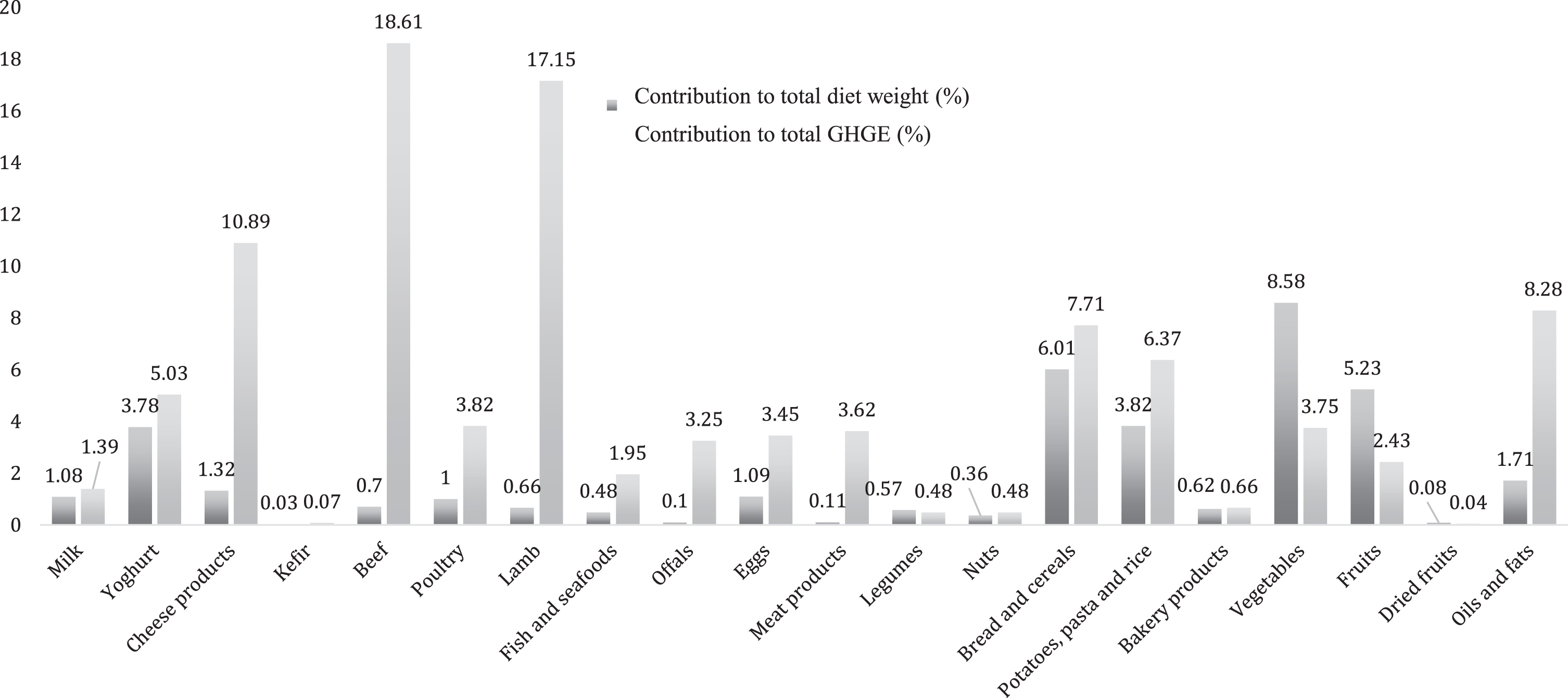
The contributions of each food group (except water, tea, coffee, and soft drinks) in the current diet to total diet weight (% of total gram/day) and total greenhouse gas emission (% of total g CO2eq/day).
Table 3 shows the carbohydrate, protein, fat, total energy efficiencies, and the animal to plant protein ratio of the current diet with the eight dietary scenarios. The animal to plant protein ratio was greatest in the current diet and the diet high in dairy products. Additionally, the current diet had the lowest protein, carbohydrate, and total energy efficiencies.
Nutrient GHGE efficiencies and the animal to plant protein ratio for current diet and diet scenarios
Data points were between 0.803 and 0.871 by linear functions with linear determination coefficients, according to linear regressions. The results showed that the linear fits could be interpreted as a negative and very strong correlation of the efficiencies versus the animal to plant protein ratio (p < 0.05) (Fig. 2).
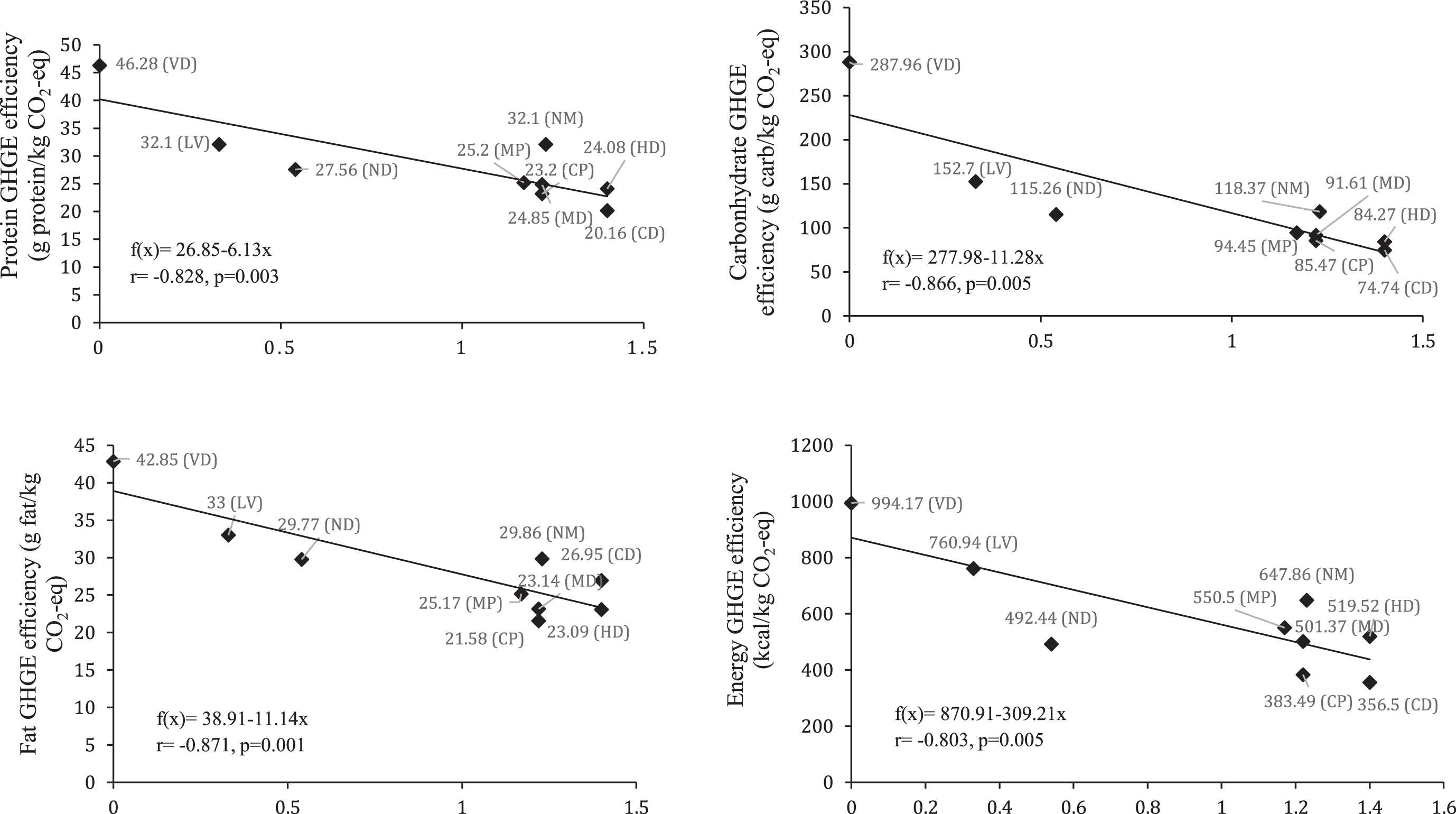
Macronutrients and total energy efficiencies per unit of GHGE versus animal to plant protein ratio for nine diets.
To the best of our knowledge, this is the first study in Turkey to compare the GHGE of the current diet to emissions from alternative dietary scenarios proposed by the NDG nutritional recommendations. The current diet contributed to GHGE in a similar way to the earlier NNHS research (3.26 kg CO2eq /person/day and 1.14–3.28 kg CO2eq/person/day) [51]. In comparison to the dietary scenarios, we observed that the current diet has the highest GHGE level while the model diet has the fourth-highest GHGE level with 2394.39 g CO2eq/person/day. The contribution of beef, lamb and cheese products to total current diet weight (0.7%, 0.6%, and 1.32%, respectively) were lower than their contribution to total GHGE (18.61%, 17.15%, and 10.89%, respectively). Additionally, the current diet had the lowest protein, carbohydrate, and total energy efficiencies. According to the linear regressions, the cases of macronutrients and total energy showed a negative and very strong correlation of the efficiencies versus the animal to plant protein ratio.
Today, as people become more concerned about global food security and climate change, there is a greater interest in sustainable and related diets [52–55]. Food consumption patterns must shift in order to reduce the existing load of food on the environment, with GHGE being one such environmental consequence [8, 56]. Most countries have analyzed GHGE of existing diets or alternative dietary scenarios provided by their NDGs [3–5, 50]. Higher consumption of meat was associated with higher GHGE, whereas higher consumption of fruits and vegetables was associated with lower GHGE [3, 50]. Consumption of dairy foods was also related to higher GHGE [32]. Our results suggest that reducing consumption of beef, lamb, and cheese products and increasing consumption of fish, vegetables and fruits were critical to achieving GHGE targets (such as consuming local and seasonal products, limiting meat consumption-especially beef, selecting fish from sustainable fishing, and so on) while maintaining a healthy eating pattern. Because of taste preferences, culinary history, and societal standards, red meat, particularly beef, plays a key role in Western diets and has been recognized as a major source of nutrients [57]. However, there is growing evidence that a high intake of red meat, particularly processed meats, is associated with an increased risk of several major chronic diseases including obesity, diabetes, fatty liver disease, coronary heart disease, heart failure, stroke, and several types of cancer, as well as mortality [58–63]. On the contrary, replacing red meat consumption with other protein sources such as poultry, fish, legumes was linked to a lower risk of chronic diseases, and mortality [61, 64–67]. The World Cancer Research Fund International and the American Institute for Cancer Research recommend that red meat intake be limited to 350–500 g/week (cooked weight) and that processed meat be consumed in moderation, if at all [68]. Meat, like other foods, can be an important source of nutrients, particularly iron, zinc, and vitamin B12. However, it is not required to maintain an optimal nutritional status [69]. People who consume a meat-free diet can acquire enough of these nutrients by making wise dietary selections. A mixture of pulses (legumes) and cereals can provide protein (grains). Iron may be present in many plant meals, albeit it is less bioavailable than iron found in meat [69, 70].
The GHGE level of our current diet was higher than in Australia (2.47 kg CO2eq/person/day) [71], U.S. (3.1 kg CO2eq/person/day) [8], Switzerland (2.1 kg CO2eq/person/day) [5]; and almost similar with Netherlands (3.2 kg CO2eq/person/day) [72]. The GHGE levels of current diets in Argentina with 5.4 kg CO2eq/person/day [50], in Dutch with 5.9 kg CO2eq/person/day [4] were higher compared to our current diet. The reason is that beef consumption compared to pork, lamb and poultry is high due to the lower sale prices in these countries [50]. Moreover, pork consumption is very common in other countries, especially their consumption in the current diet was found higher in Argentina and Dutch compared to the others [4, 50]. Also, their dairy products consumption was higher than our current diet.
According to the studies, the model diet developed by the NDGs had lower GHGE levels compared to the current diets [4, 73]. In the present study, the model diet scenario resulted in a reduction of GHGE level compared to the current diet (2994.18 and 3254.50 g CO2eq/person/day). Despite the fact that dairy products increased GHGE levels by 66% relative to the current diet, the model diet had lower emissions from animal food sources. Total meat and meat products intake in the model diet was higher than the current diet (112 g/person/day and 91.90 g/person/day), however, the modulation of this food group indicated a decrease in the contribution to total GHGE (38.44% and 48.40%).
Dairy products contain a high level of GHGE, while also having a high nutritional value. In Denmark’s study, with the complete exclusion of milk and dairy products from the diet were similar GHGE levels compared to the diet with high dairy, milk products, and cheese products [3]. Our results differed from those of Denmark study; in that, the contribution of GHGE of the diets with cheese products (3210.48 g CO2eq/person/day) and high dairy products (3134.18 g CO2eq/person/day) were almost similar to the current diet, whereas, the diets with only milk products (2872.28 g CO2eq/person/day) and non-dairy products (2394.39 g CO2eq/person/day) were low. Although it seems possible to reduce GHGE by eliminating dairy products from the diet. Dairy products are rich in various nutrients such as potassium, phosphorus, different vitamins such as B2, B12, and D, thus they reduce the risk of fracture, cardiometabolic diseases, obesity, diabetes, etc. [74, 75]. However, they also include harmful nutrients such as sodium, saturated fat, and added sugars [74]. According to the position of the Harvard School of Medicine, milk includes multiple specific nutrients that can improve blood pressure and bone health, but the high saturated fat content of whole milk may mitigate some of their health-promoting effects. Although popular media articles have speculated that whole milk is not less healthy than skim milk, research on diabetes and heart disease has not supported this claim, and excessive consumption of either form of milk can lead to weight gain due to the extra calories [76]. Additionally, one of the most common pathologies associated with vegetarian diets is increasing fractures, osteopenia and osteoporosis. Recent studies showed that if these diets are followed correctly, vegetarianism has no harmful consequences on bone health. High-quality vegetarian foods, or nutritional supplements can help maintain bones strong and prevent fractures [77, 79]. Furthermore, there is a growing demand for plant-based milk alternatives due to milk allergy, lactose intolerance, was well as milk-free diets [80]. In the literature, it was observed that some of the plant-based milk alternatives reached certain amounts of cow’s milk nutrients [80, 81]. Therefore, substituting milk and dairy products with plant-based milk products may be regarded as an approach to lowering GHGE levels. However, the environmental benefits of plant-based milk products over cow’s milk is not clear because carbon footprint, eutrophication, and water consumption vary by location [81].
Another strategy for reducing diet-related GHGE is to replace red meat and meat products with alternative protein sources, including vegetarian alternatives [73]. A systematic review showed that replacing ruminant meat with meat from monogastric animals (poultry) decreases GHGE by 20% to 35% [82]. However, a study in the UK indicated that replacing the same amount of red meat with white meat resulted in a 9% reduction in GHGE level but vitamin A and zinc were lower than the current diet [83]. In Argentina’s study, switching from red meat to white meat reduced the overall GHGE level by about 3.3 kg CO2eq/person/day [50]. In the present study, the diet scenario with non-ruminant meats developed by NDG like the model diet, showed a reduction in the GHGE level of the diet (1.2 kg CO2eq/person/day), even though both comprised the same amount of total meat of 112 g/day. Previous studies found that vegetarian scenarios had lower GHGE levels than the other dietary scenarios [3, 50]. In our results, replacing red meat and meat products with legumes and nuts (lacto-ovo vegetarian scenario) lowered GHGE levels in the diet by about 1 kg CO2eq/person/day. Additionally, when compared to the current diet and other dietary scenarios the vegan scenario had the lowest GHGE level. Modeling the environmental implications of shifts to better diets in Europe, on the other hand, found that the favorable benefits of a minor reduction in red meat are cancelled out by increased intake of fish, cereal, and vegetables, resulting in no overall positive environmental effects [52]. Also, these recommendations do not take into acoount all nutritional effects, such as environmental problems associated with land and water use. Therefore, while developing a nutritional recommendation, we must consider all nutritional consequences.
The GHGE efficiencies of nutrients increase as ruminant meats are reduced in the diet [50]. A previous study an unexpected trend in which animal food products have lower GHGE efficiency [84]. In this context, Argentina’s study showed that GHGE efficiencies of carbohydrates and total energy show a negative correlation versus the animal to plant protein ratio [50]. The present study found that all the macronutrients and total energy show a strong negative correlation versus the animal to plant protein ratio. According to our findings, we would say that the preliminary correlations observed would hold and macronutrients and total energy efficiencies can predict the total diet GHGE.
The present study had some limitations. First, GHGE data from food production was limited in Turkey. We used the GHGE levels from the literature reviews. However, food production has similar standards around the world and the reviews appear to be positive, most of the impacts affect GHGE such as energy carriers, climate characteristics, regional soil, water use, etc. Second, we did not use all of the food product’s life cycle steps such as transportation, cooking, and wasting. Third, the NNHS had limited data about food choices in the current diet. Therefore, we used the overall levels of GHGE from the literature reviews, but these results may not reflect the exact diet-related GHGE. Additionally, we excluded the items of salt, spices, sweets, and sugary food categories due to the very low contribution to the GHGE. Thus, we reduced the likelihood of overestimation of food consumption and the diet-related GHGE. Forth, we only included the food consumption of adults aged 19–64 from the NNHS and developed dietary scenarios related to this aged group so the results did not generalize for some groups such as elderly, children, and pregnant women.
Conclusion
The present study found that some diet scenarios adhering to food-based NDG, especially vegetarian diets, reduce GHGE compared to the current diet. Dairy products-based dietary scenarios such as high-daily, cheese, and milk products diets developed by the NDG, showed similar GHGE levels of the current diet. Our findings highlighted the importance of integrating both health and environmental perspectives when developing future dietary recommendations for a sustainable diet.
This study takes the first steps in quantifying the current diet-related GHGE and macronutrients and total energy efficiencies. Future studies about changes in dietary intake and GHGE will enable comparisons between them. Therefore, these results will help to inform nutrition, agriculture, and public policy to ensure Turkey.
