



Abstract
The Mediterranean Diet (MD) is a millennial example of healthy and sustainable nutrition for humankind and the planet. It bases its principles on the limited and responsible use of resources, encouraging their reuse, whenever possible, and preventing over-exploitation. The MD is also a healthy food model through the prevention of many chronic non-transmissible diseases, safeguarding human health of present and future generations. The advancement of health through healthy eating has made it necessary to disseminate nutritional recommendations in line with scientific guidelines. In order to enhance the accessibility of these recommendations to the public, it has become widely adopted to employ graphic models that are both expressive and easily understandable, like the pyramid model. The intuitive nature and simplicity of interpreting the food pyramid have made it an effective educational tool for circulating nutritional recommendations. Over the years, the pyramidal representations have been enriched in an attempt to provide increasingly more information, while at the same time becoming more difficult to read. Circular graphic models are rapidly gaining popularity as a means of representing nutritional recommendations, alongside traditional pyramid models. These circular models not only hold cultural relevance but also strike a chord with the collective imagination, making them highly effective tools for conveying dietary guidelines. The goal of our study is to propose a new representation of the Mediterranean Diet based on circularity. Our representation aims to highlight both the importance of the various components/categories within the model, as well as the inherent cyclical nature that characterizes human life, the seasonality of food, the production chain, and the concealed circular economy behind each product. The choice of a circular model therefore represents the concept that virtuous choices can feed a “virtuous cycle” and reestablish a healthy balance among people, environment, and society.
Background
The investigation of the relationship between food and health has deep and ancient roots amongst humankind. In 400 BC Hippocrates, considered the father of medical science, said “let food be your medicine and medicine be your food”, underlining the essential link between nutrition and health. The improvement of health through healthy eating has made it necessary to disseminate nutritional recommendations in line with scientific guidelines. To make these recommendations more accessible to the population, it has become commonplace to use graphic models that are visually communicative and easy to understand. However, these models, aimed at representing the foods to be consumed more or less frequently, depending on their health impact, are often adapted to the local cultural context, resulting in an educational tool with a strong national connotation.
Different ways of representing dietary patterns
In order to promote the principle of a healthy diet, many countries have developed a graphic/visual model that represents their customs and traditions in accordance with the feeding habits and social, cultural and religious attitudes of their society. Some scientifically validated examples are the typical hut from Benin, a symbol of the country; the Japanese spinning top, a game common with Japanese children; the Chinese pagoda, a building mainly used for religious purposes; the cauldron from Honduras, typical of its cooking tradition, and the pyramid, a symbol created in the USA.
The West African country of Benin, for example, places grains and tubers at the base of the house, which should be consumed in the largest quantities throughout the day; protein on the first floor, unlike most available food guides; vegetables and legumes on the second floor; fruits on the third; and dairy products on the roof of the house. The water depicted on the door of the house is not only a reminder to hydrate throughout the day, but also a symbol of Beninese hospitality [1].
The Japanese food guide, in contrast to the graphic representations of other countries, reverses the common scheme, placing the food groups that should be consumed more frequently at the top of the design, like grain-based dishes, and the food groups that should be consumed at a reduced frequency, such as vegetable-based dishes, fish and meat, milk, and fruits [2] at the bottom. The Chinese pagoda not only distributes the food groups, according to their recommended consumption, from base to apex, but also emphasizes the daily amount [3].
The peculiarity of the Honduras food guide is its distribution of food groups, including daily consumption of grains, tubers, fruits, and vegetables; triweekly consumption of milk, dairy products, eggs; and biweekly consumption of fish and meat. Notably, it uses a serving spoon graphic to represent moderation in the consumption of foods like oil, butter, and those containing simple sugars [4].
The first food pyramid was developed in 1992 following years of research by the United States Department of Agriculture (USDA) with the aim of improving food consumption of US residents. The choice of the pyramid shape arose from the concept that a person should eat more of the foods at the base and less of those at the apex. The distribution of food groups was organized in horizontal stripes where we find, starting from the base and rising toward the tip, bread, cereals, pasta, and rice; fruits and vegetables; dairy products; eggs, fish, legumes, meat and poultry; alcohol, fat and sugar [5].
In 2005, this graphic model underwent a restyling attempt in which, alongside the introduction of the physical activity icon, the categories of food were arranged on the same level [6]. Their different proportions in the diet were highlighted by the use of colored bands of different widths, to form the triangular structure. This new proposal was put forward to prevent foods arranged on different levels of the pyramid from being labeled as “best” and “worst”. However, the “hierarchical” structure, typical of the traditional food pyramid, is more immediate.
Indeed, according to this model, the foods that should be consumed more frequently and are proven to have a positive health impact are found at the base, while foods to be consumed less frequently appear progressively toward the top of the pyramid. The intuitiveness and simplicity of its interpretation made the food pyramid an effective educational tool for disseminating nutritional recommendations. Its success, born out of its intuitive features, is validated by the widespread adoption of its graphics by international organizations and institutes, e.g., WHO and FAO; national ones, e.g., the Italian Ministry of Health; and regional ones, e.g., the Piedmont Region, Italy. As a result, the model has been adopted by many countries, including those in the Mediterranean Basin.
Over the years, the pyramidal representations have been enriched in an attempt to provide increasingly more information, while at the same time becoming more difficult to read. Currently, there are a number of variations of the pyramid model. Some have been adapted to meet the needs of specific age groups, like the Trans-cultural Food Pyramid intended for children created with the aim of combining the health guidelines and principles of the Mediterranean diet with the flavors of other populations living in Italy, an increasingly multicultural country [7]. Another one, The MyPyramid for Older Adults aged 70 + caters to their specific needs, emphasizing whole grain consumption, promoting variety and nutrient density, and highlighting the top flag symbolizing potential supplementation of vitamin B12, vitamin D, and calcium in the diet [8]. Other variations are based on local feeding customs, like the Piedmont Food Pyramid, which, while referring to the pyramid of the Mediterranean diet, also includes the foods typical of this Italian Region with the aim of protecting both local feeding custom and the Mediterranean diet [9].
Additionally, the pyramid models have become more diverse, and have moved beyond the purely dietary sphere. This is the case, for example, of the pyramid for physical activity [10] and the environmental pyramid [11]. The first one refers not only to sport, but also to all the normal movements of daily life, such as walking, cycling, dancing, playing, housework and gardening. At the base are activities aimed at reducing sedentary lifestyle (climbing the stairs, walking); next are aerobic type exercises (swimming, cycling) to be carried out 3-5 times a week, then those aimed at strengthening muscles to be carried out 2-3 times a week, while placed at the apex are sedentary activities such as watching television [10]. Another example is that of the Environmental Pyramid, launched in June 2010 by the Barilla Center for Food and Nutrition Foundation, which considers the exploitation of natural resources for nutrition purposes. In order to build the Environmental Pyramid, experts had to estimate the ecological impact of various foods, in terms of resource use and greenhouse gas emissions. The Environmental Pyramid has proven that the foods whose consumption is most recommended according to the MD, such as those of plant origin, correspond to foods with a lower environmental impact and, vice versa, the foods whose consumption should be of lesser entity, such as those of animal origin, correspond to those with a greater environmental impact. By bringing the two pyramids together, experts have therefore shown how they are diametrically opposed [11].
In addition to the graphic choice linked to the cultural context of the territory and to the pyramid models, circular graphic models are also gaining popularity. This is the case, for example, of the Health Eating Plate, the MyPlate and the Planetary Diet. In particular, the Health Eating Plate is a guide to creating healthy, balanced meals, whether served on a plate or packaged in a lunchbox [12]. According to this model, each food has peculiar characteristics and properties and there are absolutely no foods to avoid. It is how foods are combined on the plate every day that determines the health of our diet. MyPlate, on the other hand, is a tool that was created with the aim of countering the obesity epidemic in the United States. In this graphic model the dish is divided into 4 parts, each of different sizes, according to the principle that some foods should be eaten in greater quantities every day, such as those of vegetable origin (vegetables, cereals, fruit), compared to proteins for which only a small amount is reserved on the dish. Next to the plate, we find a saucer with milk and its derivatives inside [13]. Finally, the Planetary Diet is a diet whose focus is not only on people, but also on the planet according to the concept that what protects our health also protects the Earth. It provides for the consumption of plant foods at the expense of animal foods which constitute important parts of a diet, but which should be consumed in significantly smaller proportions than the former [14].
The Mediterranean Diet: The pyramid model
Despite the many representations and models related to food consumption, the food pyramid remains, in our geographical context, the gold standard to represent the principles of the MD.
Acknowledged in 2010 by UNESCO as an Intangible Cultural Heritage of Humanity, the MD is a transnational cultural model common to seven countries: Italy, Cyprus, Croatia, Greece, Morocco, Spain, and Portugal [15].
The MD is the result of the interaction between the geo-environmental characteristics of the territories overlooking the Mediterranean Sea and anthropogenic activities. The mild climate and the presence of fertile lands have allowed the cultivation and conservation of plant species of ancient origin, such as the olive tree, which represent the basis of the MD.
Furthermore, the Mediterranean has represented a real bridge between territories, favoring cultural exchanges and becoming the cradle of some of the most ancient civilizations on earth, as well as the main theater of Western history and culture.
Among the most ancient civilizations, we remember the Egyptian, Phoenician, Greek and Roman societies. These civilizations used the sea to reach other peoples by developing flourishing trade. They founded colonies and favored the diffusion of knowledge and the progress of various peoples.
From these civilizations derives one of the most significant inventions in the cultural history of humanity: the alphabet. It was invented by the Phoenicians, reworked by the Greeks and, finally, passed on to us by the Romans [16]. It is precisely from the language of one of these civilizations that we inherited the deeper meaning of the term “diet”, which can be traced back to the Greek word δíαιτα (dí.aii i.ta), or lifestyle. The MD is therefore more than just a list of foods. Rather, it reflects a valuable cultural heritage that is strongly linked to the territory, grounded in conviviality, social and gastronomic practices, and celebratory events, where eating becomes a relational means to nurture unity and sharing, able to bring together people of all ages and socio-economic backgrounds.
Likewise, even physical activity, which is part of a healthy lifestyle, can become a tool for socialization when carried out as a social activity.
The pyramidal Mediterranean model [Fig. 1] [17] includes not only quantitative elements related to food choices, but also qualitative aspects, such as selecting traditional local, seasonal and ecological products.
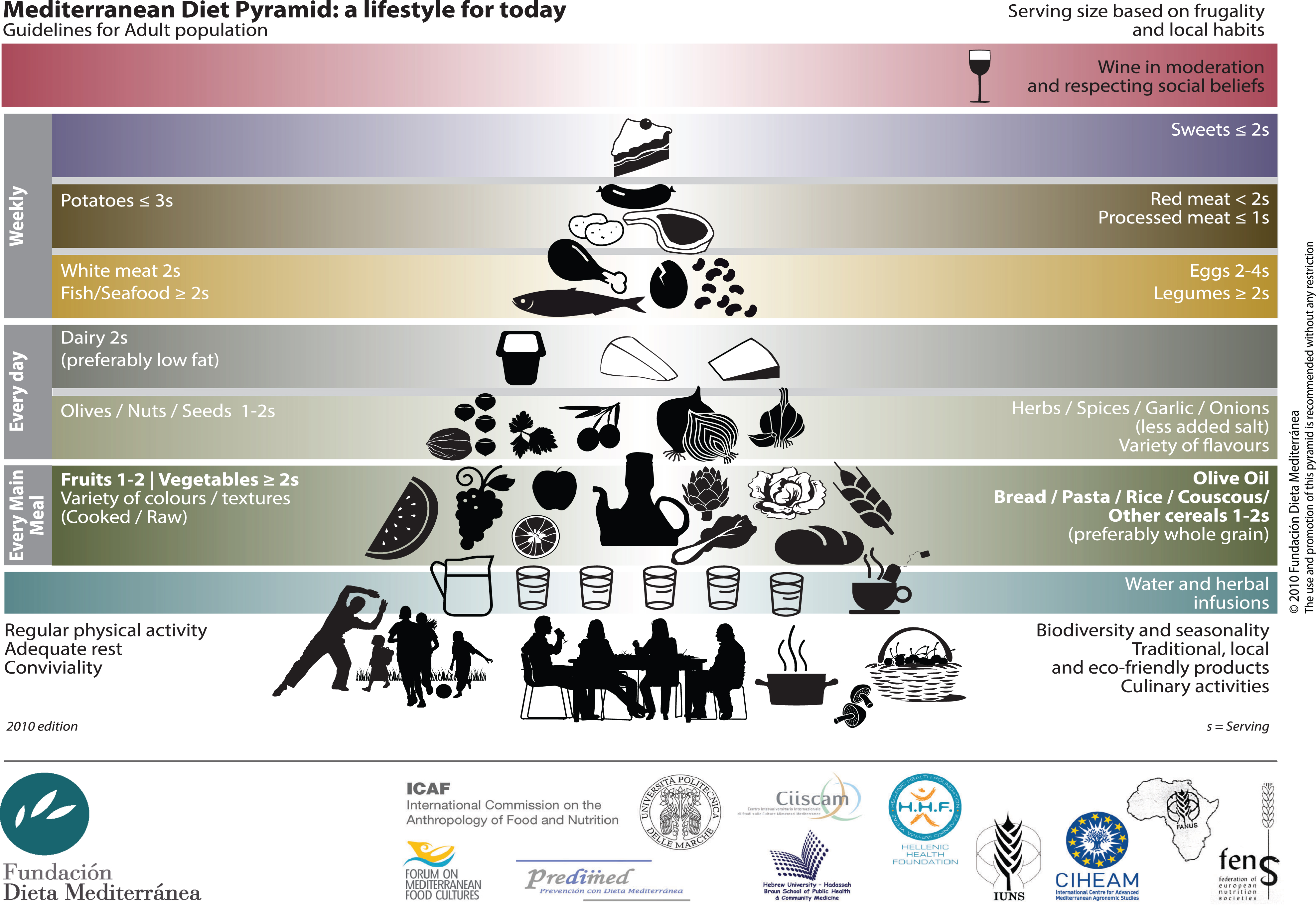
Mediterranean Diet Pyramid: a lifestyle for today. Foundación Dieta Mediterranea. 2010 [17].
Additionally, the model offers advice about the elements and number of portions of the types of food to consume for each meal, and further provides cultural and social suggestions inspired by the lifestyle of the countries around the Mediterranean Sea [18, 19].
Considering all the facets of the MD, health benefits have emerged, which are due to the general protective effect against chronic non-communicable diseases (diabetes, cardiovascular diseases, and some types of cancers) and to the reduction in the risk of global mortality [20].
Recently, the International Foundation of Mediterranean Diet has identified additional benefits of MD, not only in terms of health, but also in environmental, socio-cultural, and economic terms. In fact, MD encourages the varied and seasonal consumption of fresh and local products and preserves biodiversity; it positively influences society as it gives importance to traditional gastronomic activities, communal meals, conviviality, and social inclusion. It also respects the specificities of the territory by enhancing local products, which benefits local economies by creating jobs and income. Finally, MD potentially reduces healthcare expenditure in the long term, due to the positive impact on health. Because of its multiple benefits, the MD is regarded one of the healthiest and most sustainable diets in the world [21].
The MD, as a healthy and traditional diet, may have a wide impact on several Sustainable Development Goals of the UN Agenda 2030. It serves a fundamental role in preventing non-communicable diseases (NCDs) by reducing overweight and obesity, and lack of micronutrients in vulnerable groups, in particular children more exposed to the risk of unbalanced nutrition, both in excess and in defect (SDG 3). It may also have a positive impact on sustainability and environment, reducing pollution (GHG emissions) by relying on local production (SDG 13), protecting biodiversity, limiting food waste, and promoting the circular economy (SDG 12), and favoring food security (SDG 2). At the same time, it may promote life on land (SDG 15) by protecting rural areas, a real example of agroecology, reducing poverty (SDG 1) by converting productive processes to economic opportunity with a positive social impact as well as preventing people delocalization, the so-called economic migration.
Key determinants of the traditional MD have been climate and biodiversity; the MD is key to building sustainable and resilient food systems to ensure circularity at environmental, social, and economic levels by considering the centrality of health. Given the positive impact of MD on global health due to the indissoluble link between the health of humans, animals, and the ecosystem [22], an updated version of the Mediterranean Food Pyramid was recently published.
The goal of the new pyramid is to shift the perception of the benefits of MD from a focus on the health of the individual, to a broader focus on the benefits for the planet and global populations. The new graphic model, in fact, incorporates the environmental aspects related to food production, simplifying them in a third dimension [23]. This signifies that there is interest in developing new interpretations, as far as the Mediterranean Food Pyramid is concerned.
The goal of this work is to represent the Mediterranean Diet (MD) through a two-dimensional circular graphic form, maintaining its quantitative and qualitative characteristics, but also enriching it with symbolic, cultural and anthropological values, from a universally recognized perspective.
Bibliographic research was carried out on the main scientific search engines (Pubmed, Web of Science, Scopus) to identify graphic models already used and validated for the representation of dietary patterns. The first concept on the circular transposition of the Mediterranean diet pyramid was then elaborated by a multidisciplinary team composed of doctors, dietitians, and an expert in gastronomic sciences [24]. The model was subsequently resumed and discussed by experts in the fields of education and training, policymaking, veterinary medicine, epidemiology, and environmental protection. Discussion meetings were organized with progressive integration of the expertise involved resulting in a shared draft. This version was graphically elaborated by a graphic designer using Adobe Illustrator software and free icons from the Flaticon.com database.
The final version has been approved by each of the members of the working group.
Results
The mediterranean diet: The circular model
The proposed graphic model [Fig. 2] [24] consists of six concentric circles that substitute the ‘floors’ of the food pyramid.
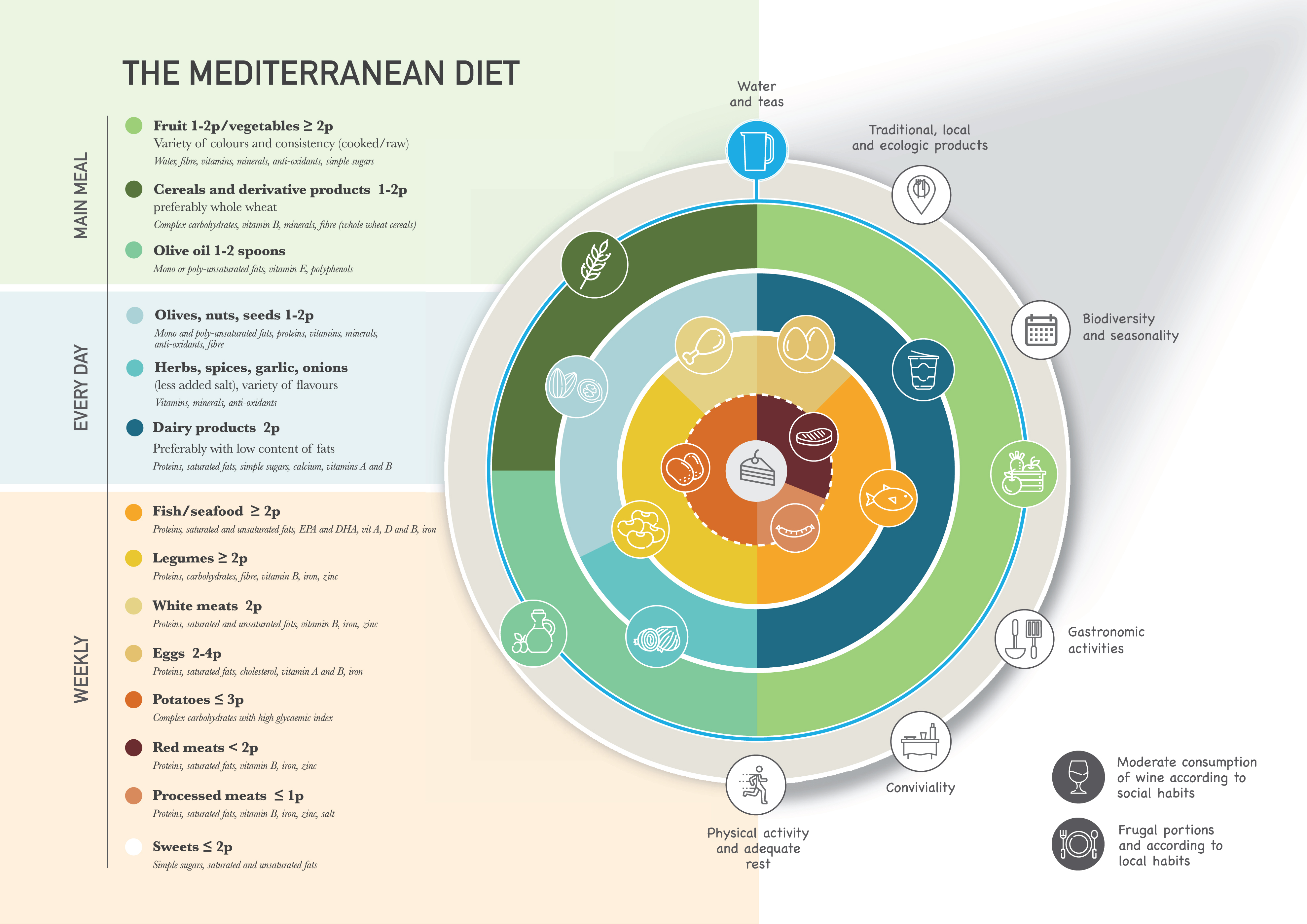
Mediterranean Diet: the circular model. CCM project-central action 2019 of the Ministry of Health [24].
Similar to the base level of the pyramid model, the outermost circle includes customs and traditions of the Mediterranean lifestyle, universally recognized as healthy and sustainable practices. Social and cultural aspects are also present; people are thus encouraged to drink water and non-sweetened drinks like teas; to improve their lifestyle by being active and sleeping an adequate amount of time; to socialize with peers in order to not lose the connection between individuals by eating and cooking together; to do their grocery shopping by giving priority to what their land has to offer in each particular season. In this way, individuals are encouraged to go back to their traditions.
Within this framework, the various food categories are listed from the most external and largest circle, listing foods that should comprise a greater share in our diet, to the progressively smaller internal circles representing foods to be consumed less frequently. Each food type is represented by a different color, which occupies a larger or smaller area of the circle depending on the number of daily or weekly portions, which have not been changed from the pyramid model.
After the larger circle, represented in green shades, we can find the categories of foods that should be consumed at each meal. They are mainly: fruit, vegetables, whole grains, olive oil. The green color also refers to the color of nature and environment to highlight the positive impact from the environmental perspective as well as from the human health point of view. Continuing inward, we find the categories of foods that should be consumed daily, such as oily fruit, olives, spices, and dairy products. Finally, in the innermost circles we can find the food whose consumption should be weekly or, in some cases, occasional.
The circular model is accompanied by a legend that reproduces the graphical representation in text form. Using the colors of the various circles, each food category is treated individually, and the recommended frequency of consumption is indicated.
Following the Pyramid Model, some qualitative guidelines are maintained. It suggests varying the color and consistency (raw/cooked) for fruits and vegetables, opting for whole grain types for cereals and cereal products, considering herbs, spices, garlic, and onions as beneficial for reducing salt intake and adding flavor to dishes, and prioritizing dairy products with lower fat content.
A nutrition tip was added to each food category, specifying the main nutrients (macro or micronutrients) characterizing the category. Finally, in analogy to the pyramid model, the circular model indicates that the MD provides for moderation in consumption, recommending frugal portions and a moderate intake of wine in accordance with local social habits.
The circle as a universally recognized symbol
To represent the MD, the circle was chosen as a graphic symbol as rooted in human culture and therefore universally recognized and accepted. It is worth noting that millennia before the birth of the written language, prehistoric humans used images to communicate, express themselves and record events. Among the earliest and most common geometric figures found in Asia, Europe, Africa, and America was the circle [25]. This symbol, whose exact original meaning has long been lost, has always fascinated humankind. Many mathematicians and philosophers considered it the most perfect of all geometric forms, while theologians considered it supernatural or divine. The circle, in fact, has been used in various contexts throughout the history of humankind, from religion to astronomy, from art to architecture and continues to be used even today [25].
In the religious field and in Christianity, the circle represents Eternity and three circles welded together are the symbol of the Trinity. The circle also has a meaning of sacredness, used in Christian iconography to surround the heads of Christ, Mary, and the Saints [26].
In Buddhism and Hinduism, the circle represents the wheel of life, enlightenment, and human perfection. In the Islamic religion, the circle symbolizes unity and diversity in nature. It is also used in the Koran as a basic form to describe the hierarchical and perfectly ordered universe in the two realms of earth and sky, each divided into seven spheres. Geometry, in fact, is one of the signs provided to humanity as evidence of the existence of God; as in the Islamic religion its representation is forbidden. One of the most widely used circular symbols in religious culture is the mandàla, an instrument of meditation and prayer. In Sanskrit this term means “circle” and “center” and consists of a series of concentric forms representing the eternal circle of the wheel of life. The mandàla appears continuously in religious buildings and art forms, from Islamic mosques to the sand creations of Buddhist monks [27].
Astrological symbolism depicts the Sun and the Moon as circular shapes, while the theory of heliocentrism is conveyed through concentric circles representing the solar system [28].
In the history of art, the circle is one of the most widespread forms. History tells that Giotto, a well-known Italian painter and architect, was able to draw a “perfect circle” freehand, showing Pope Boniface III his skills as a painter [29].
The circle is also the protagonist of some works, such as “Many Circles” and “Concentric circles” by Kandinsky, precursor, and founder of abstract painting [30].
The circular structure is also often used in architecture, such as the well-known Neolithic site of Stonehenge, which, according to some, depicts an ancient “astronomical observatory” with particular significance at the solstice and equinox points; the Greek theaters, born with a religious profile, which were erected in sacred areas near the temples; or even the Roman theaters which, unlike those of the Greeks, stood in the centers of the city and were used for entertainment purposes [31].
The circle, as the basic form of the wheel and gears, is also the symbol of modern civilization. The circular shape is still the most popular in the advertising and media industry. It is no coincidence that most logos are incorporated into circular structures. The circle, in fact, more than any other shape, counters visual distractions and acts as a focal point towards which attention is continually drawn. This is also one of the reasons why the circular structure was hypothesized to represent the MD [25].
The circle as a symbol of the Mediterranean diet
Unlike the three-cornered structure of the food pyramid, the use of the circle to represent the Mediterranean dietary pattern conveys an idea of harmony and inclusion, inviting one to “embrace” a healthy and sustainable lifestyle.
The circle can also be a sign of unity and totality [25], in which all the interconnected elements of the Mediterranean pattern, when considered as a whole, are able to effect multiple benefits in terms of health, environment, society and economy.
Moreover, these elements unite the customs of the countries facing the Mediterranean Sea, a sign of how this lifestyle can connect several peoples with different cultures and traditions. The circle was therefore chosen to express the meaning of union, a concept already well represented, for example, by the symbol of the Olympic Games, one of the many traditions that the Greeks have left to our civilization.
Unlike the pyramidal hierarchical structure, the circle is a symbol of democracy, equality, and fairness. The circular shape symbolized their perfect equality in the chivalric ideal [26]. The Mediterranean model is based on the same principles; the convivial table, in fact, is a place of mutual exchange and social inclusion, where everyone, without distinction, has the opportunity to access a primary right, such as food.
The circularity represents an eternal phenomenon, which is repeated through time, without a beginning or an end [25]. Thus, the Mediterranean Diet has been part of the Mediterranean Basin for millennia and continues to be a reference model and example for future generations.
The cyclical nature refers to the passing of the seasons, such as the seasonality of products, one of the foundations of the MD.
The circle is the symbol of life (the circle of life) [25]: a continuous process of change that, from birth and through development, leads to maturity and old age, and finally ends with psychophysical decline and death. Although it may seem like a closed phenomenon, during the lifespan and in every age group, a diet appropriate to the organic needs of that moment is not only able to influence the individual’s state of psychophysical well-being, but also to lay the foundations for the health of subsequent generations, through an epigenetic mechanism (Life Cycle Nutrition) [32].
Similar to how circularity manifests at both the microscopic level within the smallest living unit, the cell, and the macroscopic level in planet Earth [25], the benefits of the Mediterranean Diet can be observed both in individual health and in global health; global health referring to the harmonious balance between human well-being and the well-being of the planet.
The circle embodies the well-known conservation of mass principle, attributed to the 18th century famous chemist, biologist, and philosopher Antoine-Laurent Lavoisier, “Nothing is lost, nothing is created, everything is transformed”. This principle is key to understanding the transformation of an object through renewal, avoiding waste, and achieving sustainability.
This principle is close to that of the circular economy, which the Ellen MacArthur Foundation defines as an economic system capable of self-renewal. In a circular economy, there are two types of material cycles: biological material, which can be recycled in the biosphere, and technical materials that can be recovered and restored without entering the biosphere. The circular economy, therefore, is a planned economic system for recycling materials in successive production cycles, thus minimizing waste [33].
The principles of reuse and recycle are inherent in these two theories. Although the two terms appear to be synonymous, their differences are significant. While a good that has not become waste can be reused, one that has become waste is no longer functional to its initial purpose. However, it can be recycled and transformed into something new. Notwithstanding, the aim is the same: to reuse or transform without generating waste. These two concepts are represented by a circular symbol.
Applying these principles to food poses a challenge, yet it also presents an opportunity for change, given that over the past few decades, the food industry has notably deviated from a circular model rooted in the sustainable, regenerative, and responsible utilization of resources, like the Mediterranean model.
As a matter of fact, the post-war industrial production model’s strategy has been based on intensive production to support the rapid economic growth in the countries destroyed by the two World Wars, and to satisfy the demand of a growing world population.
This approach has led to the over-exploitation of natural resources and wide waste production resulting in a devastating impact on the environment and a negative outcome for the planet [34]. Furthermore, the growth of industrial production, combined with the phenomena of globalization, urbanization, and the rise of income, have favored a transition towards “Western” lifestyles, not only in developed countries, but also in developing countries. There has been a change in eating habits, characterized by the shift from the consumption of local and seasonal foods, especially vegetables rich in fiber, to processed foods, rich in refined starches, sugars, fats and salt, with a high energy density, but poor nutritional value (Western Diet) [35].
The change in eating habits along with the increase of the sedentary lifestyle have contributed to the spread of malnutrition due to excess (overweight and obesity) which, adding to the already extensive malnutrition by defect, has led to the coexistence of extreme and opposite forms of malnutrition.
The spread of a “Western” lifestyle has ultimately contributed to a higher incidence of obesity-related chronic diseases, with a consequent negative impact on human health [36]. The recovery of traditional diets like the MD is therefore necessary to steer food production systems towards regenerable and sustainable models.
The adoption of a circular Mediterranean lifestyle can contribute to the improvement and sustainability of human health while also protecting the environment. This approach is capable of triggering a virtuous cycle such that each positive behavior results in a benefit for human beings, the environment, society and the economy.
The principal differences between the pyramid and the circular models can be summarized by: Moving from a hierarchical structure to a circular one, improving the idea of harmony, inclusion, and conviviality. More interconnection between elements in the circular model than the pyramid model. Emphasis on the issues of environmental, economic, and waste circularity. Emphasis on the theme of circularity from the perspective of time and space: the seasons, the cycle of life, migrations, and the cycle of history.
Our work has some limitations. The Mediterranean diet is not applicable in all parts of the world; therefore, the model cannot be used everywhere. Furthermore, the circular model needs to be validated. Indeed, the paper represents the first part of the project. Our future goal will be to test the model on a large sample of individuals and consult nutrition experts to highlight strengths and weaknesses that can be improved.
Given its meanings, the representation of the MD as a graphic circular model is, in all aspects, potentially appropriate, innovative, and impactful.
Conclusions
The MD, declared an Intangible Cultural Heritage of Humanity, is a millennial example of healthy and sustainable nutrition for humankind and the planet. It bases its principles on the limited and responsible use of resources, encouraging their reuse, whenever possible, and preventing overexploitation.
The MD is a model, which breaks down food waste by recycling and reusing food and food by-products, while respecting the environment, protecting local food production, and simultaneously sustaining and enhancing biodiversity.
The MD is also a healthy food model because it prevents many chronic non-transmissible diseases, safeguarding human health of present and future generations.
Food in the Mediterranean Diet represents much more than a source of nutrition. The representation’s circularity aims to emphasize the significance of the various components/categories within the model, as well as the inherent cyclical nature that characterizes human life, the seasonality of food, the production chain, and the concealed circular economy behind each product. Healthy food choices for humans align with healthy choices for the planet. The choice of a circular model, therefore, represents the concept that virtuous choices can feed a “virtuous cycle” and re-establish a healthy balance among people, the environment and society, which today is strongly compromised.
If the proposed model is adopted, it could become an instrument to circulate the principles of the MD over multiple levels, supporting the implementation of trans-disciplinary and coordinated One Health approaches with particular attention to food safety and environmental, climate, human and veterinary health, principles promoted by international organizations [37]. We have already started to test the circular model in educational contexts, receiving interesting feedback. However, this paper would represent the first part of a research process. The following steps will be the further validation of the circular model by testing and refining it based on feedback from nutrition experts and focus groups. Moreover, we would like to complete the validation process through wide sampling of various populations in numerous areas of the Mediterranean basin and outside of it. The final goal would be the diffusion of this new model in order to spread the potential of the Mediterranean diet to promote a “One Health approach”.
Funding
The circular graphic model was developed as part of the project CCM project-central action 2019 of the Ministry of Health (general secretary), Models of Healthy and Sustainable Diets Starting from Traditional Diets financed by the Italian Ministry of Health. This article has not received any funding.
Conflict of interest
Andrea Pezzana is an Editorial Board Member of this journal but was not involved in the peer-review process nor had access to any information regarding its peer-review.
Author contributions
Tolomeo M.: conception, writing the article.
De Carli L.: performance of work, writing the article.
Guidi S.: conception, writing the article.
Devecchi C.: performance of work.
Zanardi M.: performance of work.
Giacomini D.: interpretation of data, supervision.
Pistone E.: conception.
Ponta M.: performance of work.
Simonetti P.: interpretation of data, supervision.
Sykes K.: interpretation of data, supervision.
Devecchi A.: writing the article, interpretation of data.
Pezzana A.: conception, interpretation of data.
All authors had access to the data.