



Abstract
Betalains are water-soluble, nitrogen-containing vacuolar pigment and can be divided into two subclasses: the yellow – orange betaxanthins and the red – violet betacyanin. These pigments can be found mainly in Latin America, but also in some parts of Asia, Africa, Australia and in the Mediterranean area. In this work an overview related with the status of research about betalains extracted from Opuntia spp and the enforces made to evaluate their positive incidence in the human body is provided. Several studies enhance their anticancer, anti-inflammatory and antioxidant properties. They also exhibit antimicrobial and antidiabetic effect. Taking into account these properties, betalains seem to be a promising natural alternative as a colorant to replace the synthetic ones in the food additive industry. In addition, the use of Opuntia spp fruits as possible colorant sources in the Food Industry, may contribute positively to the sustainable development in semi-arid regions.
Introduction
The most common natural food colorants used in the food industry are betalains, anthocyanins, carotenoids, riboflavin and chlorophylls [1]. Anthocyanins, carotenoids and riboflavin in the diet are potentially associated with the decreasing of hypertension and type-2 diabetes risk, reduction of certain cancers, anti-aging, antioxidant and incidence of cardiovascular diseases [2–5]. Chlorophylls and their processed induced derivatives have been studied for their cancer chemopreventative properties, toxin binding properties and delivering more essential metals like iron, copper and zinc [6, 7]. Plenty of studies have assayed the biological activity of anthocyanins, carotenoids, riboflavin and chlorophylls but it has not been the case of betalains.
The main source of betalains, particularly betanin, is Beta vulgaris (red beet) so that the most studies have focused on it. However, red beet has some disadvantages, such as the presence of geosmine and some pyrazines which give an unpleasantry earthy-like flavor to the food and the range of colors these pigments can produce is limited. For this reason, in the last years, other betalain sources have gained space. One of the most interesting plants containing betalain is cacti, particularly prickly pears (genus Opuntia) and pitayas (genera Selenicereus, Hylocereus and Cereus). Another advantage of cactus plant is that they can grow in hostile conditions, for instance, in semi-arid and arid regions [8].
Opuntia spp. is spread naturally in Latin America (specially in Mexico) as well as in southern United States. Furthermore, they are cultivated in Australia, Africa, Asia and in some Countries of the Mediterranean region, such as south of Spain, Italy and Greece [9]. Several reports point out that consumption of cactus pear fruits reduces lipid oxidative damage, ameliorates antioxidant status in human body, positively affecting redox balance [10]. Even though different studies assayed the biological activity of betalains from Opuntia spp, the amount is very low compared with other bioactive compounds.
This work provides an overview of all the biological properties associated with purified betalains, extracted from Opuntia spp. Papers published in English during last 30 years, available in Scopus, PubMed and Web of Science were the source of the information.
Betalains structure and their presence in nature
Betalains are the main secondary metabolite of plants belonging to the order Caryophyllales. These nitrogenous compounds are water-soluble and can be found in edible plants, such as cactus pears, chards and beets [11].
From a chemical point of view, betalains can be classified into betaxanthins (from yellow to orange) and betacyanins (from red to violet). Their basic structure comes from betalamic acid which is the main chromophore in the molecule due to its conjugated double bonds. The residue linked to betalamic acid moiety gives them the chemical classification (Fig. 1): betacyanins, which are composed by a cyclo-Dopa structure and linked to this some others substitutions, varying from acylation and glycosylation patterns at Carbone -5 or 6, and betaxanthins, which are immonium derivatives with a variety of substituents, commonly amino acids and/or amines [12].
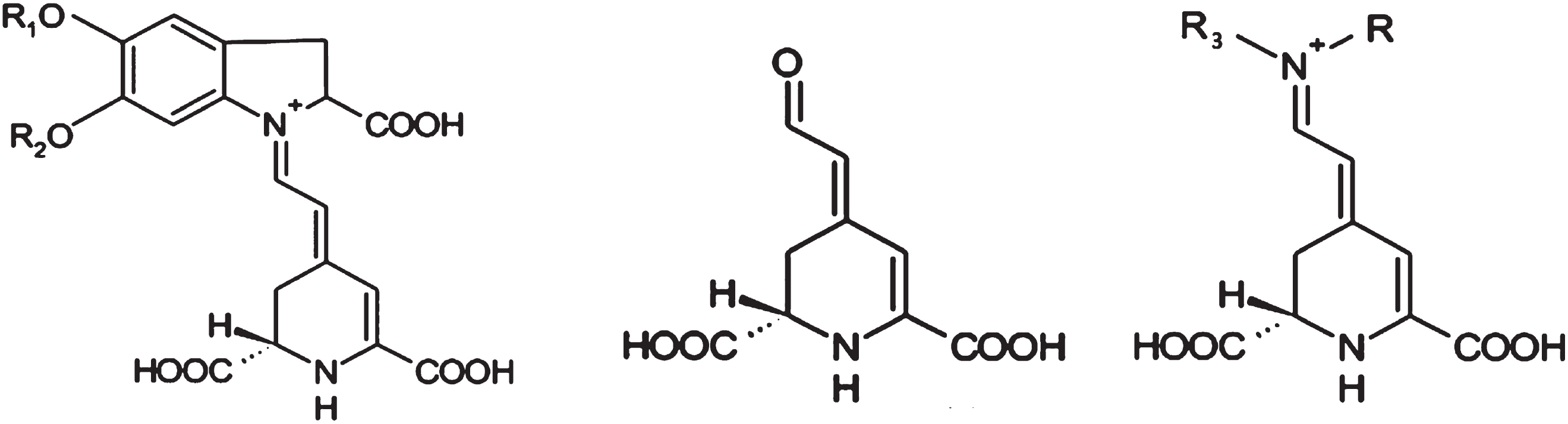
Primary structure of betacyanins (left), betaxanthins (right) and their basic building block betalamic acid (middle). R1 and R2: glucosyl derivatives or hydrogen; R3: amino acids or amine and R: frequently hydrogen (adapted from Miguel [13]).
The intake of vegetables and fruits is associated with a decreased risk of different non-communicable diseases such as obesity, diabetes, cancer and cardiovascular diseases [2, 14, 15]. In nature, the principal sources of betalains are the fruits of cacti of Opuntia (especially Opuntia ficus-indica), red beetroot (Beta vulgaris), dragon fruit (Hylocereus polyrhizus), Swiss chards (Beta vulgaris) and quinoa grains (Chenopodium quinoa). Smaller amount can be find in ulluco tubers (Ullucus tuberosus), Rivina humilis berries, Malabar spinach (Basella alba), the vegetable waterleaf (Talinum triangulare) and some fruits of the Eulychnia cactus [1]. The production of these pigments is mainly in fruits, stems, roots, leaves and flowering petals. In this plant, they are responsible for color which can ranging from violet to yellow [11].
Opuntia plants have minimal water requirement and are characterized by the ability to tolerate a variety of soils (arid and semi-arid) and temperatures. Due to their fresh flavor and odor, yellow, red and purple prickly pears can be considered a promising source crop for betalains. These pigments make attractive the prickly pear cactus fruits [16]. So far, the most common betalains identified in nature are indicaxanthin (Ind) which below to betaxanthin group and betanin as the main betacyanin. In addition, betanidin, isobetanin, neobetanin, vulgaxanthin (I, II, III and IV) and portulacaxanthin have been found [10]. Table 1 shows the amount of betalains that have been found in fresh fruits of several Opuntia spp. The values are mostly the sum of the 2 main betalains (indicaxanthin and betanin).
Betalains content extracted from fresh peel and pulp of several Opuntia spp.
Important to notice that betalains and anthocyanins are not present in the same plant, even though they provide the red, purple, and blue colors of flowers and fruits [8]. In the food industry, they both provide the color in some jam, dairy products and sausages [27].
Betalains are mainly used like natural colorant in food industry but also have been reported that these secondary metabolites could play a positive role in the human well-being. This effect can be attributed to some pharmacological properties they possess, including anti-lipidemic, anti-cancer, anti-inflammatory, antioxidant and antimicrobial [28].
The intake of betalains in the diet has showed beneficial effects in the body’s redox balance but the knowledge of the mechanisms related with antioxidant effect is still low, compared to other natural bioactive compounds [29]. Some biological and chemical studies have evaluated the antioxidant activity of betalains. The reason of their radical-scavenging properties can be attributed to the 1,7-diazaheptamethinium scaffold, which involves the occurrence of proton-coupled electron transfer [8]. It is important to highlight that the incidence of purified pigments is more difficult to assay, for this reason, most of the papers have focused on free radical scavenging activity in betalains contained extracts.
Butera et al. [21] evaluated the anti-radical-scavenging activity of purified Ind and betanin by the interaction with the ABTS radical. Betanin showed higher activity compared with Ind but both of them were highly effective. A study carried out by Osorio-Esquivel and collaborators [30] using semi-purified betalains from Opuntia joconostle (fresh pericarp, mesocarp, endocarp) demonstrated the high antioxidant activity compared with phenolic acid and flavonoid containing fractions extracted from the same matrix. The highest value was obtained for pericarp (87.09±0.9%, inhibition of DPPH) and endocarp, while mesocarp had lower values.
One of the key steps in the pathophysiology of oxidized-LDL is the production of nitrogen peroxide by the action of myeloperoxidase and nitrite. Regarding this, Allegra et al. [31] suggested that betanin can suppress the myeloperoxidase/nitrate-induced oxidation of LDL through oxidative modifications and scavenging of lipoperoxyl radicals.
Tesoriere et al. [32] also targeted the incidence of Ind and betanin in LDL metabolism. Their results shown that both compounds, isolated from OFI, incorporated into LDL, and significantly prevented the oxidation of LDL. The pigments were able to scavenge peroxyl radicals. It is important to note that Ind appears to interact synergistically with LDL, adding a relevant incidence in delaying LDL oxidation. An experiment with volunteers who consumed betalains riches extract from prickly pear fruit pointed out the incorporation of this pigment in their LDL. In addition, the extract protected LDL against ex vivo-induced oxidative injury [33].
Several studies have evaluated also the possible anticancer activity of purified betalains and the results showed their potential in the chemoprevention of different type of cancer. One of the first work that reported this property used prickly pear extracts containing betalains to treat different cell lines and nude mice. The extracts significant inhibited the growing of human ovarian cancer cells (OVCA420 and SKOV3 lines) and the effect can be compared with the synthetic retinoid N-(4-hydroxyphenyl) retinamide (4-HPR), in nude mice. Similarly, inhibitory results were obtained on the growth of cervical cancer cells and immortalized cervical epithelium cells [34].
Sreekanth et al. [35] treated lymphoblast cells (K562) with betanin extracted from OFI fruit pulp and the results showed a decrease in cellular proliferation in dose- and time-dependent manner. Moreover, betalains caused apoptosis induction in this cell line through the activation of intrinsic pathway. The apoptotic effect was mediated by cytochrome c release from mitochondria into PARP and the cytosol. Apoptosis induction in Caco-2 cells was also described by Naseli and colleagues [36] after the addition of isolated Ind from OFI fruits in the media. The proliferating decreased in a dose-dependent manner, with IC50 115±15μM, and no toxicity was found in post-confluent differentiated cells.
In addition, Ind from OFI significantly blocked the proliferation of the highly invasive and metastatic human melanoma cell line (A375), causing the reduction of the invasive properties of cells and the induction of apoptosis. The in vivo study confirmed the in vitro results because the oral administration of Ind to mice significantly decreased the tumor development [37].
Anti-inflammatory properties have been also showed in several in vitro studies. In this sense, human umbilical vein endothelial cells (HUVECs) treated with betanin and Ind extracted from OFI showed that both pigments can provide protection to the endothelium against cytokine-induced redox state alteration. The mechanism of action seems to be related with the inhibition of ICAM-1 [38]. Using RAW 264.7 macrophages stressed with lipopolysaccharide, Ind from OFI decreased the over-expression of microsomal PGE2 synthase 1 and inhibited the activation of NF-κB. Besides, the pigments prevented the up-regulation of cyclo-oxygenase-2 (COX-2) and hematopoietic PGD2 synthase, producing the anti-inflammatory cyclopentenone [39].
Furthermore, Caco-2 cells also showed the anti-inflammatory effect of Ind. Cell culture with IL-1β in the media was treated with different concentrations of Ind (extracted from cactus pear OFI fruits) and a positive effect of the pure pigment was observed. Ind prevented the release of NO, PGE2, and pro-inflammatory cytokines IL-6 and IL-8 as well as thiol loss and ROS formation [40].
7-Ketocholesterol (7-KC) is a bioactive lipid that belongs to the family of oxysterols. They significantly contribute to the progression of vascular dysfunction and development of atheroma, in particular 7-KC. The 7-KC-stimulated apoptosis of human macrophages (THP-1) was prevented by Ind purified from cactus pear OFI fruits when assayed at concentrations of 1.0 and 2.5μM Ind. The inhibition of NF-kB activation, NOX-4 basal activity and over-expression, as well as the maintenance of Ca2 + homeostasis and cell redox balance seem to be the main effects of Ind treatment. In addition, the activation of apoptosis was decreased due to the observed prevention of mitochondrial damage [41]. Similarly, anti-inflammatory effects of the same isolated pigment were found in vivo using rats with carrageenin-induced pleurisy [42].
The anti-microbial activity has not been assayed with the purified extracted but it is interesting to highlight that extract of Opuntia matudae containing betalains, as the majority bioactive compound, inhibited the growing of Escherichia coli O157:H7 [43].
Tesoriere et al. [32] carried out an incubation of human red blood cells with growing concentrations of betanin and Ind and the results showed that cells increased resistance to hemolysis. Betacyanin-rich supplement of Opuntia stricta showed some favorable effects in patients with coronary artery disease. In this study, the expression of LOX1 and highly sensitive C Reactive Protein decreased with the administration of the extracted. On the other hand, the treatment significantly increased the concentration of SIRT1 [44]. A resume of all biological activities that have been done using betalains isolated from cactus fruits is shown in Table 2.
Beneficial impacts associated with betalains isolated from Opuntia spp
Beneficial impacts associated with betalains isolated from Opuntia spp
Finally, Ind, extracted from the fruits of OFI, exerted an inhibitory action on both exogenous and spontaneous carbachol evoked contractions of mouse ileal longitudinal muscle. Its administration was able to reduce and reverse the intestinal segment contractility, in a dose-dependent manner. The combination between Ind and ascorbic acid significantly increased the inhibitory effect compared with Ind treatment alone [45].
Betalains have shown promising bioactive potentials. These bioactive compounds, once incorporated, can provide antioxidant, anti-inflammatory and anti-cancer activity in the human body. So far, the main studies related with betalains focus on betanin because red beetroot has high concentrations of this pigment. However, it is important to notice that other betalains sources have been assayed. The most promising betalains sources are cacti, particularly prickly pears (genus Opuntia). In this regard, the biological activity described have been reported in plant extracts with limited pigment purification. Further studies in vitro and animal models, as well as clinical trials, are needed to know the absorption, bioavailability and their potential health benefits. As can be seen through this review, there is much work to be done with these purified pigments to clearly confirm strong health-promoting potential of betalain from Opuntia spp.
Footnotes
Conflicts of interest
The authors declare no conflict of interest.
Funding
This research received no funding.