



Abstract
BACKGROUND:
In hemiparetic patients, the skeletal muscle is mainly affected with a combination of abnormalities (denervation, remodeling, spasticity, and eventually muscular atrophy).
OBJECTIVE:
This study examined the role of eccentric exercise in strengthening muscles of the lower extremity and ultimately improving autonomy in patients with post-stroke hemiparesis during gait.
METHODS:
Thirty-seven patients hemiparetic adults were recruited, randomized into a control group (n = 19) and an intervention group receiving eccentric muscle strengthening (n = 18). The protocol consisted of three sets of five repetitions of eccentric contraction of the paretic limb after determining the maximum repetition (1 MRI). Evaluation of the 1RM, 10 meters and 6WMT was performed before and after the exercise for each group. Manova test was used to compare the differences between the control and intervention groups.
RESULTS:
The paretic limb showed significant increase in one-repetition maximum (1RM) between before and after rehabilitation (p≤0.00003). The two groups of Patients increased their walking speed (p≤0.0005), but we observed a significant difference between groups only for the 6MWT and not on the 10 meters Test.
CONCLUSIONS:
Eccentric training can be useful in strengthening the muscles of the lower limbs, and promoting gait performance. Eccentric training could complement other methods of managing patients with post-stroke hemiparesis.
Introduction
Stroke is the most common cause of acquired brain injury and remains one of the leading causes of death and disability worldwide (Global Burden of Disease Study, 2020). Strokes cause central nervous system damage that can result in pyramidal syndrome (lesion of the pyramidal tract) leading to reduction of nerve impulses responsible for paresis (Thieme et al., 2018). It has been estimated that only one third of patients with stroke recover; the remaining two thirds either experience permanent sequelae and live at the expense of their family or the community, or become deceased (Mendis, 2009; Johnston et al., 2009). Among the two-thirds who remain alive, only 50% of patients resume an autonomous walk (Belda-Lois et al., 2011).
Hemiparesis is one of the common sequelae of stroke; unlike hemiplegia, the hemiparetic patient does not experience total paralysis. Mechanisms that impair motor skills in subjects with hemiparesis include loss of strength, muscle hyperactivity, and soft tissue retraction. The loss of strength is correlated with the decreased number and frequency of the motor unit discharge during contraction of the agonist muscle (McComas, 1994; Sheffler & Chae, 2013; Vibhor et al., 2014). Hemiparetic patients experience muscular atrophy, in particular type II atrophy (fast twitch) muscle fibers in favor of type I (slow twitch) fibers, which decreases the ability to generate force particularly at high movement velocities (Hafer-Macko et al., 2008; Saunders et al., 2016). Muscle weakness is greater in distal than proximal muscles (Mercier & Bourbonnais, 2004; O’Sullivan & Schmitz, 2006).
Many studies have reported on the correlation between gait performance and motor control in stroke patients (Nadeau et al., 1999; Takeda et al., 2018). Stroke patients frequently develop upper motor neuron syndrome, including weakness, spasticity, and abnormal movement, which further impairs lower limb, function, thus influencing walking. Patients may rely on the unaffected limb for balance and movement to compensate for this impaired function (Boudarham et al., 2014). Thus, gait rehabilitation is one of the important goals post stroke.
Hemiparetic patients have muscular atrophy, which makes it difficult to initiate and produce rapid movements with high force. One can also observe a loss of strength due to the bedrest of the patients during the acute phase that results in the degeneration of the paretic limb as well as the healthy limb (Hafer-Macko et al., 2008). The majority of stroke patients have a 50% reduction in exercise capacity compared to healthy subjects of the same age, typically observed in the sub-acute and chronic phase (Loane & Faden, 2010). In order to perform the daily living activities, a certain minimal threshold of muscle strength should be maintained. Training and repetition of the same rehabilitation moves reduces the consequences of post-injury stroke disorganization (Loane & Faden, 2010). Various approaches of physical rehabilitation have been used after stroke with varied effectiveness (Guilhem et al., 2010). Muscle strengthening in cerebral palsy and stroke patients has long been considered a heresy because it can increase spasticity (Boudarham et al., 2014); moreover, since the lesion is cerebral and involving voluntary motor control, the muscle being healthy is likely to regain its strength as soon as motor control is restored. Studies of isokinetic muscle strengthening of the lower limb have reported a beneficial effect on walking performance (Kiisa et al., 2018). A recent meta-analysis concludes that it is possible to include muscle strengthening rehabilitation programs for motor function since there is no correlation between increased muscle strength and increased spasticity (Abdollahi et al., 2015). On the energy level, the eccentric muscular reinforcement, which is a part of many daily living activities, is better tolerated, and expends less energy (Eng et al., 2009); still, this type of contraction is difficult to produce by the patients because it is susceptible to generate musculotendinous microlesions (Guilhem et al., 2010). In the already existing reinforcement protocols for traumatic brain injury patients, researchers have favored strength and endurance training with a low repetition rate (between 8 and 12 repetitions) in order to facilitate the gestures of daily activities such as walking or stand to sit position (Loane & Faden, 2010).
Eccentric training is one of the training methods for muscle strengthening that uses muscle contractions that involve lengthening the muscle while undergoing tension. It stimulates the growth of muscle cells by stimulating collagen synthesis (Pollock et al., 2014). Eccentric exercise induces greater strength gains than concentric or isometric training programs by stimulating muscle hypertrophy, increasing fascicles length, and promoting neural activation (Eng et al., 2009; Pollock et al., 2014). The medical literature is lacking on the effect of eccentric training in post-stroke hemiparesis patients (Kiisa et al., 2018). We therefore conducted a study to examine whether the effectiveness of a muscle strengthening eccentric training program could directly influence the progress of hemiparetic stroke patients. Specifically, our objective was to test the effect of a muscle building program through eccentric training on gait speed in patients with post-stroke hemiparesis.
Method
Participants
Thirty-seven patients with chronic hemiparesis following stroke were recruited for the study. All the patients have been selected consecutively among the outpatients with standard criteria of stroke by specialized neurologists. These patients were randomized into two groups: Muscle strengthening group (MSG, n = 19) and control group (CG, n = 18). MSG and CG groups were frequency matched in gender (8 Women/11 Men for MSG vs 7 Women/11 Men for CG). Patients were also similar in age (65.1±11.17 years for MSG vs. 68.7±12.4 years for CG), weight (69.03±12.93 kg for MSG vs. 72.2±11.87 kg for CG), height (1.67±0.11 m for MSG vs. 1.69±0.13 m for CG) and on set duration (12.47±4.97 months for MSG vs. 12.26±5.41 months for CG). All the characteristics of the study population are described in Table 1. The patients were recruited with the following inclusion criteria: (i) a single episode of stroke supra-tentorial that was responsible for the current clinical condition (ischemic or haemorrhagic supra-tentorial stroke), (ii) ability to communicate and understand study-related information, (iii) ability to perform the six minutes walking test (6MWT). In addition, all participants had to have spasticity in the lower limb max of 2 on the Modified Ashworth Scale, and to be able to perform the exercise requested on the horizontal press. In terms of exclusion criteria, patients were excluded if they met one of the following: (i) previous history of neurological disorders, (ii) cerebellar lesions [patients who could not be available for the entire duration of the study] and (iii) had syncinesia. Physiotherapists were also asked to indicate the presence of aphasia or higher functional disorders (non-inclusion criteria). The study was approved by the local ethics committee Sud-Méditerranée II (n°ID-RCB 2012-AOO518-35). All participants signed an informed consent form prior to the study.
Clinical data of the patient Strengthening Muscle group (SMG) and Control group (CG). For the different evaluation HPD Scale = Held & Pierrot-Deseilligny; I = infarction, H = hemorrhage FAC = the Functional Ambulation Category; RM Maximum Resistance
Clinical data of the patient Strengthening Muscle group (SMG) and Control group (CG). For the different evaluation HPD Scale = Held & Pierrot-Deseilligny; I = infarction, H = hemorrhage FAC = the Functional Ambulation Category; RM Maximum Resistance
Therapeutic follow-up assessments were conducted for all patients. Clinical assessments included: (i) proprioceptive function of the lower limb for each joint (hallux, ankle, knee and hip for range of motion using Fugl-Meyer scale where 0 = absent, 1 = impaired, 2 = intact);, (ii) voluntary motor capacity of the lower limb using the Held and Pierrot-Deseilligny scale (0 –5: absent –similar to the other side; 8 muscles were assessed: hip, knee and ankle flexors and extensors and hip adductors and abductors; total/40 points), (iii) spasticity of the Triceps Surae (postural and gait muscle) using the Modified Ashworth Scale and (iv) walking ability using the Functional Ambulation Category (FAC) (0 = non-functional walker to 6 = Independent walker; Teasdall scale). Lesion type, location and time since stroke were also recorded.
Patients in both groups received rehabilitative care over a period of four consecutive weeks. Each standard treatment session was 2×30 minutes per day 5 times per week for all patients..
According to the classic protocol, the main objective of the rehabilitative care was:
The prevention of complications: pressure sores, phlebitis, glenohumeral subluxation, installation of vicious attitudes (varus-equine, flexum or knee recurvatum, primitive patterns of the upper limb). The stimulation of selective motor skills. The management of spasticity. The acquisition of transfers and functional independence. The acquisition of the standing position with postural balance. The acquisition of an efficient functional displacement. The therapeutic education of the patient.
Evaluation of gait/walk
10-meter Walk Test (Maggio et al., 2020) was used to evaluate gait. Patients were asked to walk the distance at a comfortable speed, and the time to cover the set distance was documented. Patients were given an additional distance of 2 meters to achieve a preferred speed before the assigned 10-meters distance, and another 2 meters beyond the assigned 10-meter distance to avoid speed deceleration. The test is discontinued in the event the patient complained of pain, dyspnea, or balance problems. 6-Minute Walk Test (6MWT on neurological patients; Patterson et al., 2018): This sub-maximum effort test consists of measuring the maximum distance travelled by a patient in 6 minutes, according to a self-determined walking speed. The test takes place indoors on a flat floor (corridor, technical platform). The patient receives counts every minute of the time spent, as well as encouragement. If the patient stops walking, s/he is instructed to resume walking as soon as possible. A technical aid (single cane, tripod, star) is allowed depending on the patient’s motor level (noted on the evaluation sheet). The evaluation is stopped in case of pain, dyspnea and balance problems. A distance between 400 and 700 meters is performed by non-pathological persons. For patient safety, the pulse heart rate is checked before and after the 6-minute walk test.
Experimental protocol
Muscle strengthening during the MSG rehabilitation sessions was based on the following principles:
The patient activity was voluntary and controlled. Increasing the number of muscle fibers recruited was the desired element. Muscle contraction was progressive. During an intense muscular effort, the energy produced radiates to the other muscles, so special attention is paid to the implementation of muscular coordination during the movement.
Equipment used
The equipment used for the muscle strengthening exercises was a horizontal Leg Press (Technogym, Italy, Fig. 1). The press consisted of adjustable weights, a pulley, a fixed and a vertical footplate, a sliding seat, an adjustable backrest, handles placed on the seat and handles arranged on the folder.
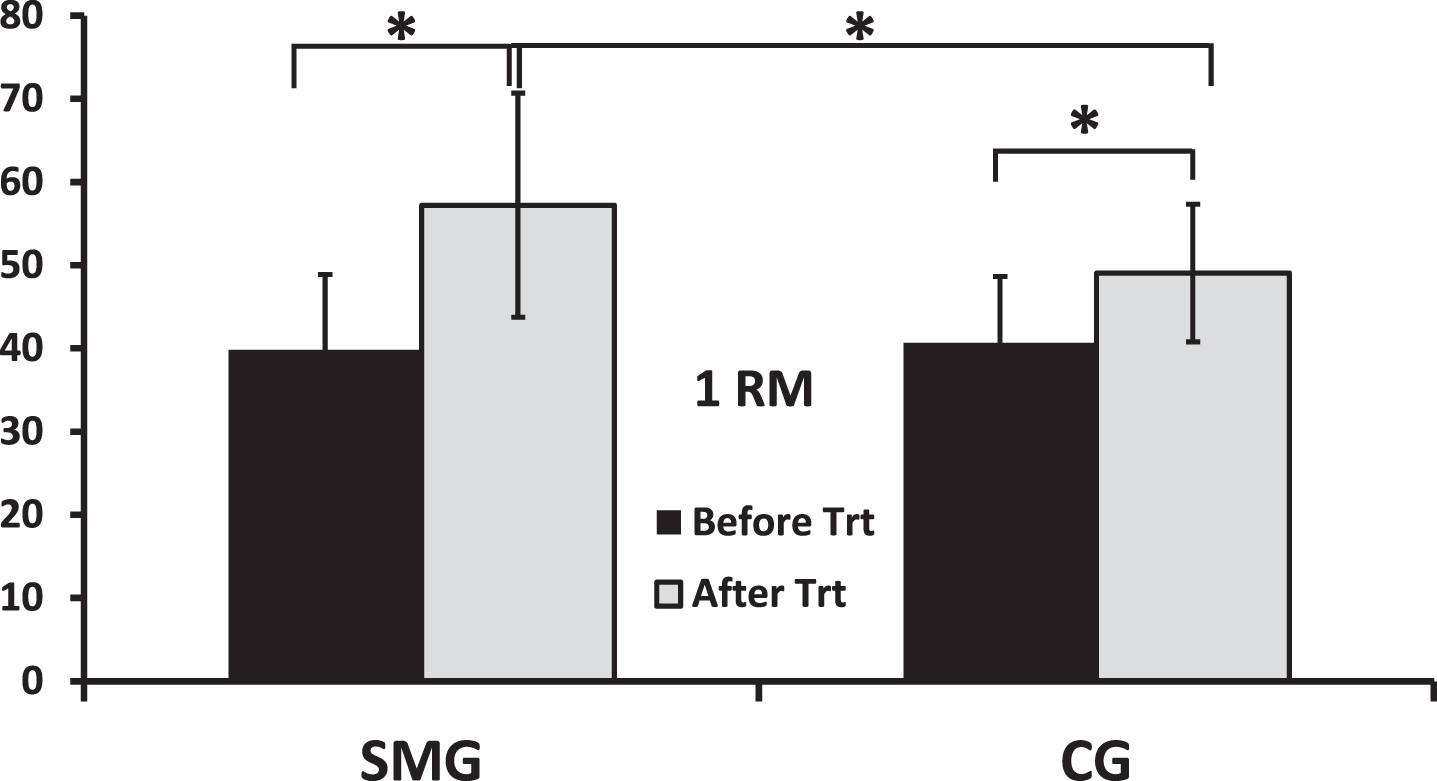
1 RM in Kgs evaluate for the two groups (control group, CG and the Strengthening Muscle Group SMG), before and after treatment (Stars denote a significant difference between groups p < 0.05).
Three phases can be noted:
A first concentric phase where one pushes on the vertical fixed tray. A second static phase where the position is maintained. A third eccentric phase where one slows down the passive return of the sliding seat.
In order to identify the maximal strength, it was necessary to calculate the one-repetition maximum (1RM) before each exercise for each patient. 1MR is the maximum weight the patient is able to move once in the full range for a given exercise, which usually correlates with strength (Thompson et al., 2019). There are two methods to calculate 1RM: the direct and indirect method. The direct method requires performing movement against a weak load that is increased gradually, while the indirect method is based on calculating theoretical 1RM using established formulae and a theoretical load. In this study, we used the indirect method to find 1RM as it carries less risk than the direct method for stroke patients. We used the calculation method proposed by Brzycki (Do Nascimento et al., 2007), which is a mathematical estimate to predict the theoretical maximum force (1RM) from the mobilized load and the number of successful repetitions until the onset of fatigue, if this number is less than or equal to 10: Weight / (1.0278 - (0.0278 * Number of repetitions)).
A session consisted of three sets of 5 repetitions each. The patient was asked to push with both lower limbs (concentric phase) until the lower limbs were taut (but with a slight flexion of the knees). This was followed by the static phase during which the patient placed his healthy lower limb on the horizontal fixed plate, and finally the eccentric phase where the patient slowed down the return of the seat with his only paretic lower limb. The first two sets were at 40% resistance to the 1MR. The last set (more specific-muscle strengthening) was at 60% of the 1MR. It was during this series that the muscle provided the most effort and was therefore more sensitive to strengthening and voluntary neurological control. The program was performed over a period four weeks, with three sessions per week. The protocol was carried out during the rehabilitation session so the two groups had the same amount of time of the rehabilitation session.
Statistical analyses
Descriptive statistics consisted of characterizing the results by mean and standard deviation (SD)/ calculations. Normal distribution of data was tested by Shapiro-Wilk and Lilliefors tests. After verifying the normal distribution of the data, all parameters were analysed using a general linear model repeated measures of variance analysis (ANOVA). The clinical characteristics of the two groups were compared using a one-way ANOVA: Group (Muscle strengthening Group/Control Group). For the reference task, a two-level analysis was performed: Before and after treatment×Group. A Newman-Keuls post hoc test was used to determine the locus of differences. Statistica (version 12) software was used for statistical analysis. The alpha critical level of 0.05 was considered to denote statistically significant results (p≤0.05).
Result
The anthropometric characteristics of the two groups were similar and there were no significant differences before treatment between patient groups for different parameters analyzed (Table 1).
When we analyze the results obtained by the 1RM calculation for these two populations we observe a significant main effect (Group * treatment F(1,39) = 409.32 p≤0.00001). We found a significant difference between before and after treatment for the two groups (40.67 + /-7.96 Kgs before treatment vs 49.06 + /- 8.29 Kgs after treatment for the CG (p≤0.0001); 39.83 + /-9.07 Kgs before treatment vs 57.22 + /- 13.47 Kgs after treatment for the MSG p≤0.0001). When we compare the differences between these two groups before treatment, no significant differences appear. However, the MSG group, which had specific training, showed a significantly greater increase after treatment than the CG group (57.22 + /- 13.47 Kgs vs 49.06 + /- 8.29 Kgs respectively, p≤0.014). This means that both groups benefited from rehabilitation with an increase in the power of their quadriceps more specifically for the MSG (Fig. 2).
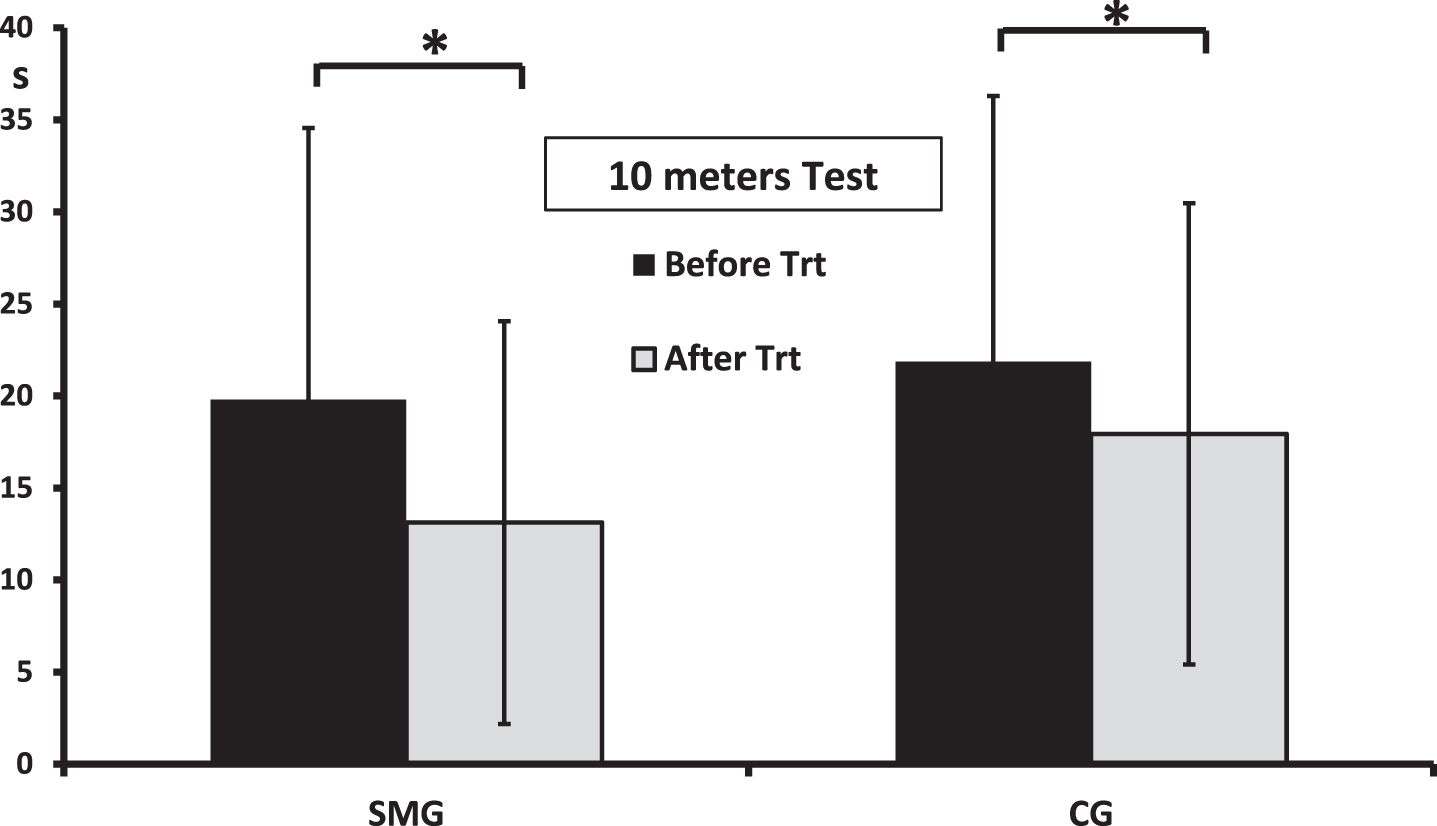
10 meters test data in seconds for the control group (CG) and Strengthening Muscle Group (SMG), before and after treatment (Stars denote a significant difference between groups p < 0.05).
We did two types of locomotion analysis. The 10 meters test evaluates a rapid gait component.
For the two groups, we found a primary significant treatment effect on the time for this test (F(1–39) = 56.77 p≤0.00001) with a greater speed of walking after (vs. before) reeducation. However, for this parameter, there was no significant interaction between the group effect and the treatment effect before and after rehabilitation (Group*treatment). However, when we compare these results in post hoc, we observe a significant difference between before and after treatment for the walking speed of these two groups with an increase of the values (21.87 + /- 14.41 vs. 17.94 + /-12.52 for the control group and 19.80 + /- 14.76 vs. 13.12 + /-10.93 for the muscle strengthening group). We observe an improvement in walking speed for both groups between before and after rehabilitation treatment. For these two groups the percentage improvement shows a significant difference p≤0.0002 with respectively 32.75% (+/-12.46%) for the MSG group and 18.57% (+/-8.76%) for the Control Group (Fig. 3).
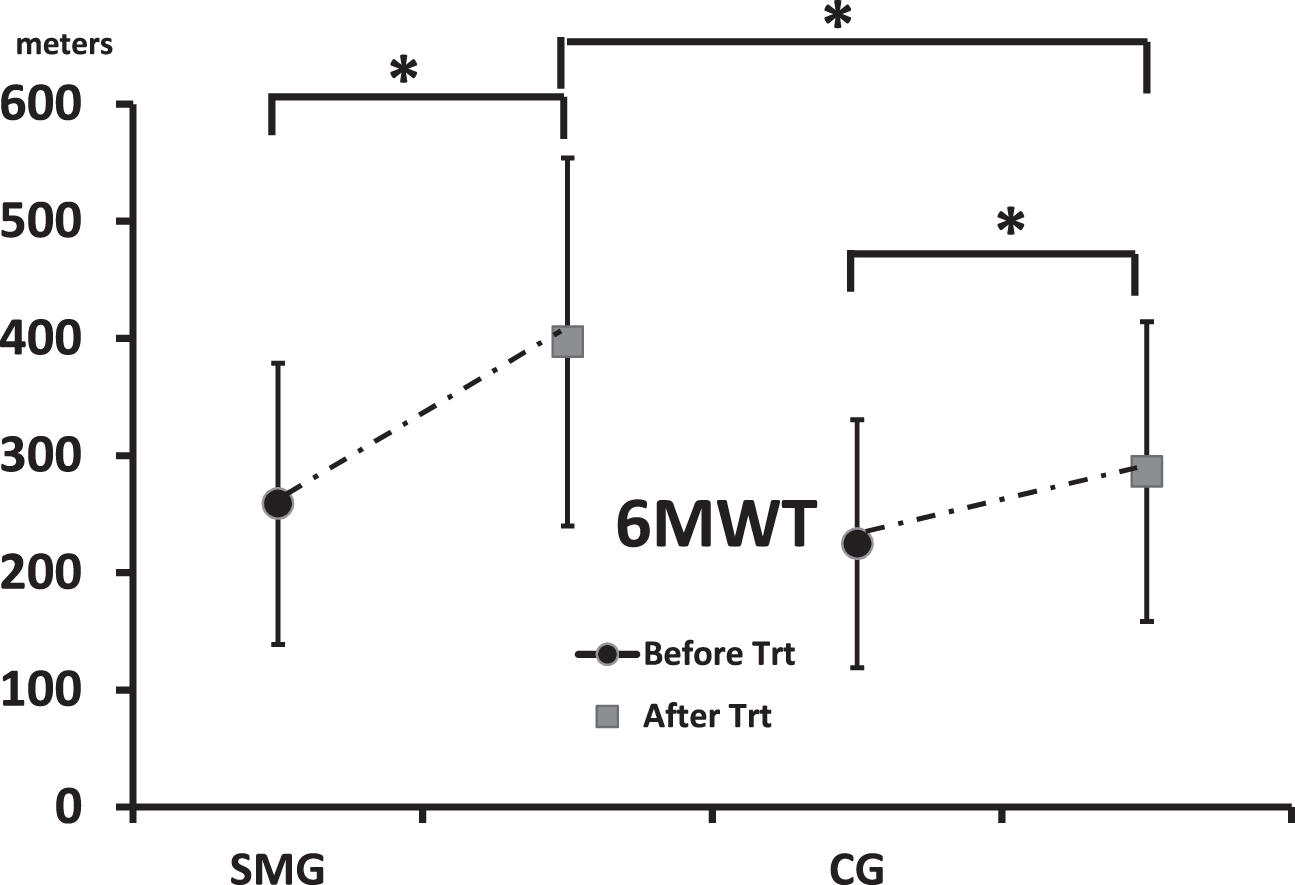
6 minutes Walking Test in meters for the control group (CG) and the Strengthening Muscle Group (SMG), before and after treatment (Stars denote a significant difference between groups p < 0.05).
For the second walking test, we analyzed the distance performed on the 6MWT. Our results show a significant main effect of treatment (before and after) and group (Group*treatment F(1,39) = 16.82 p≤0.0002). We observe a significant effect for CG between before and after treatment (p≤0.0003) and we observe the same for the MSG group (p≤0.0001). Before treatment between these two groups no significant differences were observed. Whatever treatment proposed, however, our results show a statistically significant difference between the two groups (p≤0.01). The distance increases respectively to 258.92 + /-120.05 at 396.94 + /-157.03 for the MSG vs. 224.72 + /-105.94 to 286.37 + /-127.96 for the CG; Fig. 3). For these two groups the percentage improvement shows a significant difference p≤0.001 with respectively 62.31% (+/-35.28%) for the MSG group and 30.04% (+/-17.11%) for the CG.
Finally, we found a significant correlation for both groups between increase of 1RM and distance in the 6MWT after treatment (r = 0.53 for MSG and r = 0.92 for CG).
In all the patients we observed no change in spasticity after four weeks of training using the Modified Ashworth Scale, which means that our eccentric exercises have not in any way modified a physiological component that can in turn negatively affect the standard therapeutic management proposed to these patients.
Stroke patients experience considerable impairment in their daily life activities. Gait and walking speed are affected partly due to hemiparesis because of muscle weakness and decreased motor activity (Wist et al., 2016). Regaining the ability to maintain gait balance and speed is a major functional interest for hemiparetic patients. One of the objectives of the current study was to improve on patients’ gait, not only to increase walking speed, but also to help patients regain normal walk by a better muscle control. We investigated a training protocol that consisted eccentric control on a press system by using the paretic limb. Our results show significant improvements with respect to the muscular power, which was reflected in the clinically and statistically significant differences in 1RM on the press. We observed also a significant improvement in walking, mainly gait speed using the 6MWT but not the rapid test of 10 meters test).
Muscular hyperactivity results in excessive contraction of the muscle when it should be at rest or in a certain state of relaxation (increased muscle tone). On the motor level, brain injury generates a pyramidal syndrome resulting in hyperexcitability reflex causing inappropriate muscle contractions, exaggerated and involuntary (muscle spasticity). There are also two types of co-contraction in the hemiparetic subject. Synergistic co-contraction between two flexor muscles such asdorsal flexion of the ankle during hip flexion (synchinesis), and exacerbated agonist / antagonist co-contraction that can reverse the desired direction of movement (Jonkers et al., 2009; Hyngstrom et al., 2012). Retraction of the soft tissues notably by a muscular atrophy is also observed due to either an immobilization of the muscles in short position [leading to a decrease of the proteic synthesis, a degradation of the contractile proteins and a decrease in the number of sarcomere (Mercier & Bourbonnais, 2004)], or hyperactivity of the muscle [creating excessive and non-voluntary contractions creating a permanent shortening of the muscle] (Nadeau et al., 1999. In their study during a six-minute walk test, Straudi et al. (2009) show that it is possible to determine groups of patients on gait velocity and also on differences in kinematic patterns associated to muscles coordination or coactivation. This confirms previous studies showing that, in stroke patients, increased gait velocity is associated with an increase in hip extension during stance phase and in hip flexion at the end of swing phase (Jonkers et al., 2009). Moreover, the authors demonstrated that, in addition to hip impairment, inadequate knee function was also a predictor of walking performance. Another well-known kinematic disorder in hemiplegic patients is a lack of knee flexion during swing phase (stiff knee gait; Goldberget al., 2003). This is a common abnormality in hemiplegia and is often related to over activity of the rectus femoris muscle due to spasticity (Sung & Bang, 2000). In our study, we observed an increase of the 1RM for the patients with eccentric muscle training of this muscle on a press. This result is confirmed by previous studies in stroke patients, which showed that increased gait velocity is associated with an increase in knee flexion during swing phase (Jonkers et al., 2009; Straudi et al., 2009). It seems that the gait pattern in hemiplegic patients involves a reduced range of knee motion during swing phase. The use of muscle strengthening in eccentric contraction therefore seems to modify the gait patterns of this population by a better use of knee amplitudes and knee control as our results tend to confirm.
This strategy of movement organization combining muscular synergies therefore appears to be effective for gait therapy in stroke patients. Our daily physical activities and exercises consisted of a combination of static (isometric), shortening (concentric), and lengthening (eccentric) muscle contractions, but eccentric contractions of the knee extensors are emphasized in some of the activities such as descending stairs or slopes and slowly sitting on a chair. The study by Chung-Ching et al. (2017) tested the hypothesis that eccentric training of the knee extensors would improve physical function and health parameters (e.g., blood lipid profiles) of older adults better than concentric training. Our results suggest that it is better to focus on eccentric contractions in physiotherapy for stroke patients, and that preconditioning knee extensor muscles with low-intensity eccentric contractions are effective for attenuating muscle concentric contraction of the knee extensors habitually used for elderly individuals. In hemiplegic patients, Eng et al. (2002) showed that peak and average isokinetic torque could be used to assess reliably lower extremity strength in persons with chronic stroke. There is a significant difference in peak torque measurements between affected and normal lower limbs of post stroke patients, as well as a significant correlation between the knee strength and lower limb functions. Eng et al. (2002) similarly concluded that about the hip, knee and ankle concentric flexions and extensions at 60 degrees/s and their consequences during gait. They argued that these results were essentially guaranteed if three elements were respected: the exclusion of extended positions, the adaptation of standard strength testing to patients with stroke, and the use of low velocities. In addition, the authors noticed a learning effect for these patients and thus suggested providing two training sessions before the actual evaluations to reduce this learning effect (Eng et al., 2002). Our results corroborate their findings, and including those of the 1MR despite using the indirect evaluation method. Although central mechanisms underlying force generation such as muscle recruitment and rate coding may be altered in individuals with stroke, the reliability of the peak and average torque-strength measures was high. In addition, the presence of increased muscle tone, as quantified by the Modified Ashworth Scale, did not interfere with the reliability of force production for the participants in a different study (Rabelo et al., 2016).
Furthermore, the differences in knee proprioception between the affected and intact limbs were shown to be significant (Khan et al., 2019). In their study in stroke patients, Bohannon et al. (2013) have shown that the correlation between knee extensor torque and gait speed was significant, whereas spasticity on the paretic side did not correlate with gait speed. The muscle strength of the non-paretic dorsiflexors and the left lateral trunk flexors might have a role to play in determining comfortable and maximum gait speeds of individuals with sub-acute stroke (Aguiar et al., 2018). In our study, walking distance, as reflected in the 6MWT, was significantly changed. Some authors have inferred a causal relationship between muscle strength and walking capacity to improve comfortable gait speed and total distance walked for patients with stroke (Metha et al., 2012). It is worth recalling that whereas use of the hip flexors is critical for walking in stroke patients, involvement of this muscle group was not emphasized with the current paradigm, which rather called for closed-chain, simultaneous knee- and hip controlled flexion (Fernandez-Gonzalo et al., 2014). Our paradigm of strengthening eccentric muscle exercise appears to present a safe, viable and highly effective method to improve skeletal muscle function, power, and performance in daily living activities, in individuals suffering from chronic stroke. Gait speed is generally selected as the outcome measurement in clinical practice and a predictor of fall after a patient has a stroke, but gait speed is often confounded with balance, motor function, and endurance (Ta-Sen et al., 2017). The current study and the increase of muscle activity that patients performed can also prevent the risk of fall and permit an organization of functional gait more precisely. The previous idea is confirmed by experiment where walking velocity and cadence were lower in the faller group than the non-faller group (Ta-Sen et al., 2017).
A simultaneous electromyography (EMG) study of isokinetic movements of the knee muscles in stroke and control subjects found that there was no electrical activity on the antagonist muscles and that there was indeed passive resistance to increased stretching on the hemiparetic side that was pronounced at higher velocities (Mehta et al., 2012). However, these results are correlated with a functional gain since the increase of the walking speed, as well as the decrease in the number of steps, is significant. Even a minimal increase in force would be favorable to improve the walking performance, which subsequently would increase the activity level necessary for the adaptation of the nervous drive to reach a certain spot (Carr & Shepherd, 2011). The present study showed an increase in walking speed post training, which means that the increase of patients’ strength and muscular power significantly improved their functional component.
One of the consequences of a motor deficit on walking is an asymmetric support of the two lower limbs on the ground with the paretic limb spending less time in support and more time in oscillation (Brière et al., 2010). This decreases the length of the paretic limb and may explain the fact that the number of steps decreases. We did not find worsening of spasticity in our sample of patients (0 on the Modified Ashworth Scale); this means that our exercises did not modify the physiological component in any manner that could negatively affect the standard therapeutic management proposed to these patients. Our findings are consistent with the results obtained by Jung et al. (2016) in which participants underwent 30 sessions of sit-to-stand training, five-times per week for 6 weeks. This in line with recommendations that have stated that it was possible to strengthen a hemiparetic limb muscle without increasing its spasticity (Wist et al., 2016). The quadriceps and hamstrings were chosen for their importance in walking; however, the strengthening of the knee muscles may not be sufficient to have an impact on walking speed (Tavares Aguiar et al., 2018). It is impossible to determine accurately in what proportion this increase in strength and power has affected walking speed. The performance in walking depends on other parameters such as balance during standing, strength, and inter- and intra-muscular coordination of other muscle groups such as plantar and dorsal flexors of the ankle. It would be interesting to compare the balance of patients before and after training in a future study. Since the press is an unguided movement, improvements in equilibrium may be observed. The muscles involved in this study were the muscles of the lower limb, and they were anatomically and physiologically very functional and had a high recovery capacity. In view of our results, it is difficult to determine whether the progress observed was due to an adaptation of motor control by cerebral plasticity or due to a gain that was only peripheral and therefore muscular. It might be that the adaptation was mixed and therefore of neuromuscular origin. During muscle training, there are two types of adaptations: 1) a very important neurologic adaptation during the first months that leads to a greater recruitment in the number and size of motor units and allows a better inter- and intra-muscular coordination, followed by 2) a structural adaptation that causes hypertrophy of the muscle (Rabelo et al., 2016). Since our protocol lasted only one month, it is possible to think of an adaptation essentially more nervous than muscular.
The findings of the present study should be interpreted in light of a few limitations. First, the present study results cannot be extrapolated to all people with stroke, particularly patients at lower functional levels with walking disability or severe cognitive impairments. Second, there is an insufficient cognition of the influence of neural disorders after stroke on the knee biomechanics. The reality of knee function during gait after stroke cannot be describing the real knee biomechanics completely and we need more precise kinematics and kinetics results from different research. Third, the studies about the influences of knee disorders are mainly concentrated in walking but strengthening eccentric effect of knee muscles can be tested on other daily life activities, such as running, stair climbing, and sit-to-stand. Finally, some results suggest dissociation between quantitative measures of gait, such as velocity versus symmetry, and that these parameters may measure independent features. It seems important in the future to make evaluations and correlations between these different aspects of walking and other functional activities.
Conclusions
This study adds weight to the current trend in the use of muscle strengthening versus resistance by using muscle eccentric contraction. Moreover, it shows that apart from the positive effects on muscular power, there may be also a tendency to increase the functional capacities of the non-spastic hemiparetic patient in the subacute phase. The persistence of motor deficits and the decrease in patients’ ability to move justify the interest of finding new methods of rehabilitation. All patients appreciated the technique and the smooth process of training. None of the patient discontinued the study and there were no reports adverse events during the study. Studies involving a larger number of patients are necessary in order to conclude in the intermediate and long term the effectiveness of horizontal press rehabilitation.
Conflict of interest
No commercial party has a direct financial interest in the results of the research, supported this paper, or will confer a benefit upon the authors or upon any organization with which the authors are associated.
Funding
No funding was received.