



Abstract
BACKGROUND:
Backbend-induced pediatric thoracic spinal cord injury without radiologic abnormality (BBPT-SCIWORA) in children is rare in clinical practice and leads to lower limb motor dysfunction. There are few clinical studies on BBPT-SCIWORA and even fewer on treatments for BBPT-SCIWORA-induced lower limb motor dysfunction.
OBJECTIVE:
To explore the therapeutic effect of acupuncture at bilateral spine acupoints combined with lower limb acupoints in BBPT-SCIWORA.
CASE PRESENTATION:
This study reported four cases of BBPT-SCIWORA after dancing, two of which received a unique medium-frequency electroacupuncture treatment. They were all females aged between 5 and 12 years old. They were diagnosed with BBPT-SCIWORA by magnetic resonance imaging (MRI), transferred to the rehabilitation department for lower limb dysfunction, and received rehabilitation treatments and acupuncture. Cases 1 and 2 received acupuncture treatment for lower limb acupoints, while Cases 3 and 4 received acupuncture treatment at the bilateral spine acupoints beside the lesion and lower limb acupoints. Cases 3 and 4 achieved better American spinal injury association (AIS) grades and lower extremity motor scores (LEMS) than Cases 1 and 2 after treatment.
CONCLUSION:
Acupuncture treatment of beside bilateral spine acupoints plus lower limb acupoints therapy might facilitate early lower limb motor function recovery in children with BBPT-SCIWORA.
Introduction
Backbend-induced pediatric thoracic spinal cord injury without radiologic abnormality (BBPT-SCIWORA) is a relatively rare event during dancing practice (Wang, Y. J. et al. 2016). In recent years, dance training programs for young children have been soaring, but the number of relevant spinal cord injuries (SCIs) has gradually increased, especially in girls in China. Children under 7 years of age are more vulnerable to SCIs, and SCIs are often more severe than in older children (Liang, J. et al. 2022). There are few clinical studies on BBPT-SCIWORA (Liang, J. et al. 2022; Liu, G. et al. 2022; Ren, J. et al. 2017; Tong, A. N. et al. 2020; Zeng, L. et al. 2022), with a lack of effective therapies. Clinical trials and reviews suggested that acupuncture effectively manages a range of SCI complications, including motor and sensory dysfunction, pain, neurogenic bowel and bladder, pressure ulcers, spasticity, and osteoporosis (Paola, F. A. and Arnold, M. 2003). Currently, no standard treatment protocol has been established for children with BBPT-SCIWORA. This report observed the therapeutic effect of acupuncture in four patients with BBPT-SCIWORA. Two patients received acupuncture treatment for lower limb acupoints, while two patients received acupuncture treatment for the bilateral spine acupoints beside the lesion plus lower limb acupoints.
Case presentation
Case 1 was a 5-year-old female admitted to the pediatric department of the First Affiliated Hospital, Harbin Medical University, in August 2009 for lower limb dysfunction. She was diagnosed with BBPT-SCIWORA from the backbend, and magnetic resonance imaging (MRI) showed a spinal cord injury extending from T3 to the sacral vertebra. She received anti-inflammatory drugs, rehydration, and other conservative treatment. After 2 weeks of conservative management, she was referred to the rehabilitation department. The neurological level of injury was at T10. Physical examination revealed grade 0 muscle strength in both lower limbs, bowel and bladder dysfunction, an ASIA impairment scale (AIS) grade A, and a lower extremity motor score (LEMS) of 0. Physical therapy was started to improve lower limb motor dysfunction. After rehabilitation treatments for 11 months, the bilateral hip flexor muscle strength was grade 2. The patient was able to stand independently with braces on the lower limbs. AIS grade was B, and LEMS was 4 (Table 1), but she still had bowel and bladder dysfunction. The electromyography was not checked.
The ASIA impairment scale (AIS) grade and lower extremity motor score (LEMS) of Cases 1, 2, 3, and 4 after spinal cord injury
The ASIA impairment scale (AIS) grade and lower extremity motor score (LEMS) of Cases 1, 2, 3, and 4 after spinal cord injury
a: Recovery from grade B to E within 7 days; b: Recovery from 12 to 48 within 7 days.
Case 2 was a 5-year-old female with BBPT-SCIWORA after dancing. She was managed surgically (what kind of surgery was performed is unknown) and was referred a month later, in March 2012, to the rehabilitation department for lower limb dysfunction. After admission, the neurological level of injury was at T10, and muscle strength of both lower limbs was grade 0 with AIS grade A and LEMS of 0. She was managed with continuous physical therapy, including four points of support, crawling training, and standing training. Her bilateral hip flexor muscle strength was grade 1 and grade 2 at 3 and 4 months after injury, respectively. After rehabilitation treatments for 6 months, the patient could crawl forward more than ten steps independently. AIS was grade B, and the LEMS was 4 points. Bowel and bladder dysfunction was persistent. The electromyography showed the neurogenic injury of the tibialis anterior, gastrocnemius muscle and quadriceps femoris muscle.
Similarly, Case 3, a 6-year-old female, had the same diagnosis. MRI showed a slight T2-weighted hyperintensity on the spinal cord at the T8-T12 level (Figure 1A). She received medications for 10 days, including ethylprednisolone and neurotrophic therapy, before being referred to the rehabilitation department in May 2017 for lower limb dysfunction. Her lower limb muscle strength was grade 0, tendon reflexes were absent, the neurological level was at T10, she had bowel and bladder dysfunction, AIS was grade A, and LEMS was 0.

Magnetic resonance imaging (MRI) shows an increase in the conus of the spinal cord at the day of injury, a slightly longer T2 signal at the T8-T12 level, suggesting ischemic edema of the spinal cord (left arrow). MRI shows a slightly long T2 signal at the T8-T10 level and spinal cord atrophy at the T10-T12 two months after injury (right arrow).
She started gait training and received unique medium-frequency electroacupuncture on the bilateral sides of her spine. The electroacupuncture stimulation was given five times a week for 15 min at a frequency of 20–30 Hz and a current intensity of 6–10 mA. In the early stage of injury, the acupoints were placed at BL18-26 and 1.5 inches from T8-L4. In the late stage (2 months after injury), the acupoints were placed at BL20-26 and 1.5 inches from T10-L4. The acupoints of the main core muscles of the lower limbs selected for acupuncture were GB30, GB31, GB34, ST34, ST36, BL40, and BL57 (Figure 2).

Acupoints of the bilateral spine and main core muscles of the lower limbs for Case 3.
Two months later, a repeat thoracic and lumbar spine MRI showed a slightly long signal at T8-T10 and spinal cord atrophy between T10-T12 (Figure 1B). The AIS grade changed from A to B. Between 6 and 14 months after the injury, the LEMS increased from 6 to 14, and the AIS grade changed from B to C (Table 1). Her maximum walking distance increased from 3 m to more than 400 m, the 10-m walking speed increased from 3.6 m/min to 12.1 m/min, and bowel and bladder functions were restored. There were no complications throughout acupuncture sessions and rehabilitation, such as abnormally increased muscle tone, hip subluxation, or osteoporosis. The electromyography showed muscles weakness and contraction at the proximal and distal ends of both lower limbs, due to the young age, the patient could not cooperate to complete the electromyography examination.
Case 4 was a 12-year-old female referred to the rehabilitation department of the First Affiliated Hospital, Harbin Medical University, China from Hisoshima University Hospital, Japan in October 2019 with a 17-day history of inability to move both lower limbs following an injury during gymnastics. On admission, she could only move the toes of her lower limbs. Dorsiflexor muscle strength was grade 3, the residual muscle strength of both lower limbs was grade 0, muscle tone was hypotonic, and tendon reflex was reduced.
Thoracic spinal MRI showed a slightly longer T2 signal in the spinal cord at T9 and T10, and a diagnosis of BBPT-SCIWORA was made. She started a unique medium-frequency electroacupuncture stimulation similar to Case 3. The bilateral spine acupoints were placed at BL19-24 and 1.5 inches from T9-L2 (Figure 3). Physical therapy included training on crawling, standing, walking, and balance. One week after the above treatment, the proximal flexor muscle strength of both lower limbs was grade 4+, and the distal muscle strength was grade 5. No abnormality was found in the muscle tone of extremities, tendon reflex, and sensory examination. The AIS and LEMS improved from grade B and 12 to grade E and 48 within 7 days, and she could walk independently (Table 1). The electromyography of the proximal and distal muscles of the lower limbs showed a normal signal.
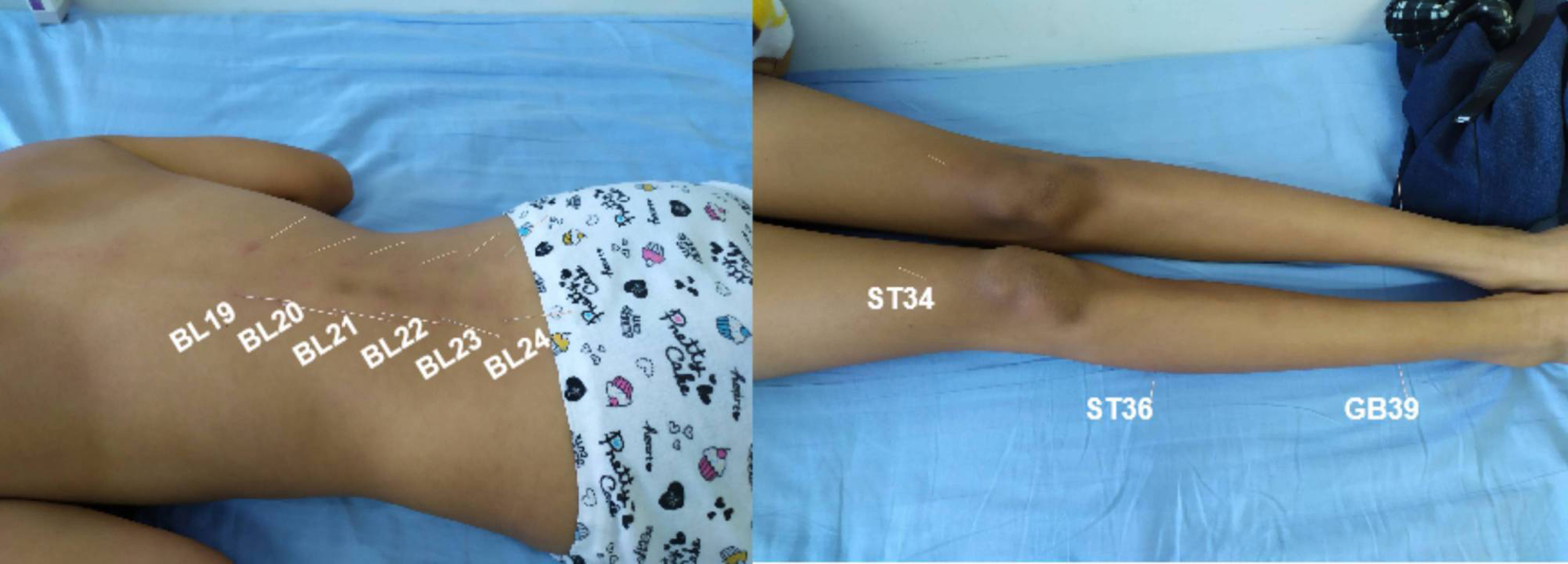
Acupoints of the bilateral spine and main core muscles of the lower limbs for Case 4.
Three patients (Cases 1, 2 and 3) were given the treatment of dehydration drugs in early stages, and neurotrophic drugs were continuously given for about three months in later stages. All treatments avoid using steroid drugs. The patient of Case 4 received no medication treatments as having mild symptoms. The rehabilitation programs are determined by functional evaluation, all patients developed a rehabilitation plan based on same process and treated by the same pediatric rehabilitation therapist.
This study presented four cases of lower limb dysfunction from BBPT-SCIWORA. All patients were female children diagnosed with BBPT-SCIWORA based on clinical and MRI findings. The patients were treated with physical rehabilitation therapy. In addition, Cases 3 and 4 received multiple sessions of bilateral spine electroacupuncture stimulation, resulting in improved lower limb motor function due to stimulation of nerves and soft tissues around the spine, especially in Case 4.
Due to its flexibility and anatomical peculiarities, the pediatric spine is more susceptible to injury without fracture and dislocation, hence the higher incidence of BBPT-SCIWORA in children (Hadley, M. N. et al. 1988) Paralysis caused by backbend during dancing is more common in the thoracic segment (Liang, J. et al. 2022; Liu, G. et al. 2022; Ren, J. et al. 2017) and is due to a low-external-force injury. There are few reports on children with BBPT-SCIWORA, all published from China recently (Liang, J. et al. 2022; Liu, G. et al. 2022; Ren, J. et al. 2017; Tong, A. N. et al. 2020; Zeng, L. et al. 2022) and there are more SCI patients in the Chinese Mainland than anywhere else (Zou, Z. et al. 2021). In contrast, in Western countries, BBPT-SCIWORA cases are mainly due to traffic accidents, and the injuries involve the cervical segment (Ellis, M. J. et al. 2019), therefore caused by a high-external-force injury. However, the prognosis of backbend-induced low-energy traumatic SCI is poorer in those children than in other injury causes (Liu, G. et al. 2022). Indeed, after 3 months, AIS grade was still A in the < 8-year-old BBPT-SCIWORA patients (Ren, J. et al. 2017). In the present study, at the initial evaluation in the rehabilitation department, all four patients had poor lower extremity motor ability, three patients were 5–6 years of age, and all three patients had AIS grades A at 1 month after injury (indicating serious injuries). Young children with BBPT-SCIWORA typically have a more severe neurological injury than their older counterparts (Liang, J. et al. 2022; Liu, G. et al. 2022; Pang, D. 2004; Ren, J. et al. 2017). In three cases in this report (Cases 1, 2, and 3), paralysis did not occur immediately, as supported by a previous study reporting a latent period of approximately 30 min to 4 h (Carreon, L. Y. et al. 2004). Cases 1, 2, and 3 subsequently lost sensation and urinary and bowel function within 24 h of injury. Ren et al. (Ren, J. et al. 2017) reported that the delayed deterioration might be due to further injury due to secondary damage, including blood vessel damage inducing microvascular perfusion dysfunction, contributing to severe hypoperfusion and spinal shock.
After starting rehabilitation therapy, the motor function improved in Case 3 after bilateral spine electroacupuncture stimulation. In Cases 1 and 2, the AIS grade was still A 9 and 2 months after injury, but Case 3 showed AIS grade B 2 months after injury (Table 1). MRI in Case 3 showed ischemic spinal cord edema but no bleeding. Tong et al. (Tong, A. N. et al. 2020) reported that spinal cord edema most commonly involved the lower thoracic spine and lumbosacral medulla, the more important concern being the late stage of ischemia characterized by spinal cord atrophy. In the present study, Case 3 showed spinal cord atrophy below the site of T10-T12 2 months after injury (Figure 1B).
The blood vessels of the spinal cord have relatively small diameters with less collateral circulation. Therefore, any force led to spasm or compression to a segmental artery can result in ischemic injury, including ischemia, edema, excitotoxicity, oxygen free radical production, and delayed apoptosis (Jiang, K. et al. 2022). It is necessary to improve the microenvironment of damaged tissues to promote neural recovery after SCI. In previous studies, the acupuncture has shown the ability to decrease oxidative stress, inhibiting inflammation and neuronal apoptosis in SCI. Furthermore, Zeng et al. (Zeng, Y. S. et al. 2022) summarized the mechanism of Governor Vessel electroacupuncture (GV-EA, located at the posterior midline of the trunk) in SCI repair over the past two decades, applied GV-EA to rats may lead to the transmission of electrical stimulation to the spinal cord segment through primary afferent nerve fibers in the meningeal branches. We used unique medium-frequency electroacupuncture techniques to stimulate the bilateral spine and lower limb acupoints around the spinal lesion in Case 3. Herein, our acupuncture manipulation is to inject the needle obliquely along the upper and lower segments of the spinal cord injury site and the acupuncture needle penetrate the skin and ligament. It may stimulate the spinal cord through afferent nerve fibers of the meningeal branch. Simultaneously, connecting to the lower limb acupoints may reactivate those neural circuits and promote the nerve-muscle connection. The unique acupuncture through stimulating the surrounding injured spinal segment acupoints might be relieve edema in the early stage after injury, also improve the microenvironment of damaged tissues to shorten the spinal shock period. Acupuncture can accelerate local blood circulation and restore the hemodynamic state. Using bilateral spine acupoints treatment, we observed that the AIS grade of Case 3 improved from A to B, and the spinal cord shock period was shorter than in Cases 1 and 2 at 2 months after injury.
The bilateral spine acupoints acupuncture was also performed in Case 4. The recovery was more rapid than in Cases 1, 2, and 3, probably because her injury was less severe and she was older. Pang et al. (Pang, D. 2004) reported that children younger than 8 years had a higher incidence of complete or severe partial spinal cord injuries than those older than 8 years. Response to rehabilitation therapy in Case 4 was remarkable. Two special acupuncture treatments raptly ended the spinal shock period. AIS improved from grade B to E, and LEMS improved from 12 to 48 within 7 days of treatment. Moreover, her motor functions were fully restored. The bilateral spine acupoints combined with lower limb acupoints might have contributed to the stimulation of the damaged nerves and improvement of the state of nervous ischemia, leading to the improvement of neurological symptoms.
This study reported that the motor function improvement was better in Cases 3 and 4 after bilateral spine electroacupuncture stimulation. Clinical studies have confirmed that acupuncture can enhance endogenous neurogenesis and ameliorate neurological impairments during rehabilitation (Fan, Q. et al. 2018; He, K. et al. 2021; Heo, I. et al. 2013), but no previous study is available specifically for BBPT-SCIWORA. By stimulating the spinal nerves and soft tissues, the early start of acupuncture in the acute phase of SCI can contribute to significant neurologic and functional recoveries, leading to better outcomes in the injured patients (Wong, A. M. et al. 2003).
Conclusion
In this study, the bilateral spine combined lower limb acupoints had a good therapeutic effect that was effective in Cases 3 and 4. BBPT-SCIWORA is a rare condition, and only four patients could be reported. Analyzing more cases could allow a deepening of the discussion of the effect of bilateral spine acupoints combined with lower limb acupoints acupuncture for BBPT-SCIWORA.
In conclusion, acupuncture of bilateral spine acupoints combined with lower limb acupoints might facilitate early lower limb motor function recovery in children with BBPT-SCIWORA.
Footnotes
Ethics statement
The work has been carried out in accordance with the Declaration of Helsinki (2000). The study was approved by the Ethics Committee of The First Affiliated Hospital of Harbin Medical University. All participants provided written informed consent.
Availability of data and materials
The datasets used and/or analyzed during the current study are available from the corresponding author upon reasonable request.
Competing interests
The authors declare that they have no competing interests.
Funding
None to report.
Author contributions
The study was designed by PH and ZJ. Acupuncture and conventional rehabilitation treatment were performed by PH and physiotherapists. PH and LH wrote the main text and helped prepare the figures, tables, and references. Each author carefully reviewed the manuscript and agreed with the final version.
Acknowledgments
The authors thank the children and families who participated in this research and the physiotherapists supervising the rehabilitation training.