




Abstract
PURPOSE:
Present study aimed to determine the effects of muscular relaxation and visualisation exercises on psycho-emotional state in women after breast cancer surgery during a 4-week individualised intervention.
METHODS:
The sample size of 51 women was chosen to perform the investigation. Women had undergone surgical treatment (radical mastectomy by Madden) for breast cancer. Participants reported anxiety and depression using the Hospital Anxiety and Depression Scale at baseline, and 4-week post-intervention. They were randomly assigned for the group A (n = 26) that received progressive muscular relaxation and visualization exercises in addition to individualised physical rehabilitation intervention, and the group B (n = 25) only received individualised physical rehabilitation intervention.
RESULTS:
It was found that psycho-emotional parameters steadily improved in both groups during a 4-week individualised intervention. However, based on the results of the 4-week monitoring, it has been established that using progressive muscular relaxation and visualization exercises in addition to the individualised physical intervention are more effective for reducing self-reported anxiety in women at hospital inpatient department. The post-intervention level of anxiety was statistically lower in women of the group A compared with the group B by 2.52 points (p < 0.05).
CONCLUSIONS:
These findings showed that progressive muscular relaxation and visualization exercises were effective interventions that had a favorable impact on anxiety in women after breast cancer surgery.
Introduction
Today patients with breast cancer are being treated successfully and problems related to mental health and quality of life become highly important [1–3]. A great number of recent studies have shown that psychological distress is often experienced by breast cancer patients. Affected women may have high prevalence of anxiety, depression, fatigue, sadness, negative emotions, and low sleep quality [4–8].
A systematic review of randomized controlled trials have presented that women often experience anxiety and depression related to breast cancer treatment and diagnosis [9, 10]. According to recent studies [3], a high prevalence of depression may persistent more than 5 years in patients after breast cancer treatment.
A lot of studies have been conducted to improve psychological well-being for women with breast cancer, to reduce side effects of treatment including yoga exercises [11, 12], cognitive behavioral therapy [10], music therapy [13, 14], progressive relaxation [15–18] and stress management intervention for problems associated with psycho-emotional state of patients. Only few studies indicate that progressive muscle relaxation may reduce the anxiety levels and side effects caused by chemotherapy in cancer patients. However, progressive muscle relaxation does not reduce vomiting and does not improve the quality of life of patients.
It has been noted that rehabilitation program should be individualised for all breast cancer patients according to their mental health status, and physical activity level. Previous studies [8, 19] have shown the importance of individualized exercise for the improvement of life quality and cancer-related cognitive problems in breast cancer survivors.
Despite the available publications, there are no studies in the literature in which progressive muscle relaxation and visualisation exercises were used for the treatment of anxiety and depression in breast cancer survivors.
All the above mentioned the importance of developing individualised intervention alongside with the need to determine its benefit for the anxiety and depression in patients after breast cancer surgery.
The aim of this study was to determine the effects of muscular relaxation and visualisation exercises on psycho-emotional state in women after breast cancer surgery during a 4-week individualised intervention.
The primary outcome was to compare psycho-emotional parameters at 4 weeks within group changes. Furthermore, secondary outcomes were to compare psycho-emotional parameters at 4 weeks between group changes.
Methods
The study has followed the principles of the Declaration of Helsinki, and has been approved by ethics Committee of Khortytsia National Academy (number 2017/12–11). Participants’ type of surgery treatment, cancer stage were determined using medical records. This research was designed in accordance with the principles of CONSORT.
We screened 58 women for eligibility; 2 (3 %) were not eligible, and 2 (3 %) were not interested in participating. The primary reasons for ineligibility were diagnosis with Stage 3 breast cancer (n = 1), metastasis (n = 1). Women were randomized using sequentially numbered, opaque sealed envelopes. Patients were randomly allocated to the group A (n = 26) received progressive muscular relaxation and visualization exercises in addition to individualised physical rehabilitation intervention, and the group B (n = 25) only received individualised physical rehabilitation intervention.
Women had undergone surgical treatment (radical mastectomy by Madden) for breast cancer and were in hospital inpatient department. Patients between ages 50 and 60 years, with recent history of radical mastectomy, I-II tumor stage, psychological distress, written informed consent, absence of metastases and contraindications to physical activity were included in the study. Women with bilateral mastectomy, metastases, III tumor stage or any contraindications limiting activity were excluded from the study. The focus on women aged between 50 and 60 years was used, because the incidence of breast cancer was the highest in this age category.
Participants reported anxiety and depression using the Hospital Anxiety and Depression Scale at baseline, and 4-week post-intervention. Hospital Anxiety and Depression Scale [20] is used to determine the presence and severity of anxiety and depression, containing 14 questions, divided into two subscales (for questioning anxiety: odd questions, for paired: depression). Applying this scale will enable you to receive operational information without significant time consuming.
Data (mean, and standard error of the mean) were analyzed using Statistica for Windows (version 8.00). Before the statistical analysis, the Shapiro-Wilk test was used to test for normal distribution of data. Dependent samples t-tests were used to analyze psycho-emotional parameter changes in one group from baseline to post-intervention. Independent sample t-tests were used to compare anxiety and depression between the women of group A and group B.
Interventions
The 45 min individualised physical rehabilitation intervention take place 5 days a week for 4 weeks in both groups. Group A additionally performed progressive muscular relaxation and visualization exercises 5 days a week for 4 weeks. All interventions were conducted by the same physiotherapist.
The developed individualised physical rehabilitation interventions are based on the gradual solving of the tasks, taking into account the level of the functional state of the cardiovascular system and current psycho-emotional state of women.
The priorities of successfully overcoming negative side effects of breast cancer surgery treatment should be personal preferences of women, the specifics of the impact of various means of physical rehabilitation and the organization of the provision of rehabilitation care. During the selection of appropriate means of physical rehabilitation to increase the functionality of the body of women, one must observe the principle of adequacy of physical activity in accordance with their psycho-emotional state and the level of functional state [21]. Forcing or excessive intensity significantly increases the price of adaptation, which can naturally lead to overstrain of the body.
To ensure adequate structural and functional changes in long-term adaptation, we propose to adhere to the undulating nature of the variation in the load, and ensure a gradual alternation of the training effect. In general, the variation in the load should depend on the initial position, the coordination complexity of the exercise, the degree of muscle effort, amplitude, intensity, the availability of auxiliary items, and functional state of vegetative nervous system of the woman [22].
Special attention should be paid to the technical characteristics of individual exercises, because only with the observance of rational technology can you achieve the best result with minimal stress of autonomic and motor functions. The methodical features of the exercises are given sufficient attention at all stages of the recovery period by means of a proper demonstration of techniques for women, as well as the use of visual control methods.
Differentiated approach to low intensity and moderate intensity exercises is provided in accordance with the participants’ health status. Exercise intensity for women ranges from 40% to 50% of heart rate reserve.
Autogenous training is used in order to correct the mental state of women and related psychosomatic disorders in this period. The purpose of autogenous training is to achieve an arbitrary relaxation of muscles and to relieve emotional stress. Women are taught the basic techniques of muscle relaxation and self-regulation of breathing. The beginning of the autogenous training is accompanied by a brief conversation about its essence, physiological bases and effects on the body, the ability of women to self-suggestion.
During the visualization, it is necessary to create the proper atmosphere (appropriate musical accompaniment, pleasant calm tone of the leader, access to fresh air, etc.). The creation of mental images contributes to the formation of positive expectations, strengthening the belief of patients in the possibility of recovery. Women need to realize their negative impact on the somatic state, as well as the healing power of positive attitudes to overcome negative emotions.
The structure of intervention consists of special physical and dynamic breathing exercises (50%), resistance exercises (20%), stretching yoga exercises (20%), and self-massage (10%). In order to obtain the relaxation effect, respiratory exercises are used to increase the duration of exhalation and exhalation delay. Such exercises are performed in static and dynamic (in combination with certain movements) mode. The load intensity is selected individually for each patient.
Results
Demographic and treatment-related characteristics of studied women are shown in Table 1. These data demonstrated that there were no significant differences between the two intervention groups at baseline. CONSORT flow diagram is presented in Fig. 1.
Demographic and treatment-related characteristics of study participants
Demographic and treatment-related characteristics of study participants
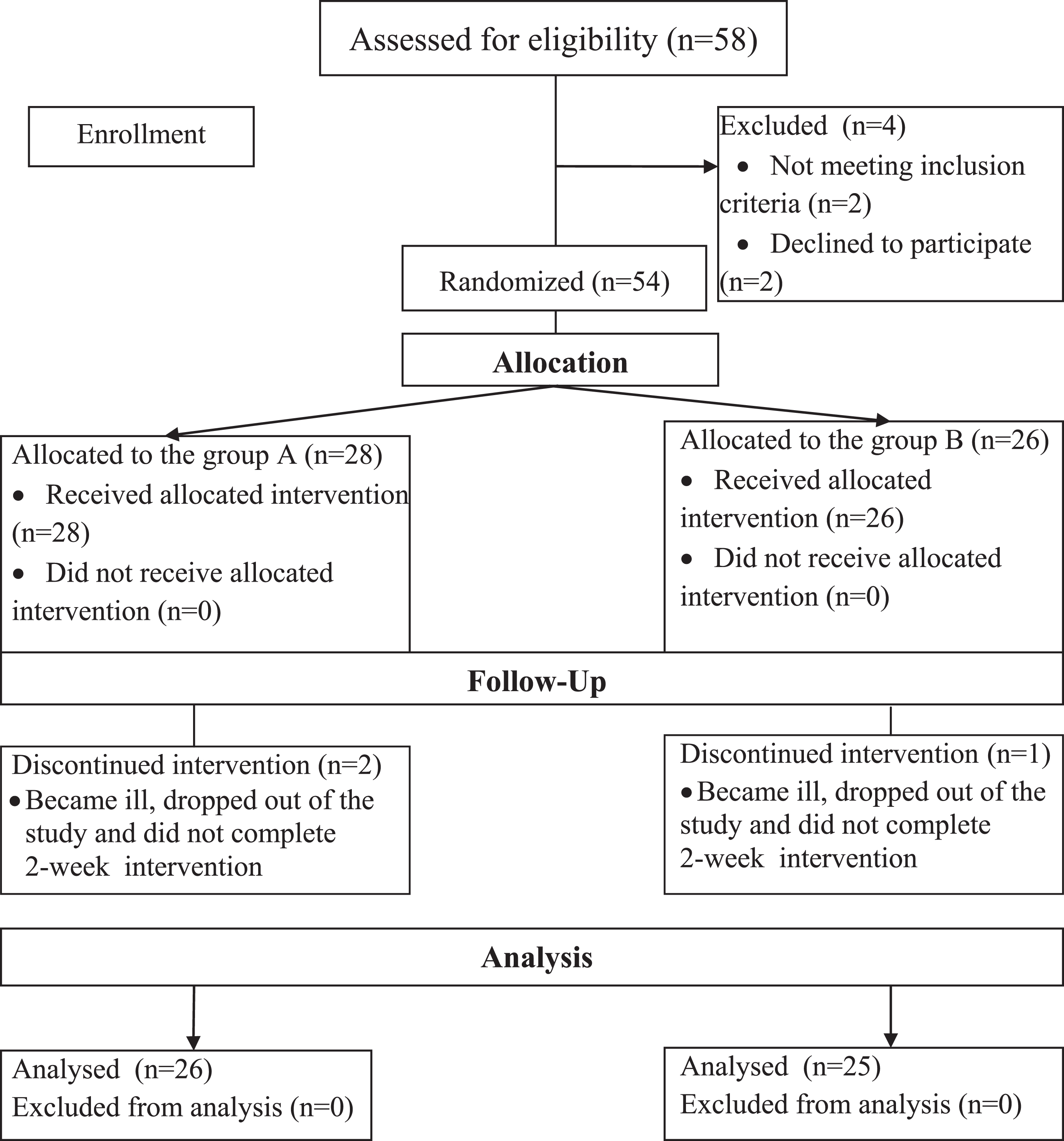
CONSORT flow diagram.
Initial detailed analysis parameters of the Hospital Anxiety and Depression Scale showed that subclinical manifestation of anxiety was observed in 16% of women after breast cancer surgery, depression in 44% of patients. Clinical manifestations of anxiety and depression were recorded in 82% and 36% of studied women, respectively.
A detailed analysis of the responses to the statement “I feel tension” indicated its occurrence at 60%, while the constant feeling was recorded in 24% of patients.
Occurrence from time to time and the constant presence of anxious thoughts was noted in 54% and 18% of studied women, respectively. Analysis of the statement “I can sit and relax” showed that only 32% of women answered “probably”, “sometimes” — 52%, “I can not at all” — 14% of patients.
The analysis of the responses to the statement “What brought me pleasure, and now causes me such sensations” showed that only 6% of women agreed with it, partially — 48% of patients.
Only 8% of respondents agreed with the statement “I am able to laugh and see funny in certain situations”, did not agree — 10% of women.
44% of women are satisfied with a good book, radio, or TV program, 42% partially agreed with this statement, 14% completely disagreed with this statement.
Changes in the Hospital Anxiety and Depression Scale parameters of studied groups are presented in Table 2. The results of the analysis of psycho-emotional parameters within groups after participating in the 4-week individualised intervention showed a positive influence on women of both groups.
Change of Hospital Anxiety and Depression Scale parameters (M±m) in women after breast cancer surgery during inpatient stage of rehabilitation
Notes: *p < 0.05 compared with the 4-week data of the group A and group B.
Revaluation of psycho-emotional parameters showed that there was a probable decrease in the indicators of anxiety by 4.44 points (p < 0.001) in women of group A, while the rates of depression were almost unchanged in both groups (p > 0.05). The post-intervention level of anxiety was statistically higher in women of the group B compared with the group A by 2.52 points (p < 0.05). Effect size (Cohen’s d) for the anxiety level was 0.85, for depression 0.45. According to Cohen effect size for anxiety was classified as large effect, for depression as small effect.
A detailed post-interventions analysis of the indicators of Hospital Anxiety and Depression Scale showed that 44% women of group A did not have anxiety at all, subclinical manifestations of anxiety were observed in 40% patients of group A and 12% of group B, clinical manifestations were recorded in 16% and 42% patients of the corresponding groups.
A detailed analysis of depression indicators showed that it was absent in 56% women of group A and 44% of group B, subclinical manifestations were observed in 8% and 12% of respondents, clinical manifestations were observed in 36 and 44% of patients, respectively.
The analysis of the responses to the statement “I feel vivacity” showed that only 16% women of both groups did not feel it, sometimes — 44% and 32%, very rarely — 20% and 28% of respondents, respectively.
The results of the respondents’ responses showed that only 12% women of group A and 24% of group B did not attend their appearance, 56% and 40% began to pay less attention to their appearance, while 8% and 12% women of the relevant groups attended their appearance as before.
Results from this study show that implementation of individualised intervention had a positive impact on psycho-emotional state in women after breast cancer surgery.
The rehabilitation of women after breast cancer surgery is a complex task, because in order to improve physical, functional capabilities, psycho-emotional state, social adaptation, it requires compliance with an individual and differentiated approach during its implementation. It is also necessary to take into account the patient’s rehabilitation potential.
Based on the results of the 4-week monitoring, it has been established that using progressive muscular relaxation and visualization exercises in addition to the individualised physical intervention are more effective for reducing self-reported anxiety in women at hospital inpatient department.
This study supports a considerable body of research that shows a significant role of physical exercises in anxiety and depression management in breast cancer survivors [4, 14].
Some studies have analyzed music therapy and patient satisfaction in women after breast cancer surgery [13, 14], other investigations have devoted to the determination of hypnotic relaxation therapy [4], yoga relaxation intervention [9, 12] as useful practices in reducing psychological distress, improvement of emotional and social functioning among women experiencing depression and anxiety. In presented studies, progressive muscle relaxation training was the part of another therapy [16–18].
Various intervention methods, duration and intensity of exercises create some difficulties in comparing the results obtained in the context of current research. Previous studies applied yoga intervention frequencies of 2–3 sessions per week, durations from 60 min to 120 min with different combination of intensity for breast cancer patients [11, 12].
Compared to previous related studies [15, 18] the results of our research confirm the researchers’ opinion that applying progressive muscular relaxation is an effective method for decreasing the anxiety level in cancer patients.
The strengths of our current research provide a rational combination of breathing exercises, progressive muscular relaxation, visualization exercises, resistance and stretching yoga practices based on patients’ preferences and their physical and psychological conditions. Breathing exercises and visualization exercises helped women to focus their attention to the present moment and to cope successfully with psychological distress.
Limitations
Our findings have some limitations, because current research was conducted on a small sample and obtained results might not be generalizable to all women population suffering from breast cancer.
Conclusions
These findings showed that progressive muscular relaxation and visualization exercises were effective interventions that had a favorable impact on anxiety in women after breast cancer surgery. Muscular relaxation and visualization exercises in addition to individualised physical rehabilitation intervention offered in clinical practice are reasonable and safe.
Prospects for further research will be directed at determining the influence of the individualised intervention on life quality parameters in women after breast cancer surgery.
Conflict of interest
None declared.