



Abstract
BACKGROUND:
A large proportion of patients with chronic stroke have permanent lower limb functional disability leading to reduced levels of independent mobility. Individually, both cross-education of strength and mirror therapy have been shown to improve aspects of lower limb functioning post-stroke.
OBJECTIVES:
This case report examined whether the novel combination of both therapies could be a feasible intervention leading to improvements in lower limb impairments and functional ability for a post-stroke individual.
METHODS:
The participant was a 66-year-old male and was six months’ post-stroke. Due to hemiparesis and spasticity he had lower limb motor impairment. The participant engaged in a combination of cross-education strength training plus mirror therapy three days per week for four weeks. Outcome measures included Maximal Voluntary Contraction, Modified Ashworth Scale, 10 Metre Walk Test, Timed Up and Go and London Handicap Scale. Intervention adherence, adverse effects and subjective feedback were also recorded.
RESULTS:
Maximal Voluntary Contraction increased in both limbs. Improvements were also seen in the Modified Ashworth Scale, 10 Metre Walk Test and Timed Up and Go. Improvements in function were reflected in a positive increase in self-perceived participation scores. The intervention was well received and no adverse effects were noted for the participant.
DISCUSSION:
The positive outcomes from this new combination therapy for this participant are encouraging and indicate the potential benefit of mirror therapy as an adjunct to cross-education training for improving lower limb strength, spasticity and motor function post-stroke.
Introduction
Stroke is the leading global cause of adult disability [1]. There are two main types of stroke; ischemic and hemorrhagic, with ischemic being the most common [1]. Seventeen million people suffer a stroke annually, of which five million are permanently disabled [1]. Twelve months after stroke 35% of patients who presented with lower limb hemiparesis will still show reduced functional ability [2], which is associated with high levels of anxiety and poorer quality of life [3].
Hemiparesis, a one sided muscle weakness [4], spasticity, an increased muscle tone [5], and reduced motor function are the most commonly reported physical impairments post-stroke [6, 7]. Hemiparesis following stroke is commonly more noticeable in distal muscle groups [8]. Maximal dorsiflexor torque of the more-affected (MA) limb can be reduced to as little as 38% of the less-affected (LA) limb [9]. Spasticity develops in 25%–30% of patients and in the lower limbs occurs predominantly in the ankle [10]. Ankle dorsiflexion dysfunction is particularly common due to weakness and spasticity, contributing to walking impairment [11]. Commonly performed rehabilitation techniques usually consist of repetitive active assisted and passive manual movements primarily addressing the MA limb directly [12], because in many cases the impairment of the MA limb is too great to be engaged in active exercise, which also denies the possibility of independent home training as therapist assistance is needed [13]. Innovative rehabilitation techniques that primarily engage the LA limb, such as cross-education and mirror therapy, are increasingly gaining recognition and may have potential to achieve rehabilitative outcomes in the MA limb post-stroke [14].
Cross-education, the performance improvement in the untrained homologous muscle after unilateral exercise [15], was first described by Scripture et al. in 1894 [16]. Cross-education of strength involves applying a unilateral strength training programme to a specific set of muscles with the aim of achieving bilateral strength gains in both the trained and the matching contralateral untrained muscle [17]. A recent review of the literature [18] found definite evidence supporting the existence of the phenomenon of cross-education with the average degree of strength increase for the untrained limb being 11.9% of initial strength. A healthy person usually trains limbs bilaterally in an attempt to improve strength or function. However, from the perspective of rehabilitation, cross-education may provide a way to benefit recovery after unilateral orthopaedic injury or neurological damage [17]. It is thought that adaptations mediating cross-education occur primarily on a neurological level, rather than a muscular level, and increased activation in the untrained motor cortex results in increased neural drive through the motor pathway to the contralateral untrained limb [19].
The use of cross-education as a treatment option for the lower extremity in stroke rehabilitation is a relatively new concept. Dragert & Zehr [20] were the first to investigate the phenomenon in the stroke population, reporting strength increases of 34% in the trained limb and 31% in the untrained limb after six weeks of maximal isometric contractions. They also report a positive effect on motor function with significant improvements in Timed Up and Go (TUG) scores. Although the study did not find significant improvements in spasticity, previous studies have reported a reduction in contralateral H-reflex excitability during unilateral training [21, 22]. A recent systematic literature review [23] supports the findings and concludes that cross–education can be effective in the lower extremity post-stroke.
It has been hypothesised that cross-education in the lower extremity may be further augmented by combining the strengthening therapy with Mirror Therapy (MT) [24], this however has never been explored in a stroke population. Mirror Therapy, whereby a mirror is placed in the patient’s mid-sagittal plane reflecting the LA side as if it were the MA side [25], improves motor function and activities of daily living post-stroke [26]. Movements of the LA limb, when observed as a reflection in the mirror, create the illusion of normal movements of the MA limb. The therapeutic approach is based on visual stimulation activating the Mirror Neuron System (MNS) [26]. Sutbeyaz et al. [27] showed significant improvements in lower limb motor functioning with a 36% increase in Functional Independence Measure scores following dynamic ankle dorsiflexion movements with mirror visual feedback. Studies also indicate that MT can facilitate neuroplasticity within the primary motor cortex and consequently aid the restoration of motor command execution and function [28].
A recent study [14] has shown that the cross-education effect in a non-clinical population is indeed further augmented by combining cross-education with MT. The study concluded that untrained limb strength increased significantly in the mirror training group (61%) when compared to strength training only without mirror visual feedback (34%). This combination of therapies has never been explored in a stroke population; therefore, the combined effects on hemiparesis, spasticity and motor function remain unexplored. This is the first study to investigate the potential of cross-education plus MT in the lower limb post-stroke.
The authors of this study hypothesised that an ankle dorsiflexion strengthening programme consisting of cross-education and MT applied to the LA limb in a post-stroke participant would be well tolerated and result in strength, spasticity and motor function improvements in the MA (untrained) limb. Therefore, this case report describes the effects of a 4-week intervention which combines cross-education and MT for the purpose of improving lower limb rehabilitation for a post-stroke participant.
Methods
Participant
This case report examines an ambulatory 66-year-old male participant (Table 1) who experienced a right hemisphere lacunar infarction six months prior to the beginning of the trial, resulting in spastic hemiparesis in his dominant (left) lower limb.
Participant Characteristics
Participant Characteristics
The participant lived independently in the community and was ambulatory but presented with strength and motor function impairment due to his stroke. Informed consent for study participation and publication of results was given by the participant based on procedures approved by the Research Ethics Committee at Sligo University Hospital and which complied with the Declaration of Helsinki.
The intervention comprised of a supervised home-based unilateral strength training plus MT programme. Training positioning was consistent with positioning at outcome measure data collection and a previous similar cross-education study [20]. The participant was seated in a chair with back support (knee joint angle at 120°). The LA lower limb was strapped into a custom designed ankle brace securing the ankle joint at a 100° angle (10° plantarflexion) (Fig. 1). Following a warm-up of unilateral submaximal isometric contractions of the LA limb, the main part of the training programme consisted of four sets of five maximal effort isometric ankle dorsiflexion contractions performed with the LA limb only. Contractions were held for five seconds with five seconds rest between repetitions and three minutes’ rest between sets. The same protocol was followed three times per week for four weeks (12 sessions). To ensure correct technique and protocol compliance each session was supervised by two therapists.
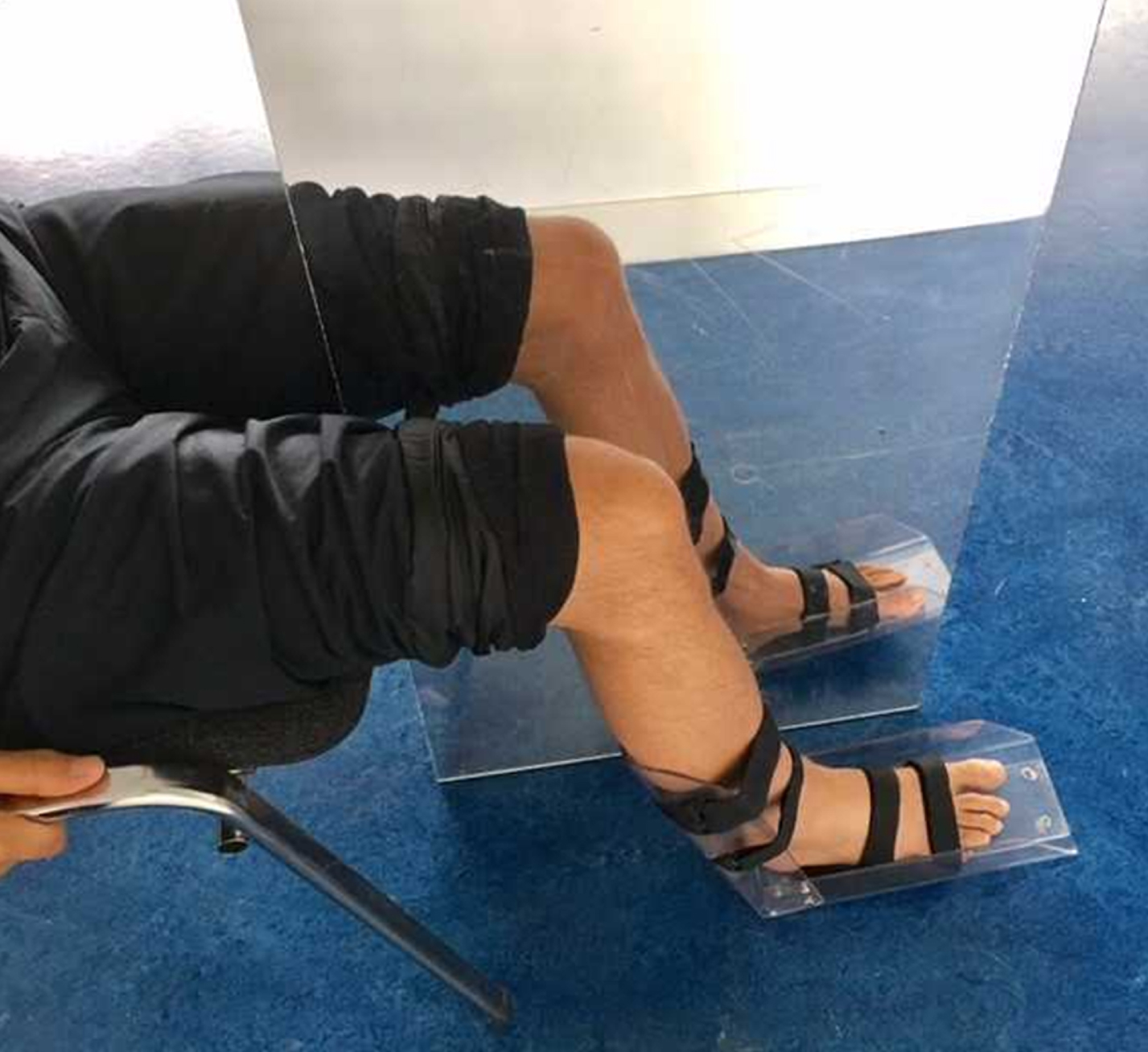
The participant is set up with the training (less-affected) limb strapped into the isometric strengthening ankle brace with the reflection of the same limb in the mirror placed between the participant’s legs. The more-affected limb is hidden behind the mirror and placed in the same position as the training limb.
Maximal isometric contractions allow for strength training at the highest intensity which is associated with the greatest cross-education of strength effects [29]. Frequency and intensity were chosen according to maximal strength training guidelines [30]. The participant was instructed to observe the reflection of the LA limb in the mirror while training. Verbal cues were given to “Go” and to “Rest” to ensure timely contractions and rest periods. Consistent verbal cues to contract as hard and as fast as possible and to focus on the reflection in the mirror and were given throughout each training session. To avoid Valsalva during contractions, correct breathing technique was explained prior to commencing each session and monitored throughout the session by the attending therapists.
To assess the feasibility of the intervention, adherence, adverse effects and subjective feedback were recorded during each training session. Adherence was recorded by noting the number of completed contraction repetitions, sets and training sessions. To identify adverse reactions, the participant was asked if he had experienced any changes in physical ability or other issues since the previous session and was invited to give any other feedback relating to the intervention.
Outcome measures were chosen to cover the three levels of human functioning as outlined in the International Classification of Functioning, Disability and Health framework (ICF) [31]: Body Function and Structure, Activity, Participation.
ICF function level/body function and structure
ICF activity level
ICF participation/involvement in life situations
Outcome assessments were administered one-day pre-intervention (baseline), three days’ post-intervention, and three months’ post-intervention (three-month follow-up).
Results
Baseline assessment showed the participant to have noticeable PT strength deficit (38.5%) in his dominant MA ankle dorsiflexors when compared to the non-dominant LA limb. All joints in the MA limb (hip, knee and ankle) showed increased muscle tone, with highest muscle tone in the hip followed by the knee and ankle joints. The participant described the issues as affecting his mobility with a feeling of stiffness in the ankle. Baseline 10MWT and TUG scores were substantially below that of healthy, aged matched males [38]. Observational assessment revealed an asymmetrical walking pattern, indicating functional disability for the participant. Assessment outcomes are presented in (Table 2).
Assessment results
Assessment results
MVC = Maximal Voluntary Contraction, PT = Peak Torque, MAS = Modified Ashworth Scale, 10MWT = 10 Metre Walk Test, TUG = Timed Up and Go, LHS = London Handicap Scale, Nm = Newton Metre, Nm/s = Newton Metre per second, m/s = metres per second, s = seconds.
Pre and post-intervention measures indicated improvements in MVC for both limbs, (3.6% and 11.3% for the trained and untrained limbs respectively). Spasticity reduced in all joints of the MA limb (1.5 point reduction in hip, 1.7 point reduction in knee, 1.63 point reduction in ankle). Walking speed (10MWT) increased by 0.21 m/s, TUG improved by 4.25 s and LHS score improved 0.306 points. Follow-up assessments revealed a regression in most outcomes subsequent to a three month period of no training. However, untrained ankle PT had further increased by 18.7% compared to baseline.
The participant completed the four-week training intervention (12 sessions) successfully with no noted adverse effects. The participant reported that the training was not invasive or stressful and that a frequency of three times per week for a duration of approximately 20 minutes per session was achievable without feeling overly fatigued.
The findings of this case study demonstrate that a four-week cross-education plus MT training intervention can increase lower limb function and reduce lower limb spasticity in a post-stroke participant. Ankle dorsiflexion strength increased in both the trained (LA) and untrained (MA) limbs. Spasticity reduced in all lower limb joints, with the greatest reduction noted in the ankle. There were also meaningful improvements in motor function (10MWT and TUG). Subjective feedback from the participant indicated that this training intervention is acceptable to people post-stroke and without adverse effect.
Studies show that high intensity unilateral strength training can increase activation in the untrained motor cortex [39] and increase excitability in the untrained motor pathway [40], leading to increased neural drive to the contralateral homologous muscle [19]. Furthermore, Dragert & Zehr [20] demonstrated that cross-education of strength is achievable post-stroke. Mirror visual feedback of a training limb has been shown to evoke adaptations in corticospinal excitability of the untrained side and enhance interhemispheric communication [24]. Additionally, mirror visual feedback overrides proprioception of the resting limb and increased attention towards the resting limb further enhances activation of the untrained hemisphere [41]. The study by Zult et al. [14] has shown the ability for MT to enhance the cross-education effect by as much as 27% in healthy subjects. With this in mind, it was not overly surprising to find post-intervention contralateral strength increases in this case study. Although clinically meaningful changes in strength are not fully established for this population, it is worth noting the post-intervention increase in PT for the untrained (MA) ankle (11.3%). Although this strength increase is lower than that reported by Dragert & Zehr [20] (31% in the untrained limb), it is in the realm of the average untrained limb strength gain of 11.9% seen in previous cross-education studies [18].
The underlying cause of spasticity is the hyperexcitability of the stretch reflex resulting from abnormal processing in the spinal cord and the balance between excitatory and inhibitory signals being disrupted [5]. Previous studies have reported a reduction in contralateral H-reflex excitability during unilateral training [21, 22]. Even though Dragert & Zehr [20] did not detect a reduction in spasticity, the study concluded that repeated bouts of high-intensity unilateral dorsiflexion strengthening could increase contralateral sensitivity of inhibitory interneurons and greater suppression of alpha-motoneuron excitability. Spasticity is just one component of muscle over-activity measured by the MAS [42]. Spastic co-contraction is another component of muscle over activity, described as an abnormal pattern of supraspinal descending drive, aggravated by abnormal reflex activity causing simultaneous activity in the agonist and antagonist muscles [5, 43]. Mirror therapy has been suggested to reverse such cortical reorganisation which can occur following a stroke [44]. The reduction in spasticity seen in this case study may be attributed to improved motor output or firing pattern to the untrained limb, potentially reducing spastic co-contraction. It is however beyond the scope of this study to determine the neurophysiological mechanisms resulting in spasticity reduction.
Results of this case study show a clinically meaningful improvement (0.21 m/s) for post-intervention walking velocity. Dragert & Zehr [20] reported no meaningful change in walking velocity but found a significant improvement (1.2 s) in TUG scores following ankle dorsiflexion cross-education strength training only. In this case study TUG scores improved substantially more (4.25 s) than those reported by Dragert & Zehr [20]. Improvements in motor function in this case may be attributed to i) the increase in dorsiflexion strength of the MA ankle and ii) the substantial decrease in spasticity, potentially allowing for more effective push off and range of movement during gait. The findings in this case study indicate that the combination of lower limb cross-education training with MT may lead to favourable outcomes, however more studies are needed to substantiate these findings.
The participant in this study was also assessed for self-perceived participation using the LHS. The fact that the participant rated himself substantially better overall at post-intervention may indicate that improvements in motor function had an impact on his self-perceived levels of participation.
Assessment at three-month follow-up indicated a regression in most outcomes. It is normal to expect a reduction in strength gains following a continued period of no training [45]. Strength in the untrained (MA) ankle, however, remained greater at three-month follow-up than at baseline and spasticity remained lower than baseline levels. Potentially, increased usage of the MA limb post-intervention aided the maintenance of rehabilitation gains.
Limitations
Spasticity was measured with the MAS which has been argued to be a description of resistance to passive movement measuring only one aspect of spasticity and is therefore not a comprehensive assessment [46]. However, the MAS is the most widely reported assessment of spasticity in the stroke population. Furthermore, potential placebo effects of this intervention were not controlled for and should therefore not be ruled out.
The results of this case report must be interpreted with caution; they do not provide conclusive evidence for the effectiveness of this intervention. The results do however indicate favourable outcomes and suggest that the application of this combination therapy is feasible as a rehabilitation treatment for addressing post-stroke motor impairment.
Conclusion
This case report is the first to investigate the application of lower limb cross-education strength training combined with MT in a stroke patient. Outcomes indicate that cross-education combined with MT has potential to increase ankle dorsiflexion strength, reduce lower limb spasticity, increase motor function and improve self-perceived participation post-stroke. The novelty of this combination therapy is that it is easily applied and has the ability to elicit rehabilitative effects in the MA limb by training the LA limb only.
Conflict of interest
None to report.