



Abstract
BACKGROUND:
Engagement in continuing professional development (CPD) has recently become a mandatory requirement for practice in Jordan. This was part of the Jordanian government strategy to advance healthcare.
AIMS
The study aimed to draw the landscape of CPD for Jordanian physiotherapists. The activities, attitudes, and workplace environment related to CPD were explored.
METHODS:
A quantitative web-based survey was used to collect data. The survey was open for potential participants for three months from 29/01/2020. Only physiotherapists practicing in Jordan; and involved in direct patient care were invited to take part. Descriptive analysis was performed.
RESULTS:
Eighty-six Physiotherapists representing multiple cities in Jordan completed the survey. The percentage of female participants was 52.3%. Most participants were general physiotherapists (N = 42). Around 13% held a post graduate qualification. Most participants fulfilled the required number of CPD hours. The main driver for engagement in CPD was advancing knowledge (N = 47, 55%), followed by improving patients’ care (N = 22, 26%), and maximising opportunities for employment or promotion. Participants engaged with local workshops, reading articles in medical journals, and attending theoretical lectures in the workplace. The main barriers to engage with CPD were the high financial burden (N = 65, 76%), inability to travel (N = 40, 47%), and time limitations (N = 33, 38%).
CONCLUSION:
This study is the first to provide evidence of the activities, motivators, and barriers to CPD in a sample of Jordanian physiotherapists. Findings are important in informing healthcare policymaking. It offers directions to maximise the impact of CPD.
Keywords
Background
Continuing professional development (CPD) is an essential part of healthcare policymaking as it impacts patients’ care outcomes [1]. It has been a mandatory requirement for ongoing registration in many countries such as Australia [2], United Kingdom [3], United States of America [4], and South Africa [5]. Just recently, mandatory engagement in CPD has been endorsed in Jordan as part of the government’s healthcare strategy to enhance lifelong learning and patients’ outcomes. With the implementation of the 2018 licence renewal act, healthcare practitioners, including physiotherapists, must provide evidence of engagement in CPD activities every five years to maintain their registration [6]. The rationale for mandating CPD were consistent with those described in the literature. Specifically, retaining the capacity to practice safely, effectively, and legally within an evolving scope of practice [7].
The positive impact of CPD on physiotherapists’ practice has been demonstrated in multiple studies [8]. It was found to better inform clinical decision-making [9]. It was also found to support physiotherapists’ extended practice role in mental health area [10], radiographic imaging [11], and management of patients in emergency departments [12]. Moreover, the evidence suggests that CPD with specialised content can enhance efficiency and effective use of resources [13, 14], which can improve the outcome of rehabilitation services for people with disabilities [15]. Such impact is linked to updating knowledge and skills as well as promoting critical appraisal of practice [16–18].
For the first time ever, CDP guidelines for Jordanian physiotherapists were published in 2019 [19]. These guidelines were consistent with international guidelines such as those of the Health and Care Professions Council, the regulator body for physiotherapists in the United Kingdom. An extensive range of learning activities were recommended, including work-based learning e.g., reflective practice, collegial interaction, and shadowing; professional activity e.g., membership of a specialist interest group, teaching, and mentoring; formal education e.g., short courses, further education, and research; and self-directed learning e.g., reading and reviewing journals, articles, and books [3]. Both guidelines do not indicate the level of support needed from employers to facilitate CPD for their staff. Such support might be financial support in form of paid leaves or covering the cost of CPD activities; administrative support by allowing the translation of learning into practice; and strategic support by planning CPD activities with their staff according to their needs analysis, not the availability of CPD activities [20, 21]. In terms of the latter, employers’ support is required to establish those needs and direct their staff toward relevant opportunities. However, there is no data about how physiotherapists in Jordan plan their CPD.
Objectives
When compared to developed countries such as the United Kingdom, CPD of Jordanian physiotherapists’ is an unexplored area of research. To our knowledge only one study related to Jordanian physicians’ CPD has been published since the implementation of the 2018 licence renewal act [22]. In this study, the most common form of CPD with which participants engaged was attending medical conferences (81%), followed by local seminars (80%), and training workshops (76%). Barriers for engagement in CPD were described as shortage of staff, the limited fund, lack of time, and the high cost. Given these gaps in understanding Jordanian physiotherapists’ CPD, the aim of this study was to explore the activities, attitudes, and workplace environment pertained to Jordanian physiotherapists’ professional development.
Methods
The study is a descriptive one. The protocol was approved by the Institutional Review Board (IRB) at the Hashemite University (Reference 5/7/2019/2020). Participants were asked to read and sign an informed consent before preceding to the survey. The consent form included the study’s purpose, procedures, and data management. The primary investigator was the only person with access to datasets.
A quantitative web-based survey was used to collect data. The content of the survey was guided by a thorough review of literature and the National Guidelines for Continuing Professional Development [19]. The content and clarity of the questions were validated by physiotherapy academics (N = 5) and by physiotherapy practitioners (N = 3). Based on their feedback, some questions were rephrased or added to produce the final version. For example, there was a need to define some terms such as hands-on workshops and reflection. The survey was divided into three sections: A) Demographics and work-related information; B) The experience of CPD activities in the past 12 months; and C) Participants’ attitudes towards important aspects of CPD such as workplace CPD and the role of regulating bodies in supporting their CPD needs. The survey was open for potential participants for three months from 29/01/2020.
Physiotherapists practicing in Jordan and involved in direct patient care for at least 8 hours per week were invited to take part. Jordanian physiotherapists who were working outside Jordan and physiotherapy students were excluded. Participants were recruited through the Jordanian Society of Physiotherapy and through social media.
Data were analysed using the Statistical Package for the Social Sciences (SPSS v25, IBM Corp, Chicago, Illinois). Descriptive statistics (frequencies, percentages, mean, and standard deviation) were calculated to describe the study variables. A Pearson correlation coefficient was utilized to describe the relationships among the study variables. The significance level was set to 0.05.
Results
Eighty-six physiotherapists completed the online survey. Their demographic details are included in Table 1. Almost half of them resided and practiced in the capital city of Amman, followed by the second most populated city in Jordan, Zarqa. The mean age of participants was 31.52 years (SD: 5.52, 95% CI: 30.34-32.71). Ninety-seven percent of participants (N = 83) earned their physiotherapy qualification in Jordan. Similarly, 97% were qualified at Bachelor of Science (B.Sc.) level, with 11 (13%) participants were holding a post graduate qualification. The mean number of years of experience was 9.48 (SD: 5.42, 95% CI: 8 : 32-10.65). Less than half of participants (45%) can be described as experienced physiotherapists, with their professional experience exceeding 10 years (Table 2). Most participants were general physiotherapy practitioners (N = 42) followed by musculoskeletal (N = 17), and paediatrics (N = 9) subspecialties. Nineteen participants (22%) were employed both full-time and part-time. Their weekly work hours ranged from 48 to 60 hours. Further details about participants’ professional profile are included in Table 2.
Participants’ demographics (N = 86)
Participants’ demographics (N = 86)
Participants’ professional profile
Almost three quarters of participants had either no (N = 20) or partial (N = 44) awareness of the health profession licensing act for 2018. Eighty-six participants had either no (N = 31) or partial (N = 37) awareness of the accredited CPD activities mentioned in the guidelines for continuing professional development published in 2019. The main reason of engagement in CPD for most participants was advancing their knowledge (N = 47, 55%), followed by improving patient care (N = 22, 26%), and maximising opportunities for employment or promotion (N = 10, 12%). Only two participants referred to the new law of mandatory CPD as a main reason of engagement. Most participants (N = 67, 78%) preferred to engage with activities that focus on practical skills over the activities that only provide theoretical knowledge.
Most participants fulfilled the required number of CPD per year of six accredited hours. While 35 participants (41%) engaged in more than 32 hours, 6 participants did not engage in any form of CPD. The details of CPD activities that participants engaged with during the past 12 months are included in Fig. 1. The main three activities that participants engaged with were attending local workshops in Jordan (N = 53, 62%), followed by reading articles in medical journals (N = 47, 55%), and attending theoretical lectures at workplace (N = 39, 45%). The motivators to participate in these CPD activities are depicted in Fig. 2. The main motivators were achieving positive patients’ outcomes, followed by the trainer’s expertise, and being an internationally recognised activity. Few participants were motivated by getting a paid leave or funded CPD activities opportunities. When participants were asked about the barriers that hindered their engagement with CPD activities, their main responses were related to the high financial burden (N = 65, 76%), followed by travel difficulties (N = 40, 47%), and time limitations (N = 33, 38%). Other barriers are depicted in Fig. 3.
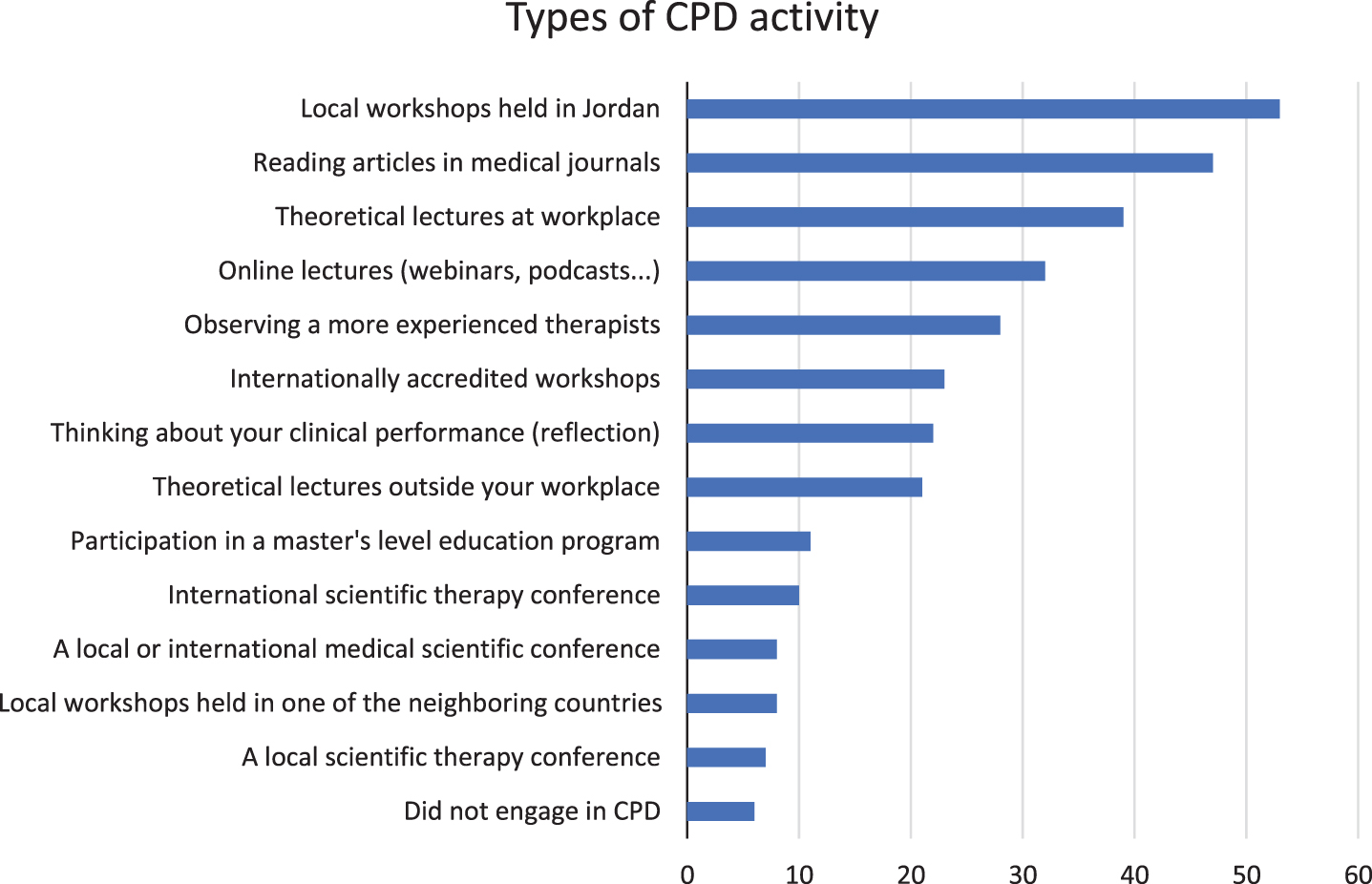
Types of CPD activity participation during the past 12 months.
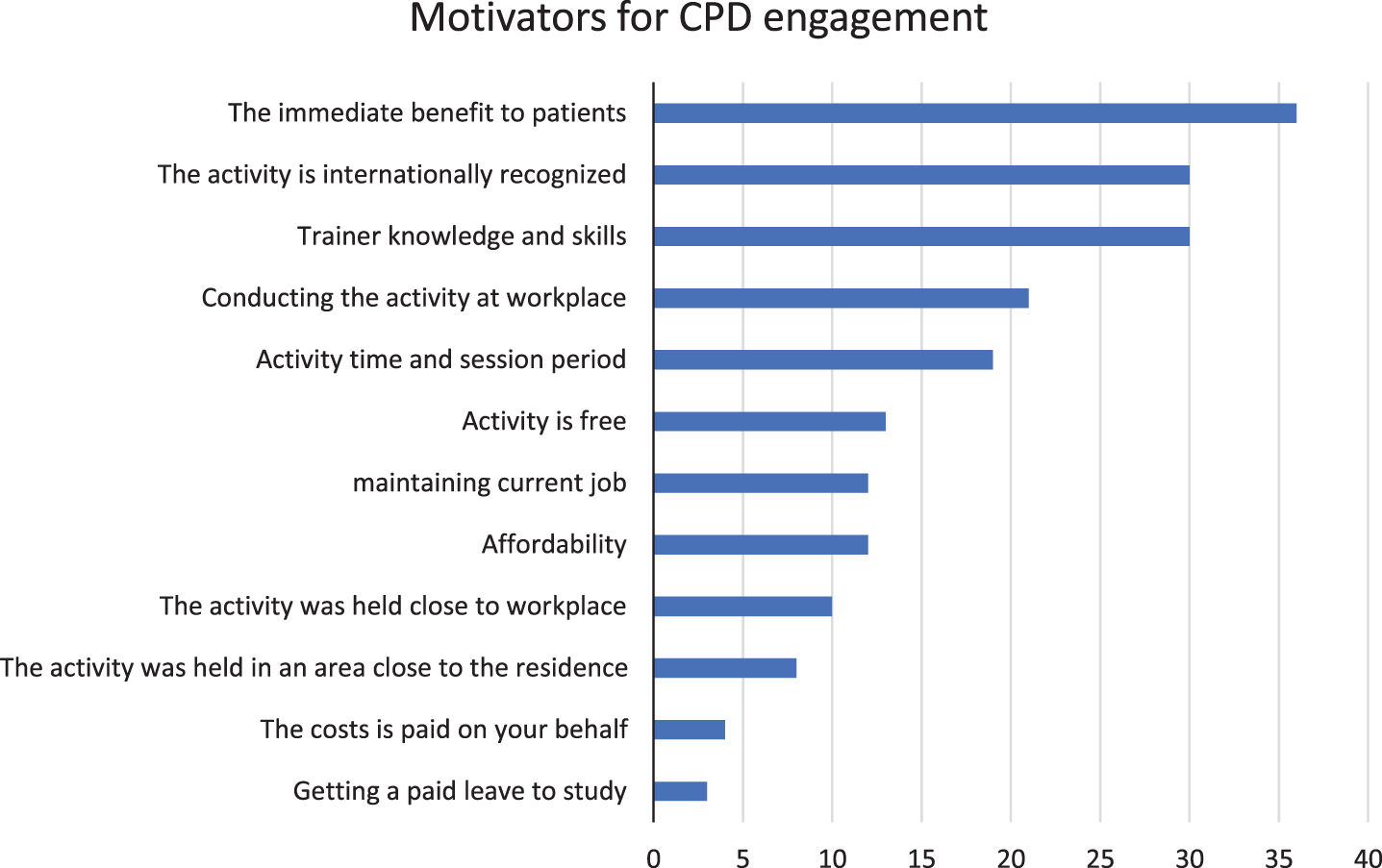
Motivators for CPD engagement.
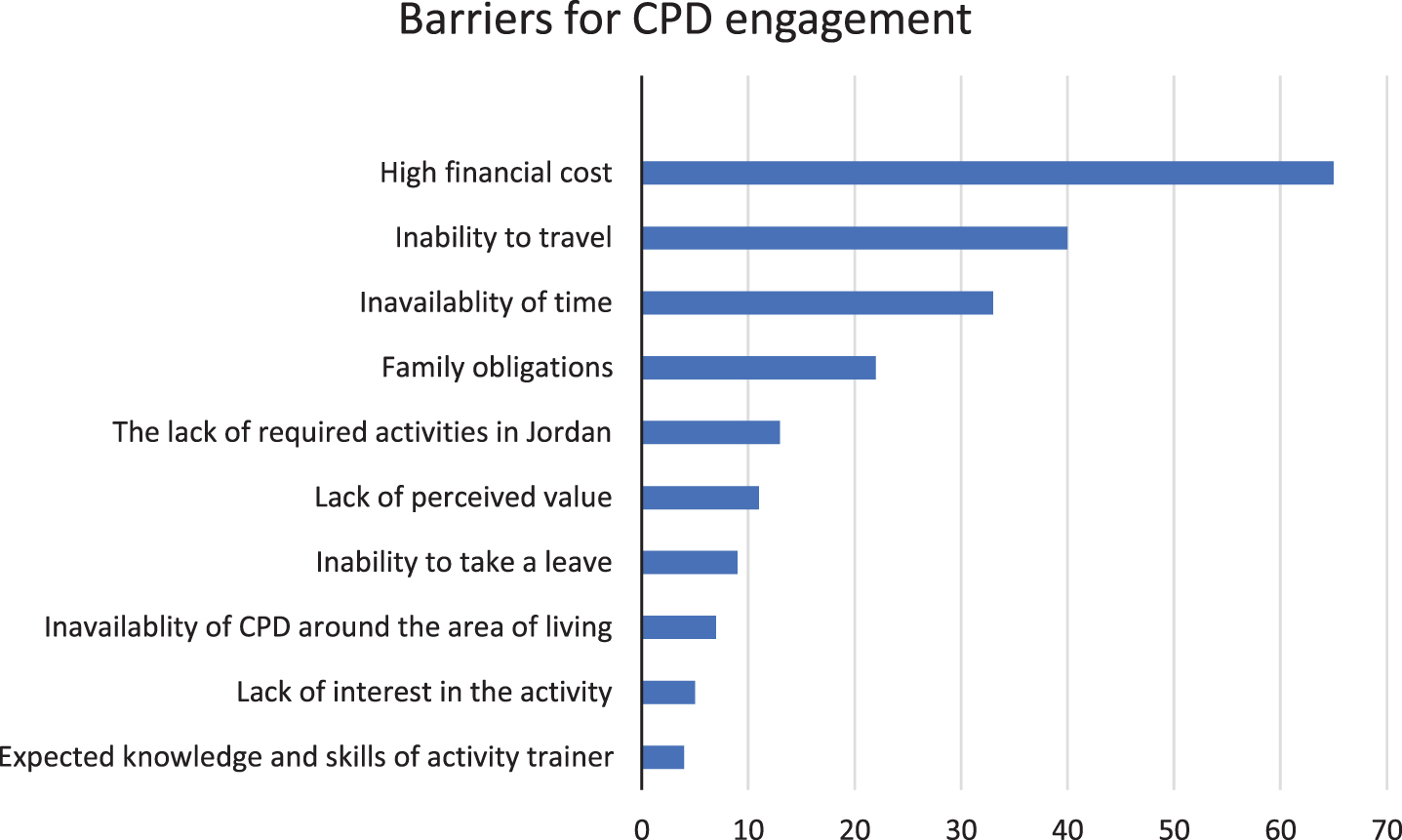
Barriers for CPD engagement.
Almost two-thirds of participants (N = 56) delivered CPD to other physiotherapists during the 12 months prior to data collection. The most common forms of CPD they provided were supervision of students (N = 31, 55%), lecturing at workplace (N = 27, 48%), and facilitating workshops in Jordan (N = 15, 27%). The most frequently reported motivators for delivering CPD were the desire to help colleagues (N = 33, 38%) and being part of academic duties (N = 24, 28%). Barriers to deliver CPD were time limitations (N = 29, 34%), the limited logistic support (N = 28, 33%) and the lack of appropriate experience (N = 28, 33%).
Fifteen out of the 86 participants agreed that the Jordanian Physiotherapy Society had a positive role in supporting its members to meet the requirements of CPD. Eighty-two participants (33%) indicated that they spent at least 5% of their annual income on CPD activities, and 58 participants (86%) pointed out to the lack of financial support from their employer toward participating in CPD. Seven participant suggested that there was excellent financial support from their employers toward participating in CPD. Those participants spent less than 5% of their annual income on CPD activities. Forty participants (47%) indicated that their employers did not enable them to take a study leave; but 32 of those participants suggested that taking a study leave would be possible if it was unpaid. Most participants indicated that the decision of which CPD activities to engaged with was based on personal desires and aspirations (N = 64, 74%) or the availability of CPD activity (N = 11, 13%). Only six participants pointed out that it was a mutual decision with their employers. Regarding the level of workplace support toward applying what has been learned in the CPD activities, participants’ responses were: None (N = 35, 41%); Weak (N = 9, 11%); Good (N = 21, 26%); and Excellent (N = 20, 23%).
Spearman rank correlation demonstrated a significant weak correlation between the role of the Jordanian Society of Physiotherapy in helping members to meet the requirements of CPD and: a) the familiarity with the health profession licensing act for 2018 (r s = .272, P < .05, two tailed); b) the familiarity with the CPD activities mentioned in the 2019 guidelines for continuing professional development (r s = .258, P < .05, two tailed); and c) lack of engagement in any CPD (r s =-.218, P < .05, two tailed). There was a significant moderate correlation between the level financial support received from the employer and applying what has been learned in workplace (r s = .478, P < .01, two tailed). There was a significant moderate negative correlation between the age of participants and observing a more experienced therapist as form of CPD (r s =-.364, P < .01, two tailed). Those who worked in private practice were more likely to participate in a local or international scientific conference (r s = .369, P < .001, two tailed). There was a significant correlation between higher spending on CPD and participation in internationally accredited workshops (r s = .369, P < .001, two tailed). Finally, no significant correlation was found between the nature of work (i.e., full or part time) and the lack of participating in CPD activities (r s = .029, P = .788, two tailed).
The term ‘Continuing Professional Development’ was used in this study to reflect its widespread use in healthcare literature. Arguably, it puts the healthcare practitioners at the heart of learning process [16, 23]. While this term has been criticised for minimizing the importance of the context of learning [24], this study has attempted to explore the activities, attitudes, and workplace environment pertained to Jordanian physiotherapists’ professional development. Thus, it captured the micro- as well as macro-learning context. Compared to Sadler-Smith, et al.’s [25] social, economic, and political drivers for CPD, participants were less driven by the regulatory policies, and more driven by social and then economic aspirations. This might be attributed to their limited knowledge of laws and regulations enacted just recently.
Compared to Jordanian physicians, who engaged primarily with scientific conferences [22], attending these conferences was the least ranked activity for physiotherapists. Reasons could be attributed to the limited number of physiotherapy-specific conferences in Jordan or neighbouring countries. However, the limited availability of funds can be considered as the main reason. This is justified considering the cited barriers and the fact that most of participants in conferences were working in private practice. Engagement in longer forms of continuing professional development such as Masters level education appears to be restricted by similar factors.
The most common activity the participants engaged with was workshops that are practical-oriented. This concurs with the finding that most participants preferred to engage with activities that focus on practical skills over the activities that only provide theoretical knowledge. This might be attributed to the overwhelming feeling that there is unsatisfactory practical training during entry level education [26]. It is anticipated that participants were looking for specialist CPD activities given that most of them labelled themselves as general physiotherapists. It was not the aim of the study to explore the focus or nature of the practical training, but it has been demonstrated that CPD that focus on practical training is effective in transforming practice [14, 18].
The second most activity that participants engaged with was reading of articles published in medical journals. This is consistent with recent evidence that 88% of Jordanian physiotherapists have a positive attitude towards evidence-based practice; and that 47% of them read clinically relevant journal articles regularly [27]. This percentage remains however far less than the number of physicians who are reading journal articles regularly or involved in research activity [22]. The level of experience did not seem to influence reading journal article since it was practiced by at least 55.6% of participants across the three levels of experience.
Evidently, reading journal articles was practiced the least by physiotherapists working in governmental hospitals (37%). In this workplace environment, physiotherapists are working under direct supervision of physicians specialised in rehabilitation medicine (i.e., they lack autonomous practice). Any change of treatment protocols, even when supported by evidence, holds them accountable. The inability to translate what is learned into practice contradict the rationale of mandating CPD. This workplace environment, which can be described as environment of conflict and divergence, has been found to limit professional learning [28]. In this environment, CPD is less likely to produce its intended outcomes. In particular, those related to promoting efficient and effective patient care.
Limitations
At the time of the study, 123 physiotherapists were active member with the Jordanian Physiotherapy Society [29]. There were 2225 physiotherapists licenced to practice in Jordan (Ministry of Health, formal correspondence, 2020). Prior to the new 2018 act, the licence to practice had been an ongoing entitlement from the time of registration. The number of those who are practicing in Jordan is unknown, with many Jordanian physiotherapists practicing in other countries. Therefore, the response rate could not be calculated, and the ability to generalise findings is limited. Recruitment through Jordanian Physiotherapy Society as well as social media produced a convenience sample. Considering the absence of knowledge about the target population, one can argue that the data provided in the study are the best data available.
Conclusion
The aim of the study was to draw the landscape of CPD of Jordanian physiotherapists to inform future policymaking and CPD planning. The findings point out to the preference of practice-oriented activities. The reasons behind this need to be further explored. Providing funds and paid leave could yield more engagement with CPD. Moreover, there is a need to re-examine the relationship between engagement in CPD and the scope of practice of Jordanian physiotherapists. The main interest when selecting a CPD activity was its immediate impact on patient care. The extent of this impact could be further explored.
Footnotes
Acknowledgments
We would like to acknowledge our colleagues for their valuable contribution to pilot and data collection stages of the research.
This research did not receive any specific grant from funding agencies in the public, commercial, or not-for-profit sectors.
Author contributions
Mohammad Madi: Conceptualization, Methodology, Investigation, Formal analysis, Data curation, and Writing. Hayat Hamzeh: Conceptualization, Methodology, Validation, Writing- Original draft preparation.
Conflict of interest
The authors declare no conflict of interest. The views expressed in the article are our own and 0not the institutions.