



Abstract
INTRODUCTION:
The Covid-19 pandemic provided a research opportunity to explore online group exercise programmes in larger numbers while restrictions on group gatherings were in place. An online survey was conducted with Irish Physiotherapists to ascertain their views on online group exercise programmes and the methods they employed to conduct their online classes in order to guide Physiotherapists with future care delivery.
METHODS:
A mixed-methods design was employed using a cross-sectional national online survey of Physiotherapists in Ireland. The survey collected both qualitative and quantitative data. Descriptive statistics were used to summarise the ordinal and continuous data and free-text responses were analysed using conventional content analysis.
RESULTS:
In total, 81 Physiotherapists completed the surveys. The majority of Physiotherapists (62%) feel a blended or hybrid model is the best option for the future. Convenience and decreased travel were cited as the main advantages of online classes. Physiotherapists cited in-person classes as being of higher teaching quality with improved safety and social interaction. Physiotherapists indicated that very little staff or technological resources were needed for their online classes and serious adverse events during the classes were extremely infrequent.
CONCLUSION:
Online group exercise programmes were well received by Physiotherapists, although the majority of those questioned believe a mixture of both online and in person exercise classes should be offered going forward.
Introduction
Group-based treatment in the form of exercise classes has long been an important and useful tool of Physiotherapists in a wide variety of settings [1–5]. However, physical barriers to attendance at Physiotherapy-led group exercise programmes are recognised across many settings. These include; individuals living alone [6], increased travelling distance [6, 7] and transportation difficulties [8]. Rural inhabitants have been shown to attend significantly fewer cardiac rehabilitation sessions (76.2% of sessions) than urban inhabitants (83.6% of sessions) [9]. Prior to the Covid-19 pandemic, investigations of alternative, home-based modes of delivery of group-based interventions had already commenced to increase attendance rates in cardiac and pulmonary rehabilitation programmes [10, 11] and falls prevention programmes [12]. Then along came the Covid-19 pandemic and with it, the rapid move to telehealth services, with supervised exercise groups delivered via telehealth becoming a commonly employed option [13, 14].
The Covid-19 pandemic provided a research opportunity to explore online group exercise programmes in larger numbers and assess if they are a useful addition to current practice or not. Emerging data suggests that online group exercise programmes produce outcomes that are comparable to outpatient group programmes in pulmonary rehabilitation [15], cardiac rehabilitation [16], musculoskeletal pain rehabilitation [17] and stroke rehabilitation [13].
However, there is very little evidence regarding Physiotherapists’ perspectives on online group exercise programmes. It is unknown also if attendance rates are better or worse with conflicting results for home versus centre based pulmonary rehabilitation for example [18]. It is difficult to know at this point, whether these endeavours were simply as a useful stopgap during an unprecedented time of global uncertainty or whether they should continue as a desired mode of service delivery. Bennell et al 2021 [19] investigated Physiotherapists’ experience with telehealth consultations and included results from 35 Physiotherapists (17% of total respondents) who had provided group classes. Physiotherapists in this study rated the efficacy of and satisfaction with their online group exercise programmes as 7.7 and 7.5 out of 10 on average. In an Irish survey of 205 Physiotherapists’ experience with telehealth, only 9 Physiotherapists questioned (4% of total respondents), reported conducting online group exercise classes [20]. In this study, 60% of Physiotherapists questioned (n = 122) felt telehealth was a sustainable, alternative mode of health care delivery although results pertaining to online group exercise alone cannot be successfully extrapolated. In a survey regarding healthcare professional perspectives on delivering pulmonary rehabilitation via telehealth, fears were expressed about losing the in-person part of the job and hesitancy about supporting patient technology use and troubleshooting [21]. Overall, the perspectives and opinions of the service providers towards these online group exercise classes remain unclear.
The rapid transition to telehealth during the Covid-19 pandemic meant for many, that evidenced based practice for the implementation of these classes was lacking, leading to unknown territories for the Physiotherapists involved. Irish guidelines have been produced to help Physiotherapists set up and run their own virtual pulmonary rehabilitation guidelines, [22] including an assessment toolkit, safe exercising checklist and disclaimers, but there is little guidance in the literature base regarding implementation of online classes.
In this research, we aimed to conduct an online survey with Irish Physiotherapists
regarding online group exercise programmes. The objectives of this surveys were: To ascertain
Physiotherapist perspectives on conducting online group exercise
programmes To ascertain how
Physiotherapists carried out their online group exercise programmes and which
methodologies, if any, were deemed more successful.
Method
Design
A mixed-methods design was employed using an originally designed, cross-sectional, national, online survey of Physiotherapists in Ireland. The survey was designed in consultation with Physiotherapists and researchers and was based on previous research in this field [19, 20, 23]. The survey was modified based on feedback from local pilot testing. The survey was designed to collect both qualitative and quantitative data. Integration for this mixed methods approach occurred through merging of these two data sets after separate analysis of the numerical data and qualitative analysis of the textual data [24]. The identity of the respondents remained anonymous throughout. Ethical approval for this study was granted by the Sligo University Hospital Ethics Committee.
Recruitment
HSE Physiotherapists were recruited through emails via managers and members of the Irish Society of Chartered Physiotherapists were recruited through an email via their organisation. Physiotherapists were also recruited through a social media campaign via Twitter. To be eligible to participate in this survey, Physiotherapists had to be CORU registered Physiotherapists based in Ireland who had conducted online group exercise programmes in the past.
The survey
The survey was conducted online using the Qualtrics software. The link to the survey remained live between May and July 2022. Information sheets and consent forms were required to be first read and agreed to prior to commencement of the survey. Questions mostly required tick box answers and 5-point likert scale responses with “further comment” options after each question. Physiotherapists were also given the chance to comment in a free text box as to why they selected their specific preferences for conducting exercise classes in the future. After they selected what they felt were the relevant advantages and disadvantages of online classes from a pre-defined list, they were also given a “free text” response opportunity to add any advantages or disadvantages that they had noted that were not on the list.
Data analysis
Reports were generated using the Qualtrics software to analyse the quantitative data. Descriptive statistics were used to summarise the ordinal and continuous data. All free-text responses were analysed using conventional content analysis. Codes were derived from exact words that occurred in the text that captured key thoughts and concepts [25]. This type of design was employed due to the fact that research in this field is limited and so preconceived categories would not be appropriate. Rather, categories were allowed to flow from the data itself [25]. All free text responses were entered verbatim into excel spreadsheets. Initially the responses were simply read to immerse the researcher in the data. Then, on second reading, similar ideas were coded. Categories were then formed by grouping together related codes. The content of these categories was then analysed, interpreted and described to identify themes.
Results
In total, 81 Physiotherapists completed the survey. It is unknown how many CORU registered Physiotherapists have actually conducted online group exercise programmes and so the sample size or response rate is unknown.
Physiotherapists’ characteristics
Physiotherapists Characteristics can be seen in Table 1. Multiple answers were allowed for most questions. The majority of respondents worked in private practice (41%, n = 33), acute hospitals (27%, n = 22) or primary care (20%, n = 16). Most Physiotherapists had never completed online group exercise programmes prior to the pandemic (91%, n = 74). Pilates classes were the most commonly provided online class (35% n = 28). Other classes conducted included general exercise (28% n = 23), pulmonary rehabilitation (25% n = 20), strength and conditioning (21% n = 17), ante-natal classes (16% n = 13) and balance or falls classes (12% n = 10).
Physiotherapists’ Characteristics (n = 81)
Physiotherapists’ Characteristics (n = 81)
Table 2 demonstrates the methodology the Physiotherapists adopted when conducting their online exercise classes. The majority of respondents used Zoom as their video conferencing software (67% n = 54) with Webex being the second most common platform used by 22% (n = 18) of respondents. It was most commonly reported that a single Physiotherapist conducted these online classes with no support in 83% (n = 67) of the cases. Participant numbers ranged from less than 6 participants per class (38%, n = 31) to more than 8 participants per class (23%, n = 19). Most Physiotherapists used their computer screens (64% n = 52) when conducting the classes. Some opted for a medium sized screen (26% n = 21) or a large screen or projected image to the wall (14% n = 11). A large percentage of Physiotherapists responded that they could not clearly see all of their participants during the classes (73% n = 59). To overcome this issue, most Physiotherapists gave regular verbal prompts to participants during the online classes about posture and technique either generally in the group (62% n = 50) or specifically to individuals (51% n = 41) or regularly asked participants to adjust their camera angles (56% n = 45). In order to instruct the classes, Physiotherapists used their phone or laptop cameras (79% n = 64) and microphones (61% n = 49) in the majority of cases. Only 27% (n = 22) chose a headset with a microphone. The average duration of the online exercise classes was approximately 50 minutes.
Details regarding conducting of the classes (n = 81)
Details regarding conducting of the classes (n = 81)
Physiotherapists commonly reported completing a pre-assessment with patients prior to attending the online classes. Forty-seven percent (n = 38) of Physiotherapists reported completing these assessments in-person at certain stages over the course of the Covid-19 Pandemic, and a nearly equal number of Physiotherapists (49% n = 40) reported completing online or phone assessments. Numbers for post assessment completion were lower with 47% (n = 38) reporting completing no post assessment at all. Six Physiotherapists (7% of respondents) reported an adverse event occurring in their online classes. Four of these reported incidents involved a patient becoming unwell or near-falling while the two other incidents involved technological mishaps and a patient becoming upset during sensitive discussions.
Physiotherapists’ preference for continuing to provide online group exercise programmes beyond the pandemic can be seen in Fig. 1. Over half of the Physiotherapists questioned (62%, n = 50) favoured a blended model going forward with the minority choosing only online classes as their preference (6% n = 5). The respondents were then given the chance to elaborate on their choices with a free text response. These answers were analysed together with other free text response opportunities provided after subsequent questions related to specified advantages and disadvantages of online exercise classes. Eighty-eight answers underwent conventional content analysis leading to the formation of four themes. Appendix 1 shows the breakdown of these themes into categories and codes.
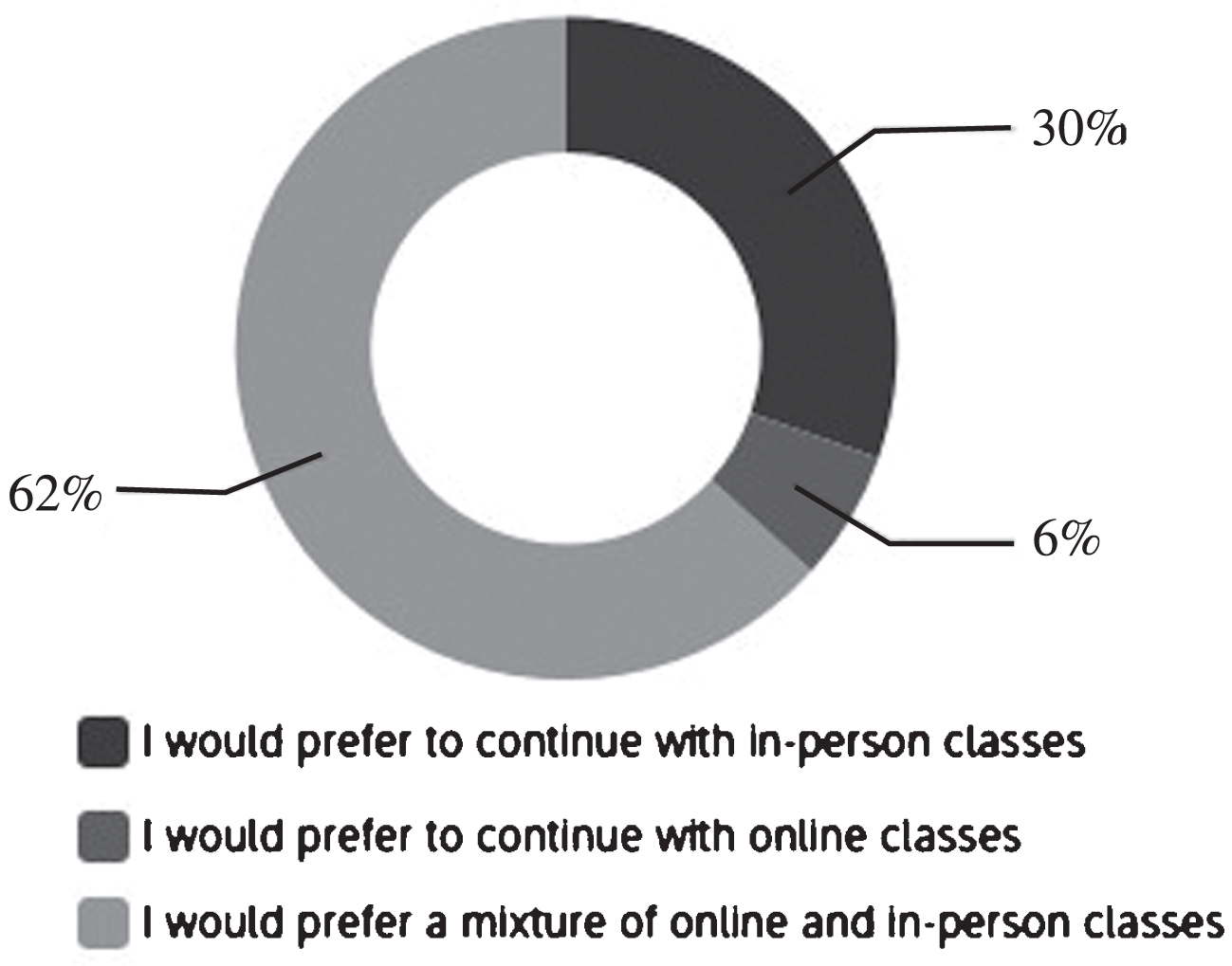
Physiotherapists’ preference for continuing to conduct group exercise classes into the future.
The theme with the greatest number of mentions was the idea that giving patients the option to attend either class is the best way forward. There were 47 mentions of this idea across three codes, with the largest code relating to the concept of different classes benefitting different types of patients (n = 27). One Physiotherapist commented; “It seems reasonable that exercise delivery will be hybrid to meet the client’s needs”, while another linked this choice with potential improved attendance “As there are benefits to both and I think it would improve compliance to have the option”. Many Physiotherapists pointed out the client groups that suit in-person classes; “I feel in person classes are helpful for beginners or individuals with very specific conditions/abilities/challenges,” and those that suit online; “I find online excellent for the right cohort i.e. people with experience of using technology.”
Theme 2 conveyed the belief that some Physiotherapists held that they were able to provide a better-quality service with in-person classes. Codes related to this theme included the improved quality of teaching and feedback available with in-person classes (n = 16), improved atmosphere and enjoyment with in-person classes (n = 11) and the unreliability of wifi and technology with online classes (n = 6). One Physiotherapist commented “Tactile correction and facilitation is key and more individualized for rehabilitating”. Another Physiotherapist reported “As a physio clinician I prefer to objectively see/ feel and hear my patients”. Some Physiotherapists commented on how in-person classes were more meaningful and personable and had better “class banter”. Physiotherapists made some commentary in relation to being unable to successfully run an online class and also be expected to fix any technological issues that arose at the same time; “single-handedly trying to fix IT glitches and run classes and internet awful- no WIFI etc...”
Theme 3 was formed from the amalgamation of coded mentions of the convenience and accessibility of online exercise classes. Codes in this theme all related to the category of advantages of online classes and included reduced travel and transport (n = 17), flexibility and convenience for patients (n = 10) and the ability for Physiotherapists to reach a wider audience (n = 7). Many Physiotherapists recognised that lack of transport and increased travel time and parking costs can deter patients from attending in-person classes and that online classes solve this issue. This was true in both rural locations and city centre locations with Physiotherapists commenting; “Less travel for clients who live in rural settings” and “Online is very good for patients, I work in an inner-city Dublin hospital where parking is impossible”. Many Physiotherapists also commented on the convenience of online classes and how they allow patients to work or look after their children whilst also attending their classes. One Physiotherapist working in pelvic health commented; “Postnatal women tend to love the classes from home (new born baby\dots.)”. Another Physiotherapist felt very strongly about this theme; “The convenience of online cannot be overstated”.
A smaller theme to emerge from the analysis was the idea that there is improved social interaction with in-person classes. Codes included in this theme all related to the category of advantages of in-person classes and consisted of; improved social gains (n = 8), improved rapport (n = 3) and improved relationship building (n = 2). One Physiotherapist recognised the importance of this theme for those with chronic conditions; “In- person classes are also a nice social outlet for those suffering from chronic disease.” This increased social interaction related to both “peer support” as well as social interaction between Physiotherapist and class participant; “In person classes are more social and interactive between physio and participants and also among participants.”
The perceived advantages and disadvantages of online classes were then quantitatively assessed by asking the respondents to select options they agreed with from a pre-defined list. Respondents were allowed to choose multiple answers. In line with theme 3 above, reduced travel, improved access for those with no transport and convenience were rated as the top advantages with 94% (n = 76), 88% (n = 71) and 80% (n = 65) of respondents selecting these options. Also, the lower risk of Covid-19 transmission was a commonly selected advantage (79% n = 64). Less commonly selected advantages were lower costs, less time consuming and increased attendance at 36% (n = 29), 36% (n = 29) and 31% (n = 25) respectively. Full results for this question can be seen in Table 3.
Physiotherapists’ perceived advantages of online group exercise programmes
Physiotherapists’ perceived advantages of online group exercise programmes
The disadvantages of online classes selected by the Physiotherapists echoed themes 2 and 4 above and can be seen in full in Table 4. Less interaction and less hands-on correction were highly selected disadvantages of online classes at 83% (n = 67) and 73% (n = 59) respectively. A divergent finding from the qualitative data above was; a lack of discretion of one-to-one correction, which was considered to be a disadvantage by 73% (n = 59) of Physiotherapists, something which did not come up at all in the free-text responses. “Less psychosocial benefits” during online classes was selected as a disadvantage by 64% (n = 52) of Physiotherapists. Respondents also recognised some disadvantages relating to the conducting of classes including poor visibility of patients on screen (61%, n = 49) less variability of exercises (44% n = 36), less ability to physiologically monitor patients (43%, n = 35) and safety concerns (38%, n = 31)
Physiotherapists’ perceived disadvantages of online group exercise programmes
This survey is the first of its kind, known to us, to specifically question Physiotherapists regarding a variety of group online exercise programmes. The survey was undertaken to better understand Physiotherapists’ opinions with regard to online exercising and to help guide Physiotherapists with future care delivery and potentially give them a successful formula to follow for conducting online classes. The results highlighted that the majority of Physiotherapists (61.7%) feel a blended or hybrid model is the best option for the future. Decreased travel and convenience were cited as the main benefits of online classes by Physiotherapists. Decreased social interaction and decreased ability for the instructor to correct posture and technique were cited as the main disadvantages of online exercise classes. These advantages and disadvantages reported are similar for other studies investigating general telehealth Physiotherapy and allied health consultations [19–21].
The issue of who is suitable for online classes is an area highlighted in the literature [26] and triaging patients for their suitability for telehealth has been suggested [27]. Based on these results, while in-person classes are preferable to many, online group exercise programmes should continue to be offered to those who need or prefer this option. Our respondents have helped to highlight certain groups of people that may be more suited to online classes going forward, including; those who are more confident in the use of technology, those with work or childcare commitments, those who have already attended in-person classes and wish to keep up their exercises through online avenues and those who have no travel or transport options to attend in-person classes. By continuing to provide online exercise classes, Physiotherapists can widen the net and capture more potential participants, break down barriers and facilitate those in need. In-person classes may be more suited to beginner exercisers, those with less technological confidence, those with higher requirements for posture or technique correction, those at higher risk of falls or those with specific needs for increased social interaction. Therefore, in a similar finding to Rawstorn et al (2016), in their systematic literature review on telehealth cardiac rehabilitation, online exercise group programmes should perhaps be considered as a complement to, rather than a replacement of, in-person group programmes [28]. Future researchers should perhaps not focus on trying to ascertain the superiority of one model of delivery over another, but rather should set out to prove that at least similar outcomes can be obtained using either model and then continue to offer both models clinically, as both are needed by different groups of people at different stages of their lives.
In terms of how Physiotherapists conducted their classes, there are lessons to be learned from our survey also. In the majority of cases of our respondents, physiotherapists carried out the class on their own without any technological support person or assistant on screen (83%), zoom was the most commonly used platform (67%) and the Physiotherapists used only their computer screen most of the time (64%). In this way, the classes appeared to be very cost effective with very little resources used. Home-based pulmonary rehabilitation was shown in the literature to be more cost effective than other models of delivery [29]. However, a scoping review investigating the overall cost effectiveness of telehealth stated that telehealth does not routinely reduce the cost of care delivery and pointed out that productivity gains may not directly result in cost savings [30]. This warrants further investigation and should be considered as an important component of online classes by those involved in governance of the provision of these services.
The safety of online exercise classes was also investigated. Six adverse events were reported by respondent Physiotherapists. These were mostly very mild and included patients having technological issues and dropping in and out of classes, patients feeling unwell and needing to rest or patients becoming upset during education sessions as part of the classes when sensitive issues were being discussed. One near fall was reported. Worryingly, 73% of Physiotherapists reported they could not see their patients clearly all the time during the classes. This does raise safety concerns and should be carefully considered by Physiotherapists engaging those at risk of falls in future online exercise classes. Ramage et al (2021), have highlighted some measures to improve safety for interventions supervised via telehealth involving standing positions for those post stroke and therefore at higher risk of falls [13]. These include in-person exercise prescription and care-giver assistance. These and other measures were often taken by the Physiotherapists questioned in our survey also, in an attempt to enhance safety. Physiotherapist respondents discussed the use of a second person at home to help adjust the camera, teaching participants the exercises at pre-assessment and leaving the channels of communication open for participants to contact the Physiotherapists separately if they were having any issues. These safety measures may need to be considered by Physiotherapists conducting online exercise programmes, if limited visibility of the patient is to be a safety issue.
Conclusion
This study found that the majority of Physiotherapists questioned indicated that a blended model of exercise class delivery would be the preferred option going forward. Physiotherapists indicated that very little staff or technological resources were needed for the roll out of their online classes and serious adverse events during the classes were extremely infrequent. Safety issues and possible strategies to improve safety are discussed. Convenience was reported as the main advantage of online classes and reduced social interaction and reduced quality of instruction were considered the main disadvantages by Physiotherapists. Online group exercise classes should be considered as a useful addition to services to increase accessibility for a wider group of patients.
Footnotes
Acknowledgments
This research has been undertaken as part of a funded PhD programme thanks to ATU Sligo’s Masters Scholarship scheme.
Conflict of interest
The authors have no conflict of interest to report.
Appendix 1:
Codes, Themes and Categories that emerged from conventional content analysis of 88 free text responses across various opportunities for commentary during the Physiotherapists’ survey. Themes are presented in order of largest to smallest representation