



Abstract
Organizations support leadership development training programs to continuously improve the level of leadership competence and the supply of suitable applicants for leadership roles. One of the skills that entrepreneurs should cultivate to become “leaders” is leadership competency. In entrepreneurship, leadership has a significant role. Therefore, the purpose of this study is to explore the role of leadership development programs that include personal development, self-assessment, team management, strategic leadership, skilled knowledge, and relationship development, to know the way they influence entrepreneurial activities. To test the hypothesis under study, this research applies the Structural Equation Modelling (SEM) approach to the data being gathered from 365 employees and managers of entrepreneurial business firms in India. The obtained results show that personal development, skilled knowledge, and relationship development have a beneficial impact on entrepreneurial activities. In contrast, self-assessment, team management, and strategic leadership are found to have no beneficial impact on entrepreneurial activities. The combination of the ideas of leadership and entrepreneurship is suggested in this study, filling the gap in the previously provided cross-sectional data of the literature.
Keywords
Introduction
Leadership allows the use of interpersonal skills of a person or a group of persons in a situation that is oriented towards achieving a specific objective or goal through communication [1]. It is the act of encouraging and assisting others to work arduously towards reaching their goals. By using his or her leadership skills, the leader seeks to change the way an individual or a group of people behave around him/ her to accomplish the shared objectives [2,3]. Leadership places a strong emphasis on transformation and transformational leadership results from it. Any form of company can succeed with the right kind of leadership. Every component of the managerial function including motivation, communication, and direction depends on effective leadership [4]. Successful leadership assures success for the organization, whereas poor leadership is the main cause of subpar human performance in any organization. In modern entrepreneurial activities, the focus has been placed on developing leadership through training, development, and the creation of supportive work environments [5]. The process of building entrepreneurs’ leadership skills allows the individuals to acquire the traits and mindsets, which can enable them to anticipate change and implement it proactively, rather than reactively [6].
Entrepreneurship is one of the most vital factors in the advancement of a country’s economy [7]. By making business decisions, the entrepreneur serves as the head for triggering any economic activity. A risk-taker, who also oversees and manages business operations, is an entrepreneur [8]. To promote economic development and growth, entrepreneurs are thought of as the leaders in business. An entrepreneur is someone, who possesses the drive, passion, and initiative to start their own company or business and constantly strive for success [9]. Profit is not always the driving force behind an entrepreneur, although it is often used as a yardstick for accomplishment [10]. Economic progress is greatly influenced by entrepreneurship. Economic development is primarily a process of upward movement in which a nation’s actual per capita income rises over time. In the development of a nation, entrepreneurship is vital. It is one of the most central factors for achieving economic growth [11]. The people in the developing and the underdeveloped nations are now aware of the significance of entrepreneurship on economic growth, due to the critical and substantial role played by the entrepreneurs in the economic growth of developed economies.
In entrepreneurship, leadership has a significant role. An entrepreneur is someone, who starts a new firm, taking on most of the risks and reaping the majority of the gains [12]. An entrepreneur is frequently viewed as an innovator, a provider of fresh concepts, products, services, ventures, or methods. Any economy relies heavily on entrepreneurship skills [13]. Entrepreneurship that succeeds in the risks, which are encountered in the beginning, is rewarded with earnings, recognition, and the chances for ongoing expansion. In contrast, losses and disappearances from the markets fail to deal with the risks [14]. Entrepreneurial leaders are people, who act on and develop possibilities that create great value for their businesses, their stakeholders, and society through an awareness of themselves and the circumstances in which they work. The urge of entrepreneurial leaders to think about how to simultaneously create social, environmental, and economic opportunities drives them toward success [15]. Additionally, they are not deterred by the scarcity of resources or the high degrees of uncertainty. Instead, they approach these situations by acting and experimenting with long-standing issues with fresh approaches [16]. The ability of team entrepreneurship to integrate more resources and to share knowledge, information, and complementary talents among team members is seen as a benefit [17]. This enables entrepreneurial firms to successfully adjust to the extremely unstable entrepreneurial environment.
By offering the theoretical foundations (Skills Approach Leadership Theory) of entrepreneurial leadership together with a comprehensive method for cultivating entrepreneurial leadership skills. Additionally, it discusses the evolution of entrepreneurial abilities within the framework of university programs in entrepreneurship before putting up a model for the development of entrepreneurial leadership that is predicated on a dynamic understanding of entrepreneurial learning. According to the suggested model, developing entrepreneurial leadership is a process that involves social interaction, experience, observation, and reflection. This process serves as a suitable basis for research, performance, and imparting knowledge related to entrepreneurial leadership.
Work contribution
Entrepreneurship businesses are essential for the growth of the market. The abilities required to start new enterprises are often lacking among company entrepreneurs. Effective guidance to entrepreneurs ensures success for an enterprise. The business leader’s vision and entrepreneurial success depend on leadership abilities. Hence, proper leadership is a crucial component for attaining entrepreneurship. Business leaders effectively implement entrepreneurial ideas for this reason. Additionally, the highest levels of any organization’s leadership must be devoted to raising the quality of any enterprise. Unfortunately, the inability of these organizations’ executives to effectively manage the entrepreneurial business in the right direction has limited their ability to grow. Therefore, the development approach hypothesis was used in the study to determine the necessary leadership capabilities that an enterprise needs to operate.
In previous years, leadership development has been a significant theme and the performance benchmark for organizations. Although the previous literature in academia had focused on the business activities of entrepreneurs, there is still a gap in the literature about the leadership development programs’ impact on entrepreneurial activities.
Research objective
This learning intends to comprehensively examine the role of leadership development programs and their impact on entrepreneurial activities.
To understand the effectiveness of the leadership development program in fostering entrepreneurship activities. To emphasize the function of entrepreneurial activity in fostering attitude, knowledge, and abilities, which are necessary for practicing entrepreneurship. To investigate how knowledge and skills affect the entrepreneurs’ actions and decisions in the business.
Numerous studies have intended to investigate how leadership training programs affect entrepreneurial activities.
Research question
The following is the research section:
A review of the literature is given in Section 2, along with a few current articles. The specifics of the study’s goals, the formulation of a hypothesis, and the research methodology are described in Section 3. Section 4 includes the analysis and a result assessment Conclusion and implications are provided in Section 5.
Review of literature
This section discusses the past research on the leadership training program for entrepreneur’s activities. Additionally, this section demonstrates various leadership development programs for personal development, self-assessment, team management, strategic leadership, skilled knowledge, and relationship development.
Related work
In 2018, Claudia Felix et al., [18] investigated the impact of cultural leadership characteristics on the levels of opportunities and requirements to achieve entrepreneurship. Utilizing the data from a worldwide free enterprise monitor (in the year 2013) and observations from 34 countries, they performed a multiple regression analysis to test their hypotheses. The results showed that all types of leadership were sure to have a big influence on entrepreneurship. Therefore, charismatic leadership can have a higher impact on entrepreneurial activities, especially in opportunity entrepreneurship.
In 2020, Lisa Prommer et al., [19] examined the leadership development strategies, which can be most effective for future startups. They performed a two-stage, international Delphi survey with 27 estimates among business professionals. With the collected data, they performed the descriptive statistics analysis and the outcome was that a majority of the companies will employ outside assistance and work to improve the collective leadership skills of their workforce. They also showed experiential learning techniques like, action education, job task development, multi-rater assessment, digital experiential learning programmers, and connections, which support sustainable development such as coaching via remote one-on-one meetings.
In 2021, Susana C. Santos et al., [20] explored the impact of culture on the relationship between female membership in entrepreneurial teams, team processes, and team outcomes. They collected data from 64 entrepreneurial teams (N = 234 individuals) with participants from 20 different nations. Through the collected data they performed correlation evaluation and descriptive analytics. The outcome showed that the proportion of female team members and cultural perceptions of female entrepreneurship can affect the efficiency of team processes.
In 2021, Phuong V. Nguyen et al., [21] investigated and found that the success of small and medium-sized enterprises was affected by entrepreneurial leadership, entrepreneurial orientation, and technological innovation capabilities. They carried out a survey and the data were gleaned from 182 medium-sized and small computer technology companies engaged in Ho Chi Minh City, Vietnam. The collected data were evaluated using the trusted PLS-SEM method. The findings demonstrated that entrepreneurial leadership may improve the efficiency of small and medium-sized IT firms via the full exploitation of staff innovation, strategic elasticity, and competitiveness.
In 2022, Mashael Abdulaziz Malibari et al., [22] emphasized the significance of entrepreneurial leadership in encouraging innovative behavior among personnel. They conducted a hierarchical multiple regression analysis using 241 data points, which were collected from full-time employees across the nation using the questionnaire technique. Executives might use the findings to pinpoint the critical duties, which they might perform in encouraging innovation within their firms and fostering an ideal environment and culture for innovation.
In 2022, Ngoc Khuong Mai et al., [23] addressed the direct and indirect effects of various leadership personality qualities on the organization’s learning on corporate innovation. About 638 executives of Vietnamese tourism enterprises were provided with a form as part of an online survey being conducted. Further, they performed a partial least squares-SEM technique on the collected data. The results showed that leadership personality qualities, which include core self-evaluation, narcissism, the need for achievement, and risk propensity, can have a direct or indirect impact on corporate innovation.
In 2022, Bablu Kumar Dhar et al., [24] identified that strategic flexibility plays a mediating function in Bangladesh’s private sector between leadership and strategy execution. Here, the data collection and analysis involved private company senior executives. They performed a literature review using the information that they had acquired. Their findings showed that a variety of their management philosophies had an impact on both the execution of their plans and the strategic adaptability of their managers.
In 2023, Simon Hensellek et al., [25] investigated how entrepreneurial leadership practices can impact the venture’s performance. They carried out a poll and gathered information from 507 entrepreneurial ventures. Additionally, they conducted a moderate mediator analysis using the variables they had received. The results indicated that strategic flexibility plays a key role in serving as a mediator in the link between entrepreneurship and enterprise effectiveness. Also, they demonstrated that high personnel counts per founder do not fully mediate the leadership-performance interaction, but rather mediate at modest to low levels of span of control.
Research gap
A summary of related scientific papers in the past is shown in Table 1. The relevant research studies indicate that a majority of the research is focused on cultural leadership, which influences the levels of possibility and the necessity of enterprises, the possibility of developing entrepreneur leadership, the effect of the entrepreneurial team on the team’s process and outcomes, the effect of entrepreneurship leadership on the success of small and medium-sized enterprises, the value of entrepreneurial leadership in encouraging the staff to adopt creative behavior, personal factors, social guidance, a person’s self-desire to practice social innovation, servant leadership’s moderating function and the strategy adaptability, the enterprise’s success and entrepreneurial leadership. In recent years, research on leadership abilities and entrepreneurial business has been promoted and practically explored in depth. Scholars have done a lot of research on entrepreneurial leadership in business. Through integrating the relevant literature, this paper summarizes the six components of a leadership development program including, personal development, self-assessment, team management, strategic leadership, skilled knowledge, and relationship development to study the impact on entrepreneurial activity.
Review analysis.

Review analysis.
This quantitative study’s theoretical framework was developed using the Skills Approach Leadership Theory. An extensive assessment of the literature that was relevant to this study revealed several insights into leadership, leadership abilities, and entrepreneurship. These insights identified the particular leadership qualities required to impact the success of businesses among Indian entrepreneurs. The results of this study on leadership abilities have inspired business leaders and executives to encourage their implementation and improve the business climate. According to the principle, a leader’s effectiveness is determined by what they can achieve. Because the idea emphasizes what a leader can accomplish rather than who they are, it offers a more comprehensive understanding of leadership and guarantees that everyone, not just a select few, may exercise leadership if they are willing to learn and put in the necessary effort. To be an effective leader, one must possess three key personal skills: technical, human, and intellectual. To accomplish their objectives, different leaders will apply these abilities in different ways. Figure 1 shows the conceptual research framework.
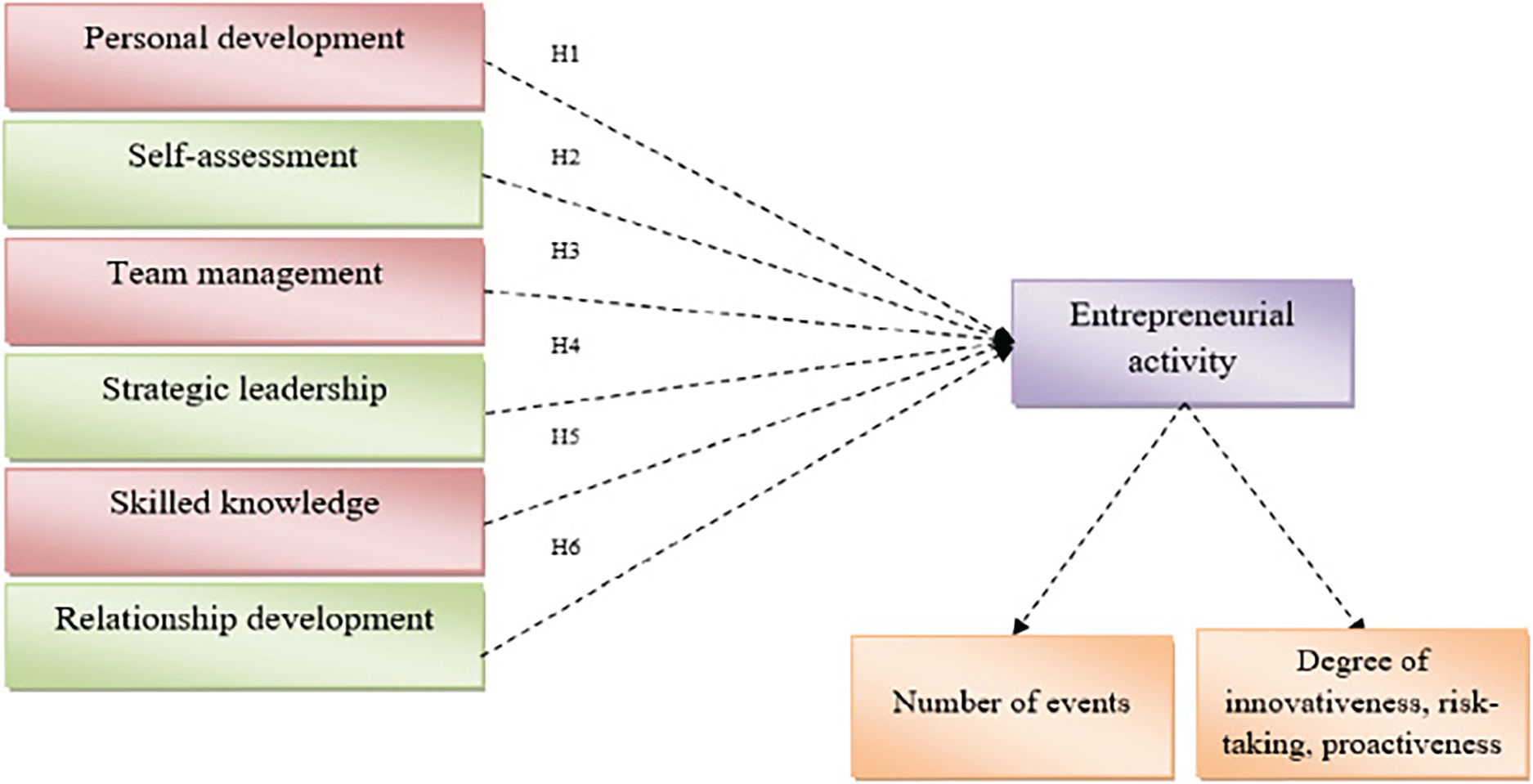
Proposed research framework.
Figure 1 states the elements that make up therole of a leadership development program inthe entrepreneur’s activities.
Personal development and entrepreneurial activity
Focus has been made on creating supportive work environments as well as the training and development of leadership in contemporary entrepreneurial activities. Introspection and improvement-oriented thinking are the key components of personal development. Self-awareness, self-esteem, skill set, and aspirations are all increased through personal development [26]. Entrepreneurship is a self-driven human endeavor, which aims to create value through the expansion or the growth of economic activity and the identification as well as the utilization of new markets, products, and processes. This will likely result in a favorable experience that the entrepreneurial activity will be impacted by personal development [27]. Building entrepreneurs’ leadership abilities helps to develop the qualities and various perspectives to foresee change and to apply it effectively, rather than responsively. Hence, this study supports the following hypotheses:
Self-assessment and entrepreneurial activity
Self-assessment is a strategy in career or business activity that entails conducting a critical study of one’s objectives, preferences, skills, and experiences. Organizations often utilize self-evaluation as a technique for self-assessment. Employee development, teamwork, and the organization’s transformational initiatives are a few of its numerous business-related applications [28]. The aptitude and preparedness to create, plan, and manage a business enterprise, along with all of its uncertainties, is needed to yield profit. The creation of new businesses is the most visible illustration of entrepreneurship [29]. Self-assessment influences entrepreneurial activity by encouraging and assisting others to work arduously toward reaching their goals. Hence, the following hypothesis is provided by this research:
Team management and entrepreneurial activity
By team management, an individual can connect their aspirations with the organization’s corporate objectives and develop into a successful business manager. Good team management is with which the people will unleash their inherent potential and strengthen their competence [30]. Usually, the colleagues anticipate the work to be completed on schedule with high quality and the least amount of waste possible. As there are various ways in which a single person is constrained, significant achievements are only attainable through teamwork. This is because several people with diverse skills join together and efficiently coordinate with one another [31]. The entrepreneurial activities become favorable with good team management. Hence, the following hypothesis is provided by this research:
Strategic leadership and entrepreneurial activity
Strategic leadership helps an organization to become successful through the application of appropriate strategies. The leader has to encourage cooperation among the organization’s staff members. Strategic management is greatly influenced by leadership, which makes it easier for the business personnel to put good strategies into action [32]. The decision-making function of the leadership quality needs crucial attention because it aids in realizing the goal. The smooth operation of an organization is up to the leaders. They must choose what to do, how to accomplish the goals, and who will do it. The leader’s decision-making ability affects every step of the strategic management process [33]. The leader stake on varied responsibilities throughout the process of strategic management, including those of the strategist, analyst, guide, organizer, motivator, developer, decision-maker, collaborator, and evaluator. Hence, the following hypothesis is provided by this research:
Skilled knowledge and entrepreneurial activity
Intangible resources are given more consideration by academicians and researchers in skilled knowledge economies. Many industrialized nations struggle with the lack of natural resources, the quick changes brought on by globalization, and all the unique challenges that are presented to the institutions of government and business entities [34]. Hence, innovative knowledge development through the efforts of researchers is useful for the advancement of society and the economy. The development of a skilled knowledge economy must be viewed as a significant success. Entrepreneurial businesses have to be better prepared to adapt to the very dynamic entrepreneurial environment. Knowledge and abilities are related to business operations, management, and performance [35]. Hence, a more recent focus on resources like innovation, information, learning, workers’ abilities, and experience renders a competitive advantage. Hence, the following hypothesis is provided by this research:
Team management and entrepreneurial activity
Measurement of learning that occurs in a relationship is made possible by the idea of relationship learning. Relationship-level learning assesses how knowledge is shared, how it is applied, and how it is incorporated into a relationship-specific knowledge base [37]. The reliability of the information depends on the level of accuracy of the source and the repeated connection with a moving individual, who is headed towards achieving the shared goals. Customer demands are determined through the interactions across different organizations and this leads to the awareness and the exploitation of chances for globalization. Additionally, the focal firm that has begun to expand into a new overseas market needs to build ties with a wide range of partners. Hence, this study supports the following hypotheses:
Research methodology
The research methodology has been developed after the literature survey. The recurring variables, which have been found during the literature review, have become the focus of the research. A study model has been developed to comprehend the variablesdominance, after identifying relevant direct and indirect relationships between the independent and the dependent variables.
Data collection
Data collection involves the collection of primary and secondary data. To gather primary data from the employees and the managers of the Indian entrepreneurial organizations, a survey questionnaire has been created to ask about the influence of leadership development programs on entrepreneurial activity. The questionnaire has been divided into several sections, each of which has inquiries to gather data that are relevant to the mentioned factors. The corporations’ acceptance and the application of analysis on decision-making have been captured by five questions for each variable, each with a five-point Likert scale. A large number of participants have been contacted later through email and personal contacts, to distribute the final online survey.
Design of questionnaire
Through the survey data, the proposed hypothesis has been tested. The data for the survey is in the form of a questionnaire. The questionnaire has been developed using a Likert scale, ranging from “highly dissatisfied” (1) to “highly satisfied” (5). The scale has allowed the employment of a special grading system, which made it possible to ask the respondents about how much they agreed with various statements being related to a particular issue. This survey has been conducted to investigate the relationships between several independent and dependent variables, about the influence of leadership development programs on entrepreneurial activity.
Sampling technique and sample size
The demographic data must be described in a way, to makes it apparent who is to be included or excluded. Convenience sampling, the unrestricted strata sampling enables a researcher to select the subgroups, by their preferences for filling units within a given stratum. The necessary data from the employees and the managers, who are the respondents of a selected retail industry, has been chosen for the study. About 400 questionnaires were given by the researcher to the respondents. In that, 365 questionnaires have been filled and the remaining have been left unfilled. All the statements have been addressed to the 365 respondents, who have made up the final sample.
In this research work, the required information has been collected from both the male and the female respondents. Table 2 represents the analysis of respondents by demographic characteristics. The study has revealed that 74% and 26% of responders are men and women, respectively. Moreover, 40.3 % of the responders (n = 147) had their age between 40 and 50 years, 32.1 % (n = 117) of the responders had their age between 30 and 40 years, 16.7% (n = 61) of the responders had their age between 18 and 30 years, and the remaining 11% (n = 40) of the responders had their age above 50 years. Furthermore, 55.1% of the responders (n = 201) had less than 2 years of experience, 25.2% (n = 92) of the responders had 2 to 5 years of experience, 17% (n = 62) of the responders had 5 to 10 years of experience and the remaining 10% of the responders had above 10 years of experience.
Analysis of the demographic profile.
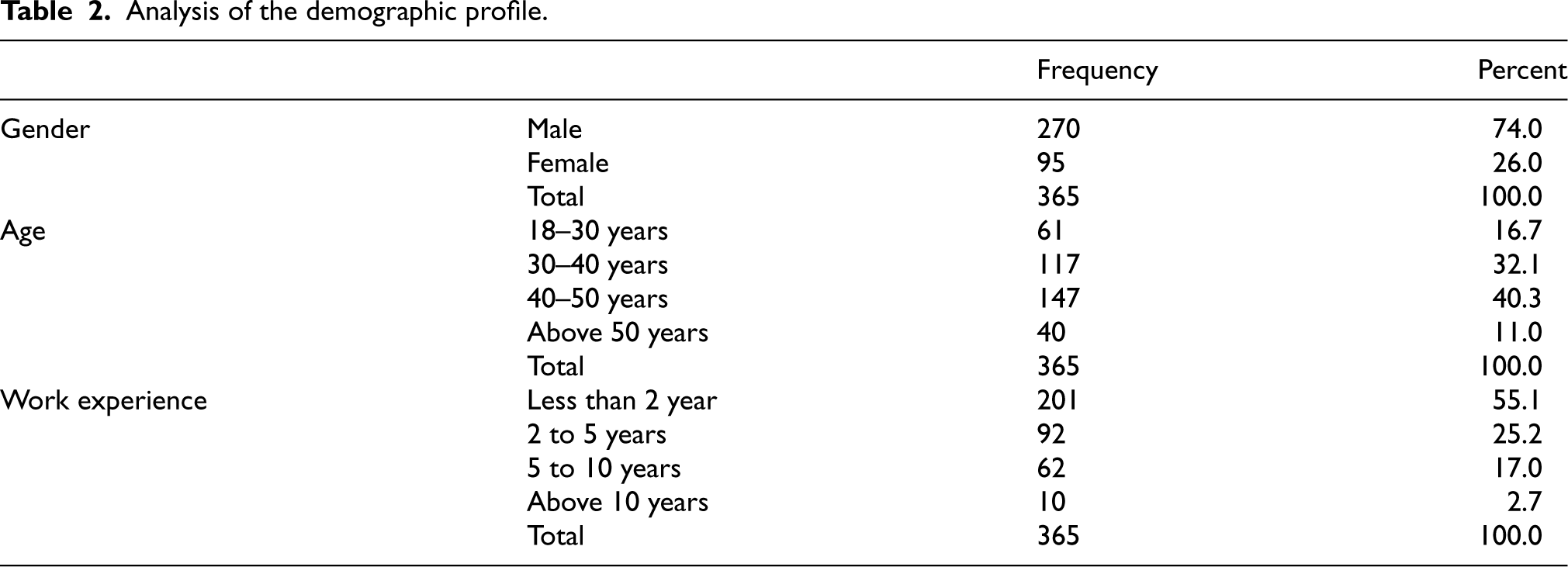
Analysis of the demographic profile.
This study is a survey-based research approach and it is quantitative in design. A quantitative approach has been used since it allows both the objective analysis and the prediction of the relationship between variables in a well-suited manner. The survey has also made it possible to collect a significant amount of data from a sizable population in a very effective way. This study is based on the research questions and the hypothesis, to examine the role of the leadership development program and its impact on entrepreneurial activities.
Tools for data analysis
For analyzing the effects of leadership development programs on entrepreneurial activities and to find the frequency analysis of the received responses, the descriptive statistics, the correlation analysis, and the regression analysis, this work has used statistical tools like SPSS and AMOS. An intuitive user interface and all the methods for statistical analysis, which are needed to support the proposed model, have been provided.
Analysis and interpretation
Using SPSS and AMOS, this study has taken a structural modeling approach. The rationale for structural modeling is ideally suited for both the exploratory as well as the confirmatory research and it also works well for expanding the hypotheses. A two-phase SEM-based methodology has been initiated with a structural model and later, it has been moved on to a measurement model. SEM is the best choice for a multivariate model since it makes the parameter computations simple.
As the first step of this research, the frequency analysis has been done to determine the respondents’ demographic responses (i.e., the responses from employees and managers in entrepreneurial business firms in India). From the frequency analysis, the maximum responses obtained for the constructs/items have been determined using descriptive statistics, to determine the validity and the reliability of the constructs. In the end, the proposed hypothesis has been tested.
Descriptive statistics
In Table 3, the descriptive statistics regarding the parameter responses of the research are presented. Overall, 365 observations have been analyzed. Table 3 reveals that the mean (X) score of the entrepreneurial activity ranged from 2.7260 to 3.0904. The item “Contributing to the local economy” obtained the majority of the responses with the mean score of 3.0904, whereas the item “I demonstrate entrepreneurial activities in team management, relationship development, and skill development” obtained the minority of the responses with the mean score of 2.7260. Also, the personal development score of the mean ranged from 2.5315 to 3.2493. The item “I gain more knowledge and learned skills” has obtained the majority of the responses with a mean score of 3.2493, whereas the item “I improve my personal and professional relationships” has obtained the minority of the responses with a mean score of 2.5315. Then, the self-assessment score of the mean ranged from 3.9863 to 4.0274. The item “I point to specific tasks and projects” has obtained the majority of the responses with a mean score of 4.0274, whereas the item “Understood my area for professional growth” has obtained the minority of the responses with a mean score of 3.9863. The team management score of the mean ranged from 3.9753 to 4.0986. The item “I understand the strengths and the weaknesses of my team” has obtained the majority of the responses with a mean score of 4.0986, whereas the item “I am responsible for the activities and deliverables” has obtained the minority of the responses with a mean score of 3.9453. Then, the strategic leadership score of the mean ranged from 3.7397 to 3.8712. The item “I help to integrate necessary vision, creativity and innovation for long-term success” obtained the majority of the responses with the mean score of 3.8712, whereas the item “I establish a balanced organizational control” obtained the minority of the responses with the mean score of 3.7392. Furthermore, the skilled knowledge score of the mean ranged from 3.4630 to 3.9205. The item “I carefully observe a situation in the field” obtained the majority of the responses with a mean score of 3.9205, whereas the item “I understand and respect other employees’ views” obtained the minority of the responses with a mean score of 3.4630. Last, the relationship development score of the mean ranged from 3.3781 to 3.7123. The item “Management within my organization recognizes strong job performance” obtained the majority of the responses with amean score of 3.7123, whereas the item “Able to make decisions more effectively’ views” obtained the minority of the responses with amean score of 3.3781. Therefore, the overall descriptive analysis shows that the team management has the highest mean score.
Analysis of percentage.

Analysis of percentage.
The three most often used reliability measures, Cronbach’s alpha, Dillon-Goldstein’s (also known as composited reliability), and Dijkstra-Henseler’s rho, have been used to evaluate the reliability of the latent factors. The extent to which a group of factors for a latent concept are internally consistent in their measure is known as reliability. The most often used indicator is Cronbach’s alpha. However, a lower-bound dependability estimate is provided by Cronbach’s alpha. This lower-bound estimation is caused by the construct’s assumption that all the objects are loaded equally. Composite reliability and rho, which generally offer consistent assessments, are alternatives to Cronbach’s alpha. A reliability metric that exceeds0.6is generally regarded to be desirable. Table 4 shows that almost all the reliability values of Dijkstra-Henseler’s rho, Cronbach’s alpha, and Dillon-Goldstein’s are all more than 0.7. This is the evidence that the reliability of constructs (Entrepreneurial activity, Personal development, Self-assessment, Team management, Strategic leadership, Skilled knowledge, and Relationship Development)appears to be acceptable.
Reliability analysis.
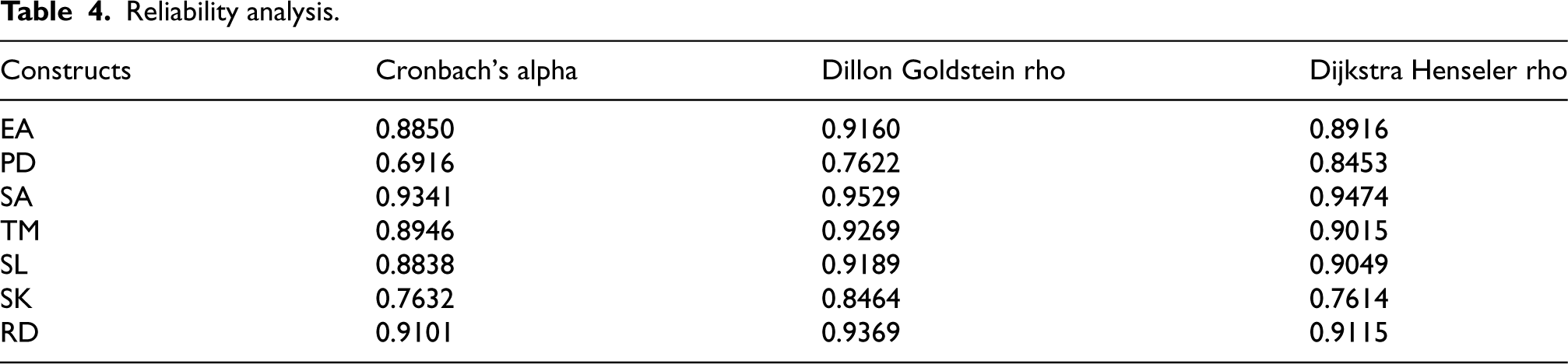
Reliability analysis.
To evaluate the study’s convergence validity, the AVE (Average Variance Extracted) metric has been employed. According to the amount of variation caused by measurement oversights, the AVE calculates how much variance the latent variable captures from the constructs it measures. A valid AVE value is higher than 0.5. The implication is that the latent concept accounts for at least fifty percent of the measurement variation. According to Table 5, all of the constructions’ AVEs are more than 0.5 and it seems to be valid.
Average variability explained.
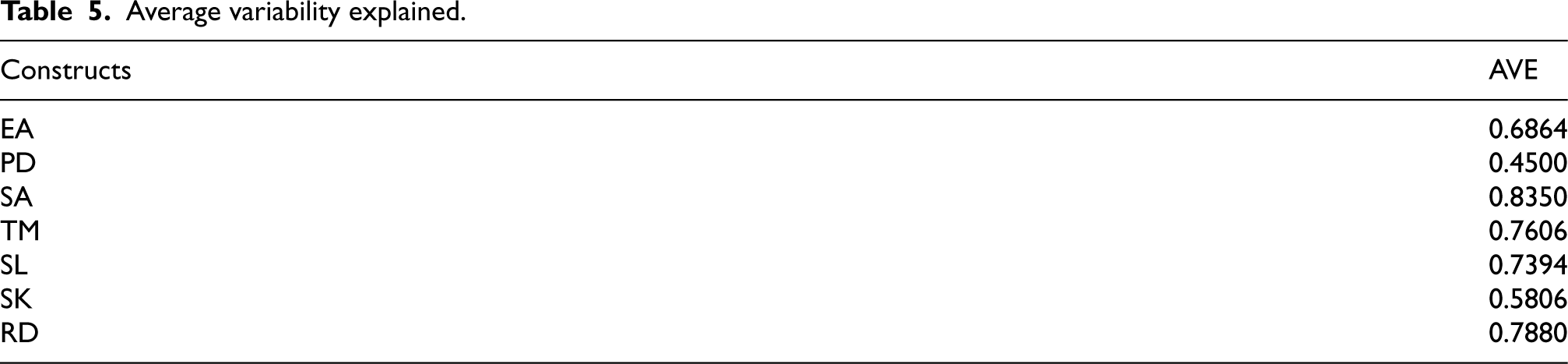
The concept of discriminant validity encompasses the extent to which a construct differs from the other constructs, concerning how strongly it correlates with others and how the measured parameters represent only this specific construct. To analyze this, Heterotrait-Monotrait (HTMT) and Fornell and Larcker’s Criterion (FLC) have been used and they are explained below.
HTMT: The HTMT correlation ratios ought to be lower than 0.85, according to the HTMT criterion proposed by Hair Jr, Hult, Ringle, and Sarstedt. The results indicate that almost all thevalues are less than the cut-off score of 0.85, as shown in Table 6. Hence,the Heterotrait–Monotrait Ratio requirement has also been satisfied.
Heterotrait Monotrait.
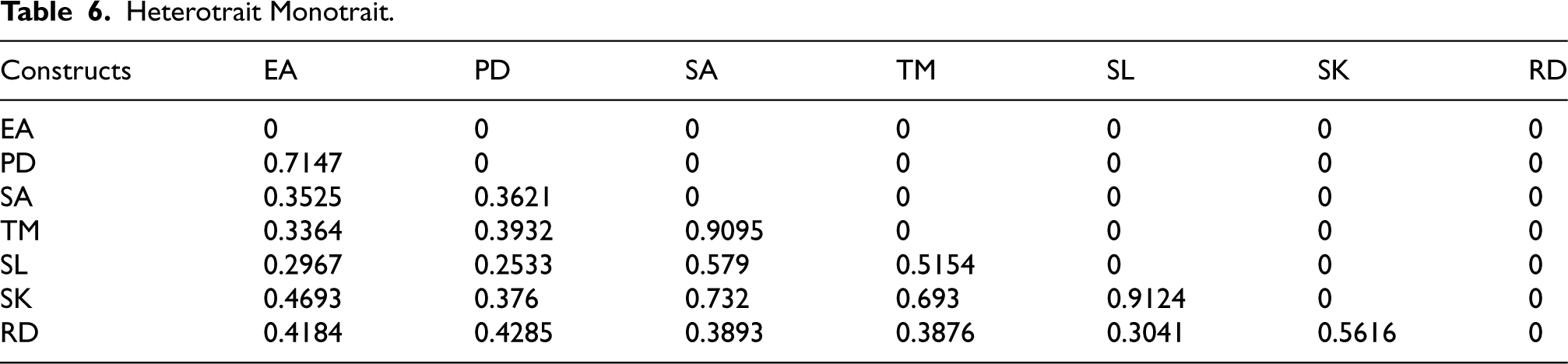
Heterotrait Monotrait.
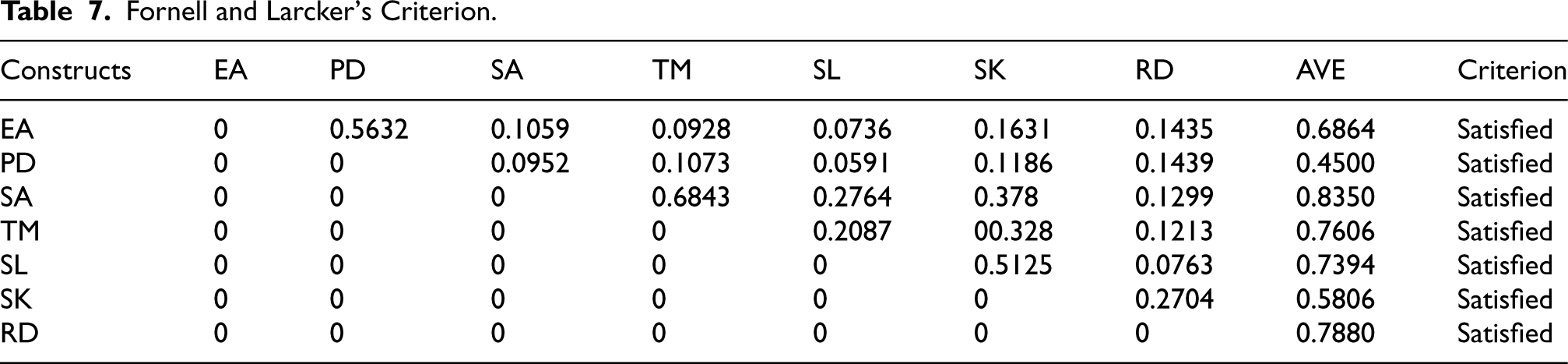
According to Fornell and Larcker’s Criterion hypothesis, the Average Variance Extracted (AVE) fromany latent construct must be greater than the strongest squared correlations with any other construct. It is evident from Table 7 that the Fornell-Lacker criteria for determining the discriminant validity is satisfied.
Fornell and Larcker’s Criterion.
Structural Equation Modeling (SEM) is frequently used to allow the researcher to quickly set up and accurately examine the hypothetical links between the theories as well as the concepts and the concepts as well as their actual indicators with an adequate sample size (N). SEM makes it easier to connect multiple variables by classifying them as measurements, which are observable, explanatory, and expected patterns. However, different kinds of SEM testing are utilized in various instances.
Measurement model
Standardized Root Mean Square Residual (SRMR): The difference between both the observed correlation and the model-implied correlation matrix is known as the SRMR. It enables the evaluation of the (model) fit criterion using the average magnitude of the differences between the observed and the anticipated correlations. A value of 0.08 or less has been regarded as a good fit. However, to prevent the model misspecification, PLS-SEM can use SRMR as a good fit measure. Table 8 indicates the SRMR fit score of 0.0725, which is an acceptable fit.
SRMR fit analysis.

SRMR fit analysis.
Tucker and Lewis Index (TLI) Analysis: TLI are comparative fit indices, which evaluate the fit between a proposed model and a reference model. Therefore, avery good fit lies between 0.90 and 0.95. On the contrary, the perfect alternative lies between 0.80 and 0.90. Table 9 reveals a TLI score of 0.9260, which indicates a good fit.
Analysis of TLI and NFI.

Normalized Fit Index (NFI) Analysis: A measure of incremental fit is the NFI. The NFI result is greater when there are more model parameters. Consequently, the most desirable alternative is between 0.80 and 0.90, and the very good fit is between 0.90 and 0.95. Table 9 shows an NFI score of 0.8785, which is a desirable fit.
The structural model finds the relationship between latent variables and enables the researcher to compute the path coefficients, which represent the correlation strength. The relevance of a certain path of the impact from cause to effect is determined by the path coefficients. All the additional variances are included to compute the coefficients of each structural equation. As a result, the coefficients are generated concurrently for all the endogenous variables. This is different fromthe conventional multiple regression models, wherein the coefficient generation is sequential.
The degree and the direction of the linear link between the two parameters can be measured by the Pearson correlation. A perfect negative correlation would have a correlation coefficient of −1, while a perfect positive correlation would have a correlation value of +1. A correlation coefficient of zero represents no correlation. Therefore, the outcomes reveal that all the variables in this study have a perfect positive correlation with the value of 1. Thus, it indicates that personal development, self-assessment, team management, strategic leadership, skilled knowledge, relationship development, and entrepreneurial activity have a positive correlation between them.
Correlation analysis.
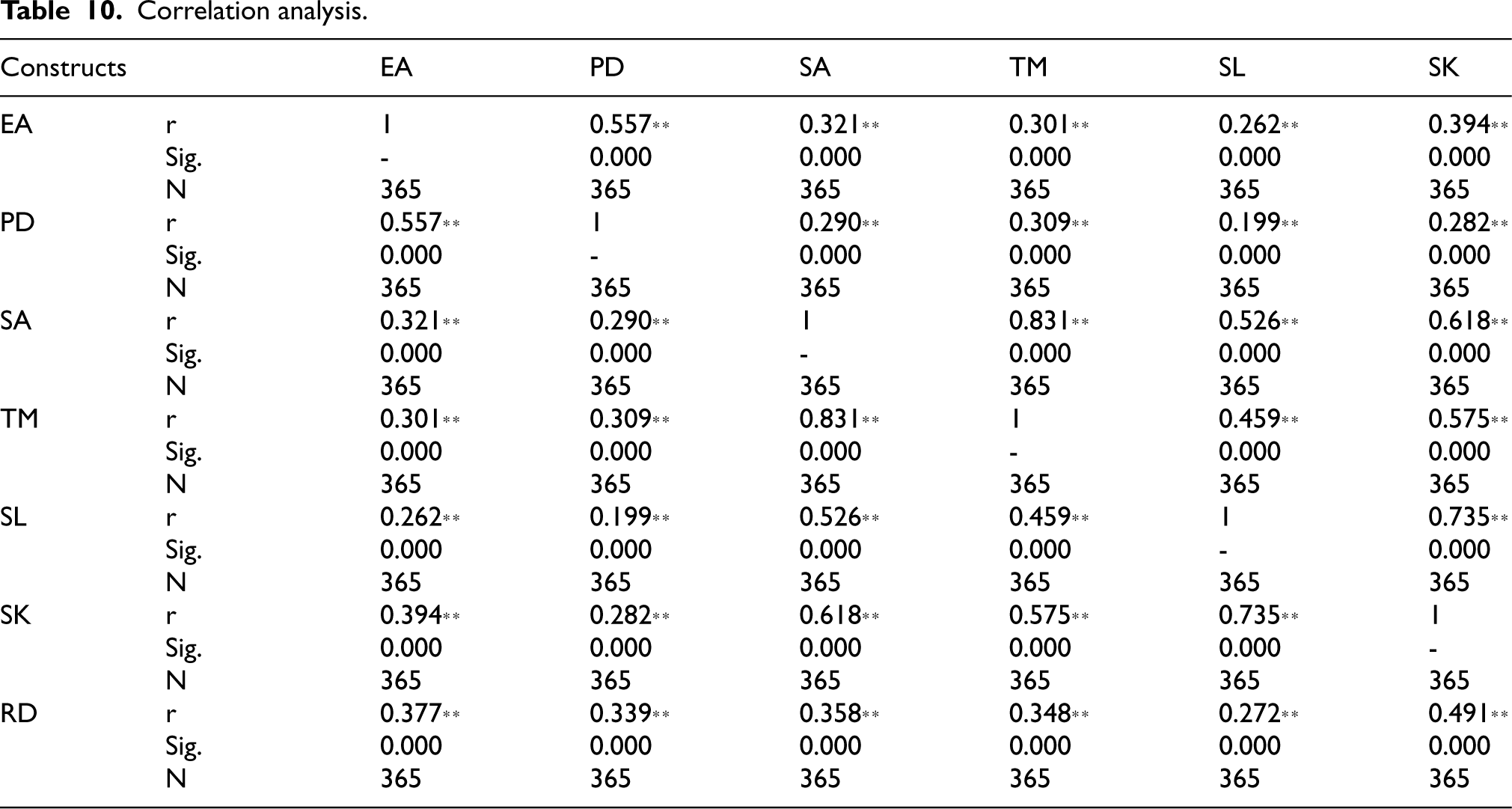
Correlation analysis.
The results shown in Table 11 explain the evaluation of the hypotheses, which are put forward in this study that concern the study’s stated objectives. The discussions of the findings, which are relative to the six hypotheses, are shown below.
H1: Personal development significantly and favorably influences entrepreneurial activity.
The outcome in Table 11 for personal development (β = 0.458, p < 0.05) demonstrates that there is a significant and favorable relationship between personal development and entrepreneurial activities. This suggests that, for every increase in personal development, there is apredictable increase of 45.8% in entrepreneurial activities (t = 10.136). Hence, H1 is accepted.
H2: Self-assessment significantly and favorably influences entrepreneurial activity.
The outcome in Table 11 for self-assessment (β = 0.071, p > 0.05) demonstrates that there is no significant and favorable relationship between self-assessment and entrepreneurial activities. This suggests that, for every increase in self-assessment, there is a predictable decrease of 7.1% in entrepreneurial activities (t = 0.895). Hence, H2 is not accepted.
H3: Team management significantly and favorably influences entrepreneurial activity.
The outcome in Table 11 for team management (β = −0.049, p > 0.05) demonstrates that there is no significant and favorable relationship between team management and entrepreneurial activities. This suggests that, for every increase in team management, there is a predictable decrease of −4.9% in entrepreneurial activities (t = −0.647). Thus, H3 is not accepted.
H4: Strategic leadership significantly and favorably influences entrepreneurial activity.
The outcome in Table 11 for strategic leadership (β = −0.036, p > 0.05) demonstrates that there is no significant and favorable relationship between strategic leadership and entrepreneurial activities. This suggests that, for every increase in strategic leadership, there is a predictable decrease of −3.6% in entrepreneurial activities (t = −0.573). Thus, H4 is also not accepted.
H5: Skilled knowledge significantly and favorably influences entrepreneurial activity.
The outcome in Table 11 for skilled knowledge (β = 0.219, p < 0.05) demonstrates that there is a significant and favorable relationship between skilled knowledge and entrepreneurial activities. This suggests that, for every increase in skilled knowledge, there is a predictable increase of 21.9% in entrepreneurial activities (t = 3.001). Thus, H5 is accepted.
H6: Relationship development significantly and favorably influences entrepreneurial activity.
The outcome in Table 11 for relationship development (β = 0.116, p < 0.05) demonstrates that there is a significant and favorable relationship between relationship development and entrepreneurial activities. This suggests that, for every increase in relationship development, there is a predictable increase of 11.6% in entrepreneurial activities (t = 2.325). Thus, H6 is accepted.
Hypothesis test.
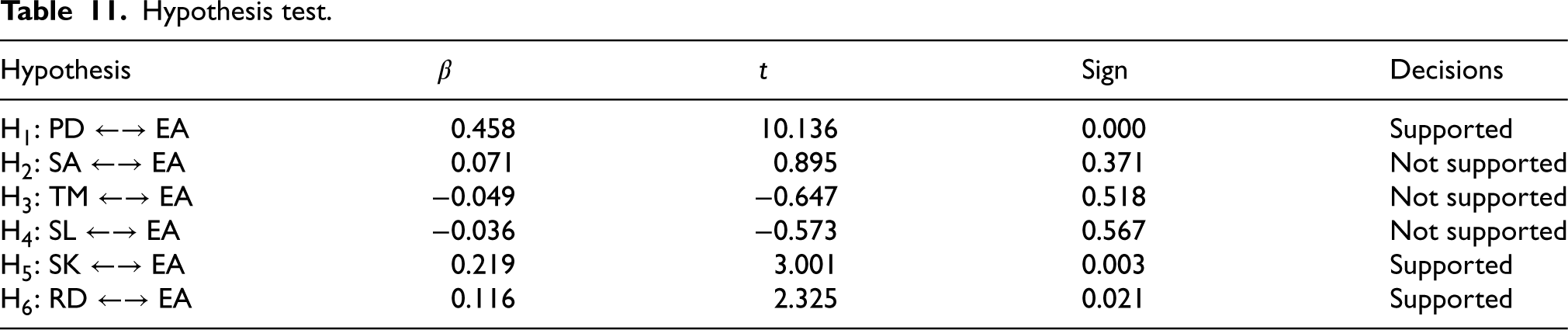
From the outcome of the analysis being performed, it has beenfound that leadership development programs like, personal development (p = 0.000), skill development (p = 0.003), and relationship development (p = 0.021) significantly and favorably influence entrepreneurial activity. Also, the outcome shows that self-assessment (p = 0.371), team management (p = 0.513), and strategic leadership (p = 0.567) do not influence entrepreneurial activity.
From all the analysis results, it is apparent that personal development activities increase the employees’/managers’ awareness and self-esteem, make them set objectives or gain more knowledge and learning skills [26] and improve the personal as well as the professional relationships [27]. Additionally, it has been found that self-assessment activities help to achieve specific tasks and projects [28], enhancing professional growth, work value, and work style [29]. Furthermore, it has been found that skill development activities enhance the knowledge of business budgets [34] and allow one to carefully observe a situation in the field, and recognize the values and goal conflicts of different stakeholders in the society [35]. It has also been found to help managers understand and respect the other employees views. Also, the outcome shows that the relationship development activities make the employees treat each other with respect, make good relationships with co-workers, manage and recognize strong job performance, and make decisions more effectively [36].
The study’s contribution is to find the effectiveness of the leadership development program in fostering entrepreneurship activities. The impact of leadership development programs on entrepreneurial activities is still not well covered in the academic literature so we concentrated on the business activities of entrepreneurs. The Skills Approach Leadership Theory employed the development approach hypothesis to ascertain the essential leadership competencies required for an organization to function. It was found from the research that having effective leadership is essential to achieving entrepreneurship
Conclusion, managerial implication, limitations and recommendations
Conclusion
Entrepreneurs are a crucial subset of strategic leaders. The growth of civilizations must comprehend how leadership and entrepreneurship activities function as drivers in various cultural situations. Therefore, this study has highlighted the role of leadership development programs (personal development, self-assessment, team management, strategic leadership, skilled knowledge, and relationship development) and it has also proven their influence on entrepreneurial activities. The data has been gathered from the 365 employees and managers of entrepreneurial business firms in India. The study results show that personal development, skilled knowledge, and relationship development have a beneficial impact on entrepreneurial activities. Also, the outcomes reveal that self-assessment, team management and strategic leadership have no beneficial impact on entrepreneurial activities.
Managerial implications
This study’s findings can be used to make some important contributions. The results suggest that to run start-up businesses, entrepreneurs need to develop their entrepreneurial skills. It states that entrepreneurial leadership, self-assessment, team management, relationship development, skilled knowledge, and personal development are required for businesses to perform better. However, in practice, improving these entrepreneurial activities might be difficult. Therefore, technological enterprises should focus more on building a foundation for team creativity, dynamic skills, and competitive advantage, rather than developing outstanding practices of entrepreneurial leadership and the execution of entrepreneurial orientation. The influence of the leadership development practice and the direction may be increased through these influencing elements, which would eventually result in improved performances.
Limitations and recommendations
It is equally important to be conscious of this study’s limitations. For this study, only Indian entrepreneurial companies have been used as the sample. The economic climate in India, as a whole, has few unique characteristics. Hence, the response received will be different from one person to another. As a result, it will be a great challenge, when attempting to apply these results to new contexts such as startups in other nations or even in different regions of India. Further, the outcomes of this study might have been impacted by the changes in the business environment. In addition, numerous performance-related antecedent elements have not been included in the theoretical framework and analyzed in depth.
The mentioned limitations can be believed to direct future research studies. For instance, the study’s scope might be extended to different industries or countries. Moreover, future research should take account of other factors, which are not mentioned in this study. Thus, considering the significance of leadership development, the leadership models must remain as clear, comprehensive, and cohesive as feasible.