



Abstract
Post-harvest losses of perishable products strongly depend on inefficiencies of the entire supply chain. In particular, these inefficiencies can be reduced by optimizing the warehouse management, taking into account the remaining shelf life of the product, and matching it to the requirements of the subsequent part of the handling chain. The replacement of First In First Out picking rule with Last Shelf Life First Out policy has been proved to improve the overall performance of the supply chain. The practicability of such approach is related to the possibility of monitoring the deterioration rate of the products and of predicting the residual shelf-life, that is mainly influenced by harvesting conditions. Shelf-life based inventory management policies are seldom employed, generally due to the difficulties in the assessment of the environmental conditions. Such problem can be overcome by means of an automatic system able to acquire the volatile organic compound emitted by the product and of a communication tool that allows sending the information to be processed. RF technologies can be efficiently employed to reach this purpose in order to establish a shelf-life based prediction model. The present paper reports the technical/economic analysis related to the employment of an RF warehouse management system in an agro-industrial supply chain based upon an experimental campaign performed in a real case study.
Introduction
Warehouse inventory systems for perishable products are strongly affected by the reduction of the product value with time, which ultimately results in the disposal of the products reaching the minimal quality level required by the final market. Warehouse operations should hence be timely scheduled and properly managed in order to reach the best compromise between the cost of handling/transporting operations and the quality of the products delivered. Deterioration processes are the results of biochemical and biological phenomena such as respiration, lipid oxidation, microbiological proliferation, which ultimately determine the shelf-life of the product. These phenomena are directly related to environmental factors that influence the deterioration rate of the harvested products. The relationship between product quality in terms of shelf-life (SL) and environmental conditions was extensively studied in the last decade (Zhang et al., 2009; Kreyenschmidt et al., 2010; Do Nascimiento et al., 2014; La Scalia et al., 2017). According to these studies, by knowing environmental factors, like temperature, CO2, volatile organic compounds etc. that affect the product is theoretically possible to predict its remaining shelf-life during the storage phase. The knowledge of the deterioration rate of a product influences the operative decisions about the replenishment policy, the optimal order quantity and the picking policy. Traditional warehouse management systems that are not based on such information are typically affected by uncontrolled deterioration of the products stored with time. Optimal warehousing policies for perishable products are well-established research field, which has lead to significant results concerning the efficiency of logistics throughout the supply chain. Hertog et al. (2014) report that the knowledge of the deterioration state in real-time can be incorporated into warehouse management systems, moving the emphasis from the classical First-In-First-Out (FIFO) towards a First-Expired-First-Out (FEFO) strategy. Aiello et al. (2012) proposes a methodology to evaluate the performance of a cold chain in terms of expected product quality at the retail store based on time-temperature data. It must be pointed out that the performance of the supply chain is influenced by some uncertain and uncontrollable factors such as the inherent variability of the deterioration state of the products entering the warehouse. Recent researches (Sciortino et al., 2016; Wang et al., 2017) show more advance in post-harvest quality monitoring system that takes into account the effect of harvest operations, which may take several hours and are generally performed outdoor where environmental conditions cannot be modified. Even when the temperature throughout the supply chain is perfectly controlled, the variability in the level of initial maturation of the products results in the presence of a fraction of perished products.
In this paper, such variability is taken into account monitoring the volatile organic compounds emitted by the product using the mathematical model developed in our previous research (La Scalia et al., 2017). To make the acquired information available to be included in the inventory management system, it is necessary to obtain data gathering procedures and infrastructures. In particular, RF based communication system is a cost-effective technology that allows the transmission of different parameters from anywhere to the end users (Bottani & Montanari, 2013; La Scalia et al., 2010). In the food supply chain, the RF-based solutions have been applied for new warehouse management approaches dedicated to perishable products (Van der Vorst et al., 2007; Martinez-Sala et al., 2009; Grunow & Piramuthu, 2013; Piramathu & Zhou, 2013). Moreover, this technology can maximize profits of selling perishable food through price adjustment based on real-time product quality and values (Liu et al., 2008). Consumers, in fact, can be less likely to purchase perishable goods when their expiration dates are near. For this reason, retailers frequently implement discount pricing policies when the products are reaching their expiration dates (Sezen, 2004). Perishable food demands are in fact generally price-sensitive and providing a discount based on food quality decay may increase the consumption rate (Xiao & Yang, 2016). Tajbakhsh et al. (2011) developed an inventory model with random discounted prices and a numerical analysis that demonstrates cost savings through discount offers. Dynamic pricing and inventory control models for the perishable food have been reported extensively in the literature. The concept of product quality or product value, in order to represent product utility, attributes on which decisions on pricing are made is reported in (Kopalle & Winer, 1996; Li et al., 2006). Kopalle & Winer (1996) presented a dynamic pricing model incorporating the relationship between expected quality and reference price. While much of the literature focuses on perishable products with fixed shelf-life, for many food products the moment of spoilage is variable and highly depends on environmental conditions such as temperature. Wang and Li (2012) proposed a pricing model to maximize the retailer’s profit in a perishable food supply chain. In a simulation study, Tromp et al. (2012) show that the sum of losses resulting from an unacceptable bacterial load, necessary price discounts and out-of-stock losses could be reduced from 17.1% to 3.8%, using a dynamic expiry date.
The purpose of the present paper is to analyse the performance of perishable food warehouse considering the effects of the deterioration rate. The two alternative policies, FIFO and Last Shelf-life First Out (LSFO) were compared with regard to their effects on the quality of the products in terms of remaining shelf life, as well as to the impact on the economic performance of the system.
The remainder of this paper is organized as follows. The inventory management policies for perishable products and the case study analysed are presented in Section 2. Section 3 provides an economic analysis to compare the traditional FIFO rule with the LSFO warehouse policy. In Section 4 the results are discussed and finally concluding remarks and future work are presented in Section 5.
Inventory management policies for perishable products
Warehouse management consists of coordinating both incoming and outgoing goods to limit product losses during the storage phase. The strategy adopted to reach this target will have to consider the product deterioration rate and product demand (Bakker et al., 2012). Food products inventory is mainly influenced by the economic impact of their perishability. The loss of perishable food can reach 15% in retail stores and hence causes costs of billions of dollars, for example, in European groceries (Ferguson & Ketzenberg, 2006). Supply chain strategies, aimed at efficient products management across the distribution chain, include FIFO and LSFO warehouse policies.
FIFO is the more commonly adopted approach as it seems to be a logical choice towards asset rotation, ensuring stock is shipped out based on its arrival date at each individual distribution centre. This approach requires each warehouse to first ship products that have spent the most time on site, indifferently of their remaining shelf-life and their final destination. This approach is based on the assumption that all products arriving on a particular date have the same remaining shelf-life.
LSFO policy consists in handling those products that have the shortest shelf-life first. It will only ship products depending on their shelf-life potential in relation to their end destination. This policy can be adopted only if the product’s expiry date is known, ensuring only high-quality products arrive at their destination and eliminating product loss during transport. LSFO compared to the FIFO current approach can lead to significant reduction of risk for unsafe products and improve quality at the consumption time. The transition to a strategy of LSFO requires the implementation of information sharing across the supply chain between trading partners.
Case study
The case here presented is concerned with monitoring the shelf-life of strawberries (Fragaria x Ananassa Duch. of the cultivar “Florida Fortuna”). In our study, the formulation of a shelf- life prevision model requires monitoring the Volatile Organic Compounds (VOC) emitted by the products at the warehouse I/O point (Fig. 1).

RF monitored warehouse.
For this reason, the VOC values were detected by means of acquisition system applied on each Stock-Keeping Unit (SKU). The harvesting is performed outdoor where environmental and transport conditions cannot be controlled, thus causing that harvested fruits, in each SKU, could have different maturation degrees when entering the warehouse. While measuring the temperature history of the fruits is not possible to take into account these factors, an experimental analysis based on the VOC data allows determining the initial value of the residual fraction of SL.
The prevision of the residual shelf-life has been calculated by means of the equation reported below (La Scalia et al., 2017):
Where SL(t) and VOC(t) are respectively the shelf -life and the VOC values measured at the generic t time and:
t0 is the initial time and t* is the acceptability limit time that also represents the marketability limit of the product, i.e. the time at which the product can no longer be sold as fresh.
To detect the VOC value the sensor TGS – 2202 (Figaro, Usa) has been used. This sensor requires a heater current of only 56 mA and the device is housed in a standard TO-5 package. It has an operating range between –10°C to +50°C and the acquisition time is 30 seconds. The sensor is applied on a support hosting a nano-processor based on MCU ATmega328 (Arduino), a micro memory card and a 3.7 V lithium battery to power the web server. The system communicates with a WiFi module ESP8282 standard IEEE 802.11 b/g/n. This hardware is also characterized by low-power consumption, which allows monitoring, processing and communicating the VOCs to a remote database. The dimensions of the proposed system is 5×6 cm and the cost is about 100 €. The system was held in place in the cardboard crate by means of PVC bands and to handle them specific procedures are not required. The schematic of the system employed is shown in Fig. 2.
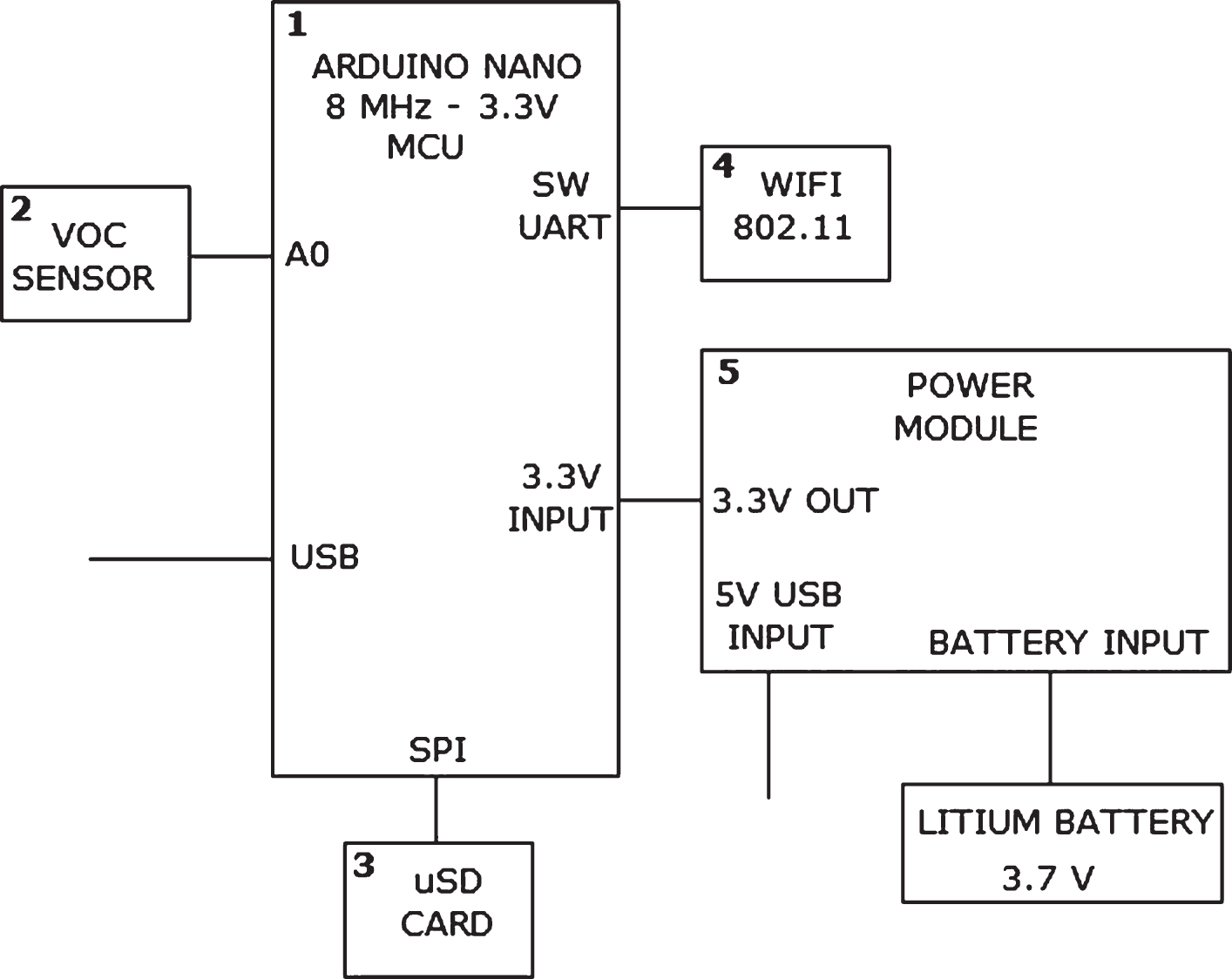
Schematic of the monitoring system.
The monitoring process has been carried out at three harvesting times (8:00,10:00,12:00) on three different days in the months of May, June and July. Starting from the shelf-life values, calculated by means of the equation (1), the fraction of shelf-life consumed (F c ) can be determined as:
where the SL(t0) value at the storage temperature (5C°) is about 7.7 days (http://postharvest.ucdavis.edu/).
For example in the table below (Table 1), the VOCs acquired and the predicted shelf-life values for the three harvesting times in the month of June are reported.
VOC and SL values in the month of June
The mean value of the fraction of shelf-life consumed for the months considered is showed in the Fig. 3.

Fraction of shelf life consumed.
As shown in Fig. 3 the fraction of shelf- life consumed is an increasing function starting from the different point and having the same slope. The Fc value in the months of May and June are very similar due to the comparable environmental conditions in which the fruits are harvested. The environmental conditions in the month of July cause Fc starting point greater than in the other two months.
In this paragraph, the economic impact of a SL based warehouse management policy is analysed. The study is referred to the supply chain starting from the harvesting operations and ending with the warehouse storage. The study has been conducted considering the quantity of harvested strawberries on the three days of each month in which the experimental campaign has been performed.
For the experimental campaign at each harvesting time, three crates made of cardboard (500 mm×300 mm×92 mm), containing 10 punnets of strawberries (100 g each one) have been equipped with the monitoring system. The mean value of the VOC concentration measured by three acquisition systems was then used to predict the shelf-life. The data gathered by the VOC sensor are reported in Table 2.
Experimental campaign
Experimental campaign
The local company involved in the study provided their replenishment plan as reported in Fig. 4.

Replenishment plan.
Moreover, for each day the demand rate is constant and equal to 2 tons and the sell order was sent at 2 pm. The economic analysis has been focused on the employment of a SL based pricing policy, which modifies the value of the stocked goods according to the residual SL. Customers are in fact usually sensitive to the quality changes of the expiring products and, as a result, give them a lower valuation. In particular, for perishable food products, many consumers consider that a new product has a higher quality than an expiring one. Considering supermarket customers, they will prefer to buy items suboptimal in appearance but at a lower price (Aschemamn-Witzel et al., 2015). To take into account this behaviour an exponential pricing model has been considered for the SL based picking rule (LSFO). In particular, this model allows applying discount level without increasing the loss of revenue of the retailer. In fact the same policy is applied also during the phase in which the retailer buys products from the storage warehouse.
We have considered a selling price of 6 €/kg if the limit of residual SL for the product to be delivered from the warehouse is lower than 0.4. This value corresponds to a SL of about 5 days and, considering an average transportation time of 12 h, products arriving to the retailer with a SL of about 3 days. The upper value of Fc = 0.7 involves that the product cannot be sold.
The selling price varying accordingly with the following equation 5 (Liu et al., 2008):
where Vo is the initial price (6 €/kg), λ is the deterioration rate and F c = - λt.
For the purpose of comparison between the two picking policies we make the assumption that for the LSFO policy the products perishability is a function of Fc.
The economic analysis involved the attribution of an initial fraction of residual SL to each incoming SKU at the time it enters the warehouse. Subsequently, considering the constant demand, outgoing SKUs are selected according to the FIFO rule in the first case, and to the LSFO rule in the second case. When SL is not monitored and the FIFO policy is adopted all products are delivered and eventually perished products would be detected when they are not sellable anymore. The revenue of the perished products was considered null and the transportation and the waste costs were neglected. When the LSFO policy is adopted, products that have a residual shelf-life value less than 0.4 at the time of shipment can be sent. If the product’s quantity exceeds the demand, the difference can constitute the sale lot for the next day, if the remaining shelf-life is still less than 0.4. If the product overcomes that limit it can be sold using eq.5. In such conditions a salvage value can be considered since they are still sellable (Fc< 0.7). The results of the economic analysis in terms of the total revenue for the two inventory systems are given in Table 3:
Comparison between the two policies (FIFO vs LSFO)
Comparison between the two policies (FIFO vs LSFO)
As shown in the table above, the LSFO policy saves 750 kg of product sold at the price of 6 €/kg. Moreover, the transition from the FIFO policy to LSFO allows selling other 290 kg using the pricing model. The overall difference in revenue between the two inventory warehouse management policies is 5,521.21 €, corresponding to an increase of 5,4% of the profit margin.
Obtained results show the effectiveness of SL based stock management policy in the case considered. The possibility of gathering data by means of commercial sensors and the use of efficient data entry devices, which consent to transfer the VOC data to the centralized warehouse management system, allow to ultimately identifying the SKUs to be picked for each delivery. Contactless RF technologies permit industrial warehouse management systems to implement shelf life- based management policies, with a great impact on the duration and the costs of handling operations.
In this paper two picking policies have been compared to demonstrate the effectiveness of shelf life- based policies (LSFO) in the logistics of perishable products. The research involved the VOC monitoring of the SKU enter in the warehouse and the establishment of an experimental deterioration model. The two policies have been compared in terms of wasted and sell products supposing a shelf-life depending on pricing rule. The results show that the LSFO allows a reduction of about 1 tons of products wasted. The employment of SKU equipped with acquiring and transmitting systems which allow contactless data transfer via RF communication channel is hence mandatory for the deployment of industrial warehouse and stock management policies. Finally, application of wireless localization systems could be implemented by effective product identification and tracking in order to enhance the functionalities of the proposed system. Future developments include the enhancement of the data gathered in the experimental campaign for example by means of a simulation approach and the establishment of the economical traceability lot in order to achieve a feasible investment payback time.