



Abstract
With the rapid development of the national economy, traffic demand is increasing, traffic congestion, traffic violations and other phenomena occur frequently, which has become a common problem faced by various cities. Intelligent Transportation System (ITS) is an effective way to solve road traffic problems. Aiming at the optimization of urban road traffic information acquisition system, a constrained optimization mathematical model of intelligent traffic information acquisition system with conference network is established by using the comprehensive evaluation function of connectivity and coverage of radio frequency identification (RFID) technology. Connection and coverage are constraints. The penalty function method is used to further transform the model into an unconstrained optimization model. Taking the road in the Second Ring Road of Beijing as an example, the simulation experiment is carried out by using radio frequency identification technology. The results show that compared with the initial manual layout, the evaluation function value of the optimized layout can be increased by 1.71% and 3.18% by RFID technology. Radio Frequency Identification (RFID) technology can optimize the traffic information acquisition system.
Keywords
Introduction
Traffic information acquisition is the basis of and key to traffic control and guidance Zhou et al. (2013). Currently, attempts have been made to apply the RFID technology (hereinafter referred to as RFID for short) to urban road traffic to accomplish the data acquisition task Zhang et al. (2016); Drira et al. (2015). Due to the low node redundancy in the urban road traffic information acquisition system, RFID nodes are required to work reliably and effectively. It is necessary to perform a rational deployment of RFID Wang et al. (2018); Fayazi & Vahidi (2016). Hence, the deployment issue of RFID is the primary problem of RFID application Tak et al. (2016); Lo (2012). Most of the related studies on RFID at home and abroad aim at the random deployment of nodes in the monitoring area Boriboonsomsin et al. (2012), and multiple optimization methods are used for node layout Gu et al. (2014), such as the virtual force algorithm Tak et al. (2016), virtual force-oriented RFID strategy Bloisi et al. (2017) and simulated annealing algorithm Hohberger et al. (2012). Under the premise of meeting the coverage requirement, with cost minimization as the goal, an approximation algorithm is used to solve the integer linear programming problem in the intelligent traffic information acquisition system Howerton et al. (2012); Kuang & Sun (2014); RFID is applied to study the coverage issue Barge et al. (2013). Although the existing research results have provided the optimization methods for RFID, they fail to consider the effect of the perceptual coverage and communication capacity of RFID nodes on the signal acquisition Zhang (2017); Zhang et al. (2017).
With the acceleration of the socialist modernization process in China, people’s demand for transportation is increasing, but the number of vehicles is increasing and the use of vehicles is becoming more and more frequent. The problems caused by urban traffic congestion, traffic environment deterioration, traffic accidents and energy shortage have become common problems faced by all countries in the world. Faced with the increasingly severe traffic situation, the government has also increased its efforts and invested a lot of manpower and financial resources, such as the expansion of expressways, high-speed rail, urban roads, etc Zhang et al. (2015). Nevertheless, it still can not catch up with the rapid growth of vehicles. Therefore, under the limited road resources, improving the road traffic rate is of the utmost importance. However, the traditional methods are helpless in improving the above situation. In this context, intelligent transportation system came into being. In order to achieve real-time, accurate, fast and efficient intelligent transportation system, it is necessary to integrate detection, sensing, intelligent control, computer and other technologies. Detection technology used in the front-end of intelligent transportation information acquisition is a very critical way. The quality of detection performance, determines whether traffic information can be acquired correctly and efficiently. The principle of detection technology is to acquire traffic information such as speeding, traffic flow and occupancy rate on the road through a variety of detectors, to obtain vehicle information and then transmit it to the background for processing. The processed traffic information is displayed by large-screen LED, so as to achieve traffic guidance and improve the road traffic rate.
At present, traffic congestion has become a hot topic for discussion. In order to improve the speed of traffic, various research departments have carried out a lot of work. Research experiments show that information acquisition is an important link in ITS. Whether the correct traffic information can be collected or not is an important link in ITS. Interest is the key to solving traffic problems. In the long-term exploration, the technology of RFID stands out. The application of RFID technology in traffic information collection has high stability and reliability. It can collect vehicle owner information, license plate information, average vehicle speed, traffic flow and other traffic information. Up to now, China is basically in the state of theoretical research, which has been applied abroad, but there are many problems. In foreign countries, the application of RFID technology in traffic information collection has been realized. Two cases of traffic information collection plan in Berlin, Germany, and vehicle journey measurement on Florida Expressway in the United States are prominent, which have a far-reaching impact in the field of transportation. In 1999, Berlin, Germany, carried out research on traffic information collection technology, and launched a traffic information collection plan. The main road was equipped with RFID equipment and tested at three points. The experimental results show that the reading distance can reach 1.2 m, which can effectively read vehicle information. Florida, USA, used RFID tags to measure the travel time of bicycle riding. Each car is assigned a tag, when it reaches the reading and writing range of the card reader, it communicates. The card reader reads the information of the tag, and records the passing time in the background according to the time of data upload. The travel time can be calculated through the background processing, which brings some convenience to the passengers. However, these experiments only focus on individual vehicles, which are far from meeting the demand in today’s traffic congestion. In China, the application of RFID in traffic information acquisition is in its infancy at first, especially for the rapid identification of multiple vehicles. Many of them are theoretical studies, but few of them are actually implemented. Nanjing has taken the lead in applying RFID technology to vehicle traffic information acquisition system, which can successfully collect vehicle information, annual inspection records and so on, but it can not be widely promoted, mainly because it is still a long way from maturity, and the cost is also a problem that can not be ignored. At present, the most successful application in China is the non-stop toll collection system. Now, an ETC channel is basically set up at every high-speed intersection. I believe that in the near future, RFID will bring more hope and vitality to the transportation field.
According to the requirements of road traffic information acquisition for radio frequency identification, this paper comprehensively evaluates the coverage and connectivity of radio frequency identification. To solve the problem of rational deployment of RFID, a mathematical model of deployment constraint optimization of intelligent traffic information collection system based on RFID is established. Penalty function method is used to transform the model into unconstrained optimization problem. Radio Frequency Identification (RFID) is used to solve the optimization problem, and Radio Frequency Identification (RFID) with dynamic inertia weight is used to solve the premature convergence problem of Radio Frequency Identification. The passive vehicle tag is applied to the traffic information collection system, and a dual-frequency processing scheme is proposed. Low frequency is used for passive vehicle tag power supply and high frequency is used for data exchange. On the premise that multiple passive vehicle tags are difficult to identify, an improved algorithm of pre-detection query tree anti-collision algorithm and a segment-ordered anti-collision algorithm are proposed. For the safe transmission of data, an improved algorithm of pre-detection query tree anti-collision algorithm is proposed.
Problem description
Network structure
The structure of the road traffic information acquisition system is shown in Fig. 1. RFID is composed of the management node, sink node and RFID technology. The management node is set in the regional control room/cabinet; the sink node is set near the roadside traffic signal or in the cabinet. The RFID based acquisition system performs hop-by-hop transmission to the sink node along the other RFID technologies. At the sink node, RFID data are integrated to obtain the interval or small area data and communicate with the management node through the Ethernet. The management node receives the data transmitted from the sink node and performs regional data fusion and comprehensive application in a wide range.

Traffic information acquisition system structure.
Given the characteristics of the traffic information acquisition system and RFID technology, the following stipulations are made on the research problem: As the traffic flow characteristics of various lanes on the traffic roads are similar, during the deployment of RFID, the multi-lane roads are simplified into single lane roads, and the deployment results are further generalized. The starting and ending points of roads are known, and there are N RFID technologies, M sink nodes and 1 management node in the road network. The number of RFID technologies set on the roads is related to the length of roads and the communication distance of RFID; the location of sink node is determined near the intersection signal or in the cabinet according to the traffic information acquisition requirement and expert experience.
Probabilistic sensing model is applied as the detection model for the road traffic information acquisition system S
k
. According to the distance between the node and target, the perceived probability at the node is obtained:
Where: p (S
k
, a
ij
) represents the probability of point α
ij
detected the on the same road by RFID technology S
k
. The distance between S
k
and α
ij
is as follows:
Where: Rd1 is the starting radius perceived by RFID with uncertainty, and Rd2 is the maximum radius of RFID perception range. In the practical traffic information acquisition, the starting radius and maximum perception radius include the physical detection and estimation given the parameter supply capability of detector data. Let Rd1 = 70 m, Rd2 = 100 m. λ and γ are the physical property parameters of RFID, both of which are set to 1.
To analyze the network performance, the probabilistic model is applied as the communication model for RFID technology S
k
, which can reflect the communication quality between the nodes in the practical network environment.
Evaluation function
The position vector of all RFID technologies is denoted as 2N dimensional vector Z = [XY], where X = [x1, x2, …, x N ] and Y = [y1, y2, …, y N ] represent the coordinate vector of RFID. According to the position vector Z and the known road information, evaluation function f (Z) is used to perform a comprehensive evaluation on the coverage performance and connectivity of RFID based traffic information acquisition, which is obtained from the weighted sum of five network performance evaluation indicators as follows:
Where: W1, W2, W3, W4 and W5 are the weights of evaluation indicators. Coverage represents the coverage redundancy, CovDegree represents the coverage scope, ComIntensity represents the communication intensity, Neighbor represents the number of network neighbor nodes, and Island represents the number of “Islands”.
1) Coverage redundancy Coverage: the mean of probability detected at all the points on the road, which is used to characterize the coverage performance of RFID.
According to the node detection model, the joint probability of point α
ij
being detected by N
i
RFID technologies on the road where it is located is as follows:
The mean of all the points p (α
ij
) in the road network is taken as the coverage redundancy. 2) Coverage degree CovDegree: the proportion of road points covered by RFID in all the points of the road network, which is used to characterize the coverage of RFID.
Where: N A represents the number of all the points on the road, N noc represents the number of road points not covered by any RFID technology. The determination basis for road point α ij not being covered by any RFID technology is p (α ij ) = 0.
3) Network communication intensity ComIntensity: the mean of communication intensity of all RFID technologies, which is used to characterize the performance of network communication.
According to the node communication model, the communication intensity at model node S
i
is as follows:
The communication intensity of RFID is as follows:
4) The number of neighbor nodes in the network Neighbor: the mean of the number of neighbor nodes in all RFID technologies, which is used to characterize the performance of network connectivity.
The concept of a neighbor node is as follows: If C
ik
= 1, RFID technology S
i
(or sink node K
i
) and RFID technology S
k
are mutually neighbor nodes. Let node S
k
have Ne
k
neighbor nodes, then the number of neighbor nodes in the network is as follows:
5) The number of “Islands” Island: the number of mutually disconnected areas that the entire network can be divided, which is used to characterize the network connectivity.
The concept of an associated node is as follows: If C
ik
> 1, RFID technology S
i
(or sink node
K
i
) and RFID technology S
k
are mutually associated nodes. In the N + M dimensional adjacency matrix G ={ g
ij
}:
Let α i be the i-th row vector of G = (a1, a2, ⋯ , aN+M) T , i = 1, 2, L, N + M. Adjacency matrix G is transformed as follows: If ∥a i ∥, ∥a i ∥ > 1, a i ∧ a j ≠ 1 and a i ∧ a j ≠ 0, then a i = a i ∨ a j , α j = 0.
According to the above principle, G = (a1, a2, ⋯ , aN+M) T is transformed into G′ = (a1, a2, ⋯ , aN+M) T , where G′ is referred to as the connectivity matrix, and its characteristic is as follows: In row vectors with the modulus value greater than 1, the working nodes corresponding to the columns where non-zero elements are located are connected; the working nodes corresponding to different row vectors with the modulus value greater than l are not connected. Therefore, the rank rank (G′) of connectivity matrix G′ represents the number of isolated and scattered regions partially connected that are formed by the nodes, i.e., the number of “Islands”.
The key to the optimization of RFID is to optimize the coverage and connectivity of the network composed of nodes by optimizing the position of each RFID technology, while meeting the road network coverage and network connectivity requirements at the same time. Therefore, the optimization problem of traffic information acquisition system is a constraint optimization problem:
Where: g
i
(Z) ≤ 0 and h
i
(Z) ≤ 0 are the constraint conditions determined by the road network coverage and network connectivity requirements: Coverage requirements: The coverage of RFID is required to reach a set value.
Where: CovCons represents the requirements of the road network for coverage. Let CovCons = 80%. Connectivity requirements The number of neighbor nodes of any RFID technology shall be greater than 0; The number of neighbor nodes of any sink node shall be greater than 0; In the islands formed in the network, the number of islands (denoted as IslandK) that do not contain sink nodes shall be 0.
Network deployment of RFID
Given that RFID is deployed on the road, N-dimensional relative position vector Q = [q1, q2, ⋯ , q
N
] is used to replace the position vector Z, where q
i
= (i = 1, 2, …, N) represents the relative position of RFID technology S
i
on the road, and its correspondence to the actual position is as follows:
Where: SX n , SY n , EX n and ET n represent the horizontal and vertical coordinates of the starting and ending points of the n-th road where the RFID technology is located.
In the RFID technology, the process of identifying the optimal RFID technology distribution is abstracted into the process of identifying the optimal RFID technology. The position and speed of the i-th RFID technology in the N-dimensional search space is as follows:
In the RFID technology, firstly, RFID is randomly initialized (let the scale be H) in the feasible solution space and speed space. In the objective function, penalty function Φ (Q) is used to determine the historical best position pbest of RFID at this moment and the best position pbest identified by the group by evaluating the objective function of each RFID technology. In the RFID technology, the position and speed at the next moment are generated according to the pbest and pbest as well as its inertia, and the equation is updated as follows:
Where: w is inertia weight, c1 and c2 are positive acceleration constants, r1 and r2 are random numbers that are evenly distributed between 0 and 1.
Given the problem that basic RFID technology is prone to fall into local optimum, the strategy of inertia weight linear decrement is adopted in general. However, it fails to reflect the actual optimization search process. The dynamically changing weight (hereinafter referred to as DCW for short) optimization speed factor h = Φ (gbest
T
)/Φ (gbestT-1) is used to indicate the optimization speed of RFID. RFID optimization factor
The inertia weight w shall decrease as RFID optimization speed decreases and increase as RFID optimization degree increases. Therefore, let w = w w - hw h + sw s , where 1 is taken as the initial value w w of w, 0.5 as the value of w h , and 0.1 as the value of w s .
Simulation experiment and result analysis
The optimization process of traffic information acquisition system is simulated in the MATLAB simulation environment to verify the performance of basic RFID in solving the problem of traffic information acquisition system deployment and further compare with the basic genetic algorithm (hereinafter referred to as GA for short). The case used in the experiment is the simplified road map within the Second Ring Road of Beijing. Firstly, six fixed sink nodes are placed in the road network according to the length of each road. The initial network layout is shown in Fig. 2. The sink nodes are represented by stars, and RFID technologies are represented by dots. The initial system in Fig. 2 is optimized by the basic RFID technology, basic GA algorithm and DCWRFID technology, respectively. The settings of each algorithm parameters in the experiment are shown in Table 1.
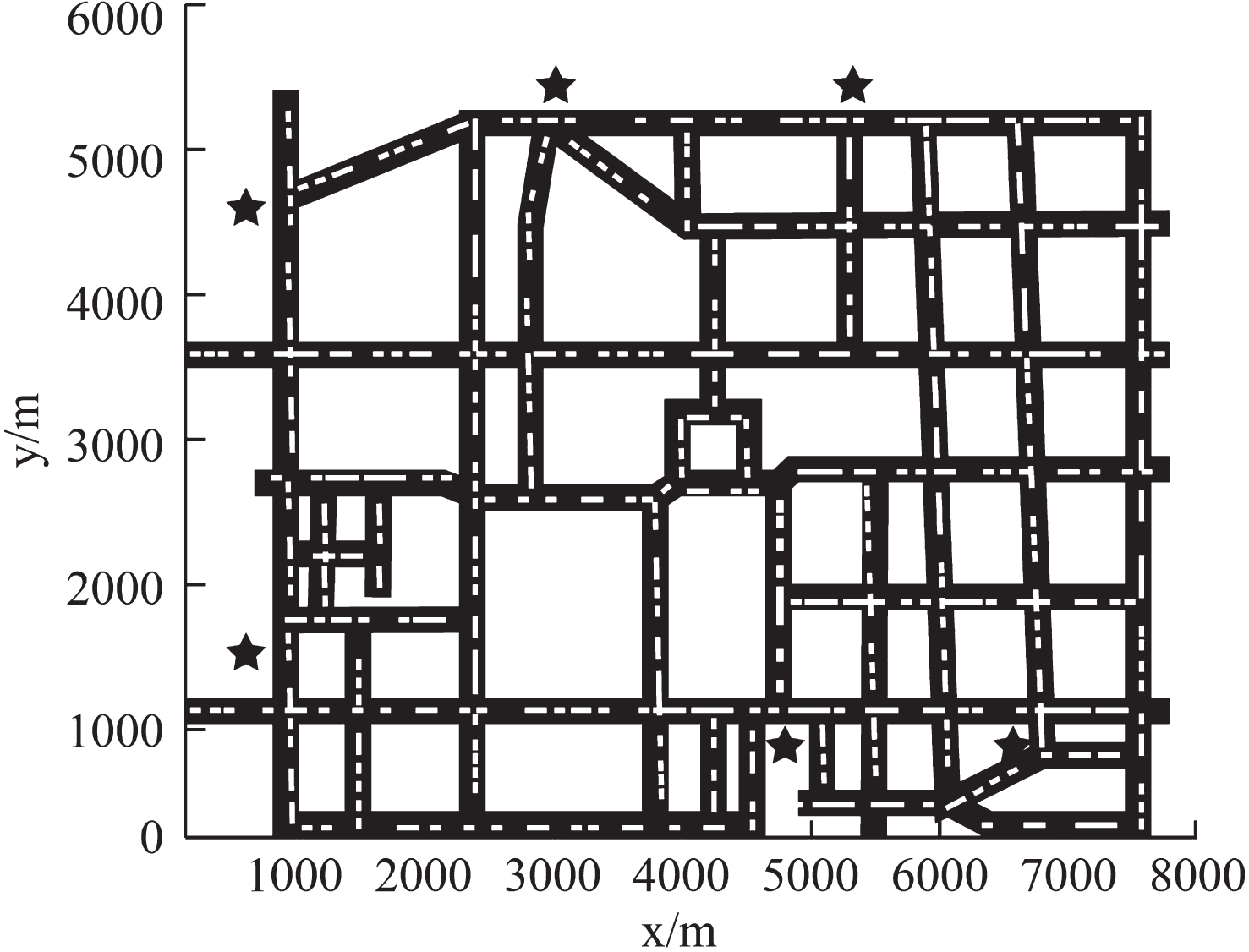
Initial network layout.
Parameter settings of various algorithms
In order to achieve multi-tag anti-collision, fast identification and information security, the system needs to solve the problems of multi-tag anti-collision, passive vehicle tag activation difficulty, data encryption and decryption. Anti-collision needs the cooperation of card reader and tag. For passive tag activation, ZVS scheme is adopted; for data transmission between card reader and tag, information encryption problem is solved. In this paper, DES encryption and decryption are designed in the logic processing of card reader and label. Figures 3 ∼ 5 show the optimized layout formed after the termination of recognition in the three algorithms. Quantitative units of information gathering under different algorithms represented by abscissa in Fig. 6 the network performance evaluation indicator of the initial layout is compared with that of the layout optimized by the three algorithms. The results show that the network performance indicator of the optimized layout is superior to that of the initial layout. Compared with the evaluation function values that characterize the overall performance of the network, the evaluation function value of the layout optimized by basic RFID is increased by 1.71%, that by basic GA is reduced by 0.5% and that by DCWRFID is increased by 3.18% compared with the initial layout.
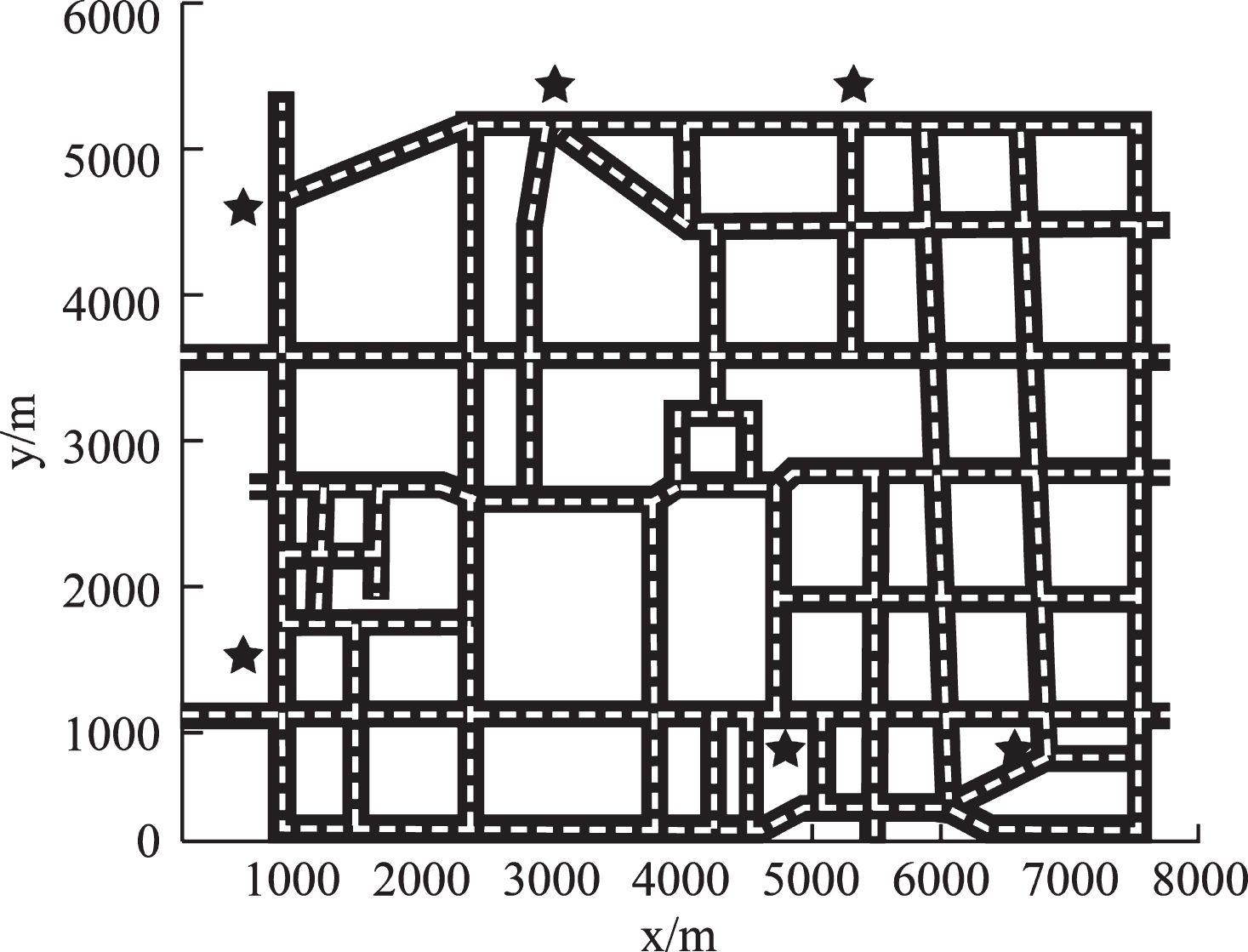
Network layout optimized by basic RFID.

Network layout optimized by basic GA.

Network layout optimized by DCWRFID.
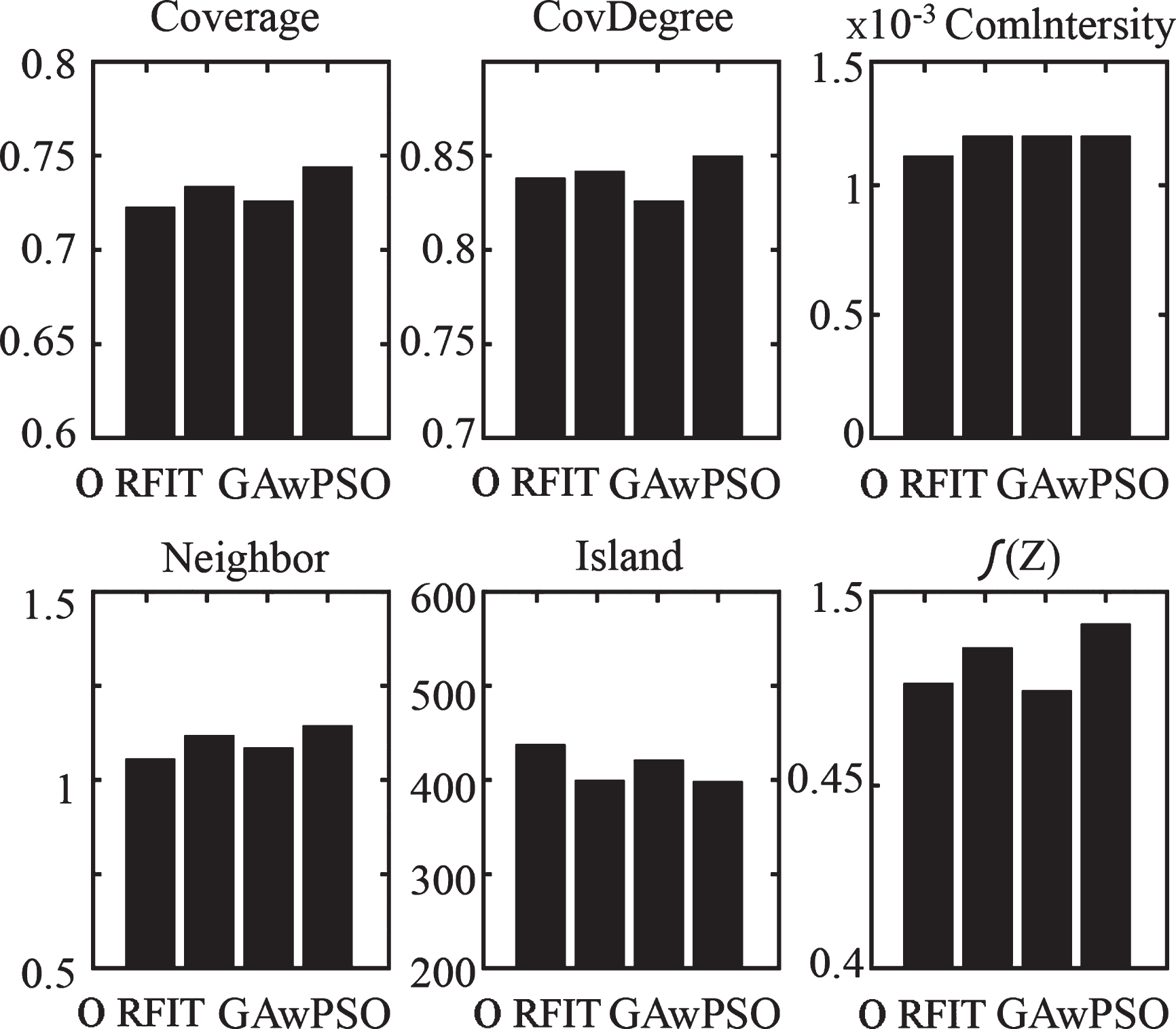
Comparison of network evaluation indicators before and after the optimization.
To observe the effectiveness of optimization more clearly, a section of road is intercepted for comparison. Figure 7 shows the comparison of node arrangement near Beijing station. For the problem of very high solution space dimension, GA algorithm has very long coding and low optimization efficiency, while RFID has the advantage in search of high dimensional space. Therefore, RFID is superior to the GA algorithm in solving the optimization problem in the traffic information acquisition system. When the number of tags increases, the efficiency of different algorithms is compared. When the high-dimensional space is fixed, the length of tag serial number increases continuously, the system efficiency of traditional algorithm is maintained at about 17% under the worst condition, and that of GA algorithm is maintained at about 63%. First, the efficiency of GA algorithm is improved by about 46%. By synthetically analyzing the simulation diagram, we can see that when the length of high-dimensional space and label serial number changes, the efficiency of the piecewise sorting algorithm is relatively stable, and the efficiency of the traditional algorithm has changed greatly. Therefore, in terms of stability, the piecewise sorting algorithm is more stable.
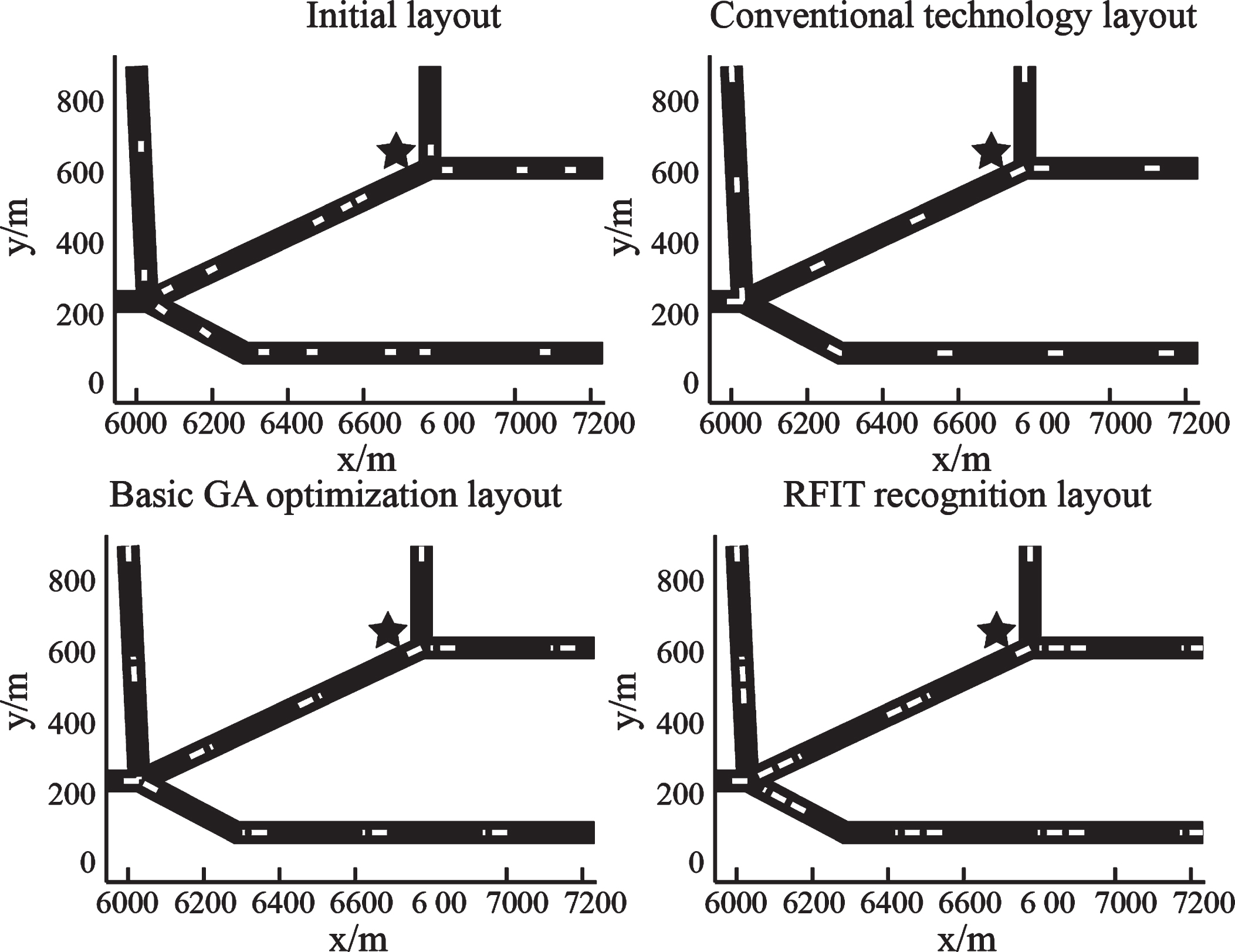
Comparison of node arrangement near Beijing station optimized by the three algorithms.
Given the rational arrangement problem of RFID, a traffic information acquisition system is established, and RFID technology is used to solve the optimization problem of the traffic information acquisition system. The experimental results show that RFID technology is more suitable for solving the optimization problem in the traffic information acquisition system than the genetic algorithm, which can effectively optimize the intelligent traffic information acquisition system, with the comprehensive evaluation value of network performance increased by 1.71%. RFID with dynamically changing inertia weight can improve the premature convergence of basic RFID and obtain better intelligent traffic information acquisition system with the network performance evaluation value increased by 3.18%. The traffic information acquisition system designed in this paper is feasible in theory and engineering, but due to the limited personal time and energy, the paper still has some shortcomings: the system mainly completes the design of each module and carries out simulation verification, but does not make the overall physical debugging. The hardware of the system mainly involves the design of card reader and passive vehicle tag, but the hardware selection of other devices in the system has not been completed.
Footnotes
Acknowledgment
Natural Science Foundation of Anhui (KJ2016A160).