



Abstract
Radio frequency identification technology offers various potential benefits compared to the traditional systems of automatic identification, such as barcodes or manual data entry. Thanks to non-contact reading, no need for human intervention and real time information update, that technology increases the speed of identification, material, and information flow and plays an important role in various logistics activities. This is why, since its introduction, radio frequency identification has always been indicated by researchers and practitioners as the technology that will have changed the way of managing logistics and supply chain processes. By means of a systematic literature review on 95 selected papers, this study proposes an examination of radio frequency identification applications targeting the logistics field, with the purpose of categorizing the available knowledge, examining the state-of-the-art solutions and highlighting the key benefits of the technology within the logistics sector. As a result, the trends of the topics treated in studies targeting radio frequency identification in logistics are delineated. Suggestions for future research directions are provided.
Introduction
Radio frequency identification (RFID) is widely employed in several contexts, industries and processes, such as logistics, supply chains, asset tracking, and healthcare, among others, therefore drawing the attention of many researchers (Munoz-Ausecha, Ruiz-Rosero, & Ramirez-Gonzalez, 2021). In logistics, RFID is one of the technologies used to track the movement of goods and transport and optimize the operation of warehouses. This technology makes it possible to minimize the influence of the human factor and automate inventory management (Popova et al., 2021). Sure enough, RFID can be used to identify and track the location of shipping containers and items (like apparel, book, drug, and others) in warehouses and on the entire shipping route; RFID can also be used to make the inventory control system more efficient (Zhu, Mukhopadhyay, & Kurata, 2012) (Nikolicic, Kilibarda, Maslaric, Mircetic, & Bojic, 2021). Studies on RFID technology demonstrates great potential for reducing shrinkage, preventing stock outs and excess stocks (Bottani, Montanari, & Rizzi, 2009), (Bertolini, Bottani, Ferretti, Rizzi, & Volpi, 2012) and (Bertolini, Bottani, Rizzi, Volpi, & Renzi, 2013), improving data accuracy, and increasing information visibility of supply chain. All these would generally improve the overall performance of supply chain (Zhu, Mukhopadhyay, & Kurata, 2012).
In the current era of Industry 4.0, RFID is becoming more popular than before. Indeed, companies are increasingly searching for tools and solutions that allow their processes, machines, employees, and products, to integrated into a single data collection system, for data acquisition, analysis, and performance evaluation (Nagy, Oláh, Erdei, Máté, & Popp, 2018). As the starting point for industrial digitalization is the networking of devices (the so-called Internet of things, IoT), all devices, such as goods, assets, plants or containers, need to the equipped with appropriate sensors (such as RFID tags), capable of networking. New areas for application of RFID have also emerged during the COVID-19 pandemics. RFID-based traceability systems have been proposed for ensuring safety and quality of food supply chains, especially for fresh food and live products, for which customers have become more demanding (Rahman, Alam, Marufuzzaman, & Sumaila, 2021); (Masudin, Ramadhani, Restuputri, & Amallynda, 2021). On the basis of these premises, this study proposes an examination of RFID studies targeting the logistics field, to categorize the literature, examine the state-of-the-art solutions and highlight the key benefits of RFID technology within the logistics sector, at the same time delineating the evolution in the topics treated in literature. The chosen research methodology for achieving this objective is the literature review. Such approach helps in identifying the conceptual content of the research area and guides toward the theory development (Seuring, Müller, Westhaus, & Morana, 2005). The remainder of this article is organized as follows. Section 2 presents an overview of RFID technology and analyse previous reviews in the RFID field, to highlight the contribution of the present study. Section 3 details the research methodology adopted for the literature review. Section 4 presents the analysis of the review results and includes not only descriptive statistics on the sample of papers reviewed, but also their categorization and their detailed examination. Section 5 summarizes the key findings from the review, discusses the related scientific and practical implications, and indicates potential future research activities.
Literature analysis
Background on RFID
The traditional way of capturing data about items –whether that item is a bottle of shampoo, a case, a container, a pallet or a location –is to gather it by hand, record data on paper and key it into the information system after events occur. A more evolved item identification method is based on the use of bar code labels and readers, by which, through manually scanning of the codes, one can identify items. In this second case, identification is made semi-automatically (Sahin, Dallery, & Gershwin, 2002). Bar code labels have been used to track items and stocks for some time after their inception in the early 1970s. Though bar codes are printed in marks and spaces and are very cheap to implement, they present undeniable obstacles in terms of their short-range readability and non-automated tracking (Preradovic & Karmakar, 2010). RFID systems can be considered as the successors of bar codes. The RFID concept was originally introduced during World War II to distinguish allied aircrafts from the enemy (Stockman, 1948; Moon & Ngai, 2008). But only in recent decades have the convergence of low cost, increasing capabilities and the creation of electronic product code (EPC) made this technology more and more attractive (Dolgui & Proth, 2008). RFID is a kind of non-touching automatic recognition technology, which can automatically recognize the target and acquire relevant data by radio frequency signals (Auto-ID Centre, 2002) (Chow, Choy, Lee, & Lau, 2006). The RFID system basically consists of three main components: the RFID tag (transponder), which contains the identification data; the RFID reader (transceiver), which takes from the tag the recorded data; and the server system, which processes the data collected through the RFID reader. The radio frequency waves sent from the RFID antenna are detected by the RFID tag antenna and transmitted to the microchip. The activated microchip sends the information to the RFID antenna; a tag of active systems amplifies and then retransmits the reader’s signal. The data coming to the RFID antenna is then transmitted to the computer or server via the reader (Gu, Wang, & Wu, 2018) (Baygin, Yaman, Baygin, & Karakose, 2022).
According to (Asif, 2011), many types of RFID exist globally but at the highest level, RFID devices can be divided into two classes: active (battery-powered) and passive (powered by energy transmitted from an outside source) (Alba et al., 2019). Active tags either require a power source, connected to a powered infrastructure, or use energy stored in an integrated battery. One example of an active tag is the transponder attached to an aircraft that identifies its national origin. Passive RFID tags do not require batteries or maintenance and have an indefinite operational life. In contrast to active RFID tags, passive tags are usually smaller and less expensive; examples of application cover transportation and logistics, where yard management, shipping and distribution are advanced by using RFID tracking (Want, 2006).
RFID tags can be designed for different frequencies, with standards for low frequency (LF), high frequency (HF), and ultra-high frequency (UHF). UHF-RFID can achieve longer sensing distances than LF-RFID (Wang, Hardin IV, Ward, Wanjura, & Barnes, 2022). In other word, RFID technology can be divided into short- and long-range systems. LF (125–134 KHz) and HF (13.56 MHz) systems are short range, whereas UHF (860–960 MHz) is long range. The range of the RFID interrogation zone spans from 3 to 100 meters depending on the type of tag and reader employed (Tucker, Darcy, & Stantic, 2014).
Relating reviews
RFID technology is very popular in literature and numerous review papers have been published about it, exploring RFID from various perspectives. In chronological order, the first review on RFID has been by (Ngai, Moon, Riggins, & Yi, 2008), who have analysed the applications of RFID technology from 1995 to 2005. In a similar period, (Nambiar, 2009) and (Thakare, Musale, & Ganorkar, 2008) have proposed technical reviews of RFID systems. Later, (Wamba, Anand, & Carter, 2013) have also presented a summary of published articles on RFID. Again from a technical point of view, a state-of-the-art analysis of RFID sensor technologies from the system implementation perspective has been proposed by (Cui, Zhang, Gao, Meng, & Li, 2019).
Some studies have targeted the implications of RFID on supply chain management. For instance, (Sarac, Absi, & Dauzere-Pérès, 2010) have instead discussed, always in a literature review, the possible impact of RFID in supply chain management. The systematic review by (Chanchaichujit, Balasubramanian, & Charmaine, 2020) has evaluated the potential benefits that act as the motivating factors/drivers in implementing RFID technology. (Oghazi, Fakhrai Rad, Karlsson, & Haftor, 2018), have also tried to identify the impact of RFID and enterprise resource planning (ERP) systems, on supply chain management. (Kgobe & Ozor, 2021) have proposed a very recent examination of RFID integration in supply chains using literature review and analytical research approaches.
Looking at specific contexts, review studies have been published about RFID usage in the construction industry (Arabshahi et al., 2021), while as far as the application areas are concerned, published reviews have targeted security issues (Munoz-Ausecha et al., 2021), cold chain monitoring (Badia-Melis, Mc Carthy, Ruiz-Garcia, Garcia-Hierro, & Robla Villalba, 2018), intelligent packaging (Sohail, Sun, & Zhu, 2018), traceability management (Costa et al., 2013; Rahman, Alam, Marufuzzaman, & Sumaila, 2021).
Compared to the available studies, this review takes a different perspective, in that it targets RFID studies in the logistic context, which originally was one of the typical application fields of that technology. To the best of the authors’ knowledge, review studies about RFID in logistics have not been carried out in literature. At the same time, as logistics processes were one of the first application areas of RFID, it is interesting to evaluate how research in that context has evolved in time, which is the goal of this study.
Research methodology
Sample creation
For the scope of this analysis, data from the Scopus database (www.scopus.com) was extracted. Scopus is a world-leading scientific database widely known for its extensive and reliable content, and for the large number of publications it contains, including journal published by international publishers like Elsevier, Springer, Taylor and Francis, Emerald Insight, and IEEE (Maflahi & Thelwall, 2016) (Rejeb, Simske, Rejeb, Treiblmaier, & Zailani, 2020). The search was carried out in its final version between September and November 2021. The search string used, quite general in nature, was “RFID” AND “logistics”, with search terms limited to the “title” field of the publication. Since there are no previous reviews related to RFID technology in logistics, we did not set a timespan for the search of articles. To ensure the high quality and academic nature of the literature, only peer-reviewed articles written in English were considered. Initially, the search query returned approximately 100 documents. The authors then screened the abstracts of these articles for relevance; similarly, the full text of each article was also reviewed to eliminate those papers that are not related to RFID in the logistics field. This resulted in 95 documents retained; relating data were extracted directly from Scopus in.CSV format and imported in a database for their analysis.
Paper classification and analysis
From a general point of view, after their screening, the 95 papers were classified into three groups (multiple classifications are possible): Technical papers (60), which develop or refine technical features of the RFID technology; Application papers (53), which develop, deploy and possibly test an RFID system in a real context; Conceptual papers (29), which discuss some specific aspects or issues of RFID adoption in logistics, but without any direct application.
Besides this categorization, the papers reviewed were subject to the following analyses. Qualitative (bibliographic) analyses: the paper metadata, exported from Scopus, were used to make descriptive analyses about the sample of studies. These analyses aim at providing an overview of the research about RFID in logistics and refer, as an example, to the distribution of the studies in time, by country or by geographic areas. Besides the metadata, some additional data was retrieved through a direct examination of the paper contents and were used to make further descriptive analyses. These data refer to the industrial context in which the study was carried out. Quantitative (bibliometric) analyses: keywords analysis was chosen as an effective tool for delineating the key themes covered by the papers reviewed and more in general, to map the research topics, evaluate their continuity in time and the relating importance (Fadlalla & Amani, 2015). The rationale behind this approach lies in the fact that keywords (also called “research terms”) are important tools in every research area, as they help researchers have access to papers, books, and research works related to their field of expertise (Amini, Jabalameli, & Ramesht, 2021). Indeed, keywords are deliberately selected or created by authors themselves, with the aim to (correctly) express the main subject of their papers (Yang, Li, & Huang, 2018). In scientometrics, author keywords are recognised to be synonyms of the research topics (Zhang et al., 2016), as they are regarded as “unique” research topics inside a wider evolving theme (Li & Yan, 2019). According to the procedure by (Fadlalla & Amani, 2015), through a keyword analysis, the research topics covered by the reviewed articles were classified into well-established (“core”), intermittent, phantom/emerging or trendy topics. This classification was obtained by evaluating the frequency of usage of the keywords and their persistence. Frequency reflects the number of occurrences of a keyword, while the persistence measures the number of years since a concept was first introduced as a keyword and is typically used to evaluate the continuity of a concept over time (Bigliardi, Casella, & Bottani, 2021).
Descriptive analyses
Sample overview
Figure 1 shows the classification of the three groups of papers (application, conceptual and technical) as a function of the year of publication. We recall that multiple classifications are possible.
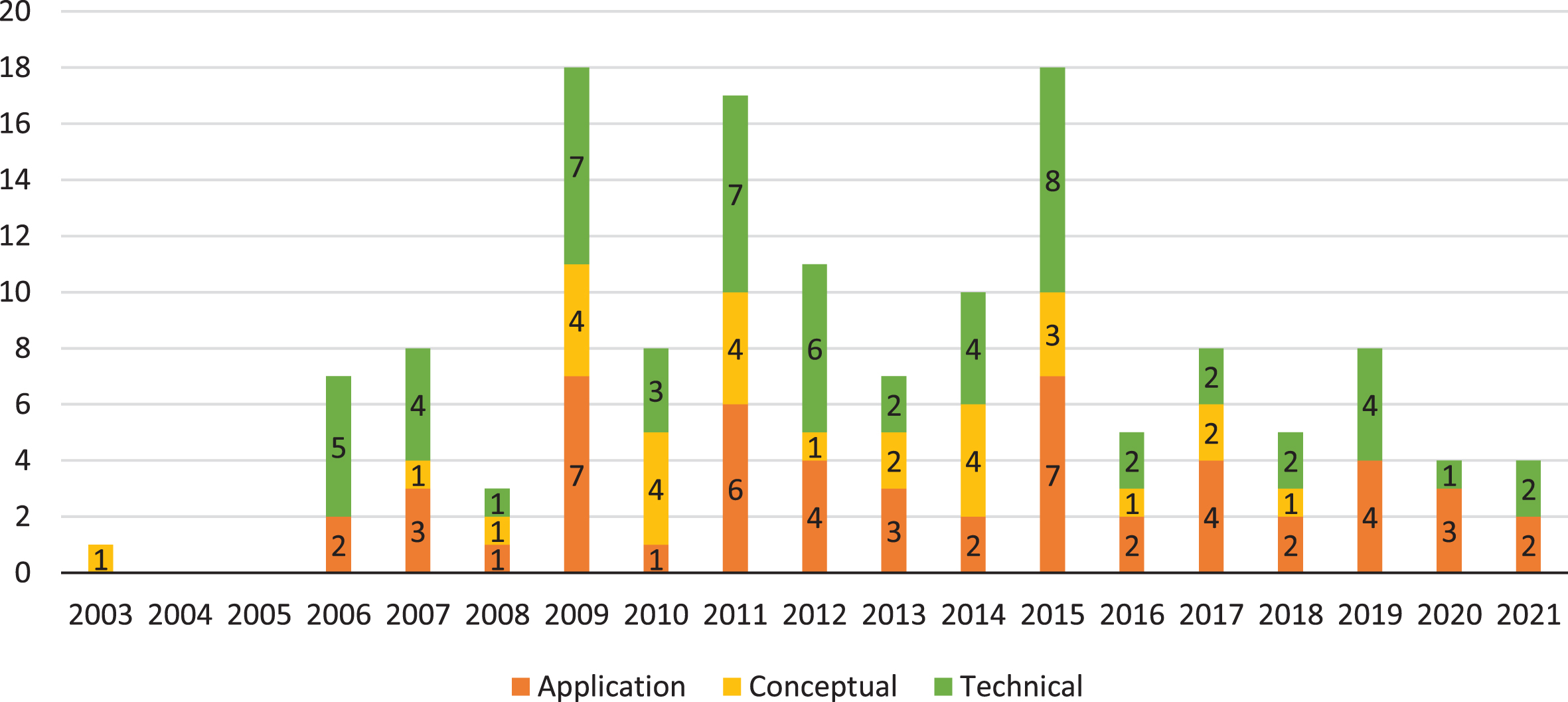
Distribution of the group of papers as a function of the publication year (note: partial data for 2021).
As can be seen from Fig. 1, the first relevant publication appeared in 2003. On the other hand, a generally growing trend was observed in the annual numbers of published articles during 2009–2015, indicating an increasing attention to such an emerging research (Bouzembrak, Klüche, Gavai, & Marvin, 2019) (Li, Xu, Tang, Wang, & Li, 2018), followed by a decline in subsequent years (Antwi-Afari et al., 2019); this could be due to the maturity level reached by the technology, which calls for less research activities to be made on the specific technological theme, and suggests, instead, to shift towards interrelated topics (Yu & Shiue, 2019).
In addition, research articles on RFID in logistics have been published with good continuity, with most of the years characterised by at least one article, except years 2004 and 2005, in which no papers were found. Another interesting aspect is that conceptual papers are always fewer in number than the remaining two categories (application and technical papers), suggesting that in-field studies prevail for the topic under examination. However, it is important to point out that the first publication (Keskilammi, Sydänheimo, & Kivikoski, 2003) is a conceptual paper, which probably aimed at laying the foundations for RFID technology in the logistics field.
Figure 2 shows the key journals in which the reviewed articles have been published; to be more effective, the figure is limited to sources that published at least two papers. This figure is useful for identifying the most influential journals in the area of RFID technology in logistics. Overall, the 95 articles reviewed were published on a total of 70 journals.

Distribution of the studies reviewed across the top-journals.
Most of the papers reviewed (6.32%) appeared in International Journal of RF Technologies: Research and Applications with 6 articles, followed by Expert Systems with Applications (5.26%). Moreover, as Fig. 2 shows, some academic journals have published some typologies of articles only. This is, for instance, the case for Telecommunications and Radio Engineering, in which application papers were published only (i.e., (Liu, 2020; Li, 2020)), while Applied Sciences, Wireless Personal Communications, International Journal of Production Economics, Computers and Industrial Engineering, International Journal of Information Technology and Management and International Journal of Software Engineering and its Applications did not published conceptual papers.
From a technical perspective, it is interesting to note that most of the top-journals are categorized into subject categories that cover key engineering areas (such as industrial and manufacturing engineering, or Electrical and Electronic Engineering) or computer science areas; otherwise, the top-journals belong to the decision science or management subject categories. This is in line with the obvious relationships of RFID with areas of electronic and management engineering.
As a further interesting aspect, the year of foundation of the top journal was quickly evaluated. Indeed, RFID technology is not new, but research relating to its deployment in logistics or supply chain management is instead quite recent; this could have led to the launch of new journals on the topic. Most of the top-journals of our sample are well-established ones, as they were all launched between 1990 and 2002; Telecommunications and Radio Engineering is the oldest journal, established in 1943. At the same time, however, there are also newly launched journals, such as Applied Sciences or International Journal of RF Technologies: Research and Applications. The launch of new (and thematic) journals demonstrates the increased interest paid by researchers to the RFID topics.
Figure 3 shows the distribution of the studies by country. To determine the country of the study, if conflicts existed, the nationality of the first author was taken as reference, which is a common approach in review studies (Bottani & Vignali, 2019). As can be seen from the figure below, the leading country in the topic of interest is China (28 articles, around 30% of the total papers). South Korea take second place with nine articles and, with eight publications Germany take the third position. It is interesting to note that in these countries there are several realities on RFID technology, such as university laboratory. In particular, the Hong Kong University of Science and Technology has brought together an interdisciplinary team of faculty under the HKUST RFID Center to facilitate the research and development of RFID core technologies and applications. Tests provided by this center are industrial application and test, RFID tag dynamic test and RFID tag static test (http://www.zk-rfid.com/). Auto-ID Lab Korea at KAIST will leverage Korea’s RFID technologies through collaboration with the world’s best RFID laboratories and participation in internation standardization processes led by GS1/EPCglobal. Furthermore, personnel exchanges and research partnerships with other Auto-ID Lab will allow KAIST to cultivate more internationalized talent (https://autoidlab.kaist.ac.kr/). The Smart City Research Lab (SCRL) is an interdisciplinary research network at the University of Bamberg (Germany), funded by the smart city initiative of the City of Bamberg. The SCRL supports the city to develop a strategy and put it into action (https://www.uni-bamberg.de/en/centres/centre-for-innovative-applications-of-computer-science/smart-city-research-lab/).
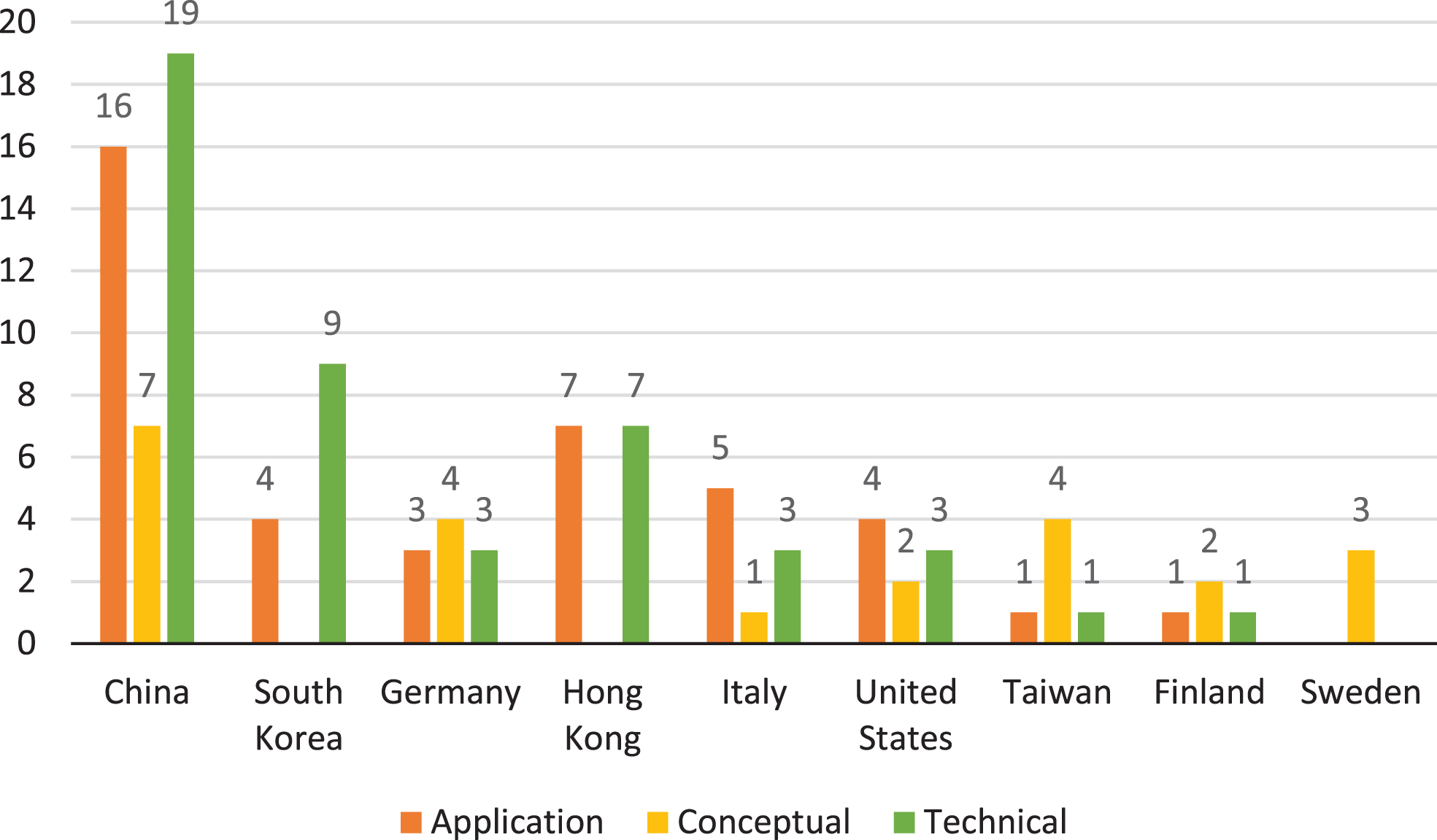
Geographic distribution of the studies reviewed.
It is interesting to note that most of the studies carried out in China and South Korea are technical in nature, which suggests that these countries are particularly active in exploring the technical aspects of RFID technology or in developing new features of the technology. Contrarily, all three Swedish papers are conceptual in nature (Ringsberg & Mirzabeiki, 2014; Plsson, 2007; Asif, 2011).
Summarizing, studies on RFID technology in the logistics field has been conducted worldwide, albeit there is a high concentration of academic research output in developed countries, while African nations are not at all included in the figure (Rejeb, Simske, Rejeb, Treiblmaier, & Zailani, 2020). This may call for the strengthening of scientific collaborations; at the same time, it cannot be excluded that some studies from these countries have been missed in creating the sample, as only publications in English language were considered for this study.
Figure 4 shows the key subject areas of the journals that published studies on RFID technology in logistics.
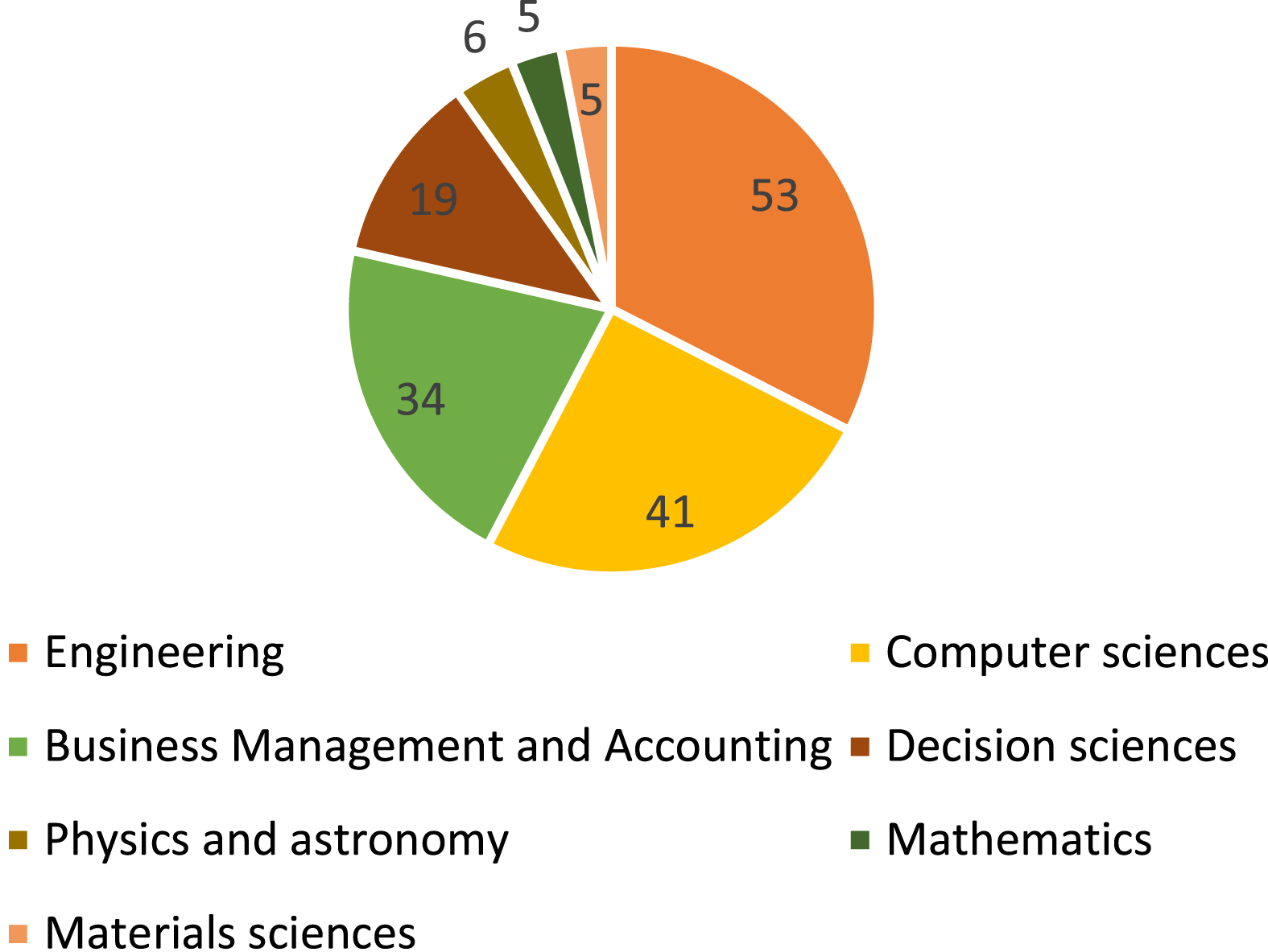
Distribution of the papers reviewed by journal subject area.
As can be seen from the figure above, the subject area Engineering embeds the majority of the papers focusing on RFID technology in logistics field (53 papers), followed by Computer sciences and Business, Management and Accounting, with 41 and 34 studies, respectively. This result confirms the suitability of the sample of papers retrieved, as logistics issues are typically engineering problems, while without a doubt, RFID systems can be associate to the computer science area. It is important to specify that the subject area Mathematics appears in all papers which are also classified under the Computer sciences field, while the subject area Materials sciences appears in all papers which are also classified under the Engineering field. The subject area Physics and Astronomy appears with Engineering, Computer sciences and Material sciences in 5, 3 and 3 papers, respectively. Finally, the subject area Engineering appears in conjunction with Computer sciences, Business, Management and Accounting and Decision sciences in 20, 16 and 9 articles, respectively.
The distribution of the application fields is proposed in Fig. 5. To be more effective, this figure is limited to the industrial sectors that presented at least three papers.
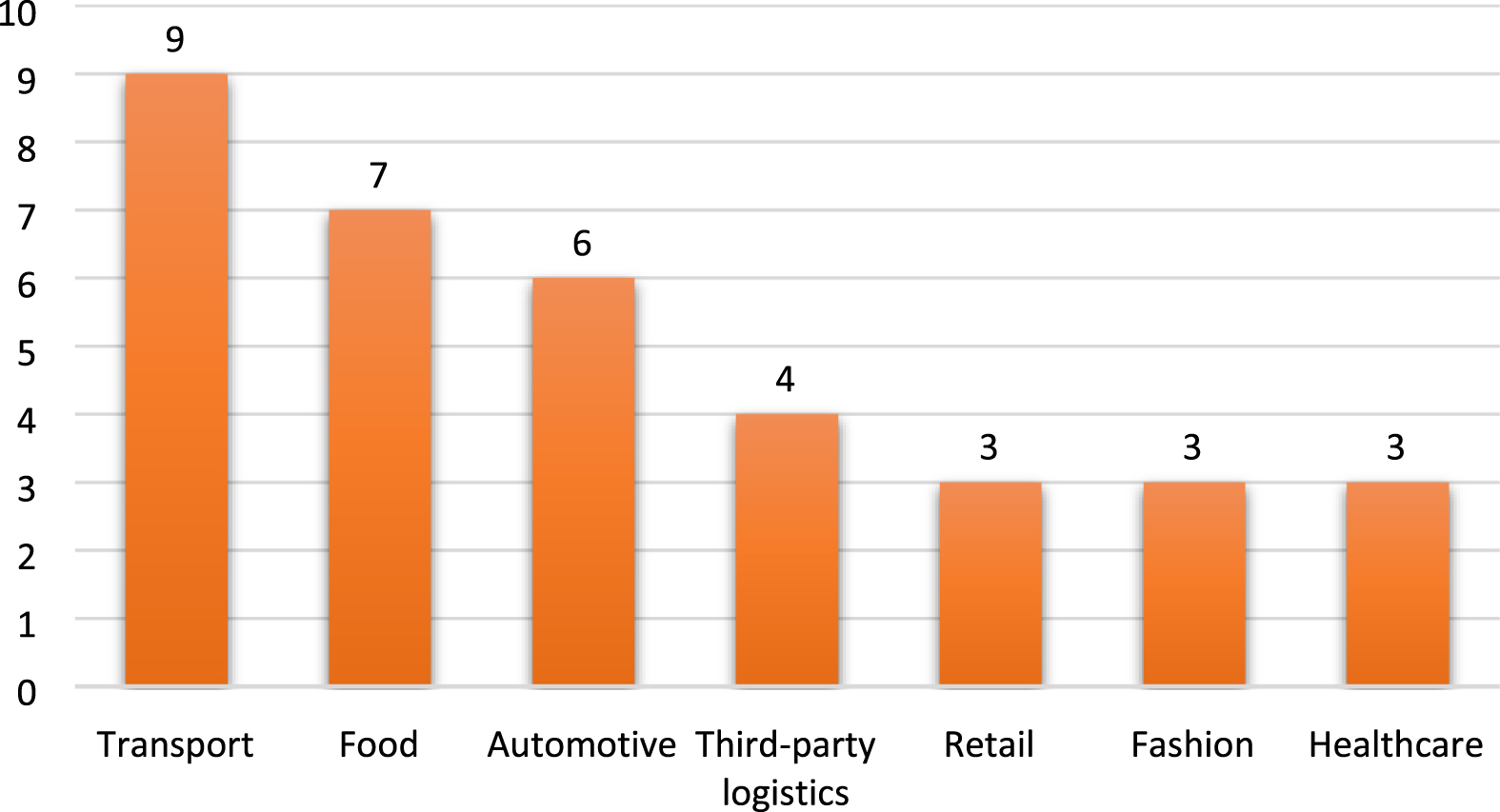
Industrial sector distribution of the studies reviewed.
In total, seventeen different industrial sectors were identified across the sample of papers examined; those not shown in Fig. 5 are: papermaking (Wei & Leung, 2011; Lee & Chan, 2009) and academic (Ramirez, 2012; Zhang & Reha, 2014) with two papers each, chemical (Miao, 2018), toys (Van De Wijngaert, Versendaal, & Matla, 2008), agriculture (Chen, Lim, Liao, Deng, & Chen, 2021), recycling (Nativi & Lee, 2012), jewellery (Lee, Ho, Ho, & Lau, 2011), humanitarian (Wu & Lirn, 2011), construction (Kim & Sohn, 2009) and information devices (Poon et al., 2009), with only one paper each. From the same figure, it can be noted that the transport sector is the most popular one in research, with 9 published papers, followed by food and automotive sectors, with 7 and 6 papers, respectively. Among these studies, (Choi, Park, Choi, & Park, 2015) have proposed an efficient data collection algorithm for active RFID systems for ubiquitous services in maritime logistics adaptation. The proposed algorithm achieves interesting performance by reading the previously collected tags without collision. (Dong, Jie, & Pin, 2015) have built a food logistics framework from producers to retailers based on the RFID technology and have designed a tracking system for food products, which transfers and tackles underlying data from various logistics nodes. (Kang, Kim, & Lee, 2018) have deployed the RFID technology to improve the just-in-sequence operation of automotive inbound logistics processes. First, the authors have implemented an RFID-based visibility system for real-time traceability and control of part supply from the production lines of suppliers to the assembly line of a car manufacturer. Then, they have developed an RFID-based sequence-error proofing system to avoid accidental line stops due to incorrect part sequencing.
One study (i.e., (Van De Wijngaert, Versendaal, & Matla, 2008)) mentions more than one application field of RFID technology. To be more precise, the authors have taken a business/IT-alignment approach and have investigated the relationship between business/IT-alignment principles and preference for RFID applications. Additionally, they have described how to apply their design and have checked the approach in thirteen cases, referring to the transport, automotive, food, retail and toys fields.
The analysis of the authors’ keywords, as they were exported from Scopus, generated a list of 243 different terms. For five papers, neither the author’s keywords nor index keywords were available –these studies have obviously been excluded from this analysis. It should be mentioned that the general keywords “Radio Frequency Identification” (or “RFID”) and “Logistics” were excluded as well from the analysis, as they were originally used to make the search query and obviously, their occurrence is expected in almost all papers retrieved.
The remaining keywords are listed in Table 1, together with their frequency, year of first appearance and year of last appearance. To be more effective, the table shows only the keywords with frequency ≥3.
Frequency of keywords and year of first/last appearance
Frequency of keywords and year of first/last appearance
The table above shows that “Supply chain management” is the most frequent keyword (frequency = 9), highlighting the importance of RFID technology in this field. “Reverse logistics” and “wireless sensor network” take second position with frequency = 7 and 5, respectively. According to several scholars, RFID is considered a breakthrough in supply chain management, and its integration in supply chain management and logistics can improve internal efficiencies, process visibility, and automation (Al Kattan & Al Khudairi, 2010) (Karagiannaki, Doukidis, & Pramatari, 2014) (Kamble, Gunasekaran, Parekh, & Joshi, 2019). The keywords “traceability”, “internet of things” and “cloud computing” also appear frequently in the researched literature.
By correlating the frequency of the keywords with their persistence, using the data in Table 1, we obtained the results in Fig. 6. The graph in Fig. 6 was divided into quarters using a horizontal and a vertical line as separators. For the persistence, the horizontal line is set at persistence = 9.00, corresponding to half of the timespan covered by the studies reviewed. For the frequency, the vertical line is set at frequency = 2.90, which is the mean of the frequencies for the keywords.
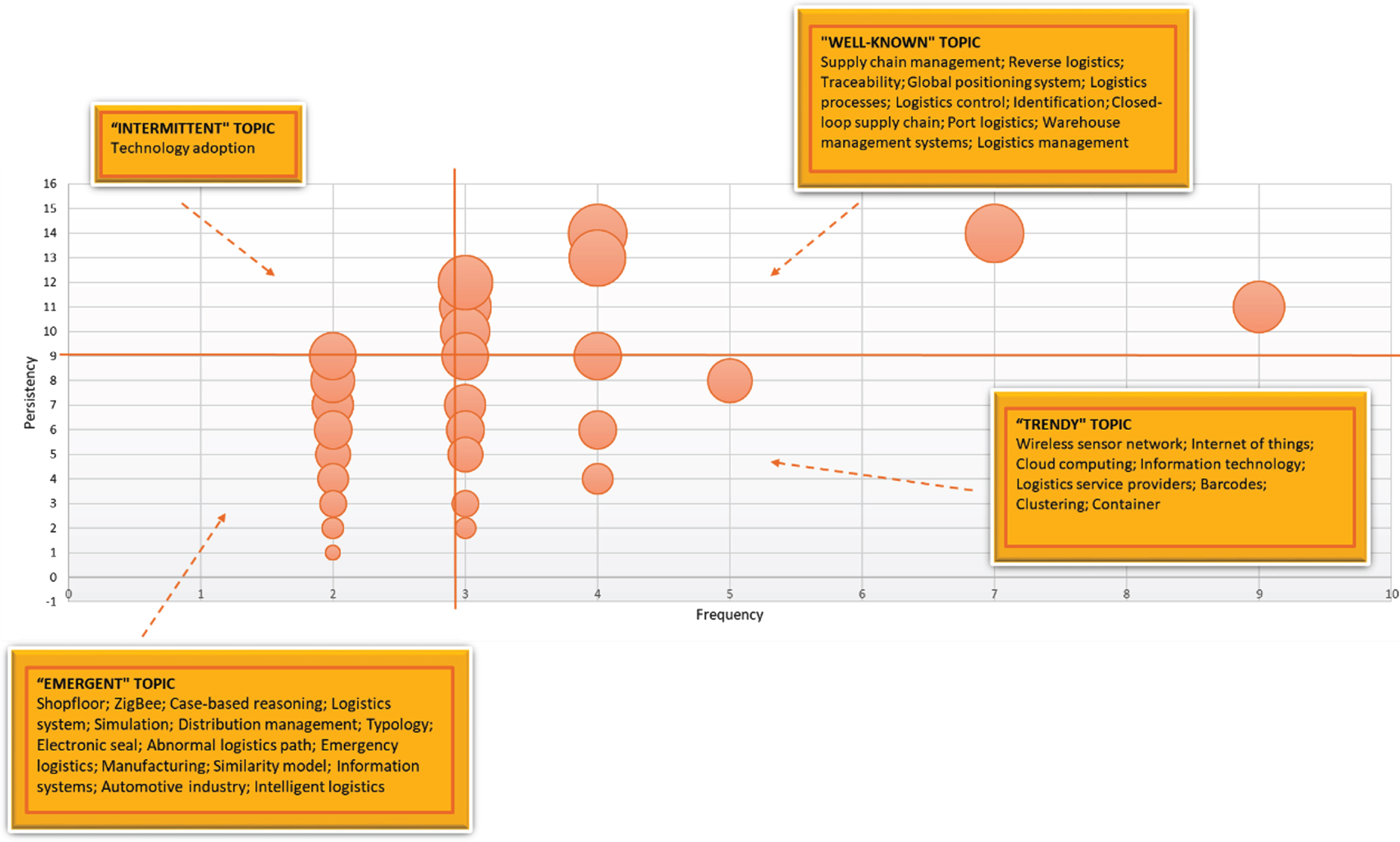
Persistence versus frequency of the keywords.
The top-right and the top-left quarters of the graph are labelled as “well-known” and “intermittent” research topics, respectively, while the bottom-right and the bottom-left quarters represent the “trendy” and “emergent” topics, respectively.
As can be seen from Fig. 6 there are many “well-known” research topics on RFID, and they include the keywords with high frequency and high persistence. These keywords include supply chain management, reverse logistics, traceability, and others. An RFID application in reverse logistics has been provided for example by (Usama & Ramish, 2020), who have proposed the framework for configuring RFID in a closed loop supply chain/reverse logistics system, by categorizing the products based on RFID tagging and correspondingly finding the place for tagging the products in order to attain sustainability in an efficient and effective manner. Another study in a similar context has been proposed by (Abad, Juarros, & Gómez, 2009), who have validated a RFID smart tag developed for real-time traceability and cold chain monitoring for food applications. The results proved that this system presents important advantages regarding conventional traceability tools and currently used temperature data loggers such as more memory, reusability, no human participation and no visibility needed for reading.
Intermittent research topics include themes that are discussed in the literature in an on-off manner. In the analysed keywords only one theme, covering “technology adoption”, turned out to be an intermittent topic (Lin, 2009; Khan, Haq, Ghouri, Raziq, & Moiz, 2017). To be more precise, (Lin, 2009) has studied organizational determinants of RFID adoption by logistics companies. A questionnaire survey on logistics companies in Taiwan was conducted to test proposed research hypothesis (Khan, Haq, Ghouri, Raziq, & Moiz, 2017) have examined the significant perceived factors, other than cost, which can enable a firm’s supply chain system to adopt RFID technology successfully. Also in this study, data was collected through a structured questionnaire.
As for “emerging” research topics, they typically represent recent or poorly explored themes; these topics could either disappear early from the literature (“phantom”) or gain interest among the researchers and become trendy topics. Shopfloor, ZigBee, abnormal logistics path and other keywords were classified as emerging research topics. For example, (Zhong, Lan, Xu, Dai, & Huang, 2016) have presented a visualization approach for the RFID-enabled shop floor logistics using big data from cloud manufacturing. An innovative RFID-cuboid model is used for reconstructing the RFID raw data given the production logic and time series.
Finally, trendy topics such as wireless sensor network, internet of things, cloud computing and barcode are those themes that seem to be very promising for researchers. For example, to better regulate the airport cargo transportation, (Wang, 2018) has presented the design of an airport logistics monitoring system based on wireless sensor network and RFID. The monitoring system is mainly composed of four modules: RFID system, wireless sensor monitoring network, communication network and remote monitoring terminal.
Technology is as a critical tool in developing effective, efficient, and competitive operation in any context. Information technology allows accessing information in real time, processing them and enhance speed and accuracy of data collection. RFID technology has been (and probably still is) one of the most promising technologies for automatic identification and data capturing in logistics and supply chain processes, which have always been recognised as promising areas for the deployment of that technology. With the purpose of delineating the research activities concerning RFID in logistics, this paper has carried out literature review on a sample of 95 papers taken from the Scopus database. These papers were first classified into technical, application and conceptual papers. Then, some descriptive analyses were made on the papers, to provide an aggregated overview of sample. A more detailed mapping of the topics covered by the literature was obtained by carrying out a keyword analysis and classifying those topics into well-known, intermittent, trendy or emergent. From the analysis made it emerged that many logistics topics (e.g., reverse logistics or supply chain management) are well-established. However, various topics fall into the intermittent themes, suggesting that they have been less debated; this is for instance the case for technology adoption themes. Similar considerations can be made for emerging topics, which typically refer to very specific arguments (e.g., Zigbee). Trendy topics, finally, clearly delineate research towards Industry 4.0 technologies.
The above outcomes indicate that research on RFID in logistics has made use of different approaches. Real case implementations are the preferred type of study, which is in line with the fact that RFID should be deployed in practice; nonetheless, other approaches are possible. In terms of topics, the themes treated are various and cover a wide range of practical and technical issues. Further research is nonetheless required for the less explored themes. For future studies, from an analysis of the trendy topics it could be argued that they will target the RFID in the Industry 4.0 area; to confirm this statement, it would be interesting to repeat the present analysis in some years, taking a longitudinal perspective, to check whether the trendy themes highlighted in this study will have become well-established topics.