



Abstract
Intergranular slow crack growth (SCG) in ceramic polycrystal is described with a cohesive zone model that mechanically simulates the reaction-rupture mechanism underlying stress and environmentally assisted failure. A 2D polycrystal is considered with cohesive surfaces inserted along the grain boundaries. The anisotropic elastic modulus and grain-to-grain misorientation are accounted for together with an initial stress state related to the processing. A minimum load threshold is shown to originate from the onset of the reaction-rupture mechanism to proceed where a minimum traction is reached locally and from the magnitude of the initial compression stresses. The cohesive model incorporates a characteristic length scale, so that size effects can be investigated. SCG is grain size dependent with the decrease of the crack velocity at a given load level and improvement of the load threshold with the grain size. Polycrystals of zirconia and alumina are both considered in the current study and a comparison between SCG resistance of alumina and zirconia is presented. This work aims at providing reliable predictions in long lasting applications of ceramics.
Introduction
Polycristalline ceramics are used in various domains such as thermal barriers, coatings, and in medical applications. They present intrinsic advantages such as chemical inertness and wear resistance. Currently, alumina and zirconia are two of the most commonly used engineering ceramics. However, ceramic materials are brittle by nature with a magnitude of their toughness K
IC
ranging in 1–5 MPa
As a general trend, SCG is evidenced on notched specimen and characterized by the variation of the crack velocity V with load level in terms of K I (stress intensity factor) or G (energy release rate) for a given environment (relative humidity and temperature). The main features are schematically described in Fig. 1 with SCG operating once a threshold load level K 0 is reached. Then the so-called regime I takes place with increasing crack velocity with load level K I . At a given vakue K I , the velocity in further increasing if the relative humidity and/or temperature increase as well. A plateau is then attained (regime II), when water diffusion becomes lower than the crack velocity. Further increasing in K I results in instable crack propagation (regime III).
This study focuses on the modeling and prediction of SCG’s regime I as well as the load threshold K 0. Although regime I is time and environment dependent, it is also sensitive to microstructure effects such as grain size. Increasing temperature and/or water concentration induces a shift in the whole V − K I graph towards smaller K I values (cf. Fig. 1). The same trend is observed when reducing the grain size 𝛷 G . Thus, increasing the grain size rends the material more resistive to SCG while decreasing the crack velocity V at a given load K I and increasing of the load threshold K 0.
Romero de la Osa et al. [9,10] further detailed by El Zoghbi et al. [5] have proposed a thermally activated cohesive model that was shown able to capture these features qualitatively. In the present study, we explore in details how the microstructure influence the threshold level K 0 and in particular that of the grain size and importance of the thermal stresses related to the processing as well as the characteristics of regime I.
A calibration of the cohesive model parameters for zirconia and sapphire is presented first, that will be used for the description of intergranular SCG. Then, the influence of the microstructure and the residual thermal stresses originating from the sintering on the SCG’s regime I kinetics and on the load threshold level K 0 is investigated. The need for considering these initial thermal stresses to predict effect of the grain size on SCG is also evaluated. Polycrystals of zirconia and alumina are both considered in the current study and a comparison between SCG resistance of alumina and zirconia is reported and discussed.

Schematic description of SCG in terms of crack velocity versus load level K I .
Within a cohesive zone methodology, Romero de la Osa et al. [9,10] and El Zoghbi et al. [5] have proposed a cohesive zone model for the reaction-rupture mechanism underlying SCG in single and polycrystals ceramics. The formulation is based on a physical description of the reaction-rupture mechanism presented by Michalske and Freiman [7] and confirmed by atomistic calculation presented later by Zhu et al. [14] which show that the reaction rupture is energetically favorable once a stress threshold is reached locally, with an activation energy that decreases with the applied stress. These observations are formulated with a cohesive zone methodology. A thermally activated cohesive model is proposed where the damage opening rate between two cohesive surfaces is taken as
When the normal traction 𝜎
n
becomes larger than a local traction threshold
In a finite element analysis, the reaction-rupture description is incorporated through the traction-opening relationship as
A quasi-static finite analysis is considered which uses a total Lagrangian description, the incremental shape of virtual work for this problem as [5,9,10]
In this section, SCG in sapphire and zirconia single crystals is investigated in order to calibrate the cohesive zone parameters which will be used later to predict the intergranular SCG in polycrystals of zirconia and alumina. To this end, a linear elastic isotropic elastic bulk representing a single crystal with an initial crack subjected to mode I loading is considered (cf. Fig. 2). Cohesive zone is inserted along the crack symmetry plane. Mode I plane strain conditions is investigated by considering small scale damage confined around the crack tip with a boundary layer approach. The loading consists in an instantaneous load up to a given stress intensity factor K I which is maintained constant. Then, the material accommodates the loading by relaxing the stress with the cohesive zones. For different load levels, the crack advance with time is recorded and the corresponding crack velocity is calculated. The obtained results are presented in V − K I curve and adjusted with the available experimental data.
The single crystal of zirconia has a cubic crystallographic symmetry structure [6] and sapphire is considered as transverse isotropic material [11], their corresponding cubic elastic constants are reported in Table 1 and Table 2 respectively. However, the experimental V − K I curves do not take into account the anisotropy [1,11]. Therefore, a linear elastic isotropic single crystal is considered, the values of the Young modulus E and Poisson’s ratio 𝜈 are determined by extracting the spherical part of the cubic elastic moduli tensor for each single crystal.
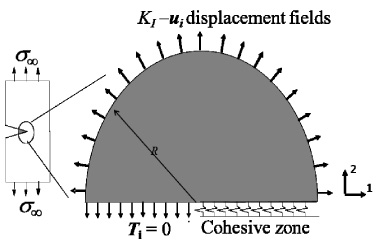
Schematic description of small scale damage configuration used to model SCG in a single crystal of ceramic subjected to mode I, plain strain loading.
Cubic elastic constants of zirconia single crystal [6]
Transverse isotropic components of sapphire single crystal [11]
For the tow single crystals, the isotropic properties are extracted from the spherical and deviatoric parts of the cubic elastic moduli tensor. The forth order isotropic elastic moduli tensor
The isotropic properties (E
iso
, 𝜈
iso
) are then calculated from the following relations
Based on the elastic parameters reported in Tables 1 and 2, the isotropic parameters for zirconia are E
iso
= 315 GPa and 𝜈
iso
= 0.24, and for sapphire E
iso
= 420 GPa and 𝜈
iso
= 0.3. Based on Zhurkov’s analysis [15], a critical thickness
The parameters 𝛽 and
The calibration of cohesive zone parameters for sapphire and zirconia single crystals is realized in ambient air with respect to the experimental V − K I curves of SCG for each single crystal.

Calibration and experimental data of SCG of sapphire and zirconia single crystals in ambient air.
The available experimental results of SCG in ambient air for sapphire and zirconia single crystals presented in Fig. 3 show that the V − K
I
curves of these single crystals are close to each other. However, the results of identification show a significant difference between the values of the characteristic opening velocity
In the formulation of the problem in small scale damage, the level of the applied stress is independent of the value of the Young modulus E for a given load level in terms of stress intensity factor K I . Therefore, the crack velocity increases with decreasing E at a given load level K I .
Furthermore, the amount of energy dissipated to create the free surface in the material corresponds to J integral in the crack initiation. Therefore, the load level close the crack tip is characterized by the amount of the J-integral corresponding to the energy release rate G in case of linear-elastic behavior which increases with decreasing the Young modulus E leading to higher level of the nominal traction at the cohesive surface. In other words, let’s consider 2 crystals having same cohesive parameters but different Young modulus E 1 < E 2, a crack advance with same crack velocity V in the 2 considered crystals requires a load level K 1 < K 2 respectively. However, these load levels correspond to the same amount of energy release rate G.
As a consequence, while in the literature SCG is represented indiscriminately in V − K
I
or V − G graph, we suggest to represent the results of SCG in V − G graph when comparing the characteristics of SCG in different materials. Therefore, the results of SCG in single crystals of zirconia and sapphire are now reported in V − G curve (cf. Fig. 4) that show a crack velocity in zirconia single crystal smaller than that observed in sapphire for a given load G. This observation is evidenced by the calibration of parameter
Cohesive zone parameters for SCG in zirconia single crystal
Cohesive zone parameters for SCG in sapphire single crystal
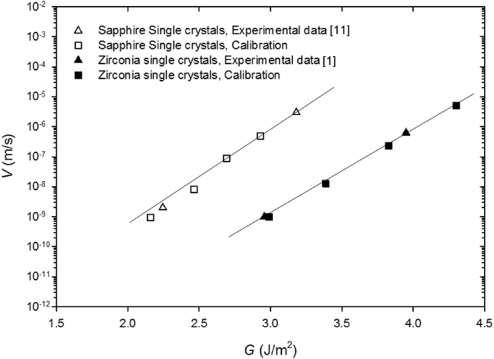
Crack velocity V versus strain energy release rate G for sapphire and zirconia single crystal in ambient air.

Small scale damage configuration used for the analysis of SCG in a 2D polycrystal.
The identified cohesive parameters in case of single crystal are used to describe intergranular fracture under SCG in a polycrystal of ceramics. The polycrystal of ceramic is considered as a granular zone composed by anisotropic hexagonal grains with random directions embedded in a continuum, homogeneous equivalent medium. An initial crack emerges in the granular zone and cohesive surfaces are inserted along the grain boundaries (cf. Fig. 5). The mode I K-displacement fields are prescribed and intergranular failure is allowed.
In this section, a polycrystal made of anisotropic grains of zirconia is considered. The cubic elastic constants of zirconia grains are reported in Table. The elastic properties of the surrounding homogenous linear isotropic bulk are derived from Eq. (6) leading to an elastic modulus E = 315 GPa and Poisson’s ratio 𝜈 = 0.24.
The considered polycrystal consists in a 8 × 8 grains with a grain diameter 𝛷
G
= 0.8 μm. According to Zhu et al. [14], the threshold stress
The distribution of the stress component 𝜎
yy
during crack propagation under a constant load K
I
= 1.89 MPa

Stress distribution during crack propagation in a 2D polycrystal with 𝛷
G
= 0.8 μm, which is initially stress free under a constant load K
I
= 1.89 MPa
For different load levels, the predicted crack velocity V versus stress intensity factor K I are reported in Fig. 7 and are compared to the experimental results of SCG in polycrystals of zirconia conducted by Chevalier et al. [2] and to the V − K I plot of zirconia single crystal. The obtained results show that the polycrystal exhibits a higher crack resistance than single crystal, the predicted V − K I curve of polycrystal is shifted toward larger load values compared to that of single crystal. The slope of the predicted V − K I curve is comparable to that of the experimental results, but the predicted kinetics of SCG by simulation is faster than the experimental one.
The influence of the threshold stress
During the sintering process, the material is cooled down from a temperature of approximately 1500 °C to room temperature. Then, this process will induce thermal stresses that originate from both the anisotropic coefficients of thermal expansion and anisotropic elastic constants of the grains. The considered coefficients of thermal expansion are 𝛼1 = 𝛼3 = 10 × 10−6 K−1 and 𝛼2 = 11 × 10−6 K−1. The surrounding homogenous linear isotropic bulk has an isotropic coefficient of thermal expansion 𝛼 = (2𝛼1 + 𝛼2)∕3 = 10.3 × 10⁻⁶ K−1 to obtain an isotropic thermal response. The effect of the initial thermal stress state is investigated by considering a uniform cooling temperature 𝛥T = −1500 K. The corresponding boundary conditions are presented in Fig. 8(a), and the distributions of the stress component 𝜎
yy
are reported in Fig. 8(b) in which regions under traction and compression are observed. From this initial state, an external load K
I
is prescribed and intergranular failure is allowed. For example, the crack paths under a constant load K
I
= 2.21 MPa
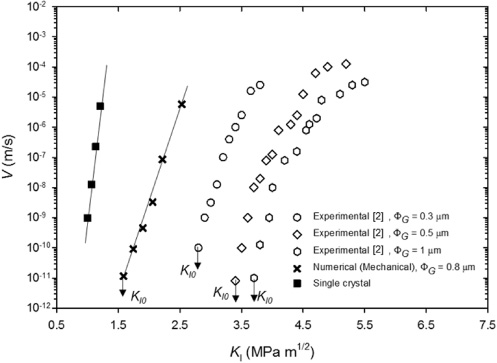
Comparison of the SCG plots V − K I between the single crystal of zirconia, the 2D polycrystal of zirconia and experimental data for sintered yttrium stabilized polycrystals of zirconia [2].
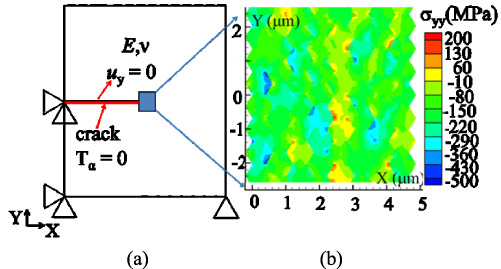
(a) Boundary conditions for thermal load. (b) Distribution of the stress component 𝜎 yy in the polycrystal of zirconia with 𝛷 G = 0.8 μm after a thermal cooling ΔT = −1500 K.
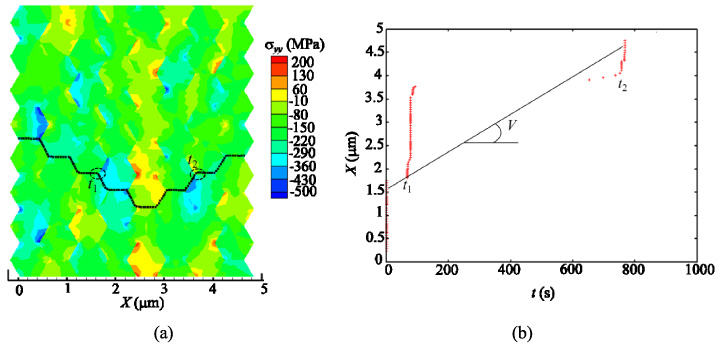
(a) Crack path for a constant load K
I
= 2.21 MPa

Influence of thermal initial stresses on the prediction of the V − K I curves and K 0 for Polycrystals of Zirconia with 𝛷 G = 0.8 μm.

Crack paths for stopped cracks: (a) without considering the initial thermal stress and (b) with considering the initial thermal stress of processing.
This section discusses the influence of the grain size on the intergranular slow crack growth.
First, a 2D polycrystal made of anisotropic grains of zirconia that are initially stress free is considered.
The influence of the grain size on SCG is evaluated by considering two polycrystal of zirconia with 0.8 and 1.6 μm grain diameters. The same amount of grains and the same grain orientation distribution are considered in the granular zones. The obtained results of simulation for the two considered grain sizes are reported in Fig. 12. The obtained V − K I curves appear as superposed with identical predicted load threshold K 0 where a premature arrested crack is observed up on initiation of propagation for the two considered grain size. The stress distribution depends on the grain to grain misorientation and on the anisotropy in elastic moduli. However, the experimental observations reported in the literature [2] show that increasing grain size improves the resistance to slow crack growth in polycrystals of ceramics. Therefore, taking into account the mechanical anisotropy alone is not sufficient to predict the grain size effect experimentally observed.
The influence of the thermo-elastic stresses on the initial damage and related dependence on the grain size has been investigated by Tvergaard and Hutchinson [13] and numerically by Ortiz and Suersh [8]. The influence of the initial thermal stresses is now considered by prescribing a uniform cooling temperature ΔT = −1500 K that induces tensile and compression regions. From this initial stress state, a mechanical test under a constant K
I
is applied. The V − K
I
curves corresponding to the two considered grain sizes are reported in Fig. 12. There curves are compared with the results of SCG in polycrystals of zirconia initially stress free. For the two grain sizes, taking into account the initial thermal stress contributes in increasing the resistance to SCG by decreasing the crack velocity V at a given load K
I
and increasing the load threshold K
0. This resistance to SCG increases by increasing grain size when initial thermal stresses are accounted for. The dependence of SCG on the grain size originates from the initial stress distribution and in particular the presence of initially compressive region. From this initial state, the polycrystal is subjected to an instantaneous mechanical loading and is followed by a relaxation of load by the intergranular cohesive surfaces along the grain boundaries. A relaxation of the intergranular cohesive surfaces with an opening 𝛿 is possible. By considering an identical opening
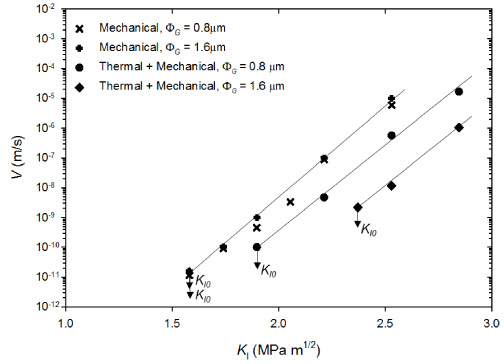
Influence of the grain size and prediction of the V − K I curves for two size grains 𝛷 G = 0.8 and 1.6 μm of polycrystal of zirconia with account for the initial thermal stresses compared to polycrystal of zirconia which are initially stress free.
In previous sections, the intergranular slow crack growth is investigated in the polycrystal of zirconia. In this section, SCG in the polycrystal of alumina is considered and the obtained results are compared with those of polycrystal of zirconia. Moreover, a 2D polycrystal made of anisotropic (transverse isotropic) grains of alumina is considered. Similarly to the previous cases, we consider an initial crack emerging in a granular zone, which is embedded in an elastic isotropic bulk. The elastic properties of grains are reported in Table 2. The surrounding homogenous linear isotropic bulk has a Young’s modulus E = 430 GPa and Poisson’s coefficient 𝜈 = 0.33. The thermal anisotropy of grains is also taken into account. Assuming 1 and 2 as the directions of the crystal, the considered coefficients of thermal expansion of alumina are 𝛼1 = 8.3 × 10⁻⁶ K−1 and 𝛼2 = 9.03 × 10⁻⁶ K−1. The surrounding homogenous linear isotropic bulk has an isotropic coefficient of thermal expansion 𝛼 = (2𝛼1 + 𝛼2)∕3 = 8.54 × 10⁻⁶ K−1. An activation energy U 0 = 160 kJ/mol identical to that of zirconia is considered. The identified cohesive zone parameters of sapphire in ambient air are adopted (cf. Table 4). Processing ceramic polycrystals involves sintering where the temperature cooled down of ΔT = −1500 K. For this purpose, a thermal loading with the boundary conditions presented in Fig. 8(a) is considered. For the case of a granular zone composed by 8 × 8 grains, the distributions of the initial stresses component 𝜎 yy are reported in Fig. 13, where regions under traction and compression are observed.
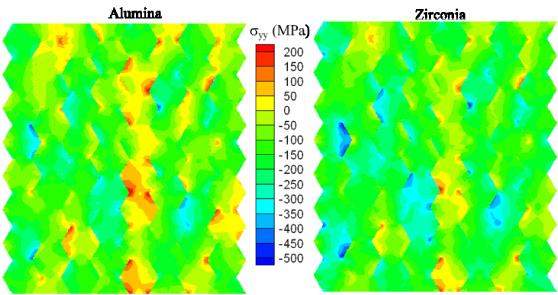
Distribution of the stress component 𝜎 yy in the granular zone of the polycrystals of alumina and zirconia after a thermal cooling ΔT = −1500 K.

SCG plots V − K I for the calibration of cohesive parameters of sapphire, the 2D polycrystal of alumina for two grain sizes 𝛷 G = 0.8 and 1.6 μm and experimental data for stabilized polycrystals of alumina with a grain size 𝛷 G = 1.7 μm [3].
From this initial state, an external load K
I
is prescribed and intergranular failure is allowed for a stress threshold
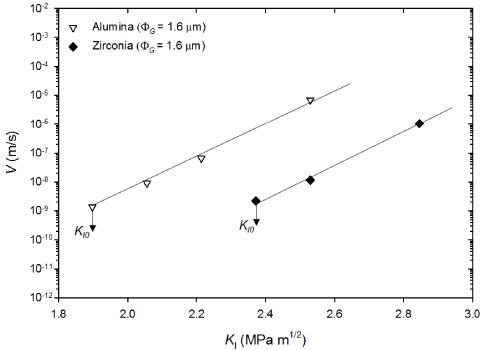
Crack velocity V versus the stress intensity factor K I for polycrystals of alumina and zirconia.
Based on those numerical results, SCG resistance of alumina and zirconia is now compared by considering two polycrystals having same grain size 𝛷
G
= 1.6 μm for example. The same amount of grains in the granular zone and the same grain orientation distribution are considered and same
In fact, the slow crack growth kinetics depends on the cohesive zone parameters. The identified cohesive zone parameters of sapphire are considered to simulate the intergranular SCG in the polycrystal of alumina (cf. Table 3). Knowing that the crack velocity is directly proportional to

Crack velocity V versus the stress intensity factor G for polycrystals of alumina and zirconia.
A physically cohesive model for slow crack growth in ceramics proposed by M. Romero de la Osa et al. [9,10] and B. El Zoghbi et al. [5] is presented. A calibration of the cohesive parameters for sapphire and zirconia single crystals is carried out in ambient air with respect to the experimental data. It is shown that the cohesive model can capture realistically experimental data of SCG in a single crystal. The representation of SCG results in a V − K
I
graph shows similar SCG behaviour of sapphire and zirconia single crystal in ambient air. On the other hand, the identification results of the cohesive zone parameters are not the same for the two involved single crystals. The characteristic opening velocity
Then SCG in 2D ceramic polycrystals is investigated. Intergranular failure is modeled with the identified cohesive zone parameters of SCG in single crystal of ceramic. The initial thermal stresses related to processing have shown beneficial on the level of the load threshold K 0 by increasing its predicted value. A crack arrest is observed when the crack tip reaches a region where the compression is initially high enough to stop the failure by SCG. Besides, the consideration of the initial thermal stresses is necessary for predicting the grain size effect on SCG. This is observed by considering two grain sizes 𝛷 G = 0.8 μm and 𝛷 G = 1.6 μm.
This description of SCG is then used to predict SCG in polycrystal of alumina, which is compared to the resistance of zirconia in SCG. The identified cohesive zone parameters for sapphire are used to predict the intergranular failure in polycrystal of alumina. The value of the characteristic opening velocity
Footnotes
Conflict of interest
None to report.