



Abstract
The present work aims to study the stress concentration factor (SCF) reduction using different functionally graded materials (FGMs) layer around the circular hole in an infinite homogeneous material panel for different load conditions. Young’s modulus of FGM layer has been considered to be varied along radial direction while Poisson’s ratio has been kept constant. The extended finite element method (XFEM) is used to find the effect of FGM layer properties i.e. Young’s modulus ratio, power law index and layer thickness on SCF. Four FGM models have been used in the present work out of which power law function based thicker FGM layer ensure the least value of SCF.
Keywords
Introduction
FGMs are nature inspired composite materials. Their continuous varying material properties along spatial dimension(s) make them a suitable material for a number of engineering applications where conventional materials fail to perform. Kim and Paulino [9] presented the first SCF analysis for FGM plate and reported that SCF is significantly affected by varying properties of FGM which is otherwise independent of material properties for homogeneous materials. A detailed SCF analysis of FGM panel can be traced in the work of Kubair and Bhanu-chander [12], in which the effect of different FGM properties on SCF was presented using finite element method (FEM). Yang et al. [20] applied complex variable theory on infinite FGM plate to calculate SCF around the hole. Mohammadi et al. [14] analytically investigated the stiffness and SCF for exponential FGM plate with circular hole. Yang et al. [21] reported the effect of FGM properties on finite FGM plate using complex variable theory. Ashrafi et al. [1] solved SCF problem of circular hole in exponential FGM plate using graded boundary elements. Kubair [10,11] reported closed form solution of SCF problem in FGM plate subjected to anti-plane load. Sburlati [15] and Sburlati et al. [16] attempted to reduce the SCF by applying the FGM layer around the hole, instead of using whole panel of FGM. Enab [4] presented FEM analysis of SCF around elliptical hole in FGM plates. Shi [17] analytically analysed the elastic stress field around the circular elastic inclusion in FGM panel. Gouasmi et al. [5] presented FEM analysis for SCF due to circular notch in a FGM panel as well as due to circular notch surrounded by FGM layer in a homogeneous panel. Dave and Sharma [3] applied complex variable theory to predict the stresses and moment in power law FGM plate for circular and elliptical hole. Yang and Gao [19] reported SCF reduction by applying power law FGM layer around the elliptical hole. Goyat et al. [6] analysed SCF reduction around rounded rectangular hole with the help of power law FGM layer using XFEM. Yang et al. [22] applied complex variable theory to solve the SCF problem in a homogeneous panel with arbitrary shape discontinuity coated with FGM. Goyat et al. [7] presented a comparative analysis of different FGMs to reduce the SCF around circular hole in FGM panel using XFEM. Goyat et al. [8] reported XFEM analysis of SCF reduction around a pair of circular holes by the application of FGM layer.
Literature review reveals that the SCF can be reduced significantly using FGM layer around the hole, but a comparative analysis of different FGM materials and their properties are not found in the literature. In the present work, a parametric analysis of SCF reduction by using FGM layer of different functions, power law index, layer thickness and Young’s modulus ratio have been presented for a homogeneous material panel with central circular hole subjected to different load conditions. The XFEM coupled with level set method has been used to study the effect of FGM layer properties on SCF. Four FGM models have been used in the present work, i.e.: power law FGM (PFGM), exponential FGM (EFGM), another parametric class of power law FGM (APC-PFGM) [7] and sigmoid FGM (SFGM). Different metal ceramic FGMs have also been used. This work may provide an insight to select a suitable FGM layer and its properties for reducing the SCF in a mechanical structure.
Extended finite element method (XFEM)
XFEM is a Galerkin FEM-based numerical method that uses the “partition of unity” [13] concept to model the discontinuities, i.e. hole, inclusion, crack, interfaces, etc., without a conformal mesh. It uses the enrichment functions to predict the behaviour of discontinuities in discrete model. This method was proposed by Belytschko and Black [2]. In this work, the XFEM has been used to analyse the SCF in an infinite panel having central circular hole surrounded by FGM layer. To model the hole in XFEM, the following scheme has been used [18]:

Flowchart of XFEM solution scheme.
A MATLAB computer code has been developed using XFEM solution scheme (shown in Fig. 1) with isoparametric graded eight-node quadrilateral elements to solve the SCF problem in an infinite thin square panel (dimension 30 times to the hole radius (r 0)) with circular hole surrounded by FGM layer subjected to different far field stress conditions. The problem geometry is shown in Fig. 2, in which H, W and t represents height of panel, width of panel and FGM layer thickness respectively. Four FGM material models have been used in this work to form a layer around the hole are as follows:

Problem geometry.
Exponential FGM (EFGM)
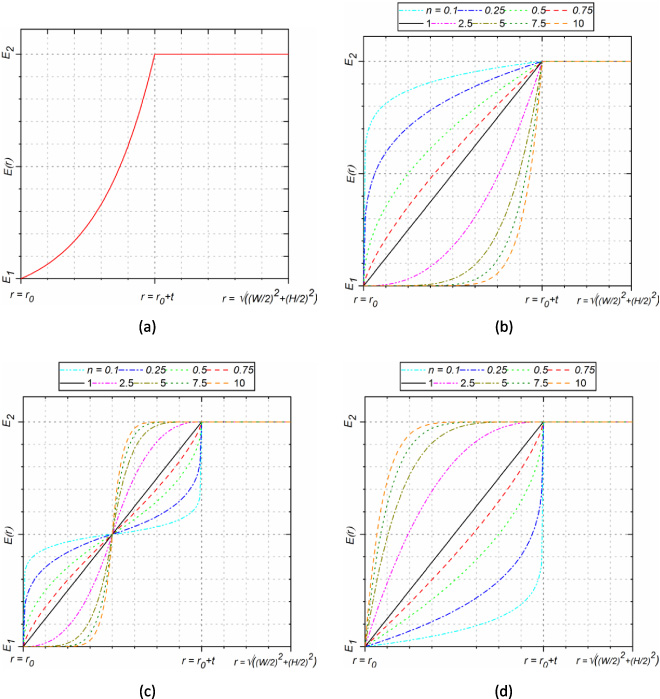
FGM material models (a) EFGM, (b) PFGM, (c) SFGM and (d) APC-PFGM.
The developed computer code has been validated with the work of Sburlati et al. [16]. For this PFGM layer has been used with E ∗ = E 2, E 1 = 0, r ∗ = r, t = t + r 0 and n = 0.5 and 1 under uniaxial tensile far field stress of 1 MPa. The obtained stress distribution of 𝜎 yy along x-axis is shown in Fig. 4 along with the published results of Sburlati et al. [16]. A good agreement has been observed between the results obtained from the developed computer code and the results reported in the literature, and a maximum error of <1.5% has also been noticed.
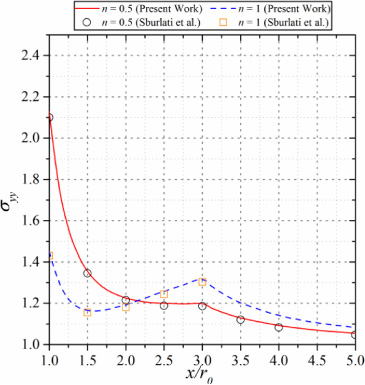
Validation of computer code (Sburlati et al. [16]).
This section contains the stress distribution and SCF analysis of square panel having circular hole surrounded by FGM layer and subjected to uniaxial tensile far field stress of 1 MPa. The SCF has been calculated as the ratio of maximum induced stress to the applied far field stress. The SCF is independent of Young’s modulus and Poisson’s ratio of homogeneous material and for an infinite homogeneous material panel with circular hole the value SCF is 3. For the case of infinite panel with different FGM layer around the circular hole the SCF values have been computed using XFEM computer code. Table 2 contains SCF values for PFGM, SFGM and APC-PFGM with different values of power law index n at a specific value of Young’s modulus ratio E ∗ = 5 and FGM layer thickness t = r 0. It has been observed that the SCF value of panel with FGM layer is significantly different from homogeneous panel case. This difference in the SCF value appears due to the varying Young’s modulus of FGM layer. As can be seen in Table 2, the SCF is significantly affected by power law index n as it controls the rate of change of Young’s modulus of FGM layer.
SCF for different FGM layers with E
∗ = 5 and t = r
0
SCF for different FGM layers with E ∗ = 5 and t = r 0
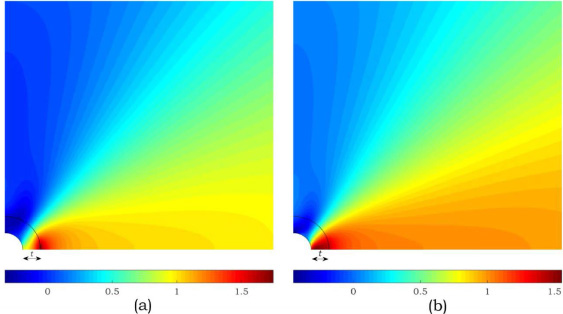
Stress distribution of stress 𝜎𝜃𝜃 around the hole reinforced by a FGM layer of (a) EFGM and (b) PFGM (n = 0.5) with E ∗ = 5 and t = r 0.
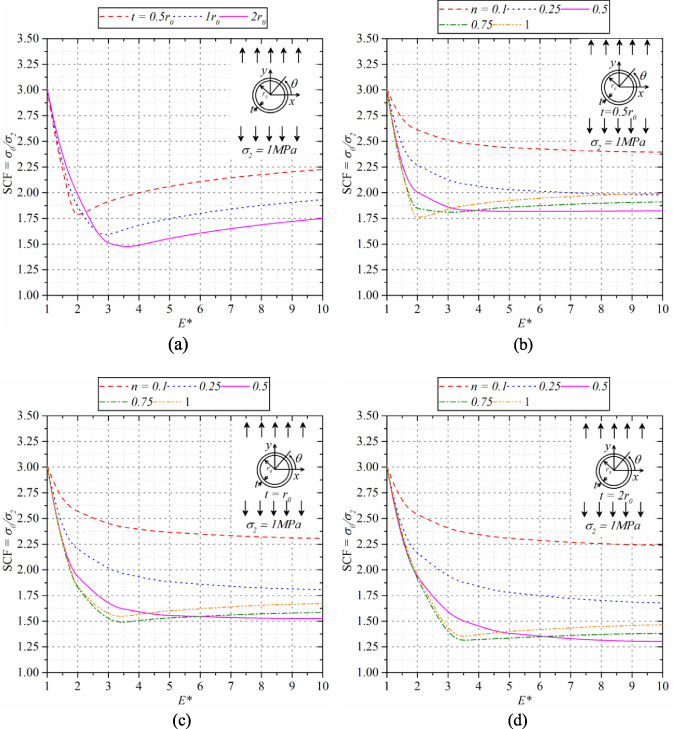
Variation of SCF with E ∗ for FGM layer of (a) EFGM, (b) PFGM with t = 0. 5r 0, (c) PFGM with t = r 0 and (d) PFGM with t = 2r 0 and subjected to uniaxial tensile load.
Furthermore, it is also observed that the SCF decreases with increase in n and after attaining a minimum value it starts increasing with increase in n. The minimum value of SCF has been found with n = 0.75 for PFGM and n = 1 for SFGM and APC-PFGM. The n = 1 represents the linear FGM case and is the same for PFGM, APC-PFGM and SFGM. Therefore, it is clear that the SFGM and APC-PFGM are not suitable for FGM layer in order to obtain least SCF. In the subsequent analysis, the PFGM along with EFGM have been analysed. Furthermore, power law index n has been selected in the range of 0.1 to 1.

Variation SCF with E ∗ for FGM layer of EFGM, PFGM (n = 0.5) and different metal-ceramic under uniaxial tensile load.
It can also be observed from Table 2 that APC-PFGM, which was found as the best candidate FGM material model for FGM panel with circular hole [7], are unable to continue their superiority in panel with FGM layer around the hole. In this work, PFGM provides lower SCF values than APC-PFGM.
Figures 5(a–b) show the hoop stress distribution around the hole surrounded by EFGM and PFGM (with n = 0.5) layer respectively. The stress distribution is found symmetric about both axes and therefore the stress distribution of quarter section is shown in Fig. 5. The Young’s modulus ratio has been used as E ∗ = 5 and layer thickness as t = r 0. For EFGM layer case, it was observed that the stress concentration region is shifted towards the FGM layer interface and for PFGM layer case, no significant shift was observed. Furthermore, the value of SCF has been found reduced for both cases when compared with homogeneous panel case.

Variation of SCF with E ∗ for FGM layer of (a) EFGM, (b) PFGM with t = 0. 5r 0, (c) PFGM with t = r 0 and (d) PFGM with t = 2r 0 under biaxial tension.

Variation SCF with E ∗ for FGM layer of EFGM, PFGM (n = 0.5) and different metal-ceramic under biaxial tensile load.
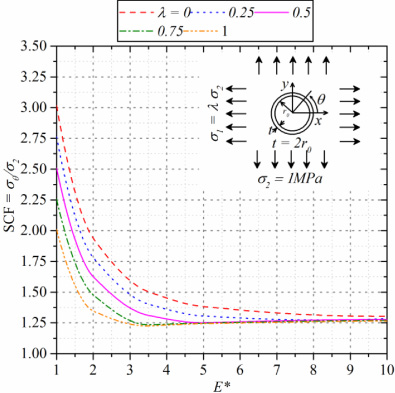
Variation of SCF with E ∗ for various values of biaxial load ratio (𝜆) in panel having layer of PFGM (n = 0.5).
Figures 6(a–d) show SCF variation with Young’s modulus ratio (E ∗) for a panel with hole surrounded by FGM layer of EFGM, PFGM (t = 0. 5r 0), PFGM (t = r 0) and PFGM (t = 2r 0) respectively. The far field stress of magnitude 𝜎2 = 1 MPa has been applied in y-direction and power law index for PFGM has been used as n = 0.1, 0.25, 0.5, 0.75 and 1. From Fig. 6(a) i.e. EFGM layer case, it can be observed that for lower values of E ∗, SCF decreases with increases in E ∗ but, for higher values of E ∗, it increases with increase in E ∗. For E ∗ > 2.5, it can be stated that the value of SCF decreases with increase in t. From Figs 6(b–d) i.e. PFGM layer cases, it can be observed that for n = 0.1, 0.25 and 0.5, SCF decreases with increase in E ∗ further rate of decrease in SCF lowers down with increase in E ∗. For n = 0.75 and 1, with increase in E ∗ the SCF shows decreasing trend followed by slight increase to become a constant value.
While observing the effect of layer thickness t, it has been found that SCF decreases significantly with increase in t. Furthermore, the results reveal that the least value of SCF can be traced by n = 0.5 for higher values E ∗ and n = 0.75 for lower values of E ∗.
The SCF for EFGM, PFGM (n = 0.5) and different metal ceramic FGMs such as exponential gradation based Copper-Titanium mono-Boride (ECuTiB), Titanium Titanium mono-Boride (ETiTiB), Aluminium Titanium mono-Boride (EAlTiB) and power law based PCuTiB, PTiTiB, PAlTiB are shown in Fig. 7. The FGM layer thickness has been used as t = 2r 0. It has been observed that the PFGM (n = 0.5) showed better results than EFGM and the PAlTiB has least value of SCF in all metal ceramic FGM layer configurations.
The variation of SCF with E ∗ for FGM layer of EFGM, PFGM (t = 0. 5r 0), PFGM (t = r 0) and PFGM (t = 2r 0) is shown in Figs 8(a–d) respectively. The biaxial tensile load in x as well as y-direction (𝜎1 = 𝜎2 = 1 MPa) has been applied. The variation of SCF for EFGM and PFGM are found similar as of uniaxial tensile case. Furthermore, it has been noticed that larger the FGM layer thickness lower the SCF value. For PFGM case, the power law index n = 0.5 showed better results irrespective of t and E ∗.
The variation of SCF with E ∗ for EFGM, PFGM (n = 0.5) and different metal ceramic FGMs (ECuTiB, ETiTiB, EAlTiB, PCuTiB, PTiTiB and PAlTiB) under unity biaxial tensile load is presented in Fig. 9. It has been noticed that the PFGM with n = 0.5 has better results than EFGM further, PFGM based metal ceramics have lower value of SCF than EFGM based metal ceramics. The effect of biaxial load factor (𝜆) on variation of SCF with E ∗ for PFGM with n = 0.5 and layer thickness t = 2r 0 is shown in Fig. 10. It has been observed that for a particular value of E ∗ the SCF decreases with increases in 𝜆.
Shear load
Figures 11(a–d) show the relation of SCF with E ∗ for EFGM, PFGM (t = 0. 5r 0), PFGM (t = r 0) and PFGM (t = 2r 0) layer respectively at shear load (𝜏 = 1 MPa). From Fig. 11(a) i.e. EFGM layer case, it has been observed that for lower values of E ∗, SCF decreases sharply with increases in E ∗, but for higher values of E ∗ it increases with increase in E ∗. For PFGM cases (except n = 1), SCF decreases with increase in E ∗, but for n = 1, SCF first decreases sharply with increase in E ∗ and then shows a slight increase with further increase in E ∗. From Fig. 11 it has been observed that for a particular value of E ∗, SCF decreases with increase in t. It has furthermore been noticed that the PFGM with n = 0.75 has least value of SCF for maximum range of E ∗ and all values of t.
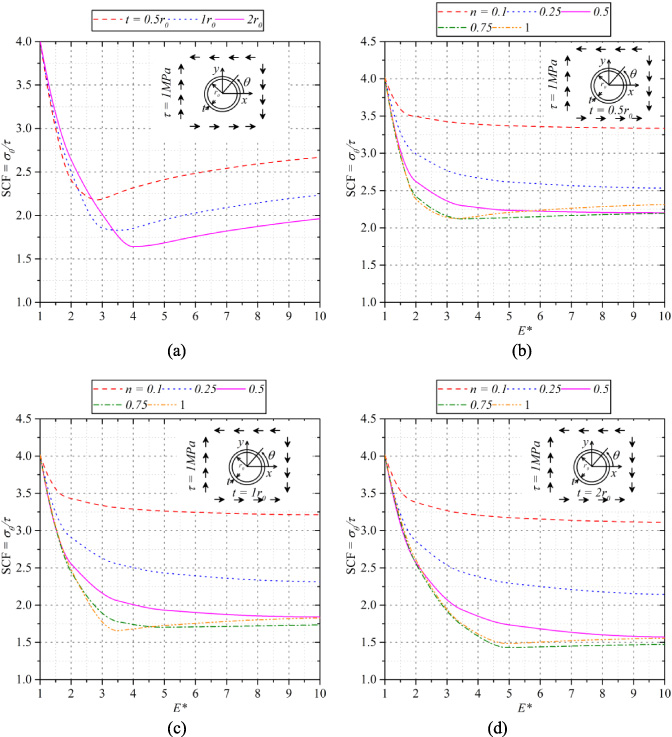
Variation of SCF with E ∗ for FGM layer of (a) EFGM, (b) PFGM with t = 0. 5r 0, (c) PFGM with t = r 0 and (d) PFGM with t = 2r 0 under shear load.
The comparison of EFGM and PFGM (n = 0.75) along with different metal ceramic FGMs is presented in Fig. 12 for layer thickness t = 2r 0. It has been observed that the PFGM (n = 0.75) has least values of SCF for a particular value of E ∗. Furthermore, the PAlTiB showed the best result among metal ceramic FGMs.
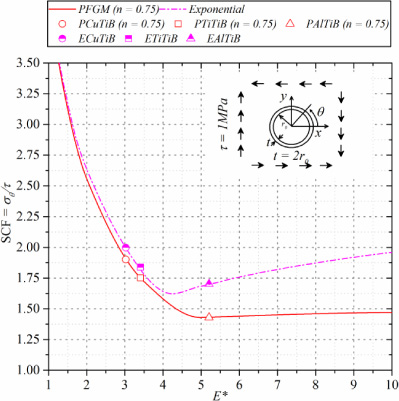
Variation SCF with E ∗ for FGM layer of EFGM, PFGM (n = 0.5) and different metal-ceramic under shear load.
This work provides the SCF analysis for homogeneous panel with a central circular hole surrounded by different FGMs layer using XFEM. The validation of developed XFEM computer code reveals that XFEM is a reliable and accurate numerical method to analyse the SCF problems in FGMs. From this work, it is concluded that the SCF can be reduced significantly using FGM layer around the hole. The PFGM was found to be the best model among all the studied FGM models. One can choose power law index n = 0.75 for lower values of E ∗ and n = 0.5 for higher values of E ∗ in case of uniaxial tension load. For biaxial tensile load n = 0.5 and shear load, n = 0.75 can be selected to achieve least value of SCF. It was also observed that the FGM layer thickness t and Young’s modulus ratio E ∗ have a significant effect on SCF. In metal ceramic FGM layer cases, PAlTiB is found to be the best among all the studied metal ceramic FGMs. This work may provide an insight to select a suitable FGM layer and its properties for reducing the SCF in a mechanical structure.
Conflict of interest
None to report.