



Abstract
In this study, a smoothed particle hydrodynamics (SPH) method for analyzing fatigue crack propagation was developed. In the simulation program, a crack is modeled to propagate virtually in particles based on the linear fracture mechanics and the Paris-Erdogan Law. This is realized by removal of one particle per analysis cycle. The SPH simulation in the case of the half elliptical surface crack propagation has given a smooth crack shape history, which is similar to the fatigue test result.
Introduction
To ensure the safety of mechanical structures, it is essential to estimate the fatigue damage, and the fatigue crack propagation is one of the dominant phenomena of fatigue damage. Accordingly, the crack propagation analysis with the element-free Galerkin method [4–6], the free mesh method [33,34], the X-FEM [1–3,8–10,12,13,19,21–24,26,29–32], and the multilevel finite element mesh superposition technique [11,16–18] and so on have been investigated in the last decades. Since the X-FEM is available as some commercial FEM software [1,2,8–10,12,13,19,21–24,29–32], it is said that the X-FEM is one of the most popular approaches to solve various engineering problems related to crack propagation.
In the case of practical engineering problems, however, we often face the crack separating and merging problems [15,27]. It is reported that the ABAQUS X-FEM program cannot solve such problem [1]. The Coad_Astar X-FEM program is considered able to manage the problem better, but it is reported that the program generates the inextricable kink, giving unnatural crack propagation during merging as shown in Fig. 1(b) and (c) [9,15,21]. Therefore, from the practical point of view, it is concluded that the above issues are difficult to solve with the X-FEM.
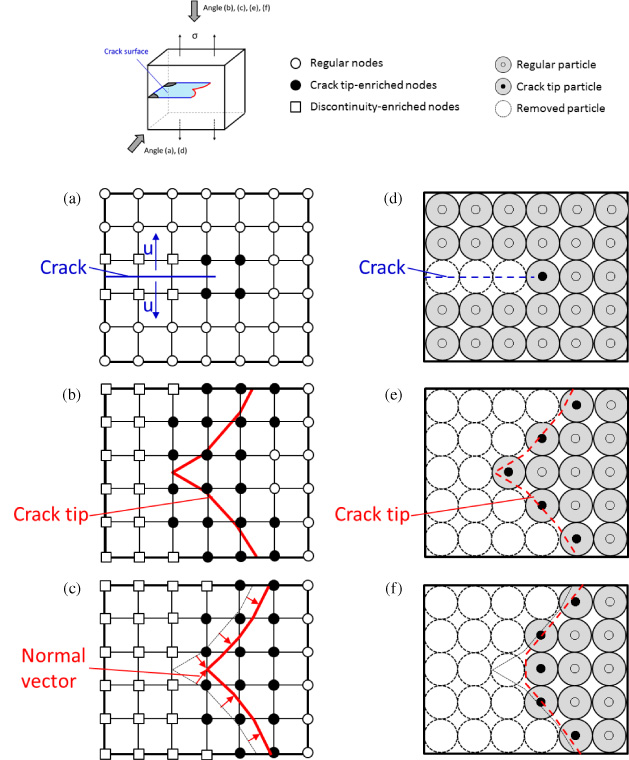
Fatigue crack propagation algorithm: FEM vs. SPH.
On the other hand, the particle methods represented by the SPH [20] are thought to have a potential to handle the above problems rather easily, because the methods can define discontinuity in the crack area simply as shown in Fig. 1(d). Thanks to this fact, in the case of the crack merging problem, although a kink is generated when cracks merge as shown in Fig. 1(e), it is thought that the kink can be smoothed naturally by removing the particle at the kink point.
Accordingly, in this study, a fatigue crack propagation program based on the SPH was developed, and the half elliptical surface crack propagation phenomenon, one of the fundamental fatigue crack propagation problems, was analyzed and compared with the fatigue crack propagation test results.
Stress intensity factor range for SPH
In order to discuss the way of computing the K value with SPH, a single edge cracked plate model [7,25] was analyzed, comparing with numerical results in the references [7,25] and our FEM results.
Figure 2 shows the stress distributions near the crack tip. It seems that the SPH results for the stress values, slightly higher than those of the references and our FEM, are well in inverse proportion to the square root of r, where r is the distance from the crack tip [14]. On the other hand, as shown in Fig. 2(b), the FEM stress values near the crack tip deviates from the inverse proportion curve, whereas this is not the case for those calculated with the SPH, which follows the theoretical curve closely. Thanks to these characteristics, even if the K value is calculated directly from the stress value of the crack tip particle, the degree of error remains constant in the case of the SPH.
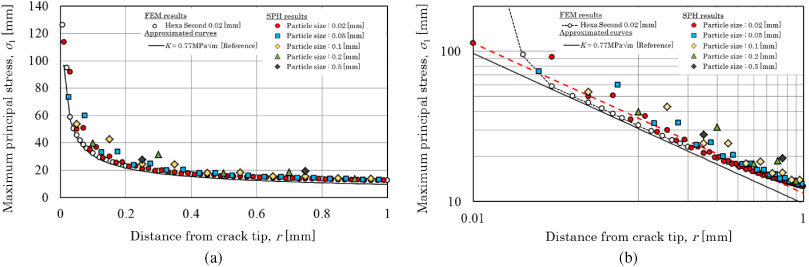
Stress distribution near crack tip: (a) Normal scale, (b) Logarithmic scale.
In this paper, we, using the above beneficial behavior of the SPH, calculated the K value based on the stress value of the crack tip particle. In the elastic condition, the stress distribution near the crack tip is written as
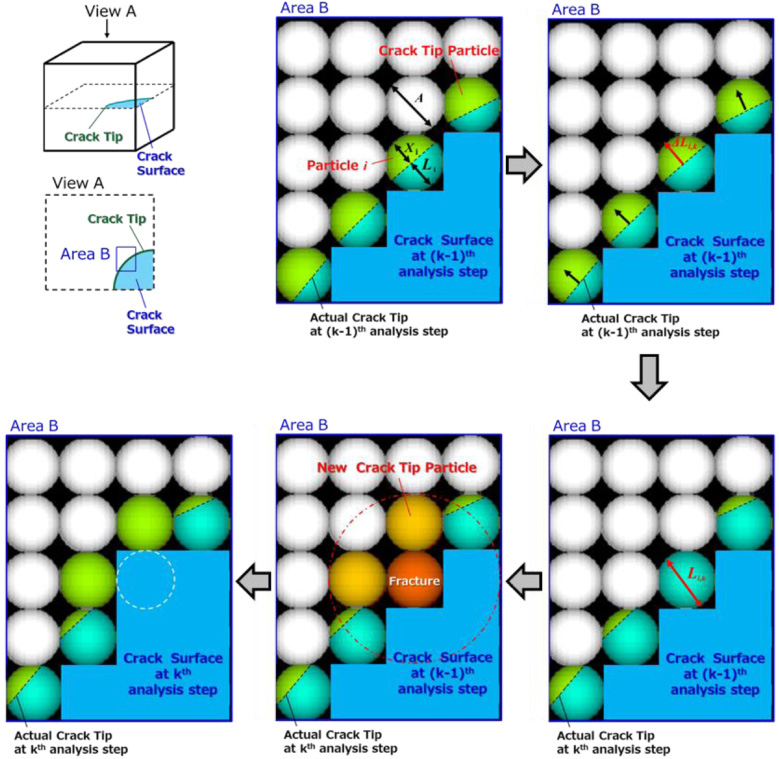
Fatigue crack propagation process.

Results of single half elliptical surface crack propagation.
Figure 3 shows the sumamry of the fatigue crack propagation process. In the crack tip particles, actual crack tips are defined as short dashes. In the particle i, the crack length L
i
, the un-cracked length X
i
, and the particle size A have the following relation:
Figure 4 shows the result of the half elliptical surface crack propagation. As can be seen in Fig. 4(b), the crack shape history of the tested fracture surface is clearly visualized by beach marks. Figure 4(c) shows the crack shape history analysed by the SPH, showing almost the same result by the test.
Conclusions
The following conclusions were made:
(a) The SPH is able to calculate stress singularity at the crack tip rather accurately.
(b) The K value obtained by the SPH analysis tends to be higher than the reference values.
(c) The half elliptical surface crack propagation is simulated in a smooth manner with the SPH.
(d) The results of the SPH analysis closely trace the beach marks observed at the fractured specimen tested.
(e) It is concluded that the SPH method is considered to be useful for the analysis of the fatigue crack propagation.