



Abstract
For Li-ion batteries, the main challenges of performance and lifetime decay are primarily dominated by the electrode mechanical behavior such as stress, fracture and structure degradation. Herein, an in situ experimental method is proposed to investigate the mechanical behavior during the electrochemical process. A customized electrochemical cell with a glass window is designed and used in conjunction with a charge-coupled device optical acquisition system to monitor electrode deformation during the electrochemical process. Further, three equations that characterize the mechanical responses are established, including an equation governing the evolution of elastic modulus as a function of Li concentration and an electrochemical stress model with a Li-dependent elastic modulus for modification of the standard Stoney equation. Finally, combining the measured deformation in the Si-composite electrode with these three equations, the elastic modulus and stresses are quantitatively characterized with capacity such as surface stress in the Si-composite electrode material and tangential stress at the interface. These new results show a significant softening of the Si-composite electrode material by 89%, where the softening significantly relieves the axial stress in the Si-composite electrode material and the tangential stress in the interface by 87%.
Introduction
Due to its high specific capacity, Si has been considered a promising anode material for alternative carbon materials [8,9]. However, Si experiences a significant volume expansion and high stress during the electrochemical process, which induces fracture and pulverization [4,6]. This affects the electrochemical process of the electrodes and results in performance and lifetime degradation in batteries [4,5]. The electrode undergoes a complex mechano-electro-chemical coupling process, wherein the electrochemical-induced mechanical responses become critical issues. Therefore, understanding and acknowledging the material properties and stresses in electrodes via experiment is critical for understanding the mechano-electro-chemical coupled process and mechanism, and are of great scientific significance for developing high-performance electrode materials.
Up to now, the elastic modulus of a lithiated electrode material has mainly been measured by nanoindentation [1,7,9,12]. However, the data dispersion exhibited by the same material makes it difficult to determine the exact elastic modulus as a function of Li concentration to calculate electrode stress, and no research for a composite electrode has ever been reported. Stress measurements in thin-film electrodes are mainly determined by using a combination of the deformation measured by a multi-beam optical stress sensor and the classic Stoney equation [2,3,6,12]. However, direct application of the Stoney equation in the electrochemistry without a Li-dependent elastic modulus can introduce errors in the stress results. Herein, therefore, we establish new models and in situ experiments to measure the material properties and the stress in Si-composite electrodes during the electrochemical process.
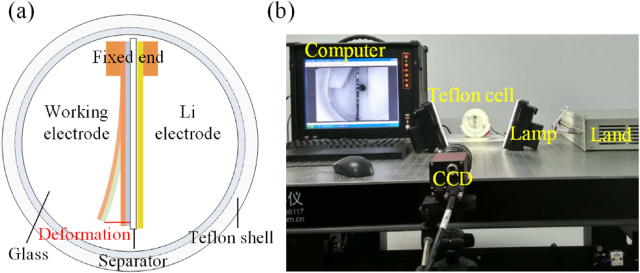
(a) Schematic illustration of the home-made electrochemical cell with a deformed electrode; (b) the CCD optical system used for the in situ deformation measurement [10].
In situ experiments
An electrochemical cell featuring a glass window was designed, which is illustrated with a simplified schematic in Fig. 1a. The electrodes exhibited a cantilevered structure with one free end, where the lateral side of the electrode rather than surface was parallel to the glass window. This arrangement allowed in situ measurements of the bending deformation during the electrochemical process. The working electrode used herein was an Si-composite electrode comprising a current collector (28 μm thick) and a composite electrode material layer composed of 70 wt% Si nanoparticles, 15 wt% conductive additive (Super P), and 15 wt% binder (sodium alginate). After assembly, galvanostatic electrochemical cycling was carried out on the Si-composite electrode using a Land battery test system at a constant current with a charge-discharge rate of C∕5 (i.e., 5 h to charge and 5 h to discharge) between 2 and 0.01 V (vs. Li/Li+). Meanwhile, the sample deformation was measured in situ via a charge-coupled device (CCD) optical system, as shown in Fig. 1b. More details of this process are given in our previous works [10,11].
Mechanical models for elastic modulus and stress
To establish the mechanical models, the composite electrode was assumed to be a bi-layer structure with electrode material that was isotropic and elastic, as shown in Fig. 2. During lithiation, an expansion of the electrode material layer appeared, which induced a mismatch stress between the two layers that resulted in a bending deformation in the electrode. Considering the Li concentration as analogous to a thermal expansion, the bending deformation was modeled and analyzed. The electrode equivalent loads at the end and the element loads including the interface are illustrated in Fig. 2. Using a balance equation, geometric equation, interface continuous equation and constitutive equation, the models were established as follows:
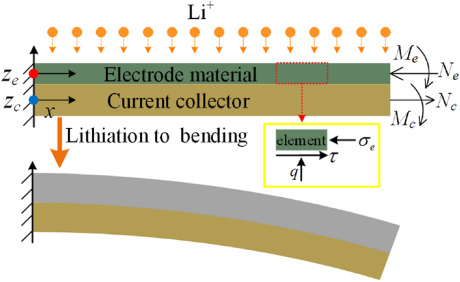
Illustration of the bi-layer electrode, showing the initial (upper) and lithiated (lower) electrode. The loads at the electrode end and at each element including the interface are shown.
The elastic modulus equation is given as [10]
Potential and deformation responses
Figure 3 shows the potential and the corresponding electrode curvature of the Si-composite electrode with capacity (i.e., Li concentration) during the second lithiation process with a constant current of C∕5. As the lithiation progresses, the potential of the Si-composite electrode gradually decreases and the curvature nonlinearly increases with increasing capacity, initially presenting a rapid trend and then a slower trend divided by an orange dotted line in Fig. 3. This changing growth trend indicates the varying material property of the lithiated Si-composite electrode with increasing Li concentration.
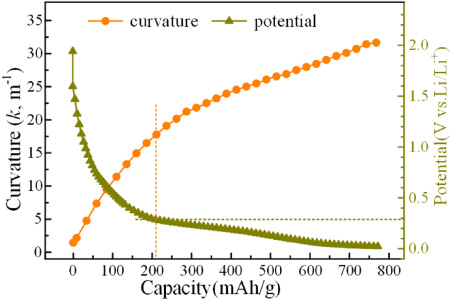
Potential and corresponding curvature of the Si-composite electrode with capacity during the second lithiation process at a rate of C∕5.
The calculation parameters used were as follows [10]: E
c
= 80 GP, h
c
= 28 μm, 𝛽 = 0.33, l = 23.8 mm, and h
e
= 18(1 + 1.3
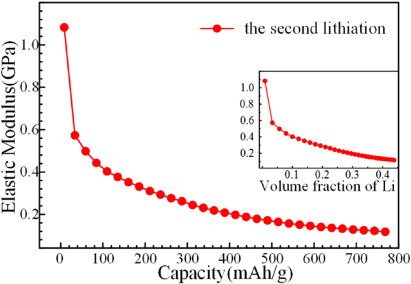
Elastic modulus of the Si-composite electrode material vs. capacity (and Li volume fraction in the inset) during the second lithiation process [10].
Introducing the measured elastic modulus (Fig. 4), the deformation data (Fig. 3) and the calculation parameters into Eqs (2) and (3), we obtained the axial stress in the Si-composite material and the tangential stress at the interface during the second lithiation. These are plotted against capacity in Fig. 5. Here, the surface stress in the Si-composite electrode material is shown as an example and, for analysis and discussion, the stresses with the Li-dependent and the constant elastic moduli are both shown. As shown in Fig. 5, the axial stress is compressive while the tangential stress is tensile during lithiation in the two conditions. With the Li-dependent elastic modulus, the axial stress and tangential stress increase nonlinearly with capacity to a maximum value of 7.9 MPa and 7.7 KPa, respectively. It is seen that the tangential stress magnitude is only several KPa, which is three orders of magnitude smaller than the axial stress, and therefore this is considered a well-bonded interface. The axial stress is two orders of magnitude smaller than that in an Si-thin film [2], which is the result of the two-orders-of-magnitude-smaller elastic modulus. It can be seen that the nonlinear trends both in the axial stress and the tangential stress with capacity are initially rapid and subsequently slow, which is roughly consistent with the trends of the elastic modulus with capacity. This indicates that the stresses are significantly affected by the elastic modulus. To further discuss this result, we compared the stresses with the two different elastic moduli. With a constant elastic modulus, the axial and tangential stresses increase linearly with capacity to a maximum of 62.9 MPa and 63.5 KPa, respectively. As a result, the softening of the electrode material by the formation of weak Li–Si bonds relieves the stresses, wherein a decrease of the elastic modulus by 89% causes an almost equivalent decrease in the stress of 87%. Therefore, for the stress measurement, the Li-dependent elastic modulus must be taken into account. In addition, the material softening and corresponding relieved stresses are profoundly important and beneficial to avoid fracture failure at interface and in electrodes.
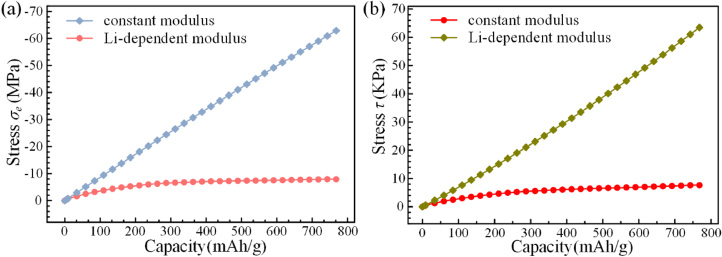
Stress vs. capacity with Li-dependent and constant elastic moduli of the electrode material. (a) Surface stress in the Si-composite electrode material. (b) Tangential stress at the interface.
In this paper, we apply a combined theoretical and experimental method to measure in situ the material property and stress in an Si-composite electrodes. The in situ deformation is captured in real time by a CCD optical system. The in situ measurements of the elastic modulus and stresses are accomplished by combining the measured deformation with a built Li-dependent elastic modulus equation and a modified electrochemical stress model that considers a Li-dependent elastic modulus.
The experiments find some new results including the potential, corresponding electrode curvature, elastic modulus and stresses of the Si-composite electrode with capacity (i.e., Li concentration) during the second lithiation process. The Si-composite electrode material softens significantly by 89% with increasing capacity, exhibiting a nonlinear behavior that is initially steep and then moderate, which is the result of weak Li–Si bonds formation during lithiation. The stresses increase with capacity, presenting a nonlinear trend similar to that exhibited by the elastic modulus. After comparison, it is found that the degree of material softening induces stress relief to a similar degree such as surface stress in the Si-composite electrode material and tangential stress at the interface. Therefore, the Li-dependent material property must be considered in the modeling of the electrode stress, fracture and structure degradation; and the experimental data herein provides a useful basis for understanding the mechano-electro-chemical coupling degradation in an Si-composite electrode.
Footnotes
Acknowledgements
This work was financially supported by the National Natural Science Foundation of China (grant nos. 11372217, 11672203).