



Abstract
Professor Takeo Yokobori, the Founder President of ICF, passed away on 9 October 2017, at the age of 100. In this paper, his whole career and research achievements are summarized. He was the first who established multiscale mechanics harmonizing micro-material structures worldwide, such as dislocation groups and grain size, with the presence of cracks. He also proposed to call his approach “Fractology”, “Combined micro and macro fracture mechanics”, “Interdisciplinary approach” and “Holistic”. “Holistic” is translated to “The Whole Theory”. He considered it the most suitable philosophical term. In this paper, these concepts are also summarized.
Keywords
Introduction
Professor Takeo Yokobori, the Founder President of ICF, has passed away on 9 October 2017, at the age of 100. He was born in 1917, graduated at the Department of Aeronautics of Tokyo Imperial University in 1941, and was employed at the Aviation Research Institute of Tokyo Imperial University.
He became Associate Professor at Tohoku University in 1955 and obtained a Doctor of Science degree from Tokyo University in 1956. He became Professor of Tohoku University at the Faculty of Engineering in 1957. He also established the Research Institute of Strength of Materials at the Faculty of Engineering of Tohoku University and became the chairman of this institute in 1964. He published many annual reports of this Institute (Rep. Res. Inst. Str. Fract. Materials, Tohoku Univ.), which were widely cited throughout the world. He became Emeritus Professor of Tohoku University in 1981. After that, he took office as the Dean of the Department of Science and Engineering of Teikyo University and also took office as Director of Teikyo University and became Emeritus Professor of Teikyo University in 2009.
In terms of his research, he first conducted research on aircraft engines at Tokyo University and proposed very original theory [7]. After the Second World War, he shifted his research interest toward the strength of materials. He has named the research on strength, fracture and fatigue of materials “Zairyo Kyoudo Gaku” (in Japanese) [13,14,18], which harmonized material properties, metallurgy and solid mechanics and originally systematized this research field. The target of his research work covered brittle fracture, fatigue, high temperature fracture, and biomaterials. Especially, he was the first who established multiscale mechanics harmonizing micro-material structures worldwide, such as dislocation groups and grain size, with the presence of cracks including the stochastic theory related to thermally activated process theory. His theories have been cited and used many times overseas and are called “Yokoboris theory” and “Yokobori’s law”. He has also proposed to call his approaches “Interdisciplinary approach” [13,14], “Combined micro and macro fracture mechanics” [18], “Fractology” [43] and “Holistic” [20]. “Holistic” is translated to “The Whole Theory”. He considered it the most suitable philosophical term.
For these research achievements, he was awarded the Japan Academy Prize (1971) and was appointed as foreign member of the U.S. Academy of Engineering (1981), and Japan Academy member (1996). Furthermore, he was honored as the Second Class Order of the Sacred Treasure (1999), and was the winner of the cultural merits prize in Japan (2000).
He published several books in Japanese [Zairyou Kyoudo gaku, gihodo pub.1955, translated into English and edited by J. D. Crisp as Takeo Yokobori: The Strength, Fracture and Fatigue of Materials, Noordhoff, Groningen, The Netherlands, 1965] [13], [The first edition of Zairyoukyoudo gaku Iwanami pub (1964), translated into English and edited by J. D. Crisp as Takeo Yokobori: An Interdisciplinary Approach to Fracture and Strength of Solids, Wolters-Noordhoff Publishing, The Netherlands (1968)] [14] and [The second edition of this book (1974) translated into Russian and edited by G.C. Pisarenko (1978)] [18].
He was furthermore elected as honorary member of the Japan Society of Mechanical Engineers, Japan Institute of Metals and Materials, and Japan Society of Materials Science. He was also elected as honorary chairman of the Japan Society for Biomaterials. He has also established the International Congress on Fracture (ICF) in 1965 and was awarded as the Founder President of ICF. In 2009, “The Takeo Yokobori Gold Medal” was established by ICF.
In this paper, the contents mentioned above are summarized.
Combined micro and macro fracture mechanics and related researches
Concerning brittle fracture of metals, instead of previous methods that noticed cracks alone, Professor Takeo Yokobori has established the mechanics which take the effect of material structures of crystal grains into account and made it possible to theoretically predict the effect of material structures on fracture strength.
The model of analysis is shown in Fig. 1 [17,22,33,42,43]. This research method is the first establishment of multiscale mechanics which incorporates the factor of material structure of crystal grains into the field of fracture mechanics which treats a crack problem alone. He considered that cracks initiate not only from main cracks but also the tip of slip band. He derived the criterion of crack initiation from the main crack and the tip of slip band, that is 𝜎c, crack and 𝜎c, slipband respectively. Fracture strength, 𝜎
f
is given by 𝜎
f
= min(𝜎c, crack, 𝜎c, slipband). Results obtained by these analyses are shown in Fig. 2 [17,22,33,42,43]. These results showed that for the case of small value of notch tip radius 𝜌, brittle fracture occurs at the notch tip and it is not sensitive to the grain size. With an increase in grain size D, fracture occurs at the tip of slip band by local stress criterion for large grain size and by energy criterion for small grain size. With further increase in 𝜌, the relationship between 𝜎
f
and

Model of analysis on micro macro fracture mechanics.

The effect of ferrite grain size on brittle fracture of low carbon steel with the parameter of notch tip radius. Theoretical results.
The theoretical results of the effect of ferrite grain size on brittle fracture of low carbon steel with the parameter of notch tip radius as shown in Fig. 2 were found be in good agreement with those obtained by experiments as shown in Fig. 3 [25,26,33,43].
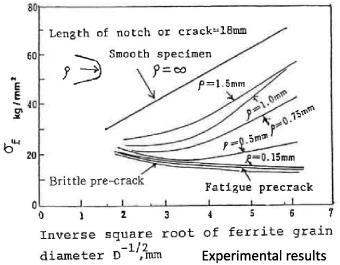
The effect of ferrite grain size on brittle fracture of low carbon steel with the parameter of notch tip radius.
Many analyses of mechanical interaction between multiple cracks and between cracks and slip band were also conducted [4,22,42]. On the basis of this, combined micro and macro fracture mechanics was established [17,43]. [17] provides an overview of fracture mechanics in Japan and his group’s works [17].
Furthermore, he has aimed to establish a fracture criterion which is different from that by maximum tensile stress, maximum shear stress and von Mises stress alone, a criterion which includes both effects of tensile and shear stress on fracture strength under combined tensile and shearing stress conditions [16,29].
Professor Takeo Yokobori has conducted theoretical and experimental research and clarified that fatigue fracture phenomenon was a statistical phenomenon dominated by the stochastic process [9,11]. These theories provide significant knowledge from the viewpoint of mechanical and structural design. These theories are also quoted by many international literature as an original and general kinetic theory which includes Weibull static theory as the special case. Furthermore, he has applied this theory to the problem of yielding of steel and has proposed the theory which is called “Yokobori’s Law” [10,12].
Theory of fatigue crack growth based rate (FCGR) on thermally activated process
Professor Takeo Yokobori experimentally and theoretically conducted systematic research on fatigue crack growth behaviors and developed original fatigue crack growth theories based on void nucleation [15,19] and dislocation dynamics theories [19,32,34]. The experimental relationship between C and n of coefficients of Paris’s law is given by Eq. (1) for steel with many various ferrite grain sizes [1,19,21,24,30,37–39,41]. [19] provides an overview of the mathematical representation of fatigue crack growth rate (FCGR) in the world. Furthermore, his experimental results on the relationship between C and n in Paris’s law [5] are discussed [19].
Paris’s law [5] given by Eq. (1) was found to be valid in the region II of fatigue crack growth rate which is the region of stable fatigue crack growth.
Professor Takeo Yokobori experimentally derived the relationship given by Eqs (2) and (3) [19].
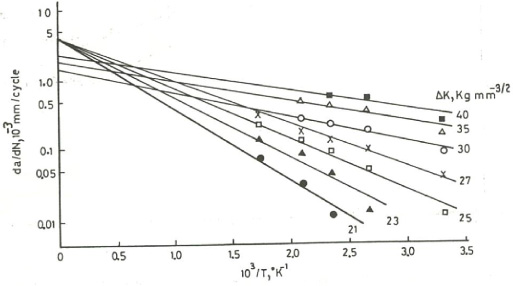
The experimental relationship between logarithmic value of FCGR and the inverse value of temperature for the increased values of 𝛥K (increase in crack length) in the second region of stable FCGR of aluminum alloys [23]. In the border of 𝛥K1 = 27 Kgmm−3∕2, FCGR is written by two different type of thermally activated equations of Eqs (4) [15,19] and (5) [19,32,34] respectively.
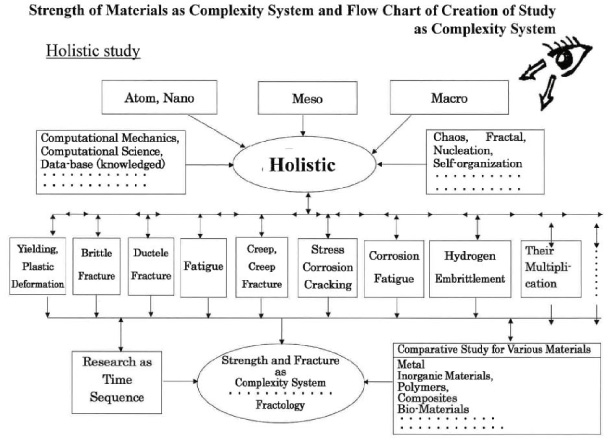
Strength of materials as complexity system and flow chart of creation of study as complexity system [20].

The first ICF held in Sendai 1965.

Collaboration with ICF.
Equation (3) was found to be independent static yield strength, but n has the trend of slowly increasing function of the ferrite grain diameter and thus indirectly decreasing function of static yield strength for low-carbon steel and 3 weight percent silicon iron, respectively [1,21,24,30,37–39,41].
Furthermore, equation of fatigue crack growth rate based on nucleation theory and dislocation dynamics theory has been proposed respectively given by Eqs (4) [15] and (5), respectively [32,34].
These equations were found to predict the characteristics of 𝛥K on fatigue crack growth rate given by Eq. (1). Especially, equation (4) was found to predict the first region of stage II (early stage of II).
Equation (5) was found to predict the followed region of stage II as follows.
The experimental relationship between logarithmic value of fatigue crack growth rate (FCGR) in the second region of stable fatigue crack growth and the inverse value of temperature for the increased values of 𝛥K (increase in crack length) of aluminum alloys is shown in Fig. 4 [23]. In the border of the specified value of 𝛥K, that is, 𝛥K1 =27 Kgmm−3∕2, in the region of 𝛥K ≤𝛥K1 (the early stage of the second region), FCGR is written by Eq. (4) [15] of which the intercept point of vertical axis is independent of 𝛥K1 . On the other hand, in the region of 𝛥K > 𝛥K1 (the latter stage of the second region), FCGR is written by Eq. (5) of which the intercept point of vertical axis is dependent of 𝛥K. Therefore, it was found to well correspond with Eq. (5) [32,34].
From the results mentioned above, FCGR in the early stage of the second region, crack growth was found to be dominated by the nucleation mechanism of void formation. On the other hand, FCGR in the latter stage of the second region was found to be dominated by dislocation group dynamics mechanism, that is, striation mechanism.
Professor Takeo Yokobori has theoretically proposed a holistic concept on the effect of creep and fatigue nonlinear interaction on fracture life [31]. The “holistic concept” [20] is examined in this section. This concept was validated experimentally [36]. Recently, this concept was also revalidated by the original theory based on chaotic analysis [40]. This theory was also validated by many experimental results [40,44].
Furthermore, concerning creep crack growth life, the Q∗ parameter which predicts creep crack growth life was proposed based on the theory of thermally activated process [27,45].
Professor Takeo Yokobori continued the international cooperative research on the standardization of the measurement and estimation methods of high temperature creep crack growth under the Versailles Agreement on Advanced Materials and Standards (VAMAS) as the Japanese representative and co-chairman of TWA11,TWA19, TWA 25 and TWA31 (1987–2009). The results obtained by this research project were highly estimated as the original results by Japanese research groups and contributed to the rise of the international position of the Japanese research of high temperature strength of materials such as ASTM and ISOTTA [2,3].
Concluding remarks concerning fracture and strength-from physics to holistic and ICF [20]
Professor Takeo Yokobori has conducted the research of prediction of fracture life and crack growth behaviors under corrosive sustained and sustained–fatigue loading conditions to clarify the interactive behaviors of sustained and fatigue loading of fracture life and crack growth behaviors as the time dependent behaviors [35]. This also concerns the “holistic concept” [20]. He was furthermore interested in the research of biomechanical engineering from the viewpoint of mechanical test method of biomaterials and tissue materials [28].
The target of his research work covered brittle fracture, fatigue, high temperature and corrosion fracture, and biomaterials. His research approach was based on a comprehensive viewpoint as shown in Fig. 5 [20].
He named the philosophy of his research the “interdisciplinary approach”, “combined micro and macro fracture mechanics” and “fractology”, however, he considered the philosophy of his research of strength of materials as “holistic”, that is, “whole theory” as shown in Fig. 5 [20] which is the final direction of his research. He also aimed and hoped that the “holistic” concept would be the direction of ICF.
Finally, some ICF photographs are shown (Figs 6 and 7) [20].