



Abstract
BACKGROUND:
Mobility devices such as walkers and wheelchairs are often associated with certain stigma. Such devices must be designed with the goal of reducing stigma to decrease the abandonment-rate. Yet there is little empirical evidence on how mobility devices are perceived.
OBJECTIVE:
This study set out to explore how (
METHODS:
A questionnaire based on semantic differential scales was designed.
RESULTS:
The results show that the more elaborate devices are perceived as more aesthetical and lighter, yet more unsafe and impractical. Moreover, respondents familiar with mobility devices through family and friends gave more biased negative responses in terms of device characteristics compared to non-experienced respondents. Next, non-experienced respondents perceived the manual wheelchair to be more stigmatizing compared to experienced respondents.
CONCLUSIONS:
The findings evidence that different designs of products in the same category can evoke different perceptions of non-users regarding practical, aesthetical and symbolic aspects. Insight into how different design characteristics are associated with perceptions of non-users may contribute to the comprehension of assistive technology stigma and may support design decisions that minimize negative judgments and emphasize positive perceptions.
Keywords
Introduction
According to the World Health Organization [1] it is estimated that approximately 190 million adults worldwide have significant reduced function and that more than 1 billion people need one or more assistive products. The International Classification of Functioning, Disability and Health (ICF) defines disability as a broad term used to categorize activity limitations and participation restrictions. Disability is the interaction between individuals with specific needs and personal and environmental factors, in this sense the concept of disability becomes quite diverse [2].
One of the means to improve the functionality of these individuals is the use of Assistive Technology (AT). Several AT devices are used to aid mobility, such as wheelchairs, walking sticks, crutches and walkers. Two widely used devices for people experiencing mobility limitations are wheelchairs and walkers.
It is estimated that about 1% of the total population, that is, around 65 million people worldwide, needs wheelchairs [1]. Broadly speaking, wheelchairs can be divided into the categories of manual wheelchairs and powered wheelchairs. Electric or motorized wheel- chairs are usually prescribed in cases where the functional and motor losses are large. In turn, manual wheelchairs are used by persons that can manually propel the chair by pushing the wheels in a repetitive way. The two most common designs of manual wheelchairs are foldable frame and rigid frame chairs. Wheelchair frame design [3, 4], handrim design [5], propulsion system [6, 7], seat-backrest configuration and accessories [6] have been shown to influence the mobility performance and the ergonomics of user-wheelchair interface.
The walker is an AT device that aims to facilitate gait, maintain balance and decrease body weight in the lower limbs with the help of the arms [8]. By having a larger support base with the surface, the walkers provide a safer support for the locomotion, increasing the balance [9].
In Brazil, the most common model is the conventional folding Walker, in which the individual must raise the walker and take steps forward to move [10]. This device is made available by the public health system.
Despite the aids available, several studies show that the abandonment of AT is common due to the stigma caused to such devices [11]. For example, Phillips and Zhao [12] found that nearly 30% of all devices are completely abandoned. The main reasons include lack of user involvement during acquisition, procurement issues, low performance and changes in users’ needs and priorities. Riemer-Reiss and Wacker [13] found that device abandonment is related to relative device advantage and user involvement. To help counteract device abandonment, Denvers, Weiss-Lambrou and Ska [14] developed an instrument for measuring user satisfaction with assistive technology devices.
Stigma can be viewed as a set of preconceptions about a particular characteristic related to an individual’s social role in society. Objects can provoke stereotypes associated with lifestyle [15].
People with disabilities often go through situations of prejudice caused by stigma that generates a negative perception. According to Goffman [16], this perception is usually accompanied by a social and cultural context that manifests itself in varied forms, including trying to help a stigmatized individual. Factors such as age, gender, device aesthetics, among others may contribute to stigmatization [17].
The negative cultural concept assistive products present causes users and family members to feel disappointed, provoking objections about the appearance and characteristics of the device [18]. The expectation of the family can be an important condition in the receptivity and use of the equipment, since in addition to the affective link, they usually present a global vision that results from the functioning of the device [17].
Although research into assistive technologies has gained increased focus there is still need for better design guidelines. There is particularly a lack of empirical evidence to fully understand the possible stigma associated with AT devices [17]. The study of symbolic and aesthetic elements can contribute to the understanding of non-users’ perception of walkers and wheelchairs.
Several researchers have addressed perceptions of assistive technologies. Examples include Cushman and Scherer [19] who found discrepancies between the perceptions of therapists and consumers in terms of device utility and aesthetics. Stern, Mullennix and Wilson [20] studied the perception of synthetic speech in context of assistive technologies. Their results showed that non-disabled respondents preferred a natural voice over synthetic speech, while disabled the synthetic speech was perceived more positively by disabled individuals. It has also been found that the appearance and to look “cool” is as important to disabled individuals as it is to non-disabled individuals [21]. Lanutti et al. [22] found gender-related differences in users’ perceptions about their own wheelchairs. In a study using semantic differentials Erler and Garstecki [23] addressed the stigma attached hearing loss and hearing aids among women. Their results suggest that younger women perceive a stronger stigma than older women. Moreover, they found that hearing loss was associated with less stigma compared to hearing aids. DeJong [24] studied how adolescent girls perceive overweight peers. The results showed that overweight girls were perceived more negatively than non-overweight peers, unless they had a valid explanation such as a glandular disorder. Shinohara and Wobbrock [25] addressed how assistive technology use is affected by social settings. Their results confirmed that 1) assistive technology marked the users as being disabled, 2) functional access trumped the feeling of self-consciousness, 3) people incorrectly perceived assistive devices as eliminating disabilities and 4) that disabled were incorrectly viewed as helpless without their devices.
The study of perceptions has also been applied to physical disability and wheelchair use [26, 27, 28]. Cahill and Eggleston [26] studied wheelchair users encounters in public spaces when receiving assistance. The results show that wheelchair users’ presence in public spaces is associated with uncertainty and unsettledness. Arbour-Nicitopoulos et al. [27] addressed adolescents’ perception of family members that are wheelchair users compared to other health issues. The results show that negative perceptions were lower towards wheelchair use compared to drug addition, alcohol, gambling and mental illness. The stigmatized attitudes of wheelchairs were similar to those of asthma. Taub et al. [29] studied coping strategies of physically disabled female students. Perceptions of wheelchair use has also been addressed in context of the wheelchair procurement process [30]. To the best of our knowledge there are few studies that have specifically addressed the perception of the visual properties of mobility devices and that have contrasted different mobility device categories.
The objective of this study was to evaluate non-users’ perceptions of four common mobility aids, two walker models and two wheelchair models in order to identify the existence of related stigma associated with the devices. The goal is that the empiric evidence can be used in decision making regarding the design of future assistive technologies. A four-part questionnaire was developed comprising the most common walker models in Brazil and Norway, respectively, as well as the two most common wheelchair models used in these countries. The standard walker is most common in Brazil as it is available for free via the public health system. It allows idling because the user must lift the device, take the steps and put it forward, being challenging for individuals with reduced function in the upper limbs. The rollator is common to observe on the streets of Norway. The rollator is agile, allowing a greater degree of freedom. It presents rear wheel brakes to avoid possible fall. It can carry objects and provides seating that facilitates resting.
Manual wheelchairs are usually operated though the work of the user’s own upper limbs or driven by caregivers. Manual wheelchairs are classified as low complexity products and provide a reasonable range of motion for users with full upper limb functioning, being frequently used by users with manoeuvring skill who wish to be physically active.
Powered wheelchairs are used by users with severe impairment of the upper limbs’ function that are not able to propel the chair manually with efficiency. Powered wheelchairs are suitable for both short and long distances.
Assistive devices used in the experiment (images released to the public domain or available under a creative commons licence).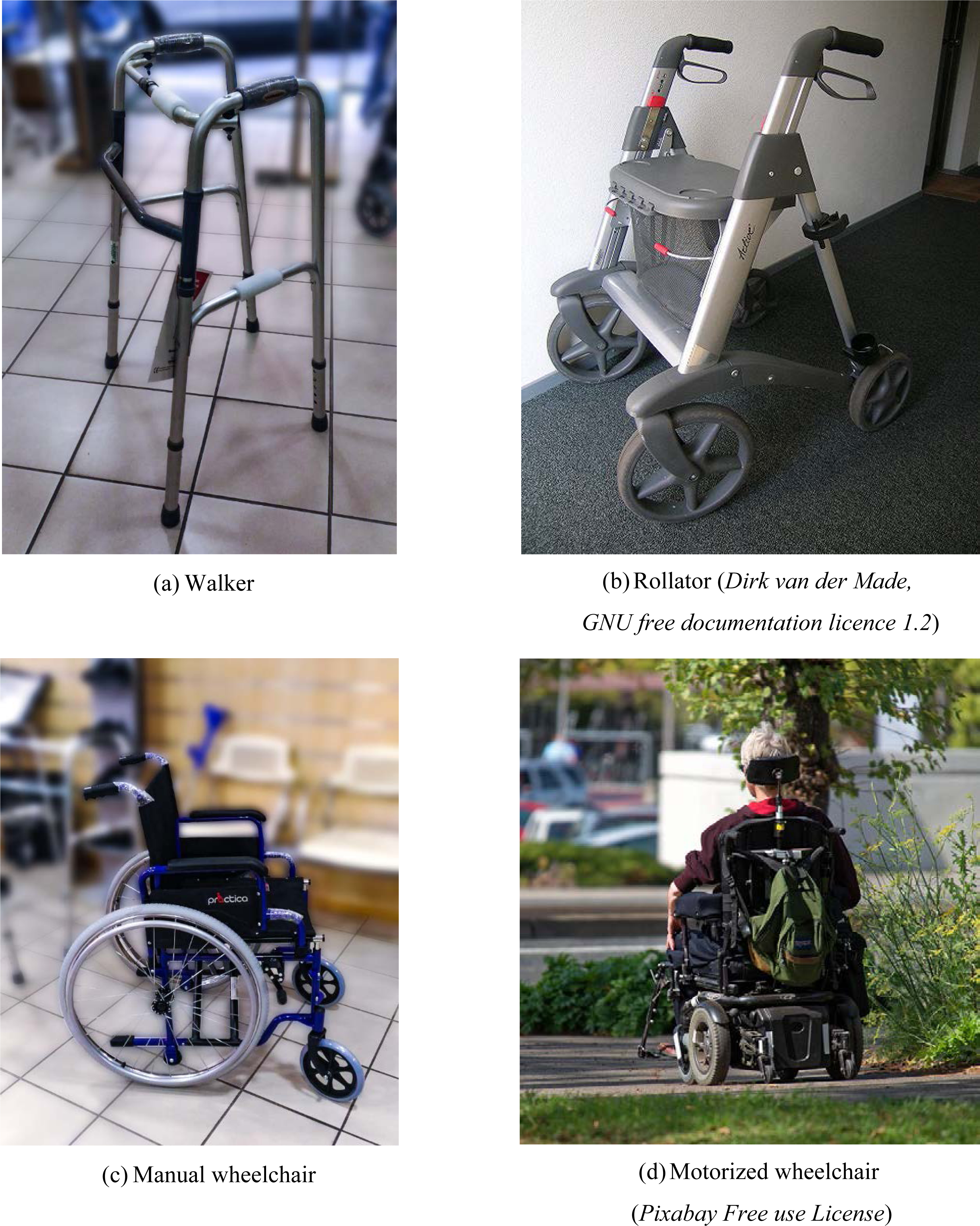
From a Design point of view, product functions are not limited to functionality, but also connected to the significance and what it communicates about the user, that is, the symbolic function. In this context, assistive devices are of particular interest as they are often associated with stigma. The main question that this study proposes to answer is: different designs of assistive products of the same category (wheelchairs; walkers) trigger different perceptions about the users of these products?
Experimental design
A mixed experiment was conducted which explored two independent variables, namely mobility device and experience. Eight semantic differential responses [31] served as the eight dependent variables. The within-groups independent variable mobility device had four levels, a walker without wheels (walker), a walker with wheels (rollator), a manual wheelchair and a powered wheelchair. The between-groups independent variable experience had two levels, namely respondents with friends or family using mobility devices and respondents without exposure to mobility devices. Measurements were acquired using a paper questionnaire.
Respondents
A total of 40 respondents without disabilities were recruited in Oslo, Norway, for the study, of which 27 were female (67.5%) and 13 were male (32.5%). Of these about half were students (52.5%). The age distribution of the respondents was as follows: 28 were between 18 and 39 year of age (70% young adults), 7 were in the range of 40–59 (17.5% adults) while 5 were 60 years or more (12.5%, senior).
Many of the respondents, namely 26 (65%), reported that they were familiar with wheelchairs and/or walkers. Of these 3 reported their spouse using such a device, 3 reported parents, brothers or sisters, 9 reported having a grandparent using such a device, 3 reported uncle or cousin, 2 reported a friend while 6 reported other. The participants were recruited in and around the campus of Oslo Metropolitan University. Efforts were made to solicit a sample as representative of the general population as possible.
Materials
A paper-based questionnaire was designed with the purpose of facilitating easy in-person data collection. The questionnaire comprised four sheets where each sheet addressed one of the four assistive devices, namely the traditional walker without wheels, a rollator, a manual wheelchair and a powered wheelchair. Each sheet had a similar structure. The top part of the sheet showed a colour image of the assistive device followed by the eight questions realised as 7-point semantic differentials. Each semantic differential scale comprised two adjectives that were antonyms of each other on each side of a 7-item scale. The respondents thus had the option of providing neutral responses. The two adjectives would represent a negative and a positive perception along the dimension. The order of the negative and positive adjectives varied for different questions.
Results from the semantic differential questionnaire. Responses are coded with dark orange 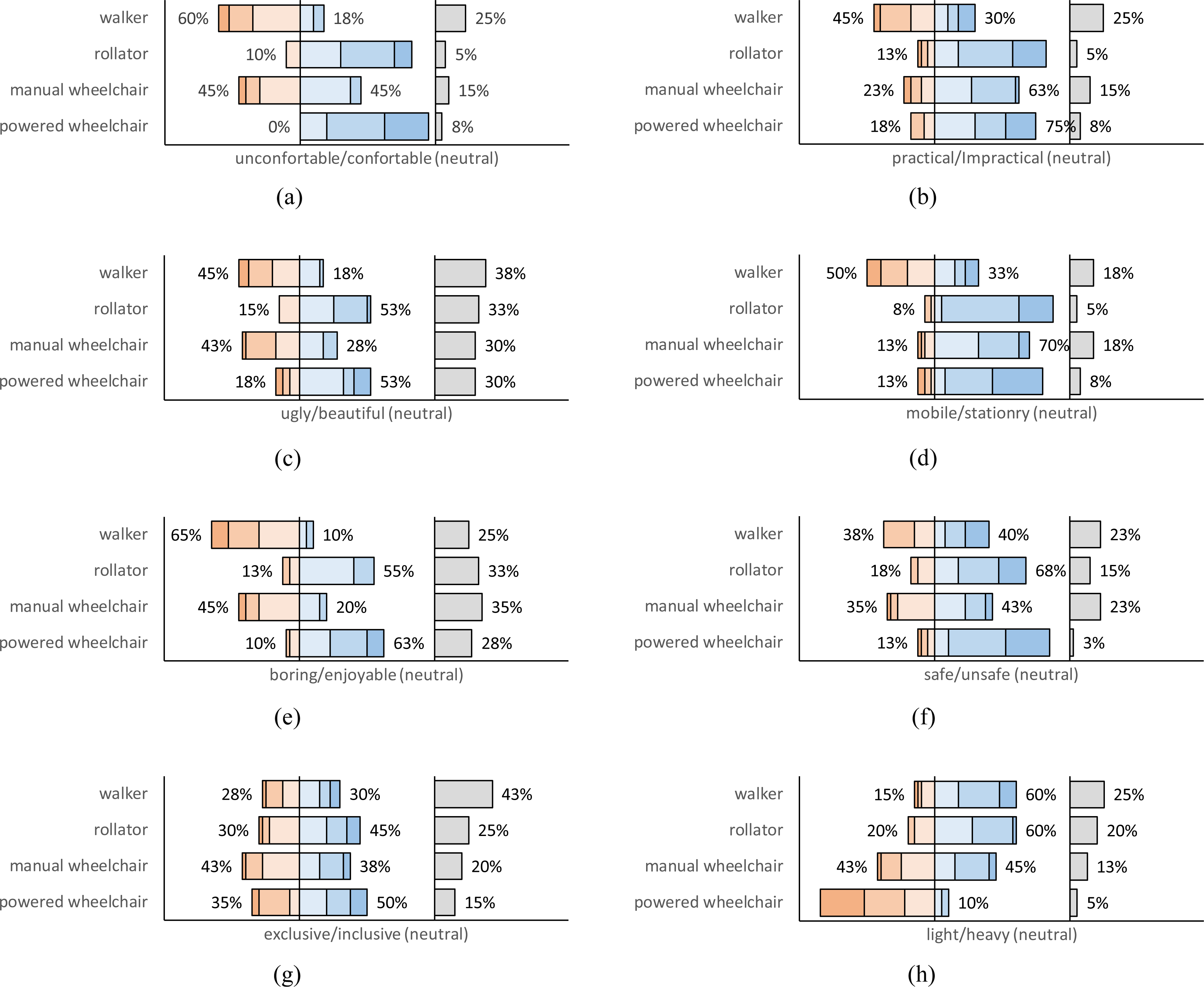
Dimensions with significant effects of experience.
Mean responses for each device type plotted factor planes.
The eight semantic differentials addressed practical, aesthetical and symbolic dimensions of the products: mobile versus stationary, ugly versus beautiful, practical versus impractical, light versus heavy, boring versus enjoyable, excluding versus including, safe versus unsafe and uncomfortable versus comfortable. Exploring practical, aesthetical and symbolic functions of products by means of a semantic differential scale has been reported in Product Design research [22]. The questions where randomized on each sheet and the presentation order of the sheets were also randomized for the respondents to minimize learning effects. The questionnaires were written in English.
The images used were demonstration photos without backgrounds or other disturbing elements. Note that the images used are not reproduced herein as the images are copyrighted by the respective manufacturers. However, similar devices are depicted in Fig. 1.
Respondents were recruited in person with two of the authors present while the questionnaires were completed. The participants were thus able to answer questions regarding the questionnaire. The respondents were presented with a consent form informing them of their rights to withdraw at any time and the anonymity of the results. The respondents were also asked to fill in general demographic information. Next, the respondents were asked to complete the questionnaire by observing the four pictures and rate the image in relation to the eight dimensions along the scale of the two antonyms. The data was collected during the autumn of 2017 before the introduction of the General Data Protection Regulation (GDPR).
Analysis
The questionnaire responses were manually converted into a spreadsheet and administered using Microsoft Excel. Statistical analyses were conducted using JASP version 0.9.1.0 [32]. The ordinal measurements were transformed using the Aligned Rank Transform (ART) procedure [33] allowing the data to be analysed using a parametric mixed two-way repeated measures ANOVA. This non-parametric procedure also allows the investigation of interaction effects. Instances not satisfying the assumption of sphericity were corrected using Huynh-Feldt corrections as both the Greenhouse-Geisler epsilon and Huynh-Feldt epsilon were above 0.75 for all these instances. Post-hoc testing was performed using Bonferroni corrections. Questionnaire results are visualized using diverging stacked bar charts as recommended by Robbins and Heiberger [34].
Results
Figure 2 shows a summary of the 40 responses to the semantic differential questionnaire. The Orange and blue are used to indicate levels of preference towards one of the sides where the intensity of the colour indicates level of preference. Figure 3 shows summary of responses with significant differences due to experience.
Uncomfortable/comfortable
Figure 2a shows the responses to the semantic differential uncomfortable versus comfortable. The walker and the manual wheelchair were strongly tending towards uncomfortable with walker being the least comfortable, while the rollator and powered wheelchair tended towards comfortable with the powered wheelchair being considered the most comfortable. There was a significant difference between the four models (
There was no significant effect of experience (
Practical/impractical
Figure 2b shows the responses to the semantic differential practical versus impractical. The walker stood out tending towards practical, while the other three tended towards impractical. The rollator was perceived as the least practical, followed by the powered wheelchair and manual wheelchair considered the least impractical of the three. Again, the walker was associated with most neutral responses. There was a significant difference between the four models (
Ugly/beautiful
Figure 2c shows how the respondents perceived the devices along the dimension of ugly versus beautiful. The walker and the manual wheelchair tended towards the ugly side with walker the ugliest, while the rollator and the powered wheelchair tended towards beautiful with the powered wheelchair being the most beautiful. There was notably also a relatively high level of neutral responses for all four models. There was a significant difference between the four models (
There was no effect of experience (
Mobile/stationary
The perception of mobility versus stationary is plotted in Fig. 2d. Again, the walker stands out as tending words being mobile, while the three other devices were perceived as stationary. The rollator was the most immobile, followed by the powered wheelchair and with the manual wheelchair as the least stationary of the three. The walker and the manual wheelchair were associated with more neutral responses than the rollator and powered wheelchair. The difference between the four models were highly significant (
Boring/enjoyable
The dimension of boring versus enjoyable is plotted in Fig. 2e. The results show that the walker and the manual wheelchair were considered boring with the walker being the most boring while the rollator and the powered wheelchairs were considered enjoyable with the powered wheelchair being the most enjoyable. There were many neutral responses with the manual wheelchair having the most neutral responses of the four models. The differences were highly significant (
Safe/unsafe
A similar pattern was observed for what was perceived as safe versus unsafe (see Fig. 2f). The walker and the manual wheelchairs were considered neutral, also with most neutral responses, while the rollator and powered wheelchair were considered unsafe with the powered wheelchair being perceived as the most unsafe device. The differences were significant (
Exclusiveness/inclusiveness
No significant differences (
Light/heavy
The perception of light versus heavy (see Fig. 2h) was highly significantly different across the four models (
Factor analysis
Factor analysis
A factor analysis was also conducted on the responses to the questionnaire as it is sometimes used in analysis of semantic differential data [35, 36]. The results listed in Table 1 shows that there were three significant factors (
Figure 4 shows the mean responses for each device type plotted for the factor pairs aesthetics versus operational and operational versus weight. An all neutral response is also plotted for reference. In terms of aesthetics the walker and manual wheelchair is below neutral while rollator and powered wheelchair are above neutral. The plots show that all devices are above neutral in the following sequence: walker, manual wheelchair, powered wheelchair and rollator with the highest operational value. In terms of weight the walker is regarded the heaviest, followed by the rollator and manual wheelchair. The powered wheelchair is the only one below neutral standing out from the other three perceived as the lightest.
Discussion
The dimensions associated with aesthetics, namely, ugly versus beautiful, boring versus enjoyable and uncomfortable versus comfortable all showed a similar pattern, namely that the walker was perceived most negatively followed by the manual wheelchair while the powered wheelchair was perceived most positively followed by the rollator. One may expect the walker to be perceived as the least aesthetic and the more elaborate powered wheelchair as the most aesthetic. However, it is somewhat surprising that the rollator is perceived as more aesthetical than the manual wheelchair. A reasonable explanation for this finding is that manual wheelchairs and walkers are visually less complex and have simpler design than powered chairs and rollators.
In terms of operational issues, the results are divided, namely that the walker is perceived as the most practical while the powered wheelchair is perceived as the least practical. This could perhaps be explained by the dimension of mobile versus stationary where the walker is considered the most mobile device and the other devices immobile. Hence the small and light small frame of the walker may give the impression that the walker is easier to move around and takes less space compared to the other devices. However, walking with the assistance of a walker demands attention from the user as it requires synchronized actions from the upper (lift, move forward and place the walker on the floor) and lower limbs (steps). According to the study of Bateni and Maki [37], walkers can demand excessive strength and affect the balance maintenance in certain situations. Furthermore, as the current study was carried out in Norway, where rollators are popular assistive walking device [38], it can be inferred that it is associated with situations of functional limitations and dependence. In turn, conventional walkers are not commonly seen in the community as rollators are in Norway. This may explain the more positive perceptions about walkers in comparison to rollators. There were no differences in terms of aesthetics in relation to experience.
It is also interesting to observe that the walker was considered the safest device while the powered wheelchair is considered the most unsafe device. Perhaps respondents feel that few things can go wrong with the stationary walker which does not move on its own, while things can get out of control with the powered wheelchair as it moves by itself. Open ended follow up questions could shed more light on these responses.
Experienced respondents also gave more strongly biased responses compared to the non-experienced respondents in terms of safety as they considered both the powered wheelchair and rollator more unsafe. Next, experienced respondents responded more negatively than the non-experienced respondents in terms of the mobility of the rollator. Again, these differences could possibly be explained by these respondents’ knowledge of these device properties. The literature documents benefits for the mobility of elderly people when using rollators. The study of Hoenig et al. [39] compared rollator, manual and powered wheelchairs in a community mobility task, and found that rollator allowed fastest mobility, while manual wheelchairs were most associated with fatigue.
In terms of weight the powered wheelchair was considered the lightest and the walker the heaviest. Clearly, this does not refer to device mass as the powered wheelchair clearly has the largest mass and the walker the smallest mass. Thus, the weight refers to the weight of handling from the perspective of the user, that is, the walker is associated with heavy work as it must be lifted and carried, while the powered wheelchair can be easily moved using gentle finger movements.
The weight factor was also associated with most differences across experienced and non-experienced respondents. The experienced respondents rated the three non-powered devices negatively, while the non-experienced respondents rated these more neutrally. This result indicates that the experienced users are more aware of the actual effort involved operating the three non-powered devices compared to the non-experienced respondents who are more ignorant of the actual work involved.
Although no differences were found across the devices in terms of exclusiveness versus inclusiveness, this dimension revealed a difference in terms of experience for the manual wheelchair. The non-experienced respondents ranked the manual wheelchair negatively in terms of inclusiveness suggesting a cultural stigma associated with the manual wheelchair, while the experienced respondents rated the manual wheelchair as inclusive, perhaps knowing that the manual wheelchair adds greatly to the quality of life for the user and inclusion in society compared to not being able to move around.
Generally, the walker ends up at the lower end of most scales while the rollator is generally perceived more favourably. One possible explanation for this trend is that respondents probably are more familiar seeing the rollator as the rollator is the most common walker device in Norway and most respondents probably have never seen a traditional walker. It would have been interesting to observe if the perception of these two devices would be different in a different environment such as Brazil where the traditional walker is more common than the rollator.
It is possible that the respondent sample was somewhat biased as it was solicited in and around the University Campus located in the city centre where people may be more open to diversity than in smaller more rural places. An extended study with participants from a wider geographical area with different socio-economic and educational backgrounds may give somewhat different results.
Although there are limitations that must be observed, this study provides some insight on the perception of non-users about practical, aesthetical and symbolic aspects of two widely used assistive mobility devices, thus contributing to the investigation of factors associated with stigma in assistive technology usage. From the perspective of Product Design, the information gained from the visual judgement of people without disabilities about two different designs of products of the same category – namely wheelchairs and walkers – may support the identification of features in the design of these products that are associated with negative and positive judgements. Ultimately, this knowledge may support innovative design proposals aiming to minimize the stigma related to assistive devices.
Conclusions
A questionnaire based on semantic differentials was developed to measure non-disabled individuals’ perceptions of four of the most common mobility devices. The results show that the responses can be explained by three factors namely aesthetical, operational and weight. The more elaborate devices are perceived as more aesthetical. Moreover, experienced respondents seem to have a more realistic, yet negative view of the actual properties of the devices, weight in particular. The results also show that respondents without experience with people using such mobility devices associate manual wheelchairs with certain stigma, while this was not found for respondents familiar with mobility devices. Future work should solicit responses from other cultural context such as Brazil.
Footnotes
Acknowledgments
The authors gratefully acknowledge the financial support from Diku – the Norwegian Agency for International Cooperation and Quality Enhancement in Higher Education (UTF-2016-long-term/10053).
Conflict of interest
None to report.