



Abstract
In the following research, we intend to highlight the importance of inclusion in the museum spaces, being the key the educational value, with the use of the new tools (ICTs), as well as the interculturality showing the diversity of the current cities in its cultural aspect, and allowing the access to all type of public, with functional diversity. A systematic review has been carried out with a selection of 490 articles examined up to 56 articles from 2002 to October 2017. The search was conducted using ten databases: Esci, Circ, Miar, Eric, Isoc, Dialnet, Scopus, Google Scholar, Teacher Reference Center and Wos. The purpose is to provide elements to carry out good practices that facilitate inclusive education and avoid cultural exclusion. Within the conclusions obtained, the role of the museum space as a place of reflection and grouping of different intergenerational groups is evident. The incorporation of ICTs that improve interaction and learning should be encouraged, valuing cooperation between museums and schools.
Introduction
Museums are places of culture and education, where the diversity of society as a whole must be reflected, as well as providing access to all types of citizens for the development of the aesthetic experience of our cultural heritage. Any type of functional diversity must be considered in museum accessibility. The aim of this research work is therefore to give a general overview of the various programmes and actions developed to provide accessibility to persons with functional diversity, as well as to expose deficiencies or implementations in terms of improvement within cultural inclusion. It reflects on the problems, difficulties and barriers encountered in accessibility, both didactically and architecturally, in favour of an authentic reality with respect to cultural inclusion.
First of all, it is important to highlight what we mean by museum:
“The museum is understood as a learning community, but it is the result of a negotiation process between different powers (consortiums, expert committees, artists, visitors, communities, etc.) that will define the museum policy.” [16].
Therefore, museums and cultural spaces play an essential role in the community as a place of union and learning, understood as living places, for this reason: “a museum and an art center must be a living, leisure and educational place, in short, integrated with its social and cultural environment” [55].
The main objective of this article is the systematic review of all available studies on cultural access, proposing a theoretical framework that relates inclusion in museums to educational potential, or in other words, the role that education can play as a driver of inclusion in today’s society, and for the improvement in the teaching and the critical thought in the students or the visitors, as well as in the access of the public of all the ages, by means of the use of the tics in the improvement of the cultural inclusion, contributing personal valuations that make possible suitable implementations in cultural centers and betting for the collaboration between schools and museums, joining effort in the education.
Methodology
A systematic review has been carried out of articles published in scientific journals on the inclusion of museum spaces through education and the use of ICTs, as well as the interculturality that shows the diversity of today’s cities, allowing cultural enrichment and access to all types of audiences, with special emphasis on the visually impaired. The selected articles range from 2002 to October 2017. The search was conducted using ten databases: Esci, Circ, Miar, Eric, Isoc, Dialnet, Scopus, Google Scholar, Teacher Reference Center and Wos.
Using the Boolean values “and/y” and “or/o”; we have used to search for articles such as the following for Web of Science, Scopus, Circ, Miar, Google Scholar and Eric: TI
The following inclusion criteria have been taken into account when selecting studies:
Only articles dealing with inclusion in museums, educational innovation capacity and the use of ICTs to improve cultural inclusion. Articles have been selected in English and Spanish, respectively.
In the ten databases used, 490 studies were found. They were all stored in the Mendeley library manager. Of the 490 studies, 189 were selected and the rest were eliminated for duplication. After a first reading of the title of the articles, a selection of screened records was made from 189, continuing with the elimination of 117 as unrelated to museum inclusion, and the use of ICT. Finally, 72 studies were selected for the reading of the abstract. After this reading, 16 were eliminated as they were not related to the subject of this research. The final selection consists of 56 research articles. The content analysis of the abstract of the 56 articles was carried out, as they provided sufficient information to identify relevant information about access in museum environments and the use of technology in them. In only 7 cases was it necessary to refer to the full text to complete the information needed for this study.
Analysis of the studies
To carry out the analysis of results, the codification of variables was carried out.
Source: Prepared by the authors on the basis of Moher et al. [42].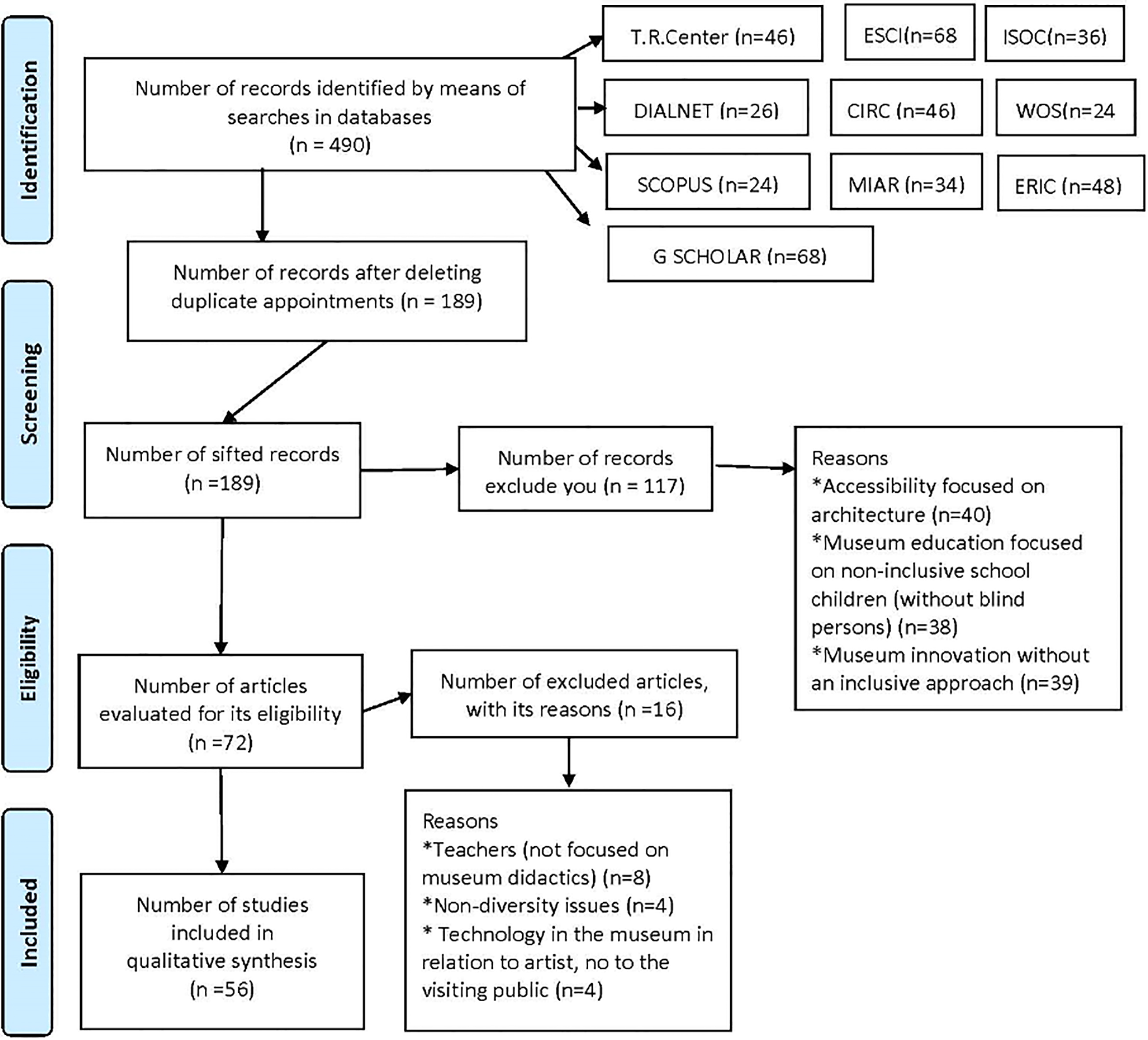
The bibliographic manager Mendeley was used for this purpose. An inductive process was followed: first, a reading was made of each study; second, the text was marked where some of the variables related to accessibility to cultural spaces were mentioned; third, with the variables found, groupings were created according to content (for example, whether the variable found had to do with education in the museum itself, technology applied to inclusion in museum environments and educational innovation in the cultural environment). Once the groupings had been made, a second reading was made in order to verify and, if necessary, modify the final classification.
The selected studies are characterized by their Spanish scope (
To properly understand this, we will explain what is meant by inclusion. Inclusion means giving all students the possibility to participate in life and work within the communities, as well as in the school. It refers to the common goals to decrease and overcome all types of exclusion, enabling access, participation and learning of quality education for all.
The UNESCO [52] defines inclusive education as a process that aims to respond to the diversity of students by increasing their participation and reducing exclusion in and from education. It relates to the presence, participation and achievements of all learners, with a special emphasis on those who, for different reasons, are excluded or at risk of being marginalized, constituting a fundamental drive to advance the EFA agenda. The concept of Education for All does not implies inclusion.
While both share the objective of ensuring access to education, inclusion implies access to quality education without discrimination of any kind, either within or outside the school system, which requires a profound transformation of education systems. Without inclusion, certain groups of students are likely to be excluded and this should be a guiding principle for educational policies and programmes, so that education is for all and not just for the majority.
Cultural inclusion in the museum
Without entering into the debate of critical museology on the concept of the museum as a place of interaction between works and the public, we will point out in this research the importance of cultural spaces as a place of contact, didactics and cultural exchange as has been the case with the use of social museology.
In the museographic panorama, Padró [55] points out the importance of understanding different typologies of cultural action within the museum landscape: museums whose aim is to disseminate knowledge from both technical and computer processes, valuing the spectator as a passive subject who only achieves the knowledge provided by the museum itself; on the other hand, museums that generate other ways of seeing, expressing opinions and questioning what is represented. Museums must be deformalized as institutions of incomprehensible buildings and collections, in favour of more direct contact with the public, with workshops and exercises that link the public with culture, with emphasis on the public with functional diversity.
The term women and men with functional diversity is a novelty and was proposed and started to be used at the Independent Living Forum in January 2005 [47]. It is an alternative term to disability that has begun to be used at the initiative of some people affected, and is intended to replace others whose semantics some people consider pejorative, such as “handicap” or “disability”. This is a shift towards a non-negative terminology on functional diversity.
The inclusive museum arose with the aim of promoting access through the work of various disciplines and sectors involved in the change of civic spaces, in the safeguarding of tangible and intangible heritage [27].
In the Convention on the Rights of Persons with Disabilities, “it states that accessibility is a right that implies the real possibility of a person to enter, transit and stay in a place, in a safe, comfortable and autonomous manner” [51, pp. 99].
In order to be inclusive, a museum must allow access to all types of public, with active participation and diverse educational programmes that can respond to all the diversity that makes up today’s society. To be able to give knowledge and voice to the diversity of people with different languages and environments, learning every day to improve continuously, although the challenge of cultural borders is tackled by strategies that are not very resolving and useful for the socio-demographic reality.
In Spain, in terms of legislation, it is stated that museums are obliged to make adaptations, although neither the terms nor how to do so are specified, nor who should evaluate the interventions. Therefore, a museum accessibility sheet does not have a specific state or regional regulation, although the precepts of the new sheets follow the model of Gorbeña et al. [30].
Cultural inclusion through technology
It is necessary to encourage the increase of elements and actions that make sensory accessibility possible and not only technical or architectural solutions. The union of sound, tactile and verbal information is an essential pillar in the didactics of subjects with Diversity Works. The museum didactic team must channel its expositive discourse towards a personalization of its own visits, adapted to its specificities.
It is worth mentioning the “Hand Museum” project of 2012, of the Museum Reina Sofía, in which the tactile interaction is facilitated to the blind public, in the program “The Guernica, testimony of a time”, entering the spectator in the context of the 1937 Pavilion, with a program of descriptive visits, valuing both low vision and total blindness for their interaction, encouraging verbal content, as well as the transmission of sensations and adapted contents. Another example of an inclusive programme can be found at the Museum Prado “The Prado for Everyone” [22] and “Today it‘s the Prado” of 2015, these two groups conform the Spanish advances in the inclusive didactic field in public with low vision and total blindness. However, one of the limitations of the programs is to respond to the blind public only with tactile charts, this is not enough, more direct didactic responses have to be given enhancing the creative and cognitive-emotional value, with activities more involved in the development of the person, encouraging not only reflection, but also their aesthetic judgement.
Heredia, indicates with respect to the relationship of art and the public with visual functional diversity “that textures, their contrasts, lights, shadows, rhythms make it possible for a blind person to express and receive these plastic elements of a work from his own creative world and from his own means of accessibility” [33, p. 42].
Fostering inclusive cultural programmes that can serve both to improve skills and competences in the field of education is the challenge of our time. There are bets to favor the creative process in blind people as a means of communicative expression, to manifest their emotions and thoughts, reflecting their interaction with the world using communication codes, understandable for no visual impairment, manifesting more the importance of capturing feelings and emotions, than color or aesthetics itself. In Potosí, Mexico, the experimental research of Espinosa [24], focused on the analysis of the creative process in blind people within the museographic environments, analyzing the artistic creations, the capacity for reflection, the configuration of the mental image and how they are capable of expressing those sensations.
On the other hand, in Spain, in the work of Sánchez [50] enters Arts Education with the adaptation of teaching materials in school environments and the appropriate training of the teachers themselves. From the results, it indicates that it is possible to adapt materials to the needs of the students in ordinary schools and to improve the skills of the teaching staff, facilitating in the students artistic skills, motivation, and improvement of artistic expression.
The International Council of Museums (ICOM) developed the Cultural Diversity Charter [46] with a specific professional standard, as a legal tool, and the subsequent evaluation of the Museums in their inclusive work, at its General Assembly [54], to encourage the analysis and exchange of comparative studies between the various institutions.
Creating inclusive materials
As the authors point out Prous and Diaz [44], in terms of the accessibility issues in museums, it is not always the economic value that should be at the forefront of museum accessibility programmes. Betting on nearby technology such as the use of mobiles, and QR technology, to facilitate real access, as well as personal assistants specialized in providing accessible information and implementing what the persons with functional diversity really demands for cultural access, is usually an unknown figure, although it is included in the Law for the Promotion of Personal Autonomy, and as a right, reflected in article 19 [44].
The museum of Málaga (MUPAM) implements an inclusive workshop cycle [49]. In the first place, with an activity focused on accessibility, by means of touch the artistic object is demystified, through workshops “sones evoked”; with Braille materials and thermoform tiflotécnica sheets, as well as interpreters of sign language. Where, by means of sensitization workshops, the approach to the artistic pieces from another sensorial perspective is given, besides, using musical sounds in relation to the artistic works that possessed instrumental forms, which was intended, in addition, uniting the sound and the forms, for the creative and sensitive development of the public. As a novelty, it is the museum itself that approaches the school.
On the other hand, an index has been developed to measure the degree of accessibility in public centres, institutions and schools, under the title of “guide for the evaluation and improvement of inclusive education” [8], to measure the degree of accessibility in public centres, institutions and schools.
The development of an inclusive education implies the creation of materials, spaces, exercises suitable for all people, we do not have to confuse it with adaptation. The creation of inclusive products is not the realization of specific elements for a specific group, but the evaluation of their characteristics, to give a proposal of unitary group that allows the joint participation of groups without segregation [57]. For this reason, special interest is played by awareness-raising activities where various groups connect and collaborate, through sensory inhibitions, for an execution of empathy, or put themselves in the place of the other person.
In such a way, “a tactile model is obviously useful for a blind person, but for a sighted person, joining touch to sight is always much better than just using sight. Therefore, it is not a question of making a specific product for the blind but an educational product that includes the blind” [38, p. 12].
Psycho-pedagogical application in museum visits
To understand the pedagogical action in the museum, we will explain what is understood by museum education, is therefore to encourage the person to use their intellectual faculties, through appropriate means to employ their personal judgement in the configuration of an idea about the works of art, generating an aesthetic experience between the feeling provided before the work of art and the spectator.
Within the activity of visiting the museum is generally raised as an extracurricular activity and like other professionals [3] we consider that it is a serious error, the disassociation with tasks of the classroom or of the school program of the center. Although there is often no unity of criteria between the objectives of the museum team and the school team, it is in this area that we must work for an authentic educational improvement with regard to the educational panorama in cultural spaces.
An inclusive design lies in the importance of the usability or ease of use of the means available to the museum to achieve access for all. It is essential to facilitate access for people with disabilities, to be able to group elements to facilitate their interaction, providing contextual content that includes the possible relationships of the components. It is worth highlighting the work of Dix et al. [18], in the principles of usability applied to technologies, shaping 14 paradigms that are still elements of debate and reflection by researchers. Emphasizing the ease of learning, where through interaction with the public is achieved the assimilation of new concepts, and their relationship with existing knowledge and this is enhanced by the use of new technologies.
Within the educational current we consider of vital importance the implementation of emotions and learning in terms of emotional management, is the study of the researcher, Álvarez [2] introducing both affective and cognitive dimensions of the visitors, in the bet of an integral education, evidencing that the emotional education in the museum propitiates an improvement of the expressions of the own feelings in the visiting public. As a sample, the research should be presented: “art to stimulate emotions and memories against Alzheimer’s: the museum as a space for social inclusion” Delgado [19].
With respect to the need for accessibility to cultural heritage and inclusive museums, the role of University Museums in Argentina is evident, as well as the interest in the number of people with functional diversity who visit it.
The museum as a space of equity, allowing access to all types of public, understanding this type of integration at various levels: “1) Physical integration consisting of the reduction of the physical distance between disabled and non-disabled subjects. 2) Functional integration that implies the use of the same means and resources by both groups of people. 3) Social integration that reflects the psychological and social rapprochement between the two groups. 4) Social integration where disabled people acquire the same rights and opportunities as non-disabled people for their personal and professional development” [13, p. 3].
Using art as an educational tool is not something current, and other entities such as the New School, Summerhill or Education by Action. They proposed the use of children’s creative self-expression, proposing the teacher’s action as support and motivation, without direct intervention and without imposing images or concepts to give students creative freedom without conditioning or barriers. Although DBAE (Discipline Based on Educational Arts) adds support and motivation, the help of the students themselves to the student who has difficulties [29].
The educational museum, as a social entity, constantly reformulates educational action with social values in both formal and informal education [7]. For this reason, museums are not mere exhibitors of culture, currently bets on the transmission of values, and the conformation of more social museums, not only as educational tools of history, but with greater possibilities for society, a place of critical reflection and sharing of knowledge.
From this current, it is important to highlight the investigation of [4], understanding the museum as more than an educating agent, with the faculty to give social participation and cohesion of diverse groups within the diverse society in which we live. It is a place where ideas, emotions, experiences, and with great value for participation and cultural enrichment, and the importance of joint work between teachers and museum educators themselves in the search for coordinated and coherent messages, with great value in the initial preparation of teachers, as a resource for their teacher development in order to achieve an authentic education, valuing its incorporation together with the educational faculties.
Representation includes the programme “Art and Social Education: A Change of Perspective in the Museum”, 2014, under the debate of the new social projection of the museum, and the diverse ways of approaching it from the educational cabinets, focusing on art as an individual and socially transforming element, under the application of art therapy, influenced by theories of Nuero-Linguistics, Systemic, Gestalt, and Emotional Intelligence.
The role of the Museum and the way it interacts with the public has been questioned, with cultural education offering the public a way to renegotiate what counts as knowledge and cultural value in terms of personal experience. A particular conception of a certain cultural democracy is promoted, in which museums invite visitors to be an active part in the process of knowledge construction, using their own experiences and knowledge as points of reference.
In the discourse generated in cultural education, there is a dichotomy about two aspects: the academic aspect with emphasis on the epistemological framework of museums as research entities, the dissemination and development of knowledge about their own collections, with a delimitation of screen pedagogy, far from the general public, and on the other hand, knowledge as a social element capable of configuring, challenging and reinforcing social power structures [39].
So far the Archaeological Museum of Seville is the only one that has a guide for the blind and specialized bibliography in collaboration with the ONCE, only the ONCE’s own Tiflológico Museum in Madrid has a similar level of accessibility and specialised information in the Spanish territory.
Furthermore, to be inclusive, a museum must not have barriers that make access impossible for the public with functional diversity: “Touch, smell and Braille reading are just traces of a process of social and cultural inclusion that must be taken into account when introducing guided tours” [34, 416] betting on sign language for people with auditory functional diversity.
To better understand it, we will explain what Information and Communication Technologies (ICTs) are: all those resources, tools and programs that are used to process, manage and share information through various technological supports.
The development of information and communication technologies (ICTs) can facilitate the acquisition of knowledge of students with functional diversity, allowing the development of skills and abilities, and adapting materials to the needs of each student, enhancing motivation in learning with the ease of acquiring knowledge and removing barriers.
It is worth mentioning the research of the Center for Integral Attention of Costa Rica, carried out by the researcher [28], on the use of TIC in inclusive education in preschool, through qualitative analysis analyzing the information, with a descriptive and exploratory design, with descriptive observation spaces, with oral and written sources of information. This research concludes that the appropriate use of technologies improves the quality of education, being an essential tool of integration the use of devices and ordinances that facilitate learning, this time through games.
Currently there is limited integration in the use of institutional pages, museums, and social networks, or Web 2.0 platforms, both nationally and internationally [36] as well as internationally [36].
In the work on the incorporation into digital communication of museums, through online platforms with web 2.0, of Martínez & Berrocal [36], shows the connection between the museum website and quality, as well as its commitment, with a sample of twenty-one museums, using Pearson’s linear and statistical regression study to corroborate the hypothesis of the relationship between popularity, visits and quality in the museum websites. Only a third of Spanish contemporary art museums achieve efficient digital communication, providing information and achieving adequate interaction with the public.
Within these digital gaps, there is still to work the use of videos with sign language facilitating cultural access, as well as the adaptation of transcribing exhibitions and using podcast, to contact the blind public in a direct way in the virtual environment. In addition, the creation of a platform to give and create critical opinions, as well as an element of artistic learning, in the acquisition of critical knowledge about works of art and broadening the idea of communication to a space for dialogue, debate and joint creation.
The researchers Caerols et al. [11] point out the need to unify criteria for a useful strategy in the digital communication of museum spaces, as content is not valued as an appropriate strategy or participation in networks and contact with the public, does not respond to the needs and demands expected by the public.
Technological accessibility
In the educational intervention at the Museum of America in Madrid, described by [43], was developed in the area of physical accessibility, positioning at various heights of the works of art, to facilitate access and visualization for the public with motor difficulties. On the other hand, for the public with intellectual disabilities, the project was conceived “serious games” in the Chimu Pyramid, by means of a movement sensor for the excavations, in addition to a specific app of augmented reality, making possible the recognition of cartels and tactile use (ChimúRA).
Museums that are concerned with accessibility research are those that often reflect current limitations in developing comprehensive accessibility. To this end, both the physical and virtual museums must house the advances in this field and provide tools for future collaborations between cultural managers and teachers, being multidisciplinary research, combining didactics, psychology, art, etc.
Museum technologies for inclusion
With the use of the network, global knowledge has been made possible by generalising access to information, evolving from the museographic past of marvellous galleries and static museums to Cybermuseographies, with the virtual nature of exhibitions and the possibility of extending information by authors or historical periods, an example is the project Google Art Project [32], started in 2011, part of the visualization of online museums, immersed in more than 40 countries, allowing to locate by artist, collection in 360
It is not a question of making the environments accessible but of a total and full integration with a diverse public, in the same way that in society it is necessary to bet for an inclusion in the rooms and not a segregation adapting rooms for a specific public visits them, this is achieved with didactic programs in which the interaction and the performances are not only of sensitization but of joint participation be people with diverse functional or not, besides working in the sensorial inhibition.
In terms of educational technology, the Thyssen Museum offers three programmes: “Nubla” the program where through a game the visitor gets into the picture, through various puzzles the protagonist tries to know his past. “Experiment now” app for learning before, during and after the visit to the Museum, encouraging interaction with a different children’s public, and, “crononautas” a game for the museum’s own journey through augmented reality that enables increased interaction with the exhibited works.
It is necessary to expose the two ways of museum environments, on the one hand, the classical aspect as an agent of the cultural manifestation, where the aesthetic and static predominates being a mere receiver of the culture and the works. On the other hand, the contemporary way, with a fuller incorporation in the life of the city as a cultural space for dialogue, interaction and participation with the public.
Several recent guides and manuals should be noted: the guide to monuments, museums and points of tourist interest accessible to all. The visual guide of the Prado Museum and the Manifesto for an Inclusive Culture [35].
Within the investigations, the following stand out, AMATRA [31], of the University of Granada about museum accessibility from other disciplines such as interpretation, translation and sociology, with emphasis on the literary field, texts, audio-descriptions. Combining image and sound, reinforcing semantics with written language.
On the other hand, a museum evaluation form was developed in Galicia [10], with the aim of measuring accessibility in museums, analysing parameters such as the environment, the spaces between rooms, the rooms, the routes, the ease or difficulty of access to information and whether the works are temporary or permanent, among other values.
The use of ICTs (information and communication technologies) with computers in the case of students with disabilities, helps to solve the needs of writing and communication. It is essential to be able to propose pedagogical programmes that develop the maximum potential in terms of integration, training and equal opportunities for students with disabilities [1, 37].
To be able to develop a didactic method that integrates diverse educational places, in this case the relationship between the museum and the school, is essential for the adaptation of ICT in adaptation and flexibility, as well as to undertake a comparative study would be of special relevance in academic effects and educational techniques. In intervention Accedo [1] under the program ink y point, Braille was used with ICT tools, through exercises that increased various factors such as: interaction, self-esteem and inclusion in the classroom.
For his part, Mateos and Serrano [37], in the inclusion of 5th grade primary pupils with mixed groups of pupils from ACNEAE disabled and non-disabled centres in the city of Valladolid, and using Mini-Weqquest, PowerPoint and Web 2.0 tools for the improvement of self-esteem and educational competences, whose results gave improvements in the understanding of analysis in descriptions, for the subsequent development of mostly complex analyses, with notable improvements in linguistic competence as well as in the degree of personal satisfaction with the improvement of self-esteem and of learning itself in the acquisition of knowledge.
In the use of ICTs and Mass Media, within the possibilities made possible by being able to create didactic routes, heritage routes that enrich school learning, in active educational policies where the visitor goes to the sites in situ. From the Ministry of Education of Andalusia [29], class topics are being put into practice, such as geometric application visible in pictures, etc. Also, the use of a methodology of intervention of spiral learning, with the union of some experiences with others, to be able to enter in other areas in relation to the subjects of the school curriculum.
We have to see the value of social networks as a key element in communication between museums and the public is tremendously important Borgatti et al. [9] and Barquier [5]. In the investigation of “Connections between museums and art centres on social networks” [15], evidenced the scarce relationship with the followers, and scarce answers to the silver doubts in the social networks.
The museums that have best implemented the use of web 2.0 are in the USA, the Brooklyn Museum, the Smithsonian, the IMA, the Moma and the North Carolina Museum [45, 26].
The difficulty that museums encounter in the use of social networks is to accommodate the content to these new channels of communication, with great difficulties in the implementation of the guidelines of the definition of a museum such as: “study, education and recreation” [20], the serious error in the use of Web 2.0 lies in the mere use of promotion by museums, stating Rodá [45], interest, as well as the exchange and relationship with other museum bodies, should be encouraged by means of social networks and the interested public.
Since its inception the controversy has been generated by the opinions expressed by visitors, and the belief that they would interfere in the official language that museums want to show from their official pages, as set out in the exercise of communication “is deliberately diluted with substantial user input” [20], or the use of networks such as Instagram or Facebook could damage the image of the museum [56].
As an example of the potential of the public as a creator, an activity was carried out at the MOMA for the students who came to the museum, under the title of “ArtMobs” [11] versions of the audioguides were modified with songs and sound immersion elements for the works, uploaded to the museum website, with critical or comic elements, as well as links between characters.
The use of ICTs poses an improvement in school education as in museum didactics, teaching goes beyond acquiring mere knowledge, it is about the development of skills, competencies and strategies for the critical development of students. With the configuration of virtual museums, a new type of methodology is developed, based on direct contact with the public and the use of the web 2.0, from the didactic strategies it makes it possible to work on both individual and group actions.
For Researcher Mackenzie [48, 156] identifies the “virtual museum as a collection of electronic artefacts and informational resources of everything that can be digitized”.
Within this digital cataloguing of the pieces, through the Digital Network of Museums of Spain [43] with the DOMUS database, the aim is to bring together the various Spanish museums on one website, which within its limitations is the only access from the DOMUS website without direct links from the museum websites themselves, the impossibility of exhibiting collections from other museums outside the DOMUS network and the multimedia level is limited to a text with a prefixed image.
On the other hand, within the researcher’s improvement approaches Beneyto [7] we coincide with the integration of the physical and virtual museum, enriching the contribution of the educational interaction with the public, although instead of the use of tablets for each student, we believe that it would be better the integration of the internet of things, through the use of intelligent mirrors, as is the case of “Firefly”.
In addition, research in this field, such as that carried out by researchers, should be borne in mind: Espinosa and Castillo [25]; Mendoza and Espinosa [40]; Urgíles [53] in inclusive technology with contributions that can promote both cultural and educational access. On the one hand, the improvement in the access to the web 2.0 for visually impaired public addressed by the researcher Urgíles [53] and, on the other hand, the use of the implementation of the CIGI system (Interactive Cinematographic for Blind People), grouping the virtual reality with the haptic system, through the Phantom Omni device allowing the blind public to feel shapes and textures. It is concluded from the experimental study of Espinosa and Castillo [25] that the results indicated that the generation of mental icons obtained from virtual environments is similar to that obtained in real environments. Although the recognition of objects was greater, as participants acquired skills, the information response time of the virtual environment was reduced.
It is worth mentioning the MIIPAT (Transmedia Interactive Museum of Audiovisual Production) in Mexico, inaugurated on October 25, 2017, is a museum oriented to the inclusion of people with disabilities in which the CIGI system has been implemented Espinosa and Castillo [25]. Although it is very useful to create inclusive spaces especially for this type of group to be able to access, we consider that it is necessary to go further, not only with the development of a specific centre, but also that the existing centres and museums give a reality of universal access and adapt to the novelties and needs.
Among the accessibility activities, it is worth mentioning the antecedents in the field of museums such as: the Didú technique, a project originating from Dürer’s studies in Vizcaya, was implemented in the Prado Museum (today’s exhibition touches the Prado) for the blind in 2015 and the other technique with the “Unseen Art Project” created by Marc Dillon, being able to represent any artistic work by means of the three dimensions, the reproduction being scanned and printed by 3D machines equipping the artistic ensembles with high resolution, to capture even the smallest detail.
The use of technology for inclusion has to be a reality, and this involves the implementation and continuous improvement in the use of virtual museum guides, highlighting the project GVAM (Virtual Accessible Guide for Museums), proposal for electronic guides for museum sets and interpretation centers [41], within the museums that have successfully implemented them we find the Tate Moderns or the Louvre, with a detailed visual narration with adapted audios. In Spain, the Reina Sofía or the Guggenheim of Bilbao, have a PDA with a preset recording in sign language and subtitled.
The only report on the technological situation of museums and art centres in Spain is more than ten years old [14]. It concludes that museums need news systems and press management, web 2.0, although today web 3.0 is used to promote virtual tours, or create their own cultural networks. Still in the early days of the technological application for the use of visitors.
Spaces as “open museums” are formed so that the visitor himself develops his personal conclusions in each exhibition element, with the diffusion and comments exposed of his own artistic experience through social networks and blogs.
With regard to museums as places of creative development, the passive visitor element must be left behind [6, 31] in favour of the active visitor interested in going beyond the contemplation of the work, being an active part of the museum and having a voice and vote in one’s own cultural context, in favour of authentic cultural democracy [23, 449], with the development of knowledge and the generation of spaces for debate, on the exhibited pieces themselves or the didactic possibilities they imply with respect to the exhibition, whether permanent or temporary.
The use of the web 2.0 connection has favoured the cultural exchange of projects and joint publications between different museums. Highlighting the page MediaMusea, with the visualization of current museum technologies, as well as Museum Analytics or Dosdoce where the use of networks by cultural entities is analyzed [12].
“For all these reasons, ICTs become a real bridge between the public and art collections (…) they are a common cultural element between these collections and present generations, they are the vehicle for the storage, exhibition and transmission of contemporary art and, finally, they are a medium used for communication and education” [17, p. 153].
Discussion
After this research and seeing the state of the matter we reached a consensus on the need to implement accessibility measures in education and especially in cultural access, raising several improvements on the one hand in developed countries have the means and technological tools to implement accessibility, although often do not know how to approach these tools to be useful and practical, It is at that moment when the role of the professionals of the disability has a greater importance and responsibility, although exerting actions in situ in workshops, or teaching to the teaching staff and the cultural workers, which means, tools and utilities, are currently used internationally, being valid this execution in countries as much developed as not.
However, in non-developed countries where there is a lack of economic means, it is necessary to resort to the implementation of means that do not require high technological costs, but that if everyone has them, as is the case of mobile phones or tablets, implementing QR code systems that link to web pages of information or sound as podcasts, although the widespread use of the Internet does not yet reach all areas, In this case, we considered other options such as the creation of haptic material (tactile and auditory) or the construction of wooden ramps or other materials, which make possible the access to the spaces and the cultural contents of the different centers and the conformation of workshops of sensorial sensitization that allow to educate the education without disability in what supposes the access to the information of the people with functional diversity.
Conclusions
The museum has to be a space in which all the components that constitute the society can have access to the knowledge that it shelters by means of adaptations and with immersive educational projects, valuing the richness of the diversity that conform the present societies and encouraging values so essential to live in society as they are: the equality, the cooperation, the empathy, to achieve an authentic equitable society influenced by the culture that surrounds it. As well as critical reflection and a sharing of knowledge, developing in these cultural environments. For this reason, the role of education in the early stages of childhood plays a fundamental role both in learning and in raising awareness of the diversity of heterogeneous groups and in valuing the wealth they bring to society.
It is essential to be in harmony with the present times and to implement both technological and educational improvements within the museum and didactic programmes, combining both experiences in physical rooms and in virtual environments, favouring global access to the exhibited goods.
Using art as an educational tool, to favour both creative development as well as emotional education and emotional intelligence, is essential if we want museographic and school centres that conform to current novelties and approaches, betting on a common line that makes it possible to improve both workshops and school curricula, enriching the learning of teachers in their initial stages as professionals and also favouring their own educational development.
The Museum should abandon the mere task of cataloguing and storing heritage, cooperating jointly museum and school to improve the didactics of the museum as well as that of the school curricula in the centers.
A good inclusive design goes through the experimentation of educators and architects in the case of new buildings, barriers and difficulties that the visitor with functional diversity finds in these exhibition spaces betting on design for all people.
At a time when new technologies are so present in our lives we have to bear in mind the disconnection that paradoxically means being connected, without personal communication, and increasingly affecting the cognitive and emotional aspects, living by and for the image that we reflect on social networks, forgetting the really important closeness of human treatment and empathizing being emotional.
Footnotes
Conflict of interest
None to report.