



Abstract
BACKGROUND:
Literacy is essential for the development and empowerment of students with intellectual disability. However, such students often present limitations that may interfere in their literacy process.
OBJECTIVE:
The aim of this research was to evaluate the potential of Virtual Reality as an educational tool to support the literacy process of students with intellectual disability.
METHODS:
We have developed a serious game based on Virtual Reality techniques. The game has been validated by special education professionals and used by students and their teachers in two inclusive schools. In order to evaluate the game’s effectiveness, a qualitative methodology has been adopted.
RESULTS:
The study points to a positive evaluation of the game as a tool to aid in the development of literacy skills of students with intellectual disability.
CONCLUSIONS:
The results indicate that Virtual Reality has potential to contribute to the inclusion of students with intellectual disability in the educational context.
Introduction
In recent years, Virtual Reality (VR) technology has been spread in many areas of knowledge and proved to be particularly interesting as a tool for students with disabilities [1, 2, 3]. With VR, these students can actively participate in the tasks and have a sense of control and mastery [4].
Virtual Environments provide people with disabilities an opportunity to have multi-sensory experiences with interactive and realistic situations that could be inaccessible to them due to their limitations [5]. The ability to adapt the Virtual Environment according to the user’s capabilities and cognitive style is also an important feature of VR technology [5, 6].
Moreover, VR provides a motivating environment for knowledge acquisition and learning, allowing the user to “learn by doing” [7, 8]. It also can present to the students a broader and deeper set of experiences when compared to conventional educational environments, since it provides sensory feedbacks and allows students to systematically interact in different natural-like environments [7, 9].
Due to these characteristics, the use of VR for people with disabilities has achieved promising results and there are several VR applications developed for the area of Special Education. McComas et al. [4], Sik Lányi et al. [10, 11] and Lopes et al. [12] did literature reviews and presented several studies about the use of VR for children with disabilities. These papers present VR applications developed for children with visual impairments, with autism, with down syndrome, with hearing and speech-impaired children, with physical disabilities and children with Attention Deficit Hyperactivity Disorder (ADHD).
However, despite a wide variety of research about the use of VR for people with disabilities, literature concerning the utilization of VR for people with intellectual disability is relatively limited [13]. Furthermore, most studies aimed at these individuals are mainly concentrated upon the use of VR for promoting daily living skills and for the rehabilitation of cognitive functions. Few studies, like [1, 3, 14, 15] have focused on the potential use of VR as an educational tool for students with intellectual disability. Questions on how VR techniques can be explored to provide a more effective learning environment for children with intellectual disability remain open.
Aiming to fill this gap and considering that literacy is essential for the development and empowerment of students with intellectual disability, the objective of this research was to evaluate the potential of VR as an educational tool to support the literacy process of students with intellectual disability. For this purpose, we have developed and evaluated a serious game based on VR techniques.
The game is aimed at students with intellectual disability in the early stages of the literacy process. The development of the game was guided by professionals with large experience in the field of special education who pointed out to the need and importance of technological resources to support the inclusion of students with intellectual disability. It is important to note that these students often present limitations in cognitive and language skills that are fundamental to the learning process, and more specifically to the literacy process. Thus, this research contributes to the inclusion of students with intellectual disability, through the development of a tool to help them in improving their literacy skills in a playful and enjoyable way.
In the following sections, we present the characteristics of the group of people to whom our work is addressed. Then, the description of the game and the methodology used in the study are described. Finally, we present the results, the conclusions of this research and possibilities for future work.
Students with intellectual disability and literacy
The American Association on Intellectual and Developmental Disabilities (AAIDD) defines Intellectual Disability (ID) as “a disability characterized by significant limitations both in intellectual functioning and in adaptive behavior, which covers many everyday social and practical skills. This disability originates before the age of 18” [16, p. 119].
Students with ID form a heterogeneous group including very low-functioning individuals who require continuous care [17]. In fact, each student with ID has specific educational needs.
In a general way, such students often present limitations in skills that are fundamental to academic learning [18]. “Barriers to starting and completing courses of study include poor literacy skills, lack of motivation and stamina in long-term commitment to study tasks, overwhelming feelings in negotiating course rules and requirements, lacking self-organization and time management skills, maintaining self-directed learning demands, difficulty, affording courses, physical and mental health issues, and homelessness” [19, p. 176].
With regard to literacy, [20, 21] found that the level of nonverbal intellectual abilities of children with intellectual disabilities in combination with rhythmic skills and the knowledge of letters are important factors in their literacy process. Van Tilborg et al. [21] also concluded that as phonological awareness plays a differential role in the early stages of the literacy process of children with and without Intellectual Disabilities, delays in phonological awareness of children with ID may interfere in their literacy acquisition.
The analysis of [22] also showed that, in comparison with typical developed children, children with ID scored significantly below on all measures (reading comprehension, decoding, language comprehension, and linguistic and cognitive skills).
However, in spite of all these limitations, according to Vygotsky [23], if students with ID are stimulated properly, being assisted in their educational needs through the use of special methods and resources, they will succeed in their academic learning. Vygotsky [23] states that the laws that govern the development of children with disabilities are the same laws that govern the development of children without disabilities. However, he emphasizes that the psychic functions are formed differently in children with disabilities.
An important concept developed by Vygotsky was the Zone of Proximal Development that is “the distance between the [child’s] actual developmental level, as determined by independent problem solving, and the level of potential development as determined through problem solving under adult guidance or in collaboration with more capable peers” [24, p. 131].
According to Vygotsky [24], it is in the Zone of Proximal Development that interference from other individuals is more transformative. In this sense, Vygotsky stresses the importance of mediation of children’s learning by more experienced adults, in order to promote their development [25]. He views learning as a profound social process and emphasizes that dialogue and language play an important role in instruction and in mediated cognitive growth [24]. Vygotsky also states that the educators have to consider not only the delay in the children development, but their overall potential [23].
No mediated learning, that is, learning by immediate and independent interaction with the environment, is limited in a child with ID [25]. Therefore, it is necessary to stimulate these students, challenging them to change from a passive position in a learning situation to an active appropriation of knowledge. Lemons et al. [26] also point to the importance of reading interventions targeting the development of phonological awareness and phonics skills.
As a mediator of learning, the teacher must intervene with resources to improve their cognitive development, strengthening the autonomy of the students to express their opinion and to have initiatives according to their needs and motivations. The teacher must know the actual level of development of his/her students in order to direct the teaching process not only to intellectual steps already achieved, but also to stages of development that the students have not yet incorporated [27]. He/she must intervene in the Zone of Proximal Development of the students, promoting advances that could not occur spontaneously.
Taking all these characteristics of the students with ID into account, we have developed a serious game, which is presented in next section.
Description of the proposed game
For Hamadaoui et al. [28], as learning technologies, Serious Games must contemplate the pedagogical objectives proposed for the system, making the design of these applications a challenging task. According to Terras et al. [29, p. 691], “developing games for individuals with Intellectual Disability (ID) introduces an additional layer of complexity into the design process that requires in-depth understanding of their cognitive, social, emotional and behavioural needs”.
Regarding the real benefits that serious games can offer to Education, Lanyi and Brown [30] point out a correlation between the level of learning and the level of fun provided by the activity. According to the authors, the more the student enjoys the game the greater is the learning of what the application aims to teach.
Taking these points into account, we developed a game called “Learning with Activities” using 3ds Max and Unity 3D tools. It is a serious game that run on desktop computers and that was developed for the use of non-immersive VR technology. It was designed to arouse children’s interest with playful and interactive activities. The activities of the game work on elements from the daily life of the children, including tasks that they can carry out throughout their lives.
The requirements and protocol that guided the development of the game were identified with professionals in the area of Special Education. Thus, a set of necessary guidelines to support the literacy process through the game was indicated. As a result, 15 requirements were set out, as described below:
User’s House and the list of objects to be searched in the chosen activity. 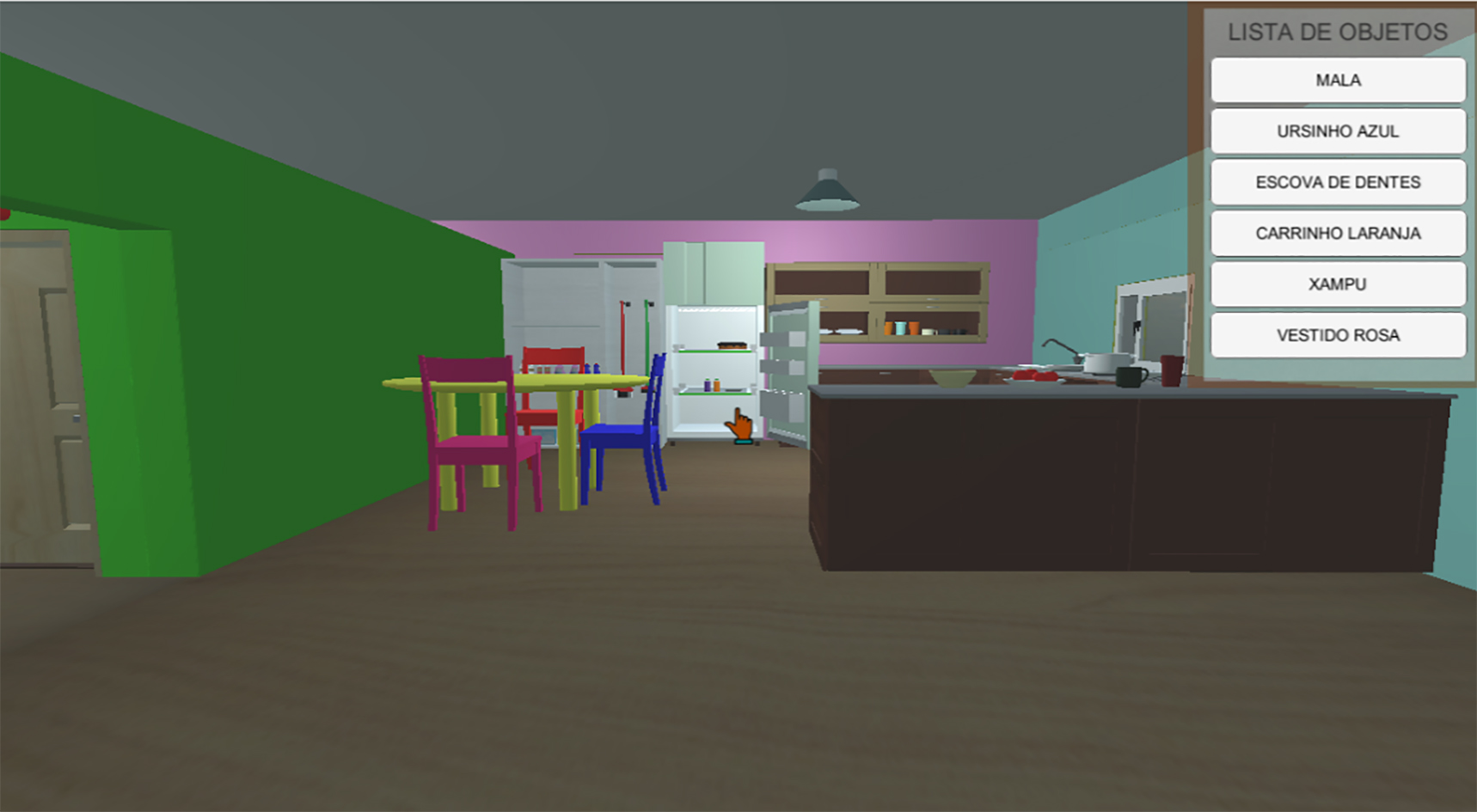
The initial screen of the game contains the main menu, where it is possible to choose one of three activity themes: Family Trip, Picnic and Surprise Party. In addition to the activities, the home screen also has options for the teacher who accompanies the child in the use of the game.
The virtual environment consists of a small town with houses, sidewalks, streets, trees and a mall with seven different stores: clothing store, shoe and accessories store, toy store, pharmacy, snack bar, supermarket and ice cream shop.
Figures 1–3 show respectively the partial view of the user’s house, of the city and of the mall.
Partial view of the city. 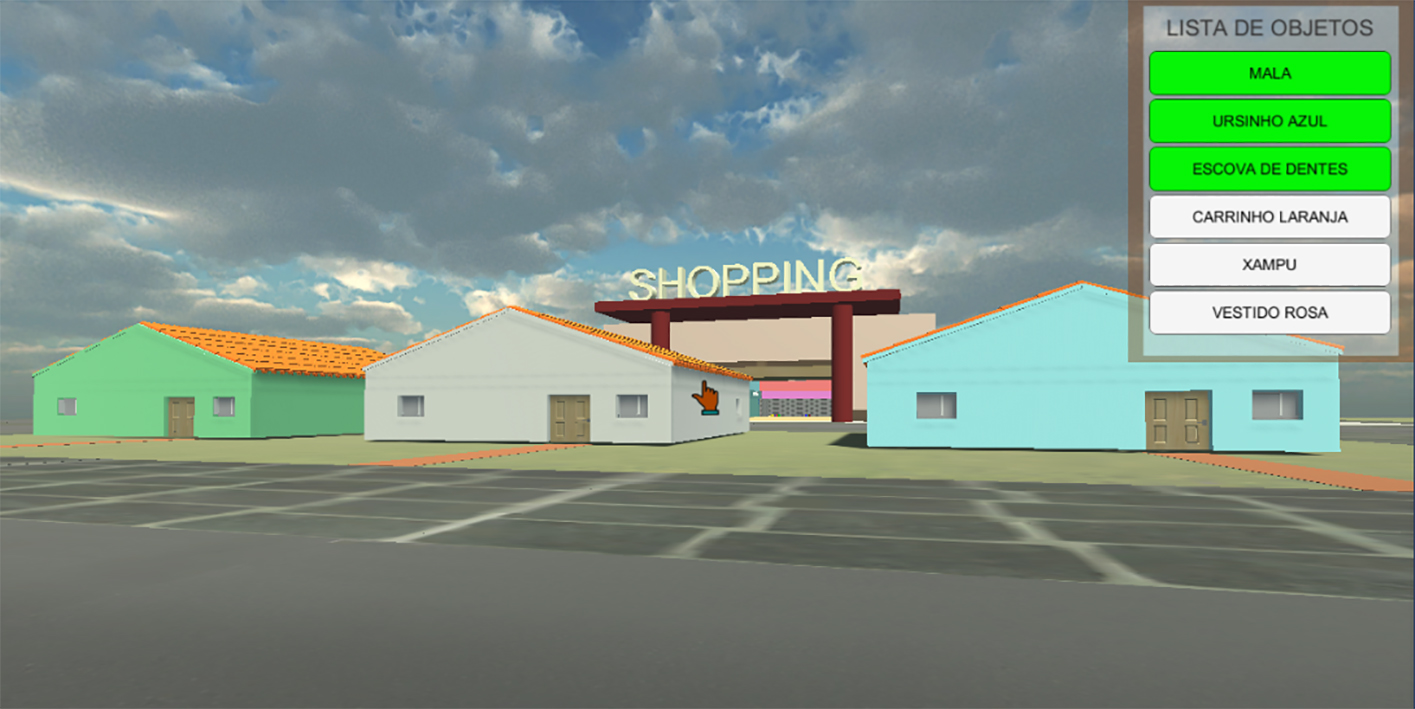
Partial view of the mall.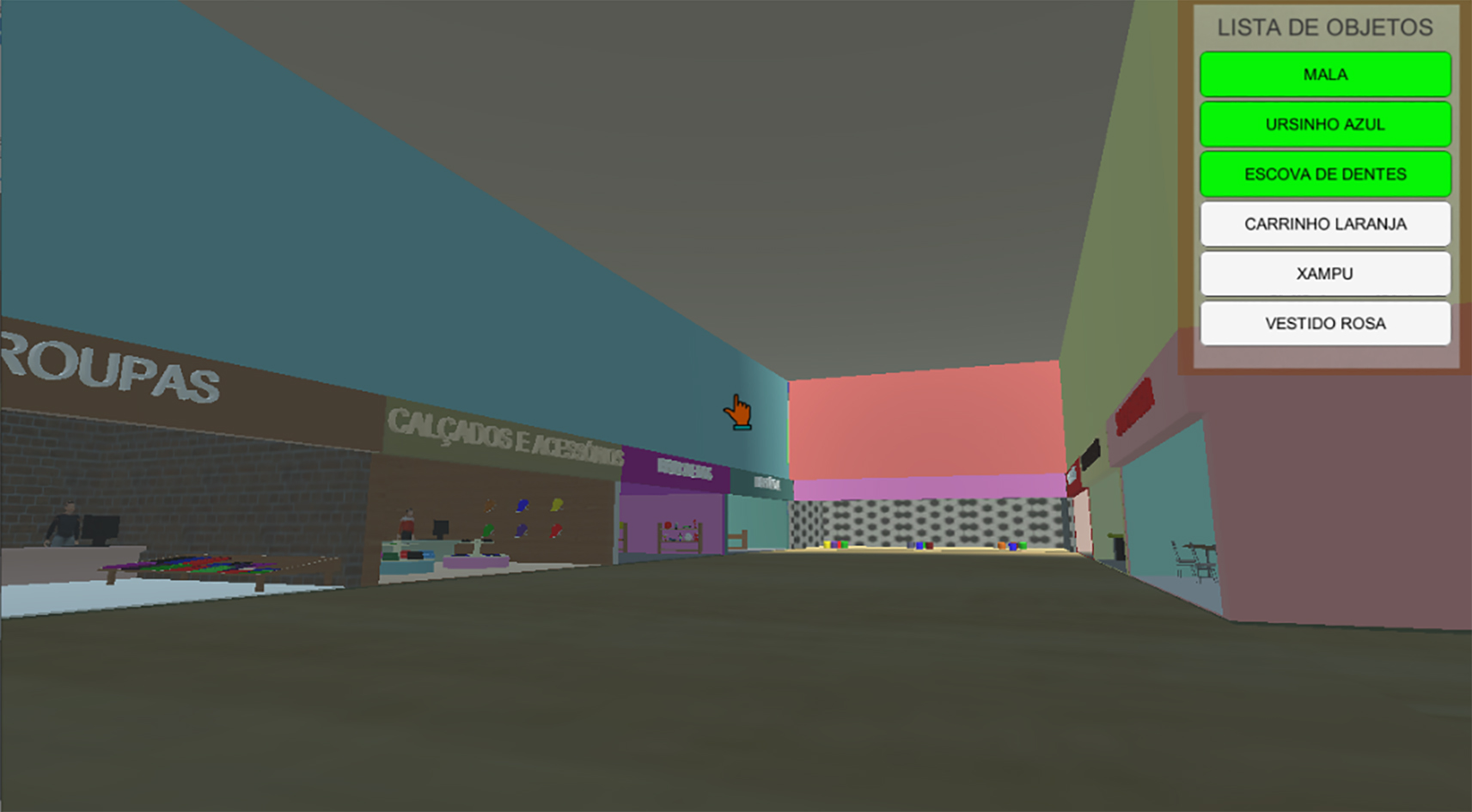
To use the tool, it is important the mediation of a teacher or tutor to transmit clear instructions regarding the student’s interaction with the virtual environment and its objects. However, it is also important to give the children the freedom to make decisions that are inherent in the game.
The flow of the game follows three distinct tasks, which the child will choose to play in the initial menu. Each of these tasks have two separate lists, a list of objects that the child has to look for inside the house and a shopping list. These lists vary according to the chosen task, but the arrangement of the objects in the virtual environment is the same for the three planned activities. In the game, children have to look for items of a shopping list inside a house and go shopping in a mall to buy items that they could not find inside the house.
Through the search for these objects in the environment, child has the opportunity to interact with all objects of the virtual environment in the house and in the mall, which provides the learning on how to spell the name of the objects, even of the objects that are not in the lists. To interact with the objects, the user has only to click on the object. Then the user will see how to pronounce the name of the objects, how to spell it and the syllable separation.
Although the lists are distinct (items to find in the house and items to buy at the mall), the objects that the user has to look for are shown in the same list, always available in the upper right corner of the screen. Three objects from each list are selected randomly at the beginning of the game, totaling six objects that the child must look for to complete the task.
Teachers’ profile
After finding the three objects that are in the house, the child receives a message to find the other three objects in the mall. Then, the child is directed to leave the house and go to the mall, strolling through the city. After completing the purchase of all items, the child is guided to return home, completing the activity and winning the game. The teacher has the option to save data concerning the student’s interaction with the game such as: name, time spent to find all objects, number of errors. These data can serve as a parameter to evaluate the progress of the students in the literacy process. The game has no difficulty levels, but as the child with ID plays with the game, it is expected that he/she will progress gradually in linguistic aspects considering writing, reading and speaking.
For this research, two public schools (S1 and S2) of the southeast region of Brazil were chosen. These schools were selected because they contemplate the requirements of being inclusive schools and having a multifunctional resource room with computer equipment for the use of the game.
Data collection for evaluation of the game was made through two questionnaires. The first (referred as Q1) was designed for the purpose of describing the students, considering questions on ID and literacy, and the second (referred as Q2) was about teachers, their involvement with the Specialized Educational Assistance and the evaluation of the game as a tool to support the literacy process of individuals with ID.
The questionnaire Q1 consists of 15 questions divided into three themes: general student data; student profile; and aspects related to literacy skills. For an analysis of aspects related to literacy, the 5-point Likert scale was used, where “Strongly Disagree” represents 1 and “Strongly Agree” represents 5.
The questionnaire Q2 has 16 questions divided into two themes: general teacher data, including questions about their involvement with Special Education, and the evaluation of the game, after its use.
The steps for the evaluation and tests of the game in relation to its purpose and proposed objectives were:
Presentation of the research and the game “Learning with Activities” to the teachers that carried out the evaluation and validation of the game; Presentation and explanation of the Terms of Free and Informed Consent to the teachers and parents of the children, and collection of the signatures; Application of Q1 to know the profiles of the students with ID that participated in the research; Use of the game (the teachers who evaluated the tool used the game with the students who participated in the project); Application of Q2 to know the profiles of the teachers who participated in the research and their evaluation regarding the game; Analysis of the results obtained in Q1 and Q2 after the use of the game by the teachers.
For the evaluation of the game as a valid tool to support the literacy process of children with ID, the method of analysis used in this research was the qualitative one, since the number of students who participated in the study was not appropriate for statistical analysis.
Profiles of the students and teachers that participated in the research
Three teachers (P1, P2 and P3) from two public schools participated in the system evaluation, two of them from one school (S1) where three students participated, and one teacher from a second school (S2), where five students participated in the research. All the teachers have a degree in Pedagogy and specialization in an area related to Inclusive Education, in addition to an experience of more than five years in the Specialized Educational Assistance (SEA). Table 1 presents the teachers’ profile.
Eight students with ID (from the 1st to the 5th year of elementary school) participated in the research. The students age range from 8 to 13 years old, with a mean age of 9.5 years. It is observed that half of the students who participated are repeating the current year.
Considering the questions on aspects related to literacy skills (knowledge of letters, reading, and writing), any student scored 5 (strongly agree). The students’ evaluations show that most of the children know the alphabet as five of them were evaluated with a score of 4 (agree) and 3 with a score of 1 (strongly disagree).
Students’ profile
Students’ profile
However, the indexes decrease in questions regarding reading and writing as the evaluation shows that only 2 students scored 4 for writing, 3 students scored 3 (I do not agree or disagree) and 3 students scored 1. In the evaluation of the student’s knowledge about reading, only one student scored 4, 4 students scored 3 and 3 students scored 1.
The students’ profile and their literacy skills are presented at Tables 2 and 3 respectively.
Literacy skills of the students
LS-1 (Literacy Skill 1): Does the student know the alphabet? LS-2 (Literacy Skill 2): Is the student able to write? LS-3 (Literacy Skill 3): Is the student able to read?
The qualitative evaluation of “Learning with Activities” was performed based on the answers of the teachers that evaluated the system.
About the purpose of the game, P1 highlighted that the game allows the interaction with the real environment represented by the virtual environment. She also pointed that as it is an interactive game, it allows the students to develop their learning in a playful way, thus contributing to the students’ literacy process. In the same way, P2 and P3 indicate that the game works in the development of important skills such as reading, memorization, attention and concentration, visual and auditory perception and spatial organization.
For P1, the virtual environment has advantages when compared to the traditional activities in the classroom, because it makes the student feel as belonging to the environment as the interaction with the objects and with the environment itself is the most realistic as possible. About this, P2 points out that the game environment gives the student enjoyment, playfulness and interest in the activity with the virtual environment, causing greater attention and concentration on the object of learning. P3 considers that the interest of the student in this type of virtual environment makes learning stress-free.
The three teachers who conducted the evaluation believe that the game can motivate students during the teaching and learning process. P1 points out that in addition to supporting the literacy process of students, the game helps in working on perception, attention and concentration. In addition, P2 indicated that the game brings a lot of motivation, since children, of course, enjoy games and activities on the computer.
For the teachers, the game provides greater security for students in activities when compared to real life activities, especially for issues related to the unpredictability of what happens in the real world. Furthermore, P1 points out that teachers do not need to leave the school environment with students to experience the activities of daily living.
The advantages related to the use of the game by teachers and students were pointed out, covering important points that conventional activities do not provide in the teaching and learning process for students’ literacy.
P1 mentioned the tranquility in the use of the game, provided by the greater availability of time in correcting the errors of the student. In addition, the aspects of motivation, dynamism, playfulness, autonomy, stimulation of creativity, and the contact of the child with technology were pointed out as advantages by P2 and P3.
With regards to other assistive technologies, according to the teachers, the game has the differential of allowing the student to experience day-to-day activities, bringing an approximation of reality in the tasks of the game.
When questioned about the knowledge of some software developed for students with disabilities and specifically for students with ID, teacher P1 answered that she does not know any specific software and teachers P2 and P3 answered that they know other software. According to them, the main advantage of “Learning with Activities” in relation to other software is the fact that it contemplates activities related to students’ daily lives. As disadvantages, if compared to these other software, it was pointed out that the game’s characteristics are restricted to commands because the activities are always oriented to exactly how the student should proceed in the situations.
For P1, with good guidance, the student will not have difficulties to use the game, in general, as it is easy to understand. For P2 and P3, in the initial students may experience difficulties with mouse handling. This is in agreement with the experiments of [14], which pointed out an initial difficulty of the students regarding the use of the mouse for navigation in the environment, but this difficulty was overcome after greater contact with the environment.
In general, a limitation was noted regarding the game navigation. The game ran slow on the computers of the schools in which the game was evaluated. This limitation is a point to be improved in the game, which in computers with good graphics processing capacity behaves without major limitations, but this is not always the reality of computers in Brazilian public schools. At this point, the game’s navigation is, to a certain extent, limited in computers with less graphics processing.
As suggestions for improvement, the teachers pointed out that more scenarios could be implemented in the game. They also suggested to put prices on products at the stores to work with math concepts, as well as to make improvements in the house and in the city environments, such as stop signs and pedestrian tracks, that would make the student’s interaction with the environment even more didactic and realistic.
Conclusions
The literature pointed out a gap in the use of Virtual Reality (VR) technology in the learning process of individuals with Intellectual Disability (ID). Aiming to fill this gap, this paper presented a study on the potential of VR as an educational tool for students with ID, especially to aid in the literacy process of these students.
To achieve the objective of this research, a game called “Learning with Activities” was developed. The game aims to help teachers in the literacy process of students with ID, encouraging the development of cognitive skills that are essential to academic learning. The game has been validated by professionals in the field of Special Education and has been used in two inclusive schools by students with intellectual disabilities.
The game has received a positive evaluation as a tool to support the literacy process of children with ID. The fact that the game has spoken instructions and shows the written form of the objects, their syllabic separation and pronunciation is an important feature of the game, since knowledge of letters and phonological awareness play a differential role in the early stages of the literacy process of children. The qualitative evaluation of the game by the teachers and students showed that the game also has advantages in its structure that allow its users to learn playfully and dynamically, relating the objects and day to day tasks with the process of literacy.
These results show evidence that VR has an important role in the learning process of students with ID. Also, the characteristics related to VR systems (high level of interaction, realistic response to user actions, involvement and immersion possibility) seemed to represent decisive factors in this process. This demonstrates the relevance, already noted by previous studies, of the application of VR for educational purposes. Thus, this study contributes to this discussion by showing empirical results in its application as educational tool for students with ID.
The fact that these students form a heterogeneous group and have different cognitive styles indicates the level of adequacy of VR. Computer technology would not be useful if there were no people interested in using it. Therefore, it is important to note that one of the innovations and contributions of this work is precisely the proposal of a new application for VR, focused on a portion of the population whose access to games and educational software is still limited.
Virtual Reality is, therefore, a technology that can contribute to the expansion of the possibilities for inclusion of children with ID in the educational context, presenting potential for the improvement of the teaching and learning processes of these students.
Although the work does not exhaust the issue at hand, it offers a contribution to the development of new actions with the objective of including students with ID in regular education systems as it relates to the use of alternative technologies seeking to facilitate learning.
As suggestion for further research, we indicate the analysis of the benefits and contributions that VR can generate in the process of teaching and learning of disciplines such as science and geography, because it allows the creation of a virtual three-dimensional interactive environment that can be explored in other contexts.
Footnotes
Acknowledgments
We would like to thank the Fundação de Amparo à Pesquisa do Estado de Minas Gerais (FAPEMIG) for its support through the project n