



Abstract
BACKGROUND:
The dominance of a digital wave is being felt in every sphere of the industry, and has been a big boon for online shoppers today. However, companies tend to ignore a section of their customer base, i.e. those who are visually impaired; although there are well-established standards set by WCAG 2.0 (Web Content Accessibility Guidelines). Although most e-commerce companies in India conform to these guidelines, as per the recommendations from the Indian government; however ironically; these are not accessible by the blind.
OBJECTIVE:
This paper specially focuses on the list of problems that the visually-impaired in India face while trying to access e-commerce sites, as most of the sites haven’t conformed to the WCAG 2.0 guidelines.
METHOD:
Qualitative analysis through the Repertory technique by Kelly in which, the grid developed for different constructs addressing various problems faced by such users in accessing e-commerce websites.
FINDINGS:
From the findings, it is evident that these visually impaired people are extremely open to gaining access towards the companies’ strategies, as they also want to be a part of the main segment of the society, and would in turn be a strong contributor to the profits of the companies, if they’re taken seriously. The findings also have a series of managerial as well as social implications.
CONCLUSION:
Further, the study also looks at lending some suggestions through which, marketing managers would be able to look into this prevailing problem, and thereby address the same, while enhancing their level of engagement with this specially-enabled client base. This would result not only in adding profits to the business at large, but also ensure customer satisfaction and delight, albeit the fact that they’re differently abled.
Keywords
Purpose of the study
Dominance of digital wave being felt in every sphere of the industry. Requirements of accessing a website successfully (especially for visually impaired customers) is missed by most of e-commerce companies. Nonconformance to the standards set by WCAG 2.0. Severity of the accessibility errors cannot be evaluated by automatic tools (e.g. TAW) [1]. Requires human intervention to understand the severity of the accessibility errors (output from TAW software).
Objective of the study
To identify the severity of the problems faced by visually challenged while accessing the e-commerce sites. To improve active engagement of these e-commerce customers.
In the digital world that we live in today, internet has penetrated every aspect of our lives. The digital platforms have gained in both accessibility and affordability; this includes E-commerce companies, which are incessantly being accessed by customers for online errands. Within this digital boom, most companies tend to overlook the needs and requirements of differently-abled customers, specifically the ones who’re visually impaired customers. Although technology at large has evolved to rope in these differently-abled people through various softwares and tools, and governments, along with policy makers globally have laid down well-established guidelines, several companies in the worldwide web have somehow chosen to overlook this section of the larger populous.
According to a study, more than 80% of the visually impaired users are dependent on cited persons for their online transactions. Due to this, there are often confronts, where the ‘visually impaired’ are reluctant to access E-commerce websites, due to which, they withdraw from e-commerce podia. In order to avoid/minimize the same, W3C has come up with the WCAG 2.0guidelines. In effect, these guidelines are based on four principles that website designers must adhere to while designing the websites. They include:
The websites should be perceivable. The websites should be operable. The websites should be understandable. The websites should be robust.
Further, to evaluate the accessibility of websites, there are many automated tools that are available, illustrating the accessibility errors of the websites, which in turn are categorized as priority 1 errors, priority 2 errors and priority 3 errors. The websites then are further classified, depending on the level of accessibility as follows:
This study specifically focuses on the challenges faced by visually impaired customers in accessing e-commerce websites. The rationale for undertaking this study is that hardly any work has been done in this expanse. Even though automated tools, such as TAW [2] shows the accessibility errors, and also elucidates the level of accessibility, they fail to explicate the severity among the errors. Thus, in order to explain error severity, and to understand the accessibility challenges, while further apprehending the coping abilities of these subjects, human intervention is indispensable. Therefore, we chose to use the qualitative approach through Repertory Grid technique, through which, we looked to identify emerging constructs that are the most severe for visually impaired customers in their attempt to access E-commerce websites.
It may be noted herein that extant literature did have a study that was similar in nature to that of ours. The context therein related to the issue of accessibility in Indian Universities’ homepages’. The study was primarily exploratory in nature, whereby the researchers looked to figure out whether or not Indian universities actually conform to the WCAG 2.0 guidelines [3]. Based on the results of their analysis, they proposed a few steps that were needed to further enhance the accessibility of the Indian universities’ websites.. While the earlier study dealt with website accessibility of Indian universities, our study specifically deals with accessibility of e-commerce portals, maintaining the common subject of ‘visually impaired’ people.
Roopa Bose and Helmut Jürgensen [4] noted in their study “Some screen readers can handle dynamic content to some extent; some cannot. A major reason for such limitations is that syntactic and semantic information is lost when content is linearized for a screen reader”. Thus, although ‘Screen readers’ are used extensively as common available output media for the blind, a few other good options include JAWS, NVDA (Non Visual Desktop Access), Speak Up, Thunder, Window Eyes and VoiceOver [5].
The other study [6] we referred to for our paper discussed ‘e-commerce web accessibility for people with disabilities’. Herein, the authors studied Australian-based B2C e-commerce companies; they found that the worldwide web does offer several opportunities for the disabled people that are otherwise not there in any other medium, offering thereby complete freedom to the differently-abled users. However, they noted “if a website is not created with web accessibility in mind, it may exclude a segment of the population that stands to gain the most from the internet. “Most people do not intend to exclude people with disabilities. As organizations and designers become aware of and implement accessibility, they will ensure that their content can be accessed by a broader population”.
Another interesting study that gave us a direction for justifying our research includes Kaur & Dani’s study [2]. They looked to find the output variables that fall under priority 1, 2 and 3, derived from the TAW software.
However, in our study, we note that the severity of accessibility errors requires human intervention, and we looked to capture the essence of this very human intervention by way of conducting qualitative in-depth interviews to get the extent to which these priorities can be lined up in detail, and are mentioned under the ‘Research Methodology’ section [2].
Additionally, we also referred to a few set of papers that highlighted the dire need of catering to accessibility for everyone. Specifically, in Auchariyabut & Limpiyakorn’s study [1], the authors stated: “The real transformative process towards eDemocracy would be made by regulations made according to the needs of all citizens”. Further, they stated: “for eGovernment model, to ensure the networking & organizational abilities among people with disabilities, could be possible by people with disabilities making use of services”.
Not enough has been done in terms of accessibility of portals, especially for the visually challenged readers; more so in the developing nations. Thus, our study is an attempt to highlight the plights of these differently-abled people, and thereby introspect on whether something could be done, specifically for both public and private e-commerce websites.
Another interesting study that we referred to, worked in the area of websites dealing with sports goods; specifically their sales and revenues, vis a vis a buying comparison between normal sighted and the visually impaired customers. The authors in this study found that sports websites suffered losses in revenues due to the non-accessibility of websites for the visually challenged. The authors stated: “the problem is even more critical for the home page, the merchandise landing page, and the ticket landing page analysis, since none of these pages from an official website was free from priority A errors (compliance with level A means that all indispensable criteria for the document information to be accessible to all are met)”. Interestingly, their pre-test results showed that visually impaired respondents, found it less convenient to buy sports-related products through the company’s official website. Additionally, they reported that it was hard to navigate these official websites, since they require a lot of effort, even post which they do not find what they have been looking for [7].
Research method
20 visually impaired participants who were unable to count fingers from a distance of 3 meters as per World Health Organization’s (WHO) definition of visually impaired people were chosen for the qualitative analysis. They are all aged between 18–35, comprising of 11 men and 9 women. Moreover, they were computer literate and used smart phones. The qualitative analysis was undertaken through the Repertory Grid technique by Kelly in which, the grid was developed for different constructs addressing various problems faced by such users in accessing e-commerce websites. This grid recommended a sample size of 15–20 for an elaborate interviewing technique, which in itself is time consuming. We interviewed each participant for about 1 hour 45 minutes. In addition, through such Qualitative analysis, further research has been carried out, where the visually challenged customers opinions and feedback related to their website accessibility problems and their specific suggestions through thematic coding are noted down.
Elements of the grid
The elements represented the e-commerce companies. They were categorized as per WCAG 2.0 guidelines, and are as follows.
Emerging constructs of e-commerce websites through Repertory Grid
(Developed by researchers).
As may be noted from above, the elements were primarily classified as fully accessible, highly accessible and low accessible to e-commerce websites. Additionally, nine such elements, i.e. three from each category were selected for this study. During the interviews, the participants were asked about accessibility issues through the tri-adding method. In this method, participants are generally asked to randomly select any three elements from each category, and are then interviewed for how the first two elements are effectively similar, and how the third element is different from the former ones.
Scree plot table (idio grid output)
Singular value decomposition of e-commerce data with principal components analysis (developed by researchers).
Scree plot table.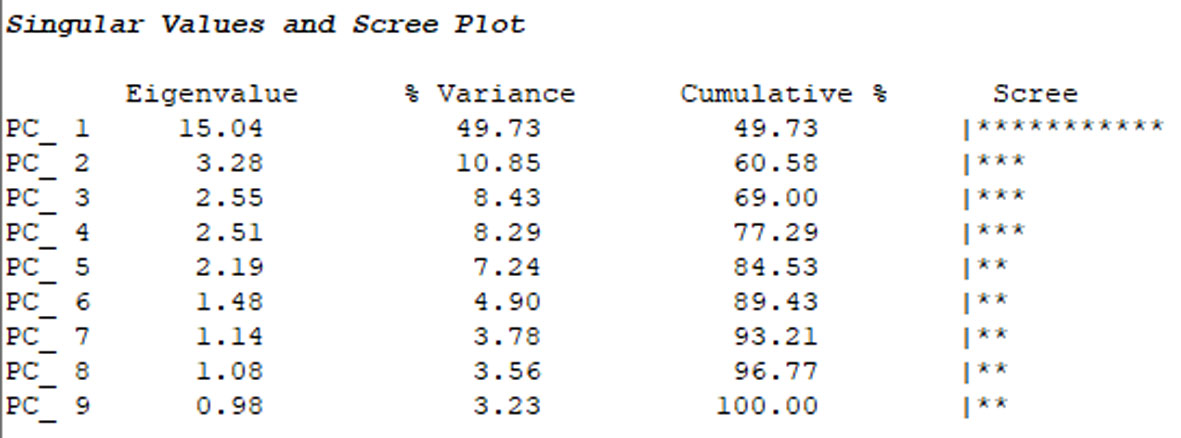
Through the tri-adding technique, various constructs evolved, mainly as a result of tri-variance permutations. Notably, the participants were well conversed with the accessibility issues, till the repetition of the same constructs. Wherever, the participants were abstracted from the central topic of issues related to accessibility of the websites, they were fixated using the laddering technique.
Development of the grid
For every emerging construct, another contrast pole had been developed. The participants were asked to rank each element from the favored pole to the contrast pole of the respective constructs. A five point Likert scale for ranking the constructs was considered, and the scoring for the satisfaction of the website accessibility was as follows: 1 for high satisfaction and 5 for low satisfaction.
Empirical findings
The Repertory Grid developed is shown in Table 1.
From the Fig. 1, it may be seen that most of the constructs were spread across principal component (i.e. PC 1), whereby the loadings were significantly higher. Moreover, we also see the elements that are clustered at the right end of PC1 (at scale more than 4). Since, the factor loadings are seen to be concentrated along PC1, it may be affirmed that the factor loadings of the constructs across PC1 could single-handedly be considered, while ignoring PC2. This is further strengthened by a scree plot table as shown in the figure below. This figure shows us that almost 50% variance are explained by PC1, followed by 10% variability observed at PC2.
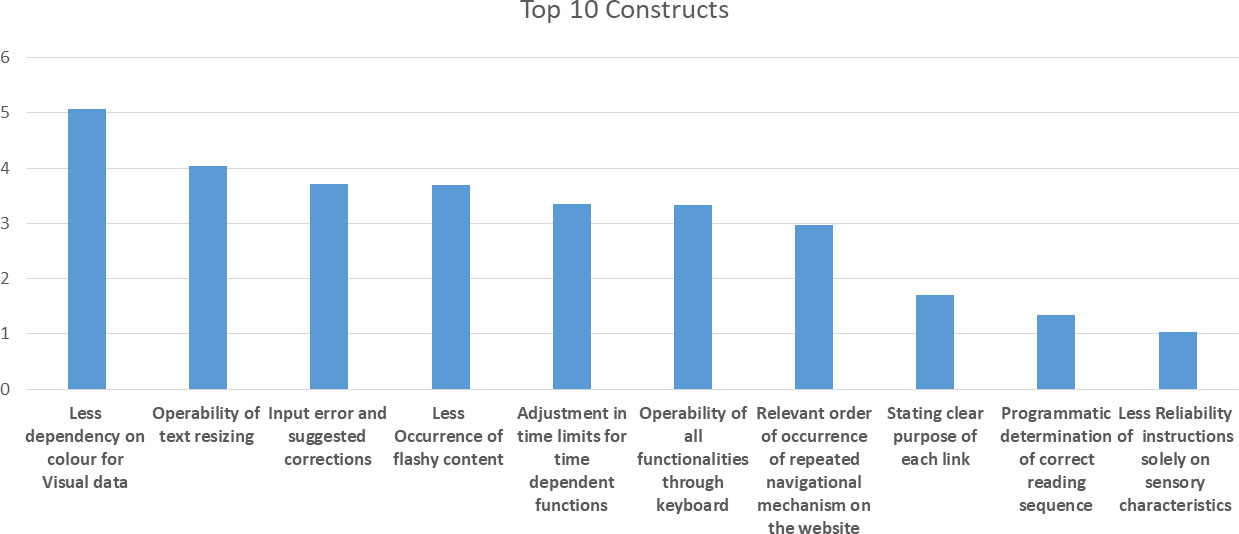
For easy understanding, factor loadings of construct across PC1 are interpreted as influencing factors, which should be considered first, while designing websites for visually impaired customers. The persuading constructs are as Table 2.
Findings and discussions
Almost all the respondents scored towards the contrast pole of the Repertory Grid, thus affirming that the websites of e-commerce companies do need to revamp themselves according to the accessibility audit check list provided by the Indian government, and thus work towards effective ways of customer engagement through the online podiums. From our results, it may also be affirmed that constructs like ‘less dependency on color for visual data’, ‘operability of text resizing’, and ‘input errors and suggested corrections’ etc. are very crucial for designing e-commerce websites for wooing these differently-abled populous of the larger society.
Moreover, the text, font size, monochromatic color schemes, graphic content, audio-visual data with sub-titles must be made inclusive for every single marketing communication adopted by the company for online marketing communication. For instance, most of the visually impaired consumers regularly use JAWS (screen reading software), AI poly, image recognizing app for accessing different online tools; these should be considered by the companies, while designing the layout and content of their websites.
Managerial implications
From the findings, it is evident that these visually impaired people are extremely open to gaining access towards the companies’ strategies, as they also want to be a part of the main segment of the society, and would in turn be a strong contributor to the profits of the companies, if they’re taken seriously.
The findings also have a series of managerial implications, and draw a big connect to the tasks that must be undertaken by the marketing managers to get their websites accessible for their visually challenged customers. The most important amongst them is their attention towards the ‘high scoring constructs’ that have emerged as per the Repertory Grid Table. Thus, working on this would make their businesses more competitive.
Social implications
Accessibility campaigns initiated by the Indian government have clear guidelines and checklists for enhancing website accessibility; in fact, it has a detailed layout on a website’s accessibility audit. Companies could choose to use these extensively to make their visually-impaired customers, a part of their global consumers’ demographics. In turn this would also help the companies in streamlining these segments of customers, so that they can have a sense of being integrated rather than differentiated from the larger society.
Originality/value
The paper is an outcome of an extensive literature review, based on the research gap that outlines a need to make a dynamic shift in the preference of companies providing marketing services through online mechanisms for their conveniently left out customers segment that are visually impaired. Negligible work had been thus far, especially in the Indian context on the severity of the errors, which effectively are the outcomes of automated tools for accessibility. Thus, the need to highlight these important issues brings about originality to our research findings and suggestions.
Acknowledgments
The Authors have no acknowledgments.
Author contributions
CONCEPTION: Neha Patvardhan
PERFORMANCE OF WORK: Both authors
INTERPRETATION OR ANALYSIS OF DATA: Both authors
PREPARATION OF THE MANUSCRIPT: Both authors
REVISION FOR IMPORTANT INTELLECTUAL CONTENT: Both authors
SUPERVISION: Both authors
Ethical considerations
Informed Consent from all the respondents was taken before the study.
Footnotes
Conflict of interest
The authors have no conflicts of interest to report.