



Abstract
BACKGROUND:
Multiple sclerosis (MS) is a chronic degenerative neurological disease with visual, sensitive, motor, or cognitive symptoms. Physical activities are recommended for people with MS (pwMS) who are at home instead of in a rehabilitation program, to help them to maintain their autonomy. Since a lack of motivation appears to be the principal barrier for pwMS to practice exercises, it is necessary to evaluate whether mobile health (mHealth) tools can offer a solution to stimulate their motivation.
OBJECTIVE:
This literature review analyzes papers to investigate to how a mobile application can motivate pwMS to practice physical activities and manage their fatigue.
METHODS:
We performed an automatic query from digital libraries and analyzed the studies.
RESULTS:
We selected seven articles that responded to our criteria. These studies tested mobile applications that used different strategies to motivate pwMS to practice physical exercises at home and manage their fatigue. A lack of motivation was the main obstacle, but depending on the type of exercises chosen, some application settings seemed to resolve this issue.
CONCLUSIONS:
Studies in this area are limited, although this literature review highlights the need for mHealth tools in which pwMS and their therapists contribute to their use and conception.
Introduction
Multiple sclerosis (MS) is a chronic degenerative neurological disease. In France, MS affects more than 100,000 people [1], while in 2013, 2.3 million people were affected worldwide [2]. The disease is the leading non-traumatic cause of severe disability in young patients in many countries. MS begins between 25 and 35 years and two-thirds of people affected are women [1]. The disease is marked by relapses. Initially, MS usually follows a relapsing and remitting course (RRMS), and as a second step, most people present secondary progressive MS (SPMS). There is currently no treatment to cure MS, but only a few drugs to slow down its evolution. Symptoms can vary between individuals. They may involve visual, sensitive, motor or cognitive impairments, and the disease can evolve toward an irreversible disability after several relapses or when the disease progresses to SPMS [3]. The most common symptom reported by people with MS (pwMS) is fatigue [4], which can be a major source of limitations in daily life activities, recognized as the main reason for the inability to work in pwMS [5]. Moreover, depression and anxiety have a high prevalence in MS [6], which might be in reaction to the difficulty of living with a chronic disease or a predisposition associated with MS [7]. Depression is a source of decreased well-being, professional achievements, and social activities, and it can take a significant place in the lives of pwMS [8]. Therefore, due to fatigue depression as well as visual, sensitive, motor or cognitive impairments, pwMS can have severe disabilities in their daily life activities.
As a result, pwMS experience a loss of independence that is difficult to endure. Their quality of life gradually decreases as the disease progresses [8]. The most affected patients are offered periodic stays of several weeks in rehabilitation centers to regain some autonomy. However, between these stays, pwMS have to perform physical exercises if they want to avoid losing the benefits of rehabilitation [9]. For pwMS, self-rehabilitation and physical activities are widely recommended when they are at home [10]. Self-rehabilitation consists of pwMS performing exercises advised by their therapists and integrating them into their daily life. These exercises help to prevent this deterioration between rehabilitation stays and maintain people with chronic disabilities at home. It is recognized that without regular physical exercises, pwMS evolve toward a loss of their abilities and thus their autonomy [11, 12].
Motivation has a positive impact on the autonomy and quality of life of pwMS [13, 14]. However fatigue and depression decrease motivation, thus preventing the practice of exercises, which represents a central issue in the psychological aspect of the disease.
Mobile health (mHealth) tools seem to be a solution to this issue. Mobile applications specifically designed for health care can represent a good solution to motivate patients given that it is adapted to their medical needs. Moreover, the medical care of chronic diseases is constantly evolving on account of the numerous tools developed to monitor these pathologies. Lee et al. presented a systematic review of studies conducted between 2005 and 2016 with mHealth as a management tool for patients with chronic diseases [15]. Their literature review concluded that an application may improve communication between patients and their therapist and help patients to improve the selfmanagement of their disease, and in some cases, their overall health.
Another study focused on all smartphone applications available in the American and Spanish Android and iOS market that targeted pwMS [16]. The findings highlighted the lack of applications devoted to helping pwMS to manage their fatigue and motivating them to practice physical activities. The majority of mobile applications focused on the education of pwMS in terms of the disease and its treatment.
To our knowledge, in France, only a few mobile applications exist for pwMS, all of which aim to improve medication compliance; none of them allow pwMS to practice physical exercises or self-rehabilitation
In our paper, the central question is how a mobile application can motivate pwMS to practice physical_ activities and manage their fatigue. Thus, we present a literature review on mobile applications specifically designed to make pwMS practice physical activities or rehabilitation exercises at home under the supervision of their therapists. This literature review only focuses on studies aimed at testing a mobile application for pwMS to make them do exercises.
Methodology
The present literature review focuses on studies with the objective to design or test a mobile application targeting pwMS to make them practice physical exercises. This state of the art is comprised of studies from the field of human-machine interaction. Papers present usability tests or user interviews. This literature review aims to guide the conception of an mHealth tool for pwMS.
Search engine query
To respond to the central question of this review, we chose the following queries: “multiple sclerosis” AND “rehabilitation” OR “physical activities” AND “mHealth” OR “mobile application.” We used the following digital libraries: MEDLINE,1
Results were screened manually. First, duplications were removed as were articles written in a language other than English. Second, results were filtered according to the following three criteria:
Pattern of selection according to the queries.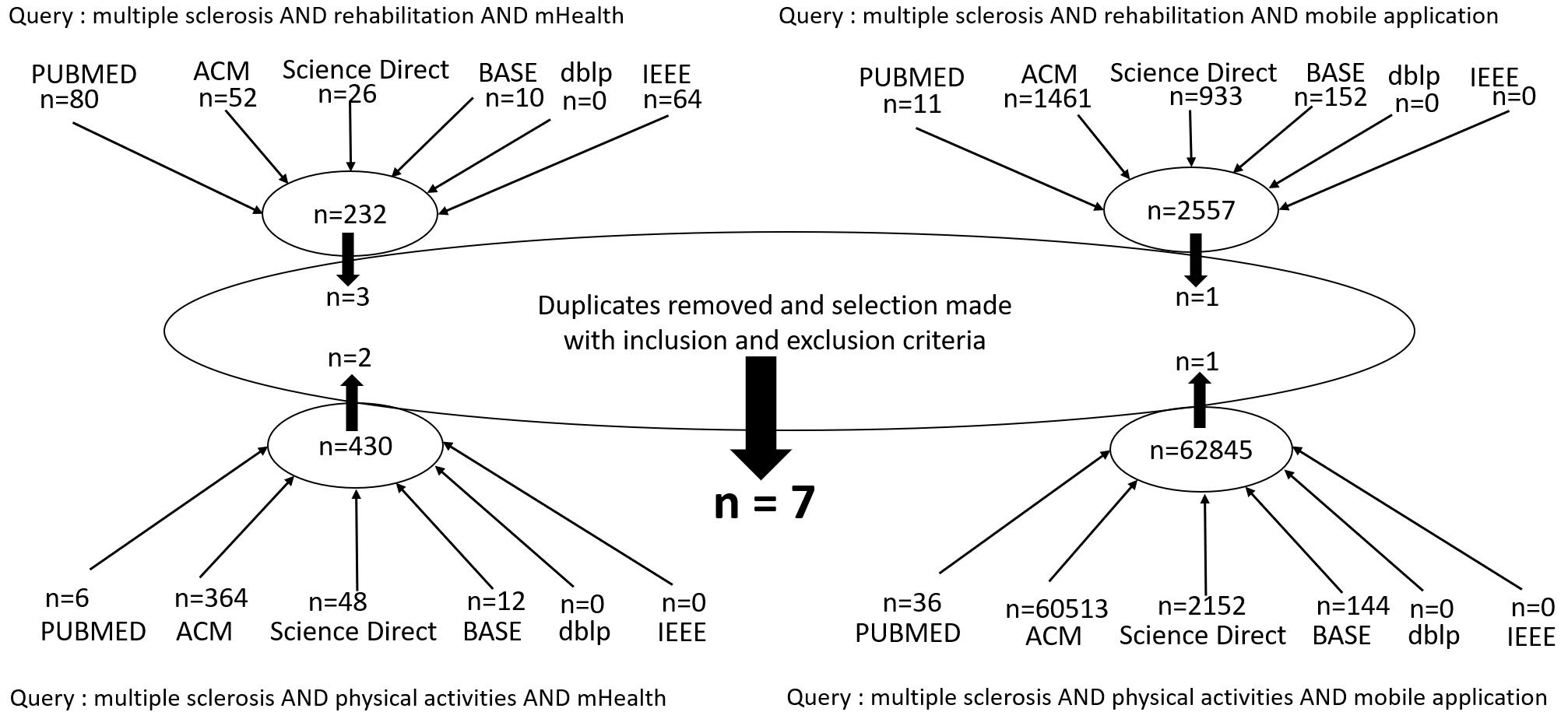
The study focused on MS; The study used an mHealth tool; The study centered on rehabilitation exercises or physical activities to be performed at home.
As mHealth concerns mobile and tablet applications, we chose not to take into account the numerous papers about videogame consoles or computers. There is currently limited research on mHealth for pwMS. Since our aim is to develop an application for people exercising alone at home, we excluded research about the practice of live telerehabilitation, where therapist is present online during the rehabilitation sessions for patients hospitalized in rehabilitation centers or at home.
Papers were selected on the basis of their title and abstract content.
Search engines were consulted with the aforementioned queries between April 19 and 30, 2020. Figure 1 shows the pattern used to select the studies. One author selected papers from databases. Then, three of the authors browsed the selections (title
After applying the previously mentioned criteria, we obtained a total of seven articles dealing with our subject of research.
These limited results (i.e., articles on our subject) bring to light the fact that very few studies to date examine mHealth applications that aim to help pwMS to practice rehabilitation exercises or physical activities at home. Although we did not use publication date as a selection criterion, the seven papers were all published after 2017. Currently, the majority of papers focus on MS treatments or mHealth with a general population of patients (not specially pwMS). Table 1 presents general information about the seven selected articles and their research goals.
Overview of the articles on people with multiple sclerosis (pwMS) and mobile health (mHealth) tools included in the literature review
Overview of the articles on people with multiple sclerosis (pwMS) and mobile health (mHealth) tools included in the literature review
Each study selected for review underwent data extraction. The goal was to analyze and obtain relevant information from the studies in order to answer our central question: how can a mobile application motivate pwMS to practice physical activities and manage their fatigue? For all the papers, we obtained a list of user feedbacks, guidelines, comments, and so on. We then classified this information into categories. This highlighted five key issues that should be taken into account in the conception of a mobile application for pwMS: motivation, fatigue, exercise context, physical accessibility and quality of life. The results below provide the current state of knowledge about these five key issues. Table 2 summarizes the contribution of each article to these issues.
Key results of articles according to the five main issues identified for people with multiple sclerosis (pwMS) using mobile health (mHealth) applications
Key results of articles according to the five main issues identified for people with multiple sclerosis (pwMS) using mobile health (mHealth) applications
To recall, our objective is to investigate how a mobile application can motivate pwMS to practice physical activities and manage their fatigue.
Motivation
The issue of motivation is often described in the literature on pwMS and for this reason, we wanted to know how each selected study aroused the motivation of pwMS. Indeed, some participants dropped out before the end of the included studies because of a lack of motivation, among others [22, 23]. D’hooghe et al. concluded that the patients who gave up often reported a lack of motivation, indicating that a telerehabilitation program might not be well suited to pwMS [22]. Giunti et al. specifically characterized a general lack of enjoyment of physical activities as “a big demotivator” for pwMS [20]. The selected studies thus proposed two types of investigation:
Focus groups and individual interviews to question pwMS and their health caregivers about how to motivate pwMS to practice exercises through mHealth; Evaluations of the mobile applications used by pwMS to test devices that arouse their motivation.
Several elements were used or discussed in the studies to motivate pwMS to practice physical exercises.
The use of visual feedback allows pwMS to follow their daily goal in real time. This was appreciated by pwMS who tested the application proposed by Geurts et al. [23]. Moreover, Giunti et al. remarked that pwMS and health care providers often mentioned that visual energy expenditure on a tool could be a good way to increase strategic energy [20].
Audio feedback
Geurts et al. provided and evaluated an audio system to motivate pwMS to walk while using the application. Results showed that this positive reinforcement stimulated some participants to walk further and faster [23]. However, the audio files were played in a systematic manner and did not follow the progress of each participant. Consequently, some of the audio files were perceived as depressing, because participants could not follow the instructions and advice.
Reminders and encouragements
The application of Ehling et al. is designed to make pwMS practice exercises with the objective to enhance spasticity [17]. This application uses reminder functions and encouraging slogans. If the application has not registered any activity for that particular day, an automatic email reminder is sent to encourage patients to practice their exercises. This reminder was appreciated by participants.
Reward programs and watching other people exercising
The results of focus groups provided some indications about how to motivate pwMS in the study of Thirumalai et al. [19]. Indeed, according to the interviewed pwMS, a reward program to complete the exercises helped to motivate them. Further, the interviewed pwMS stated that watching other people with similar abilities perform the exercises increased their motivation to exercise.
Professional endorsement
The study conducted by Giunti et al. highlighted that an official “professional endorsement” helps pwMS to accept and use mHealth solutions [20]. Indeed, pwMS expressed their fear of doing something wrong due to the evolution of their disease.
Concrete goals
Geurts et al. described a study to test an application that encouraged pwMS to walk more [23]. The usefulness of setting a goal at the beginning of the study was highlighted. After the study, participants reported that having a concrete goal was their main motivation to keep walking throughout the study.
To conclude, it seems important to identify the types of devices and concepts that motivate pwMS and incorporate them into the conception and design of the mobile applications. Furthermore, according to Simblett et al. [18], a lack of motivation is known to be a key barrier to mHealth. It is therefore crucial to take this factor into account when proposing mHealth tools.
Fatigue
Fatigue is an important symptom of MS that must be taken into account for the development of an mHealth tool for pwMS. We thus investigated the different techniques used to manage the fatigue of pwMS using a mobile application. According to the findings of Giunti et al. [2], fatigue is a limitation for pwMS in practicing physical activities. It is particularly troublesome at the end of the day and can be augmented by psychosocial stress.
Different methods are used in the selected studies to help pwMS to manage their fatigue.
Mobile application specifically designed for fatigue management
The application developed and presented by Giunti el al., called “More Stamina” is specifically designed for fatigue management in pwMS [21]. It is a task organization tool that helps pwMS to manage their energy and reduce the impact of fatigue in their everyday life. It provides “to do” lists for users to manage their daily tasks and gives some help to pwMS to ensure that they complete the list while managing their fatigue. The tests described were only performed with designers and researchers without the involvement of pwMS, although this will be the next step in the design of the application.
Exercise program adapted to individual fatigue
In the studies of Ehling et al. [17] and D’hooghe et al. [22], fatigue was used as an evaluation criterion to test the application. Ehling et al., who tested an application for practicing exercises for muscular spasticity, reported no change in the fatigue levels of pwMS during the protocol [17]. It is important to highlight that the exercises were chosen by the physiotherapists of pwMS who understood their patients, their physical capacities, and their levels of fatigue.
Energy management system
The goal of the research presented by D’hooghe et al. was to test an application to help pwMS to simultaneously practice physical activities and manage their energy levels [22]. Globally, participants felt an improvement in their perceived cognitive and motor fatigue after 12 weeks of using the application. According to the study, pwMS presented fewer limitations at work and in their daily life activities, and they succeeded in increasing the amount of physical activities.
Individually adapted goals
Finally, the study of Guerts et al. allowed pwMS to realize that physical exercises (walking twice a week as requested by the tested application) did not increase their fatigue [23]. It is important to note that the walking duration was adapted to the individual capacity of each participant.
To conclude, it appears that fatigue should be taken into account in the conception of the mobile application and the choice of physical exercises.
Exercises
The exercises chosen for mHealth technology play an important role in the design of a mobile application. The studies included in this literature review highlight the need for disability-specific exercises. Geurts et al. note that increasing the physical activity of pwMS can be difficult because common ways of practicing physical exercises such as in fitness centers are not always accessible to them [23].
The selected studies have different ways of choosing, presenting, and proposing physical exercises.
Exercises adapted to individual abilities
The application presented by Thirumalai et al., which did not initially include specific exercises adapted to the person and their capacities, received requests from pwMS who had tested the application to incorporate personalized exercises [19]. Participants reported that they wanted to be able to input their capacities into the application and receive a personalized program based on the type of activities that they could do.
Ehling et al. proposed exercises specifically chosen by the physiotherapists of pwMS [17]. The intervention of a health care provider to choose adapted exercises can be useful. For example, in the study of Giunti et al., pwMS expressed their fears about hurting themselves or triggering a relapse [20].
Well-explained exercises
The research described by Ehling et al. [17] and Thirumalai et al. [19] focused on the exercise guidelines. The videos and visual instructions were appreciated by pwMS who tested the mHealth technologies.
Known exercises
Thirumalai et al. used exercises already known to the participants or similar to those given by their therapists [19]. In this manner pwMS were not confronted with new exercises and had a sense of relief about practicing exercises provided by a health care specialist.
Exercises for daily life
Finally, all the exercises provided in the articles of this literature review [17, 18, 19, 20, 21, 22, 23] could be performed by pwMS at home and easily incorporated into the planning of their daily life activities. As Geurts et al. [23] noted, increasing the physical activity of pwMS can be difficult because the usual ways of practicing physical exercises like fitness centers are not always accessible and possible for them.
Finally, the type of exercises is important to make pwMS want to practice them and use the application, because this issue is directly linked to their level of motivation and fatigue and can have a major influence.
Physical accessibility
MS is a disease that can trigger physical limitations because of the associated motor and visual impairments Simblett et al. [18] and Giunti et al. [20] highlighted the issue of physical accessibility. Indeed, in these studies, pwMS were interviewed about mHealth in general instead of a specific mobile application. The majority of pwMS in both studies cited the accessibility of the tool.
Disabilities considered for a mobile application
Guinti et al. explained that the disabilities observed in pwMS such as reduced fine motor skills and blurry vision should be taken into account by the designers of mHealth solutions for pwMS [20].
Variable disabilities
Simblett et al. added that pwMS can have fluctuating symptoms if they are affected by RRMS and progressive limitations if affected by SPMS [18]. Indeed, pwMS may easily use their mobile application one day but experience accessibility problems on another day because of the disease fluctuation. This is therefore an important element to consider in the design of mHealth technology because pwMS can have disabilities that restrict their use of mHealth.
Quality of life and daily life behavioral changes
Simblett et al. described how MS has a major impact on social life, family, or work. Further, the interviewed pwMS reported the poor impact of feeling disabled when adopting assistive technologies [18]. The ultimate goal of encouraging pwMS to practice physical activities is to increase or maintain their quality of life by changing their daily life behavior.
Quality of life as an evaluation criterion
Only two studies included in this literature review selected quality of life as an evaluation criterion. Ehling et al. found no significant change [17], but D’hooghe et al. observed a significant improvement in physical limitations [22]. According to the authors, this was due to the improvement in the perceived physical health limits of pwMS. D’hooghe et al. also showed that pwMS felt fewer limitations at work or in other daily activities.
Daily life behavioral change
The application tested by Geurts et al. enhanced the intention of pwMS to take care of their health. Participants noted that the application led to a real change in their health lifestyle [23]. Thirumalai et al. also demonstrated a desire among pwMS to participant in community physical exercises [19].
Finally, there was limited discussion in the selected studies about the daily life changes of pwMS after using mHealth or the effect of the application on their quality of life. However, the studies describe positive effects and show a real need to change the daily life behavior of pwMS.
Discussion
As we can see in this literature review, new technologies and particularly mobile applications are increasingly studied for the advancement of health care. Marcolino et al. highlighted the increasing popularity of mHealth, although the evidence for its effectiveness is still limited [24]. Moreover, the World Health Organization is currently supporting the development and expansion of mHealth on a global scale [25]. As a chronic disease, MS is one of the targets of mHealth tools. Marrie et al. showed that eHealth and mHealth facilitated the exchange of health care information with providers [26]. Indeed, many mHealth devices are developed to help patients affected by chronic disease manage their life and treatment [15, 27, 28]. For pwMS, only a few devices focus on the management of physical activities and fatigue [16], and only seven articles were found corresponding to our research topic. This can partly be explained by the rapid evolution of new technologies. Indeed, the oldest study included in this review dated to 2017 [17]; consequently, research of this kind may have only just begun. Based on this literature review we were able to propose four guidelines that should be integrated in the conception of a mobile application to encourage pwMS to practice physical activities and manage their fatigue. These four guidelines are discussed below.
Involve therapists in the use and conception of mobile applications
One of the major lessons learned was that pwMS often need the endorsement of a health professional to use mHealth. They are afraid of practicing physical exercises alone without their physiotherapist or health care provider to advise them about the type of exercises and their intensity [2]. The fear of relapsing or injuring themselves stops them from taking initiatives in their physical activity.
This can be linked to the motivation issue. If health professionals are involved in the use of mHealth, it can enhance the motivation of pwMS to practice physical activities as they are specifically advised by their therapist. Indeed, a lack of motivation is often described in the literature, and results of the study of Simblett et al. confirmed this [18]. Furthermore, Qudah et al. showed that when health care providers are involved, mHealth improves the participation, empowerment, and autonomy of patients in their health care [29].
Consequently, we recommend including therapists in the use of mobile applications to propose exercises and thus motivate pwMS. We also recommend involving them in the conception of the application, as they are not only familiar with the needs, disabilities, and lifestyles of pwMS but will also be mHealth users themselves.
Chose personalized exercises according to pwMS capacity and fatigue
The type of exercises seems to influence the participation of pwMS. The results clearly show that the exercises have to be specifically adapted to each person and their capacity. It appears that the best solution is for pwMS to practice the exercises proposed by their therapist [17, 18, 19, 20, 21, 22, 23, 30].
If this is not the case, then fatigue, which is a common symptom with pwMS [31, 32], becomes a barrier to practicing physical activity [2]. Three of the studies included in this literature review did not show an increase in fatigue among participants despite their regular practice of physical exercise [17, 22, 23]. The tested applications took fatigue into account in their design, which allowed the participants to simultaneously manage their fatigue and physical activities. If fatigue is incorporated into the design of an mHealth tool to encourage pwMS to practice exercises, then it is not a barrier. We therefore recommend the use of specific exercises linked to a concrete goal that is personalized for pwMS depending on their capacities and fatigue limits, as advised by therapists who know their patients.
Take physical and cognitive limitations into account
According to Simblett et al. [18] and Giunti et al. [2], mHealth tools should be specifically designed for pwMS. Indeed, MS symptoms such as motor or visual impairments [3] can limit the use of a smartphone. Further, the variation of symptoms in RRMS and the evolution of symptoms in SPMS should also be considered in the design of mHealth tools [18]. The studies overviewed in this review do not consider cognitive impairments, although they are also a symptom of MS [33] that can limit the use and understanding of an mHealth tool. Therefore, due to the variety of symptoms in MS, we recommend taking the physical and cognitive limitations of pwMS into account during the conception of a mobile application, which should be accessible for any type of disability.
Place the quality of life of pwMS at the center
Finally, the goal of practicing physical activities and managing fatigue is to improve, or at least not decrease the quality of life of pwMS by stabilizing their autonomy and abilities [10, 11, 12]. Indeed, physical exercise may help pwMS to overcome certain limitations encountered in their social life, professional work or other daily life activities. In the series of studies selected for this review, only two used quality of life as an evaluation criterion, and only the study of D’hooghe found good results in terms of pwMS experiencing fewer limitations in their work and daily life activities [22]. In the studies of Thirumalai et al. [19] and Geurts et al. [23], participants showed more interest in their health, although the effect of physical exercises on their daily life activities was not evaluated. The quality of life of pwMS should therefore be placed at the center of mHealth tools and their design. The limitations of pwMS in their daily life activities are therefore the target of this research. Because MS is a progressive disease, it is difficult to improve the quality of life of pwMS The aim is rather to maintain their autonomy, capacity and quality of life for as long as possible. Finally, we recommend placing quality of life at the heart of projects to design a mobile application to motivate pwMS to practice physical activities. Indeed, this issue of quality of life should be kept in mind during the conception and design of mobile applications in order to develop a tool that responds to user needs.
Conclusion
A smartphone application might be a useful tool to guide and motivate pwMS to practice the rehabilitation exercises advised by their therapists and manage their fatigue which is the main barrier for pwMS to practice physical activities. Despite the lack of studies dealing specifically with the effects of mHealth tools that encourage pwMS to practice physical activities, we identified several guidelines about the specific needs of pwMS. We believe that pwMS would be interested in mHealth tools that took into account various conditions, especially if the proposed exercises were supported by their therapists. It could be useful to design a mobile application in which pwMS and their therapists were both involved in its use. To continue this work, we intend to design a mobile application that motivates pwMS to practice physical exercises by following the guidelines highlighted in this literature review.
Author contributions
PERFORMANCE OF WORK: Clémence Chassan, Céline Jost and Dominique Archambault
INTERPRETATION OR ANALYSIS OF DATA: Clémence Chassan, Céline Jost and Dominique Archambault
PREPARATION OF THE MANUSCRIPT: Clémence Chassan and Céline Jost
REVISION FOR IMPORTANT INTELLECTUAL CONTENT: Clémence Chassan, Céline Jost, Marc Sévène, Olivier Cras, Thomas De Broucker and Dominique Archambault
Ethical considerations
This study, as a literature review, is exempt of IRB approval.
Footnotes
Acknowledgments
We would like to thank the entire team of the rehabilitation service of the Centre Hospitalier de Saint-Denis and the CHArt laboratory team of University Paris 8.
Conflict of interest
There is no conflict of interest.