




Abstract
BACKGROUND:
Assistive technology has been a boon for children with specific learning disabilities (SLDs) as it bridges the gap between them and their peers without SLDs. Despite the vast emphasis on the use of AT and speedy propagation of AT tools, yet more research is required on actual usage of AT.
OBJECTIVE:
The purpose of the study is to identify the most significant barriers to the usage of AT by children with specific learning disabilities and suggest various measures to deal with it.
METHODS:
To accomplish the study interviews were conducted with special education teachers of schools in India to find out the major barriers toward the utilisation of AT. First, Qualitative analysis was performed using CAQDAS tool QDA Miner Lite to identify the barriers towards effective utilisation of AT. Further, ISM technique and MICAMAC analysis were used to corroborate the most significant barriers.
RESULTS:
The results revealed the most significant barriers to implementation of AT and also that timely managing these major barriers can lower the effect on other barriers.
CONCLUSION:
Eliminating the significant barriers would enhance the use of AT by the special education teachers, parents, and children with SLDs. Effective use of AT can prove to be benediction in the times of pandemic.
Keywords
Introduction
Specific Learning Disability (SLD) are neurodevelopmental disorders affecting nearly 5–17% of the children [1]. These children face problems with processing language and do not possess learning traits like other non-disabled peers. Thus, they face difficulty in performing simple learning tasks such as reading and writing or doing simple mathematical calculations [2, 3]. It is said that reading, writing and mathematics form the educational pillars and a learner with LDs lack attainment efficiency in either of these [4]. The different types of LDs are Dyslexia (reading disability), Dysgraphia (writing disability), Dyscalculia (disability in performing mathematical operations), Dyspraxia (motor skills disability), and Auditory Processing disorder (Disability in processing sounds) [5]. The persons with SLDs, face issues in acquiring knowledge right from the initial developmental stages. These issues often cause distress and low confidence and hence they need timely management [6]. Such children need special attention and different pedagogical techniques for strengthening their learning capabilities [7]. Generally, the schools in India appoint a special education teacher to impart education to these children. Also, there are occupational therapists outside the school environment to help these children work on their deficits.
Education these days is supported by information and communication technologies to enhance teaching- learning processes. Technology has facilitated self-paced and personalised learning, virtual and remote learning as well as providing anywhere anytime access to open educational resources [8]. The learners right from kindergarten to higher education and even the professional workforce and the adult generation have been able to reap the benefits of technology. The technologies such as artificial intelligence, virtual and augmented reality are being used in schools to make the students understand both the fundamental and complex concepts. Similarly, to assist the students with SLDs, a number of assistive technologies have been developed [9, 10, 11, 12]. These include Talking calculators (for children with Dyscalculia), Word prediction software (for children with Dyslexia), TalkTypers-Dictation tools (for children with Dysgraphia) etc. According to the IDEA (Individuals with Disabilities Education, 2004) assistive technology is to be used for children with disabilities [13].
The interventions introduced for children with SLDs are in the form of hardware or software tools that can help them to improve their learning. Such technological tools fall under the category of assistive technology. The term assistive technology can be considered as a blanket term which would include adaptive, assistive, and rehabilitative devices for individuals having disabilities. According to World health organisation (WHO) Assistive technology (AT) can be considered as follows:
Assistive technology is an umbrella term covering the systems and services related to the delivery of assistive products and services. Assistive products maintain or improve an individual’s functioning and independence, thereby promoting their well-being.
AT can be considered to be a software, hardware tool or a combination of both. AT enables students to engage themselves independently in various academic happenings instead of just waiting for assistance [14]. The options of AT have proliferated nowadays because of greater availability of technology-based tools [15]. There has been strong evidence that AT can have substantial advantageous effects on children with SLDs [16, 17, 18]. Not only on children, but AT has proved to be beneficial for adolescents and adults with SLDs [19].
AT software (talking word processor and word prediction software) improved the quality and quantity of writing for five out of seven LD children [20]. [21] explained the importance of m-learning gadgets in meeting the expectations of special needs people in his study [22]. explained contributions of working memory for academic achievement in students having and not having LDs [23]. in their study explained the benefits of computer-assisted instruction (CAI) in improving the reading skills of children having LDs by examining an evidence base. The mobile technology is proposed to have a positive future for people with LDs [24]. [7] proposed a framework Assistive Learning Environment which would enhance the learning experience of people with LDs. In situations where a child with SLDs is unable to accomplish their academic or behavioural goals, it is necessary to provide some technological solutions which would help them achieve their desired goals [25].
Owing to the powerful implementation of technology in the education sector, there are numerous anecdotes on the use and benefits that the technologies have been able to provide to the students. But it is not known if there are equivalent technological interventions implemented by the schools for the students with SLDs and whether they have been able to utilize and benefit to the same extent. The question arises whether the technologies are being effectively being used by special education teachers, occupational therapists, or even the parents and children themselves? A number of researchers have proved that there is ineffective use of assistive technology for children with LDs [26, 27, 28, 18, 29, 30, 31, 32]. Hence, it is worthwhile to determine why assistive technologies are not being used optimally.
In United States, SLDs encompass one of the major categories of disabilities as per the Individuals with Disabilities Education Act (IDEA) with about 38.6 percent (2,336,960) of the total (6,048,882) students of the age group 6 through 21 assisted under IDEA [33]. In UK, approximately 2.5 percent of the children between age group 0–17 (351,000) are categorized as children with SLDs [34]. About 5–15% children in India are affected by SLDs [35]. These statistics make it evident that managing SLDs is critical. Special education teachers and occupational therapists alone cannot cater to such a high percentage of children with varying types of learning disabilities. Also schooling in rural areas accounts for issues like infrastructural problems and geographic isolation [36]. Problems with teacher recruitment and retaining them for long, curricular needs of students, and lack of resourced schools are very common in these areas [37]. Effective use of assistive technology can play a significant role in helping and overcoming the learning challenges faced by these children. Like other technologies, these are not restricted for use only within the classroom or clinical environment but can be used by parents and children anywhere and at any time. This enables the children to learn at their own pace. These technologies if integrated with learning management systems such as Moodle, blackboard etc. can record the logs of student interaction with the system. Such recorded information can be analysed to provide useful insights into how these students are learning. This real-time analysis can help the educators customise their teaching and learning process. Moreover, automated feedback can be given to these students. Furthermore, technology such as the intelligent tutoring system (ITS) can provide customised learning material to the students based on their performance.
Looking at the benefits that technology can provide to the children with SLDs it is critical that they are effectively used. However, it is not being used optimally. Participation of children with SLDs in home and school environments has been abetted by proper use of AT [26, 27]. Due to technological advancements, AT options have thrived tremendously. However, there is also a strong suggestion, that despite growing awareness and beneficial effects, still AT is currently not being implemented in an optimal manner [28, 18, 29, 30, 31, 32]. According to the data from National Longitudinal Transition Study (NLTS) 2, the usage of AT by secondary students with disabilities was examined by [38]. The NLTS 2 sample had 21,960 youth in total, out of which 17,480 were students with a disability with an IEP [39]. They revealed that AT was reportedly being used very less and only 19.2 percent (3356) of the total reported children with SLDs were using AT. Furthermore, a study with special education teachers in Indian schools revealed that most of the schools were not using AT [32]. This indicates that despite vast availability of AT, it is not being used by children. Hence, it is imperative to identify why despite availability of these technologies, why are those not being used effectively? This paper attempts to determine the barriers to the effective utilization of assistive technologies for children with SLDs by analysing them qualitatively and further identify the most prominent barriers using the ISM and MICMAC technique.
Barriers to utilisation of assistive technology
Children with SLD in India found it difficult to get educated because of certain hindrances like improper teaching methodologies, lack of special education teachers, language problems etc. It was only after the March 24,2017 when the bill titled, “The Children with Specific Learning Disabilities (Identification and Support in Education)” was introduced in Rajya Sabha. After this reform the requirement for special provisions in schools, development of diagnosis and remediation centres, issuance of proper guidelines for providing certification to children with SLDs came into light [40]. Still all these issues have not been completely eliminated in schools in India. Though technology is being used everywhere in the education sector, but is it still not being optimally utilised in India [32].
Barriers to implementation of assistive technology for children with learning disabilities
Barriers to implementation of assistive technology for children with learning disabilities
Extant literature revealed that AT has a huge potential in improving the learning outcomes and efficiencies of children with SLDs [41, 42, 43, 44] as these tools help them circumvent their academic weaknesses [45, 46, 47]. It can be considered that technology can likely be a leeway to natural human proficiencies or mechanisms [48, 15]. Despite the growing interest in this area certain barriers exist which hamper the appropriate usage of AT for people with SLDs [47]. Various researchers have mentioned that eliminating these barriers is needed to make complete use of technology [44, 45, 38]. in their studies mentioned that even though awareness about educational technology is increasing, still accessible technology is not easily available to many students having SLDs globally. Limited resources in terms of appropriate infrastructure resources is one the major hindrances to AT in the education sector [49, 50, 51]. High cost of equipment is another important barrier to AT as stated by many researchers [52, 53, 49]. Lack of knowledge among teachers is another factor which hampers the use of AT for learning disabled [51, 50, 54, 55]. Other barriers included are lack of administrative support and technical issues as suggested by few researchers [56, 51, 57, 58, 59]. The number of children with SLDs has been substantial worldwide still there is lack of awareness and support among the families of such children which is another barrier [60, 61]. Lack of knowledge regarding the AT instructions among the professionals who deal children with SLDs adds to the list of barriers [62, 61, 63, 64]. [61] in his research stated that lack of resources in terms of hardware and software for persons with SLDs leads to poor utilisation of the AT tools. Assessment issues and planning issues for AT tools are important barriers as without them the proper utilisation is not possible [63]. They also added the complex behaviour of these technological tools to make them difficult to use by the instructors as well as children. After coalescing the interviews and the past researches the final barriers were identified. The major barriers identified are mentioned in Table 1.
Extant literature reveals certain barriers that have become a hindrance in the path of using AT for children with LDs. Yet more research is needed to find out the most significant barriers to usage of AT. It is vital to identify the substantial ramparts towards usage of AT and eventually overcome those barriers so that timely intervention in form of AT can be given to children with SLDs. Also, if the substantial ramparts are handled this would result in elimination of other ramparts as well. Thus, the current study aims to determine the most important barriers in using AT for persons with SLDs by using the previous literature and interviewing the SETs. The current study was guided by the following research question (RQ):
RQ1: What are the common issues being faced by the special education teachers in the school environment in India? RQ2: What are the barriers that affect efficacious utilisation of AT as identified by the SETs? RQ3: Identifying the most significant barriers to efficacious utilisation of AT by using ISM technique and MICAMAC analysis?
This study would provide a convenient blueprint to education managers, researchers, special education instructors, non-government agencies, policy makers in resolving issues persuading effective usage of AT.
Assigning codes to interviews 1–4 using QDA miner lite.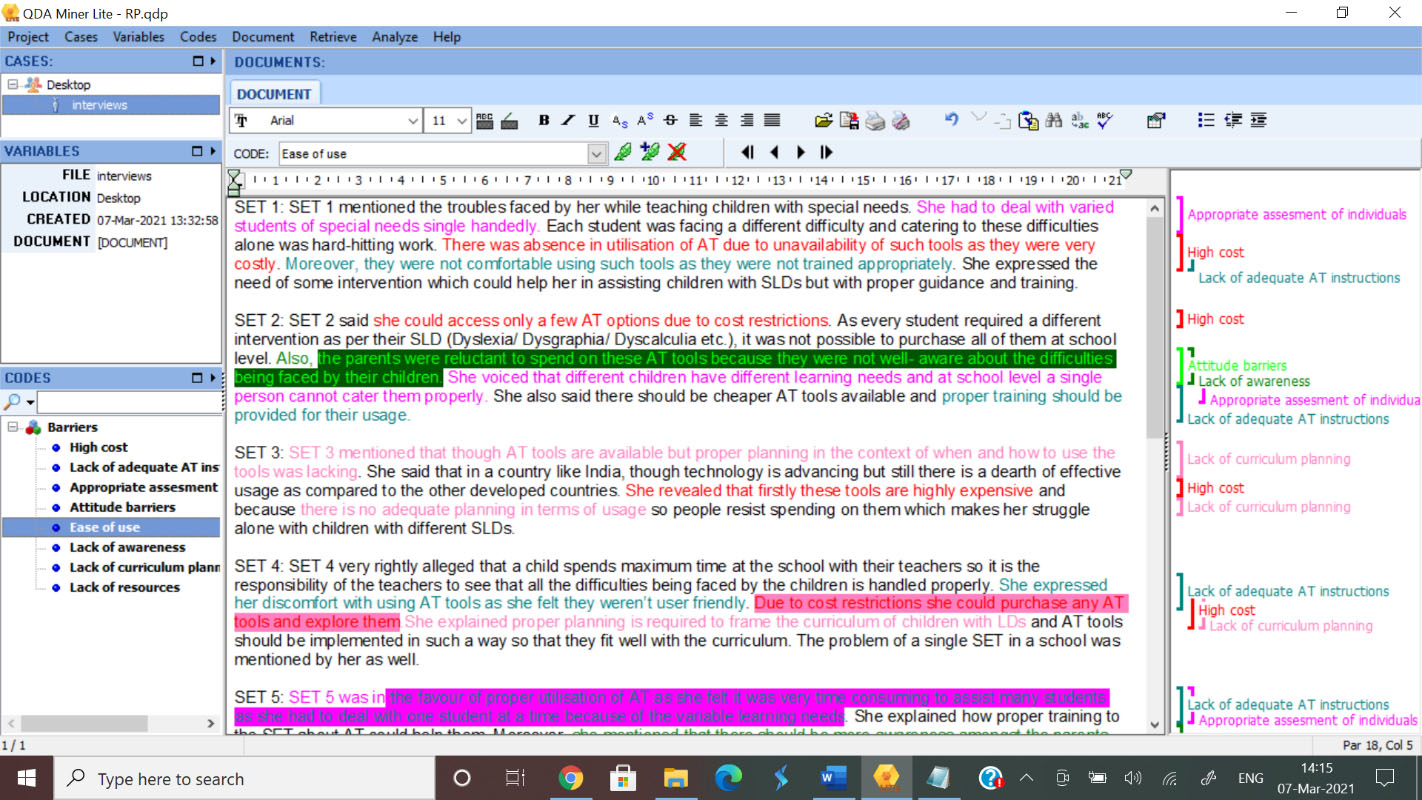
Assigning codes to interviews 1–4 using QDA miner lite.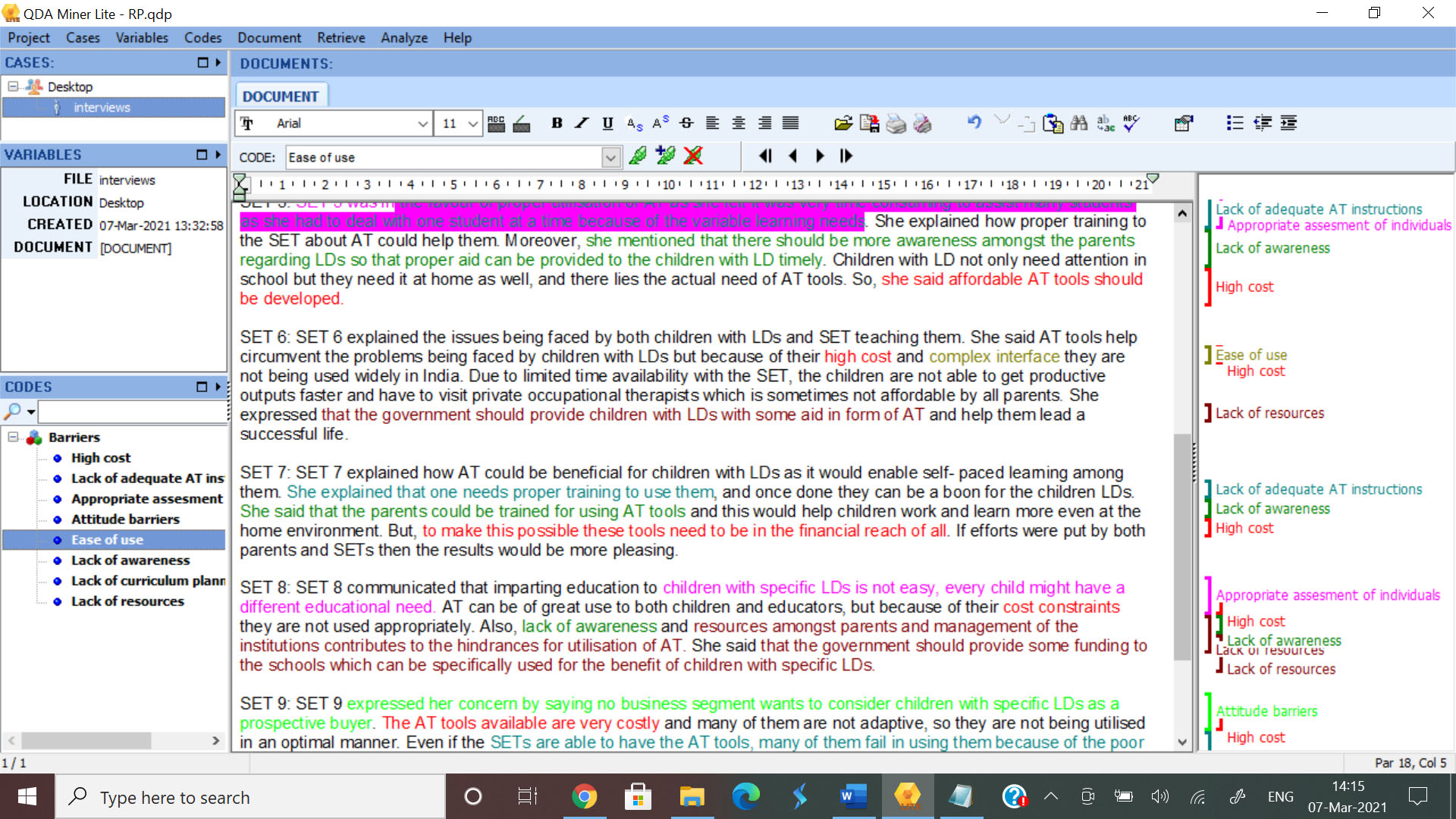
Assigning codes to interviews 1–4 using QDA miner lite.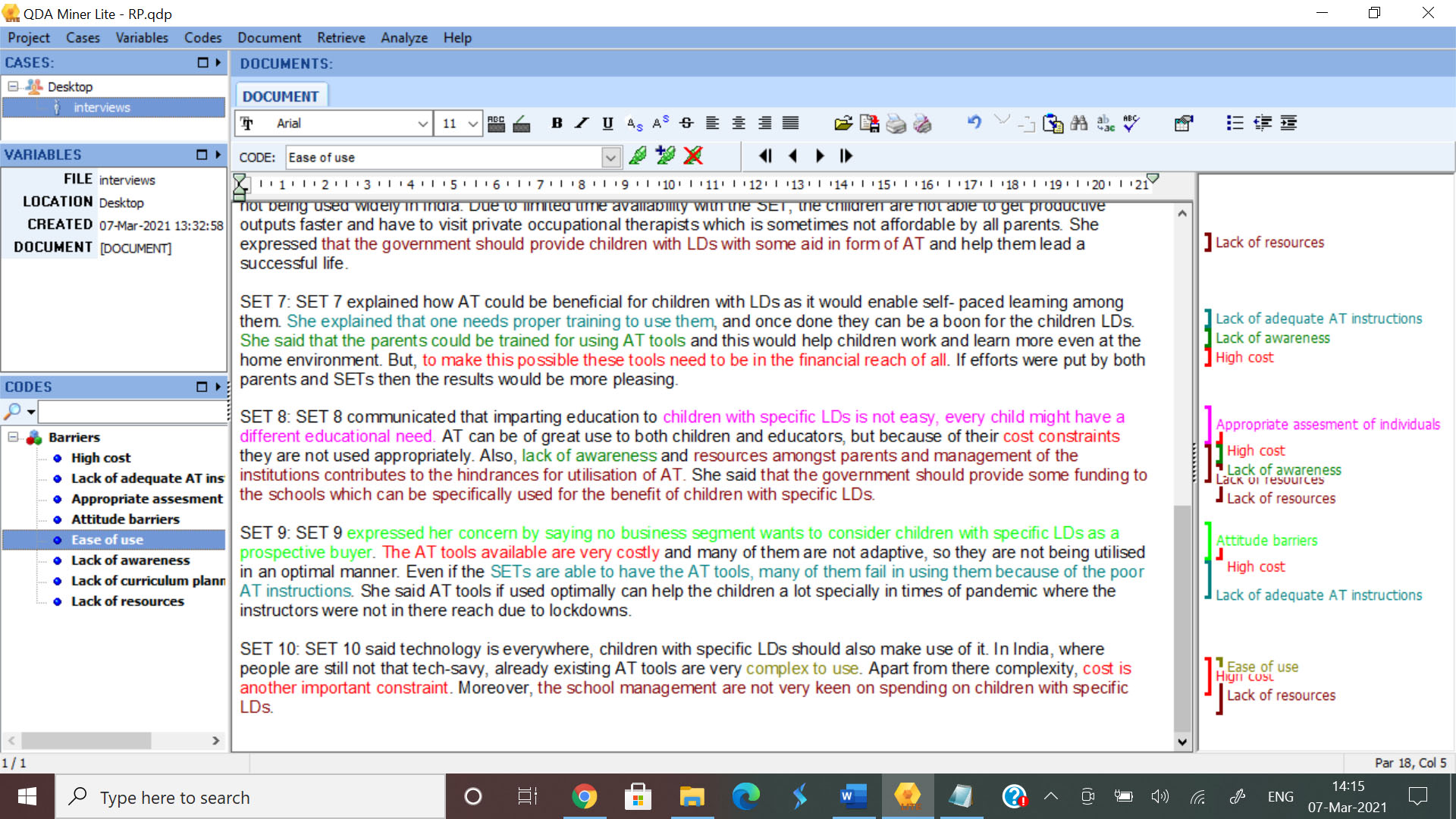
Participants and settings
The current study was conducted with Special Education Teachers (SETs) of various schools in Delhi and National capital region of India (
Procedures
Semi-structured interviews were conducted with the Special education teachers of each school. Qualitative analysis was done on these interviews to understand the barriers faced by them in effectively utilising AT. Using these identified barriers further the most significant barriers were determined. These interviews were analysed using CAQDAS tool QDA Miner Lite. Firstly, the interview data was added to the software and codes were defined. Then, the data was coded and analysis was performed over data. The qualitative analysis process used for identification of barriers is depicted in Figs 1 to 3.
Identification of the major barriers
To determine and corroborate the key barriers, well-known interactive learning Interpretive Structural Modelling (ISM) technique is used. ISM technique helps in finding structural relationships between different barriers and consequently recognise the most significant barriers.
Interpretive structural modelling (ISM)
ISM is a deep-rooted technique which is used to identify relationships among different qualitative variables which describe a problem. The methodology was introduced by John Warfield in 1973. Ever since its introduction this methodology has been of great use to individuals or groups by helping them to make valuable decisions [65, 66]. The methodology aids to develop informative relationships by constantly posing questions like “Is variable A helping to achieve variable B”? “Is variable B helping to achieve variable B” for each and every pair of variables [67]. Finally, a matrix of 0 s and 1 s is created where a relationship between variable A and B is indicated by value 1 and no relationship between variable A and B is indicated by value 0. The matrix created further helps to attain a tree-like structure where each node is a representative of a variable and the relationship between those variables are represented by edges.
The current study aims to employ the ISM methodology to find structural relationships among various barriers to AT for persons with SLDs.
Applications of interpretive structural modelling (ISM)
ISM technique has been employed by numerous studies to solve several intricate problems in different sectors. Ranking of measures to deal with waste management was created using ISM [68]. Relationship among various barriers that barred application of reverse logistics in the automobile industry were examined by [69] using ISM [66]. used ISM to find out the interrelationships between organisational risks. Appropriate technology was selected among various technologies using ISM by [70] [71]. developed structural relationships between barriers to supplier development. The set of performance measures used for assessing the performance of automotive supply chain were discovered by [72] using ISM. The barriers in developing landfill sites were analysed using ISM by aid agencies [73] [74]. identified barriers in implementing green supply management in the automobile industry using ISM. The best third-party logistic provider was identified using ISM [75]. Main features of customer satisfaction for an E-electricity company were identified using ISM [76]. The relationships between factors in implementation of green process innovation were structured using ISM methodology [77].
There are several fields like manufacturing, ecosystem management, healthcare etc where ISM methodology is employed [67]. Therefore, these facts gave us motivation to use ISM for our study.
Development of model using ISM methodology
The steps used to construct an ISM model which is used to find interrelationships among various barriers are as follows:
Recognize the barriers. Substantial literature was reviewed to recognize the barriers in utilisation of AT for persons with SLDs. Also, experience surveys were conducted to identify barriers which were averting the successful utilisation of AT for persons with SLDs. The experience survey was carried out by organising semi-structured interviews in various schools with the special education teachers to reduce the barriers for proper utilisation of AT for persons with SLDs. The common alarms among respondents included high cost of equipment, lack of adequate AT instruction, challenging behaviour, attitude barriers, lack of resources, assessment issues, planning issues, lack of awareness/knowledge. The barriers which were identified through interviews with the SETS and extant literature were common and are listed in Table 1. This table was then further used to find associations among the barriers and also to conduct focus group interviews. Creating the SSIM. A focus group of 10 members consisting of special education teachers of various schools in Delhi and national capital region were interviewed. The conversation helped identify relationships between different barriers to AT. The keywords representing relationships between the barriers are as follows: Symbol “V” indicates that barrier a is helping achieve barrier b. Symbol “A” indicates that barrier b is helping achieve barrier a. Symbol “X” indicates that both barrier a and b are helping achieve each other. Symbol “O” indicates that both the barriers a and b are not related. The SSIM developed on the basis of relationships identified is shown in Table 2. This table shows the relationship among various barriers to utilisation of AT for individuals with SLDs. Structural self-interaction matrix
Further Table 2 is used to create RM.
Initial reachability matrix (RM)
Creating RM from the SSIM.
RM is created by undergoing the following steps:
If the entry
If the entry
If the entry
If the entry
On the basis of the substitutions mentioned above, initial RM is created. Table 3 shows the initial RM.
Table 3 denotes the initial RM comprising of 0 s and 1 s. This matrix contains transitive relations at present.
Transitive relations are checked for the RM, post that the final RM is created.
Table 4 represents the final RM after transitivity check. The rows are representative of driving power and columns are representative of dependence power in the final RM. The driving power of a barrier can be defined as the total number of barriers which it may influence (including itself). The driving power of a barrier can be calculated by counting the number of 1 s in its row. In our case barrier 1, 5, 7 possess the maximum driving power which indicates that these barriers are influencing all the other barriers. On the other hand, dependence power for a barrier can be defined as the total number of barriers which might influence it (including itself). The dependence power of a barrier can be calculated by counting the number of 1 s in its column. Barrier 4 has the highest dependence power which means that this barrier is extremely dependent on other barriers.
Final reachability matrix
RM partitioning (iteration 1)
RM partitioning (iteration 2)
RM partitioning (iteration 3)
RM partitioning (iteration 4)
Digraph showing inter-relationship between Barriers to AT for children with specific learning disabilities.
ISM model.
Level partitioning.
The subsequent step is to establish the antecedent and reachability set for every barrier from the final RM. The antecedent set is the collection of all those barriers that may influence it (including itself) and reachability set is the collection of all the barriers that it may influence (including itself). Next, for each barrier intersection of these sets is calculated. Finally, we look for the barrier in which the reachability set and antecedent set are same, and then this forms the top level in the hierarchy of the ISM Model. No other barrier is influenced by the topmost barrier. After this the barrier which forms the top most level is detached from the complete list of barriers and the same process is repeatedly carried out for the remaining barriers to find out the next level.
Tables 5–8 show the iterations for each level. Table 5 shows barrier 4 at the first level. Table 6 shows barriers 5, 6 and 7 at the second level. Table 7 shows barriers 2 and 7 at the next level. Lastly, Table 8 shows barriers 1 and 8 at the topmost level.
Constructing the digraph.
The next step is to construct the digraph which shows the directional relationships between various barriers. The root node is formed by level 4, which means barriers 1 and 8 are the key driving barriers and are influencing all the other barriers.
Figure 4 shows the diagraph. This figure illustrates barriers are portioned into various levels, from level 1 to level 4.
Conversion of digraph to ISM model.
The ISM model is created by replacing the variables in nodes of the digraph by the statements. Figure 5 shows the ISM Model for barriers to AT for individuals with SLDs. The figure indicates that high cost of equipment and lack of awareness are the main barriers followed by planning issues and lack of adequate AT instructions and so on.
Reviewing the ISM model.
The ISM Model so developed was reviewed by the members of the focus group and agreed with the results. Thereafter the Model was finalised. Structural analysis of the ISM Model was achieved using MICMAC analysis which helped in further classifying the barriers.
MICMAC analysis
The driving and dependence power of variables can be properly analysed using MICMAC analysis [78]. Generally, investigations happen only to identify direct relationships and this in turn may suppress the hidden pointers and thus disturb the system which is being studied [79]. The indirect relationships being ignored might affect the system via reaction loops, influence chains or feedbacks. Barriers can be classified into four categories using MICMAC analysis on the basis of their driving and dependence power:
Cluster I: Autonomous variables
The variables which have weak driving power and dependence power both fall under this category. No variable from the current study falls under this category.
Cluster II: Dependence variables
The variables which have a strong dependence power but weak driving power fall under this category. Variable 4 (Attitude barriers) in our study falls under this category.
Cluster III: Linkage variables
The variables which have strong dependence power and driving power both fall under this category. Variable 3 (Ease of use/Usability), 5 (Lack of resources), 6 (Appropriate assessment of individuals AT needs), 7 (Lack of curriculum planning) fall under this category.
Cluster IV: Driving variables
The variables which have a strong driving power but weak dependence power fall under this category. Variable 1 (High cost of equipment), 2 (Lack of adequate AT instruction), 8 (Lack of awareness/knowledge) in our study falls under this category. Figure 6 shows the classification of barriers.
In this section the findings are discussed based on the research questions of the study.
Research Question 1 – Common issues being faced by the special education teachers
Clusters for Barriers.
The common issues being faced by the SETs was that it was being difficult for a single teacher to cater the learning needs of varied children with SLDs. Every child has a different learning need and learning pace. Due to fixed school hours a teacher could spend limited time with children with SLDs. This in turn affects the pace their performance improvement. The SETs articulated that if they were provided and duly trained with some AT tools it would lead to better utilisation of time and resources. AT tools could not only be use in the school, but they could be used in the home environment as well. The parents of children with SLDs can be trained for using these tools and then AT tools can be comfortably used by the children at their homes as well.
Research Question 2 – Barriers that affect efficacious utilisation of AT
Various barriers to effective utilisation of AT as mentioned by the SETs included high cost of equipment, lack of adequate AT instruction, lack of awareness/knowledge, ease of use/ usability, lack of resource, appropriate assessment of individuals AT needs, lack of curriculum planning and attitude barriers.
It could be observed that the barriers identified by SETs and the ones in literature were the same. Thus, it is visible that even though these barriers have been existing from the past but still are not eliminated and there is under-utilisation of AT. After coalescing the interviews and the past researches the final barriers were identified. Analysing the impact of these barriers on each other could help eliminating them.
Research Question 3 – Most significant barriers that affect efficacious utilisation of AT
It can be concluded from the ISM Model and MICMAC analysis that high cost of equipment, lack of adequate AT instruction (Inapt and insufficient support amenities and approaches of teaching, Lack of special skilled educators for the children with SLDs), lack of awareness/knowledge form the major barriers which are hampering the proper utilisation of AT for persons with SLDs. These major barriers somehow affect the other barriers as well and eliminating them would help removing all the other barriers eventually.
AT have the capability to bridge the gap between persons with SLDs and their peers [80]. It is evident that the learning outcomes in terms of reading, writing and mathematical problems improve when these AT devices are used properly [81]. It could be observed that high cost of equipment, lack of awareness, lack of AT instructions, lack of curriculum planning are among the major barriers and are impacting other barriers as well. Therefore, it is the need of the hour to overcome the major barriers to effective utilisation of AT so that the children with SLDs can make proper use of it. Not only this, but these barriers also have a strong impact on the learning of children with SLDs in this COVID 19 pandemic. Telephonic conversations during this pandemic with special education teachers further revealed that because of lack of proper utilisation of AT the children with SLDs are not getting due attention which helps them to work on their weak areas and the result is delay in their progress rate. Therefore, it is needed that these barriers are eliminated so that children with SLDs do not face learning issues in scenarios like COVID 19. Identification of these significant barriers would help eliminate the other barriers as well which would lead to proper utilisation of AT in home and school. Parents and schools can focus on eliminating these barriers timely and children would make use of technology reducing human efforts. They would be self-reliant and easily compete with their non-disabled peer group in all aspects. The following solutions can be provided to cope up with barriers identified in our study:
Open-source free software can be developed and made available to the schools to help them aid children with SLDs. Awareness camps about SLDs must be organised. Small mobile based assessments for parents should be developed that are handy and can be used easily on the go. Surveys can be conducted with SLD alumni who faced learning issues and corresponding feedback can be obtained for improvement in curriculum and pedagogy for them. Special task force be created for spreading knowledge about SLDs to special education teachers. Funds should be given by the government to provide resources for the individuals with SLDs.
Author contributions
CONCEPTION: Kriti Dhingra, Anchal Garg, Divakar Yadav and Jayanti Pujari
PERFORMANCE OF WORK: Kriti Dhingra and Anchal Garg
INTERPRETATION OR ANALYSIS OF DATA: Kriti Dhingra, Anchal Garg, Divakar Yadav and Jayanti Pujari
PREPARATION OF THE MANUSCRIPT: Kriti Dhingra
REVISION FOR IMPORTANT INTELLECTUAL CONTENT: Anchal Garg, Divakar Yadav and Jayanti Pujari
SUPERVISION: Anchal Garg, Divakar Yadav and Jayanti Pujari
Ethical considerations
In the current study, only special education teachers were interviewed and their anonymity is maintained throughout the study. No child with specific learning disability or their parent were interviewed. The study was exempted from Institutional Review Board approval.
Footnotes
Acknowledgments
The current study was conducted as a part of PhD work done by the author. We would like to express our gratitude to the special education teachers who spared their valuable time and participated the interview process for our study.
Conflict of interest
There is no conflict of interest to be reported.