



Abstract
BACKGROUND:
Walking difficulties put an individual at high risk of falling, institutionalisation and even death. The use of robotical rehabilitation or assistive devices for walking has gained considerable interest as a means of improving patients’ gait abilities.
OBJECTIVE:
The aim of this research was to examine patients’ intrinsic motivation to train with a wearable hip exoskeleton (Honda Walking Assist).
METHODS:
Rehabilitation patients (stroke, medullar lesion, orthopaedic surgery) and elderly (
RESULTS:
All participants presented with high scores on the IMI, in particular for the items ‘interest/enjoyment’ (median: 43; 25
CONCLUSIONS:
This robotic exoskeleton for assisted walking was considered a valuable device by the majority of participants, eliciting a high degree of motivation and enjoyment.
Introduction
Many pathologic conditions alter the mode and the efficiency of walking. Gait disorders are most frequently seen in neurological conditions (e.g. stroke, spinal cord injury …) [1, 2]. Orthopaedic problems (e.g. congenital or acquired after arthroplasty) and aging, among others, also can cause difficulties with ambulation [3, 4, 5, 6]. Improving the ability to walk or retaining independent ambulation is one of the major objectives for all these individuals. Despite the efforts of physical and occupational therapists, residual gait impairments are often seen, especially in neurological disorders. For instance, 25% of stroke survivors have persistent gait impairments despite rehabilitation effort and the majority of independent walkers after stroke struggle to ambulate in a community setting [7, 8]. Residual gait impairments include slow walking speed, gait asymmetry, shortened (paretic) limb support, decreased step length, wider base of support, etc. [6, 8]. Gait inability and gait impairment have important consequences for individuals’ quality of life, causing limitations in independent performance of activities of daily living, work-related activities, sports and in their social life [7, 8]. In particular, elderly people with gait difficulties are at greater risk of institutionalisation and mortality. Both rehabilitation patients and elderly individuals with gait impairment may benefit from using a supplementary robotic device for improving gait, on top of standard gait training. A wearable hip exoskeleton can either be used as an assistive device in everyday life or as a rehabilitative training device [6].
A wide variety of rehabilitation strategies are at hand for stroke patients and current best practice guidelines recommend early rehabilitation with intensive, repetitive and task-specific training to improve walking and enhance neurogenic plasticity. The specific content of rehabilitation treatment for promoting functional independence in post-stroke patients is still a matter of debate. Conventional physiotherapy (e.g. physical training, high-intensity physiotherapy and repetitive task-specific training) has been proven effective, but is also highly-demanding for the therapists [7, 8, 9, 10]. Gait robotics such as exoskeletons have the capacity to deliver intensive and repetitive therapy in accordance with the principles of motor learning. They can be used as an adjunct to conventional therapy, enable greater workloads and possibly reduce the strain on therapists [11]. At present, gait training methods in clinical settings often are limited to treadmill walking or walking in a constrained environment. As lower limb exoskeletons become lighter and less constraining they could be used to target essential elements of gait and provide the specificity of over-ground walking [2, 9, 11]. Though robotic devices are currently used for assistance during community-walking, to our knowledge, no scientific literature is available on this type of implementation [6].
The Honda Walking Assist (HWA) (Honda R&D Co. Ltd. Tokyo, Japan) is a wearable hip exoskeleton developed to enhance walking performance and to increase the community mobility and social interaction of elderly and patients with gait disorders [5, 12]. In chronic stroke patients, HWA has shown to improve gait performance (e.g. improved muscle activation, energy efficiency and walking pattern) upon a short period of training. For example, Jayaraman et al. implemented a training period of 18 sessions of 45 minutes, 3 times per week [11]. Also, in comparison with functional task-specific gait training, therapy sessions with the HWA provided similar, significant improvements in walking speed, balance and endurance which were above the threshold of minimal clinically important difference [11, 12]. Long-term outcomes are not available yet.
Few studies have investigated the participants’ experience of robotic gait devices. A literature review in 2017 reported that only 3 out of 51 exoskeleton studies investigated users’ perspectives [13], essentially in stroke patients [14]. To take full advantage of such technology, it is fundamental that patients are motivated. A study by Swinnen et al. [15] investigated stroke patients’ and therapists’ motivation and expectations of robotic assisted gait training (Hocoma’s Lokomat
The aim of the present study was to examine the intrinsic motivation of rehabilitation patients and elderly individuals to use a wearable hip exoskeleton for assisting gait. Different aspects of motivation were assessed using the Intrinsic Motivation Inventory scale [21, 22] after a single session of wearing the Honda Walking Assist device.
Methods
This study was a single session experimental cross-sectional study. Ethical approval was obtained from the Medical Ethics Committee of Universitair Ziekenhuis Brussel (Belgium) (reference number: 143201940620) before starting the inclusion of patients.
Participants
During the period of mid-June to mid-August 2019, patients admitted to the rehabilitation department or attending out-patient rehabilitation at Universitair Ziekenhuis Brussel (UZ Brussel, Belgium) were screened for inclusion. Elderly were recruited in a nursing home (Woonzorgcentrum De Ceder, Beersel, Belgium).
Inclusion criteria were: impaired or slowed gait pattern (i.e. gait speed
Procedure
Baseline demographic and/or clinical characteristics from the participants were obtained by interview and by examining their medical files. Before the intervention, MMSE was filled out. The supervising physiotherapist chose the optimal gait settings of the HWA. Thereafter, the participant walked for 30 minutes. The total duration of the session was one hour. After the intervention session, participants filled out the IMI.
Device
The Honda Walking Assist (Honda R&D Co. Ltd. Tokyo, Japan) is a wearable hip exoskeleton which provides independent assistance with hip flexion and extension.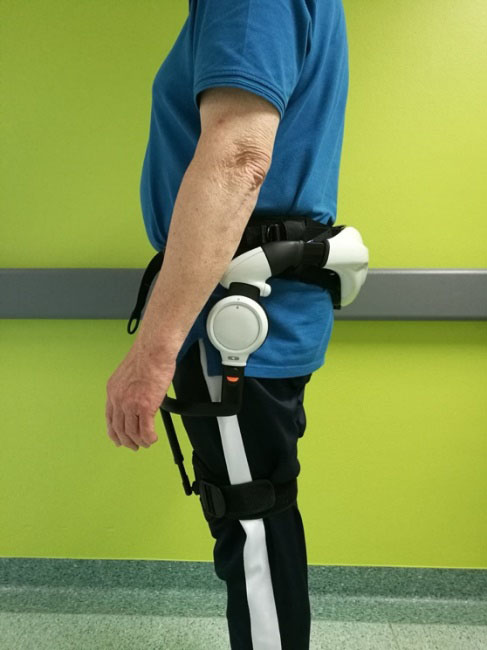
The HWA is a robotic powered hip exoskeleton developed by Honda R&D Corporation
In practice, walking is initiated by the user. Following the phases of the gait cycle, after initial contact, the extensor torque initiates and reaches its peak just before mid-stance. Then the device switches to flexion assist during terminal stance and this torque reaches its maximum around initial swing. Finally, it switches again to extension during terminal swing and the cycle repeats.
Percentage distributions of items of the Intrinsic Motivation Inventory (IMI) subdivided in six subscales: interest/enjoyment, perceived competence, effort/importance, pressure/tension, value/usefulness, relatedness. Each item is scored on a 7-point Likert scale (1 “not at all true” to 7 “very true”). Bars represent the percentage of subjects who scored 1 to 7 for each item. The total length of each bar equates 100%. The vertical line is equidistant to the extreme scores of 1 and 7. The letter (R) at the end of some items indicates that item scores were reversed (that is: subtracted from 8) to facilitate the interpretation of data.
When walking is initiated, the HWA automatically manipulates the gait pattern to increase the walk ratio (step length/cadence). For example, if the device detects hip joint angle asymmetry, the HWA assist pattern follows a more flexion dominant curve for the leg with shorter stride length, in attempt to improve the gait pattern [11, 12].
Intrinsic motivation was assessed using the Intrinsic Motivation Inventory (IMI), a multidimensional questionnaire for measuring motivational characteristics of participants related to a target activity. The complete IMI consists of 45 items categorized into 7 subscales: “Interest/Enjoyment”, “Perceived Competence”, “Effort/Importance”, “Pressure/Tension”, “Perceived Choice”, “Value/Usefulness” and “Relatedness” (Fig. 2). In the present study, the subscale “Perceived Choice” (10 items) was excluded because participants did not have the choice whether or not to use the HWA. The first subscale “Interest/Enjoyment” assesses the interest and pleasure when doing a target activity and is considered a self-report measure of intrinsic motivation. “Perceived Competence” is theorised to be a positive predictor of both self-report and behavioural measures. “Pressure/Tension” is considered a negative predictor. “Effort/Importance” assesses person’s investment in what he/she is doing. “Value/Usefulness” measures how individuals internalise with respect to activities they experience as useful or valuable for themselves. Finally, “Relatedness” refers to interpersonal interactions. Each of the 35 items is rated on a seven-point Likert scale (1 “not at all true” to 7 “very true”). A neutral score on the Likert scale is 4. The Likert scale rating of items with a negative valence (for example: “I thought this was a boring gait training”) is reversed. Thus, a higher rating on that item represents a more positive result on motivation. The items which had their rating reversed, are marked with a ‘R’ behind the item in Fig. 2.
The score of each subscale is computed as follows for each patient: “sum of the Likert scores of all items in that subscale”; the maximal score being “7 times the number of items in the subscale”. Higher scores of subscales correspond to a more positive result on motivation, except for the “Pressure/Tension” subscale, where higher scores indicate greater feelings of pressure.
The IMI has been validated and used in diverse research domains, such as training/education [21] and sports activities [22]. In all these studies, different versions of the IMI have been used with variation in subscales and items depending on the characteristics of tasks and participants [17, 18]. Specifically, the validity of the Relatedness subscale has been investigated and results suggested good internal consistency [23].
The IMI has been used previously for investigating intrinsic motivation in using robotic assisted gait training after stroke [15]. The target activity for the IMI was ‘gait rehabilitation training’.
Statistical analyses
Statistical analyses were performed using IBM SPSS Statistics 26.0. Descriptive statistics were computed on demographic and clinical variables. Per subscale (
Results
Participants
A total number of 48 individuals were screened for participating in this study. The main reasons for exclusion were medical: multiple concomitant neurological disorders, lower limb amputation or limited weight bearing. Five patients were excluded due to a MMSE below 21.
In total, 23 individuals were eligible for participation in this study. Participants’ demographic and clinical characteristics are shown in Table 1. Eleven participants were elderly with impaired or slowed gait pattern. Twelve patients were rehabilitation patients of which 8 patients with stroke, 2 patients after orthopaedic surgery and 2 patients with medullar lesion (quadriparesis caused by compression of the medulla oblongata; paraparesis caused by spinal cord compression at D7).
Demographic and clinical characteristics of included participants (
23)
Demographic and clinical characteristics of included participants (
Between group differences (rehabilitation patients vs elderly) were analysed with univariate analysis of variance (ANOVA).
Percentage distributions of each item of the IMI are shown in Fig. 2. Results per subscale are described in Table 2 for each group (rehabilitation vs. elderly).
Scores on the six subscales of the Intrinsic Motivation Inventory in the entire population (
23), as well as in the Rehabilitation group (
12) and in the Elderly group (
11). Scores are expressed as medians and 25
–75
percentiles. Mann-Whitney U-test was used to assess the between-group differences (Rehabilitation vs Elderly). No significant differences were observed between groups for any of the subscales
Scores on the six subscales of the Intrinsic Motivation Inventory in the entire population (
For the entire study population, the score of the subscale interest/enjoyment, (i.e. reflecting the self-reported measure of intrinsic motivation) was 43 [25
For the entire study population, the score of the subscale perceived competence was 35 [25
For the entire study population, the score of the subscale value/usefulness was 44 [35–49] (maximal score 49). Likert scale scores of all the different items of this subscale were rated above 5 by at least 78.2% of the participants. Such ratings indicate that most participants thought that the robotical gait training was useful and beneficial.
For the entire study population, the score of the subscale pressure/tension (considered a negative predictor of intrinsic motivation) was 7 [5, 6, 7, 8, 9, 10] (maximal score 35). This means that pressure and tension with regards to the HWA were low. Likert scale scores of all the different items of this subscale were rated above 5 by at most 13% of the participants. Such ratings indicate that few participants felt nervous, anxious or pressured while using the HWA.
For the entire study population, the score of the subscale effort/importance was 24 [18, 19, 20, 21, 22, 23, 24, 25, 26, 27, 28, 29] (maximal score 35). Likert scale scores of all the different items of this subscale were rated above 5 by at least 73.9% of the participants. Such ratings indicate that most participants invested energy into this training and thought it was important to do well.
Finally, for the entire study population, the score of the subscale relatedness was 31 [27, 28, 29, 30, 31, 32, 33, 34] (maximal score 35). Likert scale scores of all the different items of this subscale were rated above 5 by at least 69.6% of the participants. Such ratings indicate that most participants felt related or concerned about using the HWA. The two participants with underlying medullar lesion felt unconnected to this type of training and preferred not to train with the HWA in the future anymore.
No significant differences were observed between the rehabilitation group and elderly for any of the subscales of the IMI (all
The present study aimed at evaluating user’s intrinsic motivation to wear a hip exoskeleton, the HWA, for gait training. The subscale “interest-enjoyment” of the Intrinsic Motivation Inventory, which is considered the self-reported measure of intrinsic motivation, scored high both in rehabilitation and elderly participants. The participants enjoyed walking with the HWA and found it valuable for improving their walking abilities. Furthermore, participants felt competent and that they had put effort into the training session. Our study did not show significant differences in intrinsic motivation between rehabilitation patients and elderly.
Many challenges remain in benchmarking wearable robots from functional, user experience and methodological perspectives. Better understanding of patients’ perspectives towards robotic-assisted gait devices is valuable for both clinicians and engineers [24]. This information is needed for translating more efficiently technological advances into clinical practice and ultimately everyday use. Motivation has a major effect on the outcome of rehabilitation, in particular during repetitive activities [16]. Patients achieve better therapeutic outcomes when they are motivated. Negative feelings (e.g. tension, pressure or anxiety) may affect the motivation and compliance with the therapy [25]. To our knowledge, this is the first study focusing on the individual’s intrinsic motivation with regards to the HWA wearable hip exoskeleton. Till now, only studies investigating mechanical gait characteristics and adverse events were available [12, 26]. Similar to other exoskeletons that have elicited positive responses in terms of motivation in different patient populations such as stroke patients [15] and spinal cord injury patients [27, 28, 29, 30, 31], the HWA may appeal to different subpopulations. Both rehabilitation patients and elderly participants were motivated to use this device. A recent review concluded that exoskeletons could be a promising assistive device for elderly with partial mobility limitations [32]. These authors believed that improvement in physical parameters may improve general functioning and consequently quality of life. The present research results highlight that elderly people may be willing and motivated to use assistive devices, regardless of their training effects.
It is important to recognize which patient populations may benefit most from using robotic devices not only from a motivational point of view, but also from a mechanical/technical point of view. Two patients participating in this study clearly indicated that they did not wish to use the HWA again in the future. These patients both had medullar lesions with bilateral lower limb paresis. Possibly, their motor and sensory deficiencies were significantly different from the rest of the study population: bilateral and more severe. Thus, the HWA could be inadequate from a technical point of view to improve gait parameters in patients with this clinical presentation, and consequently lead to demotivation. Furthermore, a few patients perceived walking with the HWA as boring. For these patients, the implementation of a more functional training (e.g. outside walking) or virtual reality (e.g. gaming) as an adjunct could be helpful in increasing their motivation [33, 34, 35, 36, 37].
Some limitations of the present research protocol need to be discussed. The sample size of the study was small and statistical power limited. This was due to many potential participants not meeting the inclusion criteria for medical reasons. Present results may need to be confirmed in a larger cohort of patients. Furthermore, the present study population was heterogeneous in age and pathology. Though this type of recruitment may be close to real-life clinical situations, it may not be appropriate to reach sound conclusions from statistical analyses. Furthermore, limiting the intervention to one training session did not give information on how patients could react to multiple training sessions for rehabilitation. The fact that a participant can use new technology for gait, can make him/her either more excited or on the contrary more anxious about the device. This feeling of ‘newness’ may decrease with subsequent uses of the device.
In summary, this study showed that rehabilitation patients as well as residential elderly were intrinsically motivated to use a wearable exoskeleton, such as the presented HWA.
Future studies should investigate the patients’ perception of a training program with a higher number of sessions. Also, the cost-effectiveness of this type of devices should be investigated in comparison with conventional rehabilitation techniques. Finally, it is important that future research determines which patient populations benefit most from the use of this type of exoskeleton. The present data indicate that its use could be beneficial in a rehabilitation setting for patients with reduced gait speed and/or asymmetric gait pattern as a consequence of orthopaedic surgery (e.g. hip prosthesis) or stroke, as well as for elderly persons as an assistive device to facilitate walking. However, individuals with other types of gait deficits may need other or more sophisticated devices.
Author contributions
CONCEPTION: Stijn Roggeman, Mahyar Firouzi and Eva Swinnen.
PERFORMANCE OF WORK: Stijn Roggeman and Mahyar Firouzi.
INTERPRETATION OR ANALYSIS OF DATA: Stijn Roggeman, Nina Lefeber, Eva Swinnen and Samar M. Hatem.
PREPARATION OF THE MANUSCRIPT: Stijn Roggeman and Samar M. Hatem.
REVISION FOR IMPORTANT INTELLECTUAL CONTENT: Mahyar Firouzi, Nina Lefeber, Emma De Keersmaecker, Lotte Cuypers, Eva Swinnen, Erika Joos and Samar M. Hatem.
SUPERVISION: Marc Schiltz and Samar M. Hatem.
Ethical considerations
Institutional Review Board approval was obtained from the Medical Ethics Committee of Universitair Ziekenhuis Brussel (UZ Brussel, Brussels, Belgium) (reference number: 143201940620). Participants were included in this study upon prior written informed consent.
Footnotes
Acknowledgments
Fiona Desmet (Honda Motor Europe Ltd, Belgium) gracefully provided the Honda Walking Assist device.
Conflict of interest
The authors have no conflicts of interest to report. Honda Motor Europe Ltd, Belgium gave the opportunity to use the Honda Walking Assist during a short period of time. The manufacturer’s aim was to prospect if the European market was in demand of this type of devices. During the trial period, the authors were free to use the device at their best interest. No contracts were signed and Honda Motor Europe Ltd, Belgium was not involved at any stage of the study protocol, data analysis or writing.