




Abstract
BACKGROUND:
In recent years, with ever-improving technology, considerable progress has been made in the approaches available to develop mobility assistive technology systems.
OBJECTIVE:
This paper aims to anticipate the future of assistive technologies of navigation and mobility for people with severe visual disabilities in the next twenty years (2021–2041).
METHODS:
We conducted a technology foresight exercise by identifying promising technologies and invited over 20,000 researchers worldwide to share their views on the future of assistive technologies for people with visual impairment. The technologies and respondents were identified from specialized journals indexed on Web of Science.
RESULTS:
Most respondents believe computer vision will be the most important assistive technology group for mobility and navigation for visually impaired people, especially with haptic feedback. They also believe that voice and vibrotactile are the most relevant feedback and that glasses and smartphones will be the most important tools for visual impairment support.
CONCLUSIONS:
While costs and lack of user training may hamper the development and use of these new technologies, they represent the future of assistive technology for people with visual impairments.
Introduction
Globally, at least 1 billion people have moderate or severe distance vision impairment or blindness. The occurrence is highest in low-and middle-income countries, older adults, and underserved populations – women, migrants, indigenous peoples, and rural communities [1]. Population growth and aging, alongside behavioral and lifestyle changes, will significantly increase the number of people with eye problems, visual impairment, and blindness in the coming decades [2].
Studies indicate that vision impairment severely affects the quality of life. Adults with vision impairment often have lower workforce participation and productivity [3, 4] and higher rates of depression and anxiety than the general population [5, 6]. In the case of older adults, vision impairment can contribute to social isolation, difficulty walking [7], and a higher risk of falls and fractures, especially on the hip [8, 9]. It can also add to other problems, such as limited mobility or cognitive decline [10].
Fortunately, assistive technology (AT) has successfully mitigated some of these adverse impacts. AT’s primary purpose is to maintain or improve the functioning and independence of an individual to facilitate participation and enhance overall well-being [11]. However, ensuring that AT supports safe and efficient navigation remains one of the significant challenges in this field.
Traditionally, visually impaired people have relied on navigation tools such as white canes and guide dogs, despite these aids having inherent limitations in detecting obstacles [12, 13]. Nevertheless, with ever-improving technology in recent years, significant strides have been made in developing more sophisticated mobility AT systems [14]. Progress in computer vision, wearable technology, multisensory research, tactical displays, smart canes, and smartphones-based apps has led to the evolution of more advanced Electronic Travel Aids (ETAs),1
Devices that gather information about the surrounding environment and transfer it to the user through sensor cameras, sonars, or laser scanners [15].
Devices that provide pedestrians with guidance in unfamiliar locations [15].
Devices that determine the precise position of their support, such as devices that utilize GPS technology [15].
Despite the substantial advancements in ATs, few studies have attempted to anticipate the emerging ATs most likely to be employed as navigation tools [15, 16, 17]. In contrast, this paper offers a more comprehensive outlook on the future of non-invasive ATs for people with severe visual impairment, utilizing the Technology Foresight (TF) approach [18, 19, 20]. TF offers a systematic framework to look into the future, integrating a suite of programs dedicated to analyzing innovation strategies and priorities to foresee, influence, and direct the potential trajectory of technological change [21]. Therefore, TF provides strategic insights for decision-making and long-term planning in science and technology.
The motivation for undertaking this study stems from the swift progression of technology and its promising potential to significantly enhance the quality of life for individuals with visual impairments. We aimed to comprehend how these advancements might evolve and anticipate the future landscape of AT for people with visual disability. To address such goals, we surveyed 621 AT researchers worldwide regarding their perceptions of the future of smart navigation aids within 20 years (2021–2041). Our results offer a snapshot of expert views and the expected future trends that should provide valuable foresight for policymakers, private companies and people with severe visual impairment into the longer-term future of ATs for visually impaired individuals.
Rapid technological evolution is substantially reshaping economies and societies at large. Innovation drives the Schumpeterian process of creative destruction and enables countries and enterprises distanced from the frontier to converge economically and augment their global competitiveness [22]. Furthermore, frontier technologies offer numerous opportunities to re-imagine how our economies could better serve social needs. Over recent decades, policymakers have become increasingly concerned with the role of innovation in economic performance and new solutions in response to problems, challenges, or opportunities [23, 24, 25].
Recent developments in frontier technologies are directly linked to The Fourth Industrial Revolution (4IR), which introduces the concept of cyber-physical systems [26]. The confluence and synergy of emerging technological fields, including nanotechnology, biotechnology, new materials, and cutting-edge digital manufacturing technologies, distinguishes the 4IR Progressions in domains such as robotics, artificial intelligence, big data analytics, cloud computing, and the Internet of Things, among others, create substantial opportunities to expedite innovation and enhance the value-added content of production.
A significant concern is how to ensure that the benefits of 4IR extend to all sectors of society, including people with disabilities. One way is to invest in AT with 4IR [27]. The market for assistive products is poised for significant growth, with projections estimating a value of US$ 26 billion by 2024, spurred by population growth, increased life expectancy, and technological progression [28]. Such investments broaden the potential for ATs to enhance the quality of life for individuals with disabilities, including those with visual impairment. These technologies can amplify the capacity of individuals to engage fully in social activities and maintain independent living [29].
Responsible governance requires preparing for the unexpected in an era of rapid transformation. In this context, TF is a tool for policymakers and stakeholders to understand future technology trajectories and develop policies to support and benefit from such trends. It gives better anticipation to identify and prepare earlier for new opportunities and challenges that may arise and stimulate fresh thinking about the best policies to address these opportunities and challenges [30].
The practice of foresight has evolved over several decades, and similar approaches, such as future studies, technology forecasting, la prospective, and future-oriented technology analysis, have been employed in both private and public sectors since the mid-1940s [31]. The consistent application of these approaches by industrialized countries, and subsequently by developing nations [32, 33, 34, 35], has resulted in incorporating the TF approach within the realm of activities of supranational institutions [30, 36, 37]. Beyond the public sphere, numerous studies employing TF tools have been conducted within corporate settings, reflecting the concept of ‘strategic foresight’ [38].
Linstone [39] defined three eras of TF, the third corresponding to 4IR. Long-term analysis of the future of science and technology to pinpoint strategic research domains and emerging generic technologies yields substantial economic and societal advantages. Primarily, it unveils new opportunities for rejuvenation, particularly for followers and laggards, while concurrently engendering social welfare through improvements in ATs.
TF draws on pivotal sources of knowledge and change agents to develop strategic visions and anticipatory intelligence. By adopting a future-oriented perspective, stakeholders can strategically plan in a data-informed manner, identifying essential research topics, gearing up for technological progress in manufacturing, and adjusting policies to encourage the integration of these technologies.
Material and methods
Literature review and questionnaire
A literature review was conducted to identify the most relevant AT groups for visually impaired people based on recent scientific publications indexed in the Thomson Reuters’ Web of Science (WoS). The publications were identified according to the following search strategy:
(ts
Timespan: 2017–2021. Indexes: SCI-EXPANDED
Only the Science Citation Index Expanded (SCI-EXPANDED) was used, thus prioritizing information from publications in natural sciences. We restricted the time interval from 2017 to 2021 to include only recent content on ATs for people with visual impairment. The research was carried out on June 05, 2021, and retrieved 41 documents. The publications were read, and the technologies were categorized into three groups: computer vision, sensors, and map-based systems. The literature also made it possible to identify specific technologies for each group.
The questionnaire was designed to cover the most pressing issues found in the scientific and gray literature. The literature references the key questions in the questionnaire are listed in Table 1.
Sources referenced in the development of the survey questionnaire
Sources referenced in the development of the survey questionnaire
The questions were divided into three parts. The first considered the respondent’s level of knowledge about assistive technologies. Respondents who indicated they had no knowledge of the questionnaire topic were disqualified and could not answer the other questions. The second section covered questions about the future of AT for people with visual impairment.
From the selected group, the respondent was directed to the choice of specific technologies within each group and then to general questions about the advancement and impact of AT for people with visual impairment. Finally, respondents shared some demographic information, such as education level, occupation, years of experience, and geographic location.
For our survey, we used specific concepts when creating the questions. We used the concept of navigation derived from the concept of travel activity. Travel is understood as a fusion of mobility and environmental access [40]. Mobility encompasses elements like obstacle avoidance, environmental orientation, and navigation. According to Brambring’s model of locomotion for visually impaired individuals, the perception of obstacles, landmarks, and orientation constitutes the concept of mobility [14]. The individual’s perception of his or her position in space defines the sense of orientation, while navigation refers to the intentional process involved in moving from one place to another, using mobility skills and environmental orientation relative to a desired path [41]. Therefore, the assistive navigation and guidance systems in this study aim to provide directional information for a predetermined route, and obstacle detection and early warning systems use various sensors (laser, infrared, ultrasonic sensors, cameras) to detect objects within their range and convey this information to users through tactile, audible, or haptic feedback, among others [40].
The decision to adopt 20 years for our technology foresight exercise was motivated primarily by the need to balance the feasibility of anticipation and the significance of possible changes. The existing literature on foresight considers this duration sufficient to allow extrapolation of ongoing technology trends while maintaining a solid foundation in current research and development efforts [42, 43].
In the next phase, a new WoS search was conducted to build a list of respondents for the web survey on the future of AT for people with visual impairment. To identify such researchers, we used the following query:
(ts
Timespan: 2017–2021. Indexes: SCI-EXPANDED
We decided to limit the search to articles, editorial materials, and reviews in the SCI-EXPANDED index. Again, the intention was to identify respondents with research in the natural sciences, especially those with papers in the biomedical area. The search yielded 20,396 article records, which were transformed into CSV format files with the authors’ data (e-mail, name, and publication title). The duplicates were removed using a Python code developed by the Foresight Studies Center at the Oswaldo Cruz Foundation, and authors’ names were associated with titles and e-mails. The final yield was 25,332 emails of which 22,350 were sent in a personalized manner, with the author’s name included in the e-mail text.
A pilot was conducted with a random sample comprising 5% of the e-mails (1,266 e-mail addresses without the author’s name). Invitation messages and three reminder messages were sent via the SurveyMonkey platform, and the questionnaire was available for access for up to 8 days. The pilot had 16 respondents (1.3% response rate). As there were no suggested changes or problems in conducting the questionnaire, the results of this step were subsequently grouped with the results of the main survey.
The main stage of the web survey was conducted in July 2021. The response rate was 2.45% (621 completed questionnaires, 406 fully answered). This rate is compatible with a representative sample of 95% confidence and 3% margin of error. There was no statistically significant difference between the answers considering the self-reported knowledge level of the respondents.
Study limitations
Most important assistive technology groups for mobility and navigation for visually impaired people in the next 20 years.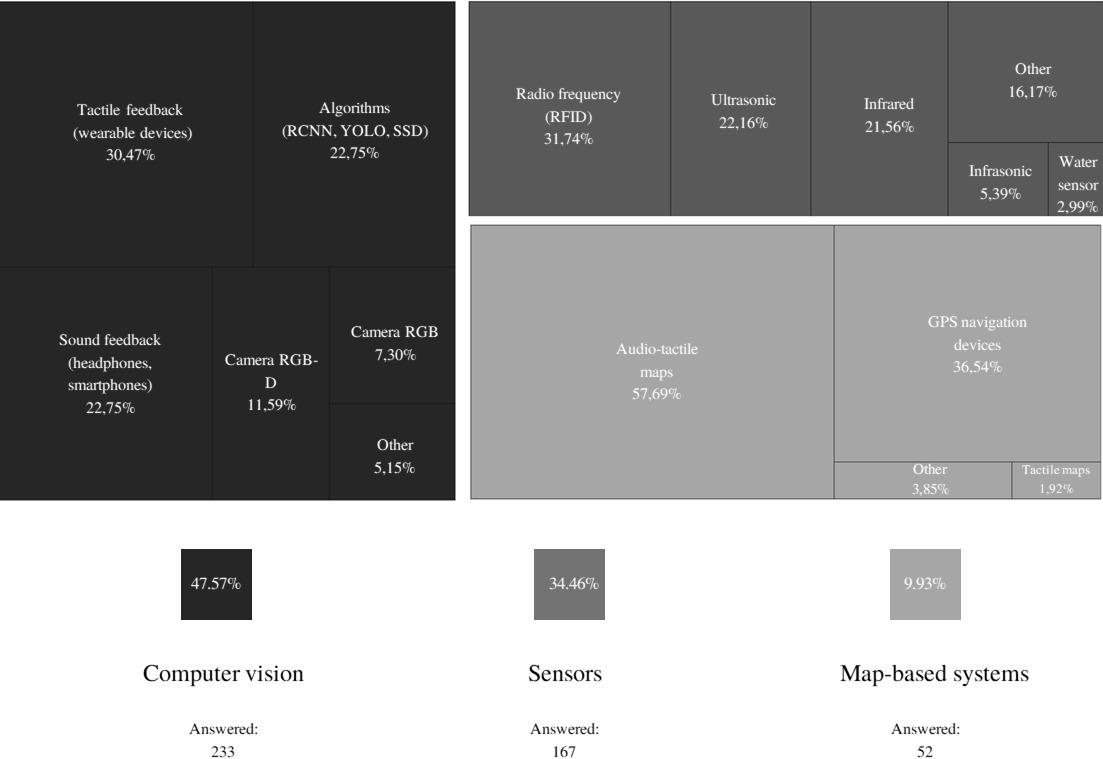
The methodology adopted in this study aligns with previous research that has surveyed experts in an effort to anticipate future trends in assistive technologies for individuals with visual impairments. However, it shares similar limitations with these studies [43, 44, 45, 46, 47, 48, 49].
The first limitation pertains to the diversity of respondents, which arises from the strategy of identifying and selecting respondents from scientific articles. Consequently, if respondents are authors of scientific articles, they are naturally likely to be predominantly researchers and professors affiliated with universities and research organizations.
Another limitation is the potential for an optimism bias among the respondents. As these respondents are authors of articles related to assistive technologies and thus deeply invested in the subject, they may have a more optimistic outlook regarding the future of these technologies than other possible respondents (such as visually impaired individuals, policy makers, entrepreneurs, or politicians). Yet, given their involvement in advancing scientific and technological knowledge, they are among the most qualified to provide insights into the future possibilities of assistive technologies for visually impaired individuals.
The final limitation pertains to the self-reported level of knowledge by the respondents in the questionnaire. Unfortunately, it is not within the authors’ capacity of this study to assign knowledge levels to each respondent or to verify the accuracy of the self-reported level of knowledge. Therefore, the self-reported level of knowledge depends on how respondents evaluate their own expertise in the field. Nonetheless, all participants in this study are authors of peer-reviewed scientific articles related to assistive technologies for visual impairments indexed in WoS, which minimizes the likelihood of incorporating opinions from individuals lacking knowledge in the subject.
Most important types of feedback for visually impaired people in the next 20 years.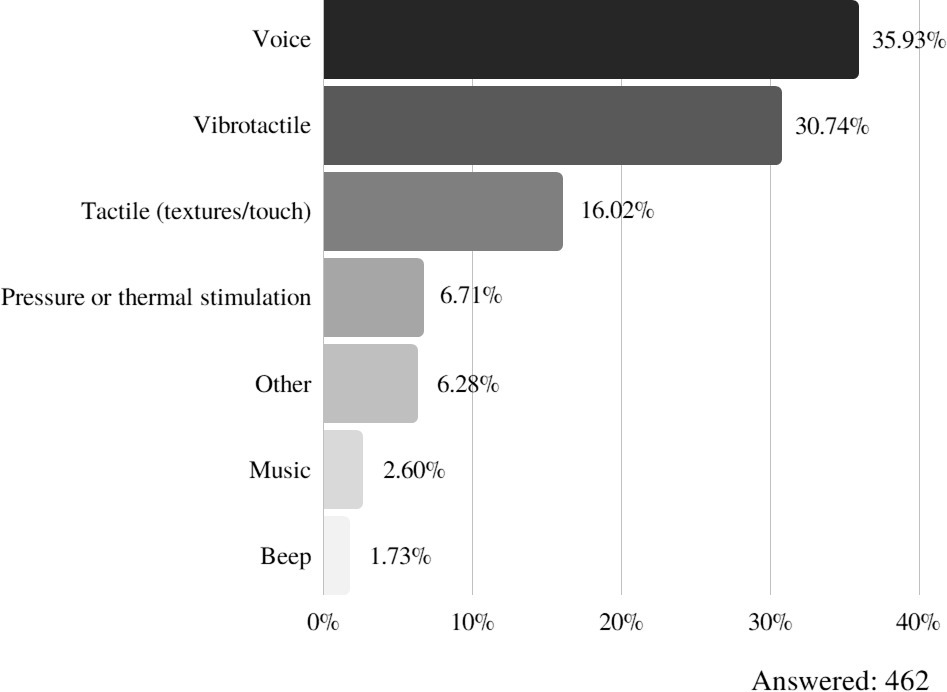
Types of smart tools most relevant for visually impaired people in the next 20 years.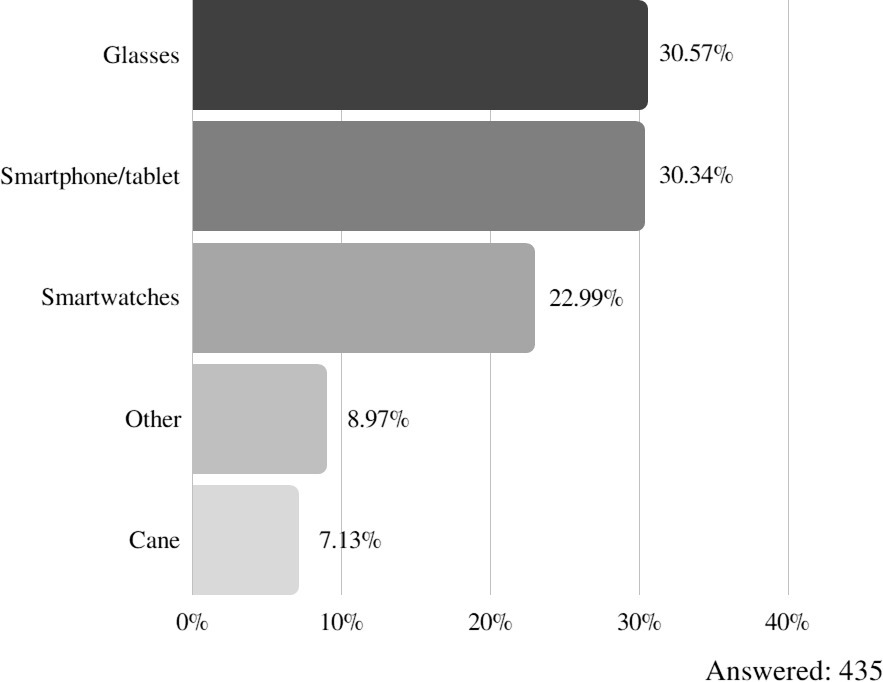
The respondents represented a diverse demographic profile, with a significant majority (83.46%) holding doctoral degrees and predominantly occupying roles as professors or researchers (67.49%). Most were affiliated with universities or research organizations (over 78%). Regarding experience, nearly 40% boasted over 20 years in the field, just over 30% possessed between 10 and 20 years of experience, and slightly over 22% had between 5 and 10 years of experience. Geographically, the majority hailed from Europe (42.61%), followed by Asia (21.18%) and North America (18.47%). Detailed demographic data is available in the Supplementary Material.
Regarding the technology-related questions, respondents believed the most important navigation technology group in the next twenty years will be computer vision (47.57%), followed by sensors (34.46%) and map-based systems (9.93%). Figure 1 presents the results.
Likelihood of integrating various assistive technology groups for mobility and navigation for visually impaired people into a single tool, and achieving significant social inclusion gains through the use of smart devices, in the next 20 years.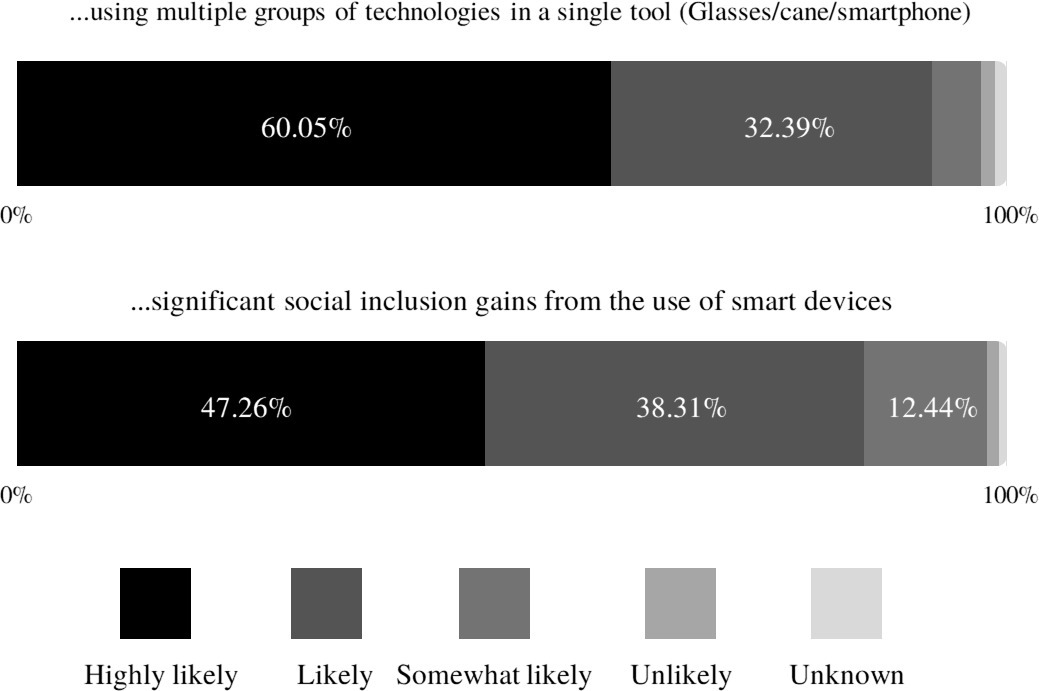
Main barrier to the development and applicability of intelligent devices for mobility and outdoor navigation for visually impaired people.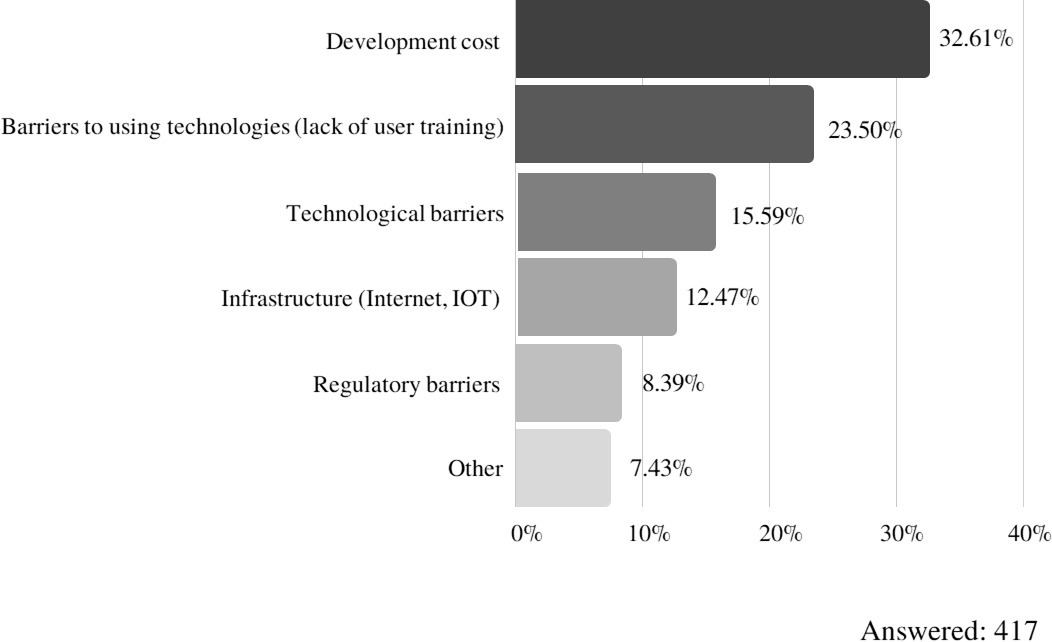
After indicating which AT technology group had the greatest potential to aid people with visual impairments, respondents were asked to choose the most relevant specific technology from the selected group. Of the total respondents who indicated computer vision, 30.47% chose the subgroup of tactile feedback (wearable devices) as a technology with high potential use, followed by algorithms (22.75%), sound feedback (22.75%), RGB-D cameras (11.59%) and RGB cameras (7.30%). Other technologies were selected by 5.15% of the respondents. Of respondents who indicated sensor technology as the most important group of assistive technologies for mobility and navigation for visually impaired people, 31.74% chose the radio frequency (RFID) subgroup, 22.16% ultrasonic technology, 21.56% infrared, 16.17% “other,” 5.39%, and 2.99% chose infrasonic and water sensor, respectively. Individuals who selected map-based system technologies identified audio-tactile maps (57.69%) as the most important specific technology, followed by GPS navigation devices (36.57%), other devices (3.85%), and tactile maps (1.92%).
All participants were guided to answer the types of feedback considered most relevant for people with visual impairments in the next 20 years. Little more than two-thirds (35.93%) indicated voice feedback as the most important, followed by vibrotactile (30.74%), tactile (textures/touch) (16.02%), pressure or thermal stimulation (6.71%), other (6.28%), music (2.60%) and beep (1.73%) (Fig. 2).
Figure 3 presents the results of the most important smart tools. The most prominent tool was eyeglasses, chosen by 30.57% of respondents, followed by smartphones and/or tablets, with 30.34%. In sequence, 22.99% of the total responses indicated smartwatches as the most important tool, followed by the “other” category with 8.97% of the responses and cane with 7.13%.
Figure 4 shows other exploratory data on AT for people with visual impairment. First, about the potential of using several assistive technology groups in a single tool (glasses/cane/smartphone) in the next 20 years, 60.05% consider it highly likely, 32.39% likely, 4.96% somewhat likely and 1.42% unlikely. As for the likelihood of achieving significant gains in social inclusion with the use of smart devices, 47.26% of respondents consider it highly likely, 3831% likely, 1244% somewhat likely and 124% unlikely.
Next, we focused on identifying the main barrier to developing and applying smart devices for mobility and navigation for visually impaired people in the next 20 years (Fig. 5) The development cost was considered the most significant barrier for 32.61% of the respondents, followed by barriers to using technologies (i.e. lack of user training) (23.50%) and technological barriers (15.59%). Infrastructure (12.47%) and regulatory barriers (8.39%) were also mentioned, followed by other barriers (7.43%).
As delineated in existing literature on navigation for visually impaired people, EOAs, PLDs and ETAs clusters are categorized as assistive devices or systems [12, 50], differentiated by their mechanisms of data capture, processing, and user information transfer [41]. A comparison bewteen a range of assistive systems, including those founded on computer vision, infrared sensors, and tactile maps indicated a distinct advantage of computer vision-based systems over other forms [15]. Similarly, a comparative evaluation between computer vision-based systems and other sensor-based devices, such as those employing infrared technologies, uses these same categories [51].
Consequently, we structured our comparison among these technological groupings despite the inherent limitations. The distinction was primarily informed by the literature referenced in this study. We anticipate future research to elucidate these differences further, discussing the unique role and potential prospects of each component. Such studies would also probe into the manner by which advancements in individual areas could influence the overall efficacy of assistive technologies designed for people with visual impairments.
Overall, respondents anticipate that computer vision will be the most important technological group over the next two decades. The result reflects the advancement of 4IR’s technologies and the many opportunities for gains in AT, especially in ETAs, EOAs and PLDs [15, 16, 52, 53].
Computer vision-based applications significantly enhance mobility, orientation, and object recognition capabilities for visually impaired individuals. These applications capture, process, analyze, and provide feedback on isolated images or sequences, effectively reconstructing the user’s surroundings [51, 52, 54]. Computer vision further offers a robust set of tools for filtering the information in a manner that does not confuse the user [51]. The existing arsenal of computer vision equipment ranges from wearable devices utilizing single-board computers to smart glass cameras and laptops carried in backpacks, all designed to aid the outdoor navigation of visually impaired individuals [52, 55, 56].
Given the limitations of traditional outdoor navigation and mobility tools such as canes and guide dogs, there’s a growing interest in harnessing the potential of computer technologies. These traditional aids often fall short when encountering obstacles above waist-level, underscoring the need for technologies capable of providing a comprehensive and intricate visualization of objects and scenarios [57]. Thus, the integration of computer vision technologies, which has been generally positive and promising, can significantly enhance the experiences of visually impaired individuals [52].
Among the specific technologies related to computer vision, wearable devices providing haptic feedback were identified as the most important within the computer vision group. Despite the apparent feasibility of audio feedback, it tends to become indistinct in noisy environments, potentially interfering with environmental perception [58]. Conversely, tactile feedback does not occupy the auditory sense, which is a crucial sense for visually impaired individuals [59]. Along with the likelihood of algorithm and application usage [13, 16, 53, 60], this finding underscores the increasing importance of advancements in image understanding techniques and software based on Convolutional Neural Networks [16].
Simultaneously, smartphones, especially those providing audio feedback, are gaining prominence due to rapid technological developments and increasing accessibility in healthcare [61]. While handheld computers or backpack units have been used for high-precision image processing, the trend is shifting towards smartphones, given their widespread availability and acceptability [62].
The sensor group received the second-highest favorability rating, with advances in the Internet of Things (IoT) enabling real-time or near-real-time information exchange between the user and the sensors. Radiofrequency, ultrasound, and infrared were the most preferred sensor technologies, commonly incorporated into ETAs4
Devices to help the visually impaired avoid obstacles. They detect obstacles and provide better guidance to users, enabling them to perform activities more safely [50].
Infrared, an electronic sensor capable of detecting objects and measuring distances by identifying infrared light radiating from such objects, is recognized as another important technology in aiding outdoor navigation for the visually impaired. Hence, the research results corroborate with the literature [12, 63]. Ultrasound-based navigation systems measure the distance to the obstacle through ultrasound and the user receives the information through voice or vibration [12].
However, there are limitations. Radio frequency-based systems do not offer a wide range due to the need to install tags in all locations where the system is used [64]. Infrared sensors can perform poorly in environments with bright sunlight; glass doors and windows cannot be detected [40, 65]. Precise localization with ultrasonic-based obstacles is difficult due to the divergence of large waves, making it challenging to detect smooth waves and small opening surfaces [40].
The last group of technologies addressed in the research was map-based systems. The tactile tool helps visually impaired people outdoors navigate with specific features, such as maps with raised points, reduced scale prototypes, and others [12]. Although the tool makes it possible to improve the quality of life of the visually impaired, users face limitations, such as being unable to update the maps’ content.
The literature makes it possible to identify relevant assistive devices to help visually impaired people in their mobility and outdoor navigation. The most frequent devices are smart glasses, smartphones and smartwatches [12, 13, 15, 16, 17, 53, 62, 63, 66, 67, 68]. Smart glasses are the primary mobility and outdoor navigation assistance device for the visually impaired, as many such devices are already on the market [63]. The same applies to smartphones, as they are ubiquitous and general-purpose handheld devices that have been exploited by several researchers to extend traditional navigation aids [62]. Smartwatches are also important devices to help people with visual impairments navigate outdoors [69].
The respondents presented optimism about the integrated use of the devices. The majority (72.44%) believe that using multiple technologies in a single tool is very likely or likely by 2041. Advances in tools will provide greater well-being and social inclusion in mobility and outdoor navigation for people with visual impairments. Integrating smart glasses, smartphones, smartwatches and others, provides a greater interface between users and these devices [16, 17, 53]. Improvements in the functionality of conventional mobile technologies advances in computer vision processing algorithms, and the miniaturization of electronic devices further propel this field into the challenges and reality of creating successful AT [16].
The biggest challenge reported by respondents for expanding AT was development costs, consistent with the numerous prototypes in development [13, 16, 53, 68, 70, 71, 72, 73]. In addition, improvements to existing tools are needed. First, concerning appearance: the units used for accessible outdoor navigation aids may not be compact, indiscreet, and have low power capacity leading to transportation concerns. Secondly, operability: some keyboards have a single key responsible for punching multiple characters, the QWERTY keyboard is tricky to follow, and the touch screen interface may not be efficient for use by the visually impaired [17]. Third, connectivity: most tools rely on the ability to connect to Wi-Fi, satellite, or Bluetooth networks. If these signals are blocked, as they can be by tall buildings or as they are indoors, the system is unable to function. This can lead to confusion and inaccuracies in information [41]. Lastly, the high acquisition cost of cutting-edge equipment ultimately restricts access to new technologies and creates barriers to the consumption and inclusion of visually impaired individuals [62].
Although the focus of our study was on ATS for visually impared people in outdoor environments, the literature also demonstrates the use of these technologies in indoor environments [74, 75, 76, 77]. Computer vision allows localization in these environments by recognizing landmarks, reading signs, or even combining with an autonomous navigation robot, capable of locating a user with visual impairment and transmitting the direction to a certain destination in real-time, avoiding obstacles [77]. RGB-D cameras have been used to help visually impaired people find specific objects in an indoor environment, such as chairs, and understand scenes [12, 78].
While there are noticeable advances in navigation for visually impaired people, there are still several barriers to overcome from a technological standpoint. A major challenge for developers is to increase the devices’ response time and improve their accuracy in identifying or locating targets [52, 78]. Solutions are expected to be available jointly, enabling user access through unique software and portable device, covering indoor-outdoor navigation, obstacle, object and person recognition, human crowd behavior, and more [52].
This study aimed to provide reliable information to help stakeholders promote and develop ATs for outdoor navigation and mobility of individuals with visual impairments. The goal was not only to anticipate the future but also to assist researchers in shaping it. Our findings, in tandem with existing literature, indicate that computer vision technologies are the most likely to be important for severely visually impaired people in the next twenty years. Amongst the specified technologies, wearable devices employing tactile feedback emerged as the most important, followed by algorithms and audio feedback mechanisms (headsets and smartphones).
With respect to smart tools for AT, smart glasses were considered the most important among, followed closely by smartphones and smartwatches. Currently, most of these devices are prototypes, which may explain why most respondents pointed out costs and lack of user training as the biggest barriers to developing such ATs. On the other hand, the high expectation that these technologies will have a relevant impact on the inclusion and improvement of the lives of thousands of people may indicate the highly disruptive potential of these ATs.
The conclusions derived are inherently an integration of expert projections on forthcoming technological advancements, grounded in knowledge prevalent as of 2021. While an in-depth investigation into possible ’wild card’ technologies exceeded the scope of this study due to its methodological design, other future studies, particularly those focused on unexpected or disruptive innovations, could benefit from considering these elements. We also acknowledge the importance of incorporating the perspectives of end users – individuals with visual impairments – who will directly experience the impact of these technologies. We could not do this due to methodological limitations, but it should be considered in a broader exercise. Additionally, an economic analysis could provide valuable insights into the development and adoption of these technologies, and highlight relevant socioeconomic and environmental factors. However, these aspects fall beyond the scope of our current study, indicating avenues for future research to augment our present findings.
Author contributions
All authors contributed equally.
Ethical considerations
This study is exempt from Institutional Review Board approval.
Footnotes
Acknowledgments
The authors would like to thank all the respondents who participated in the web survey.
Conflict of interest
The authors have no conflicts of interest to report.