



Abstract
BACKGROUND:
Extracorporeal membrane oxygenation (ECMO) has developed rapidly and becomes a significant treatment for emergency. Current blood pumps for ECMO have different disadvantages.
OBJECTIVE:
To design a pulsatile DC electromagnetic blood pump for ECMO.
METHODS:
The design is presented with a driving principle which the rectilinear reciprocation of a magnet inside energized solenoids is implemented, and with a structure of solenoids with compensation coils. Furthermore, a prototype was constructed and the performance indexes of it were measured with the experimental evaluations, where the acceleration experiment was performed without any loads, and the flows were measured in the ranges of preload and afterload are 5 to 30 mmHg and 50 to 80 mmHg respectively when the frequency of the motion is 80 beats per minute.
RESULTS:
The electromagnetic force is greater than 1.4 N when the DC reaches 2.7 A and the flow of the prototype is greater than 3.0 L/min except the differences between the preload and the afterload are greater than or equal to 70 mmHg.
CONCLUSIONS:
The design of the blood pump for ECMO meets the theoretical and clinical requirements.
Introduction
Extracorporeal membrane oxygenation (ECMO) has been standard care for newborn infants and children with heart and lung disease since 1990, and for adults with cardiac and respiratory failure since 2009. Nowadays, ECMO is a significant method for emergency treatment of hospitals, regions or even countries [1, 2, 3]. As one of the core components, a blood pump affects the treatment effectiveness and development of ECMO directly. Currently there are two main types of blood pumps in clinical ECMO systems: Roller pumps and centrifugal pumps. The former is able to provide a steadily pulsatile flow, however, the severe blood damage is induced by a high pressure from rotor to tube. The centrifugal pumps are safer because of the low pressure, but the blood in the pump head will be damaged (PfHb
This paper presents a pulsatile DC electromagnetic blood pump with solenoids with compensation coils. Furthermore, a prototype was constructed and its performance indexes were measured with acceleration and flow experimental setups.
Presentation of design
Corresponding to electromagnetism and classic mechanics, a magnet which is positioned at either end face of an energized finite solenoid will move towards the center of the solenoid driven by the unbalanced magnetic forces. Thus, if several solenoids with same length and direction of rotation are closely and adjacently wound on one central tube, which the length is also equal to the width of the magnet, the rectilinear reciprocation of the magnet will be implemented when the adjacent solenoid shifts to be power-on successively and solely.
A pulsatile DC electromagnetism blood pump for ECMO was designed with aforementioned driving principle and variable volume principle. It is composed of two main components including solenoids: A central tube and a pair of housings possess thin-walled structures and they are made from medical rigid plastic; a mover is composed of a magnet and hermetic sacs within saline on both sides, which provides a soft touch between the mover and the blood during the device operation.
Figure 1 shows the structure and operation of the blood pump: The nominal diameter of the mover is same as the nominal inner diameter of central tube with a clearance fitting at high accuracy; each housing possesses a liquid inlet and a liquid outlet with check valve in order to prevent a backflow; two cavities are formed by the mover, the housings and elastic film with high elongation on both sides of the mover respectively. During the device operation, the cavities are full with blood in advance; and then if the mover is driven by DC electromagnetism from the right to the left inside the central tube, the volume of left cavity will decrease with the left elastic film shrinking and the situation will be opposite at the right side, so that the blood will outflow through the left outlet and inflow through the right inlet from external blood storage device, and vice versa.
Structure and operation of the blood pump.
To optimize the force on the mover during motion, in Fig. 2, a structure of the solenoid with compensation coils was designed via theoretical simulation and utilized in the blood pump. There are two layers of the compensation coils, where the length ratio to the single layer solenoid of the first layer and the second layer are 0.72 and 0.62 respectively. Comparing to the single layer solenoid, the uniform area of the inside-spatial magnetic field was more than doubled including the improvement of the axial magnetic induction.
Solenoid with compensation coils.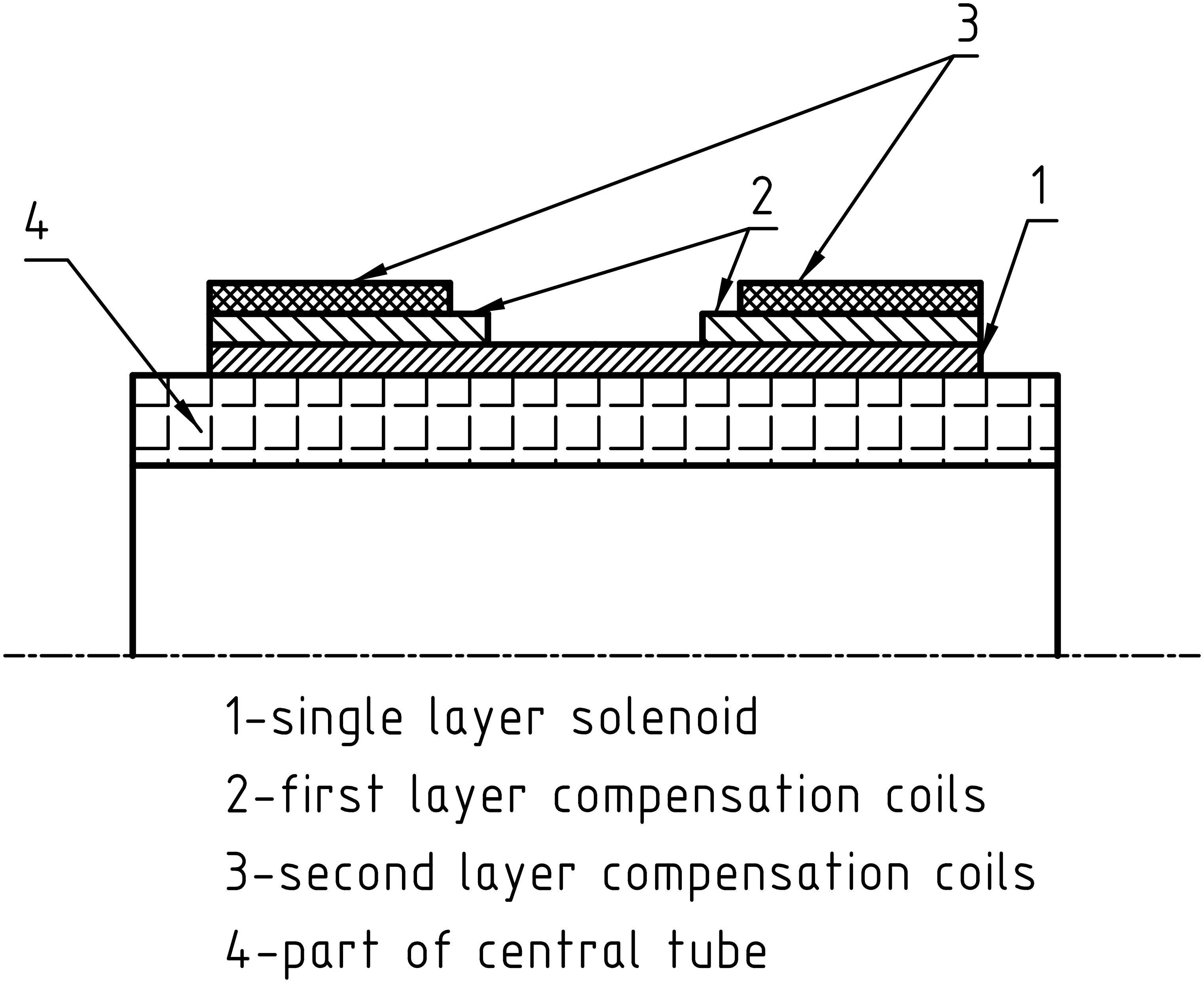
To demonstrate the validity and rationality of this design, a prototype of this blood pump was constructed and two experimental evaluations were conducted.
Requirements
The driving force, which is the electromagnetic force in this design, and the flow are significant performance indexes of blood pump, and they need to meet following requirements:
Corresponding to the conservation law of energy, the physiological index of a normal adult, and the friction state of this blood pump [9, 10, 11, 12], the electromagnetic force
Devices and methods
First, the acceleration experimental setup is shown in Fig. 3(a). It consists of four major components: the prototype, a DC source, the device of data collection and an acceleration sensor. The acceleration sensor is fixed with the mover of prototype, and its accuracy is 20.41 mv
Then the Fig. 3(b) shows the flow experimental setup which includes the prototype, the DC source, the device of liquid overflow, a pressure gauge and the device of liquid storage. The preload and the afterload are controlled via the height of liquid level. The saline, being the experimental liquid, will overflow during the operation, and the flow is collected and measured by every single beat when the frequency of the motion is 80 beats per minute.
Results
The maximums of the electromagnetic force on the mover is obtained with conversion and listed in Table 1.
Maximums of electromagnetic force on the mover
Maximums of electromagnetic force on the mover
Results of flow experiment (L/min)
Acceleration experimental setup (a) and flow experimental setup (b).
From Table 1, the maximums are almost same with tiny random errors in both directions of motion, and when the DC reaches 2.7 A the values are beyond 1.4 N, which have met the aforementioned requirement.
Besides, the flows were repeatedly measured 15 times when the DC was 2.7 A and the averages of the results are listed in Table 2.
From Table 2, the flows are greater than 3.0 L/min except the differences between the preload and the afterload is greater than or equal to 70 mmHg, and the flow maximum 9.864 L/min is similar to current blood pumps.
A pulsatile DC electromagnetic blood pump for ECMO has been designed. The novelty of this design can be summarized as follows: (1) This paper firstly proposed and applied the driving principle that the rectilinear reciprocation of a magnet is implemented by energized solenoids, which improves the efficiency and performances of the blood pump by avoiding the conventional disadvantages of machinery transmission. (2) The structure of hermetic sacs within saline on both sides of the mover provides a soft touch between the mover and the blood during the device operation, so the blood damage will be reduced to utmost degree. (3) The structure of a solenoid with compensation coils is simulated and used to optimize the motion of the mover.
Two experimental evaluations were performed to measure the performance indexes of the blood pump prototype. In one aspect, the results of the acceleration experiment show that a significantly positive-linear correlation is noted between the driving force provided by the prototype and the value of DC, and it has met the requirement when the DC was still small. Thus the DC can be adjusted precisely or increased in a large range to adapt to changes of the preload, the afterload and some situations else.
In the other aspect, the results of flow under the experimental conditions are suitable for following laws: The significance of the negative-linear correlation between the flow and the afterload increases with increasing preload, however, the significance of the positive-linear correlation between the flow and the preload is irrelevant to the afterload; with a multivariate linear regression of the results, it is known that the flow is affected by the preload more considerably than by the afterload. Thus, combining the control of the preload and afterload and the adjustment of the frequency of the motion, the flow can meet the clinical requirements of different patients.
Future work involves the optimization of the design and the measurement of the performance indexes in more complex experimental conditions. For example, the driving force will be measured with different preloads and afterloads, and the animal blood will be utilized as the liquid in flow experiment instead of the saline because of the differences. Importantly, the DC which possesses some variation tendency will be researched to replace the constant DC to optimize both the motion of the mover and the performances of the blood pump.
Conflict of interest
The authors have no conflict of interest to report.
Footnotes
Acknowledgments
The authors would like to thank Changqian Xie, Lingxuan Wei, and Lei Zhang for their help in experiments, and the support of University of Shanghai for Science and Technology.