



Abstract
PURPOSE:
To assess the attitude to and perception of transvaginal sonography (TVS) among Nigerian women of mixed educational status in order to ascertain factors that may prevent them from submitting to TVS when recommended.
METHODS:
A Cross-sectional survey was adopted for the study. Subjects were enrolled from one missionary, one government and eight private hospitals. The instruments for data collection were visual analogue scale (VAS), to ascertain patients’ pain/discomfort experience, and a researcher-developed semi-structured questionnaire. The level of pain/discomfort on the VAS was categorized into four on a scale of 100. The categories were: 0–5 (no pain), 6–40 (mild pain), 41–74 (moderate pain), and 75–100 (severe pain).
RESULTS:
The majority (50.6%) of the respondents who attained secondary education had positive attitude to TVS. The majority majority of the respondents (63.1%) preferred female sonographers. A majority of the respondents (54.1%) perceived TVS as not embarrassing, 78% did not consider it stressful, 96.9% reported that the sonographers were professional, 46.7% felt that a chaperon was needed, 98.4% reported there was enough privacy and 84.7% reported they needed prior information. Most of the respondents (82%) were willing to consent to TVS in future, 90.5% reported no pain, 8.6% reported mild pain/discomfort and 0.9% reported moderate pain.
CONCLUSIONS:
Majority of our respondents had a positive attitude to TVS and were willing to consent to TVS in future, hence it was acceptable to them. It was however observed that acceptability increased with increasing education.
Abbreviations
i.TVS: Transvaginal sonography
ii. VAS: Visual analogue score
Introduction
Transvaginal sonography (TVS) is a diagnostic tool that can be used for the evaluation of the female pelvis and involves the use of high frequency transducer placed in the vagina where it is in close anatomic proximity to the pelvic structures. It is ideal for the assessment of ovulation [1] and in oocyte recovery for the management of infertile patients [2]. The procedure overcomes the obese patients, patients with large amount of bowel gas, and those with inadequate bladder filling [3]. Since Transvaginal sonography invades the privacy of the female patients, there is need for a study that will focus on the attitude to and perception of the procedure by female patients. Several studies had reported its acceptability and not being embarrasing [4, 5, 6, 7, 8]. However a study by Onderi et al. [9] reported that majority of the patients he studied found TVS to be embarrassing. Most of these studies conducted so far in Nigeria and other countries were on literate population. We therefore sought to ascertain the attitude to and perception of TVS by women of diverse tribes most of who engaged in buying and selling in Onitsha, Anambra State, Nigeria. We also assessed patients’ experience of pain and choice of sex of the sonographer.
Materials and method
This study adopted the cross-sectional survey design. Ten hospitals that incorporate transvaginal sonography for obstetrics and gynaecological cases were purposively enlisted into the study consisting of one missionary, one government and eight private hospitals. All the 255 patients who consented to participate in the study were scanned by qualified sonographers with TVS, within the period of the study. The procedure was explained to the patients before any examination. The instruments for data collection were visual analogue scale (VAS), to ascertain patients’ pain/discomfort experience, and a researcher-developed semi-structured questionnaire divided into three sections A, B and C. Sections A elicited information on some demographic variables while section B sought data on the knowledge of TVS. Section C sought data on attitude to and perception of TVS among others. The researcher-developed questionnaire was validated by three experts from Department of Medical Radiography and Radiological Sciences of University of Nigeria. The instrument was pilot tested in Enugu State and its reliability computed using Cronbach’s alpha test which gave a coefficient of 0.81. Data generated were subjected to descriptive statistics and analyzed using Chi square and Pearson product moment correlation. Probability value (
Results
All the administered 255 VAS and semi-structured questionnaires were completed and returned giving a return rate of 100%.
Demographic characteristics of the respondents (
255)
Demographic characteristics of the respondents (
A majority (47.1%) of the respondents were within the age group of 26 to 35 years, 68.2% were married and 55.3% had secondary school education. Tertiary education group includes those who acquired post-secondary school education in accredited institutions and they constituted 38.8% of the respondents.
Attitude of the women based on educational status and choice of sonographer
A majority (50.6%) of the respondents who attained secondary education had positive attitude to TVS. Also a majority of the respondents (63.1%) preferred female sonographers.
Perception of TVS by the respondents
A majority of the respondents (54.1%) considered TVS not embarrassing, 78% did not consider it stressful, 96.9% felt that the sonographers were professional, 46.7% felt that a chaperon was needed, 98.4% reported there was enough privacy and 84.7% reported they needed prior information.
To assess the pain/discomfort experienced by the respondents, the visual analogue scale (VAS) was used. This scale had been used in previous studies to assess pain/discomfort [10, 11]. The participants were asked to mark the level of pain/discomfort on the VAS. The level of pain/discomfort was categorized into four on a scale of 100. The categories were: 0–5 (no pain), 6–40 (mild pain), 41–74 (moderate pain), and 75–100 (severe pain).
Respondents perception of pain/discomfort on the VAS.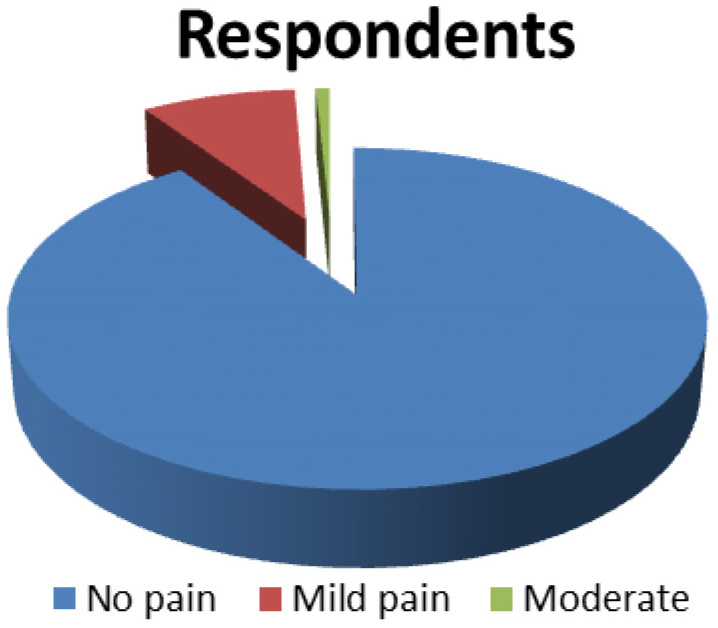
Most of the respondents (90.5%) reported no pain, 8.6% reported mild pain/discomfort and 0.9% reported moderate pain.
Our study revealed that majority of the respondents (47.1%) were within the age range of 26 to 35, married (68.2%) and attained secondary school education (57.7%). The attitude to TVS by majority (89%) of the respondents was positive. Positive attitude was positively and significantly related to the increased level of education (
On the respondents’ assessment of pain/discomfort, 90.5% reported no pain/discomfort, 8.6% reported mild pain/discomfort while 0.9% reported moderate pain/discomfort. Some previous studies had also reported TVS to be associated with pain/discomfort at varying levels [14, 15, 16, 17]. The following factors were presented in literature as being related to pain experience; age, hysterectomy, experience/skill of the sonographer and prolonged scanning time [14, 18]. However our study revealed that pain was more in primips and in respondents with lower educational status.
One of the limitations of our study was not randomizing the respondents based on prior explanation of the procedure or not for the assessment of pain. Also environmental factors and the responses of the participants scanned by male/female sonographers were not compared in the pain assessment.
Conclusion
A majority of our respondents had positive attitude to TVS and also were willing to undergo the investigation in future, allowing us to infer acceptability. It was however observed that acceptability was positively correlated with increasing academic status. Few respondents reported mild/moderate pain/discomfort. We recommend prior information, provision of calm and conducive environment and employment of skilful/experienced female sonographers as measures to reduce embarrassment and perceived pain during TVS.
Conflict of interest
The authors have no competing interests.
Footnotes
Acknowledgments
The authors appreciate the co-operation obtained from the hospital and clinics during the course of the research.