



Abstract
OBJECTIVES:
This research assesses the use of Radio Frequency Identification (RFID) technologies as an alternative for insurance costs in hospitals.
METHODS:
Despite the advantages of RFID, this technology has not been applied in most hospitals due to implementation costs and amortization of RFID. In this paper, we intend to model the total profit of hospitals in three scenarios namely, application of RFID technology in the hospital, without applying RFID technology in the hospital and insuring patients and equipment in the hospital.
RESULTS:
We analyzed the aforementioned situations over a period of time to find out how they affect the profit of the hospital. Based on this analysis we concluded that if applying RFID technology is costly, it will be feasible for advanced hospitals with more beds. In the scenario of insuring patients and equipment, if insurance organization takes over a small portion of the cost of the mistakes and oversights, insuring patients and equipment will not be feasible for the hospital, and it is better to apply RFID technology Instead.
CONCLUSIONS:
RFID is among the technologies applied to reduce mistakes of the personnel in hospitals. Moreover, applying this technology has led to a decrease in the number of personnel required in hospitals. This study models total profit of hospitals in three aforementioned scenarios. Based on analyzing these models we conclude that if applying RFID technology is costly, it will be feasible for advanced hospitals with more beds.
Keywords
Introduction
As mentioned by Curry and Sinclair [1], health care is among the fastest growing industries. Tsacle and Aly [2] stated that health care industry is facing with the challenge of an ever-increasing competitive and globalized environment. Fisher and Monahan [3] concluded that in order to stay in current competitive and globalized environment, health care industry requires new technologies for managing patients and personnel. Jaana et al. [4] developed an information technology capacities assessment tool in hospitals as an integral part of survival in current competitive environment. Radio Frequency Identification (RFID) is an advanced technology, which uses radio waves to collect and transmit data [5]. RFID systems consist of tags and readers. Tags are attached to the item being tracked and the data is stored in their memory. Readers are the devices that read data from and write data to tags and are connected to a network to transfer their data. Lin [6] mentioned that RFID technology has been generally applied to improve the supply chain of organizations. Kumar et al. [7] concluded that by applying RFID technology, objects can be easily and automatically organized and identified in the factory, through shipping and in hospitals. According to Britton [8], several studies on potential effects of RFID in health care industry show that this technology positively affects safety of patients and medical devices. Southard et al. [9] applied a Six Sigma DMAIC approach and their simulation results showed significant estimated annual cost and time savings in carrying out patients’ surgical procedures when RFID technology is implemented for surgery processes. According to a research by Ku et al. [10] reducing costs and raising patients’ happiness have been among the most widely agreed upon advantages of RFID in health care industry so far. Every perioperative department could benefit from having an information system that facilitates managerial function and improves efficiency in their operations management. Vanany et al. [11] indicated the application of RFID in monitoring temperature and location of patients in Paintai hospital in Malaysia.
Although, the aforementioned advantages have led to reducing costs and improving satisfaction of the patients, RFID technology is rarely applied in hospitals. Cheng and Yeh [12] adopted structural equation modeling to investigate the impact of three factors on RFID technology adaptation based on the technology acceptance model. These factors include perceived benefit, perceived ease of utilization, and the social norm on the utilization of international distribution centers. Empirical results show that a reconsidered technology acceptance model could explain the RFID acceptance behavior. Monahan and Fisher [13] empirically assessed the social and ethical risks associated with applying radio frequency identification devices. They identified three primary social and ethical risks associated with applying RFID technology including, unfair prioritization of patients based on their participation in the system, diminished trust of patients by care providers and endangerment of patients who misunderstand the capabilities of the systems. Tsai and Tang [14] examined how the adoption of RFID technology affects the operational performance of logistics service firms. They developed the RFID technology adoption model based on the organizational information systems view of the firm that integrates the various strands of research into the framework. Nagy et al. [15] investigated the use of RFID in surgical settings to track workflow, assets, staff members, medication and inventory supply chain. They concluded that RFID technology provides a significant opportunity to help patients to have excellent recovery periods through the health care systems. Ranasinghe et al. [16] investigated the accuracy of a continuously wearable, low power and low cost monitoring device with a single kinematic sensor capable of real-time monitoring to automatically detect bed entry and exit events. Chang et al. [17] investigated the performance of RFID in relation to patient safety in Taiwan by conducting a survey collecting perioperative doctors’ and health care personnel’s opinion on the benefits of RFID technology for operational structure, the organization, and the environment. They concluded that RFID technology had the greatest potential in the domain of patient safety. Su [18] developed a prototype system based on active RFID technology that detects and prevents errors in the operating room. In order to completely comprehend the operating room process, multiple rounds of on-site discussions were conducted. An on-site survey have been conducted subsequently to better perceive the hardware requirement. Zare Mehrjerdi [19]mentioned that RFID technology is applied in hospitals such as the Massachusetts General Hospital, Hospital of the University of Pennsylvania, Carolina Medical Center, and Washington General Hospital. Angeles [20] showed that despite the benefit and potentials of RFID technology to reduce costs of hospitals and firms, and to improve industry’s supply chains, many hospitals are still reluctant to set up RFID technology. Past studies indicate that high price of RFID technology is the main reason of reluctance to adopt RFID. Chong and Chan [21] provided a multi-stage analysis on the antecedents that affect the diffusion of RFID in the health care industry. The results will help decision makers in health care industry to better understand the diffusion process of RFID, and to formulate strategies for successful diffusion of RFID. van der Togt et al. [22] presented a framework for performance and data quality assessment of RFID systems in health care settings. Their RFID performance assessment framework can play the role of a reference model to start an RFID development, engineering, implementation and testing plans.
Previous researches on applying RFID technology in health care industry concentrate on utility and benefits of applying RFID technology in hospitals. These researches show that applying RFID technology have led to decreased costs of hospitals. But quantitative investigation of the effectiveness of RFID technology have been ignored so far. In this research we intend to develop a mathematical model of profit of hospital in three scenarios namely, applying RFID, not applying RFID and insuring patients and equipment.
The rest of the paper is organized as follows. Problem statement and the mathematical model are presented in Sections 2. Results are provided and analyzed in Section 3. Finally, in Section 4 concluding remarks and directions for further research are provided.
Method
Utilization of RFID technology in hospitals not only helps them prevent human mistakes, but also it is very helpful for patients. This is because these mistakes may have fatal consequences. Moreover, utilization of RFID technology in hospitals can be economically feasible. We aim to model profit of hospitals in three scenarios: application of RFID technology in the hospital, without applying RFID technology in the hospital and insuring patients and equipment of the hospital without applying RFID. Hence, we can compare these three settings. For this purpose, we first introduce all costs of hospital and afterwards we present these costs mathematically. Some of these costs like doctors, nurses, salary, administrative staff, security guards, etc. are fixed. There are other types of cost that are consequences of human mistakes and are variable in different hospitals. There is another type of variable cost that depends on the type of hospitalization and equipment and drugs used. Also, insurance costs are variable depending on the number of hospitalized patients. As variable costs depend on a complex set of factors, their probability distributions are incorporated into the model. Revenue of hospitals depends on the number of patients and type of their hospitalization. Probability distributions are also used in modelling the revenue of the hospital.
Mathematical model
In the rest of this section, we first model total cost of the hospital and its components and then revenue of the hospital is introduced and modelled. Finally, hospital’s profit in three aforementioned scenarios are calculated. It is worth mentioning that in the following sections the word personnel is used for all the staff except doctors and administrative staff.
Total costs of the hospital
A large number of administrative staff work in different sections of the hospital. These staff are paid based on their type of work. In this model salary of administrative staff type I is indicated by
Nurses, ambulance drivers, security guards and janitors are among other hospital personnel that are paid different salaries. Here we show the number of personnel of type
When RFID technology is applied in a hospital, the number of personnel and amount of their work decreases. In this case, the amount of hospital payment to personnel over a period will be calculated using Eq. (3).
The number of doctors of type
The number of patients who are admitted to the hospital over a period is assumed to be a random variable. This variable is denoted by
Cost of drugs and equipment used to cure patients is also considered to be a random variable with normal distribution. This normal variable is denoted by
Hence, the total cost of equipment and drugs used for patients over a period will be equal to Eq. (7).
Insurance costs od equipment are assumed to be fixed and denoted by
Where
Another type of cost often incurred due to mistakes and negligence of nurses, doctors, etc. It is assumed that the number of mistakes is a random variable
Also, it is assumed that cost of each mistake type is a normally distributed random variable
In this case, total costs mistakes and errors will be equal to Eq. (11).
Fixed costs including cost of electricity, water, gas, etc. are also incorporated into the model and are denoted by.
Total revenue of the hospital is assumed to be proportional to total equipment and drugs used and calculated as Eq. (12).
Here,
Scenario 1. Profit in the scenario where RFID is not applied
Hospital’s profit is indicated by
This model can be simplified as shown in Eqs (14) to (17).
Scenario 2. Profit in the scenario where RFID is applied
Applying RFID technology, leads to a decrease in the number of personnel in different sections of the hospital. Moreover, it almost eliminates mistakes and negligence by personnel. These benefits lead to cost savings but implementing RFID incurs a cost to the hospital which is denoted by c. Hospital’s total profit in this scenario is calculated as shown in Eq. (18).
This model can be simplified as shown in Eqs (19) to (21).
Scenario 3. Profit in the scenario where equipment and patients are insured
If the hospital insures patients and equipment but does not apply RFID technology, the hospital has to pay a percentage of the cost of mistakes. In this case profit is calculated as shown in Eq. (22).
This model can be simplified as shown in Eqs (23) to (24).
Comparing hospital’s profit in three scenarios
According to Eqs (17), (21) and (24) we can conclude that if the following condition holds application of RFID is beneficial.
Also, if the following condition holds, we can conclude that application of RFID is more feasible than insuring patients and equipment.
However, in calculating costs and revenue, in order to make model simplification possible, we assumed that the number of patients visiting the hospital in a period ranges between zero and infinity. It is obvious that in reality the capacity of the hospital is limited and this assumption is not realistic. In order to make the model more accurate, we can replace this assumption with the one in Eq. (27).
We have also assumed that the cost that patients pay is normally distributed between zero and infinity. Defining an upper bound like the one in Eq. (28) improves the model’s consistency with real-world conditions.
Using these new assumptions, Eqs (13), (18) and (22) can be calculated as shown in Eqs (29)–(31) respectively.
In this section sensitivity of the hospital’s profit in each scenario is analyzed to changes in parameters
Sensitivity analysis to changes
As shown in Fig. 1, as maximum capacity of the hospital (
Sensitivity analysis to changes in 
Figure 2 shows that if RFID technology is applied in the hospital, profit of hospital does not depend on parameter
Sensitivity analysis to changes in 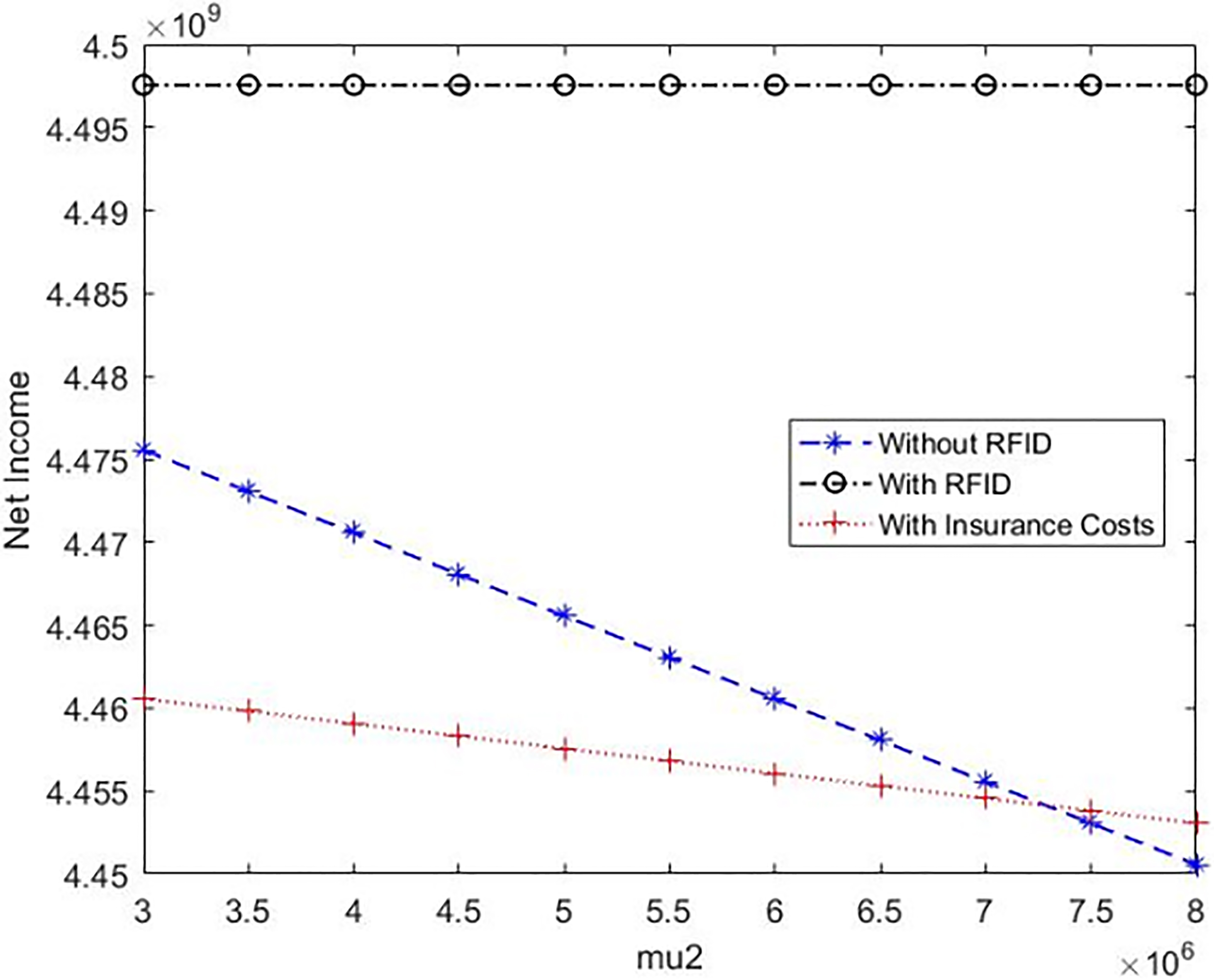
Parameter
Sensitivity analysis to changes in 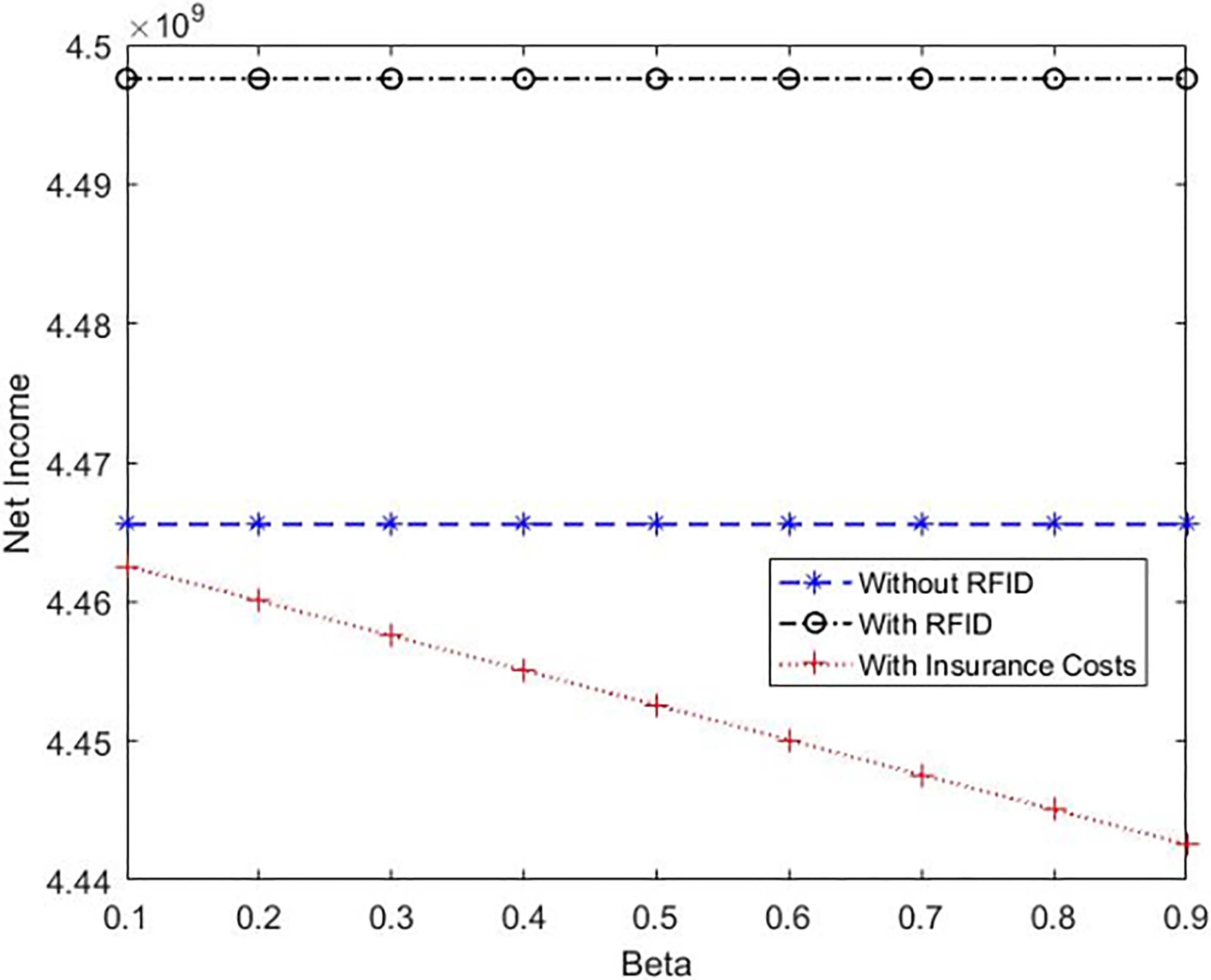
Sensitivity analysis to changes in 
As shown in Fig. 4, due to the fact that the revenue of the hospital depends on
Conclusions
According to models obtained for profit of the hospital in three scenarios namely, application of RFID technology in the hospital, without applying RFID technology in the hospital and insuring patient and equipment of the hospital, we can conclude that if the cost of applying RFID is relatively high, it will only be feasible for advanced hospitals with more beds. In the scenario of insuring patients and equipment, if insurance organization takes over a small portion of the cost of the mistakes and oversights, insuring patients and equipment will not be affordable for the hospital. Despite the conclusion that in small hospitals and in the case that the share of hospital in insurance cost is low; RFID technology is not economically feasible; it should be considered that RFID technologies can prevent mistakes and damages to infrastructures and patients. In other words, the value of one patient’s life and prosperity may not be measured through economic evaluations. Also, if RFID technology can prevent damages to an applicant, costs corresponding to maintenance of these applicants may decrease and so through a comprehensive assessment, RFID technologies are profitable and desirable for excellence and supplying qualified services. Briefly we may conclude that the use of RFID technologies in large hospitals is crucial and profitable and can compete with insurance activities. In small hospitals, in which the level of mistakes may be more considerable the use of RFID is also recommended. For future researches, modelling the application of RFID in hospitals using operations research techniques may provide extra insights for decision-makers. Modeling the effects of applying RFID on profit in other environments is also recommended for future researches.
Footnotes
Conflict of interest
None to report.