



Abstract
Wireless body area network (WBAN) is a breakthrough technology in healthcare areas such as hospital and telemedicine. The human body has a complex mixture of different tissues. It is expected that the nature of propagation of electromagnetic signals is distinct in each of these tissues. This forms the base for the WBAN, which is different from other environments. In this paper, the knowledge of Ultra Wide Band (UWB) channel is explored in the WBAN (IEEE 802.15.6) system. The measurements of parameters in frequency range from 3.1–10.6 GHz are taken. The proposed system, transmits data up to 480 Mbps by using LDPC coded APSK Modulated Differential Space-Time-Frequency Coded MB-OFDM to increase the throughput and power efficiency.
Keywords
Introduction
The ultra-low-power radio is a key component of the autonomous wireless sensor nodes in future Wireless Body Area Networks (WBANs). Power consumption requirements of the radio interface are very severe, targeting an average power consumption of less than 100
In this paper, an enhancement to the Pulsed-OFDM UWB system was proposed, where the performance of LDPC Coded APSK modulation technique with DSTFC is analyzed. which provides better throughput with optimum power and distortion and tested for body area networks.
Section 2 describes the proposed DSTFCS for Pulsed-OFDM UWB communications system model. Section 3 presents the simulation results of the proposed system for channel models CM3 and CM4 with different MIMO Techniques. Section 4 discusses the concluding remarks of the proposed system.
DSTFCS for pulsed-OFDM UWB communications
The proposed model of a DSTFC MB-OFDM UWB system, which does not require the knowledge of the transmission parameters of symbols is considered. In this system, two novel blocks of multiplexing (MUX) and demultiplexing (DEMUX) blocks, are transparent, i.e. having no effect on the system [4, 5, 6, 7]. The proposed system does not prefer the constant envelop modulation schemes (e.g. PSK and 4-QAM) because they are non-transparent.
Considering the application of the Alamouti STFC
where the MB-OFDM symbol
The channels of the DSTFC MB-OFDM system are assumed to be constant during a time window of
Similarly to Eq. (1), the STFC in Eq. (2) can be rewritten in the following form
The proposed DSTFC MB-OFDM system initializes the transmission with an identity matrix
The subsequent code matrices will be generated and transmitted according to the following principle
The transmission model can be expressed as follows
Since channels are assumed to be constant during the transmission of
As mentioned detailed in Section 4, the proposed DSTFC MB-OFDM concept would work well if the channel coefficients are assumed to be constant during at least two consecutive DSTFC blocks (i.e.
This assumption is in fact normally the case. In practice, the UWB channel is typically unchanged during several tens of Alamouti DSTFC blocks to several thousands of DSTFC blocks [30]. Therefore, the case where the channel changes after every two consecutive Alamouti DSTFC blocks is merely the fastest fading case where the proposed DSTFC concept still works accurately. If the channel matrix changes in every block, the difference of channels during different code blocks results in interference in the differential decoding process, thus the system performance would be degraded [8, 9, 10].
To examine the performance advantage of the proposed DSTFC MB-Pulsed-OFDM system, several Monte-Carlo simulations were run in Matlab for the LDPC coded APSK modulated – Pulsed MB System is compared with the conventional system.
Figure 1 shows the sample of the heart rate which will be given as the input signal to the system.
UWB channel parameters
UWB channel parameters
Simulation parameters
Heart rate as the input signal.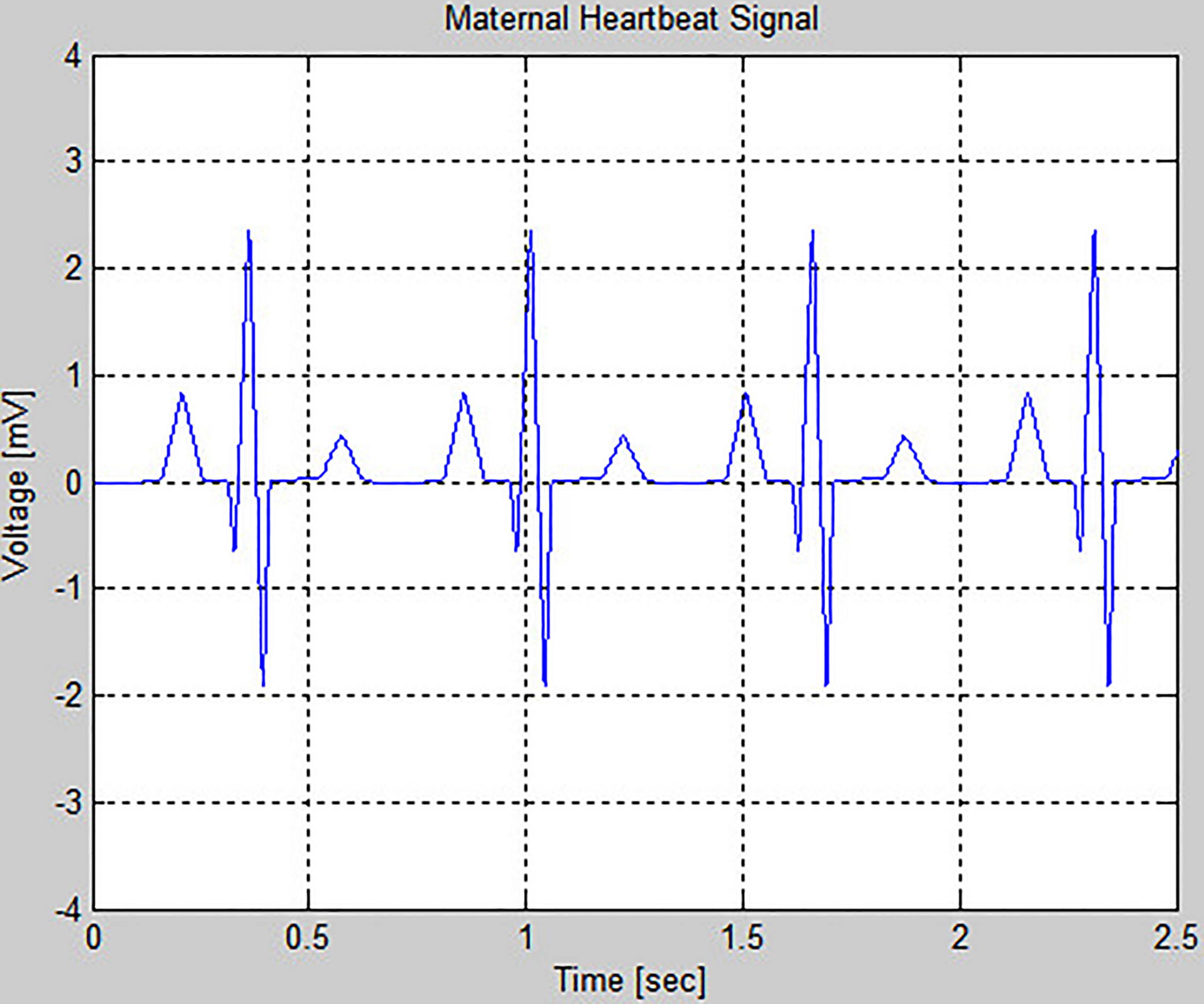
Capacity analysis of LDPC coded-APSK Modulated-DSTFC technique in CM3 and CM4 with 2 RX antennas.
Comparison of APSK system performance with QPSK and QAM.
The IEEE 802.15.3a UWB channel parameters that is used for the simulation is given below in Tables 1 [9] and 2.
Figure 2 shows the capacity analysis of LDPC coded-APSK Modulated-DSTFC technique in CM3 and CM4 with 1 & 2 RX antennas. It is observed that the maximum capacity can be achieved in LDPC coded-APSK Modulated-DSTFC technique in CM3 and CM4 with 2 RX antennas with less SNR of 2 dB when compared to LDPC coded-APSK Modulated-DSTFC technique in CM3 and CM4 with 0ne RX antenna.
Figure 3 shows the Probability Distribution Function (PDF) of the transmitted signal envelope for QAM, APSK and QPSK. As can be observed, the APSK envelope is more concentrated around the outer ring amplitude than QAM and QPSK. This shows that the selected constellation represents a good trade-off between QAM and QPSK, with error performance close to QAM and QPSK. Therefore, APSK is preferable to the rest of modulations considered. LDPC coded APSK modulated Pulsed-OFDM Ultra wideband MB-transceiver consumes less power compare to PSK and QAM.
Conclusions
The performance of UWB channel which sends the body parameters with high data rate is measured. The data was sent using LDPC coded APSK Modulated DSTFC MB-Pulsed-OFDM scheme. The proposed UWB communication for a WBAN scenario is compared to conventional QPSK & APSK system. The body parameters are received at high data rates in the frequency range between 3.1 GHz–10.4 GHz. The simulation results show that the proposed system performs better than the existing system with 1 dB improvement in SNR.
The complexity of the existing system is reduced by using pulsed-OFDM modulation and LDPC coded APSK modulation techniques. The different types of parameters for body area networks are generated and the signals were analyzed with reference to the real time body parameters. The analysis was done with various measurements taken for different channel models and different data rates. The simulation results prove that the system consumes very less power using LDPC coded APSK modulated DSTFC MB-Pulsed-OFDM communication system.
Conflict of interest
None to report.