



Abstract
OBJECTIVE:
To investigate the association of single nucleotide polymorphisms (SNPs) of soluble low-density lipoprotein receptor 11 (sLR11) genes with type-2 diabetes mellitus (T2DM) and carotid atherosclerosis (CAS) in Korean and Han nationalities in the Yanbian area.
METHODS:
530 T2DM patients were divided into two groups according to the intima-media thickness (IMT) of the carotid artery: CAS group (
RESULTS:
1. Allele frequency and genotype frequency distribution results: Differences in genotype and allele frequency distribution between the CAS and NGT groups, the NCAS and NGT groups, and the CAS and NCAS groups were not statistically significant (
CONCLUSION:
This study is the first to determine that the sLR11 gene rs3824968 polymorphic of factor T may increase the risk of CAS in T2DM patients by regulating the concentration of LDL-C, showing the dominant mode of inheritance.
Introduction
The main pathological change of diabetic macrovascular disease is atherosclerosis (AS), and the mechanism involves the induction of smooth muscle cell proliferation, thickening of the arterial wall, atherosclerotic plaque formation and vascular calcification [1]. In the formation of AS, the migration of vascular smooth muscle cells (SMCs) from the media to the intima is a critical step [2]. In 1996, Yamazaki et al. [3] first discovered that low density lipoprotein receptor (LDLR) relative with 11 ligand-binding repeats (LR11) detected by immunological methods in serum is a member of the LDLR family. Furthermore, it was also observed that LR11 was highly expressed on the intima of SMCs, which was followed by medial SMCs near the intimal boundary of the AS lesion [4]. Subsequently, they found that the serum concentration of soluble LDLR relative with soluble LR11 (sLR11) was positively correlated carotid artery intima-media thickness (IMT) in patients with dyslipidemia. Furthermore, multivariate regression analysis revealed that sLR11 levels served as a new quantitative circulatory marker of IMT, and was independent of the classic risk factors for AS [5]. A recent study revealed that sLR11 levels are positively correlated with IMT in middle-aged and non-obese type-2 diabetes mellitus (T2DM) patients. At present, the association of sLR11 gene polymorphism with T2DM and carotid atherosclerosis (CAS) has not been reported in any study worldwide. However, the analysis of single nucleotide polymorphism (SNPs) of the sLR11 gene has been used in studies on the pathogenesis of Alzheimer’s disease (AD). Studies have revealed that the gene polymorphism of apolipoprotein E (APOE) was closely related to T2DM and AD [7, 8, 9, 10]. We inferred that T2DM and AD may have a similar etiology. Therefore, in this study, the positive motif rs3824968 related to AD [11] was selected to investigate the association of the rs3824968 polymorphism of the sLR11 gene with T2DM and CAS in Korean and Han nationalities in the Yanbian area, and provide a genetics theoretical basis for the effective prevention and treatment of AS in diabetes patients.
Subjects and methods
Subjects
The T2DM group: A total of 530 patients with T2DM were enrolled into this study and divided into two groups: CAS group (
Methods
General information of subjects
Gender, age, course of disease, blood pressure, body mass index (BMI) were recorded from all subjects; and fasting blood glucose (FBG), 2-hour postprandial blood glucose, glycated hemoglobin (HbA1c), total cholesterol (CHO), triglyceride (TG), high density lipoprotein (HDL) and low density lipoprotein (LDL) were detected. The ACUSON-128 probe (frequency: 7.5 MHz) was used to determine IMT at the site 1 cm under the enlargement of the common carotid artery, where the thickness of the thickest site and two sites 1 cm from the thickest site in the lengths near and beyond the heart were measured. A total of six sites on the left and right sides were measured, and the average value was defined as the IMT value. In order to ensure the stability of the IMT values, all operations were conducted by the same personnel.
Fasting peripheral venous blood was withdrawn in the early morning for detection of the following biochemical indexes: high-density lipoprotein cholesterol (HDL-C), low density lipoprotein cholesterol (LDL-C), CHO, TG and HbA1c. Then, 0.5 mL of whole blood was placed in an anticoagulant tube containing ethylenediaminetetraacetic acid disodium salt (EDTA-Na
Primers and probes: PCR primers and LDR probe sequences are shown in Table 1
Primer probe sequence
Primer probe sequence
Step 1: Multiple cycles of polymerase chain reaction (PCR) amplification was performed in a 20-
Statistical analysis
Allele frequency, genotype frequency and Hardy-Weinberg genetic equilibrium tests were performed using the SHEsis online software (
Results
Detection by 3% agarose gel electrophoresis
Detection by 3% agarose gel electrophoresis was performed. The PCR products were observed to determine the amount that would be added to LDR as a template.
Electrophoretogram of PCR products. The markers were 100, 200, 300, 400 and 500, respectively. The size of the destination fragment is: 151 bp.
Genemapper analysis result.
Results are shown in Fig. 1. The main purpose of this experiment was to determine whether the PCR was successful. It cannot be observed by electrophoresis whether each site is normal.
151 bp PCR product of sLR11 gene polymorphism (rs3824968).
Genemapper 4.0 analysis results are shown in Fig. 2, that the rs3824968 was divided into AA, AT and TT genotypes. And the results of the whole blood genome sequencing are shown in Fig. 3, peaks demonstrated SNP homozygous AA (Fig. 3A), heterozygous AT (Fig. 3B) and homozygous TT (Fig. 3C) genotypes. These figures refer to the reverse complementary sequences. In Fig. 3A, the arrow points to a map of the homozygous AA genotype sequence with the base T as a single peak. In Fig. 3B, the arrow points to two A/T peaks, and represents the map of the heterozygous AT genotype sequence. In Fig. 3C, the arrow points to a single A peak, and represent the map of the homozygous TT genotype sequence. Genemapper analysis result and randomly selected sample sequencing results completely match,accuracy rate is 100%.
A: Sequencing graph of homozygote AA; B Sequencing graph of heterozygote AT; C: Sequencing graph of homozygote TT. The Genemapper analysis result and randomly selected sample sequencing results completely match. The accuracy rate is 100%.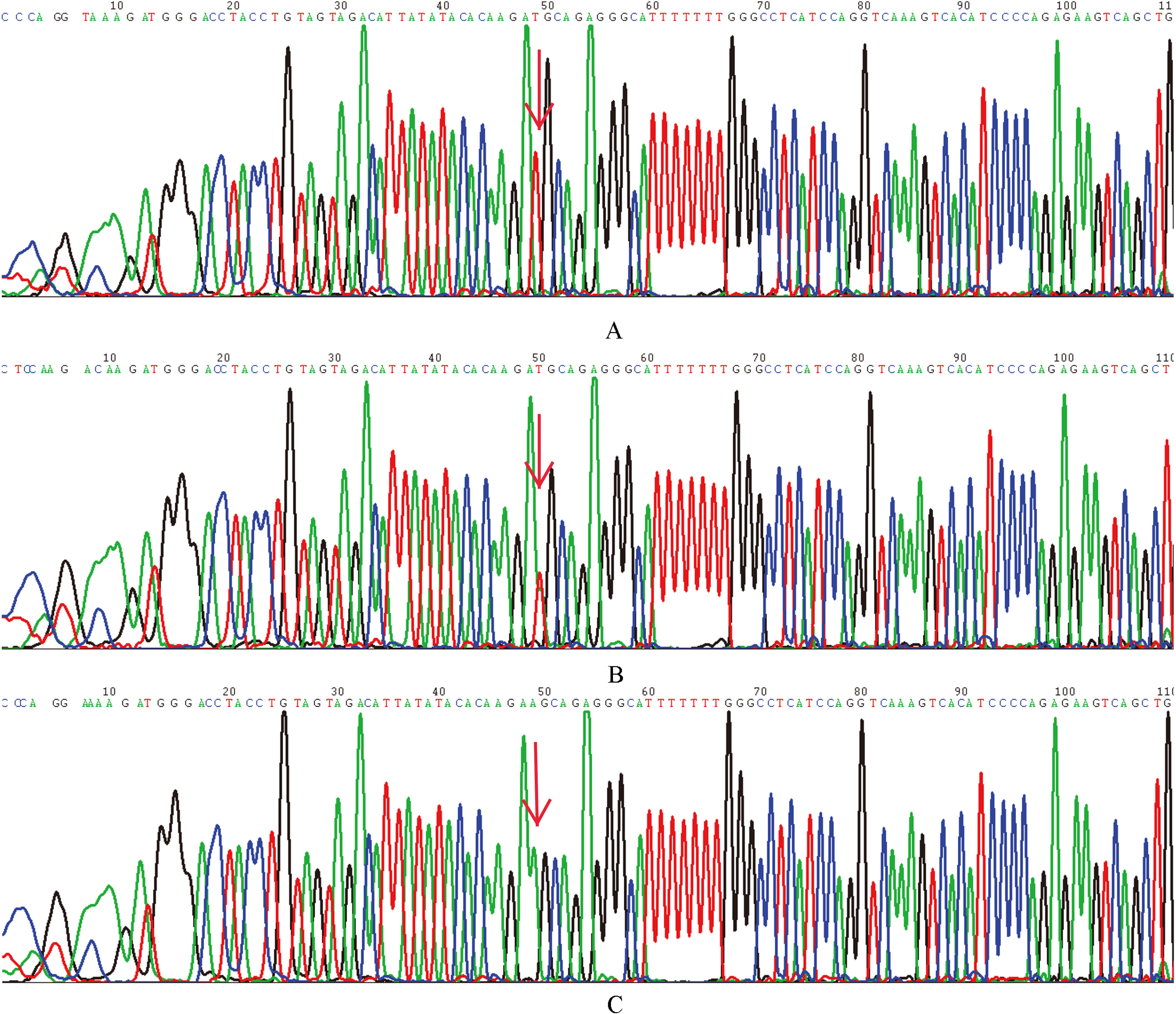
Comparison of the rs3824968 polymorphism genotype of the sLR11 gene and allele frequency distribution
In the Yanbian area, the differences in genotype and allele frequency distribution between the CAS and NGT groups, the NCAS and NGT groups, and the CAS and NCAS groups were not statistically significant (
sLR11 gene rs3824968 allele and genotype frequency distribution in NGT, NCAS, and CAS groups [n(%)]
sLR11 gene rs3824968 allele and genotype frequency distribution in NGT, NCAS, and CAS groups [n(%)]
Genotype and allele frequency distribution were not statistically different between the CAS group and NGT group, NCAS group and NGT group, and CAS group and NCAS group,
Distribution under different models of sLR11 gene rs3824968 genotype frequency[n(%)]
There was no significant difference in genotype frequency distribution among the three groups,
Allele and genotype distribution in Korean and Han of sLR11 gene rs3824968 allele and genotype frequency in the CAS group, NCAS group and NGT group
Allele and genotype frequency distribution in Korean and Han of three groups have no significant different,
The regression coefficients of LDL-C and TG were 0.451 and 0.135, respectively, regression coefficient was positively correlated with CAS. From the foregoing, LDL-C and TG are risk factors for CAS (Table 5).
Logistic stepwise regression analysis of risk factors for carotid atherosclerosis
Logistic stepwise regression analysis of risk factors for carotid atherosclerosis
The CHO level order was AT group
Comparison of clinical data of different genotypes in the CAS group
Comparison of clinical data of different genotypes in the CAS group
TG, HDL-C, HDL-C taking logarithm;
Comparison of LDL-C of different models in the CAS group
AA group and AT
Diabetes mellitus is a common metabolic disease characterized by hyperglycemia. The risk of cardiovascular disease in patients with diabetes mellitus is 2–4 times of that in normal subjects. The main pathological change of macrovascular disease in patients with T2DM is AS. IMT thickening occurs earlier than AS. IMT is an early quantitative clinical marker of AS in patients with diabetes mellitus. A study revealed that the LR11 (SORL1) gene is located on chromosome 11 (11q24.1), and is the same gene as the sorLA gene in brain, which is consists of 177,491 base containing 51 exons. Studies have confirmed that as a novel circulatory marker for IMT risk of carotid artery, the level of serum sLR11 was correlated with carotid artery ITM thickening and plaque formation, acute coronary syndrome and diabetic retinopathy in T2DM patients [12, 13, 14, 15]. Most experiments have revealed that sLR11 gene polymorphism is associated with the pathogenesis of AD. According to statistical data, approximately 65% of patients with diabetes mellitus have mild-moderate cognitive impairment [16, 17]. The risk of AD in patients with diabetes mellitus is higher than in the normal population. Studies have revealed that in patients with diabetes mellitus and AD, atrophy of the hippocampus and amygdala could be observed by MRI [18, 19]. Therefore, T2DM may be related to the occurrence and development of AD. A study in China revealed that the level of plasma cholesterol was significantly higher in individuals carrying the ApoE
This experiment revealed that a single-base mutation A
The sLR11 gene polymorphism is affected by genetic heterogeneity. A large number of experiments revealed that sLR11 gene variation is associated with the risk of AD in different ethnic populations. At present, the study subjects are mainly European, Hispanic, African American, Japanese, Israeli Arab and Chinese Han nationality populations. At present, there is still a lack of reports on ethnic differences in sLR11 gene polymorphism among the ethnic minorities in china. In the present study, the genotype and allele frequency distribution of the Korean and Han nationality populations in the Yanbian area were selected and compared. Results revealed that the difference in sLR11 gene rs3824968 polymorphism in the NGT, NCAS and CAS groups between Korean and Han nationalities was not statistically significant. The reason may be related to the small sample size.
At present, it is considered that diabetic hyperglycemia may directly induce the expression of sLR11, and the phenotype of smooth muscle cells in the vascular wall is transformed into the so-called synthetic type. These possibilities are currently being studied [20]. This study revealed that LDL-C and TG are risk factors for CAS. This is consistent with the results of other studies, in which serum sLR11 level was positively correlated with LDL-C and HbA1c [21], and that serum sLR11 level was correlated to the formation of AS [6]. Recent studies have revealed that the deposition of cholesterol and other lipids in the blood vessel wall plays a decisive role in the early formation of AS. These lipid settlings are mainly derived from lipoproteins in the blood, especially from LDL [22]. The concentration of LDL on the surface of the inner wall of blood vessels is proportional to the lipoprotein entering the vessel wall. With the increase in TG and LDL levels, arterial intima thickening and elasticity decrease has become more significant. The present study revealed that in the CAS group, the level order of LDL-C closely correlated to CAS was TT group
In this experiment, no direct risk factors for T2DM were found. However, this study is the first to determine that the sLR11 gene rs3824968 polymorphic of factor T may increase the risk of CAS in T2DM patients by regulating the concentration of LDL-C, showing the dominant mode of inheritance. This would provide some direction and basis for research work in the future.
Footnotes
Acknowledgments
The study was supported by grants from the National Natural Science Foundation of China (no. 81060067 and no. 81460158 (Study on relationship of genetic susceptibility and machanism of ARL15 associated with type 2 diabetes mellitus with macroangiophy). The author is Kang-Juan Yang).
Conflict of interest
None to report.