



Abstract
BACKGROUND:
Repeated mild traumatic brain injury (mTBI) has been associated with increased risk of degenerative neurological disorders. While the effects of mTBI and repeated injury are known, studies have only recently started examining repeated subconcussive impacts, impacts that do not result in a clinically diagnosed mTBI. In these studies, repeated subconcussive impacts have been connected to cognitive performance and brain imaging changes.
OBJECTIVE:
Recent research suggests that performance on a visuomotor tracking (VMT) task may help improve the identification of mTBI. The goal of this study was to investigate if VMT performance is sensitive to the cumulative effect of repeated subconcussive head impacts in collegiate men’s lacrosse players.
METHODS:
A cross-sectional, prospective study was completed with eleven collegiate men’s lacrosse players. Participants wore helmet-mounted sensors and completed VMT and reaction time assessments. The relationship between cumulative impact metrics and VMT metrics were investigated.
RESULTS:
In this study, VMT performance correlated with repeated subconcussive head impacts; individuals approached clinically diagnosed mTBI-like performance as the cumulative rotational velocity they experienced increased.
CONCLUSION:
This suggests that repeated subconcussive impacts can result in measurable impairments and indicates that visuomotor tracking performance may be a useful tool for monitoring the effects of repeated subconcussive impacts.
Introduction
Mild traumatic brain injury (mTBI) can result from a variety of insults such as impacts to the skull, rapid acceleration of the head, or exposure to blast overpressure. The negative consequences of repeated clinically-diagnosed mTBIs are well established, including increased risk of post-concussive syndrome and second impact syndrome [1]. Additionally, repeated mTBI is associated with an increased risk of negative long-term consequences such as degenerative neurological disorders and chronic traumatic encephalopathy [2, 3].
Because of recent awareness of the potential long-term negative effects of mTBI, there is growing concern that subconcussive head impacts, impacts that do not result in a clinically diagnosed injury, may also result in long-term neurological damage and increased risk of neurodegenerative disorders [1]. Studies have used helmet-worn accelerometers to quantify mTBI related impacts experienced by individuals during practices and games, although the exact association between impact features and clinically diagnosed mTBI is still debated [4, 5]. Using these sensors, studies have also illuminated the extent of repeated subconcussive impacts during an athletic season [6, 7]. Recently, changes in brain activity and reduced cognitive test performance have been associated with repeated subconcussive impacts after a season of high school-level American football [8, 9, 10, 11]. Additionally, a linear relationship between a combined linear and rotational head acceleration metric and abnormal white matter integrity has been observed [8]. While the majority of research on subconcussive impacts has examined American football, cognitive deficits have also been observed in other sports such as high school soccer [12]. Although lacrosse has been identified as the male sport with the second highest incidence of clinically diagnosed mTBI [13], there is no data on the effect of repeated subconcussive impacts in this population.
mTBI is typically a diffuse injury and can result in a broad range of mild impairments in behavioral, cognitive, sensory, and motor function. The variety of potential impairments after mTBI makes it difficult to identify and monitor symptoms. Clinical assessment questionnaires and imaging modalities frequently are unable to reliably detect mTBI [14]. As a result, a wide variety of assessment tools are being evaluated and used for mTBI detection and tracking.
Visuomotor tracking performance has shown promise as a potential diagnostic and monitoring tool for mTBI [15, 16]. Visuomotor tracking may be preferable for examining diffuse impairments because it simultaneously evaluates many potentially impaired processes, such as attention, spatial processing, reaction time, and fine motor performance. In previous work, we asked participants, half with clinically diagnosed mTBI, to perform a visuomotor tracking task; participants squeezed a hand dynamometer and varied their grip force to match an unpredictable target force [17]. We quantified participants’ feedback response – how participants changed their grip force in response to errors in position and velocity – and demonstrated that model parameters had better diagnostic accuracy than conventional assessment tools also evaluated, suggesting that visuomotor tracking performance could serve as a rapid evaluation for diagnosing mTBI. These same parameters were sensitive to time post injury, suggesting the system could have sufficient resolution to track recovery and monitor the effects of repeated subconcussive impacts. The purpose of this study was to investigate if the same visuomotor tracking task was sensitive to potential cumulative effects of subconcussive head impacts in male collegiate lacrosse players.
Materials and methods
The protocol was reviewed and approved by the Towson University Institutional Review Board (15-A058). Eleven male lacrosse players (age 20.44
Visuomotor tracking and reaction time metrics were collected approximately two months into the lacrosse season (main evaluation). Follow-up evaluations were completed 2 and 4 weeks after the initial evaluation to examine changes in performance (the first and second follow-up evaluations respectively). Due to scheduling conflicts one participant did not complete the main evaluation and a different participant did not complete the second follow-up evaluation. No concussions were diagnosed during the lacrosse season for study participants.
A computer-based system was used to collect visuomotor tracking and reaction time data. The device was composed of a hand dynamometer (G100, Biometrics Ltd.), a data acquisition device (USB-6009, National Instruments), and a laptop computer. During the visuomotor tracking task, participants were asked to modulate their grip force, as measured by the dynamometer, to match a variable target force, displayed visually on a computer screen. Figure 1A shows an individual performing the tracking task. Participants control the height of the vertical bar by squeezing the dynamometer. The horizontal line is the target and moves up and down on the screen in a smooth but unpredictable manner. The range of the target force was set to between 2 and 8% of the participant’s sex and age-based maximum grip force [18] to minimize fatigue effects. The target force was the same for all participants in this study and ranged from 0.9 to 3.8 kg (2.0 to 8.3 lbs).
A. The participant squeezes a hand dynamometer to control the height of a vertical bar on the screen to track the horizontal bar, which moves up and down unpredictably. B. An example of data collected during the task.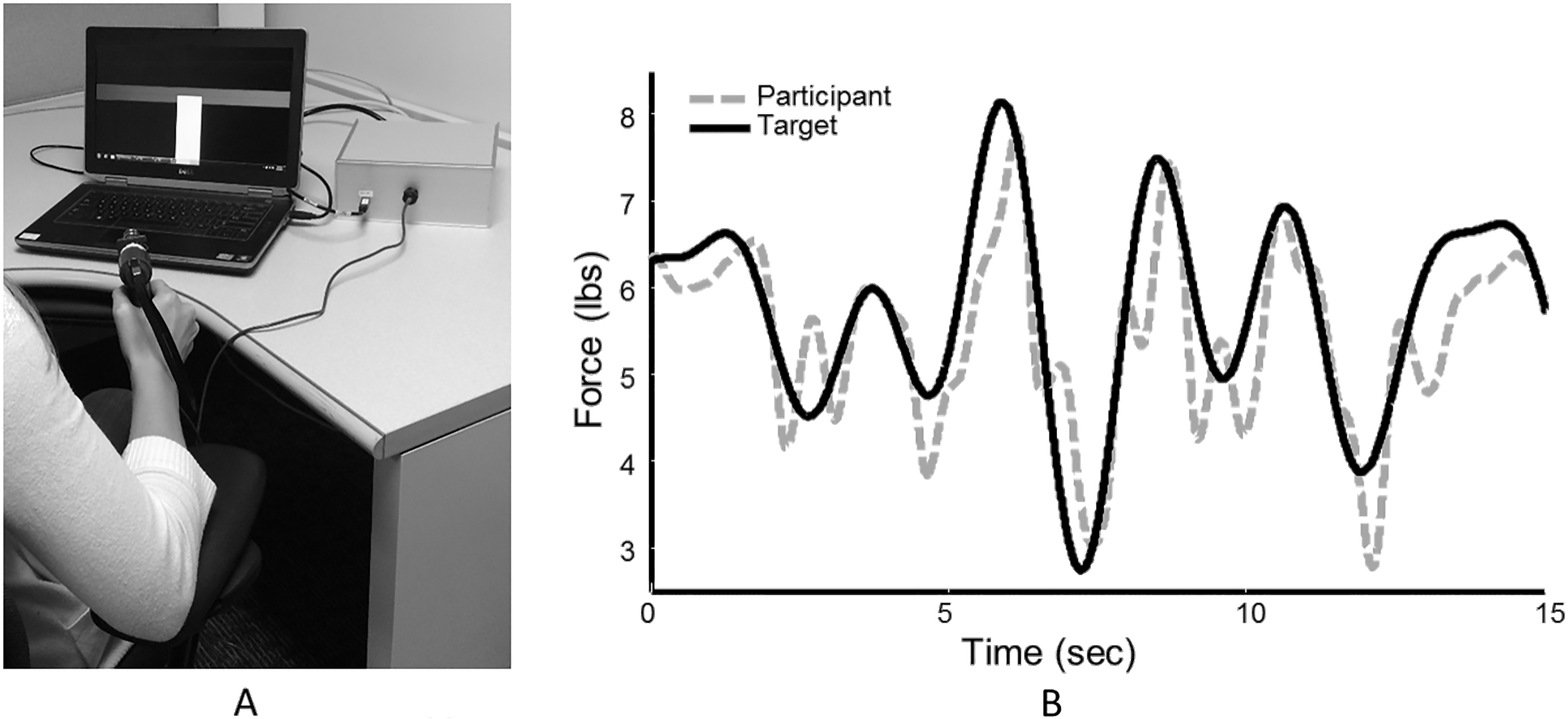
Prior to the task, participants were given 30 s of practice without the unpredictable target force present. Participants were asked to squeeze the dynamometer at 2, 5, and 8% of the participant’s gender and age-based maximum grip force, corresponding to the bottom, middle, and top of the screen respectively. Participants were then asked to track the unpredictable target for 3 minutes.
Custom software (MATLAB) was used to collect force data and display grip force and target force levels. Data were collected at 1000 Hz. Figure 1B shows an example of 15 seconds of visuomotor tracking data.
Participants also completed a 20 repetition reaction time test using the dynamometer, squeezing it as quickly as possible when a line appeared on the screen. The participant then relaxed their grip until the line appeared again.
Back of a men’s lacrosse helmet and a GForceTracker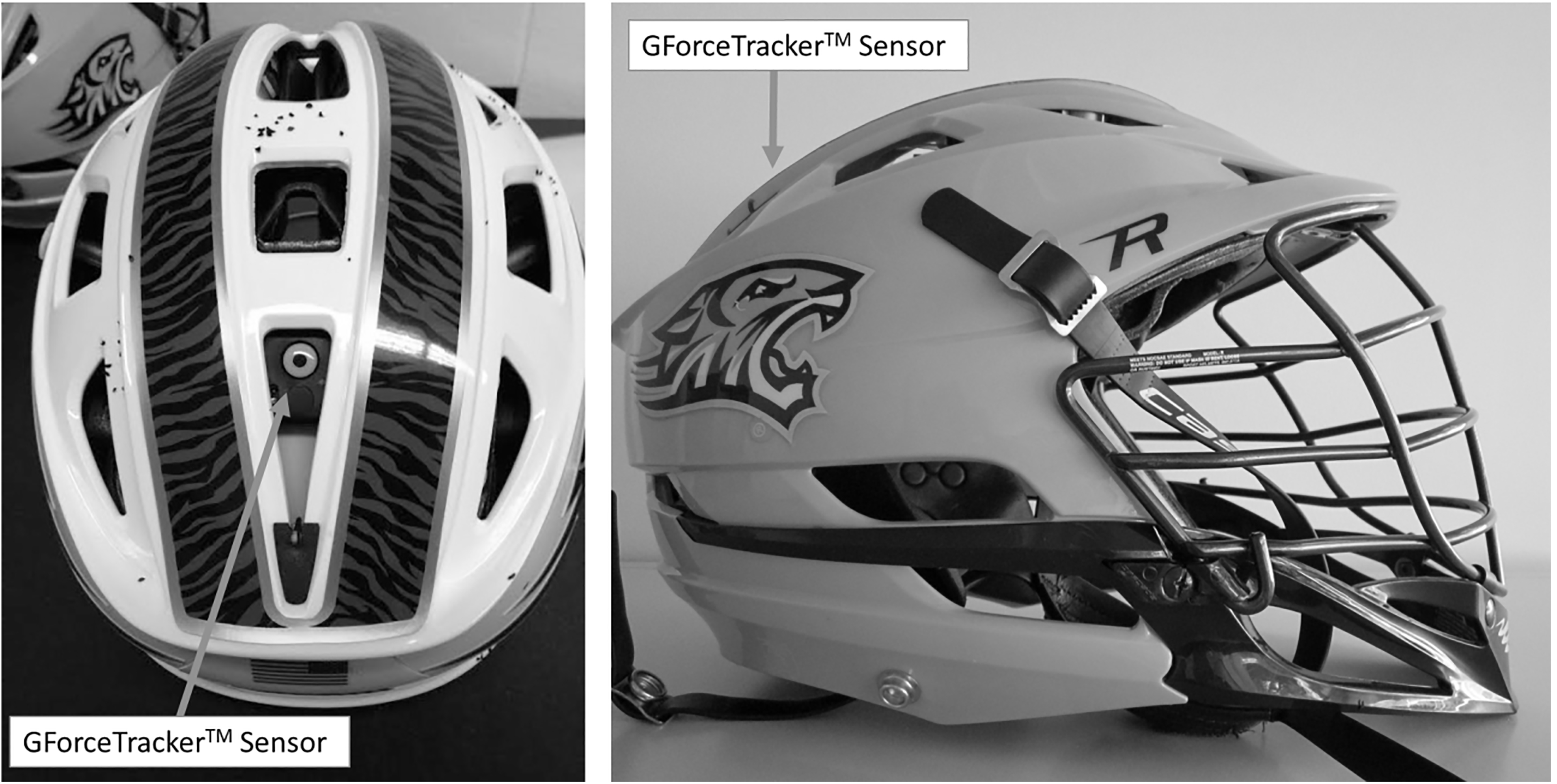
Each player was fitted with Cascade R helmets (Cascade, Liverpool, NY), according to manufacturer’s directions at the beginning of the season. The participants wore helmet-mounted GForceTracker
All data analyses were performed using MATLAB and SPSS.
A wide variety of head impact thresholds have been used with no clear consensus on what impact features cause brain injury [4, 5]. We used impacts with a linear acceleration magnitude greater than 80 g (a commonly used threshold in football impact research of concussive and subconcussive impacts [23, 24, 25]) to focus on higher magnitude subconcussive impacts that were more likely to result in injury. Additionally, head impact data artifacts are common and focusing on higher linear acceleration impacts significantly increases sensor accuracy [7]. Sensor artifacts, impacts with a high linear acceleration and low time duration, were further excluded by limiting our analysis to impacts with HIC
For each participant, the cumulative effect of all impacts was quantified by the sum, across all impacts received, of maximum linear acceleration magnitude, rotational velocity magnitude, HIC
Visuomotor tracking and reaction time performance analysis
We quantified each participant’s error correction strategy while performing the visuomotor tracking task using a previously developed model of feedback control [17], which provides information about how each participant tracks the position and velocity of the target over time. Briefly, the model utilizes three parameters to describe a participant’s feedback response – how each participant used errors in position and velocity at time t to update their grip force at time
Commonly calculated error-based metrics were extracted for each participant including: the mean tracking error (kg), the average absolute difference between a participant’s grip force and the target grip force; the standard deviation of the tracking error (kg); the mean velocity error (kg/s); and standard deviation of the velocity error (kg/s). The first 10 seconds of data were removed prior to analysis to reduce the effects of task acclimation. For the reaction time task, mean reaction time and reaction time variability were calculated across all reaction time trials.
Relationship between head impacts and visuomotor tracking and reaction time performance
The primary outcome measure of this study was the relationship between visuomotor tracking model-based parameters (
Change in performance metrics over time
A secondary goal of this study was to evaluate the change in performance over time. Changes in visuomotor tracking and reaction time performance were evaluated 2 and 4 weeks after the main evaluation using repeated measures analysis of variance (ANOVA). Where significant group changes were observed, a series of paired t-tests were used to investigate the changes, and the correlation between the participants’ change in performance metrics and impact metrics was evaluated.
Results
Prior to the main evaluation, participants received an average of 8.2
Main evaluation: Cumulative effect of subconcussive head impacts
We examined the relationship between cumulative head impacts and visuomotor tracking and reaction time metrics. We found a significant correlation between the cumulative rotational velocity magnitude and
Relationship between the cumulative rotational velocity of the head impacts received and 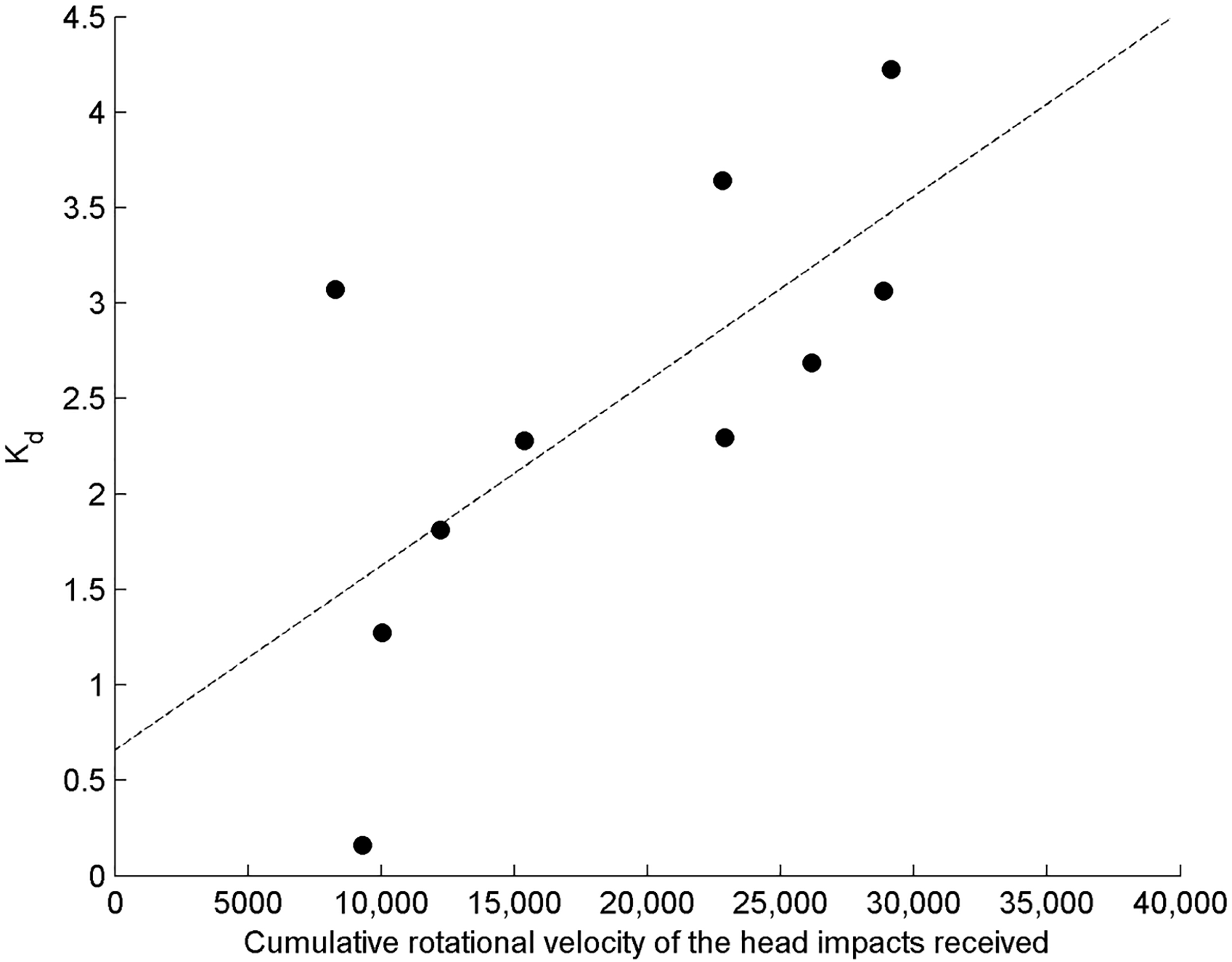
Although previous research has suggested that error-based visuomotor tracking metrics have limited resolution of mild brain injury [17], for completeness, the same evaluation was completed for the error-based visuomotor tracking metrics (absolute value of the positional tracking error, standard deviation of the positional error, absolute value of the velocity tracking error, and standard deviation of the velocity error) and reaction time. No significant correlations to the cumulative impact metrics were observed (
We also evaluated changes in visuomotor tracking and reaction time performance 2 and 4 weeks (first and second follow-up evaluation) after the main evaluation to quantify the effect of additional impacts. Changes in performance metrics are shown in Table 1. Between the main evaluation and the first follow-up evaluation, each participant received an average of 1.45
Average performance metrics and changes over time
Average performance metrics and changes over time
Between the first and second follow-up evaluation, each participant received an average of 1.45
Four participants received no impacts that met the inclusion threshold between the main evaluation and the first follow-up; five participants received no impacts that met the inclusion threshold between the first and the second follow-up evaluation. However, these participants showed no trends in visuomotor tracking (error and model-based) and reaction time metrics (
While acute impairments due to subconcussive impacts have not been established [27, 28], there is growing evidence that repeated subconcussive impacts in American Football result in significant impairments [8, 9, 10, 11]. This study provides further support to this research and suggests that the men’s lacrosse population is also affected. We found that the cumulative rotational velocity (from impacts with linear acceleration
No clinically diagnosed mTBIs were reported during the study period despite the high linear acceleration and rotational velocities observed. Although studies have been unable to consistently associate impact features with mTBI diagnosis [4], some impacts were greater than values associated with mTBI diagnosis in American Football studies [29, 30]. This could potentially be due to differences in impact features, such as impact duration or location, or other differences between American football and lacrosse play. Interestingly, our results suggest that repeated subconcussive head impacts may accumulate to mTBI-like performance in men’s lacrosse players. As shown in Fig. 3, individuals with large cumulative rotational velocity exposure approached a previously established mTBI diagnostic threshold of 4.1 for
While error-based metrics decreased significantly between the main evaluation and the first follow- up evaluation, the correlation with the impact metrics was not significant, suggesting that changes in the error-based metric were due to learning rather than recovery. Learning effects are a common concern with mTBI assessment tools that leverage unfamiliar tasks, such as the King-Devick [31] and the Balance Error Scoring System (BESS) [32], and can limit utility for monitoring recovery from mTBI. Other researchers have used error-based visuomotor tracking metrics to identify impairment due to mTBI [16, 33]. Our finding suggests that learning effects will need to be investigated before error-based visuomotor tracking metrics can be used clinically. While it is possible to correct for learning effects, the fact that the
Reaction time is a commonly used conventional assessment for mTBI. mTBI results in increased reaction time [34] and is correlated with damage to white matter [14]. Research has also suggested that subconcussive impacts affect choice reaction time [35], although the sensitivity of reaction time metrics to subconcussive impacts has not been universally observed [27]. Our study used a simple reaction time assessment, which may have reduced resolution of subconcussive effects. Additionally, the use of the hand dynamometer may have increased performance variability, which would mask small changes in performance.
Limited data is available on recovery timelines for mTBI and there is currently no data on recovery from the effects of repeated subconcussive impacts. However, based on research showing significant visuospatial performance and cognitive function recovery within a week after mTBI [36, 37], we might expect to see improvements in visuomotor tracking and reaction time performance for participants that had no impacts meeting our inclusion criteria between evaluations. There are several possible reasons we did not observe recovery effects during the study. The relatively mild effects of repeated subconcussive injuries may require a longer recovery time, which is supported by research showing rapid acute recovery after mTBI and then slowed return to baseline [37]. Additionally, our study participants were not at rest between evaluations, which may have limited their ability to recover within the short time window.
The impact of this study is limited by the sample size, the lack of comparison to conventional assessment measures other than reaction time, and the relatively short observation period. The lack of a preseason baseline means it is not possible to establish a causal link between head impacts and visuomotor tracking performance. However, the homogeneity of the population in age, sex, education level, and high physical fitness status increases the likelihood that the correlation between the head impacts and task performance is clinically meaningful. In spite of these limitations, this research provides an important initial examination of the effect of repeated subconcussive impacts in a men’s lacrosse population.
This preliminary research suggests that cumulative repeated subconcussive head impacts during men’s lacrosse is associated with visuomotor tracking performance, approaching previously identified mTBI-like performance. The portability and short duration (3 minutes) of the visuomotor tracking task makes this result promising for future evaluation of not only acutely-observed high-severity impacts that might result in mTBI, but also cumulative repeated subconcussive impacts. Improved monitoring of mTBI, including injury due to repeated subconcussive impacts, could have major implications for informing removal and return to play decisions to reduce the likelihood of repeated head injuries and the incidence of associated increased risk of neurodegenerative disorders.
Footnotes
Conflict of interest
Two patents apply to portions of this work. Dr. Lum is an inventor on the visuomotor tracking task patent (PCT/US2013/058567) and Dr. Fine is an inventor of the processing algorithm used for data analysis (US Patent Application 14/483,741). There are no additional conflicts of interest.
Funding
This research was internally funded by the MITRE Corporation, which is a not-for-profit organization that operates federally funded research and development centers, and Towson University. The authors’ time was supported by their respective organizations.