



Abstract
BACKGROUND:
Polydimethylsiloxane (PDMS) is widely used in biomedical research and technology, but its mechanical properties should be tuned according to the desired product specifications. Mixing ratio of base polymer to curing agent or additives enables its mechanical properties to be manipulated and fit to mechanical properties of biological tissues.
OBJECTIVE:
In this paper, we analysed the effect of mechanical load on silk-reinforced PDMS depending on silk concentration.
METHODS:
We prepared cylinder-type PDMS samples with different silk concentrations and performed cyclic uniaxial compression tests with a fixed magnitude of applied strain. Next, we analysed the mechanical charascteristics of PDMS using computational modelling.
RESULTS:
The stress-strain data within the large-strain region of different PDMS cylinders without silk and with 1%, 5% and 10% silk concentrations was fitted to non-linear second order Mooney-Rivlin, and third-order Ogden models. The results show the equivalence of both models for investigated strain region of PDMS. On the other hand, PDMS cylinders with 10% silk concentration allowed the successful fitting of experimental data just for the second-order Mooney-Rivlin model, while all numerical probes to find an appropriate fitting parameters for third-order Ogden models were unsuccessful.
CONCLUSIONS:
The second-order Mooney-Rivlin model is preferable for analysing the properties of silk-reinforced PDMS over the entire measurement range.
Introduction
Polydimethylsiloxane (PDMS) is a silicone elastomer that is highly biocompatible, biostable and supports extracellular matrix deposition. Its suitability for microporous scaffold fabrication has been demonstrated [1, 2]. These characteristics together with its gas permeability, good optical transparency and low autofluorescence make PDMS an attractive candidate for tissue engineering applications as a scaffold material. However, tissues in the organism depending on their location are exposed to various mechanical forces such as compression, fluid shear stress, hydrostatic pressure, and stretching [3]. Numerous studies have demonstrated how scaffold mechanical properties affect cell adhesion, cytoskeletal arrangement, motility [4], proliferation [5], and differentiation [6].
PDMS resistance to mechanical loading such as pressure or external force is limited. On the other hand, mechanical properties of the elastomer can be optimised by varying curing temperature and mixing ratio or adding other materials. Young’s modulus, ultimate tensile strength, compressive modulus, ultimate compressive strength and hardness dependency on curing temperature were characterized by Johnston et al. [7]. To modulate PDMS properties, Quake and his colleagues proposed the structural bonding of relatively flexible vinyl PDMS and rigid Si-H PDMS [8]. Kim et al. used this method to demonstrate the possibility of fabricating many devices [9]. As a composite component to stabilize PDMS, silk fibroin, a natural biomaterial produced by silkworms and spiders, can be used. Because of its unique mechanical properties, biocompatibility and the ability to support cell differentiation, silk is favourable for a numerous tissue engineering applications, especially in bone tissue engineering [10, 11, 12]. Moreover, silk may be combined synergistically with other biomaterials to form composites of desired physical and biological features.
It is widely agreed that it is very difficult to predict and evaluate the nearly incompressible mechanical behaviour of PDMS structures [9]. Therefore, computational modelling is needed in order to understand and choose optimal mechanical properties for bioapplications [13, 14, 15, 16, 17, 18, 19, 20]. In this paper, we analyse the effect of mechanical load on silk-reinforced PDMS depending on silk concentration. The nonlinear material properties of PDMS were modelled using both the second-order Mooney-Rivlin and the third-order Ogden models.
Experimental methods
Silk-reinforced PDMS sample fabrication
The silk preparation procedure was adopted from the protocol developed by Rockwood et al. [21]. Silkworm (Bombyx mori) cocoons were fragmented using scissors and subsequently boiled for 1 h in a 0.02 M solution of
PDMS (Sylgard 184, Dow Corning) was thoroughly mixed with the proprietary thermoinitiator at a mass-to-mass ratio of 10:1. Silk was subsequently added to the mixture at 1%, 5%, or 10% mass ratio, and a pure PDMS-thermoinitiator mixture was used as the reference. The mixtures were poured into wells of 24-well polystyrene tissue culture plates (cylinders with diameters of 15.6 mm, heights of 17.8 mm, and volumes of approximately 3.4 mL) and left in a refrigerator (4
Experimental setup
The compression tests were performed using a Mecmesin MultiTest 2,5-i micro-compression machine (Mecmesin Limited., Slinfold, UK) in a Mecmesin AFG25 load cell with controlled load of measured accuracy
PDMS sample during the cyclic compression test.
The loading was controlled by measured the displacement until the maximum displacement value of
Different models of hyperelasticity
Each hyperelastic model defines its own energy deformation function with material constants that should be obtained by fitting experimental data with model curves. In essence, these are phenomenological models that treat the problem from the perspective of mechanical continuity and stress-deformation behaviour, ignoring the microscopic properties of the structure. However, if appropriate, the revised physics models should consider the characteristics of the microscopic properties. The following section presents a brief overview of hyperelastic models used in this study and an explanation of the algorithm that performs a nonlinear fit of the constants in the models.
Full polynomial model
The polynomial model for isotropic and compressible rubber is described as follows [22]:
Here,
This model was proposed in 1972 by Ogden [23] as a phenomenological model that was based on the use of principal stretches instead of invariants. The model can describe upturn (stiffening) of stress-strain curve and is accurate in models of rubber for large ranges of deformation. However, the use of this model is limited. (e.g. only when the tension is uniaxial).
where
The nonlinear curve fitting is based on finding one or more parameters of a model equation
where
The material constants
Preparation of silk-reinforced PDMS samples
Three samples were fabricated in each of the following categories: control PDMS samples without silk, samples with 1% silk, samples with 5% silk and samples with 10% silk (Fig. 2). The samples with silk tended to have air bubbles formed within the materials due to insufficient degassing as compared to pure PDMS, and this might have influenced the mechanical properties of the samples. In addition, the silk dispersed throughout the samples randomly, possibly yielding varying degrees of stiffness within and between the samples.
Pictures of PDMS samples with varying concentrations of silk.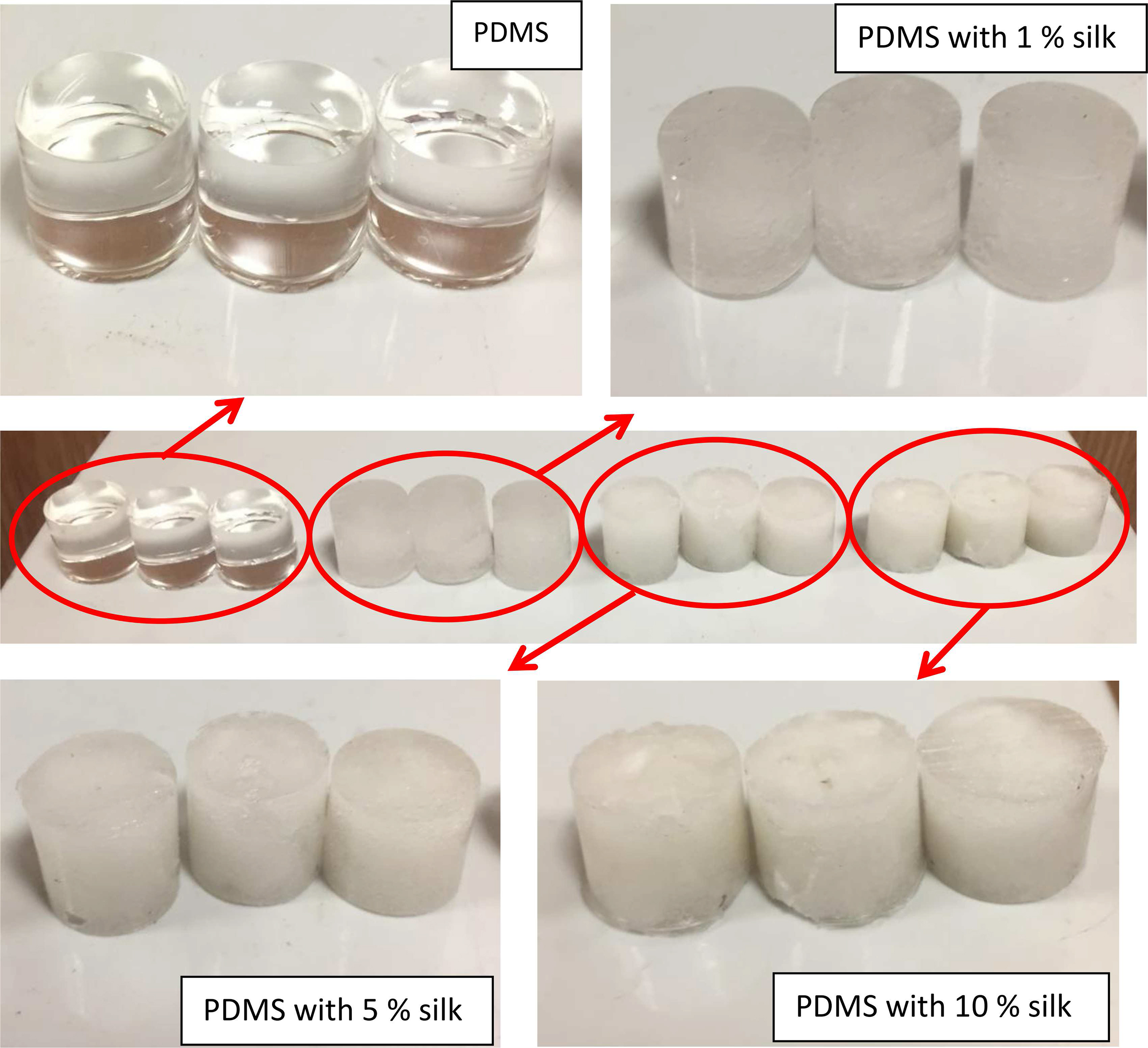
Compression tests were performed on all samples. The stress-strain curves averaged from measured displacement-load curves of different PDMS samples are shown in Fig. 3A–D. Hysteresis was observed during the cyclic loading and relaxing paths of the stress-strain curves. The results retain initial series measured within the limits of accuracy; therefore, fully nonlinear elasticity behaviour was observed during the experiment.
Experimental stress-strain relations. A – PDMS, B – PDMS 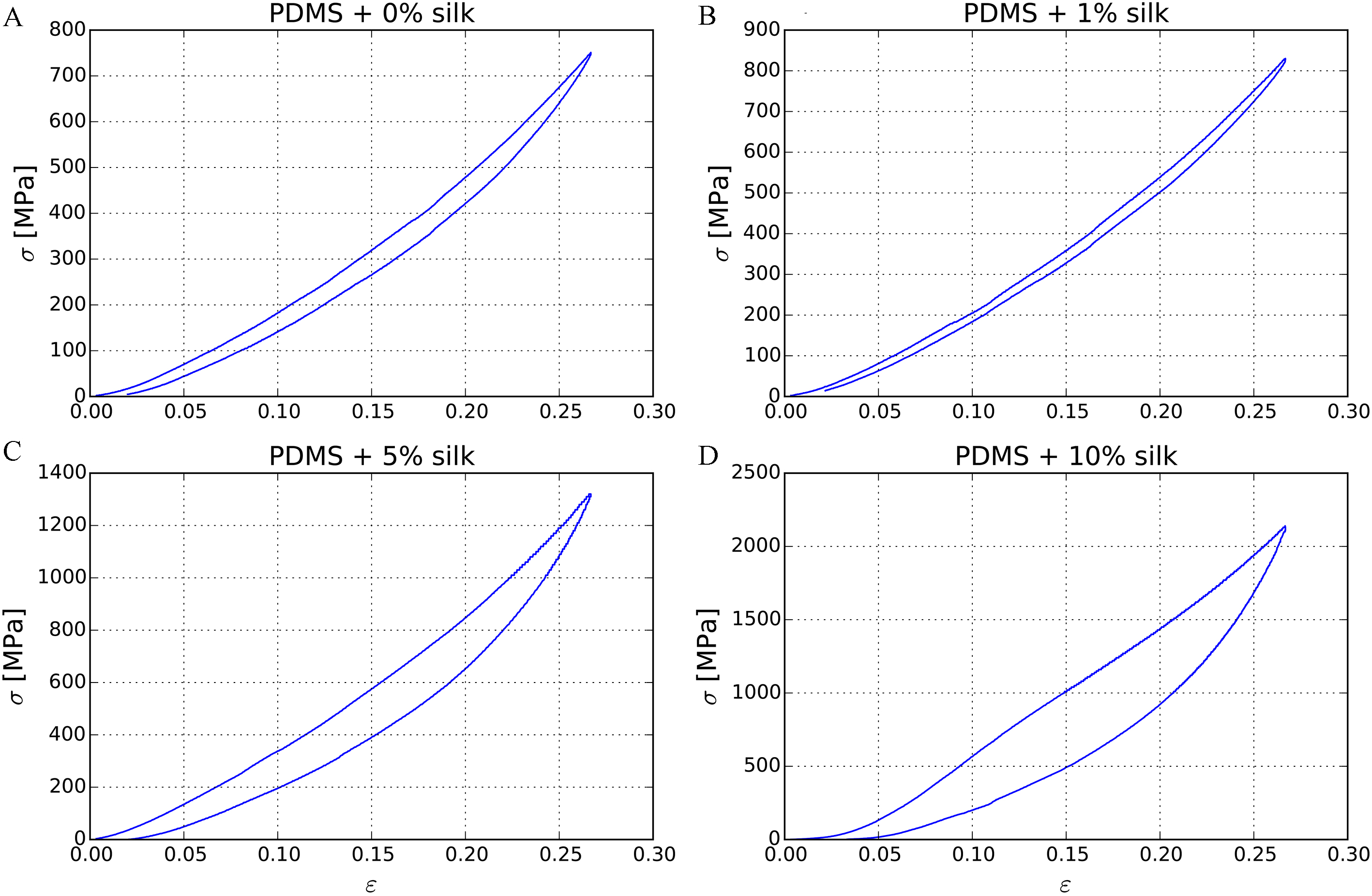
The results presented in Fig. 3 show that for PDMS with 10% silk, the maximum stress was 2144 MPa; for PDMS with 5% silk, the maximum stress was 1324 MPa; for PDMS with 1% silk, the maximum stress was 832 MPa; and in pure PDMS, the maximum stress was the smallest and equal to 752 MPa. The changes in
These results show that the mechanical properties of silk-reinforced PDMS can be controlled. The hysteresis can be reduced by changing the proportions of the composite components. These results provide a qualitative understanding of silk-reinforced PDMS.
The experimental data for the cyclic compression tests of PDMS with different silk concentrations were modelled (Fig. 3). Two different material models, Ogden and Polynomial, were examined. The quality of nonlinear fitting was measured by calculating the mean absolute percentage error (MAPE) as follows:
where
As shown in Fig. 4, MAPE ranges from 1.36% to 1.58% for the polynomial
Combined uncertainties of measured material properties in compression tests is expressed as follow
where
where
Material models of silk-reinforced PDMS samples and their corresponding material constants obtained from experiments
MAPE and RMSE for different materials.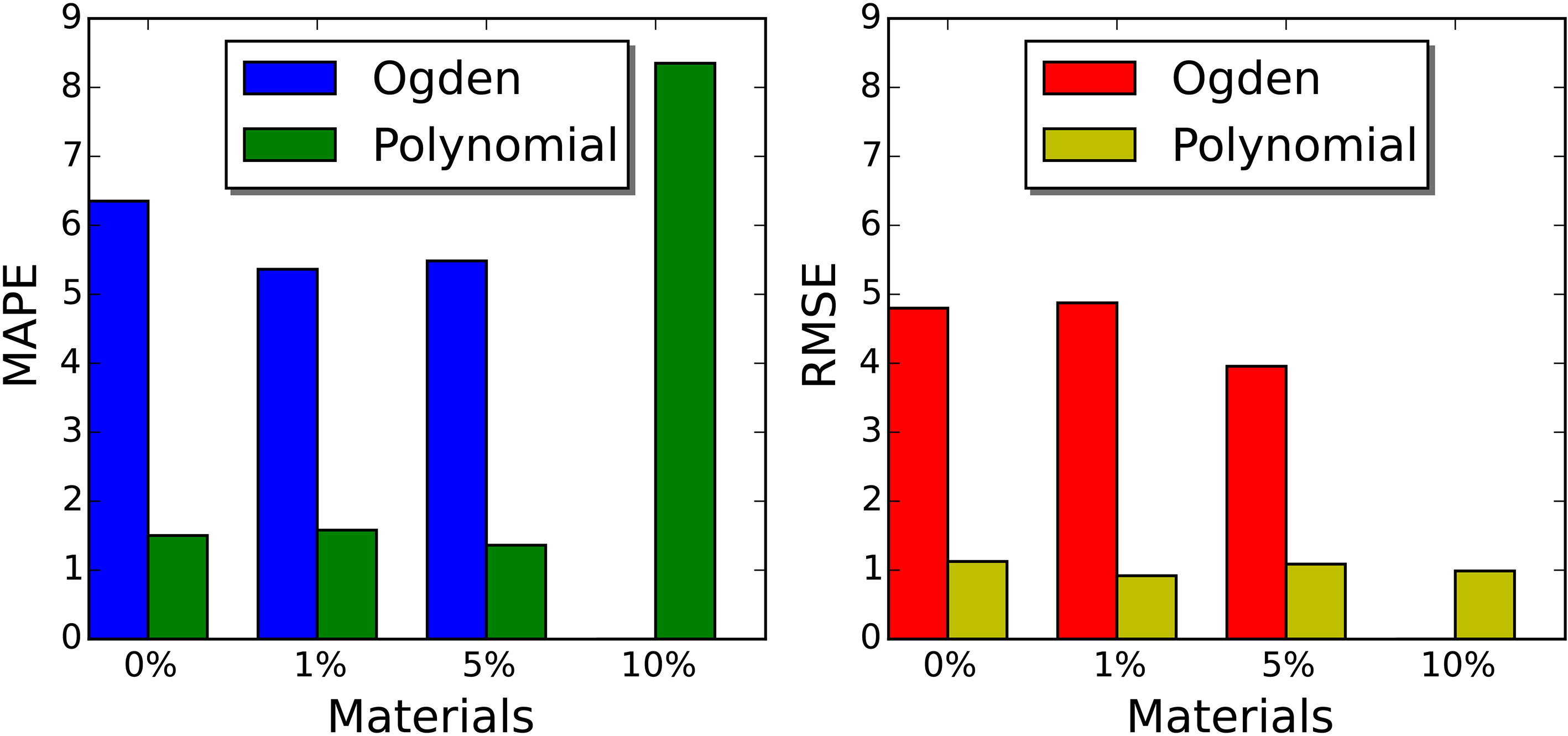
Figure 5 represents the nonlinear fitting results for silk-reinforced PDMS samples. Two material models, second-order Mooney and second-order Ogden models, were evaluated. Considering the number of coefficients (presented in Table 1) and calculation time required in finite element method simulations, both models are suitable for describing the small strain region of silk-reinforced PDMS. In the nonlinear and large strain region, the second-order Mooney-Rivlin model defined the mechanical behaviour of the silk-reinforced PDMS elastomer better than the second-order Ogden model. The silk-reinforced PDMS samples were too stiff or flexible in the measurement range for the second-order Ogden model. In particular, the nonlinear model of the second-order Mooney-Rivlin model matched the measured strain-stress curves for load regime in Fig. 3 well. Consequently, the second-order Mooney-Rivlin model is preferable to analyse silk-reinforced PDMS structures over the entire measurement range.
Comparison of Ogden and polynomial curves with experimental data. A – PDMS, B – PDMS 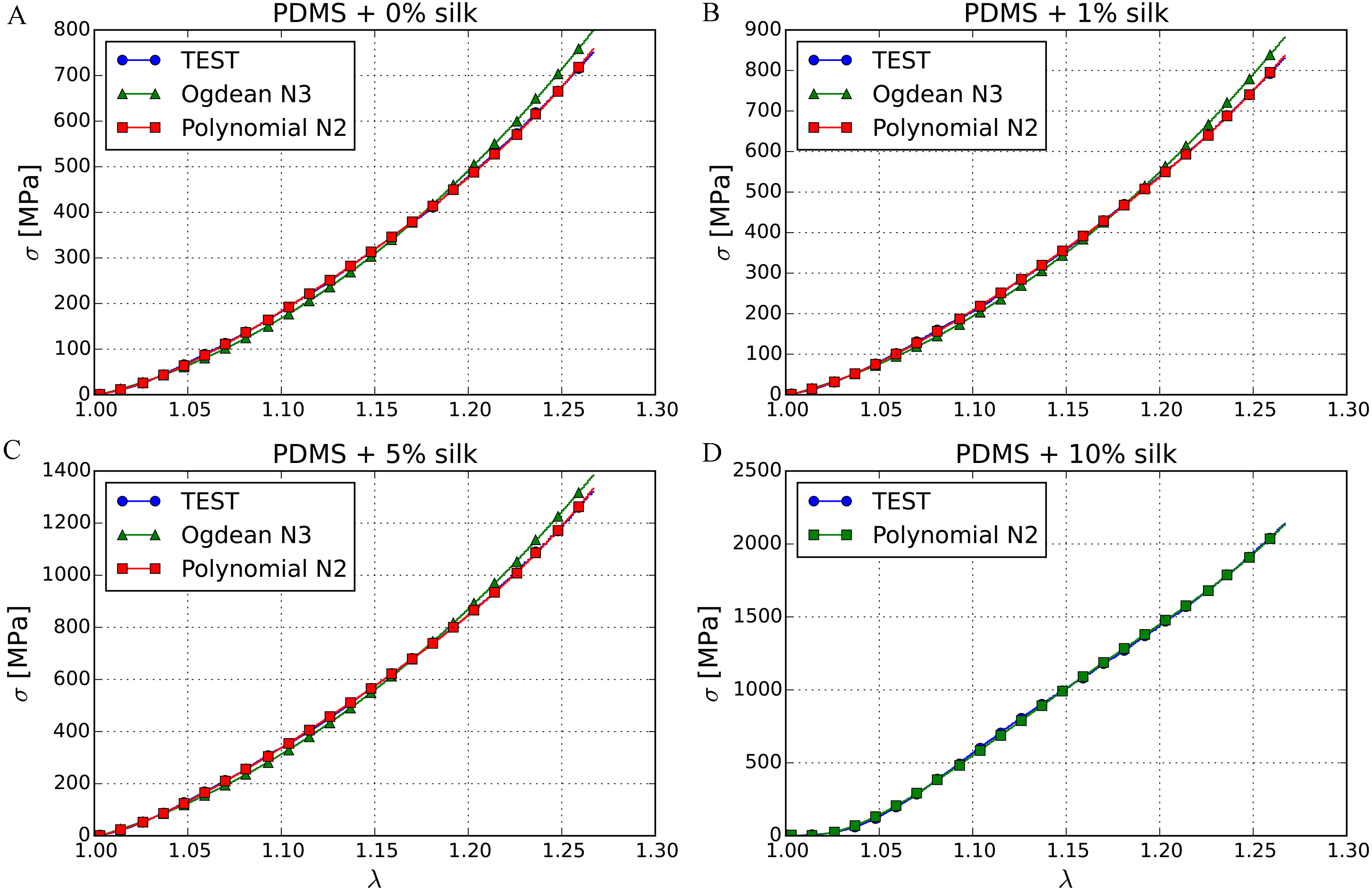
The nonlinear mechanical properties of silk-reinforced PDMS were obtained from a nonlinear fit of the experimental stress-strain curves of the silk-reinforced PDMS samples. The modelling results show that both the second-order Mooney-Rivlin model and the third-order Ogden model were suitable for the small strain region of silk-reinforced PDMS. However, in the nonlinear and large strain regions, only the second-order Mooney-Rivlin model characterized the mechanical behaviour of silk-reinforced PDMS. Because of stiffness and flexibility in the measurement range, the third-order Odgen model was not functional enough. Hence we may conclude that the second-order Mooney Rivlin model is preferable for modelling the nonlinear behaviour of silk-reinforced PDMS over the entire measurement range.
The results obtained in this work can serve as a basis in constructing silk-reinforced PDMS scaffolds for soft tissue engineering applications, where it is essential to finely tune the mechanical properties of the artificial cell niches to both integrate with the surrounding tissues and to guide cellular differentiation towards the desired lineages. Future work should be focussed on the investigation of cellular responses to such silk-reinforced materials.
Conclusions
PDMS-silk composites were prepared, and cyclic compression tests were performed. The materials showed varying degrees of hysteresis, with
Footnotes
Acknowledgments
This research was funded by a grant (No. SEN-13/2015) from the Research Council of Lithuania. E. B. would also like to acknowledge Dr. John G. Hardy from Lancaster University (Lancaster, United Kingdom) for generously providing the silk used in these experiments.
Conflict of interest
None to report.