



Abstract
BACKGROUND:
This study was planned to investigate the research trends related to naturally derived anti-inflammatory and anti-obesity components. The main purpose of this study was to find out and develop natural health cosmetic ingredients which has high effects on lipid degradation, moisturizing and elasticity enhancement.
OBJECTIVE:
We all hope this research provided systematic and practical data that can suggest an opportunity to further develop new products.
METHODS:
This is a descriptive research which classified the natural and traditional components that have important obesity management effects based on the experimental technique (in vitro and in vivo). we investigated the effects of 13 natural raw materials selected through preliminary investigation on lipid metabolism related enzyme activity. We first introduced Ainsliaea acerifolea, Onion, pear, Sanguisorba, Limonium tetragonum, Cornus walteri, Loquat, and Loquat-which have recently been shown to be effective in anti-obesity tests, and then described the research methods by showing the effects of onion extracts, Glasswort, Pine Cone (Korean white pine), Orostachys japonicus, African mangoes, Pepper, and Clathratum (sea weed), which actually had effects on anti-obesity in the in vivo experiment.
RESULTS:
As a result of investigating the effect of 13 natural raw materials selected through a preliminary investigation on lipid metabolism related enzyme activity, the study found nature-derived ingredients which induce anti-inflammatory and enhance the anti-obesity enzyme activity, and ingredients showing myriads of biological activities such as anti-oxidant, body fat reduction, lowering of blood cholesterol, and weight control.
CONCLUSION:
In this paper, we would like to delve into the possibility of using natural components with natural lipid-lowering effect, and systematically and practically study if they can actually be helpful to develop new cosmetic products.
Introduction
The artificial intelligence used in the present society has changed not only the culture but also the psychologic aspect of the human being, and now has reached to the unprecedented technological power for mankind. Such advancement is also reshaping the healthcare technology. The change is deemed mainly positive and auspicious. In the future, we expect that nano-robots will kill human pathogens and cancer cells by going inside the vessels of human body in the fourth industrial revolution era. But in spite of this, some health issues still remain challenging. The number of people who died from malnutrition was about 1 million, while the number of people who died from obesity was 3 million. Nowadays, obesity is being considered as a serious public health problem globally due to increased prevalence of obesity and overweight in developed and developing countries. No matter how much people believe in the future healthcare advancement, the Organization for Economic Cooperation and Development (OECD) predicted that the high obesity population would double in 2030 [1].
Obesity is the ongoing major challenge human healthcare must tackle, and with cost. The socioeconomic loss due to obesity has increased from 4.8 trillion won in 2006 to 9.2 trillion won in 2015, and the obesity rate of male children and adolescents is 26%; which is higher than the OECD average, 25.6%. This may also affect Korea since obesity, global health problem, is also becoming prevalent. According to the Ministry of Health and Welfare of Korea, the prevalence rate of obesity among Korean adults (over 19) increased 6.1% from 31.7% in 2007 to 34.8% in 2016. Among men, the rate increased 3.1% from 36.2% to 42.3%. For women, the rate didn’t show a meaningful change since it was 26.3% in 2007 and 26.4% in 2016. Based on the results of 2016, the prevalence rate of men was 1.6 times higher than that of women (Fig. 1).
Trends in prevalence of obesity among Korean adults (obesity rate), 2007–2016. From 2007 to 2016, age-standardized prevalence rate of obesity among Korean adults aged 19 years and over increased 6.1% from 31.7% to 34.8%. Among men, the rate increased 3.1% from 36.2% to 42.3%. For women, the rate remained more or less constant from 26.3% to 26.4%. Based on the 2016 data, the prevalence rate was 1.6-fold higher for men than women.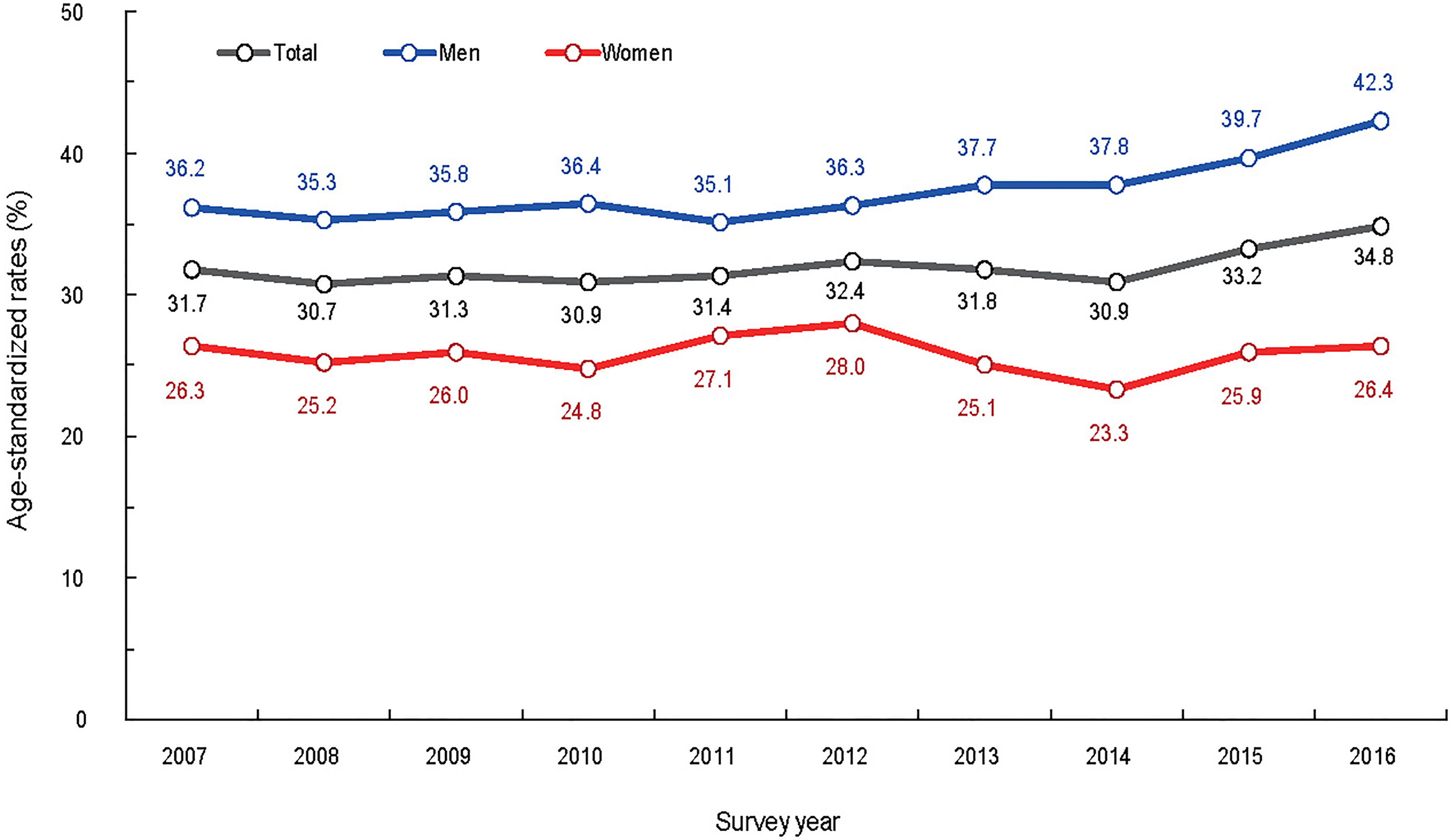
The seriousness of the issue called for the governmental intervention as a part of their public healthcare policy. The Ministry of Health and Welfare has opened the ‘National Health Promotion Policy Deliberation Committee’ and announced that the Ministry of Education and other related ministries have concluded ‘comprehensive measures for national obesity management (2018
With the obesity health problem constantly escalating, the World Health Organization (WHO) now classifies obesity as a disease and presents it as a major cause of cancer. Other than governmental healthcare policy, research has been also putting greater concern to overcome obesity related health issues. Although various studies are recently being conducted to develop drug treatments for obesity, it is known that the drugs developed so far have grave adverse effects such as headaches, insomnia, nervous anxiety, high blood pressure, abdominal pain, and increased defecation [3]. These drugs interfere with the absorption of vitamin K and thus cause adverse effects such as an anticoagulant effect of african mango extract, mouth dryness, sleep disturbances, anxiety, depression, and memory impairment. There have been various studies on functional food using natural ingredients, which have the health effect of preventing, and improving the self-obesity but not causing side effects, these side effects of drug treatment require development of new anti-obesity functional foods and medicines. However, the recently published report from the Ministry of Food and Drug Safety showed that 54 products (from 324 websites) from 146 konjac jelly products (from 1,185 websites) were displaying false excessive advertisements and content on 146 products containing konjac jelly. Among them, 200 cases (61.7%) were reported to demonstrate unproven efficacy and effectiveness in diet (weight loss). The exaggerated or falsifying advertisement can lead to misinformation causing public health problem or slowing of overcoming obesity as a whole. To prevent such problems, we proposed the names of the components and recommended daily requirements approved by Korean Food and Drug Administration, as shown in Table 1 [4]. Also, to provide aid in tackling obesity, and to give other researchers guidance as much as possible, we will investigate various naturally derived raw materials which are proved or anticipated to have anti-inflammation efficacy based on anti-obesity health effect. We all hope this research to be a systematic and practical data that can suggest possible opportunity for future healthcare product development, or health research.
Visceral fat reduction component
Nature-derived ingredients which have anti-inflammatory and anti-obesity effects
Anti-inflammatory drugs are classified into two groups; synthetic anti-inflammatory agents and natural anti-obesity agents. Anti-inflammatory agents are relatively expensive and inefficient than synthetic ones, but their development and processing are being actively pursued since the safety and production standards of synthetic anti-inflammatory agents are being constantly questioned. Some well-known examples of natural anti-inflammatory drugs are tocopherol, lecithin, cephalin, polyphenol, ascorbic acid and flavonoids [5], and from the result of recent research, we could found out that those elements are contained. We will investigate cellulite and obesity based on anti-inflammation. Obesity refers to the state of excess body fat accumulation due to the imbalance between energy intake and consumption. Obesity is known to be caused by a variety of causes including mental, genetic, and endocrine disorders, among which oxidative stress in the body is known to be a major cause of chronic diseases including obesity, diabetes, and cancer. Oxidative stress, one of the various factors of obesity, In addition to obesity, other health problems such as insulin resistance and hypertension are closely related to various chronic diseases. Generation of reactive oxygen species in the body’s energy production process is an indispensable factor. Normal production of reactive oxygen species is positively involved in the growth, proliferation and differentiation of normal cells. However, when the concentration of active oxygen is excessively increased, the antioxidant defense system in the body is destroyed, which causes oxidative stress in the body. The direct cause of obesity is reported to be an increase in the number and size of abnormal adipocytes. Adipocytes (adipocaine), a biomodulatory substance secreted from adipose tissue, is produced and secreted by adipocytes, It is known to cause an onset. Therefore, it is considered to be one of the important parts to examine anti-inflammatory activity in search of anti-obesity natural material. As a result of recent research, 13 kinds of naturally derived ingredients-Ainsliaea acerifolea, Onion, pear, Sanguisorba, Limonium tetragonum, Cornus walteri, Loquat, Glasswort, Pine Cone (Korean white pine), Orostachys japonicus, African mangoes, Pepper, Clathratum, and were scientifically evaluated by checking the anti-obesity efficacy by providing a measure of the degree of enzyme activity that stimulates fat utilization. It has suggested the emergence of natural plants as safe anti-obesity materials. Studies on anti-obesity and anti-inflammatory raw materials of natural origin are as follows, and the scientific names and major components of the related raw materials are shown in Table 2.
Botanical names and major chemical constituents of natural materials
Botanical names and major chemical constituents of natural materials
Ainsliaea acerifolia (Ainsliea acerifolia Sch.Bip) is a chrysanthemum and perennial herb that lives in mountain wilderness, and is characterized by its bitter taste and distinctive flavor. In order to confirm the unique function of the Ainslaea, a study of anti-inflammatory effect was conducted, including the anti-inflammatory effect of Ainslaea on macrophage induced by lipopolysaccharide, and Ainslaea’s antioxidant and inhibiting ability of Onion (Allium cepa) is produced in large quantities in Korea. It has been widely used as a folk remedy for treating diseases from ancient times, and flavonoids such as quercetin and organic sulfur compounds such as S-methyl cysteine sulfoxide are highly contained. Onion has various beneficial health effects such as anti-inflammation, antioxidant, anti-diabetic and anti-cancer, preventing of hypertension, diabetes treatment, treatment of heart disease, lowering of blood cholesterol and weight control. The Amadori compound content showed a tendency to increase when arginine’s amount, reaction time and temperature involved in arginyl-fructose (AF) production increase. When investigating ONI_H (Heat-treated onion extract containing high ARCs) and ONI_L (Heat-treated onion extract containing low ARCs) Inhibition of Pear (Pyrus pyrifolia Niitaka) pomace is a fruit of deciduous tree belonging to the family Pyrus, which is higher in sugar content than other fruits and contains a large amount of inorganic components. Among all, polyphenol major drive for pear’s health benefit. Polyphenols which are highly contained in pears have been shown to lower blood cholesterol, inhibit the growth of cancer cells, and enhancing physical immunity. The prawns remaining after pear juicing have a higher pectin content than dry apple pods or citrus peels, and higher organic acids and polyphenols. The polyphenol content of the prawn was 10 times higher, and the content of organic acid was 3 times higher than those of the original pear. In order to investigate the mechanism of lipid degradation and synthesis of the pear’s water extract, an experiment was conducted and ultimately the effect of lipid peroxidation on cell proliferation and apoptosis was found out. It was confirmed that it actually had a crucial effect [10, 11]. Sanguisorba (Sanguisorba officinalis) is a perennial plant belonging to the rose family, and is easily found in Korea, Japan, Europe, China, and many other countries. It is well known because of its various effects of the ingredients which are contained in each part of the plant. The main components of Sanguisorba include saponin glycosides, including glyoxylic acid, porcelain, pomolic acid, sanguisorbic acid, kaempferol, gallicacid, ellagicacid, and catechin. Further, the outposts and leaves contain components such as tannins, flavonoids, quinone compounds, and vitamin A. The main health efficacy of Sanguisorba is that it supports various physiological activities such as antibacterial, antioxidant, antiallergic, anti-cancer. The results of Sanguisorba’s anti-obesity effect showed that the effect of ellagic acid was much bigger than that of Sanguisorba [12]. Limonium tetragonum (Limonium tetragonum (Thunb.) Bullock) is a phyllotaxis of the phyllotaxis and is a plant which grows up to 30–60 cm in height and can be edited as a flower with five branches. It is mainly found in Jeju Island, Gyeonggido and Yellow Sea beaches, and its roots are used for food. Roots and leaves of the plant have been used as folk medicines for treating uterine bleeding and tinnitus. Studies proved that Limonium actually had effects on antioxidant and anti-inflammation, inhibition of cancer cell growth, and liver protection. To investigate the effect on inhibiting adipocyte differentiation, Oil Red O standing method was used, and as a result, it showed maximum 70% of the inhibition rate, and further showed inhibitory effect on adipocyte formation, and showed anti-obesity effect as well. These results demonstrate the possibility of Limonium tetragonum as a prospective healthcare food material which can help overcoming to obesity [13, 14]. Cornus walteri (Cornus Walteri Wangerin) Walter is a deciduous arboreous tree which belongs to dicotyledonous plant. It is mainly used to stop the diarrhea and to treat the lacquer [15]. In the private sector as a folk remedy, it has been used under the name of ‘fresh neck’ since people believed that it has the effect of weight loss. Large amount of minerals such as gallic acid and isoqiercitrin were contained in it, and it is also known for its effects of Loquat (Eriobotrya japonica Lindl) is an evergreen tree of Rosaceae, which is originated from China. It has been reported that the leaves and fruits of it were traditionally used as folk remedies for decolonization, dryness, edema and diuretic effects, and it was also known that it had antioxidant, anti-cancer, and anti-diabetic effects [17], and the effect of controlling the calming, gut, vomiting, and helping respiration. Corosolic acid from Eriobotry japonica Lindley’s leaf has been reported to inhibit lipogenesis in 3T3-L1 adipocytes. In this study, we investigated the anti-obesity effect by using 3T3-L1 adipocytes and ‘db/db mouse’ model- which is considered as a genetic obesity animal model- and found that Eriobotry japonica upregulates the C/EBPa level in 3T3-L1 adipocytes and ultimately inhibits the fat formation. Therefore, it is considered that the leaf of Eriobotrya japonica has proven to be a useful ingredient for controlling weight [18].
Onion (Alium cepa) extract is one of the most widely consumed species in the genus. Onions and their extracts have been reported to contain anti-hyperglycemia, antioxidants, antimicrobial agents, anti-inflammatory drugs, and anti-hypertension drugs. The physiological active compounds present in onions are organic sulfur compounds such as quercetin, S-methyl cysteine sulfide side, and allyl profile ditholeum. Onion extract intake was relatively safe and well tolerated, confirming the possibility of a health functional food for cardiovascular disease [19]. As a result of compliance with ingestion of onion extracts, most onion extracts were regularly consumed, and changes in appetite and food quantity, no serious adverse reactions, and normal hepatic function levels were maintained, indicating that onion extract intake compliance was good and safe. The intake of onion extract for 10 weeks showed anticholesterolemic effect by decreasing total cholesterol, LDL cholesterol and atherogenic index in patients with borderline hypercholesterolemia. Therefore, intake of more than a certain amount of onion physiologically active substance will lower blood lipid level, which will be helpful for prevention and treatment of cardiovascular diseases. Onion was useful as a dietary regimen for hypercholesterolemia and adequate onion intake may be helpful in the prevention of cardiovascular disease [20]. Glasswort (Salicornia herbacea) is an annual plant belonging to Chenopodiaceae, which accumulates a large amount of salinity. The fiber of the green tea not only helps the peristalsis of the intestines but also is rich in minerals such as potassium, magnesium and calcium. Linolenic acid, the essential fatty acid, 50%, and the content of essential amino acid contains about 40% of the total amino acid content. It has been reported that eating green tea in an experiment using an experimental animal has an effect of suppressing weight gain and lowering of blood cholesterol and lipid content, which is very useful as a health functional food. Also, it is a seaweed containing bioactive substance including dietary fiber, mineral. Therefore, in this study There were no differences in LDL-cholesterol between the high fat diet groups, and glucose levels decreased when SH-shik administered the therapy (HNS) to mice. These results indicates the intake of Salicornia herbacea extracts can have beneficial effects on obesity by reducing weight and fat levels and improving blood lipids [21]. Pine Cone; Korean white pine (Pinus koraiensis Siebold et Zucc) is an evergreen tree belonging to Pinus koraiensis. It contains antimicrobial and insecticidal effects other than nutrients and its main components are phenol, terpenoid, tannin and alkaloid. Terpinolene and bomeol of Pinus koraiensis promote biliary secretion. To lower the cholesterol level is known to act [22]. The anti – obesity functionalities of Pinus koraiensis extract were confirmed by inhibition of fat accumulation and activation of lipid metabolism in cell and animal experiments on anti – obesity functionalities. The extracts of Phellinus linteus showed no effect on the fat synthase FAS, but the intracellular triglycerides were decomposed into fatty acids and glycerol as the gene expression of LPL and HSL was increased. There was significant reduction of lipid regulatory transcription factors such as PPAR- Orostachys Japoincus (Orostachys japonicus A. Berger) is an old tile roof or rock on the mountain. It is a perennial plant belonging to Gyeongcheon, which is called Ganseong, which grows up. It is harvested from summer to autumn, and has been used for medicinal purposes by drinking the jujube as a juice or by drying it in the sun. It is reported that Orostachys Japoincus contains a large amount of acetic acid to treat all hemorrhagic edema, pain and bleeding in the classical herbal medicine [24]. These wastes were traditional healthcare materials as they have been used for long time as folk remedies for cancer treatments. In the clinical herbal medicine, they have a sour taste and refreshing sensation. It is known as a non-toxic plant with efficacy and hemostatic effect for eliminating edema by eliminating clogged vaginal discharge have. Orostachys japonicus extract was extracted with 95% ethyl alcohol (EtOH) by pulverization of naturally dried warts, and the anti-inflammatory effect was measured. As a result, the extracts of Orostachys Japoincus extract significantly reduced free radicals, and lipopolysaccharide. The expression of inducible nitric oxide synthase (iNOS) in n-hexane (hexane) and dichloromethane (DCM) decreased during LPS treatment. In order to examine the increase in total cholesterol, triglyceride and LDL-cholesterol in serum by high fat diets was lowered by the ingestion of Orostachys japonicus and resulted in a marked increase in HDL-cholesterol. The size of adipocytes observed in epididymal adipose tissue also showed a very similar pattern to that of normal group in the extract of Orostachys japonicus extract. The results of the above results suggest that the extract of Orostachys japonicus supplemented with high fat diet has a positive health effect on various obesity related diseases due to the reduction of body weight loss and fat accumulation as well as the improvement of blood fat level [25]. The rich dietary fiber of African mangoes (Irvingia gabonesis) has been shown to reduce hunger and reduce appetite, lowering the blood cholesterol and blood sugar levels in rats. Thus, African mango extracts may have anti-obesity effects. However, there is still a lack of efficacious experimental and empirical research on this. The African mango it is an indigenous African plant belonging to the genus African mangoes, Main protein and energy sources in West Africa, including Zyria Has been used for a long time. It has also been used for medicines for metabolic syndrome related diseases such as obesity, diabetes and dyslipidemia. These results were supported by the level of expression of enzymes and proteins associated with lipid metabolism evaluated by real-time PCR. There were significant increases in apiponectin expression as well as significant reductions in both low and low expression of FAS, LPL, and geologic-regulated transcription factors such as PPAR-CSI, C/EBP, and SREBP. High Capacity African mangoes (IGOB 131TM) Treatment. However, there was no statistical difference between low-capacity and high-capacity treatments. These results suggest that African mangoes (IGOB 131TM) can control serum lipid profile by reducing triglycerides and increasing blood lipid concentration. HDL levels as well as the expression of lipid metabolic factors reduce the weight gain in leptin-deficient mice [26]. Pepper (Capsicum annuum) is an annual plant of branches and has been introduced into Korea about 400 years ago and is known in the literature as the names such as Wanchu, Nanshan, Ganjiao, Zenchuan, Guanzi. The domestic annual production of red pepper is 1,300 to 150,000 tons on a dry pepper basis and the consumption per capita is 4 kg. There are many red carotenoids in the skin of the red pepper. Carotenoids are precursors of vitamin A, and in particular, Clathratum; seaweed (Agarum cribrosum) belongs to kelp, and Japan Of Hokkaido, the Kuril Islands, the Pacific coast of the Americas, and the Bering Sea And it is distributed in the northwestern region of the eastern coast of Korea. Leaf It has rounded features and round leaves have many holes It is inhabited deeply at depths of 30 meters and recently used for food. Hole-dried seaweed contains 34% dietary fiber. It contains natural minerals such as K, Ca, Na, and Mg, essential amino acids Abundant. Studies on the aquatic anthrax seaweeds have shown that inhibition of carcinogenic nitrosamine production by effectively calling nitrite, one of the carcinogenic nitrosamine production factors, and inhibition of 5 lipoxygenase-II, which causes chronic diseases, In recent years, studies on the search for nutrients and physiological activities for the prevention and treatment of dementia have been actively conducted. The purpose of this study was to investigate the effects of dietary supplementation on body weight, blood lipids, serum biochemical test and organ weight in obese and hyperlipidemic rats [29]. Effect of Seaweed Extract on Liver and Kidney Function and Organ Weight. Weight gain and feed efficiency were increased in the highland diet by the high fat diet and decreased in the weight gain and diet efficiency due to the application of the aortic anchovy extract in the 5% and 10%. Serum biochemical tests showed elevated levels of ALT and AST in the blood by high fat diet, but they were maintained at a level similar to that of the basal diet group by the administration of aortic anchovy extract. As a result of the above experiment, it was found that the extract of aortic anchovy had a positive effect on the improvement of serum lipid profile in obesity-induced rats as well as weight and liver weight reduction. These results suggest that physiologically active substances such as dietary fiber and minerals contained in aquacultured seaweed improves lipid metabolism and inhibits fat accumulation, thereby preventing and improving obesity, hyperlipidemia, and dyslipidemia. Further, It is believed that there is a positive effect on the prevention and treatment of the disease [30].
This study is considered as a descriptive research which classified the natural and traditional health-effector components that have important obesity management effects based on the experimental technique (in vitro and in vivo). In this paper, we will organize various naturally derived ingredients that are suggestive or proven to be a potent player in current and future healthcare industry or in health research. They have been proven or anticipated to have anti-obesity effects based on health effect such as anti-inflammation, and we summarized their experimental methods to be useful data for healthcare industry and related research field for future healthcare product development. Therefore, we described the trends of anti-obesity and anti-inflammatory research on natural raw materials that have been studied based on pharmacological actions.
Ainsliaea acerifolea, which has inhibitory effect of digestive elements, actually showed the effect of decreasing the size and number of Lipid droplets. It has also proved the possibility of adipocyte formation and lipid accumulation by inhibiting the lipid biosynthetic pathwyas and lipid differentiation. Onions also had anti-inflammatory, antioxidant effects and were also proved that they also had effects on lowering of blood cholestero, and weight controlling. Scalded onions also have effects on anti-obesity and inhibiting hyperglycemia. The effect of onion extracts on serum lipid components and blood pressure in obese rats is reduced in the size of fat cells, steatosis, and serum hyper glycemia. Pears also were effective to removing fats from body. When compared with dry apple or citrus peel, the pear residue after squeezing of the pear was high in pectin content and also contained higher organic acids and polyphenols than pulp. The main efficacy of Sanguisorba is that it supports various physiological activities such as antibacterial, antioxidant, antiallergic, anti-cancer. The results of Sanguisorba’s anti-obesity effect showed that the effect of ellagic acid was much bigger than that of Sanguisorba. Studies proved that Limonium actually had effects on antioxidant and anti-inflammation, inhibition of cancer cell growth, and liver protection. The experiment studying the adipocyte differentiation rate of burnets showed that ellagic acid’s anti-obesity effects were much bigger. As a result of measurement by Oil Red O standing method, inhibition rate of adipocyte differentiation of sea lavenders was maximum 70% or more. Cornus was also proved that it helps the enzymes which degrade intracellular fat and thereby increasing the consumption of accumulated fat in the cells. Studies on Eriobotrya japonica Lindley have shown that upregulation of C/EBPa in 3T3-L1 adipocytes inhibits lipogenesis. In addition to the above-mentioned in vitro anti-obesity results, the results of in vivo anti-obesity studies on human and experimental animals are also proved noteworthy. Glasswort is an annual plant belonging to Chenopodiaceae, which accumulates a large amount of salinity. The fiber of the green tea not only helps the peristalsis of the intestines but also is rich in minerals such as potassium, magnesium and calcium. These results indicates the intake of Salicornia herbacea extracts can have beneficial effects on obesity by reducing weight and fat levels and improving blood lipids. The terpinolene and bomeol components of Korean white pine (Pine Cone) promoted bile secretion and lowered cholesterol levels. The anti-obesity effect of the water extract from of Orostachys japonicus was also confirmed to inhibit weight loss and body fat accumulation. Showed a positive effect on the improvement of African mangoes (Irvingia gabonesis) serum lipid profile as well as the loss of body weight, liver weight and fat tissues in obese rats. contains a large amount of mangiferin, especially from various polyphenol compounds, and African mangoes has myriads of biological activities such as anti-inflammation, immunomodulating function, anti-diabetic function, antitumor and antioxidant activity. The effect of capsaicin – which is a component of Pepper (Capsicum annuum) annuum a representative Korean food is demonstrated by its ability to transport cholesterol in tissues to liver to ultimately dissolve and excrete it, in order to demonstrate such effects as analgesic action, anti-cancer and body fat degradation. Agarum cribrosum effectively inhibited nitrite production, which is one of the carcinogenic nitrosamine production factors, and it finally helped boosting the nutrition level and physical bioactivity.
This study was designed to investigate the research trends on anti-inflammatory and anti-obesity components that are naturally derived. The main purpose of the study is to discover and aid the development of natural health and cosmetic ingredient that has a high impact on lipid degradation, moisturizing and enhancing skin elasticity.
Regarding the nature of this study, it is a descriptive and technical study that classifies natural and traditional ingredients, which are proven effective for obesity management into groups according to its proving experimental techniques both in vitro and in vivo. Our group also investigated the effects of in thirteen natural factors selected from an preliminary study on each lipid metabolism-related enzyme activities. Our study introduced Ainsliaea acerifolea, onion, pear, Sanguisorba, Limonium tetragonum, Cornus walteri, Loquat and Loquat, all proven to be effective from obesity testing, and later on the effectiveness of onion extract. For other ingredients that had effect in vivo includes Glasswort, Pine Cone, Orostachys japonicus, African mangoes, Pepper, Clathratum, all of which were also selected after investigating enzyme related to lipid metabolism. These ingredients were shown to have an anti-inflammatory effect and were able to induce increment in anti-obesity enzymes. Their biological effects related to coping obesity was also various, including antioxidant activity, body fat reduction, blood cholesterol and weight control.
Our group conducted descriptive study for evaluating natural and traditional health effectors that can be used as core factors in the healthcare industry. Focusing on obesity, the serious global health problem, our group gave stronger emphasis on factors promoting anti-inflammatory and anti-obesity effect. Starting from the in vitro experiment, more and more anti-inflammatory and anti-obesity studies are now being safely conducted by proving the naturally derived ingredients’ efficacy and using various testings based on animals and human application. In order to systematically develop new ingredients and further boost their applications in tackling major health problem like obesity, more diverse and new methods should be devised and continuous research should be done as well. Our group expects that this study will be a systematic and substantial resource that can help propose new product development.
Footnotes
Acknowledgments
This study was supported by the Bio & Medical Technology Development Program of the National Research Foundation (NRF) funded of the Ministry of Science & ICT (2017M3A9D8048416) and by the Eulji University & Bumsuk Academy Foundation.
Conflict of interest
None to report.