



Abstract
OBJECTIVE:
This study investigated the differences in trunk sway during stair climbing between people with normal spinal alignment and people with flat-back syndrome.
METHODS:
Twelve male volunteers with flat-back syndrome (global angle
RESULT:
Participants with flat-back syndrome showed significant differences in vector, anteroposterior sway, and vertical sway of the trunk during stair climbing (
CONCLUSION:
Our findings can be used as baseline data for prevention of back pain. Furthermore, increased trunk sway can cause increased energy usage, leading to inefficient gait. Further research is needed to prevent this problem.
Introduction
Stair climbing is as common as horizontal walking in daily life. Important actions [1] for living independently or climbing stairs, compared with horizontal walking, it needs more lower limb muscle strength, balance ability and joint range [2]. Yang [3] reported that during continuous stair climbing, the activities of joints and muscles showed a more complex state than horizontal walking. It requires the lower-limb muscles to generate greater net joint moments. Compared with horizontal walking, the best lower limb muscles help to raise the center of mass for the next step of climbing stairs [4]. Warren noted that the energy required to climb stairs is 15 times that required to walk horizontally for the same distance [5]. Shin and Yoo [6] showed that the range of motion of knee joint and lower limb is about 30 degrees larger than that of horizontal walking; Protopapadaki et al. [7] indicated that the knee flexion moment is three times that of horizontal walking, and the hip flexion moment is 1.5 times that of horizontal walking.
Climbing stairs can be divided into three stages: weight acceptance phase, single limb phase and swing limb advancement phase. When climbing stairs the position and change of trunk will affect the balance ability and the movement of lower limbs [3, 8]. In order to walk or climb stairs efficiently, the normal bending and stability of the trunk are important factors, because it affects the normal spinal rhythm of the human body [9, 10]. Normal bending is in the neutral position, cervical and lumbar vertebrae have lordosis with front convex and back concave, and on the back have kyphosis with front concave and back convex [11]. This normal bending, together with the muscles and ligaments around the spine, plays an important role in dispersing the weight, reducing the burden on the vertebral body and each joint, relieving the external impact and maintaining the correct posture. However, the lower back bone and lumbar bone of flat-back syndrome are less curved than normal or in a straight line shape, which will bring pressure to the spine and lead to chronic low back pain [12]. This abnormal spine shape will continuously deform the trapezius muscle, latissimus dorsi muscle, inferior posterior saw muscle, thoracolumbar erector muscle, etc. [13] and exert pressure on the whole spine. In addition, long-term stress on the spine will cause muscle fatigue and pain of the spine, resulting in thalamus imbalance, which will bring obstacles to gait when the situation worsens [14, 15].
Although the number of young people with flat-back syndrome is increasing with the increasing use of computers and smart phones, the research on trunk movement of adults with flat-back syndrome during climbing stairs is insufficient. Therefore, the purpose of this study is to analyze the trunk movement of patients with flat-back syndrome during stair climbing, so as to provide basic data for preventing pain.
Methods
Participants
In this study, 24 healthy male students from a university in Gimhae, Gyeongsangnam-do, South Korea were selected for a two-week study from 3 to 14 September, 2018. The subjects whose angle between the tenth thoracic vertebra and the second sacrum is below
General characteristics of the research subjects (
24)
General characteristics of the research subjects (
Inclinometer
An inclinometer (Acumar; Lafayette Instrument Co., Lafayette, IN, USA) was used to classify the flat-back syndrome group and normal bending group. Participants spread their legs as wide as their shoulders, and looked forward. After standing in a relaxed posture, tested the angle of lumbar vertebrae in natural state. The angles of the tenth thoracic vertebra and the second sacral vertebra were measured three times with the Dual inclinometer. The angle between the tenth thoracic vertebra and the second sacral vertebra was less than
Inclinometer.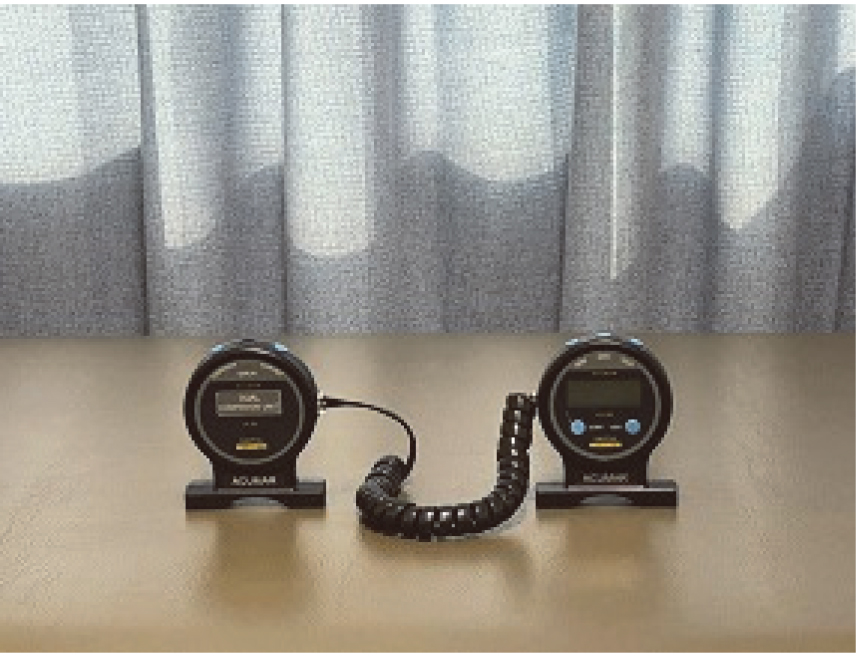
In order to test the change of walking time and trunk swing speed during climbing stairs, a 3-axis accelerometer (Fit Dot Life; Suwon, Korea) with a size of 35
Stairs
The stairs used in the study are 16.5 cm in height and 29 cm in width, and a total of 11 stairs needed to be climbed continuously.
Data analysis
The data transmitted to the computer through USB is analyzed using the following formula.
Experimental method
Participants were fixed with 3-axis accelerometer on the third lumbar spine in natural standing posture. Participants start walking according to the inspector’s instructions. In order to obtain natural walking data, a 1-meter parallel walk was carried out before and after the first and last stairs, with a total of 3 tests. Only the data of stair walking is used in the study. Automatically transfer raw date in x, y and z axes to the computer through a USB cable [16].
Analysis method
SPSS version 18.0 for Windows (SPSS Inc., Chicago, IL, USA) was used for independent specimen
Results
In the stair walking process, the trunk acceleration value in the anterior-posterior (3.39
Comparison of trunk swing and walking time between flatback syndrome group and normal bending group (
24)
Comparison of trunk swing and walking time between flatback syndrome group and normal bending group (
In this study, we compared the trunk swing between flat-back syndrome group and normal bending group during stair walking. The results of this study show that the trunk acceleration and vector value in the anterior-posterior and vertical directions in the flat back syndrome group are significantly increased compared with those in the normal bending group, but there was no significant difference in the trunk acceleration and walking time in the medial-lateral direction. Previous reports showed that there was no significant difference in the range of motion of lumbar spine on frontal plane compared with horizontal walking [17, 18]. This is consistent with our research.
Nedeau et al. [1] reported that more pelvic tilt occurred at the beginning and end of stair climbing, and Jang et al. [19] reported that lower lumbar lordosis plays an important role in sagittal alignment and balance. Surgical restoration of lumbar lordosis results in predictable spontaneous correction of the thoracic curve and sacral slope in patients with degenerative flat-back syndrome. The normal curvature of the spine helps to absorb the impact of the ground reaction force when walking, and vertical movement of about 5 cm occurs [6]. When suffering from flat-back syndrome, the ability of relieving impact decreases or the external impact force cannot be relieved normally, which causes greater vertical movement of center of mass (COM) than the normal bending group [20].
In our research, in the weight acceptance phase of climbing stairs, the flat-back syndrome group showed greater flexed thoracic and spinal regions and restricted pelvic obliquity to achieve swing clearance. This posture can keep the patient in a stable position, because the base of stability (BOS) can be enlarged and the COM can be lowered when climbing stairs, and the COM will be closer to the pressure center [21]. As the anterior displacement of the center of mass that comes with more trunk forward flexion would produce a concomitant increase in the sagittal plane ground reaction force (GRF) lever arm at the hip joint and a decrease in the sagittal plane GRF lever arm at the knee [22]. To put it simply, this trunk lean has the potential to alter the orientation of the ground reaction force and subsequent external moments acting on the knee in the frontal plane. In the sagittal plane, trunk flexion moves the ground reaction force vectors anteriorly to both the hip and knee joints, thereby increasing the demand of the hip extensors and decreasing the demand of the knee extensors [21, 23]. Krebs et al. [24] showed that the relative forward movement of hip joint may reduce the risk of falling backwards when climbing stairs. It is speculated that part of the reason comes from the flexion of trunk, this requires the human body to have excellent ability to control the extensor muscles of the hip joint. A previous study by Vishnu et al. [25] showed that if the standing and swinging stages of climbing stairs were considered independently, the elderly showed greater joint contraction of knee muscles in the swinging stage of walking. Compared with young people, during the transition period of climbing stairs, the mode and variability of joint coordination are consistent and decreased [26]. Similar to the larger curvature of spine, this can be presumed to be an intensive measure to compensate the balance of the elderly.
With the progress of the single limb support phase, the trunk stretches out. According to the accelerometer results of our statistical analysis, speculated that the range of flexion and extension of trunk in flat-back syndrome group will increase when walking on stairs and the anterior-posterior movement of trunk will further increase compared with normal bending group. Compared with previous studies on horizontal walking [27, 28], the range of flexion and extension of lumbar spine and the movement of trunk increased in sagittal plane during stair climbing [24], which is consistent with our research speculation. In this study, compared with the normal bending group, the acceleration of trunk movement in the anterior-posterior and vertical directions in the flat back syndrome group compensated for the unstable balance caused by the smaller normal bending of the spine. Considering the typical phases of stair-climbing activity composed of weight acceptance, pull-up, and forward continuation, it is reasonable that the sagittal plane motions play more important role than other plane motions in satisfying the biomechanical requirements of stair-climbing as compared to level walking. Accordingly, the sagittal plane motions possibly have more chances to be affected by the LBP [29]. In addition, vector is a numerical value that reflects the whole movement. According to vector analysis, the flat-back syndrome group in order to compensate for the unstable movement during stair walking, the overall movement of the trunk also increased [6].
There are several limitations in this research. We limited the subjects to 24 men, so it is difficult to get the results of generalized experiments. Future studies need to compare the muscle activity of the standing muscles and lower limb muscles between the flat-back syndrome group and the normal bending group when walking on stairs.
Conclusion
This study was divided into flat-back syndrome group and normal spine bending group and compared the difference of trunk swing during stair walking. In the flat-back syndrome group, the swing speed in the anterior-posterior, vertical direction and vector increased significantly. The increase of the whole trunk speed will increase the energy consumption and make it difficult to walk efficiently. Therefore, more research is needed to prevent this situation.
Footnotes
Acknowledgments
This work was supported by the National Research Foundation of Korea (NRF) grant funded by the Korea government (MSIT) (No. NRF-2020R1F1A1049191).
Conflict of interest
None to report.