



Abstract
BACKGROUND:
Circular RNAs (circRNAs) are a new class of noncoding RNAs, which interfere with gene transcription by absorbing microRNAs (miRNAs).
OBJECTIVE:
The expression profile and roles of circRNAs in unstable angina (UA) patients remains unclear.
METHODS:
An initial screening of circRNA expression by microarray analysis was performed using blood samples from three pairs of UA patients and matched healthy individuals. The differential expression of the chosen six circRNAs from the results of the microarray analysis was validated by quantitative real-time polymerase chain reaction (qRT-PCR).
RESULTS:
The microarray results demonstrated that some circRNAs were markedly different in UA patients, when compared with matched healthy individuals. In these UA patients, 22 circRNAs were upregulated and six circRNAs were downregulated when a
CONCLUSION:
The present study provided the expression profile of circRNAs in UA patients. Moreover, some circRNAs have the potential to be biomarkers for the detection of UA patients. Further studies with a larger population will focus on hsa_circ_0002229, hsa_circ_0005580, hsa_circ_0046667 and hsa_circ_0001451.
Introduction
Cardiovascular disease is the leading cause of human death among men and women in the United States, which will be the main cause of death in the world by 2030 [1, 2, 3]. Unstable angina (UA) is a serious type of coronary atherosclerotic heart disease, which is a clinical syndrome between chronic stable angina and acute myocardial infarction (AMI) [4]. UA is a precursor of AMI. The occurrence of AMI is 12–13%, with a 3–18% mortality rate in UA patients within one year. At present, the diagnosis of UA is based on clinical symptoms, an electrocardiogram and coronary angiography (CAG) [5, 6, 7]. There is a need determine sensitive biochemical indicators for early diagnosis. Therefore, searching for the early diagnosis of molecular markers has become a hot topic in the cardiovascular field.
Circular RNAs (circRNAs) are a class of non-coding RNA (ncRNAs) that assume a covalently closed continuous conformation [8]. Recent studies have revealed that circRNAs are stable and widely expressed, and often exhibit cell type-specific or tissue-specific expression [9]. Emerging evidence has indicated that some circRNAs can serve as microRNA (miRNA) sponges [10], regulate transcription or splicing [11], and interact with RNA binding proteins [12, 13]. Moreover, circRNAs have been reported to play essential roles in myriad life processes, such as aging [14], insulin secretion [15], tissue development [16, 17], atherosclerotic vascular disease [18, 19], cardiac hypertrophy [11] and cancer [20]. Therefore, the characteristics of cirRNAs determine that they may become a new molecular marker of disease, and many studies have also verified this result. However, the roles of circRNAs in UA remain largely unknown.
Since the expression profile of circRNAs in UA patients remains uncovered, in the present study, blood samples were collected from UA patients and healthy individuals. These were used for blood circRNA microarray and qRT-PCR validation in order to obtain the early diagnosis of molecular markers for UA. Our results indicated that four circRNAs (hsa_circ_0002229, hsa_circ_0005580, hsa_circ_0046667 and hsa_circ_0001451) may be the biomarkers for diagnosing UA.
Materials and methods
Study cohorts
Three UA patients and three healthy subjects from Beijing Luhe Hospital (Capital Medical University) were recruited for the present study between January 2017 and June 2017. Three UA patients and three healthy subjects had similar age, the same gender (male) and similar BMI. Moreover, the age, gender, BMI and other basic characteristics of healthy controls were matched with patients in the UA group (Table 1). The exclusion criteria were as follows: (1) malignancy, (2) liver or kidney dysfunction, (3) any other clinically acute or chronic inflammatory systemic disease, (4) previous history of AMI, percutaneous coronary intervention (PCI), (5) autoimmune disease, and (6) malignant arrhythmia or valvular disease.
UA patients and healthy controls clinical baseline characteristics
UA patients and healthy controls clinical baseline characteristics
The definition of UA is based on the 2011 (American College of Cardiology/American Heart Association) guidelines for non-ST elevation myocardial infarction. There is at least one characteristic in the UA patients: increased angina or frequent seizures within 1 months (the duration of the disease was increased, the degree of exacerbation increased); and the newly developed angina pectoris within 1 months; resting angina pectoris: angina pectoris occurs in resting or quiet state; the effect of nitroglycerin is not good, the course of the disease is within 1 months.
The diagnosis of coronary artery disease (CAD) was conducted by CAG, and this was defined as coronary stenosis
Peripheralblood samples (2 ml) were obtained from UA patients and healthy controls using a vacuum blood collection tube anticoagulanted by ethylenediaminetetraacetic acid (EDTA). Peripheral blood was centrifuged to collect the plasma or serum. Then, TRIZOL LS (Catalog no. 15596-026, Life Technologies, Carlsbad, CA, USA) was added at a proportion of 1:3. The samples were preserved in liquid nitrogen or reserved at
RNA extraction and quantitative real-time polymerase chain reaction
Total RNA was extracted from the peripheral blood samples of UA patients and healthy controls using Trizol Reagent (Catalog no. 15596-026, Life Technologies, Carlsbad, CA, USA). This was followed by purification using an RNeasy kit (Qiagen, Valencia, CA, USA), according to the manufacturer’s manual.
MMLV reverse transcription (Promega) was used to synthesize the cDNA. Quantitative PCR analysis and data collection were performed on the ABI 7900HT qPCR system using the following listed primer pairs: hsa_circ_0046667, forward, 5’-AGAGGTCCACTGGTTTTGGT-3’, reverse, 5’-TACAGGTTTG TCTCGCCGAA-3’. The raw quantifications were normalized to 16 sec values for each sample, and fold changes were shown as mean
CircRNA microarray analysis
Total RNA was extracted from the peripheral blood of three UA patients and three healthy subjects using Trizol Reagent (Life technologies, CA, USA) [H2], and purified using an RNeasy Mini Kit (Qiagen, Hilden, Germany). RNA was detected using a UV–VIS Spectrophotometer (Thermo, NanoDrop 2000, USA) at 260 nm absorbance, and purity and integrity were assessed by agarose gel electrophoresis. The minimum RNA concentration for the microarray was 20 ng/ul. Next, 250 ng of total RNA was used to prepare the biotinylated cDNA, according to the standard Affymetrix protocol. After labeling, the cDNA was hybridized on GeneChip Human Clariom D Array (Catalog no. 520859, Affymetrix, Santa Clara, CA, USA). GeneChips were washed and stained in the Affymetrix Fluidics Station 450. Then, GeneChips were scanned by using the AffymetrixGeneChip Command Console installed in the GeneChip Scanner 3000 7G. Data were analyzed using the Robust Multichip Analysis (RMA) algorithm through the Affymetrix default analysis settings. The values presented was log
Statistical analysis
SPSS 19.0 statistical software was used for data analysis. The variables of different distributions were expressed as the mean
Results
Expression profiling of peripheral blood circRNA in UA patients
The microarray results demonstrated that some circRNAs were markedly different in UA patients. A total of 28 significantly and differentially expressed circRNAs were found. Among these, 22 circRNAs were upregulated and six circRNAs were downregulated, respectively (Table 2). The upregulated circRNAs (78.6%) were more common than the downregulated circRNAs (21.4%) in the microarray data. Hierarchical clustering (Figure 1A), volcano plots (Fig. 1B) and scatter plots (Fig. 1C) revealed that the expression profiles of circRNAs between UA patients and healthy subjects were diverse.
The up- and down-regulated differentially expressed circRNAs in UA patients compared to those in healthy individuals by microarray analysis. FC: Fold change
The up- and down-regulated differentially expressed circRNAs in UA patients compared to those in healthy individuals by microarray analysis. FC: Fold change
Hierarchical clustering, volcano plots, and scatter plots exhibited the differentially expressed circRNAs in UA patients compared to paired healthy persons. Test: UA patients, Con: healthy individuals. (A) Hierarchical clustering, numbers were the samples used for the microarray assay. (B) Differentially expressed circRNAs were displayed by volcano plots. The red and green parts indicated upregulated and down-regulated expression of the dysregulated circRNAs in UA patients (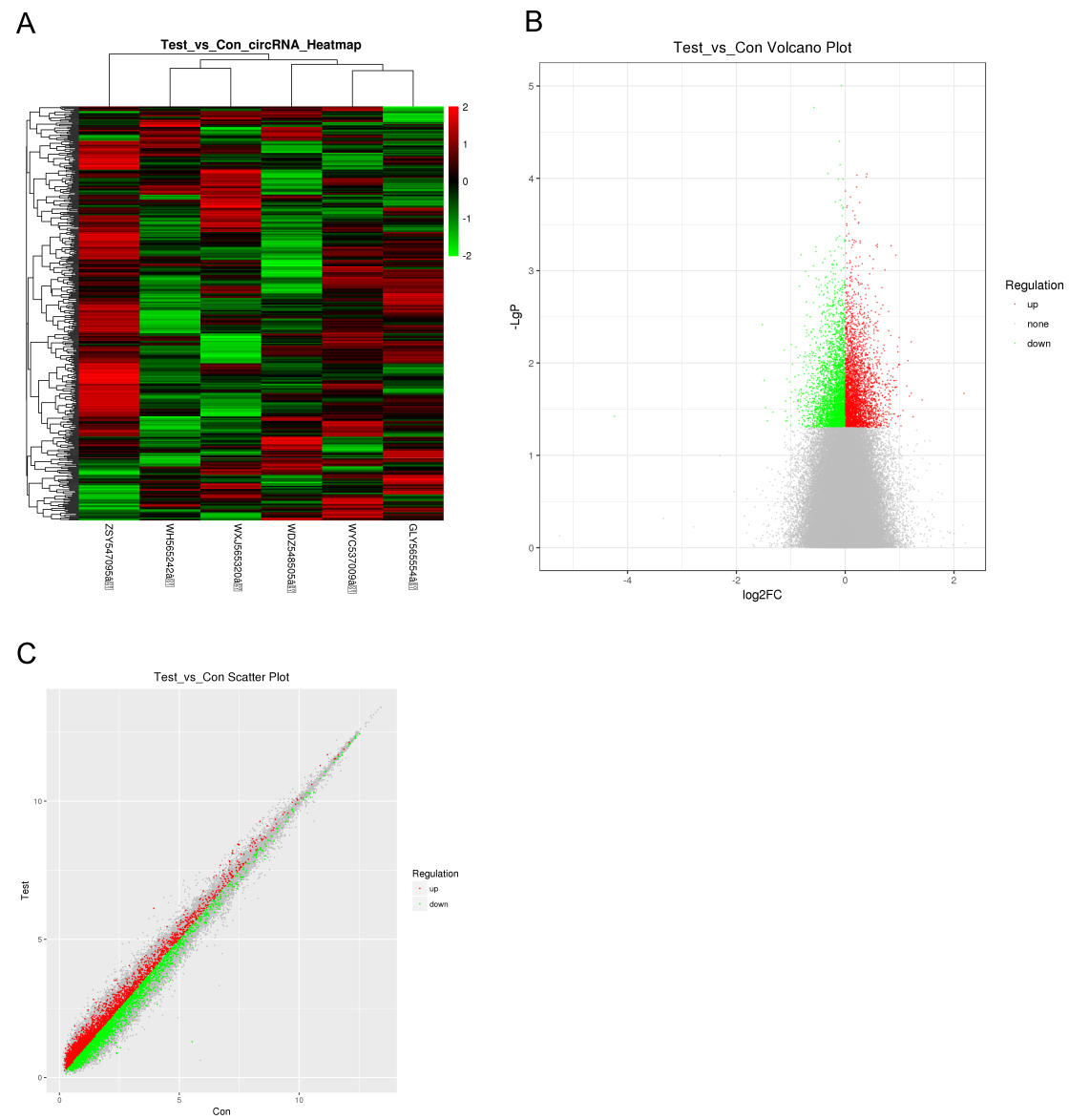
To identify the promising biomarker for the early diagnosis of UA, we chose six differentially expressed circRNAs from the microarray screening assay for further analysis, including hsa_circ_0002229, hsa_circ_0003954, hsa_circ_0005580, hsa_circ_0046667, hsa_circ_0000188 and hsa_circ_0001451. We verified these six candidate circRNAs by RT-PCR in the same cohort.
The results revealed that five of these (hsa_circ_0002229, hsa_circ_0005580, hsa_circ_0046667, hsa_circ_0000188 and hsa_circ_0001451) were upregulated, while the remaining one (hsa_circ_0003954) was downregulated (Fig. 2).
Comparison of the results of 6 candidate circRNAs obtained from circRNAs microarray assay and RT-PCR revealed satisfactory consistency
Comparison of the results of 6 candidate circRNAs obtained from circRNAs microarray assay and RT-PCR revealed satisfactory consistency
Verification of the differentially expressed circRNAs by qRT-PCR, which were shown by the relative expression value.
The four circRNAs (hsa_circ_0002229, hsa_circ_0005580, hsa_circ_0046667 and hsa_circ_0001451) had the same variation trend and revealed a satisfactory consistency (Table 3), comparing the six candidate circRNAs obtained from the circRNAs microarray assay and RT-PCR validation.
CircRNAs are a class of ncRNAs involved in transcriptional and posttranscriptional gene expression regulation [10]. With the development of deep sequencing of ribosomal RNA (rRNA)-depleted RNA libraries, several new circRNAs has been identified in all sorts of organisms, from protists, plants and fungi to animals [19, 20]. At present, Hansen and Memczak et al. discovered that circRNAs can work as microRNA (miRNA) sponges. This means that circRNAs can bind to miRNAs, and consequently repress their function [10, 22, 23]. MiRNA is one of the most prominent classes of ncRNAs, and is involved in several aspects of gene regulation in eukaryotes. CircRNA sponges are abundant, stable and has a tissue-specific expression. These special features make them very attractive for clinical research, such as exploring these molecules in the diagnosis of human diseases. Recently, several researches have associated miRNA sponges with human diseases [8, 24]. CircRNAs have already been observed to be associated with gastric cancer, cardiovascular system diseases and nervous system. Yin et al. found that hsa_circ_0001785 acts as a diagnostic biomarker for breast cancer detection [25]. Chen et al. indicated that hsa_circ_0000190 may be a novel non-invasive biomarker for the diagnosis of gastric cancer [26]. In the aspects of cardiovascular diseases, Zhao et al. identified that peripheral blood circular RNA hsa_circ_0124644 can be used as a diagnostic biomarker of coronary artery disease [27].
There are increasing evidences that circRNAs are involved in atherosclerosis, which provide a possible insight for seeking a biomarker of UA [18, 28]. In the present study, the expression profiles of circRNAs in the peripheral blood of UA patients and healthy subjects were first screened by microarray analysis. A total of 28 circRNAs were differently expressed, including 22 upregulated and six downregulated circRNAs. Then, six representative circRNAs were selected for further verification in the same cohort, including hsa_circ_0002229, hsa_circ_0003954, hsa_circ_0005580, hsa_circ_0046667, hsa_circ_0000188 and hsa_circ_0001451. The results suggest that five of these were upregulated, and the remaining one was downregulated.
Through further analysis, it was found that four circRNAs (hsa_circ_0002229, hsa_circ_0005580, hsa_circ_0046667 and hsa_circ_0001451) had the same variation trend, when the outcome of six candidate circRNAs was compared between the circRNAs microarray assay and RT-PCR validation. Similar with the present study, five circRNAs (hsa_circ_0082081, hsa_circ_0113854, hsa_circ_0124644, hsa_circ_0098964 and hsa-circRNA5974-1) were differently expressed, and only hsa_circ_0124644 exhibited a good potential to act as a diagnostic biomarker of CAD [29]. Plans would be made to verify the above four circRNAs, in order to investigate the diagnostic biomarker of UA in a larger population. There is presently no detailed evidence on the biological function of the above four circRNAs. Hsa_circ_0002229 is located at chr2:11905658-11907984 with a spliced length of 297 nt, hsa_circ_0005580 is located at chr11:107965117-107966418 with a spliced length of 462 nt, hsa_circ_0046667is located at chr18:214519-214921with a spliced length of 402 nt, and hsa_circ_0001451is located at chr4:153332454-153333681 with a spliced length of 1227 nt.
Our results indicated that four circRNAs (hsa_circ_0002229, hsa_circ_0005580, hsa_circ_0046667 and hsa_circ_0001451) are related to UA. They may be a promising biomarker for the early diagnosis of UA. However, this study is single centred, and the number of subjects is too small. We will verify the above four circRNAs in a larger population.
Conclusion
The present study is the first to investigate the expression profiling of circRNA in patients with UA. The present results indicate that four circRNAs (hsa_circ_0002229, hsa_circ_0005580, hsa_circ_0046667 and hsa_circ_0001451) were associated with UA, more focus would be given in exploring the above four circRNAs in future studies.
Footnotes
Conflict of interest
None to report.