



Abstract
BACKGROUND:
The Ling sound test cannot provide the test of Chinese tone for preschool children with hearing aid and cochlear implants.
OBJECTIVE:
The paper tries to design a new tone test method composed of the Ling sound test and four Chinese tones to evaluate the hearing level of Chinese hearing-impaired children.
METHODS:
The tone identification rates of 20 cochlear implant children were statistically analyzed to verify the validity of the Ling sound test in the Chinese tone version. In addition, this paper analyzed the pronunciation characteristics of the Ling sound test in the Chongqing-accented Mandarin version of 20 subjects.
RESULTS:
The identification rate of Ling six sounds was more than 97.0%, the identification rate of tone was more than 81.0%, and the identification rate of vowels was 83.1%, which was higher than that of consonants 79.0%. The Ling sound test n the Chongqing-accented Mandarin version has a narrower frequency range.
CONCLUSION:
The results verify the effectiveness and feasibility of the Ling sound test in the Chinese tone version in the assessment of frequency range and tone identification for cochlear implant users.
Keywords
Introduction
Hearing is important for human communication. Hearing impairment often brings serious obstacles to patients in daily life. Hearing loss currently affects more than 1.5 billion people or 20% of the global population. If unaddressed, it will impact their daily activities and quality of life. According to the WHO world report on hearing of 2021 [1], by 2050, it is estimated that some 2.5 billion (1 in every 4) people will experience hearing loss. Rehabilitation is essential to improve function, activity, and participation, and ultimately offers a better quality of life for people with hearing loss. China accounts for approximately 20% of the world’s population, and there is an enormous need for hearing rehabilitation services for hearing-impaired people in China [2].
Hearing rehabilitation techniques, including hearing aids and cochlear implants (CIs), have made important progress [3, 4, 5, 6]. Niparko et al. [7] found that language performance scores in children who received CI earlier were closer to scores of normal-hearing controls. Children with hearing impairment should use CIs as early as possible [8]. However, there are still many problems in hearing assessment after CI implantation, such as language environment [9], participation in hearing therapy [10], and brain plasticity [11]. The ability to resolve talker-specific information may be impaired for CI users relative to their normal-hearing peers. The complexity of the language environment constructed by different languages and dialects increases the difficulty of hearing tasks, which undermines the participation of child CI users in hearing speech rehabilitation [12]. Therefore, companionship and encouragement from family and friends are particularly essential for CI users’ speech rehabilitation [13, 14, 15]. Because hearing rehabilitation is closely related to language [9], the hearing assessment of hearing-impaired Chinese patients need to be improved to adjust to Chinese lingual characteristics.
The Ling sound test (LST) is widely used by clinicians and researchers for postoperative hearing assessment of CI users. The current LST in the American English (AE) version [16] consists of six sounds, including three vowels /a/, /i/, /u/ and three consonants /m/, /
So non-English native speakers’ hearing testing program should be adjusted according to the characteristics of their language, to ensure the evaluation effect of LST [22]. China Rehabilitation Research Center for Hearing and Speech Impairment replaced consonants and vowels in American LST [23, 24] with initials and finals in Chinese Phonetics [25]. Wen [26] preliminarily established the frequency range of Ling six sounds in the Mandarin version, and also proved the difference in the frequency of Ling six sounds between Mandarin and AE [27]. Hung et al. [19] proposed an adapted version of Ling six sounds to improve the accuracy of Taiwan Mandarin listening test, which contained six phonemes (/u, ǝ, a, i, tch, s/), mainly adding the consonant [tch] (/j/). Tone is as important as vowels and consonants in Chinese, because different tones represent different semantic information for each Chinese syllable. However, the LST in the AE version cannot provide a tone identification test.
To better serve the auditory assessment of hearing impairment in China, it is necessary to develop a tone identification test. Moreover, Chinese pronunciation in different regions of China has distinct spectral features, leading to significant differences in frequency components between dialects and Mandarin. For example, the pronunciation of Ling six sounds in the Shanghai-accented Mandarin (SM) version is different from that in the Mandarin version, with little difference in frequency range in their vowels, and quite a difference in high frequency in their consonants. These results provided a reference for the clinical application of LST in Shanghai [28]. Compared with SM, the LST in Chongqing is more different from the Mandarin version. Only by measuring and evaluating the frequency and tone characteristics of LST in Chongqing, can we ensure the accuracy of the listening evaluation of CI users in Chongqing.
Based on the above-mentioned research progress, we put forward two hypotheses. (1) we believe that the LST in the Chinese tone version can be used to test the tone identification ability of Chinese CI child users. We designed the LST in the Chinese tone version by combining four basic tones of Mandarin with six sounds in LST respectively. Of the four basic tones, the first tone (T1) is the flat tone. The second tone (T2) is the rising tone. The third tone (T3) is the falling-rising tone. The fourth tone (T4) is the falling tone. Therefore, the collected Ling six sounds in the Chinese tone version were presented to hearing-impaired children, verifying the hypothesis by counting their tone identification rate. (2) there is a great difference in the frequency between Chongqing-accented Mandarin (CM) and Mandarin [29, 30, 31]. We propose that the difference would affect the hearing evaluation effect of Ling six sounds in Chongqing, but there is a lack of experimental data. For this reason, our team collected Ling six sounds of the Mandarin version and the CM version, and compared and analyzed their frequency characteristics. The results of this study could provide professional guidance for hearing tests and speech rehabilitation training for CI child users in Chongqing.
Materials and methods
Sample collection
The sample collection environment is as follows. The acoustic recording of LST in the Mandarin version was carried out in a professional standard sound insulation room. The ambient noise was less than 30 dB. The experimental recorder instrument (Philips VTR5200) has two microphone sensors, PCM lossless recording, 1536 kbps, and the sampling rate with a set of 48 kHz and with the output format of .wav. During the collection process, we made sure that the distance between the pen and the lips is about 10 cm. First of all, LST in the Chinese tone version of one male and one female were recorded. The speech was recorded according to the LST in the Mandarin version, and each subject got enough time to be acquainted with Ling six sounds before recording. The content of voice recording is /a/, /i/, /u/, /m/, /sh/, /s/ (international phonetic alphabet [a], [i], [u], [m], [
Secondly, LST samples in the CM version were collected from 10 males and 10 females (19–21 years old, undergraduates, normally hearing). When pronouncing, each subject was divided into a group according to the order of /a/, /i/, /u/, /m/, /
Examples of typical results of LST in a Mandarin female processed by Praat software. The time domain waveform (top) and spectrogram (bottom) of LST, and the six sound signals are /a/, /i/, /u/, /m/, /sh/ and /s/. The Abscissa is time, in which the red line outlines the formant information of the speech signal. The green tag of “0 dB”–100 dB” represents the values scale of the intensity (yellow line). The yellow line represents the intensity of the speech signals. The blue line represents the fundamental frequency of the speech signals.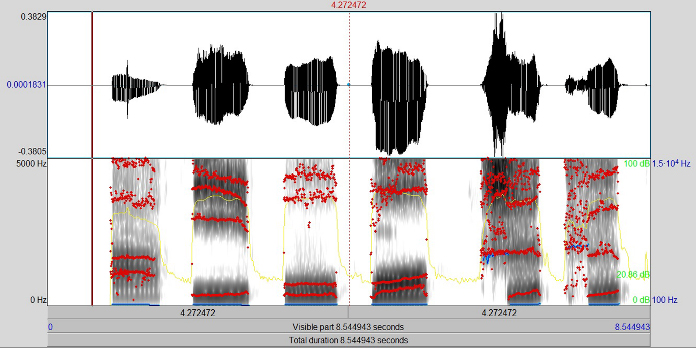
Schematic diagram of the research method.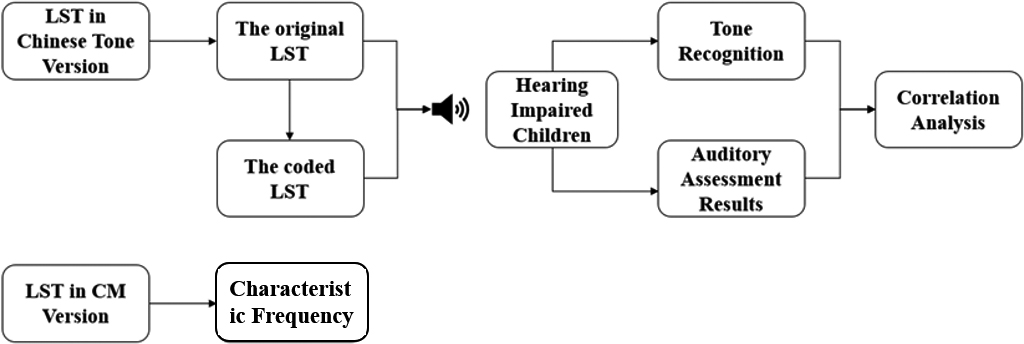
CIs have a good recognition effect in a quiet environment, but a poor recognition effect in a noisy or multiple voices environment. The traditional speech coding strategies in CI, such as the continuous-interleaved-sampling strategy, discard the temporal fine structure information. In order to preserve this time fine structure information of speech, Nie et al. [32] designed harmonic single sideband encoder (HSSE) strategy that converts an audio signal into time-varying electrically stimulating pulse trains. Li et al. [33] established an auditory nerve model to simulate the neural discharge pattern induced by HSSE. Their results showed that HSSE could well transmit temporal pitch cues. Therefore, we chose HSSE to process the two cases of LST signals.
Two cases of LST signals in the Chinese tone version were processed by HSSE with MATLAB [34]. HSSE consists of six steps: preprocessing, frequency channel division, fundamental frequency (F0) extraction, harmonic selection, frequency reduction processing, and vocoder synthesis [33]. The least-square-harmonic (LSH) is used to extract the F0 and harmonics. Because the selected harmonics in most of the channels are high-frequency components, they cannot directly be used as modulated signals. So we shift these high-frequency components into lower-frequency ones [33]. We choose the envelope of the lower-frequency signals as the modulation signals for accumulation by a group of sine signals.
The feature extraction of 20 samples of LST in the CM version was carried out in Praat 6.1.04 [35] and MATLAB. First, we used Praat 6.1.04 software to complete sound segmentation, feature extraction, and then used MATLAB to pre-process the sound signal and draw its time domain waveform map and spectrogram, the first formant frequency (F1), the second formant frequency (F2) and the central frequency of the consonant. The vowels /a/, /i/, and /u/ spectrograms show multiple black stripes, each representing a resonant peak, the lowest stripe representing the sound’s F0, and the stripes above F0 being F1, F2, and so on. The central frequency of consonants /m/, /
Subjects and test flow
To test the effectiveness of the LST in the Chinese tone version, we used the collected LST in the Chinese tone version to carry out a hearing test among CI children. Participants included 20 hearing-impaired children and teenagers with CI (Cochlear
Details of hearing impaired children
Details of hearing impaired children
Remarks: intelligence assessment, use Hiskey-Nebraska Test of Learning Aptitude over 3 years old, and Griffith Development Assessment scale under 3 years old. CIs of two different manufacturers: Cochlear
In an environment with sound insulation, each CI child was tested separately. The first task was the original LST. First of all, participants studied the original LST in Chinese tone version, and they need identify or imitate the syllables on the card after the sounds were randomly played out. The completion of identification or imitating one of the syllables can be recognized as valid. The second task is the coded LST. The subjects learned the coded LST in Chinese tone version, and then they need identify or imitate the syllables on the card after the voices were played out randomly. The completion of identification or imitating one of the syllables can be recognized as valid. Half an hour after the original LST in Chinese tone version, subjects began to learn the coded LST in Chinese tone version in order to reduce the interference of the previous test on this one.
The data of Mandarin and AE are extracted from Wen [26]. The range of values is the approximate range of the central frequency plus or minus the standard deviation.
The LST in the Chinese tone version
The original and the coded LST in Chinese tone version were used to test the tone identification rate of CI children. As shown in Fig. 3a, the correct rate of Ling six sounds identification is more than 97.0%, the rate of tone identification is more than 81.0%, and the identification rate of vowels is 83.1%, which is higher than that of consonant (79.0%). Some hearing-impaired children fail to recognize the specific Ling six sounds, but can still correctly judge the tone.
Test results of LST in Mandarin tone version. (a) Recognition results of original LST in Chinese tone version. (b) Recognition results of coded LST in Chinese tone version. (c) Sounds misjudgment in the original LST in Chinese tone version. (d) Sounds misjudgment in coded LST in Chinese tone version.
In the results of the same participant, the identification rate of vowels is higher than that of consonants, especially in the consonants /s/ and /sh/, which are much lower than the identification rates of vowels. Surprisingly, the identification rate of consonants /s/ and /sh/ is higher in some children with average or poor auditory rehabilitation levels.
The tone identification rate of T1 is higher than that of the rest. The misjudgment of T1 in original version is more complicated than that in the coded version. And there are all cases of being misjudged as T2, T3, and T4 (Fig. 3c). As shown in Fig. 3b, the identification rate of the coded version is 52.9%, which is lower than that of the original version. The main results are as follows: (1) for the same subject, the identification rate of vowels is higher than that of consonants, and there is a phenomenon that the identification rate of /s/ and /sh/ consonants is much lower than that of vowels. (2) only T1 is correctly recognized. However, the rest tones including T2, T3, and T4 are misjudged, and the number of misjudged syllables as T1 is significantly higher than those as T2 (Fig. 3d).
Auditory evaluation and tone identification scatterplot of 20 subjects.
Characteristics of 20 subjects in CM. Blue is female and orange is male.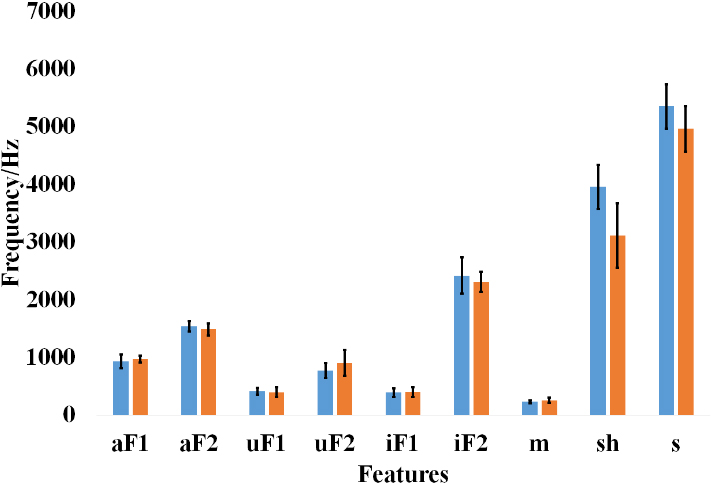
Based on the statistics of the average tone identification rate of six sounds in 20 children, the correlation between the average tone identification rate and the auditory evaluation level was analyzed. As the scatter diagram in Fig. 4 shows, there is a positive correlation between tone identification and auditory evaluation. The correlation between the two variables is 0.8519. It can be concluded that the subjects with good auditory evaluation have a higher tone recognition rate.
Figure 5 and Table 2 show the LST features of 20 cases in the CM version. The subjects show no distinction between flat tongue sounds and warped tongue sounds, which show the characteristics of the Chongqing dialect. There is no significant difference in the central frequency of /sh/ and /s/ collected in Chongqing.
Analysis results of LST
test in CM version
Analysis results of LST
Table 2 shows that the overall frequency range of the CM version of females is wider than that of males. The highest frequency is /s/, about 5500 Hz, and the lowest frequency is /m/, about 200 Hz. The average central frequency of the other two sounds (/sh/, /s/) in females is significantly different from that in males.
Three versions of Ling Six Sounds
Table 3 shows the comparison between LST in the AE version, Mandarin version and CM version. In the AE version, the difference between F1 and F2 of /u/ sound is 330 Hz. In the Mandarin version, the F1 and F2 of /u/ sound are lower than the AE version, and the F1 and F2 in the CM version are not much different from the Mandarin version. /m/ sound is in the lowfrequency range, and all three versions are very close. When collecting samples in the Mandarin version, /sh/ is used instead of /
The LST in the Chinese tone version
It is necessary to test whether the tone version of LST can be used to test the hearing frequency range and tone identification ability.
The sound identification rate (97.0%) and tone identification rate (81.0%) in Fig. 3a show that the sound identification rate is relatively higher, although the tone identification rate is lower in the original. The efficiency and feasibility of LST in the Chinese tone version in the rehabilitation of CI children were verified. On the other hand, the results of the lower sound identification rate and the lower tone identification rate in the coded version (Fig. 3b), are mainly due to the great difference between the coded sound and the original sound. However, the identification result of vowels is significantly better than that of consonants, indicating that the coded effect of vowels is better than that of consonants.
The identification rate of vowels (83.1%) is higher than that of consonants (79.0%), either in the original LST in the tone version or the coded LST in the tone version (Fig. 3b), either in the identification of Ling six sounds or in the identification of tones. This result is supported by the research results of other publications [39, 40], vowels (/a/ of 14.29% and /i/ of 12.86%) are the easiest to recognize correctly, while consonants (/zh/, /c/, /f/, /ch/ and /sh/) are most likely to be misidentified in the analysis of Chinese phoneme error rate. This is because the vocal cords only vibrate when vowels are pronounced.
Analyzing the lower tone identification rate of the original LST in Chinese tone version (Fig. 3a), as shown in Fig. 3c, the misjudgment in the original LST in Chinese tone version is more complicated than that of encoding. All test sounds of T1 were recognized without misjudgment. The test sound of T2, T3 and T4 were mainly misjudged as T1. And the test sounds of T3 were misjudged as T2. And the test sounds of T2 were misjudged as T3 and T4. The misjudgment of T1 may be due to the fact that the tone feature of T1 is not obvious. There are also some cases of misjudgment as T3 or T4, which implies some CI child users do not pronounce their tones. And there is a rise in the endings, which sounds like T2 or T3. The confusion of T2 and T3 in vowels is more significant. Analyzing the misjudgment of coded LST in Chinese tone version, as shown in Fig. 3d, the test sounds of T2, T3 and T4 were mainly misjudged as T1. There are fewer cases of misjudgment of T2. The misjudged as T3 and T4 didn’t appear. There are more cases of misjudgment of T1, and we speculate that the tone characteristics are not obvious, and CI child users often guess as T1 when they are unable to accurately judge the tone.
The correlation analysis between tone identification rate and auditory evaluation score of 20 children shows that there is a strong correlation between them (
The LST in the CM version
As a branch of southwest Mandarin, CM is quite different from Mandarin. Both /sh/ and /s/ are high -frequency sounds and have very wide frequency coverage. In CM, flat tongue sound is indistinguishable from warped tongue sound, and /sh/ and /s/ are indistinct. Scollie [17] summarized that the test content of the LST included detection and identification. The former mainly focuses on whether the subjects hear the sound, while the latter requires the subjects to respond. The teachers from Chongqing Hearing and Speech Rehabilitation Centre pointed out that the difficulty in teaching practice for /sh/ and /s/ lies in distinguishing between the two sounds when CI child users heard them. There are obvious frequency differences of /s/ between the CM version and the Mandarin version. The tip of the tongue in the /s/ sound of the Mandarin version should be put against the lower jaw. The participants of CM usually put their tongues between the upper and lower teeth to articulate /s/, so the frequency of /s/ in CM is low. Because many parents of CI child users in Chongqing are not able to accurately pronounce /s/ and /sh/, they could not teach or guide their children to distinguish them. The frequency differences between /s/ and /sh/ of CM are smaller than that of the Mandarin version [27]. Compared to the SM version [28], the LST in the CM version has a narrower frequency range, covering a maximum frequency of approximately 5500 Hz and the lowest frequency of 200 Hz. This shows that the language is susceptible to regional influences. The F2 value of /u/ in the CM version is increased to the mid-high frequency, which is consistent with studies of CM [29, 30, 31].
Major sounds differ significantly between males and females except for the central frequency of /m/ in Table 2. /sh/ and /s/ have a significant difference between males and females. The voice pitch and the formants of males are generally lower than those of females. F2 of vowels is related to the front and back of the tongue position and the degree of rounding of the lips. There was a significant difference in F1 and F2 of /a/ and /i/ and the central frequency of /m/ between males and females. Overall, the female version of CM differs less from the Mandarin version than the male version and is more suitable for teaching and instruction.
The LST in the Mandarin version can detect a wider range of 220–10474 Hz than the frequency range of 275–7056 Hz of LST in the AE version. The frequency range of the LST in the CM version is half that in the Mandarin version (Table 3), and a frequency region of 450–600 Hz is missing. There is no significant difference in the three vowels between the Mandarin version and the CM version. Consonants, especially the two high-frequency sounds of /s/ and /sh/, have obvious frequency differences between the Mandarin version and the CM version. The Mandarin version of /m/ has a wider frequency range, because /m/ was replaced by the sound of /mo/ in the experiment, in the /mo/ pronunciation /m/ is followed by an /o/ sound. Both /sh/ and /mo/ are high-frequency sounds. The Mandarin version of the /sh/ sound has a wider frequency range than the AE version of the /
Practical significance
High-frequency speech perception
These results suggest that researchers should pay attention to high-frequency sound perception during the hearing test of CI child users in Chongqing. The CM version of the LST cannot be employed directly to complete the hearing test. In contrast, the SM version of LST can be applied to the hearing tests of CI child users in Shanghai due to the similar frequency distribution of SM and Mandarin.
Direction for CI postoperative adjustment
CM and Mandarin are the main languages used in communication in Chongqing. Therefore, audiologists need to fully consider the high-frequency perception in the process of CI adjustment. The target of the CI postoperative adjustment is to adapt the CI performance to the living environment of child CI users. When CI child users fail to distinguish high-frequency sound, audiologists should fully consider the differences in the language environment, in addition to physiological and equipment factors, and avoid simply improving the intensity of the high-frequency sound. Moreover, we propose to create a new version of the LST in CM for CI users in Chongqing. There are three vowels and two consonants in the LST of CM. The vowel /a/ is close to the Mandarin version, /i/ is close to the AE version, and /u/ is close to the Mandarin version. The consonant /m/ is close to the AE version, and the consonant /sh/ is close to the AE version. Then we need to find another sound in CM that has a frequency close to /s/ in Mandarin. This solution could provide great accuracy and convenience for hearing assessment and testing for CI child users.
Guidance for teaching CI child users
Our work may guide the teaching of hearing rehabilitation in Chongqing. In the process of children’s Mandarin teaching, the teachers should pay more attention to strengthening the children’s differential pronunciation, by prompting the parents to improve their language environment, vocabulary memory and distinction. Consequently, CI child users can hear the differences in frequency clearly and express themselves clearly. For example, in teaching practice, some children have difficulty pronouncing cacuminal sounds, which is largely caused by the language environment and requires special training combined with vocabulary memory.
Conclusion
The study focused on developing an auditory assessment method for CI child users in Chongqing, based on LST. We proposed a new method for tone identification assessment, which keeps Mandarin tone characteristics and serves tonal identification test for China CI child users. And we analyzed the characteristic of LST in the CM version. The results of this study show that the frequency range of the CM version of the LST is significantly different from that of the Mandarin and the AE versions. These results can provide reference values to guide the individual customization of hearing aids and CI and to provide theoretical support for the education and teaching of CI child users in the Chongqing area.
Footnotes
Acknowledgments
The authors thank Prof. Kang Houyong for his technical guidance in the experiment.
Conflict of interest
None to report.
Funding
This work was supported by the National Natural Science Foundation of China (No. 31700856 and 31872751) and the Research and Training Program for College Students of Chongqing University (No. CQU-SRTP-2019277 and CQU-SRTP-2019286).