



Abstract
BACKGROUND:
Understanding how pharmaceutical formulas target specific illnesses is crucial for developing effective treatments. Enriching ion channel data is a critical first step in comprehending a formula’s mechanism of action.
OBJECTIVE:
This study aims to explore the effective disease spectrum of the Qi Yu granule formula through network pharmacology analysis and backtracking, and analyze its potential curative effects on liver and spleen system diseases, particularly depression and breast cancer.
METHODS:
Using pharmacological tools and database analysis, the ion channel data of the formula’s components were investigated. The effective disease spectrum was determined, and diseases related to liver and gallbladder, liver depression, and spleen deficiency were identified. Network pharmacology analysis was conducted to backtrack diseases, target gene proteins, and drug compositions. The extraction technology of volatile oil from medicinal herbs was experimentally studied to optimize the preparation process.
RESULTS:
The effective disease spectrum analysis identified potential curative effects of the Qi Yu granule formula on various diseases, including breast cancer. Backtracking revealed relationships between diseases, target gene proteins, and drug compositions. Experimental studies on volatile oil extraction provided insights into optimizing the preparation process.
CONCLUSION:
The study underscores the potential therapeutic benefits of the Qi Yu granule formula for liver and spleen system diseases. By integrating network pharmacology analysis and experimental research, this study offers valuable insights into the formulation and efficacy of the Qi Yu granules, paving the way for further exploration and optimization of TCM formulations.
Introduction
The qi-stagnation constitution health-preserving granule is based on a clinical empirical formula, and clinical research shows that the formula has a good curative effect on the symptoms of emotional discomfort and spleen and stomach disharmony caused by liver depression and spleen deficiency [1, 2]. In traditional Chinese medicine (TCM), liver qi stagnation is treated with the health-preserving granule. It regulates qi dynamics by using herbs and sophisticated extraction processes. Clinical research demonstrates its effectiveness in enhancing mental health and reducing symptoms like irritation and stomach problems. This granule promotes general well-being and is beneficial for those with a qi-stagnation constitution. The composition comprises the following components: fingered citron, mint, rose, Chinese date, tuckahoe, and honey-fried licorice root [3, 4, 5]. The monarch drug is rose and jujube, the ministerial drug is finger citron, the adjuvant drug is tuckahoe and mint, and the guide drug is honey-fried licorice root. According to the Measures for the Administration of the Catalogue of Traditional Chinese Medicinal Materials, these TCM belong to 101 kinds of drugs with the exact origin of medicine and food [6]. Consistency between batches is ensured by quality control procedures in extraction operations. These consist of reference standards, batch-to-batch monitoring, sampling methods, analytical techniques, documentation, staff training, statistical process control, standardized processes, calibration, validation, and continuous improvement. For the preparation of medicinal products, a strong quality control process entails assessing raw materials, adhering to standard operating procedures, performing in-process inspections, rigorous testing, stability assessments, documentation, validation studies, quality assurance supervision, and ongoing efforts to improve [7, 8]. Drugs known as TCM have the same roots as food and medicine and support a holistic approach to healthcare. Research, standardization, and public education are all necessary to incorporate TCM into healthcare procedures and foster an awareness of its nutritional and therapeutic qualities.
This study intends to preliminarily determine the reasonable preparation process of the Qi Yu granule by network pharmacology analysis and the analysis of existing preparation methods.
Analysis of efficacy and chemical composition of monarch drug
Rose (meiguihua) tastes slightly bitter, sweet, and warm. The liver, spleen, and qi-regulating drugs can regulate liver-qi stagnation, qi, and blood pain [9]. Doctors from historical periods assessed its healing properties. According to “Materia Medica Justice”, roses were believed to have the ability to soothe the liver and stimulate the stomach, facilitate the flow of qi, and improve blood circulation. The medicine can be used for treating hypochondriac pain and epigastric distention caused by liver-qi disharmony, epigastric distention and pain caused by liver-stomach disharmony, gynecological menoxenia, premenstrual breast distention and pain caused by liver channel obstruction, and the like, and has sound effects of regulating qi and treating traumatic swelling. Treatment for epigastric distention resulting from an imbalance in liver qi and hypochondriac pain is a comprehensive treatment in TCM [10]. This covers acupuncture, herbal medicine, dietary modifications, stress reduction, and mind-body activities. Patients are encouraged to speak with healthcare professionals while the treatment attempts to relieve symptoms and bring the liver system back into balance. It is reported that there are many chemical components in rose, up to more than 100 kinds [3], and the main bioactive components include volatile oil, flavone, polysaccharide, phenolic acid, etc. The rose polysaccharide mainly comprises the following components: galacturonic acid (45.5%), galactose (5.5%), and arabinose (4.7%). Most of the polysaccharides were methyl esterified (62%) and acetylated (10%). Rose pigment also has specific medicinal value. Some studies have found that the main components of rose pigment are cyanidin-3,5-diglucoside, cyanidin-3-glucoside, delphinidin-3-glucose-rhamnoside, and paeoniflorin-3-glucoside, etc. In addition, roses are rich in fatty acid components. Pengyu et al. [11] found that wild roses contain unsaturated fatty acids, and the main components are as follows: linoleic acid, methyl docosaenoate, methyl triaconitahexaenoate, ethyl nonadecenoate, methyl eicosenate, and the like.
Volatile oil components mainly include six categories: Alcohols, esters, terpenes, aldehydes, ketones, and others. Alcohols such as alpha-terpineol, leaf alcohol, benzyl alcohol, beta-phenyl ethyl alcohol, 1-hexanol, etc.; terpenoids such as alpha. -pinene, beta. -pinene, beta. -myrcene, limonene, beta. -caryophyllene, isoterpinene, cis-. Beta. -ocimene and the like; aldehydes such as hexanal, 2-hexanal, nonanal, neral, geranial, etc.; esters such as ethyl octanoate, citronellyl formate, ethyl decanoate, citronellyl acetate, and the like. Other examples include 2-nonanone, methyl nonyl ketone, 2-tridecanone, beta-damascone, geranyl acetone, etc.; such as rose oxide, methyl eugenol, eugenol and the like [3]. Treatment strategies are influenced by the volatile oil content of medicinal ingredients; a high amount necessitates steam distillation for efficacy and preservation, while a low content calls for gentle extraction techniques. Considerations include dose form, shelf life, and stability.
Doctors from historical periods often used rose as decoction or tea for treating liver and spleen symptoms, such as compendium in the treatment of liver and stomach pain: Roses are dried in the shade, made into soup, and served as tea. The “Ming Food Materia Medica” describes rose food as having a fragrant sweetness and being refreshing. Regarding the treatment for liver wind headache, according to the “Quanzhou Materia Medica”, a remedy involves using 9 to 12 grams of broad bean flower and 4 to 5 roses, which are brewed as a tea to be consumed regularly. Shandong Manual of Chinese Herbal Medicine records that “white peony root 9 grams, rose 9 grams, nutgrass galingale rhizome 12 grams, Szechwan Chinaberry fruit 9 grams” can be used to treat stomachaches [4].
Dazao (Jujubae Fructus), sweet and warm in taste, enters the heart meridian of hand shaoyin, spleen meridian of foot taiyin and stomach meridian of foot yangming. It belongs to a qi-tonifying medicine and has the effects of tonifying qi, strengthening the middle warmer, calming the nerves, and nourishing the blood. It can treat fatigue, loose stool, and anorexia caused by spleen deficiency, as well as deficiency of qi and blood caused by spleen deficiency [12]. Health analyses concentrate on blood lipids, thyroid function, renal function, and ultrasonic cardiac indicators for a thorough evaluation of cardiovascular, endocrine, and renal health. Monitoring these indicators helps with understanding the physiological system, early danger identification, and preventative measures.
Zhong et al. [13] conducted a study on the protective effect of jujube polysaccharide at different doses on the liver using a rabbit liver injury model. Ancient literature, such as the Waitai, contains reports on using jujube as a medicine. For example, it mentions proportions such as one and a half dried jujube meat, along with one and a half each of fried licorice, almond and dark plum. The results showed that jujube polysaccharide significantly reduced alanine aminotransferase activity in model rabbits. After smashing, mix with honey to make pills, the size of which is like a jujube pit. The potential of jujube’s antioxidant and anti-inflammatory qualities to mitigate oxidative stress and inflammation has been investigated in rats; however, the degree to which these characteristics may effectively cure acute liver damage caused by drugs such as CCl4 and paracetamol differs, necessitating more studies. It can be used for dry mouth. Modern pharmacological research shows that jujube protects the liver, resists fatigue, increases white blood cells, and enhances immunity. In addition, some experiments [14] showed that jujube had a protective effect on acute liver injury caused by paracetamol and CCl4 in mice. Increased blood levels of alanine aminotransferase (ALT), which are a marker of liver damage, can be caused by liver illnesses, drugs, alcohol, obesity, metabolic disorders, viral infections, gallbladder problems, and liver trauma. The chemical composition of jujube mainly includes amino acids, saccharides, vitamins, insoluble dietary fiber, and trace elements such as Ca, Fe, K, Mg, Mn, Al, and there are also a large number of nucleotide derivatives in jujube. In the preparation process, the processes related to the above substances mainly focus on whether to extract with water and precipitate with alcohol, the specific indicators of the extraction process, and the treatment mode of the rose volatile oil.
To further understand the pharmacological components of jujube rose, BAT-MAN (Bioinformatics Analysis Tool for Molecular mechANism) was utilized to study the components of Ganpishuangli granules. This involved a comprehensive analysis of the molecular mechanisms and bioactive compounds present in Ganpishuangli granules, particularly focusing on how these components interact and contribute to the pharmacological effects associated with jujube rose. The use of BAT-MAN allowed for a detailed examination of the chemical composition and potential therapeutic properties of Ganpishuangli granules, shedding light on the intricate relationships between its constituents and their biological activities. The methods are outlined below.
Firstly, the pharmacological tool database is put in to investigate the formula. After the formula data is put in, the ion channel of the whole component acting on the organism is obtained. A critical first step towards comprehending how a pharmaceutical formula targets a particular illness is to enrich ion channel data. This entails determining the effective illness spectrum, translating effects to the organism level, and analyzing the regulation of ion channels by the formula’s constituent parts. This thorough study directs further investigation and validation of focused therapy strategies. The effective disease spectrum of the formula substance is obtained through the enrichment of the ion channel. It is found that the granule drug combination has a potential curative effect on liver and spleen system diseases such as depression and breast cancer, especially the jujube containing various components with curative effects on breast cancer [15]. Data of the top 40 effective disease spectrum of prescription substances are shown in the Table 1.
Effective disease spectrum of prescription substances (top 40)
Effective disease spectrum of prescription substances (top 40)
According to the theory of TCM, the diseases related to the liver and gallbladder, liver depression, and spleen deficiency in the above conclusions are:
Breast cancer (No. 4 stagnation of liver-qi) [16], Parkinson’s disease (No. 10 internal movement of wind yang in TCM), hypertension (No. 8 is closely related to spleen dysfunction, “Origin of TCM Etiology and Pathogenesis Theory of Prehypertension”), schizophrenia (No. 14), anxiety disorder (No. 15), depression (No. 17), migraine (No. 22), and epilepsy (No. 25). Epilepsy is closely related to phlegm and wind, and the disease location is mainly in liver, spleen and other viscera [4].
The following information is obtained by backtracking (Fig. 1): disease (square in the figure), target gene protein (five-pointed star part), and drug composition. In rose, the substances highly related to liver depression are isoamyl alcohol and isoamyl amine. The proteins against which the above substances act is e.g. DRD1.
Visualization of network pharmacological analysis of roses.
According to the analysis of existing pharmacological materials, saccharides are effective components for liver and spleen symptoms.
There are three categories of sugars: monosaccharides, oligosaccharides, and polysaccharides, commonly known as carbohydrates. Monosaccharides are readily soluble in water. Weifang’s study [9] showed that the pharmacological experiment on rose polysaccharides showed that the spleen index of mice taking rose polysaccharides was superior to that of the control group, and it was confirmed that rose polysaccharides had antitumor activity. El-Sayed et al. [17] showed that the water extract of taif rose had a clear inhibitory effect on the growth of hepatoma cell line HepG2 in vitro, and IC50 was less than 20
Literature analysis of existing relevant preparation process
According to the pharmacopeia and ministerial documents, the process flow of common TCM preparations containing roses is summarized in Table 2.
Summary of preparation methods in pharmacopoeia and ministerial literature
Summary of preparation methods in pharmacopoeia and ministerial literature
As can be seen from the comparison in Table 2, when extracting the effective substances, three processes are often used: crushing and adding, water extraction, and alcohol precipitation. A number of variables, including temperature, extraction time, solubility, and efficiency, affect the complicated connection between the concentration of the extracted component and the addition of water. A trade-off between concentrated extract and high yield impacts the concentration of solutes. From the previous analysis, the polysaccharides and alcohols in jujube and rose are effective ingredients with medicinal effects, and the alcohol precipitation process will separate the above substances, so it is recommended to adopt the crushing and adding water extraction method. Polar components such as polysaccharides and phenolics are extracted from herbs using alcohol and water. While alcohol selectively precipitates some chemicals, concentrating the extract lowers microbial contamination and collects a wide range of bioactive substances; water is safe and compatible with heat. The extraction process dramatically influences the chemical makeup, therapeutic qualities, bioavailability, and medicinal effects of natural compounds. Environmental factors, temperature sensitivity, and solvent selection are a few more factors that come into play. The required treatment effectiveness is ensured by choosing the appropriate approach.
In the treatment of volatile oil, the method of spraying or ignoring is often adopted. In traditional and herbal medicine, the amount of volatile oil in medicinal materials affects the choice of drugs and treatment methods. Aside from considering individual differences and safety, essential oils’ antibacterial and anti-inflammatory qualities influence medicine formulation, dosage, and form. Volatile oil-containing medicinal products provide a range of therapeutic advantages, such as antibacterial, anti-inflammatory, digestive, respiratory, analgesic, soothing, and antispasmodic properties. Spraying improves therapeutic efficacy by optimizing delivery, targeting, aromatherapy, and controlled dose. Through literature review, experiment, and consultation with the staff of a pharmaceutical factory, it is known that the reason why volatile oil is treated by this method is not only the cost [8] but also because the actual content of volatile oil contained in medicinal materials is relatively low. There are specific difficulties in collection and treatment. Plants have essential oils that differ in composition and concentration. The extraction method, temperature, pressure, plant component, and contamination impact quality. Oil quality maintenance requires standardization of extraction techniques, proper storage, and shelf life. Therefore, for the medicinal materials with definite curative effects and rich volatile oil, the method of spraying after crushing or extracting the original drug is adopted, and the technique of not treating the medicinal materials with low volatile oil content is adopted. An all-encompassing method is used to evaluate a therapeutic substance with a volatile oil. This method includes quality standards, plant species authentication, safety profiles, pharmacological studies, bioactivity assays, volatile oil content measurement, critical compound identification, traditional use, and environmental factors. Spraying or not spraying volatile oil treatment relies on several criteria, including consistent application, minimizing waste, treating quickly, penetrating tight areas, and having flexible coverage. The expense of the equipment, environmental issues, lack of accuracy, and aviation hazards are possible drawbacks. Aiming at the scheme to determine that the volatile oil extraction process needs to simulate factory production conditions, an experiment is designed to verify and compare two situations of collecting volatile oil components simultaneously with water extraction. Volatile oil extraction simulations ensure constant production, energy efficiency, and cost reduction by optimizing operations for efficiency, safety, and quality. They also support staff training for actual production situations. Chemical diversity, synergistic effects, therapeutic benefits, efficiency, flavor, economics, environmental sustainability, cultural practices, and regulatory compliance influence simultaneous water extraction of volatile components, enhancing product authenticity and efficacy. Through the pre-experiment to compare the volatile oil content of three kinds of rose medicinal materials, the rose medicinal material of TYSK pharmaceutical factory was selected finally.
Experimental materials
Two iron stands, rubber plug, condenser tube, thermometer, liquid pipe, conical flask, asbestos net, and connecting rubber tube were used. Weighing equipment: measuring cup, electronic balance, separating funnel. Materials: rose, bergamot, mint, zeolite. Reagent: distilled/purified water.
Experiment of volatile oil extraction
According to the proportion in the formula, weigh the rose, the fingered citron, and the mint with the content of 5 times as one part and consider the other part with the content of 5 times as the formula. The extraction was performed according to the previous optimal water volume (9 times) and soaking time (240 minutes). The time and speed of distillation are based on the dropping speed of condensed water drops; 1–2 drops per second are suitable, and each 15 minute is taken as one portion, numbered 1–8 respectively; the method for layering the emulsion is as follows: Add sodium chloride solution with mass concentration of 0.1 g/mL into the conical flask. Then, pour it into a separatory funnel, completely separate the oil and water layers, and weigh them respectively.
Results
The amount of volatile oil obtained was tabulated according to that extraction rate to obtain the curve as outlined in the experimental record form (Table 3).
Relationship between immersion time and total volatile oil
Relationship between immersion time and total volatile oil
As be seen from Table 3, if the three herbs of rose, bergamot, and mint are selected, the soaking time is more than 60 minutes; if the six herbs are extracted at the same time, the wet time is more than 120 minutes. Soak those two groups of medicinal material for 120 minutes, taking the condensate every 20 min, adding sodium chloride to clarify, and measuring the volatile oil content (See Table 4 and Fig. 2).
Extraction time determination table
Volatile oil extraction profile.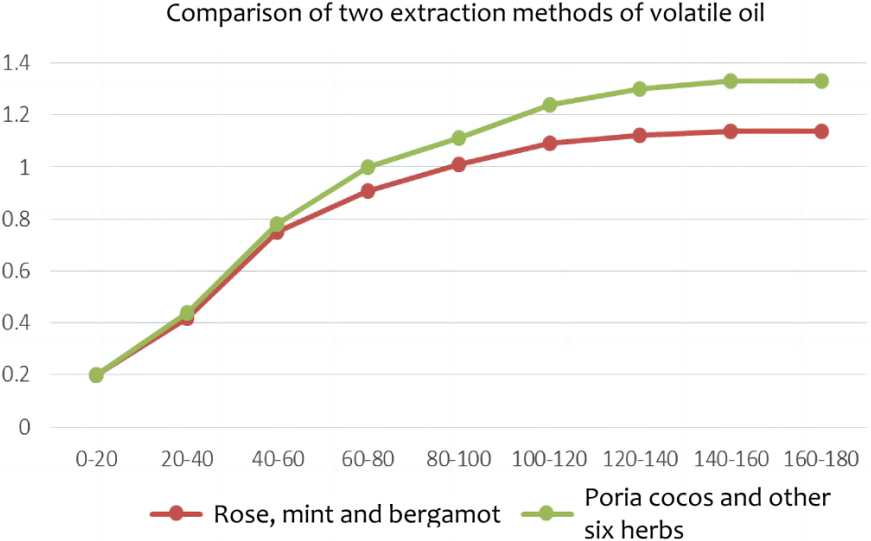
In addition, that experiment proved that the water absorption rate of the medicinal material is the fastest within 30 minutes of soaking, and the water absorption rate within 30 minutes is greatly influenced by rose, mint, and fingered citron, while the water absorption rate within 60 minutes to 120 minutes is mainly influenced by Chinese date. Measuring the rate at which medicinal materials absorb water helps to maximize extraction procedures, regulate soaking time, and increase bioavailability. Consistent product quality and reduced resource use are guaranteed by effective water absorption. Sustainable extraction is aided by knowledge of plant physiology. After 120 minutes, the water absorption rate of the medicinal material reached 149.46%, and the water absorption rate slowed down, which is lower than 16% per hour 105.11 g, 107.82 g, the water absorption changed little. In the long term, soaking in a muggy environment will also cause mildew. Therefore, it is appropriate to soak for 2–4 hours. This experiment was conducted in winter, so 4 hours of soaking was selected.
Response surface methodology (RSM) is a statistical approach that modifies temperature and duration in tests in a systematic way to find the parameters for water extraction. A mathematical model represented as a response surface is constructed using the gathered data to help optimize circumstances to maximize or minimize desired results. Take the times of decoction, extraction time (start timing after slight boiling), and the multiple water additions as the investigation factors, and each factor is set with three levels. According to the clinical decoction habits of tea drinks, the factor levels are shown in Table 5. Weigh two parts of medicinal materials in the prescription proportion, put them into a 500 ml flask, experiment according to Table 6, extract the dry extract and weigh the weight, and select the best extraction conditions according to the dry extract rate by response surface methodology. In developing pharmaceutical products in factories, scalability, efficiency, and dependability are critical factors in experimental design. Maximizing production includes scale-up studies, realistic operating conditions, robust processes, sensitive parameters, appropriate equipment, environmental control, FMEA, regulatory compliance, QbD principles, and continuous improvement.
Experimental factors and levels of water extraction process investigation
Experimental factors and levels of water extraction process investigation
Based on the dry extract weight and the obtained hesperidin content, a response surface experiment was performed:
The weight of dry extract powder after water extraction 1, 2, and 3 times was compared by extracting for 30 minutes and adding water nine times. The weight of dry extract powder was reached when the extraction time was 30 minutes, and the times of adding water were 6, 9, and 12. Comparing the weight of dry extract powder after adding nine times of war and extracting for 20 minutes, 30 minutes, and 4,0 minutes, it was found that the above parameters greatly influenced the weight of dry extract powder. The main factors affecting water extraction were decocting times, extracting time, and adding water and removing times. Various factors influence decocting times, including plant variability, economics, standardization, efficiency optimization, traditional practices, temperature sensitivity, bioactive constituent extraction, and material complexity. The ultimate goal is to maximize the desired compounds. According to the pre-experiment results, each factor was coded with
Experimental arrangement of water extraction process
Water extraction experiment
Water extraction experiment hesperidin content
Significance of fitted equation.
After obtaining the above experimental results, the analysis model was established using the Design-Expert V. 10 software to analyze the response surface methodology (Fig. 3).
Comparing the significance of the fitted equations, the results were all “significant”. Observe the normal distribution of the residuals (i.e., the difference between the actual and estimated values) as shown in Figs 4 and 5.
Actual vs. estimated.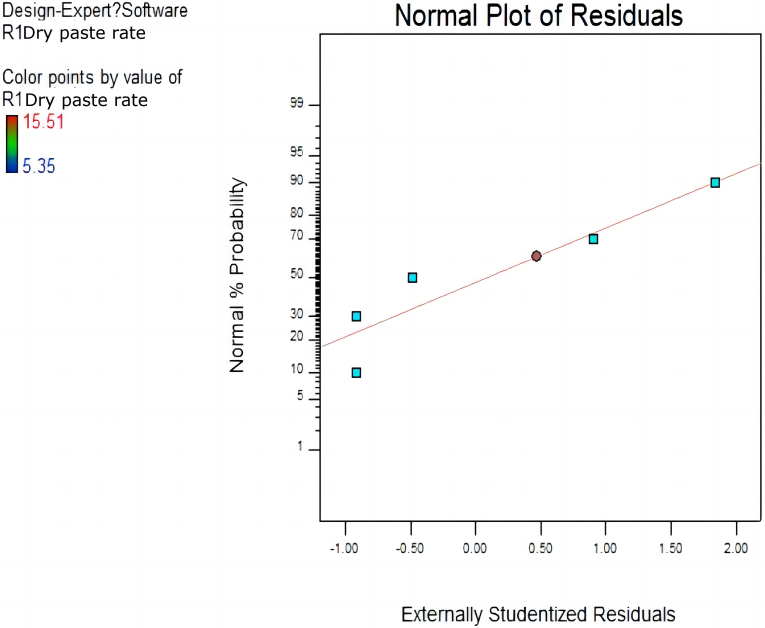
Actual vs. estimated.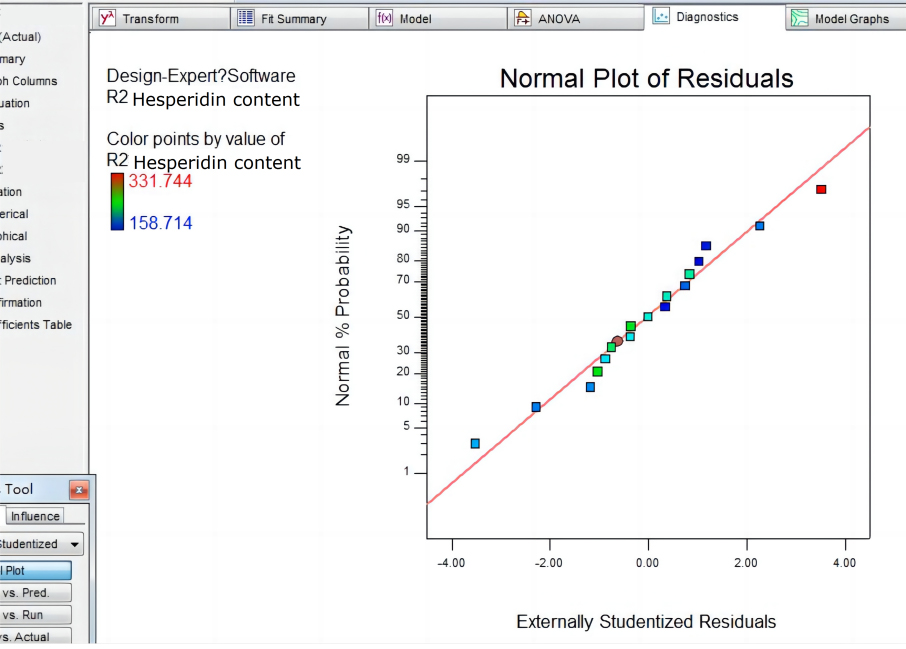
See Fig. 6 for the plot of residuals versus equation predictions (the more scattered and irregular the distribution, the better).
Plot of residuals vs. equation predictions.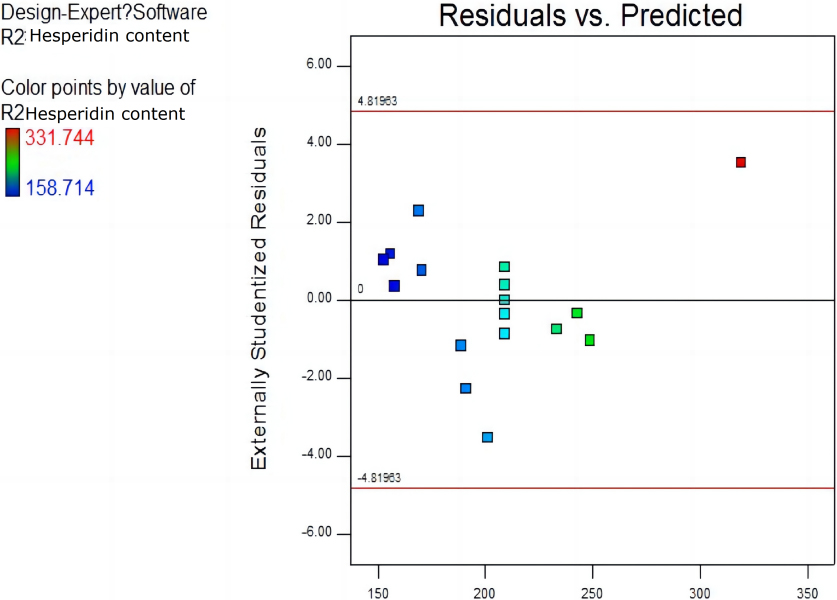
Multiple linear regression and equation fitting were carried out on the three factors (independent variables) A, B, and C, respectively, and the regression equation was as follows:
Hesperidin content
According to the determined equation as the model, the corresponding dry extract weight and hesperidin content as the dependent variables, draw the three-dimensional map of the response surface. In hesperidin extraction processes, a three-dimensional map of the response surface facilitates the identification of ideal conditions, the visualization of variable interactions, the validation of models, the performance of sensitivity analyses, the effective optimization of processes, the definition of perfect varying ranges, the disclosure of nonlinear relationships, and the evaluation of risk and robustness. The decoction times are discontinuous variables, hence C can only be taken as one time, two times, and three times. The corresponding contour lines and three-dimensional map are as outlined in the following figures: Decocting once (Figs 7–10); decocting ptwice(Supplementary Figs 1–4); decocting thrice (Supplementary Figs 5-7); equation Predictions vs. actual (Supplementary Fig. 8).
Contour modeling (hesperidin).
Three-dimensional curve modeling (hesperidin).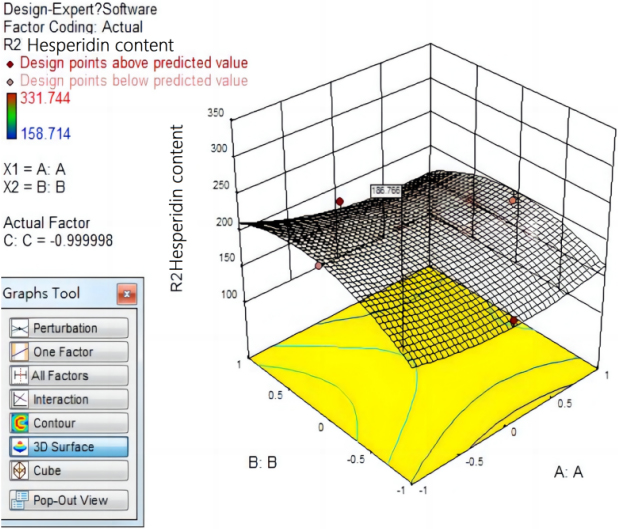
Contour modeling (dry paste ratio).
3D curve modeling (dry paste ratio).
According to Figs 7–10 and Supplementary Figs 1-8, the following conclusions can be drawn:
Each part of the experimental medicinal materials is four parts of Chinese restorative materials, and the weight of each part is 18 g, performing the water extraction and concentration processes.
(1) Under one extraction, the dry extract rate increased with extraction time and water content.
The reason for the two high points in the chart is that at the beginning of extraction, because the liquid medicine has been thoroughly soaked, many substances are dissolved in the aqueous solution. Hence, the software simulates the rising trend according to the data in the image under the condition of short extraction time and less water addition. The trend is confirmed by experimental verification. Water-soluble components of plant materials, such as extractives, phenolic compounds, vitamins, alkaloids, amino acids, and pigments, dissolve in an aqueous solution during extraction. Other solvents can collect more bioactive substances. Thorough experimental settings, such as reproducing parameters, managing the environment, robust sampling, real-time monitoring, sensitivity testing, comparison analysis, feedback loops, documentation, validation criteria, and peer review, are essential to validate the increasing trend in simulations. In addition, by observing the dry paste trend of the second and third extractions, it can be seen that the trend is gradually not evident with the increase of extraction times.
The hesperidin content decreased first and then increased with water content, but the trend was not obvious. There are several reasons why the concentration of hesperidin decreases as the water content increases, including the influence of temperature and extraction time, matrix interactions, dilution effects, hitting solubility limitations, and possible degradation. You may lessen these impacts and increase hesperidin output by optimizing the extraction conditions. With the increase in heating time, the hesperidin content increased first and decreased slightly when the heating time was close to 40 minutes.
Under these conditions, the highest dry extract weight of a sample of experimental medicinal materials was 10.98 g, and the hesperidin content was about 185.99
(2) The dry extract rate increased with the increase of the two conditions when the times of adding water were more than nine and the time was more than 30 minutes, and the maximum dry extract rate was obtained when the conditions reached the upper limit of the interval. According to the contour map, it can be clearly seen that the effect of the water addition ratio on dry extract rate is greater than that of extraction time.
The content of hesperidin decreased with the increase of the water addition ratio. The content of hesperidin increased at first and then reduced with heating time.
Under these conditions, the maximum amount of hesperidin extracted from a sample of experimental medicinal materials was 271.53
(3) The weight of the dry extract increased with the ratio of water and heating time when the extraction time was fixed three times. The weight of the dry extract was higher than 14 g when the water ratio was 12 times and the extraction time was 20 minutes or the water ratio was 8
The hesperidin content is more than 300
Under these conditions, the maximum hesperidin extracted from a sample of experimental medicinal materials was 309.60
Therefore, if hesperidin is taken as the only index, the best index is extraction three times, the condition of adding six times, and the time of 32.325 min. If that weight of dry extract was taken as the only index, the optimum condition was as follows: extract three times, adding 8.697 times of wat, heating for 40 min.
If those two parameters are higher than 95% of the high value, i.e., higher than 14.74 g, 294.12
According to the 20 optimal solutions given by the system, if according to the dry paste weight. The weight of hesperidin content is 6:4, and the two solutions with the highest scores are selected as follows(Supplementary Fig. 10).
The screen solution can be determined if the weight ratio of the dry extract weight to the hesperidin content is 5:5. The final parameters were determined to facilitate the actual operation: extraction three times, extraction time for 40 min, and water addition multiple approaching six times.
Response surface validation experiment: Three validation experiments were carried out according to the optimized process conditions, and the results of sample 18 19 and 20 showed that the average content of dry extract was 14.80 g and the moderate content of hesperidin was 254.34
Through the literature analysis, network pharmacology analysis, and experiments, the feasible scheme of producing Qi Yu constitution Yangsheng granules in the factory is determined, and the optimal process is determined according to the mathematical model established by the content of hesperidin measured by HPLC and the weight of dry extract. For a factory to achieve its operational excellence and product quality goals, it is essential to optimize the manufacturing process of Qi Yu constitution Yangsheng granules manufacturing process. This includes optimizing formulation, efficient resource utilization, consistent product quality, yield maximization, cost reduction, and compliance with quality standards. By comparison, response surface methodology was chosen as the analysis tool instead of the orthogonal experiment.
This choice is based on the following considerations:
The response surface model is more realistic: The mathematical model based on the orthogonal experiment is linear, which is inconsistent with the fact that multiple factors cross-affect the experimental results. When the experimental conditions change, the results are often not linear (for example, the increase in water volume is beneficial to the dissolution of effective substances but also increases the difficulty of concentration. If the heating method is used for concentration, the material loss caused by heating will also increase). The response surface method based on a multi-dimensional high-precision regression equation makes up for this shortcoming. The factory production has different needs: On the premise of stable quality, according to the specific situation, saving time and fast production, or saving energy. Orthogonal experiments can only obtain the pre-set value; the conditions provided are limited and cannot meet the above requirements. The response surface model can achieve the above goal. The response surface can simulate the values of various parameters in the conditioning interval according to the experimental conditions, which meets the requirements of obtaining a stable production interval in the factory. The response surface model can get the best production condition interval, prioritize the conditions in the interval according to the production conditions of the factory, and produce products of similar quality under different conditions by fine-tuning other conditions to obtain stable production quality and ensure the stability of the products. The response surface model can provide more effective mathematical support for fine-tuning conditions.
The premise of the orthogonal experiment was that the extraction time was the same. If we want to analyze the optimal solution under fixed conditions, we need to redesign the experiment, and the results of the past orthogonal experiment need to be more competent. The response surface experiment provides the possibility of predicting the experimental results under fixed conditions, which can ensure the stability of product quality according to the formula of response surface simulation.
Author contributions
All authors reviewed the results, approved the final version of the manuscript and agreed to its publication.
Data availability
The experimental data used to support the findings of this study are available from the corresponding author upon request.
Funding
This study is supported by the National Key R&D Plan Fund (No. 2019YFC1711700); Chinese Sleep Quality Assessment Technology (No. JBGS2021009); and the Science and Technology Innovation Engineering Project of the China Academy of Chinese Medical Sciences (No. CI2021A05407).
Supplementary data
The supplementary files are available to download from http://dx.doi.org/10.3233/THC-232034.
Footnotes
Acknowledgments
The authors would like to express their gratitude to everyone who contributed to this research.
Conflict of interest
The authors declare that they have no conflicts of interest regarding this work.