



Abstract
BACKGROUND:
Rib fractures are one of the most common blunt injuries, accounting for approximately 10% of all trauma patients and 60% of thoracic injuries. Multiple rib fractures, especially flail chest, can cause local chest wall softening due to the loss of rib support, leading to paradoxical breathing, severe pain, and a high likelihood of accompanying lung contusions.
OBJECTIVE:
This study investigates the mechanical properties of a new polymer material rib internal fixator to provide theoretical data for its clinical use.
METHODS:
We conducted in vitro mechanical tests on 20 fresh caudal fin sheep ribs, using different fracture models across four randomly assigned groups (five ribs per group). The fixators were assessed using non-destructive three-point bending, torsion, and unilateral compression tests, with results averaged. Additionally, finite element analysis compared stress and strain in the polymer fixators and titanium alloy rib plates during bending and torsion tests.
RESULTS:
In vitro tests showed that the polymer fixators handled loads effectively up to a maximum without increase beyond a certain displacement. Bending and torsion tests via finite element analysis showed the polymer material sustained lower maximum equivalent stresses (84.455 MPa and 14.426 MPa) compared to titanium alloy plates (219.88 MPa and 46.47 MPa).
CONCLUSION:
The polymer rib fixator demonstrated sufficient strength for rib fracture fixation and was superior in stress management compared to titanium alloy plates in both bending and torsion tests, supporting its potential clinical application.
Introduction
Rib fractures are one of the most common blunt injuries, accounting for approximately 10% of all trauma patients and 60% of thoracic injuries [1]. Multiple rib fractures, especially flail chest, can cause local chest wall softening due to the loss of rib support, leading to paradoxical breathing, severe pain, and a high likelihood of accompanying lung contusions. These conditions can further induce acute respiratory distress syndrome (ARDS) or multiple organ failure (MOF) [2, 3]. If not treated promptly, the mortality rate can reach 15–20% [4]. In recent years, the use of rib internal fixators for surgical treatment has become a consensus in the industry. Surgical treatment not only eliminates floating chest walls and flail chest, reducing the risk of complications, but also effectively reduces the use of ventilators and hospital stay, significantly alleviating patients’ pain [5]. Currently, commonly used rib internal fixation materials in clinical practice include pure titanium claw-type osteosynthesis plates, nickel-titanium memory alloy encirclers, chain-type nail plate systems, and polylactic acid absorbable fixation nails. Long-term retention of these implants in the body can affect patient prognosis [6]. This study aims to address the shortcomings of current non-absorbable fixation materials, by designing and manufacturing an absorbable polymer material rib internal fixator. Its feasibility and reliability to provide sufficient fixation strength for rib fractures are jointly verified through finite element modeling analysis and in vitro mechanical experiments.
Materials and methods
Materials and equipment
Experimental specimens
The study was approved by the Ethics Committee of Tianjin Hospital Affiliated to Tianjin University, China. 20 fresh caudal fin sheep rib specimens were used. Muscles and soft tissues attached to the ribs were carefully removed before the experiment, while preserving the periosteum. The ribs were sawed into 20 cm equal-length mid-sections. All specimens were free from deformities, damage, and other pathological changes. The width and thickness of the specimens were measured, and the type of internal fixation material was determined based on these measurements (all specimens were 20 cm in length and 2 cm in width). The 20 ribs were numbered and divided into 4 groups, with 5 ribs in each group, using a random number table method. During the experiment, normal-temperature saline was intermittently sprayed on the specimen surfaces to keep the ribs moist. The polymer material rib internal fixator was used for anatomical positioning and fixation after sawing the ribs at the midpoint.
Materials and equipment
Polymer material rib internal fixator: characterized by including a binding strap (bundling strip, fixation head), and a fixture (length 4 cm, width 2 cm) with thermoplastic properties, becoming soft under high temperatures allowing manual curvature adjustments to fit the rib more closely, and hardening at normal temperature for fixation. The binding strap is attached to the fixture (one end of the strap is fixed, the other end is free). The fixture has fixing holes (with cards and grooves on both sides of the fixture, and the binding strip is fixed in the groove). The binding strap passes through the fixing holes and is fixed together with the fixture. The fixture and binding strap are used together, where the strap has a certain width (5 mm) and length (8 cm), increasing the contact area with the ribs and sternum, preventing damage due to a small contact area. Bose ElectroForce 3200 biomechanical experimental system and its biomechanics analysis software (Tianjin Hospital Orthopedics Research Institute), three-point bending and torsion experiment molds (Tianjin Hospital Orthopedics Research Institute), vernier caliper (Mitutoyo, Japan), pendulum saw, Type II dental base tray powder and self-condensing dental tray water (Beijing Oriental Rainbow Dental Materials Co., Ltd.), ABAQUS (3D modeling software), Ansys2021R2 (finite element preprocessing).
Mechanical experiments
Non-destructive three-point bending test
During the experiment, the rib specimens were divided into two groups based on their orientation: inner side facing up and outer side facing up, as shown in Fig. 1(a) and (b). One group of rib specimens was placed on the three-point bending fixture for testing. The parameters were set with a span of 100 mm and a displacement speed of 2.5 mm/min, with a maximum displacement limit of 12 mm. The force application point was at the midpoint of the fracture line. The computer recorded the displacement of the force center and the corresponding applied force, noting the loads at displacement points of 2, 4, 6, 8, 10, and 12 mm (unit: N).
Experiments on polymer material rib fixator involving three-point bending, torsion, and unilateral compression bending. (a) Non-destructive three-point bending experiment model with outer side facing up; (b) Non-destructive three-point bending experiment model with inner side facing up; (c) Non-destructive torsion experiment model; (d) Unilateral compression bending test experiment model.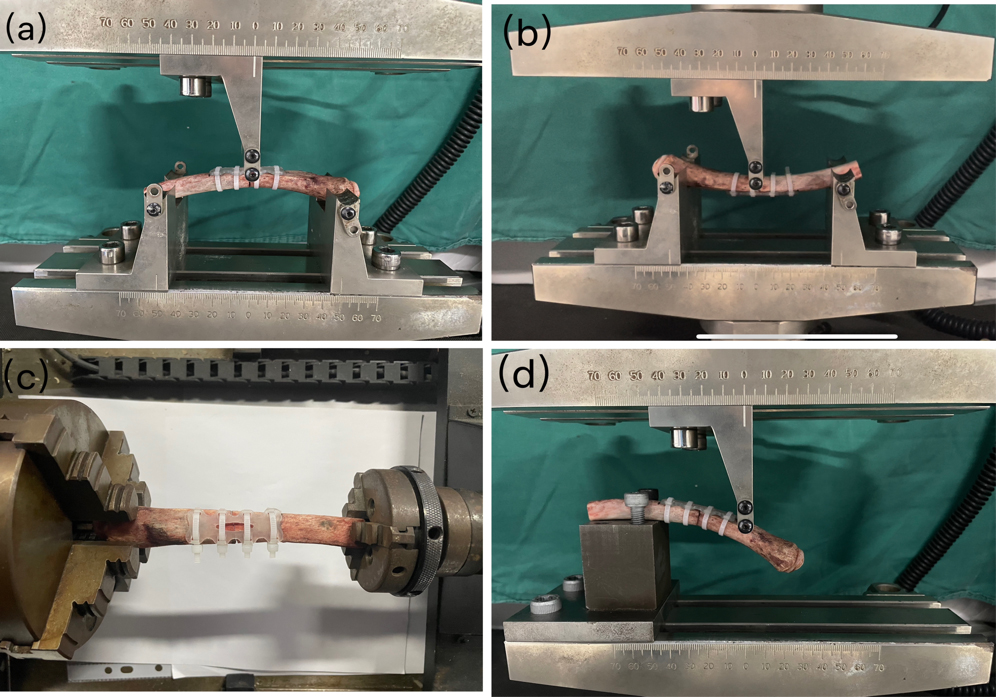
Another group of rib specimens was taken, with fixtures installed at both ends of the specimens. The distal end was fixed, and a rotational load was applied to the proximal end. Centering on the fracture line, a torsion angle sensor was placed, and torsion was performed at a speed of 10∘/min. The torsional torques at torsion angles of 5∘, 10∘, 15∘, 20∘, 25∘, and 30∘ were recorded (unit: N
Unilateral compression bending test
Another group of rib specimens was taken, with one end fixed on the unilateral compression bending jig and the other end left hanging. The fixing point and the pressure roller axis were located 20 mm horizontally from the edge of the rib fixator at the fixed and hanging ends, respectively. The loading speed of the pressure roller axis was 2.5 mm/min, and the experiment was stopped when the force value no longer increased, as shown in Fig. 1(d).
Rib and brace modeling
Using Mimics20.0 software, human rib CT data was reconstructed to form a three-dimensional model of the rib (as shown in Fig. 3). ABAQUS software was used to establish three-dimensional models of an octopus rib plate and a polymer material rib internal fixator (as shown in Fig. 2(a), (b), (c), and (d)). The rib model was then bundled and assembled with the above two types of fixators (as shown in Fig. 3(a), (b), (c), and (d)).
(a) & (b) Eight-claw rib plate model; (c) & (d) High-polymer rib internal fixator model.
(a) Schematic assembly of the high-polymer bundled rib fixator; (b) Assembly under worst-case conditions for the high-polymer bundled rib fixator; (c) Worst-case scenario assembly for the eight-claw rib plate; (d) Schematic assembly of the eight-claw rib plate. 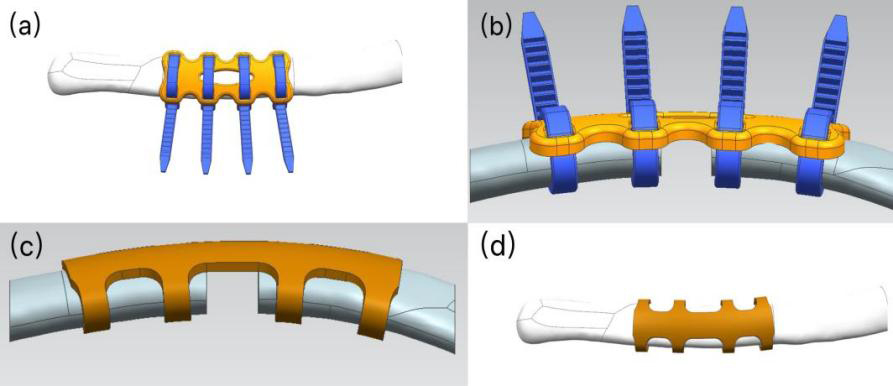
The finite element processing software Ansys2021R2 was used to mesh the generated geometric models, assign materials, define contacts, and set loads. The meshing of the samples is shown in Table 1; material properties of the samples are listed in Table 2. The contact between the polymer material rib internal fixator and the rib was set as frictional contact with a friction coefficient of 0.2. The contact between the binding strap and the polymer material fixation plate was set as bonded contact, and between the strap and the rib as frictional contact, with a friction coefficient of 0.2. The contact between the octopus osteosynthesis plate and the rib was also set as frictional contact, with a friction coefficient of 0.2. Both models underwent bending and torsional load conditions (as shown in Fig. 4), observing the stress-strain distribution of the polymer material rib fixator and the octopus rib plate. During the torsion simulation, one end of the rib was completely fixed, and a torque of 1 N
Mesh division details
Mesh division details
Material characteristics
(a) & (b) Schematic diagrams of bending load application; (c) & (d) Schematic diagrams of torsional load application.
Non-destructive three-point bending experiment
For the group with the inner side facing up, the maximum load occurred at a displacement of 10 mm, reaching 28.3 N. In the group with the outer side facing up, the load increased with increasing displacement, with the maximum load appearing at a displacement of 12 mm, reaching 13.8 N. The relationship between displacement and load during the experiment is illustrated in Table 3 and Fig. 5. Visual observation revealed that at the limit displacement, the group with the inner side facing up exhibited a gap widening of 2–3 mm, while the group with the outer side facing up showed a gap widening of 3–4 mm. After releasing the pressure and removing the jig, the group with the inner side facing up still had a widened gap of 1–2 mm. The group with the outer side facing up, however, returned to its original state, as shown in Fig. 6.
Relationship between displacement and load in non-destructive three-point bending experiment
Relationship between displacement and load in non-destructive three-point bending experiment
Relationship between torsion experiment angles and torsional moments
Relationship between displacement and load in non-destructive three-point bending test.
The corresponding torsional torques of the fixator at rotation angles of 5∘, 10∘, 15∘, 20∘, 25∘, and 30∘ were 13, 20, 27, 34, 42, and 49 N
Unilateral compression bending test
The polymer material rib fixator reached a displacement of 9.2 mm with a corresponding load of 15.124 N. Subsequently, as the displacement increased, the load did not continue to increase and hovered around 15 N. The maximum load sustained in the unilateral compression bending test is shown in Table 5, and the relationship between displacement and load is illustrated in Fig. 9. Changes before and after the unilateral compression bending test experiment are shown in Fig. 10.
Maximum load sustained in the single-sided bending test
Maximum load sustained in the single-sided bending test
(a) Rib’s inner side facing up experiment, situation when pressure is applied to 12 millimeters; (b) Rib’s outer side facing up experiment, situation when pressure is applied to 12 millimeters; (c) Rib’s inner side facing up, before the experiment; (d) Rib’s inner side facing up, after the experiment; (e) Rib’s inner side facing up, after the experiment; (f) Rib’s outer side facing up, before the experiment; (g) Rib’s outer side facing up, after the experiment; (h) Rib’s outer side facing up, after the experiment. 
In the finite element analysis, the maximum equivalent stresses of the polymer material rib fixator in the bending and torsion tests were 84.455 MPa and 14.426 MPa, respectively. For the octopus rib plate, the maximum equivalent stresses were 219.88 MPa and 46.47 MPa, respectively. The maximum equivalent stresses and strains in the ribs fixed with both methods are shown in Table 6. The distribution of stress and strain is illustrated in Figs 11 and 12.
Maximum equivalent stress and equivalent strain of the ribs after fixation using 2 methods
Maximum equivalent stress and equivalent strain of the ribs after fixation using 2 methods
Torsional moment – torsion angle curve. (a) Image after the experiment; (b) Image before the experiment; (c) Image after the experiment; (d) Image at a rotation angle of 30∘.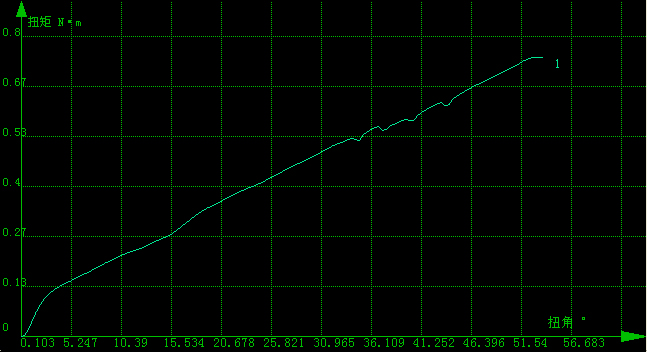
Images of the polymer material rib fixator experiment.
Relationship between displacement and load in the single-sided bending test.
Images of the unilateral compression bending test experiment with polymer material. (a) Image before the experiment; (b) Image before the experiment; (c) Image after the experiment; (d) Image before the experiment.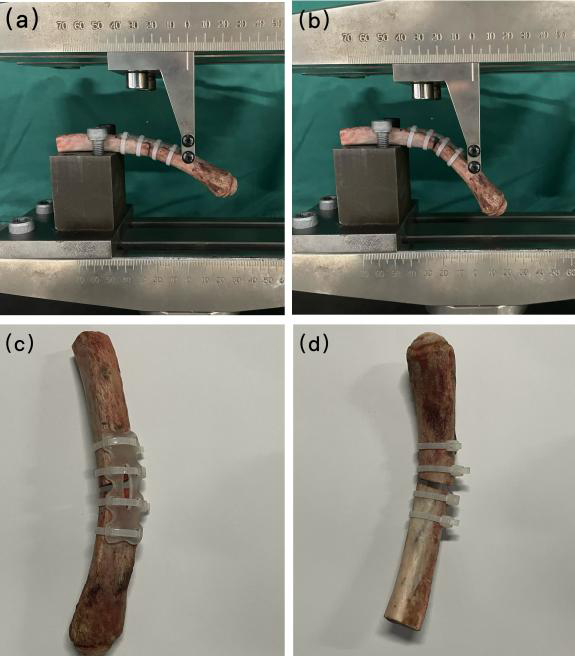
Stress and strain distribution cloud diagrams in bending and torsion simulation of polymer material rib fixator. (a) Stress distribution of polymer material rib fixator in bending resistance; (b) Strain distribution of polymer material rib fixator in bending resistance; (c) Stress distribution of polymer material rib fixator in torsion resistance; (d) Strain distribution of polymer material rib fixator in torsion resistance.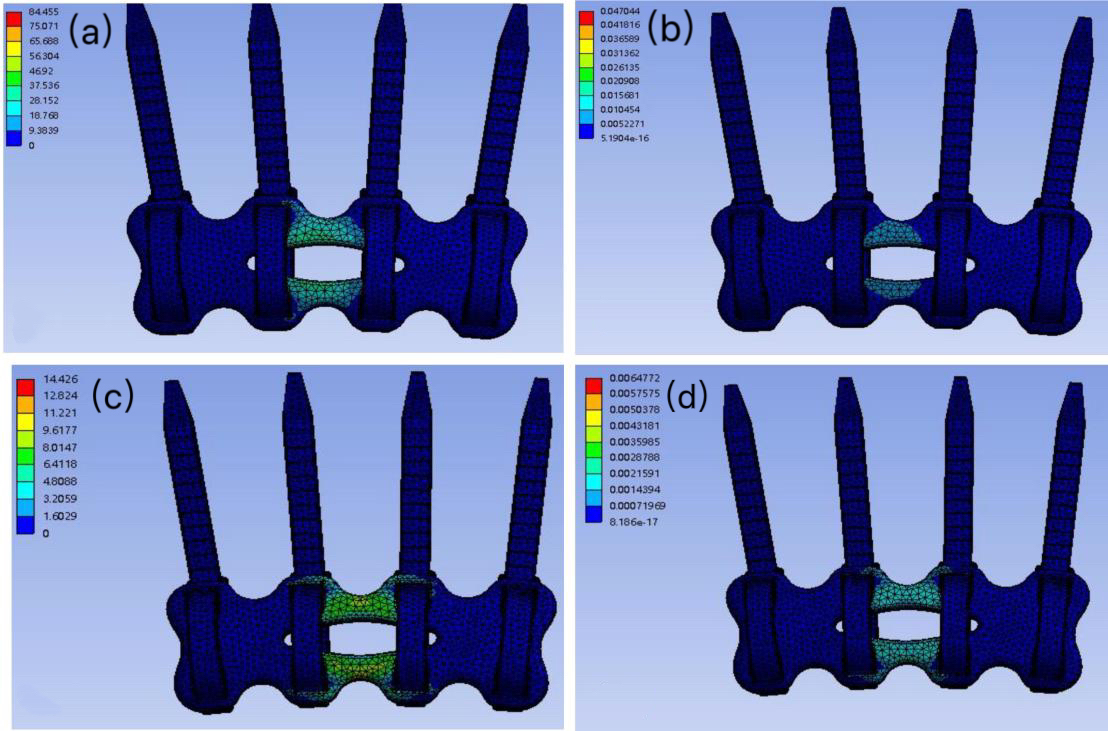
Stress and strain distribution cloud diagrams in bending and torsion simulation of octopus rib plate fixator. (a) Stress distribution of the octopus rib plate in bending resistance; (b) Strain distribution of the octopus rib plate in bending resistance; (c) Stress distribution of the octopus rib plate in torsion resistance; (d) Strain distribution of the octopus rib plate in torsion resistance.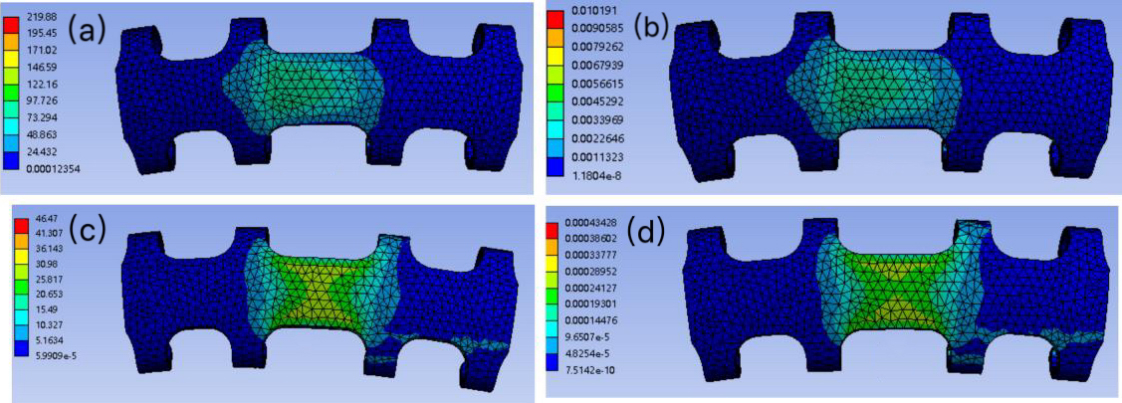
Currently, the commonly used materials for rib internal fixation in clinical practice include pure titanium claw-type osteosynthesis plates, nickel-titanium memory alloy encirclers, and chain-type nail plate systems. Postoperative internal implants remaining in the body for a long time can affect patient prognosis [7]. Designing a rib fracture fixation method suitable for absorbable materials is imperative. The newly designed polymer material rib internal fixator in this study adopts a binding fixation method, divided into binding straps and fixing beams. The binding strap part has certain toughness and plastic stability, while the beam part has higher mechanical strength. The main body of the fixator uses a three-point binding fixation design to achieve overall mechanical stability. The inner side of the beam is designed with floating points to increase friction and reduce pressure on the periosteum.
Ribs contribute to the structure of the thoracic cage and are closely related to its physiological functions, aiding in respiration [8, 9]. During normal human respiratory movements, the movement trajectory of the ribs involves bending and twisting, similar to the movement of pump and bucket handles. Therefore, this study conducted bending and torsion tests. The intercostal muscles, important muscles involved in respiratory movement, exert a pulling effect on the ribs during breathing, hence the ribs bear a certain amount of physiological load [10, 11]. In the finite element experiment, the ribs were cut in the middle, leaving a 10 mm wide gap to simulate the worst-case scenario in the actual experiment and assess the bending resistance limit of the samples. The force required on the lower surface of the sternum during deep human breathing is approximately
The in vitro mechanical three-point bending experiment observed that under the limit displacement of 12 mm, the deformation of the polymer material rib internal fixator was greater than that of the titanium metal encircling osteosynthesis plate reported in the literature [13]. This is because the toughness of polymer materials is better than that of metal materials, making rib plates made from them better at releasing stress [14]. Finite element analysis results supported this view. In static tests, the normal pressure of the polymer material rib plate at the limit displacement of 12 mm was about 27.5 N, and the reverse pressure was 13.8 N, with the maximum unilateral compression bending force limited to 15.128 N. Even if the displacement continued to increase, the force value would not. Referencing literature on human rib mechanics and current fixation materials [15, 16], it is concluded that polymer material rib plates provide a certain level of protection for fractured ribs. Even if the rib position changes later due to coughing or deep breathing, or the ribs deform due to external pressure, the force value will not exceed the maximum force of 46.7 N that ribs need to bear. The pressure can be released by the polymer material rib plate. Torque represents the force that causes an object to rotate, reflecting the load capacity within a certain range. The purpose of the non-destructive torsion experiment, examining the relationship between rotation angle and torque, is to measure the torsional yield strength and torsional strength after rib fixation [17, 18]. The experiment found that the corresponding torsional torques of the polymer material rib internal fixator at rotation angles of 5∘, 10∘, 15∘, 20∘, 25∘, and 30∘ were 13, 20, 27, 34, 42, 49 N.cm. Compared to data in the literature [13, 19], it suggests that the torsional properties of polymer materials are similar to those of mainstream rib fixation materials and can achieve stable fixation effects with higher maximum loads as the angle increases.
With the advancement of medical and health services, high-performance biomedical materials, especially high-performance biomedical polymer materials with degradability, are increasingly prominent in the medical device field [20, 21, 22]. Through finite element modeling analysis and in vitro mechanical experiments, it was proven that the polymer material rib internal fixator can provide sufficient strength for rib fracture fixation, providing mechanical data support for the future design of absorbable rib fixators with this fixation structure.
There are several limitations for this study. First, the study employed only caudal fin sheep ribs as test samples, and the limited sample size might not adequately replicate human rib biomechanics, potentially affecting statistical significance and broader applicability. Additionally, the experimental design relied on non-destructive three-point bending and torsion tests that may not fully represent the fixator’s performance under diverse clinical conditions. The controlled testing environment differs from real-life human applications. Although the article evaluates the short-term mechanical properties of the polymer material, it lacks a comprehensive analysis of its long-term biocompatibility and stability. Furthermore, the long-term effects of material degradation byproducts on surrounding tissues remain unexplored. Lastly, the findings are primarily based on laboratory testing and finite element analysis without clinical trial data, leaving the fixator’s actual clinical efficacy and safety unproven. Thus, further animal experimental and clinical research is necessary to validate these results’ practicality and effectiveness.
Advancements in artificial intelligence (AI) are significantly enhancing medical diagnostics and device management [23]. AI models precisely predict medical device performance and standardize diagnostic imaging, reducing human errors [24]. For neonatal care, AI-enhanced systems improve infant incubator management [25]. In pharmacology, AI accurately predicts antimicrobial activity, facilitating faster drug development [26]. Additionally, AI software for diagnosing Chronic Obstructive Pulmonary Disease (COPD) mirrors clinical assessments with high accuracy, improving treatment management [27]. Looking ahead, the potential of AI extends into orthopedics, particularly in designing and optimizing rib fracture fixators, which could revolutionize material selection and device configuration for better patient outcomes and personalized treatments.
Funding
The authors report no funding.
Data availability
The datasets used and/or analyzed during the current study are available from the corresponding author on reasonable request.
Ethics approval and consent to participate
The study was approved by the Ethics Committee of Tianjin Hospital Affiliated to Tianjin University, China.
Footnotes
Acknowledgments
The authors have no acknowledgments.
Conflict of interest
The authors declare that they have no conflict of interest.