



Abstract
BACKGROUND:
Cirrhosis is one of the most common clinical diseases in the world. The patient with cirrhosis has many complications, such as spontaneous peritonitis, hepatic encephalopathy. Malnutrition is one of the most common complications in patients with cirrhosis, and it is also a key factor affecting the prognosis of patients. However, the research on cirrhosis malnutrition is relatively scarce.
OBJECTIVE:
This study aimed to explore the new factors of the liver cirrhosis with the nutritional status.
METHODS:
A total of 370 patients with liver cirrhosis were admitted to the Fourth Affiliated Hospital of Harbin Medical University from January 2019 to January 2023 were selected. Patients were assigned to the malnourished group and normal group. The weight, height, mid arm circumference (MAC) and triceps skinfold thickness (TSF) of the two groups were measured. Body mass index (BMI) and mid-arm muscle circumference (MAMC) were calculated. Furthermore, the Health Literacy Management Scale (HeLMS), biochemical indexes, incidence of complications, disease grade were also counted and the Royal Free Hospital-Nutrition Prioritization Tool were used to evaluate the nutritional status of the patient.
RESULTS:
A total of 370 patients was included in this study, including 177 malnutrition patients, accounting for 45.29%, and the scores and total scores of the patients in the malnutrition group were lower than those in the normal group. The measured values of Na
CONCLUSION:
The incidence of malnutrition in cirrhotic patients included in this study was at a moderate level, and the nutritional literacy of these patients was low. In addition, the level of serum sodium, Hemoglobin can affect the nutritional level of patients with cirrhosis.
Introduction
Cirrhosis is one of the most common clinical diseases in the world. The disease is characterized by diffuse proliferation of fibrous tissue in the liver, resulting in extensive necrosis and the formation of nodules and pseudolobules, which impairs the liver’s ability to perform normal physiological functions [1, 2]. According to a systematic report of disease research covering 195 countries [3], the number of cirrhosis patients worldwide has exceeded 160 million in 2017, and the number of cirrhosis deaths accounted for 2.4% of the total global deaths. Although with the development of medical technology in recent years, the mortality rate of this disease has been reduced, however, how to reduce the mortality rate and improve the quality of life of patients is still the primary area of investigation for scholars. Malnutrition is one of the most common complications in patients with cirrhosis, and it is also a key factor affecting the prognosis of patients [4]. In a prospective cross-sectional study of out-patients with cirrhosis in Australia [5], 40% of out-patients with cirrhosis had malnutrition complications. The single-center cross-sectional study conducted by Sharma P et al. [6] showed that 65% of patients with cirrhosis had malnutrition. Meanwhile, the study found that even patients with cirrhosis with normal nutritional status had significantly lower total calorie and protein intake than the recommended value, and malnutrition was a predictor of the morbidity and mortality of patients with cirrhosis. Currently, there are many methods of nutritional screening and nutritional assessment for the diagnosis of malnutrition in cirrhosis [7], such as anthropometric methods, relevant indicators such as Body mass index (BMI), Arm circumference (AC), Triceps Skinfold Thickness (TSF), Arm muscle circumference (AMC). However, there are many malnutrition factors that cause cirrhosis. Meanwhile, because of the differences in population characteristics, regions, diagnostic criteria and diagnostic tools, the influencing factors in various studies varies greatly [5, 6]. Therefore, the objective of this study is to investigate the factors that influence nutritional status in patients with liver cirrhosis, aiming to identify high-risk groups and develop early preventive interventions for malnutrition in cirrhotic patients.
Study subjects and methods
Study subjects
Cirrhotic patients admitted to The Fourth Affiliated Hospital of Harbin Medical University from January 2019 to January 2023 were selected.
Studies have shown that the higher disease grade of cirrhosis, the higher incidence of malnutrition, and its incidence ranges from 25.1% to 65.5% [6, 7, 8, 9]. The incidence rate of 25.1% was employed in this study to estimate the sample size, aiming to comprehensively evaluate the nutritional status of patients with cirrhosis. The sample size was determined to be 154 cases using PASS software. Considering potential trial loss, the sample size was increased by 10%. Consequently, a minimum of 170 patients were proposed for inclusion in the study.
Inclusion criteria
1) Patients with age from 18 to 85 years. 2) Patients with decompensated cirrhosis with Child-Turcotte-Pugh (CTP) of at least 6 and 13 or less. Decompensation was defined as the occurrence of any of the following events: ascites, encephalopathy, variceal bleeding, jaundice, or hepatorenal syndrome (HRS). 3) Patients who agreed to participate in the study and signed informed consent.
Exclusion criteria
1) Patients with acute liver disease except cirrhosis. 2) Patients with serious underlying diseases other than cirrhosis or potential malnutrition potentially interfering with the study results. 3) Patients with incomplete medical records.
On overall subjects the following measures were performed:
Anthropometric measures
According to the measurements conducted by a dietitian, weight, height, mid-arm circumference (MAC), and triceps skinfold thickness (TSF) were assessed. Body mass index (BMI) and mid-arm muscle circumference (MAMC) were calculated. The average value of each variable was obtained through three repetitions.
According to the Royal Free Hospital-Nutrition Prioritization Tool (RFH-NPT) Nutritional screening: Specific screening contents include: assessment of acute alcoholic hepatitis or nasal feeding nutrition, fluid retention, BMI, unplanned weight loss, and insufficient food intake. The evaluation results were divided into 3 levels, 0 as low nutritional risk, 1 as medium nutritional risk, and 2 to 7 as high nutritional risk, the patients were assigned to the malnutrition group who RFH-NPT evaluation results were 1 to 7, and the rest were assigned to the normal group.
Patient clinical data
Clinical information about the patient was collected, such as gender, age, marital status, and education level.
Health literacy management scale
The Health Literacy Management Scale (HeLMS) was developed by Simonds in 1976 to assess the ability of chronic disease patients to perceive health information and risks. The translated and modified version of 2011 by Sun Haolin was used in this study. The scale consists of 24 items, which comprehensively assess patients’ health literacy across four dimensions in the following domains: information acquisition proficiency, communication and interaction aptitude, willingness to improve health outcomes, and readiness to contribute financially. The questionnaire consisted of five options, ranging from “very difficult” to “very not difficult,” with corresponding scores from 1 to 5. The scale scores ranged from 24 to 120, where higher scores indicated greater levels of health literacy in patients. The Cronbach’
Biochemical indexes
In order to ensure the integrity of the collected data, we included routine admission examination indicators. The biochemical indexes of the two groups were counted separately, which included blood sodium (Na
The incidence of complications
According to the medical records, the cases of hypersplenism, ascites, peritonitis, and esophageal and gastric fundus varices in the two groups were counted.
Nutritional status assessment
The nutrition status was measured using the Royal Free Hospital-Nutritional Prioritizing Tool (RFH-NPT), which considers factors such as body fluid retention status, unplanned body mass loss, and alcoholic cirrhosis. The obtained scores were utilized for the classification of nutritional risk levels, with a score of 0 indicating a low risk of malnutrition, a score of 1 representing moderate risk, and scores ranging from 2 to 7 indicating high risk. The tool categorizes a patient’s nutritional risk as low, medium or high. At present, this tool was widely used to assessing the nutritional risk of patients.
Disease grade
The Child-Pugh liver function grading standard was employed in this study to evaluate the hepatic function of the patients, which currently serves as a widely adopted assessment criterion for liver function. This grading system primarily encompasses five parameters, namely serum albumin, total bilirubin, prolonged prothrombin time, ascites, and hepatic encephalopathy. When the score is 5–6, it is class A, when the score is 7–9, it is class B,and if the score is 10 or more, it is class C. A higher score proves that the patient’s liver function is poorer. In this study, patients classified as A were assigned to the normal group, while patients classified as B and C were assigned to the malnourished group
Statistical analysis
The collected data underwent statistical analysis using the SPSS 21.0 software. Mean and standard deviation (mean and SD) were employed to quantify the data, while median and quartiles [M (P25, P75)] were utilized for assessing skewed distribution of the measurement data. The
Results
General information
A total of 370 patients was included in this study, including 177 malnutrition patients, accounting for 45.29%. There were 109 males and 68 females, aged 36–68 years, with a mean of (56.76
General information
General information
The scores and total scores of the patients in the malnutrition group were lower than those in the normal group (Fig. 1).
Comparison of the HeLMS.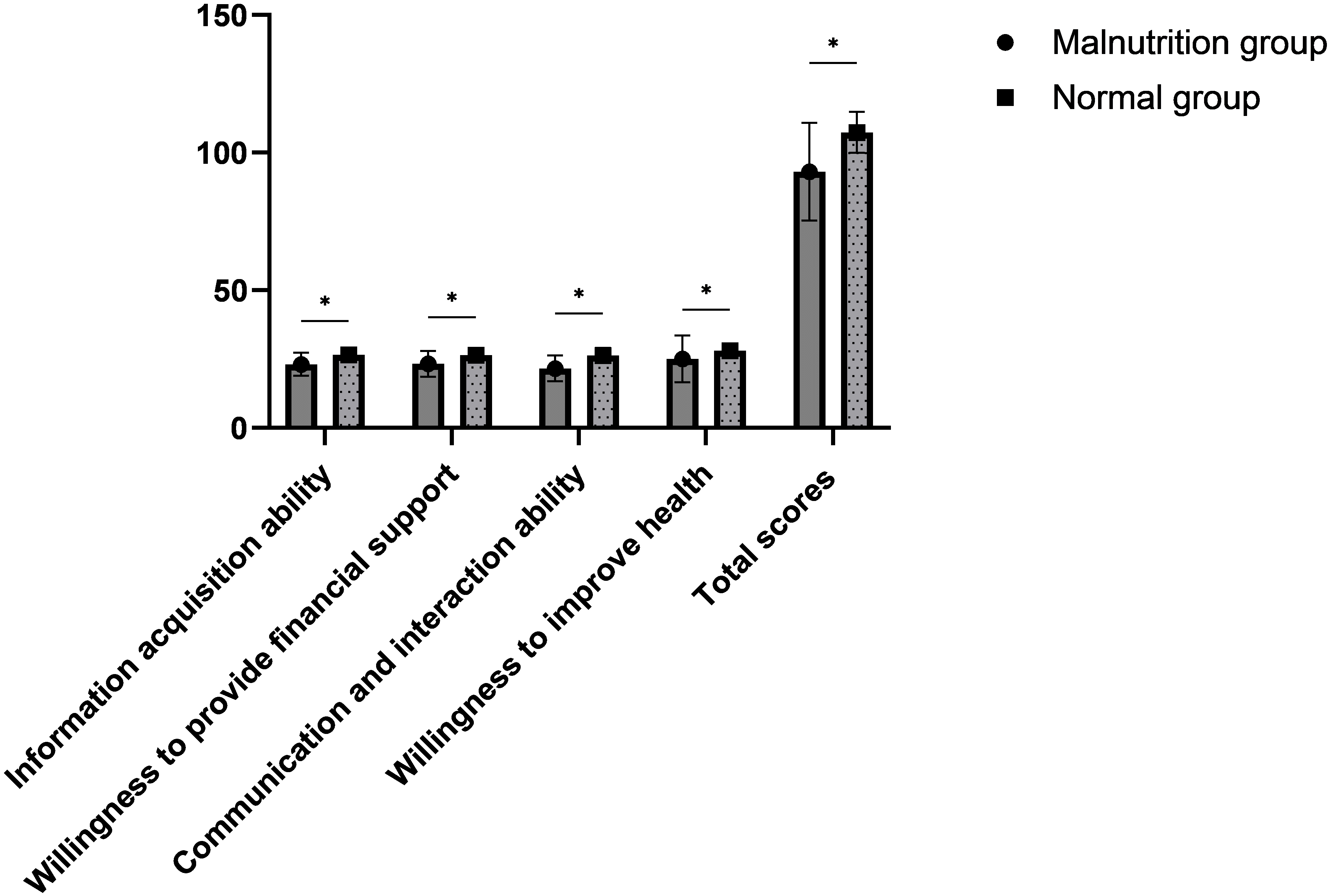
The measured values of Na
Comparison of complication rates
The overall complication rate among patients in the malnourished group was 89.61%, whereas it was 39.78% among those in the normal group. The incidence of complications in the normal group was significantly lower compared to that in the malnourished group (Table 2).
Comparison of complication rates [
(%)]
Comparison of complication rates [
Comparison of serological indexes.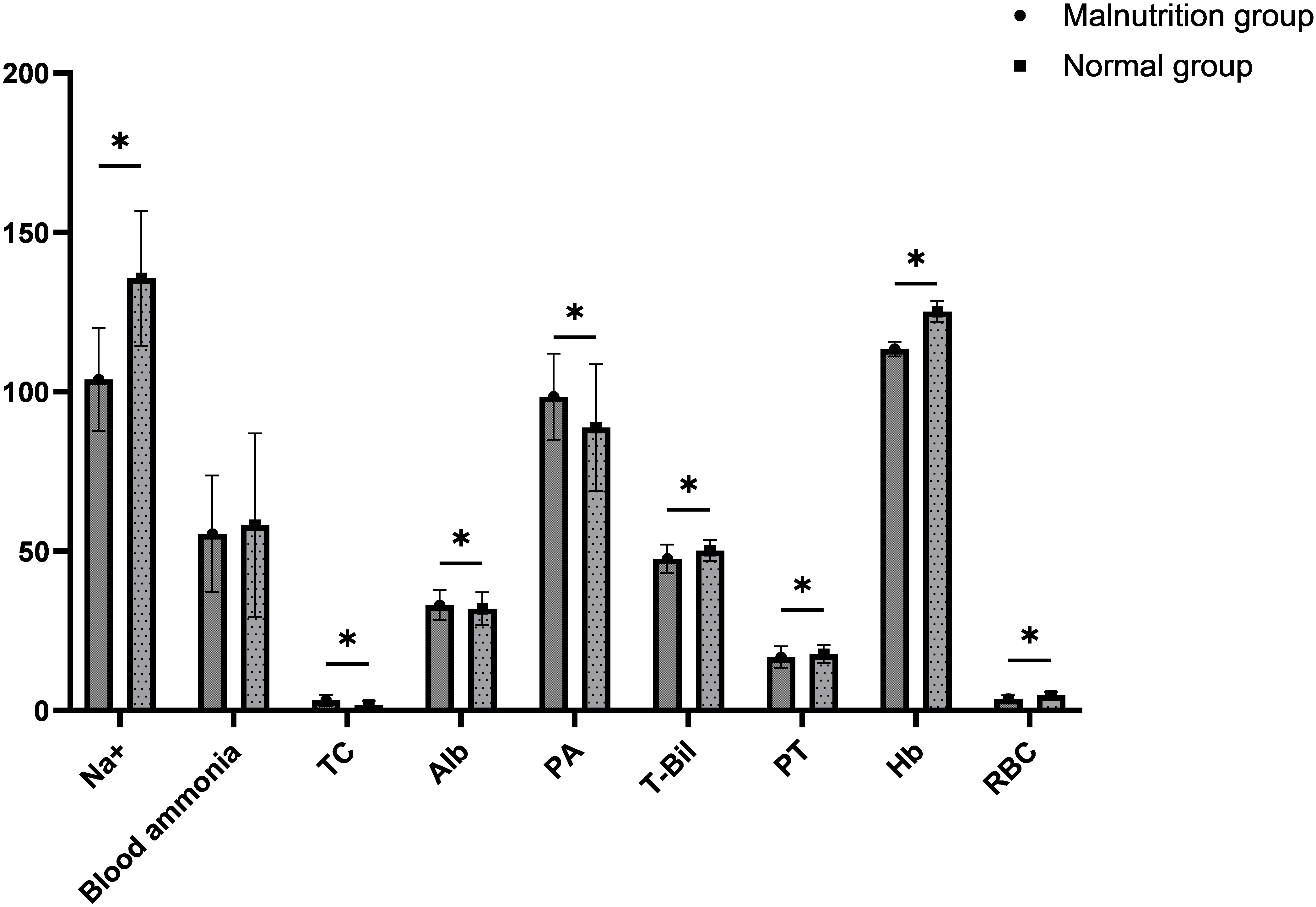
Multifactorial logistic regression analysis was performed with nutritional level as the dependent variable (normal
Logistic regression analysis of factors affecting nutrition level
Logistic regression analysis of factors affecting nutrition level
The statistical findings of different scholars regarding the prevalence of malnutrition in individuals with liver cirrhosis exhibit significant variations. JUAKIEM et al. [10] showed that the incidence of malnutrition is only about 5%, while Boulhosa et al. [11] showed the incidence of malnutrition can reach 57.2%. A total of 370 patients with cirrhosis were included in this study, and among them, 177 or 45.29% were identified as malnourished individuals. A study has shown that patients with different degrees of cirrhosis have different risks of malnutrition [10]. In the early stage of cirrhosis, patients often do not show obvious malnutrition because of the high compensatory capacity of liver. The progressive nature of the disease leads to a loss in hepatic compensatory capacity, resulting in an increasing prominence of malnutrition. The study conducted by CEDERHOLM [12] revealed that patients with cirrhosis in Child-Pugh B category had a significantly higher incidence of malnutrition, approximately five times greater than those in the Child-Pugh A category. In addition, comparing the nutritional literacy scores of the two groups, the results showed that the overall HeLMS of cirrhotic patients in the malnourished group was lower than that of the normal group, suggesting that malnourished cirrhotic patients have a lower degree of cognition and attention to their own nutritional status.
In our study, we found that Sodium, anemia, complications, grade of disease were risks factor of cirrhosis. Sodium, as an essential substance in the human body, is crucial for the regulation of blood volume, blood pressure, osmotic balance, and blood PH stabilization [13]. At the same time, the deficiency of Na
Conclusion
In conclusion, the incidence of malnutrition in cirrhotic patients included in this study was at an intermediate level and the nutritional literacy was low. In addition, the level of serum sodium, Hemoglobin can affect the nutritional level of patients with cirrhosis.
Funding
The authors report no funding.
Data availability
The datasets used and/or analyzed during the current study are available from the corresponding author on reasonable request.
Ethical approval
The study was approved by the Ethics Committee of the Fourth Affiliated Hospital of Harbin Medical University, China.
Footnotes
Acknowledgments
The authors have no acknowledgments.
Conflict of interest
The authors declare that they have no conflict of interest.