



Abstract
Metaphor is important in all sorts of mundane discourse: ordinary conversation, news articles, popular novels, advertisements, etc. Issues of prime human interest – such as relationships, money, disease, states of mind, passage of time – are often most economically and understandably conveyed through metaphor. This ubiquity of metaphor presents a challenge to how Artificial Intelligence (AI) systems not only understand inter-human discourse (e.g. newspaper articles), but also produce more natural-seeming language; however, most AI research on metaphor has been about its understanding rather than its generation. To redress the balance, we directly tackle the role of AI systems in communication, uniquely combining this with corpus-based results to guide output toward more natural forms of expression.
Keywords
Introduction
Working out why a speaker might choose to use metaphor is very much an open question. By way of attempting to answer the more tractable question of why, after having decided to express things metaphorically, a speaker may choose one metaphorical expression over another, we have formulated a way of meeting the challenge of generating metaphor. We describe in this paper an approach to metaphor generation which uniquely combines reasoning with data-oriented techniques, potentially accounting not only for more conventional forms of metaphorical expression, but also novel extensions to established metaphor. Our approach, which we have dubbed “Gen-Meta”,1
While still being prototyped, the system aims to coordinate in modular fashion the interaction between three existing frameworks: ATT-Meta, Embodied Construction Grammar [13], and Dynamic Syntax [25]. This paper reports on the development of this approach, as well as some initial findings.
Overview of Natural Language Generation (NLG)
Producing natural language utterances involves numerous choices about what to say and how to say it; how to best make these choices are central problems in Natural Language Generation (NLG), the study of the use of computational techniques for adequately generating strings of natural language. Such choices cover everything from deciding the basic content of the utterance (what), through to determining how to resolve forms of reference, planning discourse structure, and realising appropriate words and their combinations [9]. Regarding approaches to modeling such decision-making in NLG, there seem to three broad classes:
Template-based: generating via predefined slots of a template.
Pipeline-based: stepping through decisions about what to say and how to say it, like a sort of production line.
Learning-based: adapting via a form of learning, to particular domains and/or users [21].
The first class is the most common, while the second and third are closest to our own, combining “knowledge intensive” approaches to metaphorical extension through inferential processing, with more data-oriented approaches crucial for modeling the wide variety of forms possible for expressing oneself metaphorically. While much (if not all) NLG takes actual usage into account, we directly incorporate patterns of metaphorical expression found in corpora, to produce texts more directly reflecting language use.2
We consider our approach to address the so-called “knowledge bottleneck” [20], by tackling the immense amount of (lexical, morphological, syntactical, etc.) knowledge required to generate natural language. Of course, the challenge of building the resources required for work on large-scale corpora is not without problems (see e.g. [2]).
Producing expressions that are in some sense “more natural” is a key aim in NLG, so that a phenomenon as ubiquitous in everyday human communication as metaphor (e.g. [7,19]) should be a priority within NLG, one would think. Yet, while there is a recognisable body of research on the natural language understanding (NLU) of metaphor, much less research has been devoted to generating metaphor [16]. Both NLU and NLG face many of the same issues when modeling more general cognitive phenomena such as metaphor, which apparently require solutions to substantial parts of core artificial intelligence. While much NLG research has assumed content to be given, enabling a focus on how to realise such content in actual linguistics strings, generating metaphor is very much about modeling content, requiring new ways of thinking and new techniques, or at least fresh ways of using already established techniques.
The three forms of metaphorical extension employed by MIDAS (from [22])
The three forms of metaphorical extension employed by MIDAS (from [22])
Past approaches to metaphor generation based on rule- or constraint-based methods include [18,22,28] and [16]. We have chosen to compare two exemplary approaches.
MIDAS
The “computational theory of metaphor” proposed by [22] yielded the MIDAS system, having the capacity to both understand and generate metaphors in the narrow domain of the UNIX operating system, for example:
How can I get into mail?
How can I get out of emacs?
How can I kill a file?
The italicised items are metaphorical, since a direct reading of verbs is non-sensical in these contexts (e.g. killing a file here cannot mean, directly, ending the life of something that is alive, but it can mean, less directly, ending a computer process, and even deleting some item of information stored on a computer). For [22], many such metaphors are largely conventional (see [19]), reflecting larger conceptual classes of which they are members (other examples being
An important capability of MIDAS is its ability to go beyond its current store of conceptual mappings. [22] points out that MIDAS deals with unfamiliar metaphors “by extending an existing metaphor in a systematic fashion to cover a new use.” The chief mechanism whereby MIDAS achieves this is through one of three forms of extension: similarity extension, core extension, and combined extension. These extension types are defined and illustrated in Table 1. [22] concedes that under this approach, if a metaphor is truly novel in the sense of being unrelated to the current store of knowledge about metaphor, then it is unlikely to be understood by the system.
[22] also presents an implementation of such metaphorical extension, demonstrating the innovative nature of his approach. MIDAS is an important predecessor to our own approach to generating metaphor.
[12] notes that while MIDAS is apparently over-specialised to the domain, incorporating conventional metaphors like
ATT-Meta
A key component of our approach to metaphor is the ATT-Meta system, a state-of-the-art AI system for modeling metaphor as reasoning-by-simulation [4], whereby those aspects of a metaphorical expression, like How do I get out of emacs?, which are clearly not about reality, on a par with How do I get out of this house?, are dealt with in a distinct mental space, a so-called metaphorical pretence cocoon, wherein reasoning about such propositions and inferences can be kept separate from propositions and reasoning about reality.
While ATT-Meta has until now been used for metaphor understanding, it turns out to be fairly straightforward to extend it to generation, due to a novel feature of the system, namely its ability to transfer information from target-to-source, as well as in the more usual source-to-target direction. The reversed transfer is held to be crucial for the understanding of some metaphor, but can be adapted also for generation. ATT-Meta is set apart from other approaches to metaphor in AI not only by its use of reverse transfer and pretence cocoons but also by allowing metaphorical transfer steps to be freely intertwined with general reasoning about the target and source domains, where that reasoning is itself of indeterminate extent. This allows great generality in the metaphorical language it can address, and great context-sensitivity of interpretation.
While ATT-Meta’s reverse use of mappings can be readily deployed as a part of the process of generating metaphorical utterances, we need some way of causing a reverse use to happen, bearing in mind that ATT-Meta works entirely by backward-chaining reasoning, or goal-directed reasoning, a form of reasoning commonly used in rule-based systems. So we need either to add a forward-chaining capability to ATT-Meta (so that, given a reality-space representation, reasoning would step forwards into the pretence space across a mapping), or to emulate such forward chaining by construcing a certain type of rule of the following intuitive form (where “can-state(Y)” means that the system can create linguistic output that expresses Y):
IF reality situation X corresponds to pretence situation Y, and Y holds in the pretence THEN can-state(Y). IF guard-condition G holds THEN real-U corresponds to pretend-V. IF X is a person and D is a disease and in the pretence D is a physical object, THEN
where X and Y are variables. Here we are helped by a distinctive feature of ATT-Meta mappings, in that they have the form:
Here and throughout,
Consider the following example utterances expressing the metaphorical notion of a cold as a physical thing (including representations of these in ATT-Meta terms):
Bill has a cold → Bill gave Bob a cold →
First consider understanding of the sentence Bill has a cold assuming that has is interpreted as physical possession. Through use of, in part,
For generation, suppose we start with (6), and suppose that in the discourse John’s cold has already been metaphorically regarded as a physical object, or (more likely for this example) it is a standard default assumption that a cold is metaphorically regarded as a physical object (i.e., it is a physical object in the pretence). Then only those mapping rules such as
By way of illustrating further the approach taken by ATT-Meta to modeling relations between reality and pretence space, it should also be noted that, given that we are attempting to model talk about diseases, ATT-Meta has provisions for treating some physical objects as copiable, so that transferring them doesn’t cause the original owner to lose the object. Part of ATT-Meta’s built-in knowledge of the metaphorical view of diseases as physical objects is a default ancillary assumption that when a disease is being regarded as a physical object, it is in fact a copiable object.
Finally, a note of clarification about our examples (the antecedents in (4) and (5)) may be necessary – these examples are being used purely for a simple illustration of how ATT-Meta works, and under the assumption, for the sake of presentation, that using words like have and give about a disease is not highly conventional phraseology (although, arguably it is in fact conventional to a significant degree). Importantly, the type of example that ATT-Meta is designed for is typified by the (attested) example in (7):
I don’t think strings are attached. If they’re there they’re nylon ones. I don’t see them.
Here, a conventional metaphor of abstract constraints as strings is elaborated to bring in the unconventional issue of the physical composition of those strings, requiring reasoning about the properties of nylon.
Data-driven approaches to modeling metaphor
Mounting evidence suggests people frequently employ formulaic language to express figurative meanings such as metaphor (e.g. [11,17]). The approaches of [10] and [7] are central to how we ourselves approach this. [10] prefers a corpus-driven approach to modeling metaphor, aiming to determine taxonomies directly from the corpora concerned, although she points out that many corpus-driven studies of metaphor, tend to start “by necessity… with some sort of working hypothesis, but this is explored and tested through the data rather than being preimposed on them.” [7] presents evidence of metaphor tuning during reconciliation talks within the context of acts of terrorism, in particular the way in which someone can increase the impact of their contribution by employing metaphor to describe the effect on their lives of another’s actions. Such evidence has inspired our own use of corpus studies to guide generation toward conventionalised forms of expressing metaphors (for further illustrative approaches, see also [1,27]). For example, one interesting data-intensive method to generating metaphor is [27], which involves mining the world-wide web in order to process and generate “apt” metaphors, finding metaphorical expressions based on the grammatical markedness of relatively simple similes, schematically
It is important to note that while Sardonicus has no knowledge base for Paris Hilton, since it is basically a purely data-intensive approach, lacking more sophisticated reasoning capacities, [27] point out that Sardonicus can be supplied with additional resources to make up for this limitation (e.g. hypotheses derived from collocational analysis of large corpora, and so working out the meaning of some lexical item based on the company it keeps).
Gen-Meta: Combining inferential and data-oriented approaches to modeling metaphor
We will present our approach by starting with a brief overview, and then go on to report on the progress we have made in prototyping a system, by presenting a case study, as well as an empirical investigation we have carried out. These results are presented in terms of metaphorical expressions in illness discourse, which is one of the two domains we are investigating (the other being political conflict).
Overview
Gen-Meta attempts to explicitly combine inferential and data-oriented modeling of metaphor, by chaining together modules which, as separately and independently validated approaches to modeling language, bring advantages to the resulting system as a whole. We have discussed ATT-Meta above, and immediately below we discuss the remaining two modules.
Embodied Construction Grammar (ECG) ECG is a language understanding (but not generation) system having aspects highly congenial to metaphor, and of interdisciplinary significance [13,14].3
ECG has also recently been implemented [6].
Meaning in ECG is grounded in an external ontology, see [23] for details.
It should be noted that our presentation of the ECG formalism here is somewhat simplified, for ease of exposition. For details, see [5,6,13], among others.
Dynamic Syntax (DS) DS models syntax as a parsing-directed process of progressively developing linguistic content relative to context, with generation modeled as parsing-based so that DS is bi-directional. DS provides a fully incremental and context-dependent parsing model, with update modeled as transitions between successive parse states, and parsing proceeds essentially by incrementally enriching partial tree structures. Parsing can then be seen as the sequence of pairings of natural language strings of terms s with the logical formula lf representing the semantic structure of those terms, as in (8):
Thus,
In this constructed dialogue, B completes A’s utterance, and such completions are a common dialogue phenomena [24]. Note the similarity of (9) to elliptical phenomena, such as, “Bill gave Bob a cold, and Sue a bunch of roses,” where the verb “give” is missing in the second clause but recoverable from the context that includes the initial clause. In the same way, in (9) B can treat their own understanding of A’s utterance as the context against which they develop their own contribution, and the result of both A’s and B’s respective contributions is a complete utterance “Bill gave Bob a cold,” split over two turns [25]. DS is able to model such phenomena quite naturally due to the tight integration of parsing and generation.
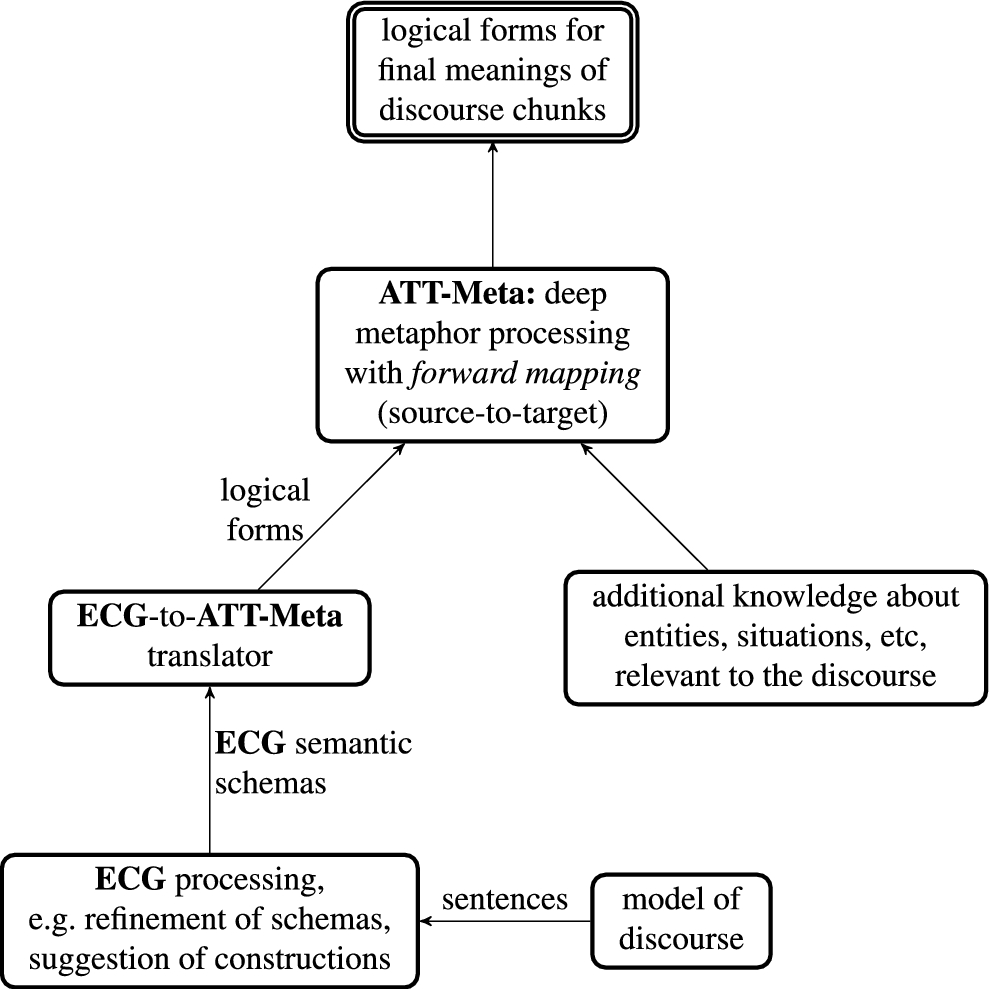
Schematic of Gen-Meta system: Understanding (stages in system development shown in single-lined boxes, output in double-lined box, selected arrows are labeled with material being piped from one stage to next).
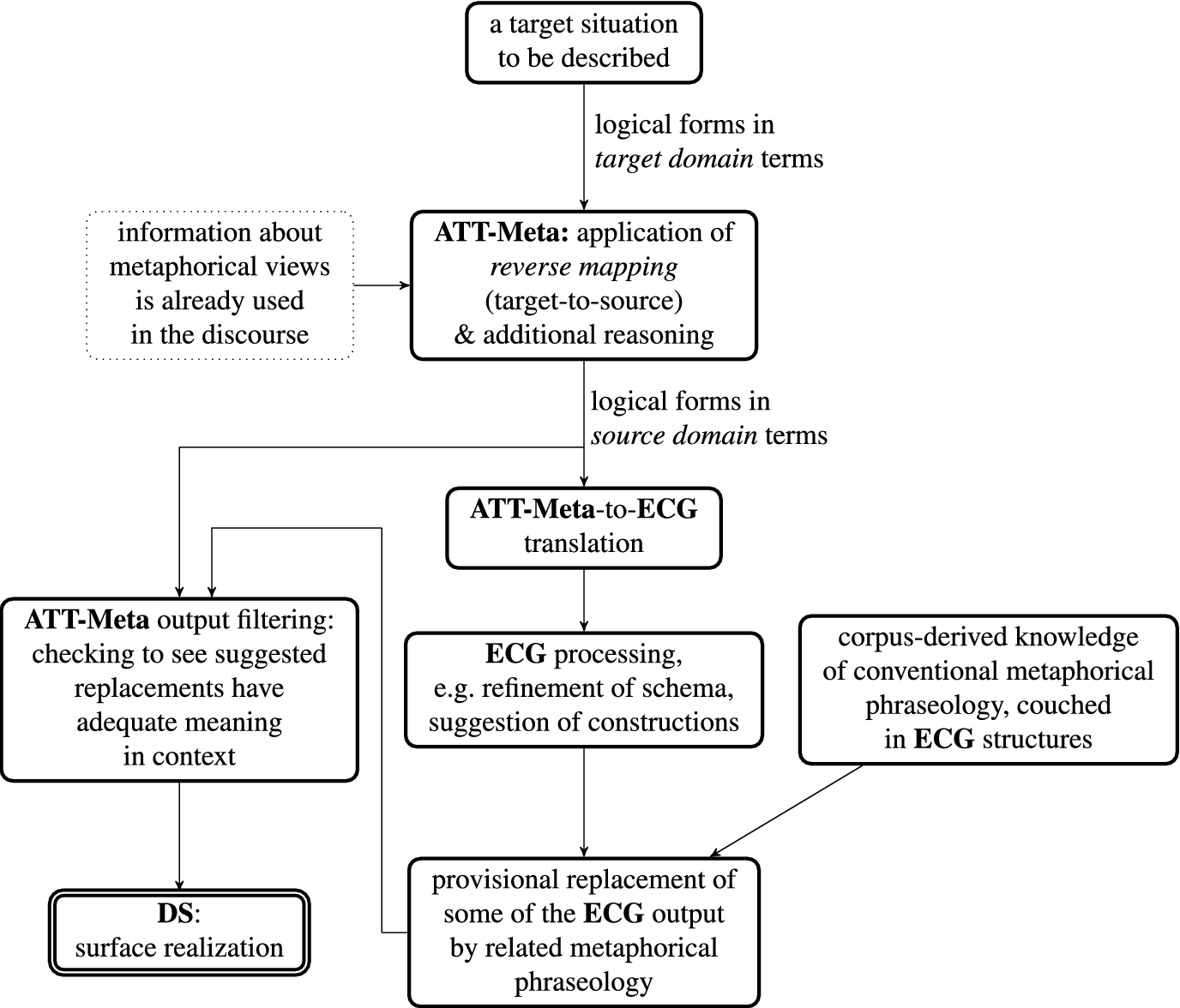
Schematic of Gen-Meta system: Generation (stages in system development shown in solid single-lined boxes, output in double-lined box, dashed-lined boxes contain additional notes about a particular stage, selected arrows are labeled with material being piped from one stage to next).
Our project involves arranging these three stand-alone modules, ATT-Meta, ECG and DS, in a pipeline formation. Each component provides a necessary role in achieving a system with the capacity for generating metaphor. To this end, we develop a hybrid of DS and ECG, incorporating ECG-style form-meaning mappings, in particular between constructions and schemas, but extending ECG with parsing/generation techniques from DS (ECG currently has no capacity for carrying out generation). In addition, while ECG has facilities for handling metaphor, these don’t enable reasoning-heavy, flexible metaphor processing of the kind which ATT-Meta is capable of, and this is needed to handle the open-endedness of metaphor. However, while the approach taken by ATT-Meta presumes that sufficiently frozen conventional metaphorical phraseology can be handled by fairly straightforward lexical access, bypassing ATT-Meta’s use of reasoning and mappings, no facilities for such lexical access are available in the implemented ATT-Meta system; as a comprehensive cognitive linguistics account of natural language, ECG, on the other hand, is well-equipped to model the richness and variety of metaphorical forms of linguistic expression. Further, while ATT-Meta can indeed model metaphor understanding, the equally important task of metaphor identification is addressed in corpus work we are undertaking ([15], more on this below). Moreover, as also discussed below, we employ computational resources made available via the ECG Workbench,6
Diagrammatic representations of both (i) the understanding sub-system, and (ii) the generation sub-system, are presented in Figs 1 and 2, respectively, in line with the discussion in this section.
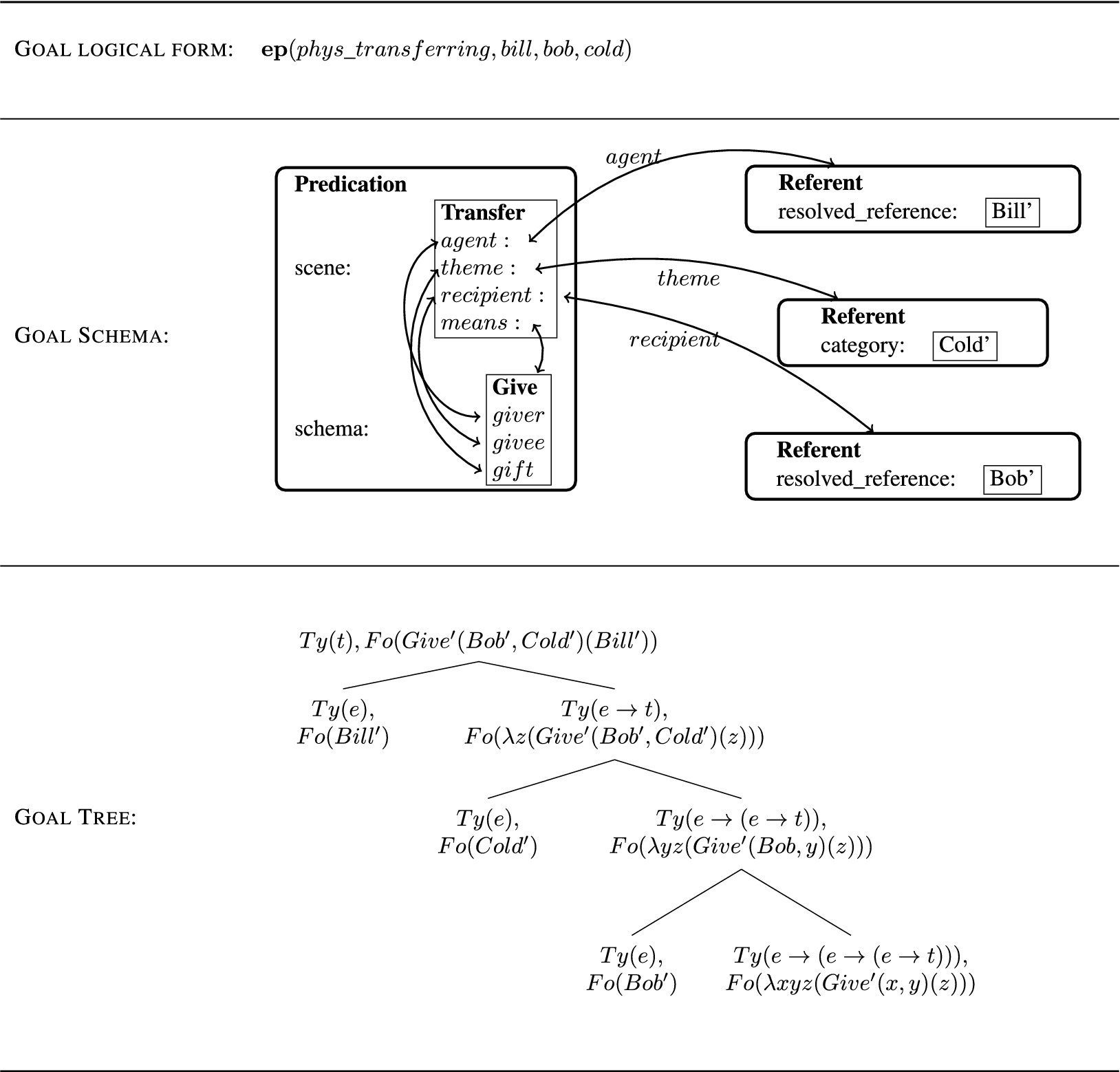
Representations of the goal content for “Bill gave Bob a cold”, for each of the Gen-Meta modules.
Consider Fig. 3, showing how the sentence Bill gave Bob a cold is differently represented by each module (recalling the discussion in Section 3.2, in terms of a concrete example): starting with the Goal Logical Form, assuming ATT-Meta has generated it via reverse transfer operations associated with the metaphorical view of
The initial stages in our system involve interfacing ECG and ATT-Meta. While our eventual aim is for generation of metaphor, we facilitate development of this interface, by running the system in the reverse direction as it were, and modeling metaphor understanding by parsing metaphorical utterances using ECG, then piping the output semantic representations to the ATT-Meta module. As both ATT-Meta and ECG are already set up for running in the understanding direction, then this initial step is a shortcut to building the representations required for interfacing these modules.
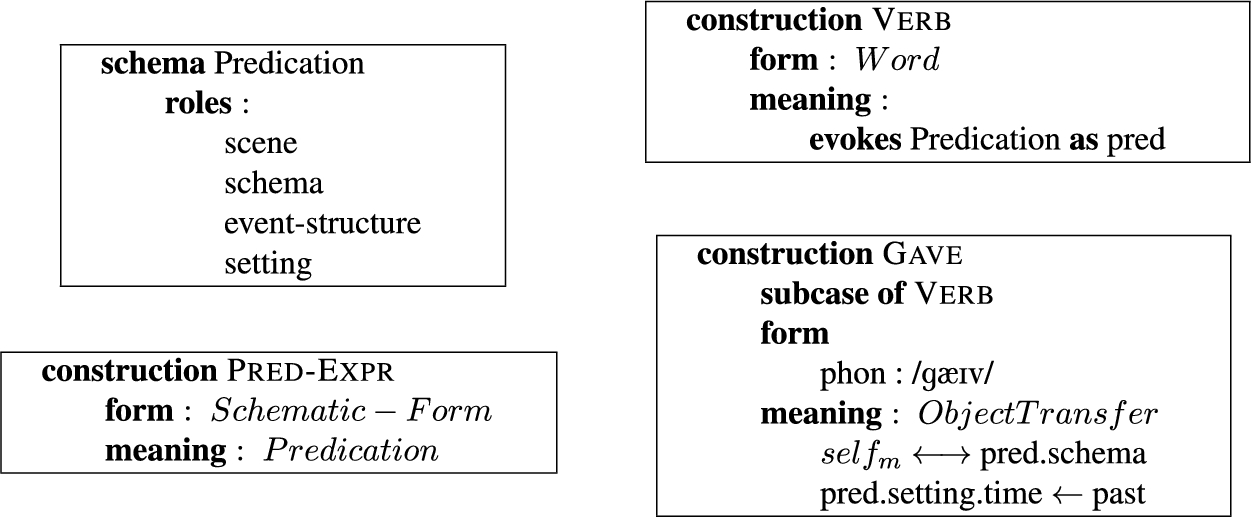
Selected ECG constructions and schemas required to parse the verb token “gave”.
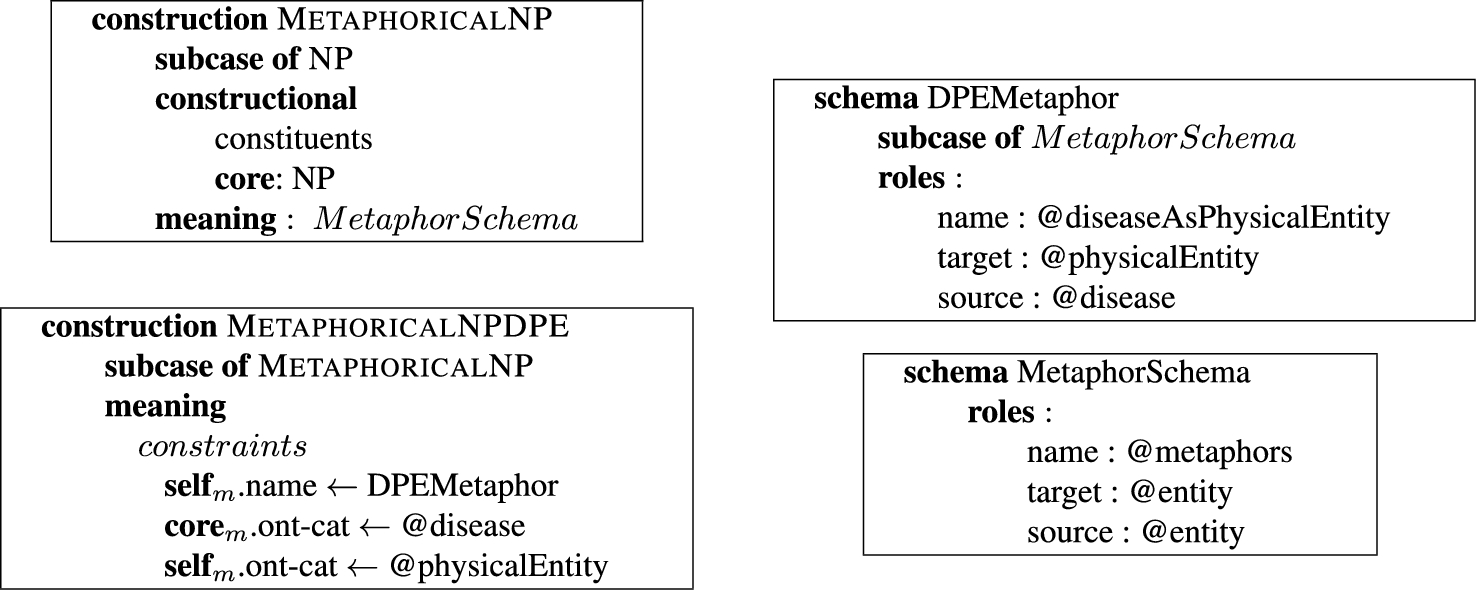
Selected ECG constructions and schemas required to parse metaphorical uses of the verb token “gave” (ont-cat = “ontological-category”).
On the ECG side, carrying out this first step involves initiating an ECG grammar tailored to our corpus. Given the complexity of such a grammar, which involves parsing with respect to both conceptual and linguistic levels (see [13] for details), we will not go into the details of this here. By way of illustration, recall our running example Bill gave Bob a cold. A small sample of possible ECG constructions and schemas for parsing just the verb gave from this example are provided in Fig. 4, and although this selection is somewhat simplified (see [5] for details), important aspects of the ECG approach are represented here. For instance, as [6] notes, there are four ways of specifying relations between ECG schemas and constructions: accessing other structures via roles, inheritance through sub-typing (using the key phrase
A further dimension for this fragment of ECG grammar, is that the meaning of the
Consider a simplified version of such an extension specifically for our running example, which is set out in Fig. 5. Now, an additional aspect of this representation which has not as yet been discussed is ECG’s use of ontological categories [23], such as @physicalEntity and @disease; in order to enable the metaphorical mapping we are considering here, an additional ontological category is required: @diseaseAsPhysicalEntity, which is in fact a sub-type of @metaphors. To see the impact of this, note that the meaning of the
With this grammar in hand, we are in a position to annotate our corpus with ECG-based schemas and constructions, and thereby make this information available to the ATT-Meta module. To proceed with this, we require a way of capturing such information, and for this we have utilised the ECG Workbench tools.7
Most importantly, if ECG has identified a sentence as containing a metaphorical construction such as MetaphoricalNPDPE, then this identification tells ATT-Meta that it can put the literal meaning of the sentence (found by ECG) in a pretence cocoon. Additionally, assuming the ECG ontological category @diseaseAsPhysicalEntity from the DPEMetaphor schema is linked to ATT-Meta’s mapping rules such as
Also, suppose previous sentences have already stimulated the use of the above ontological category or ATT-Meta’s disease-related mapping rules. Then for the current sentence these rules, the literal meaning of the sentence, and the pretence cocoon can be brought into play even if the this sentence is wholly conventional. This caters for cases where a metaphor is re-enlivened by discourse context. It allows the literal meaning of the current sentence to contribute to the building of a fuller, more coherent source scenario in the pretence cocoon than would be possible if the current sentence were simply given its own metaphorical meaning, with the literal meaning being thrown away.
An advantage Gen-Meta has over other NLG approaches, is that reasoning done by the AI module increases overall system flexibility. Thus, if it turned out that, following example (6), Bill is no longer infected by a cold, ATT-Meta’s reasoning about such change in circumstances, plus ATT-Meta’s reverse transfer ability, can lead to the conclusion in the pretence that John physically lost the cold. This proposition can then be piped to the ECG module. This greater control over content specification also has the potential to directly address so-called strategic generation, a relatively under-researched area of NLG. Further, the data-driven aspect of Gen-Meta, means that candidate expressions are favored which more closely match formulaic expression of metaphor: so that the relatively formulaic sentence Bill gave a cold to Bill would be favored over something as novel as Bill foisted a cold on Bob.
Our combined AI/corpus-based approach enables fine-tuning of (tactical) generation by clothing AI-generated content in patterns of typical metaphorical expression, as determined via corpus-based discovery of conventional forms of expression. To this end, we have mined such web-based sources as online discussion forums, within one of our chosen domains of illness discourse.8
We are currently analysing a corpus we have collected of our other chosen domain, political conflict discourse, with a view to replicating the approach we have used for illness discourse.
We have collected a corpus of online discussion forums for illnesses of various kinds, including diabetes, stress, infections and cancer, and we annotated illness metaphors in this corpus (see [15], for more details). These annotations yielded metaphor types such as those reported in [26], as well as novel modifications of these types, such as
Evoking the notion of “metaphor tuning” from [7].
For discussion of issues we encountered while labeling metaphors, see [15].
Key to types of metaphor:
With
Frequency of metaphor types for different illnesses (including standardised residuals in brackets), in online discussion forums (see text for details)
Our generation approach combines AI techniques for producing metaphorical meanings, with corpus-based approaches for identifying conventionalised forms of metaphorical expressions. This enables three main advantages over existing approaches: (1) compared to other NLG approaches, Gen-Meta combines deep AI reasoning to increase flexibility in generating underlying content, (2) which together with data-driven techniques enables realization to favor formulaic expression of metaphor, and, finally, (3) the greater control over content specification which Gen-Meta affords suggests a new and exciting direction to follow in the under-researched area of strategic generation.
Footnotes
Acknowledgements
We acknowledge financial support through a Marie Curie International Incoming Fellowship (project 330569) awarded to both authors (A.G. as fellow, J.B. as P.I.).