



Abstract
Various types of everyday arguments are represented as argumentation schemes, originating from the Legal Argumentation literature. The recent achievements in this domain can be applied to multi-agent settings to enrich the paradigmatic aspects of communication and reasoning. Agents typically populate complex environments where incompleteness and inconsistency of information is rather a rule than exception. Although the problem how to tackle inconsistencies is already present in argumentation, a paraconsistent (that is, tolerating inconsistency) approach is still missing from the literature. The contribution of this research is a computationally-friendly framework for formalizing paraconsistent argumentation schemes. This is achieved by extending agent’s reasoning capabilities with non-deductive methods rooted in argumentation. To this end we provide a generic paraconsistent program template for implementation of various argumentation schemes.
Our methodology is strongly influenced by ideas underlying 4QL: a four-valued, rule-based,
Modeling assumptions
The logical modeling of complex phenomena appearing in the context of intelligent distributed systems sometimes lacks realism. What emerges, is often both computationally complex and idealized theories not fitting well the modeled reality. A great deal of this mismatch lies in the quality of information available in dynamic and unpredictable environments. Intelligent agents, viewed as autonomous information sources, may perceive the surrounding reality differently while building their informational stance. The information they need to handle comes from multiple sources of diverse credibility, quality or significance. Even though consistency of their beliefs is a desirable property, in practice it is hard to achieve. Thus, when modeling real-world situations, ignorance and inconsistency of information occurs naturally. However, instead of making a reasoning process trivial, what is a hindrance in classical logical systems, we view inconsistency as a first-class citizen and try to efficiently deal with it. This leads to creating logical systems which tolerate inconsistencies, i.e., to paraconsistent systems. On the other hand, as missing knowledge can be completed and inconsistent information can be disambiguated, the realistic modeling of agency requires nonmonotonic reasoning mechanisms, where new information may invalidate previously obtained conclusions. Such approach to lacking and inconsistent information is the basis of realistic models of agency. Despite the rich field of non-monotonic reasoning and paraconsistent formalisms (see Section 1.1 and 1.2 for a survey), in general a tractable approach that combines both aspects was missing from the multi-agent systems (MAS) literature.
The approaches to modeling agency typically feature the informational and motivational stance of an agent, comprising beliefs, intentions and commitments. From multiple available frameworks (see a discussion about realistic models of agency in Section 1.3), our solution falls into the category of rule-based systems: we associate individual agents with programs composed of a set of facts and reasoning rules organized into a layered architecture by the use of modules.
To reflect the diversity of possibilities we view agents as heterogeneous reasoners. Following Dunin-Kȩplicz and Szałas [23], the way the individual agents deal with conflicting or lacking information is encoded in their epistemic profile (see Section 3). Typically, an epistemic profile embodies agents’ reasoning capabilities. These in turn influence the agent’s deductive processes to finally affect their belief structures, i.e., agents’ informational stance [23]. Moreover, various agents may reason differently using diverse methods of information disambiguation.
This paper is a part of a larger research program, whose overall goal is a creation of a paraconsistent model of agents’ communication, suitable for dealing with unsure and incomplete information especially in applications related to multi-agent systems. Generally, MAS are created for the synergistic effect of collaborating agents, thus their essence is complex interactions. They are vital to the paradigmatic activities like coordination, collaboration and negotiation, which naturally include phases of communication and reasoning. Therefore, an adequate modeling of communication is one of the challenges in building autonomous agents.
Communication has a long tradition as an important topic in computer science, specifically in (distributed) artificial intelligence and recently in MAS [15,45]. Starting from fixed communication protocols in distributed systems, we now attempt to approach flexible dialogues among agents (see e.g., [14]). To achieve the goal of agents communicating freely in the paraconsistent world, we build upon Austin and Searle’s theory of speech acts [3,44] and Walton and Krabbe semi-formal theory of dialogue [55]. We view the dialogue participants as independent information sources, which try to expand, contract, update, and revise their beliefs through communication. Taking this perspective, speech acts are “actions that change your mind” [51] and provide the necessary building blocks to construct complex dialogues, such as information seeking, inquiry, persuasion, negotiation or deliberation.
We have initiated our research program, by proposing a paraconsistent framework for perceiving new facts [21]. That enabled the agents to discuss their informational stance, i.e.,:
inform one another about values of different propositions via assertions, ask for other agents’ values via requests, acknowledge the common values via concessions, and question the contradictory values via challenges.
The second step was a preliminary analysis on communication involving reasoning rules [17]. In that paper, a model for assertions and concessions regarding reasoning rules was proposed, permitting the agents to accept or reject another agent’s reasoning rule according to a defined admissibility criterion. Recently, these building blocks were used to construct tractable, sound and complete inquiry dialogues in the paraconsistent settings [20]. In the current paper we show how to extend agent’s reasoning capabilities with non-deductive methods like argumentation skills, which will later enable agents to conduct arguments over reasoning rules. To this end, we study so-called argumentation schemes [56] (see Section 1.3).
Indeed, the question whether to adopt, challenge or reject a reasoning rule has no single straightforward answer. This issue has been studied from multiple angles. In the Belief Revision approach the influence of reasoning rules on agents’ knowledge bases was studied. Our solution proposed in [17] followed this approach. A different approach leverages the social choice theory methods where the decision about the admissibility of a rule is made on the social level (see e.g., [19]). Finally, yet another research thread concerns the methods originating form the Legal Reasoning, where argumentation schemes are proxies for an ontology of reasoning methods. In such approach a reasoning rule can be accepted if it is an instance (or a template) of an established argumentation scheme.
Paraconsistency in multi-agent settings
In real-world applications one should accept uncertainty and inconsistency of information, assuming that four types of situations may occur:
fact a holds,
fact a does not hold,
it is not known whether a holds (no source has any information about a),
information about a is inconsistent (some sources claim a holds, other that a does not hold).
Modeling assumptions of this research require the use of a paraconsistent and paracomplete formalism. Put crudely, paraconsistency is a property of logics whose logical consequence relation is not explosive (i.e., where ex contradictione quodlibet (ECQ) does not hold). Indeed, the principle of explosion is controversial to paraconsistent logicians who argue that “the move from a contradiction to an arbitrary formula does not seem like reasoning” and provide examples of such absurd “proofs” [40].
Needless to say, paraconsistency was studied from multiple angles (see e.g., [7,9,12,40] for paraconsistent reasoning techniques):
discussive logic of Jaśkowski [27] aimed at ensuring that contradictory sentences do not arise by blocking the rule of adjunction;
preservationist school of Schotch and Jennings [43] for reasoning with consistent subsets of premisses;
relevance logics (Orlov, Belnap, Anderson, see [2] and references therein) required that premisses are relevant to the conclusion;
C-System of da Costa [11] (and its generalization: logics of formal inconsistency) allowed to distinguish consistent sentences from inconsistent ones and reason about them differently;
Priest’s logic of paradox [38] utilized third truth value (both) and identified designated values (true, both) to allow reasoning about paradoxes;
logic of Belnap [4] added unknown and inconsistent truth values to reason about information from many sources.
Although to model phenomena such as lack and inconsistency of information, the Belnap’s four-valued logic is commonly used, it often provides counter-intuitive results in ares we focus on (see [16,53] for details). Let us recall the well-known example to show one problematic situation.
A family owns two cars:
The logic underpinning our implementation tool (see Section 5) does not share such problems therefore is better suited for this research.
The second important aspect of realistic modeling is allowing that “additional information may invalidate conclusions” [50]. Indeed, agents are situated in environments where only incomplete information is available, so any monotonic formalism (where new information never invalidates conclusions) is inadequate to capture this phenomenon.
Currently, there is a variety of nonmonotonic techniques (see e.g. Chapter 6 in [50] for general nonmonotonic/defeasible reasoning techniques):
Reiter’s default reasoning [41], consisting of applying defaults, i.e., meta-rules of the form “in the absence of any information to the contrary assume…” [50]; Closed World Assumption (CWA) [42], to represent how databases handle negative information; Moore’s autoepistemic logic [34] to formalize how perfectly rational agents form beliefs; McCarthy’s Circumscription [33] to model “jumping to conclusions” by minimizing the extent of abnormal predicate; Preferential models [28] based on preference relation expressing typicality of possible worlds (e.g., Shoham’s preference logic); Nute’s Defeasible Logic [35] encompassing strict and defeasible rules together with a preference relation among defeasible rules. “are argument forms that represent inferential structures of arguments used in everyday discourse, and in special contexts like legal argumentation, scientific argumentation and especially in AI”.
As typically these nonmonotonic techniques were designed to formalize phenomena appearing in commonsense reasoning, they are suitable for modeling rational agents. On the other hand, argumentation schemes attempt to classify the various types of everyday arguments, utilizing the ideas underlying the formalisms described above. As characterized in [56], argumentation schemes (AS)
Looking for tractability
The entire line of our research is characterized by a shift in perspective: instead of creating complex logical theories, we tailor them to their tractable versions, like rule-based systems. Then, instead of reasoning in logical systems of high complexity we query paraconsistent knowledge bases.
Many important aspects of classical agency have to be adjusted when adopting a paraconsistent semantics. First of all, the AGM postulates for Belief Revision [1] are no longer valid (but see [39,48]). On the other hand, some assumptions underlying classical formalizations of agency (Dynamic Epistemic Logic (DEL) [49], intention logic [10]; BDI [26] & KARO [52] frameworks) are unpractical: real agents do not have infinite resources (like time) available for reasoning and they are not logically perfect reasoners. Therefore a formalism which does not require such assumptions would be preferred.
Our approach is strongly influenced by ideas underlying 4QL: a four-valued paraconsistent query language introduced by Małuszyński and Szałas (see [29,30] and Section 5 for details). We have chosen 4QL as a suitable tool for formalizing paraconsistent argumentation schemes (PAS), as it provides simple, yet powerful constructs for application of a range of well-known nonmonotonic techniques (see [22] for examples of default reasoning, autoepistemic reasoning, defeasible reasoning and the (Local) Closed World Assumption expressed in 4QL).
The contribution of the paper is extending epistemic profiles with paraconsistent argumentation schemes, providing templates for their implementation and ensuring tractability of reasoning by using 4QL.
This paper is an extended version of our conference paper [18]. In comparison to [18] we:
provide implementation and discussion of additional five argumentation schemes,
show scheme embedding, based on the Reputation and Prudence schemes to reason about trust,
elaborate on the role of communicative relations and their relationship to the Ethotic Argument,
revise and extend discussion and background.
The paper is structured in the following way. First, in Section 2, we describe the computational approach to argumentation schemes. Next, in Section 3 the language and logic used throughout the paper as well as the concept of epistemic profiles and belief structures are introduced. Section 4 presents the main contribution of this paper, namely the formalization of the paraconsistent argumentation scheme as a part of epistemic profile. In Section 5 our implementation tool of choice is described. Section 6 presents the formalization of paraconsistent argumentation schemes with use of the notion of well-supported models as well as the implemented solution, which we illustrate on four argumentation schemes: Expert Opinion, Position to Know, Perception and Ethos. In Section 7 we show how to embed schemes, utilizing the Reputation and Prudence scheme for reasoning about trust. Section 8 concludes the paper.
Computational perspective on paraconsistent argumentation schemes
The aim of this work is augmentation of agents’ inferential capabilities with the methods rooted in argumentation. Our primary goal is to provide means for implementing the paraconsistent argumentation schemes in a tractable way. This computational approach aims at combining techniques of classical reasoning with non-monotonic, argumentative reasoning. The conclusions obtained with the use of both methods exist on equal terms, but possibly can be used in different situations.
Following [37], we simplify the set of critical questions to those pointing to the specific undercutters, called exceptions. Thus, the exceptions serve as means to both undercut the argument and shift the burden of proof to the other side [56].
Observation that most common sense rules have exceptions gave birth to nonmonotonic reasoning techniques [50], however the difficulty lied in specifying all the ‘abnormal’ cases. Here, through modeling critical questions as exceptions, we try to minimize the set of abnormalities under which the scheme is not applicable. All in all, the opponent may attack the claim in three ways:
by rebutting the premisses,
by rebutting the conclusion,
by undercutting the argument using the exceptions.
In addition, we encourage a rigorous separation of various aspects of reasoning:
the information, the opinion about the information and its source, the disambiguation of inconsistent information.
To illustrate this, consider our running example: the argument from Expert Opinion. It is summarized in Table 1 (see also its implementation in 4QL presented in Fig. 4). The first column conveys the original form of the argument, including the scheme (premises, conclusion) and critical questions (as in [56]). The second column presents the adapted, paraconsistent version of the argument. There, the set of critical questions is replaced with the set of exceptions and the original premises are encoded by four-valued literals. Importantly, the conclusion is tetravalent (
Expert Opinion Argumentation Scheme
Expert Opinion Argumentation Scheme
Now, the various aspects of the reasoning can be easily distinguished:
object level, e.g., the claim
meta-level:
the reasoning about the claim, e.g., using
the reasoning about the sender agent, e.g., using
meta-meta-level: reasoning about the compatibility of experts’ opinions (here it is excluded from the scheme, as it corresponds to disambiguation of inconsistent information arising from multiple sources of opinion).
Our formalization concerns a mechanism for specifying any argumentation scheme. In addition, when formalized in 4QL, the solution becomes tractable. Since 4QL captures all tractable queries, the expressiveness is maintained.
The heterogeneity of agents’ means, among others, that even when seeing the same thing, the particular individuals may draw different conclusions. The powerful notion of epistemic profile [23] explicitly models this problem. In general, it defines the way an agent reasons (e.g., in this paper a rule-based agent implementation is assumed), including the manner of dealing with conflicting or lacking information (e.g., by combining various forms of reasoning available to the agent, including belief fusion, disambiguation of conflicting beliefs or completion of lacking information).
The following definitions are adapted from [23], where intuition and examples can be found.
In what follows all
A literal is an expression of the form
Though we use classical first-order syntax, the semantics substantially differs from the classical one as truth values
The semantics of propositional connectives is summarized in Table 2. Observe that definitions of ∧ and ∨ reflect minimum and maximum with respect to the ordering:

It is worth noting that whenever truth values are restricted to
Let
The truth value
For a formula
Semantics of first-order formulas
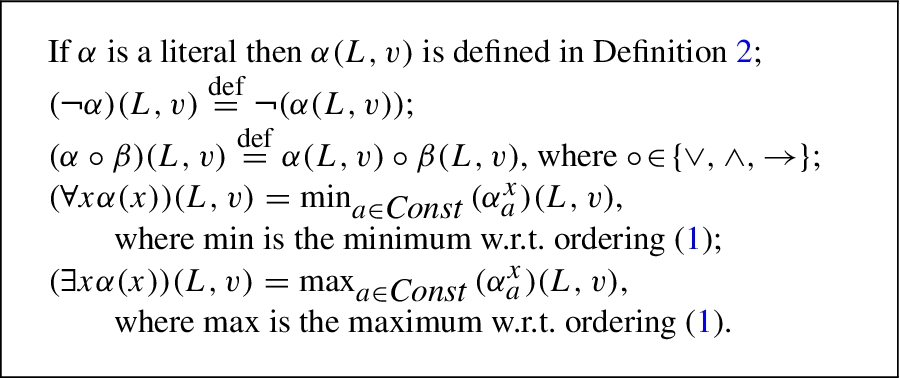
Belief structures can now be defined as in [23]. If S is a set, then
Let a constituent is any set an epistemic profile is any function by a belief structure over epistemic profile
Final beliefs are represented as consequents.
Notice, that the epistemic profile, being any function, can encode any reasoning schema (especially when we disregard complexity issues). In this paper we extend agent’s repertoire to include user-defined argumentation schemes, that employ incomplete and uncertain information. In the sequel, we will show the theoretical foundations, and then the implementation in 4QL.
Until now, the epistemic profiles, being arbitrary functions, conveyed all reasoning capabilities of agents (and groups of agents) [23], including their communicative strategies [21]. Here we distinguish yet another component, namely, argumentation schemes that extend an agent’s (or a group’s) epistemic profile.
Paraconsistent argumentation schemes: Intuition
Argumentation schemes are modeled with the use of the sets of premisses and exceptions, the latter one replacing the concept of critical questions (see Section 6 for the alternative formalization using the well-supported models of 4QL modules). In our approach, the conclusion of the paraconsistent argumentation scheme can be: when the premisses are lacking, or when the exceptions are present.
If the conclusion may be drawn, then its value is logically equivalent to conclusion resulting from the premisses.
Let us give some intuitions first, before defining the paraconsistent argumentation scheme. Since we admit premisses, exceptions and conclusions to take any of the four logical values, what happens when inconsistent and missing information regards the premisses of the argumentation scheme? To this end, recall the argument from Expert Opinion (see Table 1). When the premise “a is an expert in domain D” is:
proving one of them is proving their inconsistency (
Thus, attacking an argument on premisses can be achieved by:
Next, let’s consider the set of exceptions. It contains all the exceptions potentially applicable in the scheme. Whenever any of them becomes true, the schema is blocked and cannot be applied. For example, consider the exception regarding the expert’s reliability:
if the expert is not reliable ( otherwise, the exception is not triggered.
Therefore, as regards exceptions, their attacking power matters only when they are
Paraconsistent argumentation schemes: Definition
In our framework for paraconsistent argumentation schemes we deal with the three sets of ground literals: Premisses (P), Exceptions (E) and Conclusions (
The high-level structure of our running example is presented in Fig. 1. The ovals correspond to the sets of ground literals, arranged into above-mentioned sets of Conclusions, Premisses and Exceptions, as well as: Expert, Ontology, Evidence, Assertions and Reliability, which are specific for a particular scheme (here the Expert Opinion utilizes the set of Assertions for constructing both the Premisses and Exceptions). The arrows (from Premisses and Exceptions to Scheme) represent the function of the paraconsistent argumentation scheme (
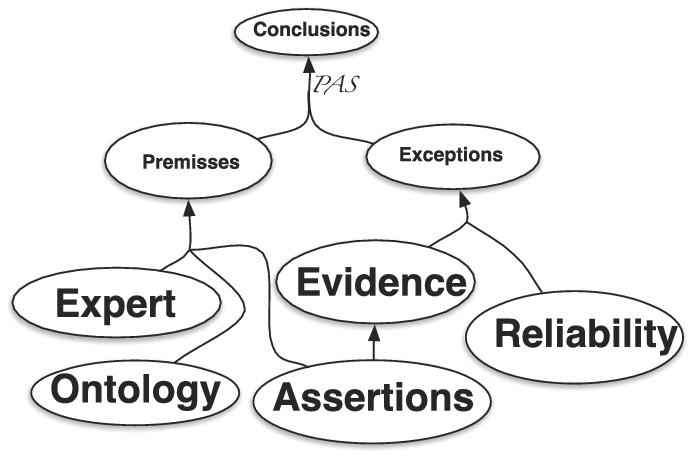
Modular architecture of Expert Opinion Scheme.
The elements of the Conclusions set (literals) are
The set of Premisses contains
The elements of the set of Exceptions are
Ultimately, the conclusion of the scheme is obtained in the following way. If there exists a tetravalent candidate for a conclusion
If there is no such a trigger, the candidate conclusion becomes the ultimate conclusion of the scheme.
Otherwise, the scheme cannot be applied causing that the value of
To sum up (adopting the notation from Definition 4), a conclusion c is established based on the supporting arguments given by the set of Premisses (i.e.
Recall that
by a constituent we understand any set P and E be two constituents, representing the set of premisses and exceptions, respectively,
Let:
Then, paraconsistent argumentation scheme is a partial function
We identify the belief structure over
The above definition presents the paraconsistent argumentation scheme as a partial function: a fragment of agent’s epistemic profile that expresses agent’s argumentative skills. The implementation of PAS in 4QL is presented in Definition 7, where also the analogy between both definitions is explained.
The rule language 4QL has been introduced in [29] and further developed in [31,46]. In 4QL, beliefs are distributed among modules. The 4QL language allows for negation in premisses and conclusions of rules. In particular, negation in rule heads may lead to inconsistencies. 4QL is based on the four-valued logic described in Section 3. The semantics of 4QL is defined by well-supported models [29–31,46], i.e., models consisting of (positive or negative) ground literals, where each literal is a conclusion of a derivation starting from facts. For any set of rules, such a model is uniquely determined: “Each module can be treated as a finite set of literals and this set can be computed in deterministic polynomial time” [29,31].
Typically, in multi-agent architectures, 4QL would be situated in the layer that processes qualitative information, as opposed to the lower-level quantitative information processing layer, for which various techniques, including fuzzy, rough set and probabilistic approaches, can be used (e.g., for image, voice and other sensor data processing).
For specifying rules and querying modules, we adapt the language of [46]. To this end we need the notion of multisource formulas defined as follows.
A multisource formula is an expression of the form: m is a module name; A is a first-order or a multisource formula;
We write
The intuitive meaning of a multisource formula “return the answer to query expressed by formula A, computed within the context of module m”.
Rules are expressions of the form:
A fact is a rule with empty premisses (such premisses are evaluated to A module is a syntactic entity encapsulating a finite number of facts and rules. A 4QL program is a set of modules, where it is assumed that there are no cyclic references to modules involving multisource formulas of the form
Openness of the world is assumed, but rules can be used to close it locally or globally.

Example of a 4QL program.
Let us illustrate 4QL, consider Fig. 2, where we use syntax of the 4QL interpreter inter4QL.2
The interpreter, developed by P. Spanily and revised by Ł. Białek, can be downloaded from
From the epistemic profile perspective, the two modules: r and
Each argumentation scheme is a standalone entity, with a dedicated 4QL module, containing two specific rules:
and
The multisource formulas in the bodies of the rules pertain to two other specific sub-modules: one corresponding to the premisses and one to the exceptions. Intuitively, these rules express the mechanism of drawing the scheme conclusions using the premisses and exceptions in the way described in Section 4. Altogether, the 3-modular 4QL architecture reflects the structure of the argumentation scheme:
the set of
the set of
the
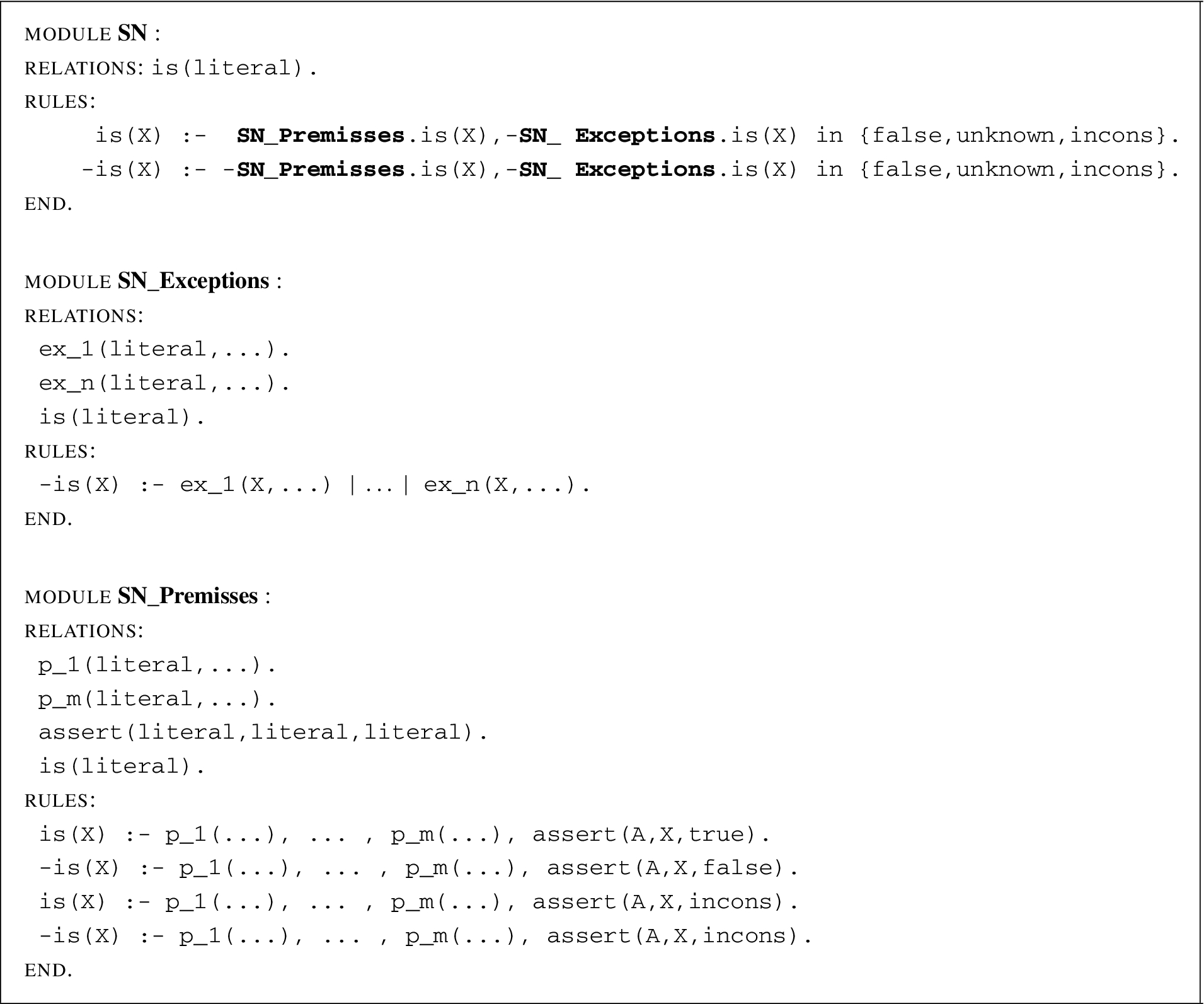
General 4ql Template for Argumentation Schemes.
These three modules constitute the standard approach to argumentation schemes in 4QL. They are captured in a generic template of a 4QL program consisting of the three modules:

Argumentation Scheme from Expert Opinion.
The two rules encoded in module
When it is
The only situation where both rules cannot be executed due to it, is when the value of Indeed, otherwise: if it’s true, the first rule would be executed, if it’s false, the second rule would be executed, if it’s inconsistent, both rules would be executed. the first literal is the second literal is
Consider a situation, where there are both exceptions from the argumentation scheme and also not all premisses are present. This would correspond to the following case for both rules:
Then, the conjunction would evaluate to
If there are no exceptions prohibiting the scheme from being applied, the conclusion
As mentioned before, the burden of proving the premisses lies on the proponent. The opponent can fight a successful argument is two ways. Either by rebutting it (by proving the conclusion is unknown) or by undercutting it (by proving the conclusion is inconsistent). The first goal can be achieved in two ways:
by showing that in the
by showing that
To undercut a successful argument the opponent may attack the true premisses by proving their inconsistency.
In what follows we present the definition of a paraconsistent argumentation scheme, which is, in fact, an implementation of Definition 4 in 4QL. The analogy between both definitions is founded on the following observations:
the functions are represented as the sets of rules (4QL modules),
the sets of ground literals correspond to well-supported models (see Section 5).
Recall that L stands for the set of ground literals with constants in Const. Let
then
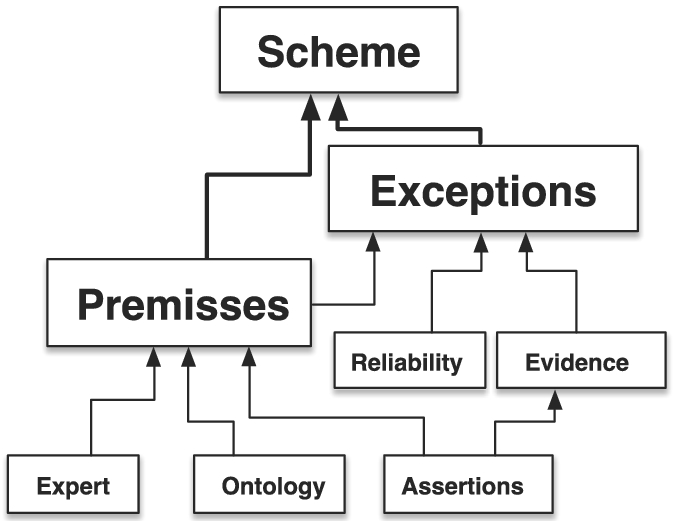
Modular architecture of Expert Opinion Scheme.
The above definition presents PAS as a tuple of specific 4QL modules (sets of rules). Figure 5 illustrates it with the rectangles depicting the 4QL modules, as in the Figs 4, 7 and 6. On the other hand, Definition 4 expresses PAS as a partial function: a fragment of agent’s epistemic profile. Here, the
Any argumentation scheme that can be represented as PAS can be implemented in 4QL. Obtaining conclusion c of the scheme is in polynomial time, as it amounts to computing the well-supported model of the module
As a showcase for our solution, consider the Argument from Expert Opinion. The modules implementing the scheme (
The implementation of the Expert Opinion scheme deals with two explicit exceptions (as argued in Section 2):
evidence-based claim:
reliability:
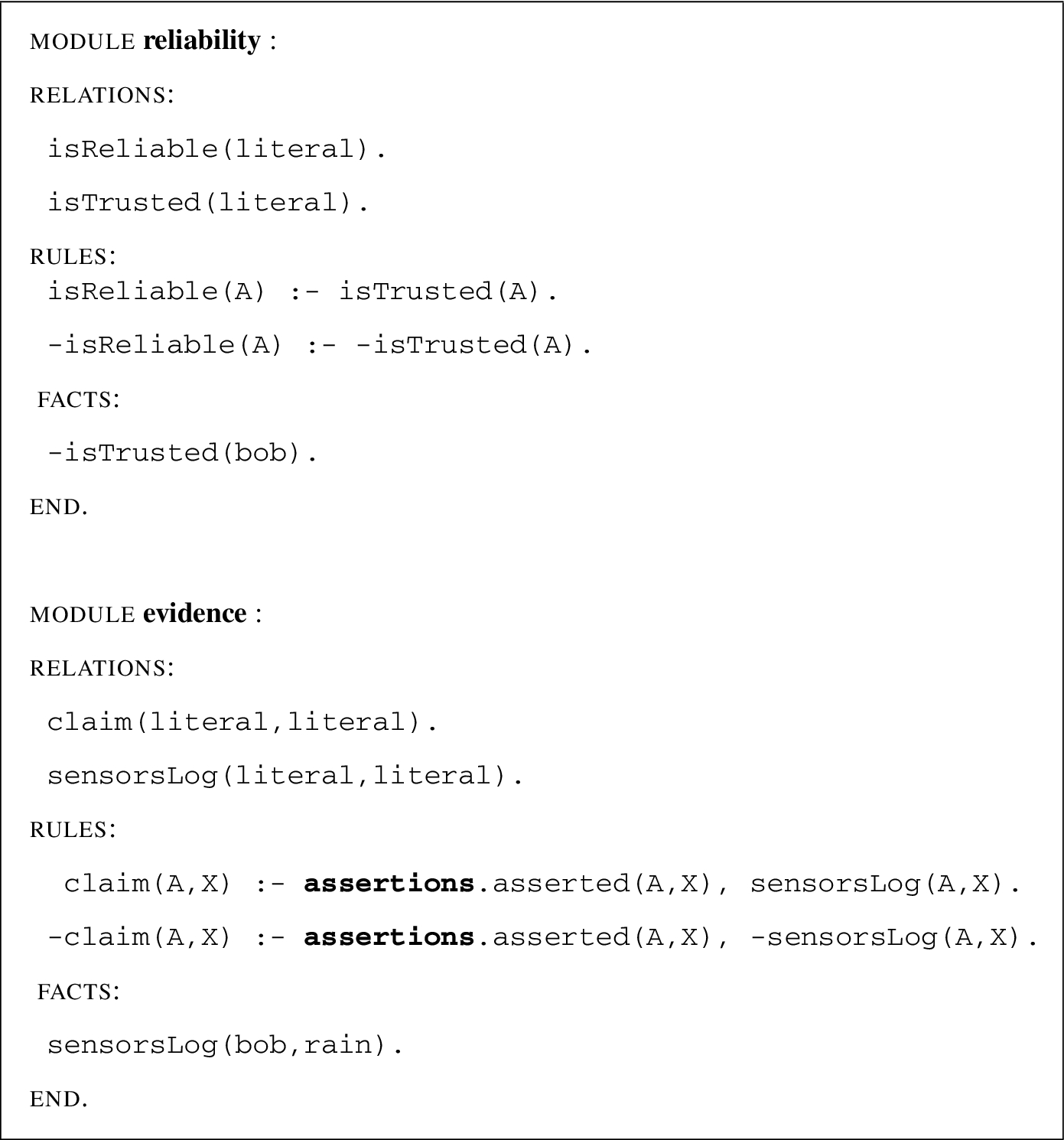
Modules for Exceptions.
The sub-modules implementing particular exceptions are presented in Fig. 6. The
evidently, it rained:
The sub-modules (
Module
This example allows us to test various scenarios of missing and inconsistent information appearing in the Expert Opinion scheme. If we load the program to the interpreter and ask:
and reload the module, the same question would yield the following results:

Modules for Premisses.
If we intend to learn which experts’ opinions were essential to that verdict, we should ask:
Now, what should happen, if in the
Consider the following argumentation scheme, which allows agents to reason about percepts. The classical scheme has two premisses and one critical question (see Table 4). Since the second premise expresses the link between the first premise and the conclusion, it is redundant. The critical question works as an undercutter for that link and as such remains in our framework. The Argument from Perception scheme, viewed solely as an argumentation or reasoning pattern, is quite simple. All the difficulty connected with assessing the reliability of perception is extracted to the relation
Perception: from Original to Paraconsistent
Perception: from Original to Paraconsistent
– Critical Questions
– Assumptions
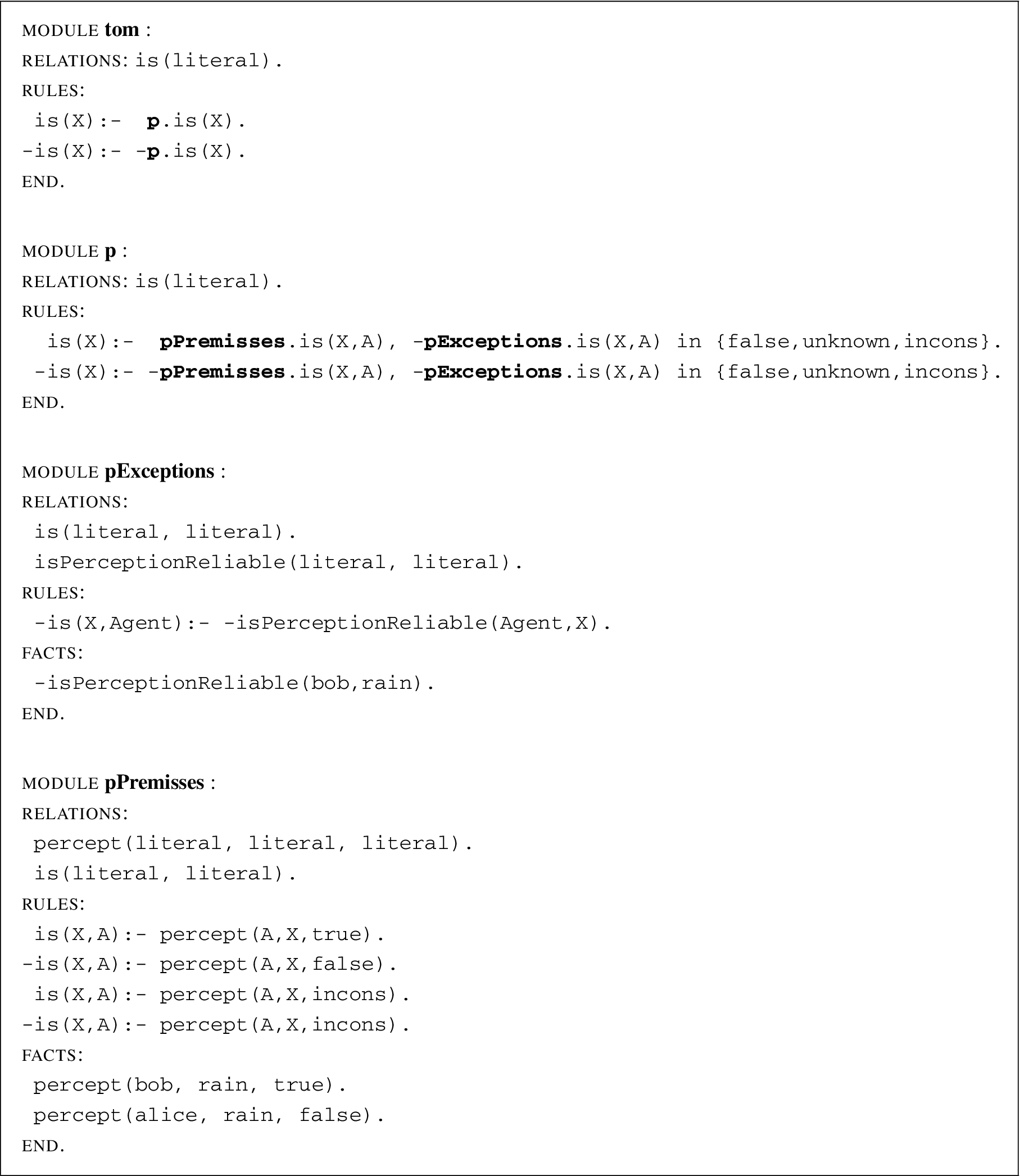
Perception Argumentation Scheme in 4QL.
Let’s consider another example of an argumentation scheme: argument from Position to Know. The original form of this scheme is presented in Table 5. It consist of just two premisses and three critical questions. Notice that two critical questions are redundant. After eliminating them, the only relevant critical question that remains concerns the reliability of the source. In our framework it is expressed as an assumption “a is a reliable source” implemented using relation
Position to Know: from Original to Paraconsistent
Position to Know: from Original to Paraconsistent
– Critical Questions
– Assumptions
For simplicity, instead of expanding the relation
Recall, that the original form of the Position to Know scheme does not contain facts. Here, and for the remaining schemes, we equip the modules with some basic facts so that the programs shown in figures can be executed with use of 4QL interpreter. In this example,

Position to Know Argumentation Scheme in 4QL.

Ethos Argumentation Scheme in 4QL.
The Argument from Ethos is commonly used to adjudicate about truth or falsity of a proposition on the grounds of the qualities of the information source. The original form of the scheme is given in Table 6. The two non-redundant critical questions are: the one about relevancy of the character qualities and the one about the claim being evidence-based.
In the example in Fig. 10, the main premise (
Ethos: from Original to Paraconsistent
Ethos: from Original to Paraconsistent
– Critical Questions
– Assumptions
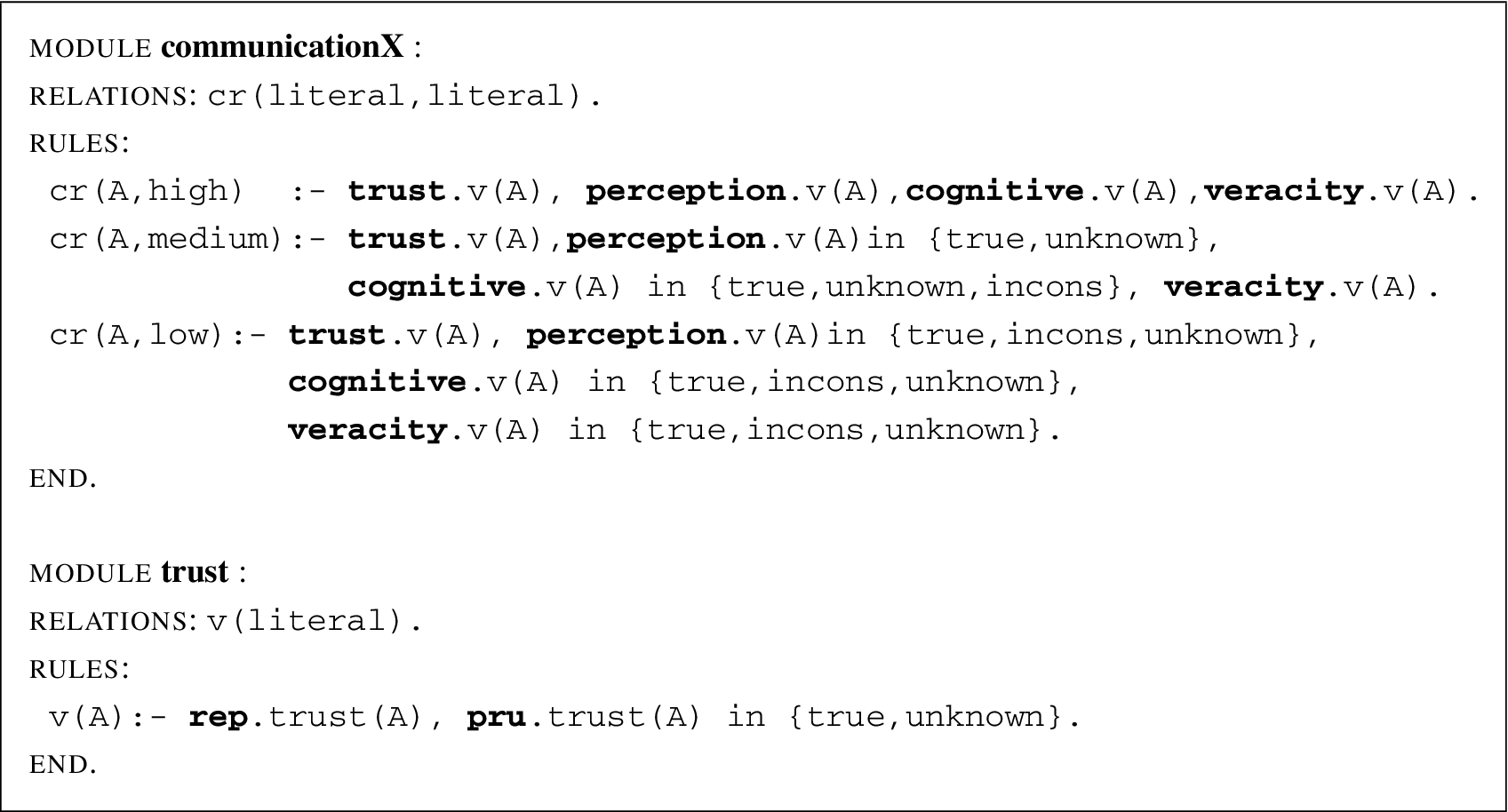
Communicative Relations and Reasoning about Trust.
Let’s recall the original Ethotic Argument and our paraconsistent version of it (Table 6). As we do not intend to over-antropomorphize our artificial agents, the classical notion of good (bad) moral character should be treated in a way that is more relevant to MAS. One approach can be to focus on qualities such as: veracity, prudence, perception and cognitive skills as proposed in [54]. However, in [54], the problem whether agent’s statements should be considered or disregarded was adjudicated with use of a higher-level concept: the credibility of an agent, which was expressed with the use of the credibility function. The character traits recalled above play a role in judging agent’s credibility and therefore plausibility of his arguments. In addition, “when one of these traits is a relevant basis for an adjustment in a credibility function, there is a shift to a subdialogue in which the argumentation in the case is re-evaluated” [54].
A slightly different approach to the same problem is presented in [36], where the role of credibility, plays trust, which is considered to be “a mechanism for managing the uncertainty about autonomous entities and the information they deal with”. Furthermore “trust should be reason-based, which suggests argumentation as a mechanism for constructing arguments (reasons) for and against adopting beliefs and pursuing actions, and explicitly recording the agents that need to be trusted.”
Finally, in [21], yet another solution to the same problem has been proposed, with the use of communicative relations, which comprise various aspects of communication and “can be viewed as selective lens, through which we can see only these parts of the relations involved, which affect communication”.
The common part of these approaches is the need for assessing plausibility of arguments put forward by agents. In this paper we lean towards the solution that uses the notion of communicative relation, which covers a wide range of relations or concepts that could be relevant for assessing the plausibility of agent’s arguments from the ethotic standpoint.
Figure 11 represents an example of a 4QL module (
One advantage of this approach is an easy fine-tuning of applications. It is fairly straightforward to change the
Then, through simulations, one could obtain an optimal division of weights for which the system achieves its goal in the best way, e.g., the fastest.
Selected Argumentation Schemes for Reasoning about Trust
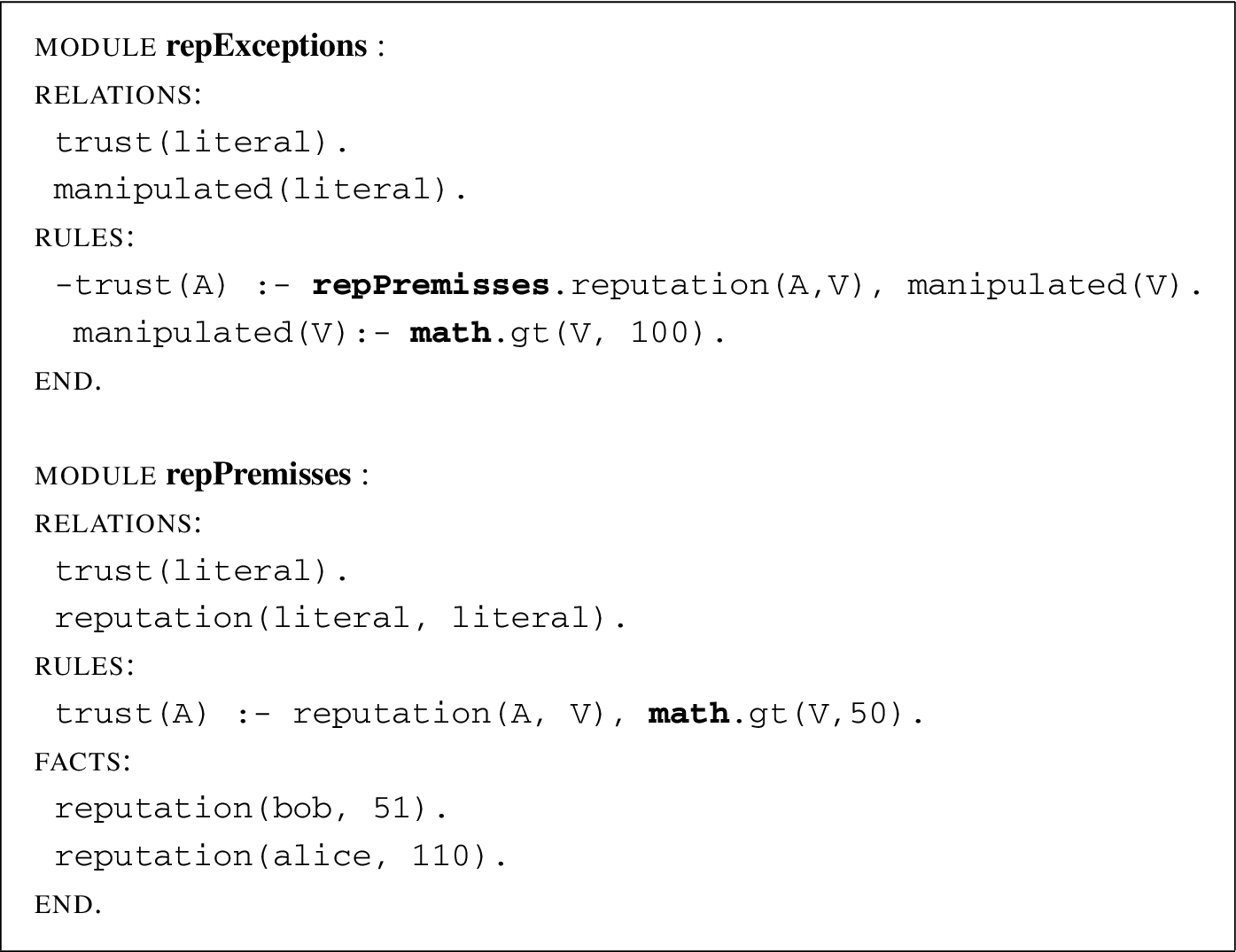
Argumentation Scheme for Reasoning about Trust from Reputation.
As argued above, the factors which may influence the communicative relation are diverse. Here we intend to present how the trust component can be realized in the paraconsistent setting and embedded in the Ethotic Argumentation scheme. For this purpose, we utilize two argumentation schemes for reasoning about trust, as proposed in [36]: Reputation and Prudence.

Argumentation Scheme for Reasoning about Trust from Prudence.
Table 7 summarizes both schemes, giving their original form in the first column, the adapted version with reduced critical questions in the second column, and the paraconsistent version in the third column.
Next, the 4QL modules that encode these schemes are presented in Figs 12 and 13 respectively (notice we omit the standard top-level module
Let’s consider the Reputation scheme first. The only critical question that is not redundant is the one regarding the manipulation of reputation score. We make it explicit in the
Now that we have shown the paraconsistent implementation of the Reputation and Prudence Argumentation Schemes for reasoning about trust, let’s look at their embedding in the Argument from Ethos. The embedding of the schemes is realized in the following way. Instead of (or in addition to) drawing conclusions about agent’s qualities from the facts base only, we equip the module
to the module
Discussion and conclusions
The contribution of this paper is a computationally-friendly framework for paraconsistent argumentation schemes, extending agent’s reasoning capabilities. The tetravalent model of argumentation schemes can be used in information-rich environments, naturally obeying incomplete or uncertain information. To this end, we provided templates for implementing an arbitrary argumentation scheme in 4QL, like Position to Know, Ethos, Perception or Expert Opinion [56]. Further, we showed a way of embedding argumentation schemes, on the example of Argument from Reputation and Argument from Prudence to reason about trust. Our solution is both expressive (as 4QL captures all tractable queries) and feasible (as 4QL enjoys polynomial computational complexity of computing queries). Such a choice allows for:
an efficient belief revision upon filling the gaps in knowledge (see also [5]), using light-weight forms of nonmonotonic reasoning [22]),
exploring different disambiguation strategies for dealing with inconsistencies [24]. This aspect will be investigated in detail in the upcoming paper.
Such features distinguish 4QL from other formalisms, e.g., Answer Set Programming (ASP) [25]. ASP is based on the trivalent semantics (
Dealing with missing or ambiguous information in argumentation is not a new subject [6]. For example, in [8] the authors propose a formal bi-party inquiry dialogue system where DeLP is used to deal with ignorance and inconsistency. In [47], the authors proposed a logic of multiple-valued argumentation (LMA), in which agents can argue using multi-valued knowledge base in the extended annotated logic programming (EALP) (such an approach was next applied in [32]). However, unlike our approach, the solution was based on Belnap’s logic.
Footnotes
Acknowledgement
The authors would like to thank Professor Andrzej Szałas for his comments which greatly improved this paper.