



Abstract
A MANET consists of a self-configured group of transportable mobile nodes that lacks a central infrastructure to manage network traffic. To facilitate communication, govern route discovery, and manage resources, all moving nodes in multi-hop wireless networks (MANETs) work together. These networks struggle with dependability, energy consumption, and collision avoidance. The goal of this research project is to establish a new, dependable MANET routing model, where the selection of predictor nodes comes first. For selecting predictor nodes based on factors like distance, security (risk), Receiver Signal Strength Indicator (RSSI), Packet Delivery Ratio (PDR), and energy, the adaptive weighted clustering algorithm (AWCA) is used in this case. Using the Interfused Slime and Battle Royale Optimization with Arithmetic Crossover (IS&BRO–AC) model, the node with the lower weight is selected as the Cluster Head (CH). Additionally, mobility prediction is carried out, in which the node mobility is forecast using Improved Long Short Term Memory (LSTM) while taking distance and Receiver Signal Strength Indicator (RSSI) into account. Based on the forecast, trustworthy data transfer is implemented, ensuring more accurate and dependable MANET routing. The examination of RSSI, PDR, and other metrics is completed at the end.
Keywords
Introduction
Nomenclature
Nomenclature
It is challenging (though not impossible) under such circumstances to reinstall the equipment or offer wireless access to the backbone network. Additionally, all linked nodes in MANETs are peer nodes (client and agency nodes 1) with comparable features and abilities that enable them to serve as a mobile router as well [3,11,13]. User nodes have unrestricted movement and are typically unsure about their future positions. A packet is transmitted in multi-hops from sender to receiver involving a lot of intermediary nodes in MANETs because nodes may maintain routes and forward packets while having a restricted communication range. Because of this distinctive method of message transmission, MANETs depend on node cooperation to function. In this method of collaboration, the MANET control system receives constant location information about user nodes from GPS. Along with the range and speed of their wireless connections, this information describes the user nodes [9,19,37].
This infrastructure needs flexibility, meanwhile, comes at a cost of challenges and concerns that are not present in typical wireless networks. In reality, issues with MANETs include ad-hoc addressing, self-configuration, and adaptive reconfiguring to address the impact of mobile nodes on the network architecture [26,33,34]. Additionally, data flow is subject to scheduling limits, necessitating proactive routing [17,24], and involves continuous ad hoc network appliances. This adaptability in infrastructure needs, meanwhile, comes with concerns and problems that are not yet identified in traditional wireless networks [8,12,45]. In reality, problems with MANETs include ad-hoc addressing, higher energy limitations, and self-configuration and adaptable reconfiguration to clarify the effect of the mobility of nodes on the network architecture [25,32]. To overcome certain drawbacks the proposed model is used.
The contributions are as follows:
This research work plans to develop a new reliable MANET routing model, where, predictor node selection is done via IS&BRO–AC algorithm.
Deploys new distance evaluation, where, the total absolute distinction among the 2 vectors is used to determine the Manhattan distance.
Moreover, mobility prediction is done using improved LSTM.
Here, Section 2 analyses conventional works on MANET routing. Section 3 provides an overview of MANET routing. Sections 4 and 5 depict predictor node selection and predicting mobility with optimized LSTM. Sections 6 and 7 depict results and conclusions.
Related works
Singh et al.’s [31] innovative DTRP, a data mining approach, was suggested in 2020 for the source-to-destination route selection process. The one-hop neighbors are chosen using the suggested DTRP method based on factors including speed, Link Expiration Duration, journey time, and node lifetime. So choosing secure sone-hop neighbors along the way to the destination improves the performance of a route-finding technique. The simulation results demonstrate that adopting the suggested DTRP routing mechanism as opposed to existing routing methods increases the lifespan of the route, minimizes data loss, and end-to-end latency, enhancing network performance.
In 2020, Wang et al. [29] presented an effective PS-ROGR strategy in MANET to enhance resource optimization and network longevity. Each particle’s (or mobile node’s) locally renowned position in the search area initially governs how it moves through a network (i.e. geographic location). The entire particle in the system can communicate with one another through the PSO using the least amount of energy possible. Therefore, the optimal position for optimizing the network resources is shared by all of the particles. In this way, the PS-ROGR approach increases network longevity while consuming the least amount of energy possible.
Rahimizadeh et al. [18] establishment of the ideal loop-free path using fuzzy logic and an EO in 2020 ensures the continuity of development. Five steps are described in the proposed algorithm: route discovery, routing information, path recovery, reactive path setup, and multipath routing setup. The EO technique using fuzzy logic was first utilized to determine the best route for the data packets during the route research phase. This outcome shows that the suggested strategy works better than other current options.
The nodes were organized using a clustering algorithm by Pan et al.’s [21]. Using PSO, this protocol will forecast where a node will be in the future. Before finding the optimal path, the link lifespan, position, distance, and speed of the nodes are determined. To discover malicious network nodes and minimize packet loss, the trust values of nodes are calculated from their neighbors. The packets are encoded utilizing ECC to stop data from hostile nodes. Because of trust value, updating routing information is simple and increases the throughput of the network.
An adaptable routing for MANETs was introduced in 2020 by Singh et al. [42] that constantly sets up the routing function about the metrics: (1) The different requirements’ parameters and (2) according to the required application context, the contextual characteristics. Different efficiency, safety, and functional parameters are included in the requirement models. Contrarily, contextual aspects include node/group mobility, node trust values, node resource limits, geographical context, individual node roles, etc. Extensive simulation test scenarios are used to assess our routing system, and the protocol’s effectiveness is documented.
To improve network and data security in 2020, Penna et al. [7] employed the FSMR strategy. The FSMR is created based on abnormal and normal behaviors from the statistics data to assess the existence of misbehaving nodes. The suggested solution uses certificate-less routing and uses the idea of key generation to authenticate the data. Without being aware of certificate routing, packets are sent and verified. The study of the suggested system shows that it has superior data packet authentication while using less energy.
To create efficient routing, Penna et al. [38] developed the ReCoMM in 2020. ReCoMM allows for the assessment of the connection stability of the node. The ReCoMM model looks at the variables that affect cooperative and node state change using a Markov process. The Markov process is employed to alter connection stability and node longevity. With the calculation of collaboration value, the Markov process assists in identifying the upper and lower boundaries of cooperation. Additionally, it performs far better than earlier models regarding average routing overhead and e2e latency.
The presentation of extracting features and a categorization model based on ANFIS by Kostenko et al. [30] was developed in 2020. The retrieved characteristic was trained and then categorized using the ANFIS classifier. This research also suggests SMA2AODV identify flooding assaults for MANETs to combat floods through energy-preserving routing. Following detection, the hybrid approach ACO and FDR PSO were coupled for energy optimization. To extend node lifespan and assure energy-efficient routing, ACO-FDR PSO determines the energy-efficient routing and reduces the network’s energy consumption.
Shajin et al. [35] have deployed safe and effective communication between sender and destination nodes, this study seeks to assess the direct trust value for each node, compute the trust value of all nodes meeting the criteria, and update the trust value and value per trust update interval. Thus, a Trusted Secure Geographic Routing Protocol (TSGRP) that takes into account the trust value for a node obtained by combining location trusted information and direct trusted information has been proposed for detecting attackers (the presence of the hacker).
Theerthagiri et al. [39] have presented ARIMA model uses autocorrelation in conjunction with the random walk (RW) model to predict node mobility in the future. The Akaike information criterion (AIC) and auto-correlation function (ACF) are evaluated for the anticipated mobility model. When comparing the ARIMA- and RNN-predicted mobility datasets, the mean square error (MSE), a measure of error performance, is significantly lower for the ARIMA-predicted mobility datasets.
Jalade et al. [20] have deployed stable node prediction; stability measure establishment, route finding, and data transmission are the four main stages of the suggested methodology. The ADRKGN model is first used to predict the stable node and pick the stable neighbors’. The stability measure is then established, according to which the stable node and neighbor node for routing are similar in the Routing Table (RT). The suggested method has improved end-to-end delay, routing overhead, throughput, energy consumption, and network longevity. For 50 seconds, the throughput of 1178.79 was achieved using our suggested method.
Research gap
MANET research has been influenced by the widespread accessibility of wireless connectivity services and quickly growing deployment requirements over the past couple of decades. A MANET is a wirelessly linked network of mobile devices that continually configures itself. Due to the mobility, self-organization, quick deployment, and lower-cost communications of MANETs, they may be used for a wide range of purposes, together with environmental monitoring, disaster assistance, and military communications. Because of the multiple-hop manner in which data is transmitted, decentralized networks often tend to be more resilient than centralized networks. For instance, if a BS ceases operating in a cellular network, coverage would decrease. However, because data may go through several channels in a MANET, the likelihood of a single failure point is greatly diminished. The MANET design can address problems like isolation or network disconnection since it changes over time. However, the usage of an open wireless medium, changing network architecture, and resource limitations provide several security and performance difficulties for MANET routing. As a result, the academic community is very interested in creating an effective and secure routing system for MANET.
Mobility prediction in MANET: An overview
The purpose of this study is to create a new, dependable MANET routing model. Predictor node selection will be the first step in this process. Here, AWCA is used to pick the predictor nodes based on a variety of requirements, including proximity, security, RSSI, PDR, and energy. The IS&BRO–AC algorithm is used to select CH in the best possible way. Additionally, Mobility prediction is carried out, in which Improved LSTM is used to forecast the node mobility. Prediction-based trustworthy data transfer is used to support more dependable MANET routing. The illustrative depiction of IS&BRO–AC model is exposed in Fig. 1.

PictorialModel of IS&BRO–AC method.
Here, we have used AWCA to anticipate the out-of-range of the mobile node. All of these factors are taken into account by AWCA when selecting the CH. The cluster head that manages the trade-off between numerous cluster heads with a variable number of clusters, latency, power consumption, and data computational capabilities of each node is chosen in computing based on several viewpoints and the application domain. One of the indicated nodes is chosen as the CH, and it is given the name predicting node. LetMANET is represented as an undirected graph denoted by
This work aims to choose a CH for which, parameters such as distance, security, RSSI, PDR, and energy are considered.
Objective model
This project aims to accelerate data transmission while reducing distances and risks between and within clusters. Instead, the system’s residual energy, RSSI, and PDR ought to be at their greatest levels after a successful data transfer. The objective of the IS&BRO–AC model is revealed in Eq. (1). Here,
The constraints in Eq. (1) are described as follows.
In Eq. (10), the energy needed for amplification is referred to as
Here,
Equation (12) displays the total energy required to broadcast data.
The node with a smaller weight is chosen as CH using IS&BRO–AC model. Here, CH is said to be the predictor node.
As seen in Fig. 2, the CHs are here selected in the best possible way using the IS&BRO–AC method.

Solution encoding.
The best possibilities are identified by the current SMA [27], however, it is not particularly precise. As a result, IS&BRO–AC is coupled with BRO [15] to overcome the inadequacies of conventional SMA [33]. Some search issues have purportedly been solved via hybridized optimization methods [5,10,36,40].
The activities taken in the predicted model are as follows:
The search agent’s population The search agent’s population is initialized Determine the search agent’s fitness using Eq. (1). Update the best fitness Perform while The parameters b that were collected inside the range Here, Conventionally, the mathematical formula a is denoted as per Eq. (17). As per IS & BRO–AC a is modeled as in Eq. (18), wherein Calculate W by means of Eq. (19).
Here, The randomized value is represented by Adjust the search agent’s position to match Eq. (20).
Here, Arithmetic crossover is performed for the attainment of objectives. End for
End while Return
Predicting mobility with an optimized LSTM model
After CHS, the node with higher mobility is predicted using the DL algorithm. The CH will estimate the mobility information, RSSI, etc. of all nodes inside the cluster. The prediction inside LSTM is carried out based on distance and RSSI.
LSTM
It includes [46]: a forget gate, an input gate, and an output gate. Assume that variables Y and A are concealed and cell states.
LSTM made use of
In this work, the cross entropy-based loss is computed as shown in Eq. (27).
Mobility control
Following mobility prediction, anytime the target node broadcasts outside of its transmission range, CH sets a flag. A different path will be selected and transmission can proceed depending on that flag value.
Results and discussions
Simulation setup
Python was used to execute this project. The number of nodes used is 100 and 200. The maximum number of rounds used is 2000. The length of the data packet is 4000. The efficacy of IS&BRO–AC was demonstrated over WCA [28], HM-MPR [14], SSA, SSOA, CA, SMA, and BRO. The examination was done on the topic of throughput, energy, PDR, delay, and distance. The sample model of MANET and simulation set up for 100 and 200 nodes is exposed in Fig. 3 and Fig. 4.

Sample model of MANET for nodes (a) 100 and (b) 200 before clustering.

Sample model of simulation set up for nodes (a) 100 and (b) 200 after clustering.
Statistical study on delay
Statistical study on distance
Statistical study on RSSI
Tables 2, 3, and 4 depict the study on delay, distance, and RSSI via IS&BRO–AC oriented model over WCA [28], HM-MPR [14], SSA, SSOA, CA, SMA, and BRO. The met heuristic schemes are stochastic, and to substantiate its fair evaluation, each model is analyzed quite a lot of times to accomplish less delay, distance, and high RSSI. For minimum case, a less delay of
Convergence study
The convergence rate of IS&BRO–AC algorithm over WCA [28], HM-MPR [14], SSA, SSOA, CA, SMA, and BRO is exposed in Fig. 5. In Fig. 6, analysis is done for 100 nodes and 200 nodes. Here, a lesser cost of 0.45 is achieved by IS&BRO – AC from the 3rd to 8th iterations when the node count is 200. While the node count is 100, a lesser cost of 0.57 is achieved by IS&BRO–AC from the 5th to 8th iterations. Thus, a node count of 200 exposed lesser values than a node cunt of 100. During the prime iterations, even the IS&BRO–AC approach revealed high-cost values. Nevertheless, with raise in iterations, the cost is lessened, and at last, the less cost is attained by IS&BRO–AC. The improvements in CHS and improved LSTM offered better results for the proposed mobility prediction.
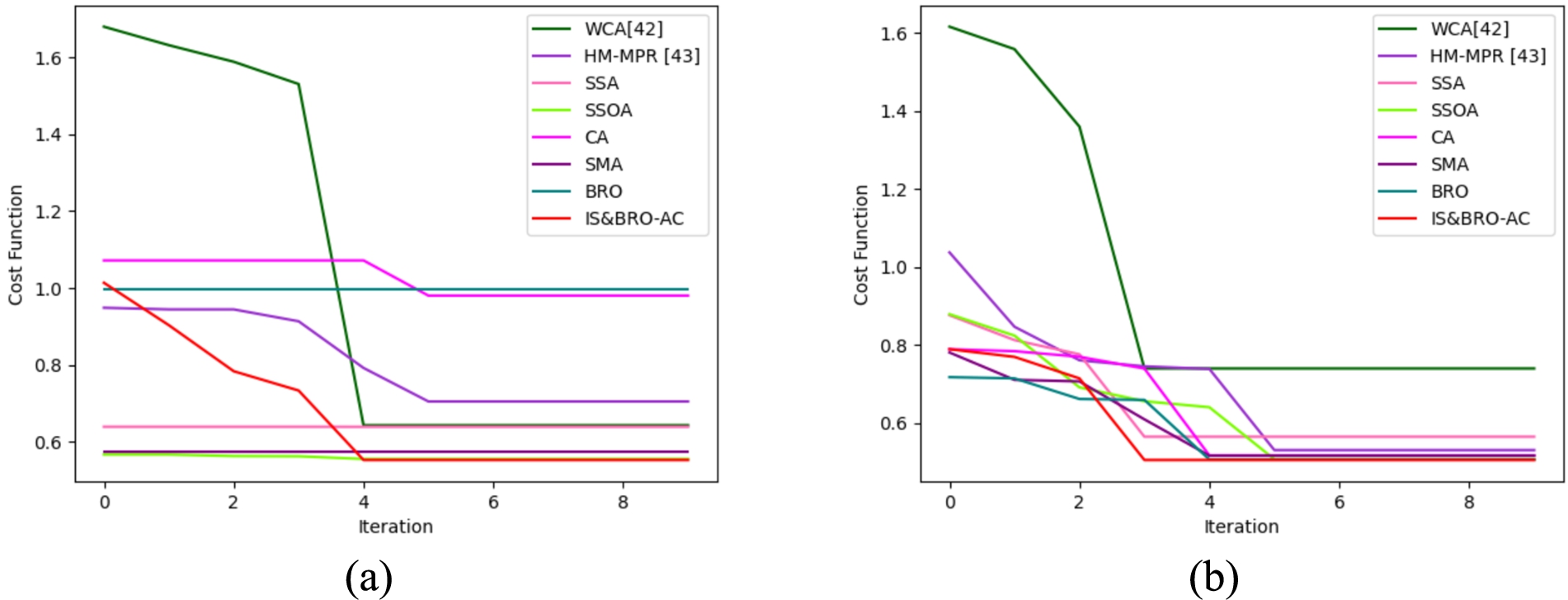
Convergence study of IS&BRO–AC based mobility prediction for nodes (a) 100 and (b) 200.
The assessment of proposed IS&BRO–AC over WCA [28], HM-MPR [14], SSA, SSOA, CA, SMA, and BRO regarding energy and PDR are given in Fig. 6. In the case of energy from Fig. 6, it is noted that energy is narrowed with raise in the count of rounds, nevertheless, IS&BRO–AC offered high energy over WCA [28], HM-MPR [14], SSA, SSOA, CA, SMA, and BRO. At around 0, the energy is superior by about 0.58, but with an increase in rounds, the energy is decreased to about 0.43 when round is 2000. Similar outcomes are observed for IS&BRO–AC when node counts are 200. In Fig. 7, PDR is computed. The PDR for IS&BRO–AC is high than WCA [28], HM-MPR [14], SSA, SSOA, CA, SMA, and BRO. Particularly, the PDR at the 2000th round is high (0.992) than at other rounds for a node count of 100. For a node count of 200, the PDR from the 500th round to the 700th round is higher (0.993) than at other rounds. The improvements in CHS with improved distance evaluation and improved LSTM offered better energy and PDR for the developed mobility prediction model.
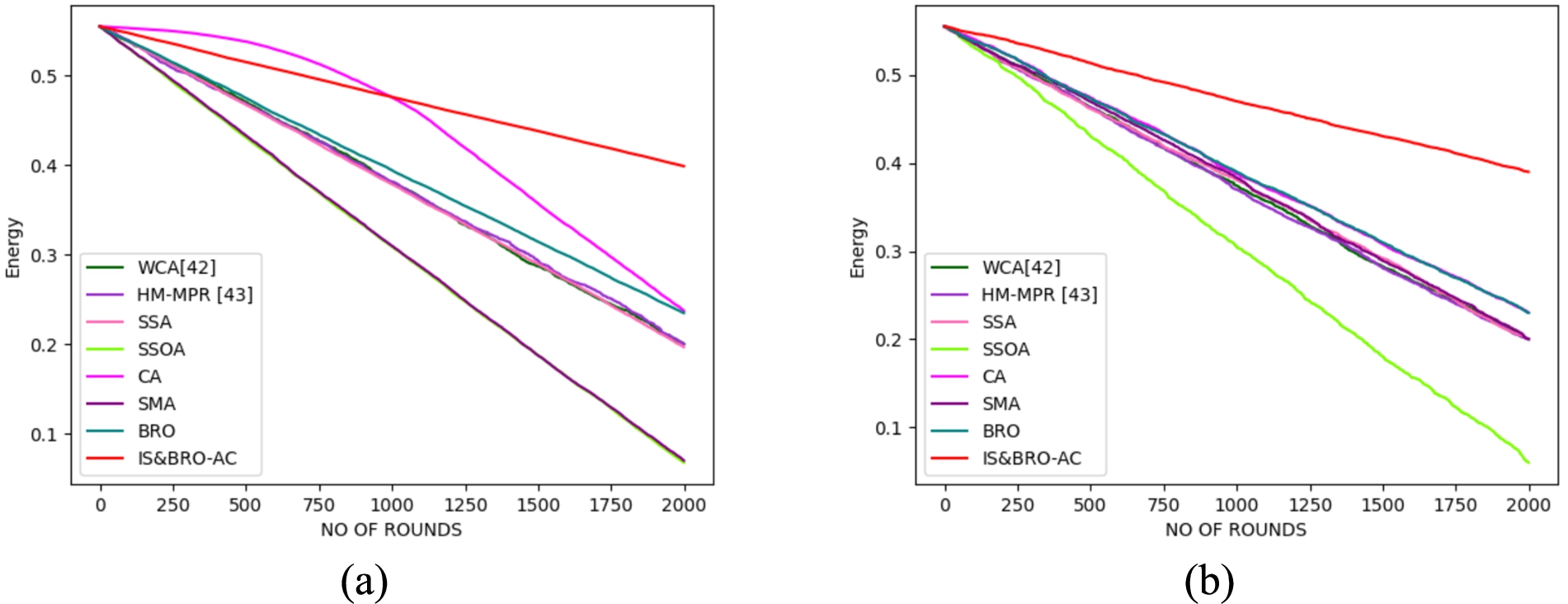
Energy analysis on nodes (a) 100 and (b) 200.
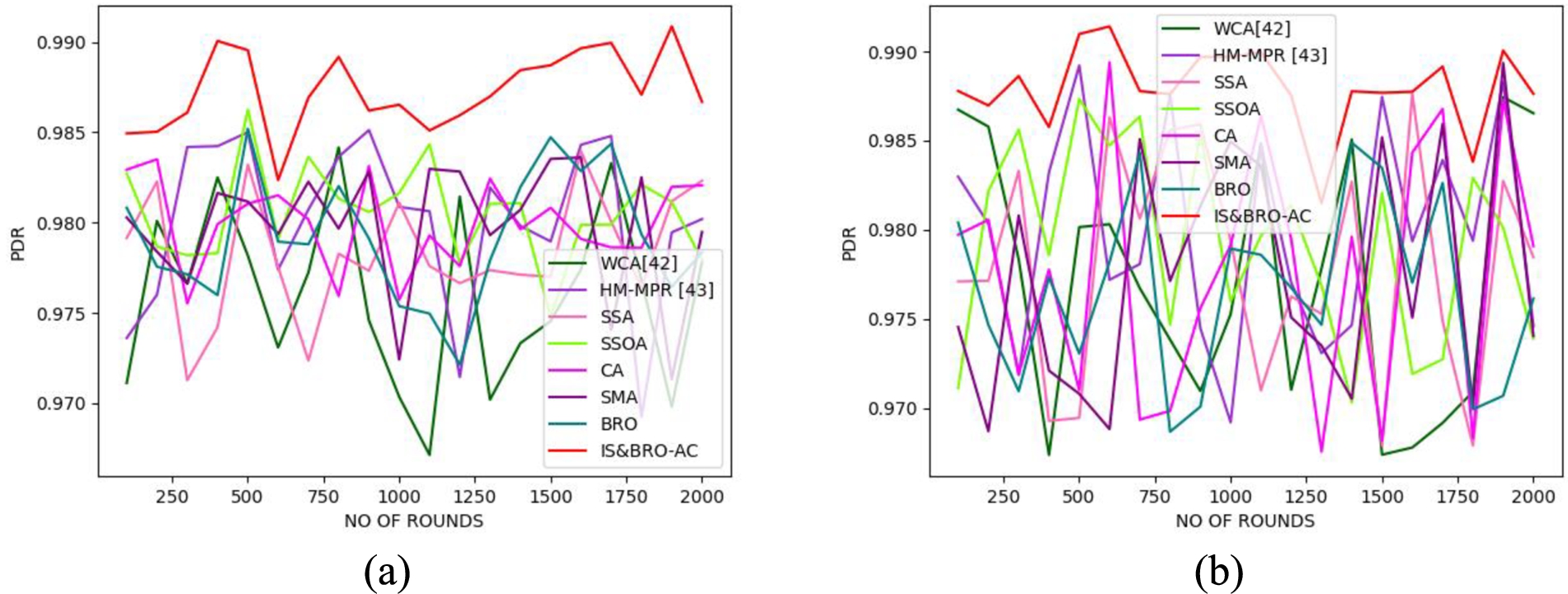
PDR analysis on nodes (a) 100 and (b) 200.
The analysis of throughput using IS & BRO–AC is specified in Fig. 8 for 100 and 200 nodes. Here, the throughput in Fig. 8(a) is fluctuating for all rounds. Particularly, high throughput of 3650 is gained by IS&BRO–AC at the 1500th round, while WCA [28], HM-MPR [14], SSA, SSOA, CA, SMA, and BRO gained relatively less throughput. A minimal throughput of 2900 is observed for WCA at the 2000th round for 100 nodes. The throughput graph in Fig. 8 (b) is also showing fluctuating outputs for all rounds. At the 500th round, high throughput of 3680 is observed using IS&BRO–AC, which is higher than WCA [28], HM-MPR [14], SSA, SSOA, CA, SMA, and BRO. In the case of 200 nodes, HM-MPR [14] and CA have exposed minimal throughput values than WCA [28], SSA, SSOA, SMA, and BRO. The improvements in CHS with improved distance evaluation and improved LSTM offered better throughput for the developed mobility prediction model.

Analysis of throughput for nodes (a) 100 and (b) 200.
This research work developed a new reliable MANET routing model, where, the initial phase was predictor node selection. Here, AWCA was adopted for predictor node selection based on parameters like distance, security (risk), RSSI, PDR, and energy. The node with a smaller weight was chosen as CH using IS&BRO–AC model. Moreover, mobility prediction was done, during which the node mobility was predicted using improved LSTM on considering RSSI and distance. Based upon the prediction, reliable data transmission was carried out that ensured better reliable MANET routing. In the end, analysis was done on RSSI, PDR, and so on. A minimal throughput of 2900 was observed for WCA at the 2000th round for 100 nodes. The throughput graph was also showing fluctuating outputs for all rounds. At the 500th round, high throughput of 3680 was observed using IS&BRO–AC, which was higher than WCA, HM-MPR, SSA, SSOA, CA, SMA, and BRO. In the case of 200 nodes, HM-MPR and CA have exposed minimal throughput values than WCA, SSA, SSOA, SMA, and BRO. The advantage of the proposed model is performance efficiency is high and the disadvantage is needed to consider the routing tables to reduce the data exchange in MANET. In the future, time analysis has to be concerned more.