



Abstract
This case study used the Nordic Musculoskeletal Questionnaire (NMQ) to explore work that involves handling gas cylinders and to determine risk factors that may cause related injuries. The NMQ survey was distributed to 100 gas cylinder handlers in Taiwan, and their handling tasks were analyzed. The results showed that the overall prevalence of musculoskeletal disorders was 91% within 1 year. More than half of the respondents (62%) experienced shoulder discomfort, followed by lower back/waist (57%) and neck (47%) discomfort. Daily work hours (>10 h) were primary factors influencing the development of discomfort when handling gas cylinders, whereas the daily delivery frequency (>30 deliveries) was relevant to the prevalence of lower limb discomfort. Individual factors also substantially influenced upper body, lower back/waist, and knee discomfort (i.e., age, job tenure, and exercise). The findings of this study can serve as references in the prevention of work-related musculoskeletal disorders caused by performing gas cylinder handling tasks.
Introduction
High flexibility and mobility, a low number of involved workers, and poor cost benefits of automation are factors preventing certain manual operations from being widely performed by mechanical equipment. Work-related musculoskeletal disorders (WMSDs) affect the well-being of workers [1] and have therefore become a critical topic, especially regarding people who must handle heavy objects in awkward postures [2]. Although extensive and in-depth studies on WMSDs have been conducted [2–4], a literature review revealed that no studies have addressed gas cylinder handling, which is a common handling task in Taiwan.
Lin reported that handling gas cylinders weighing over 40 kg induces risks of shoulder and back injury [5]. Westerling and Kilbom surveyed the physical loads of four oxygen cylinder (34–76 kg) handlers, observing that these handlers exhibited considerable shoulder extension and an average heart rate of 99 bpm at work [6]. Devereux et al. evaluated the effectiveness of using auxiliary devices to handle small gas cylinders (16–22 kg), finding that these devices increased handlers’ physical loads [7]. Recently, Chen and Chiang [8] surveyed four gas cylinder handlers from a large technology company in Taiwan, finding that their tasks may potentially cause injury to the upper limbs (particularly the wrists). However, none of the aforementioned studies have explored musculoskeletal disorders in gas cylinder handlers. Therefore, this study employed the Nordic Musculoskeletal Questionnaire (NMQ) to investigate the prevalence of body part discomfort and to determine risk factors that may cause injury among gas cylinder handlers in Taiwan.
History and description
Gas cylinders are used frequently in Taiwan because of the dietary and living conditions of the Taiwanese population. Gas cylinders are involved in various aspects of daily life in Taiwan, such as cooking meals and providing heat for water heaters. In Taiwan, the estimated number of gas stores is 10,000, and approximately 40,000 people are employed in gas distribution. Nearly 8 million gas cylinders are currently in use in Taiwan, each with a full and empty weight of 40 and 20 kg, respectively. Particularly in rural areas or villages and towns where natural gas pipelines have not been developed, numerous individual gas stores maintain designated service areas. In general, gas cylinder handling consists of several individual tasks, such as delivering empty cylinders to liquefied petroleum gas companies to be filled and bringing filled cylinders back to gas stores; these tasks are performed two to three times daily, with greater frequency during holidays. Loading and unloading tasks are required when filling cylinders and unloading them at gas stores. Handlers typically deliver gas cylinders by motorcycle to designated places according to customer requests and are sometimes requested to carry cylinders up several floors. Workers must handle gas cylinders by almost entirely manual means every day. Handling involves clutching the top handles of the cylinders and rapidly rolling the cylinders by twisting the wrists. Furthermore, lifting a cylinder onto the shoulders requires supporting the cylinder by hand, which may cause severe injury to the hands and shoulders (Fig. 1).
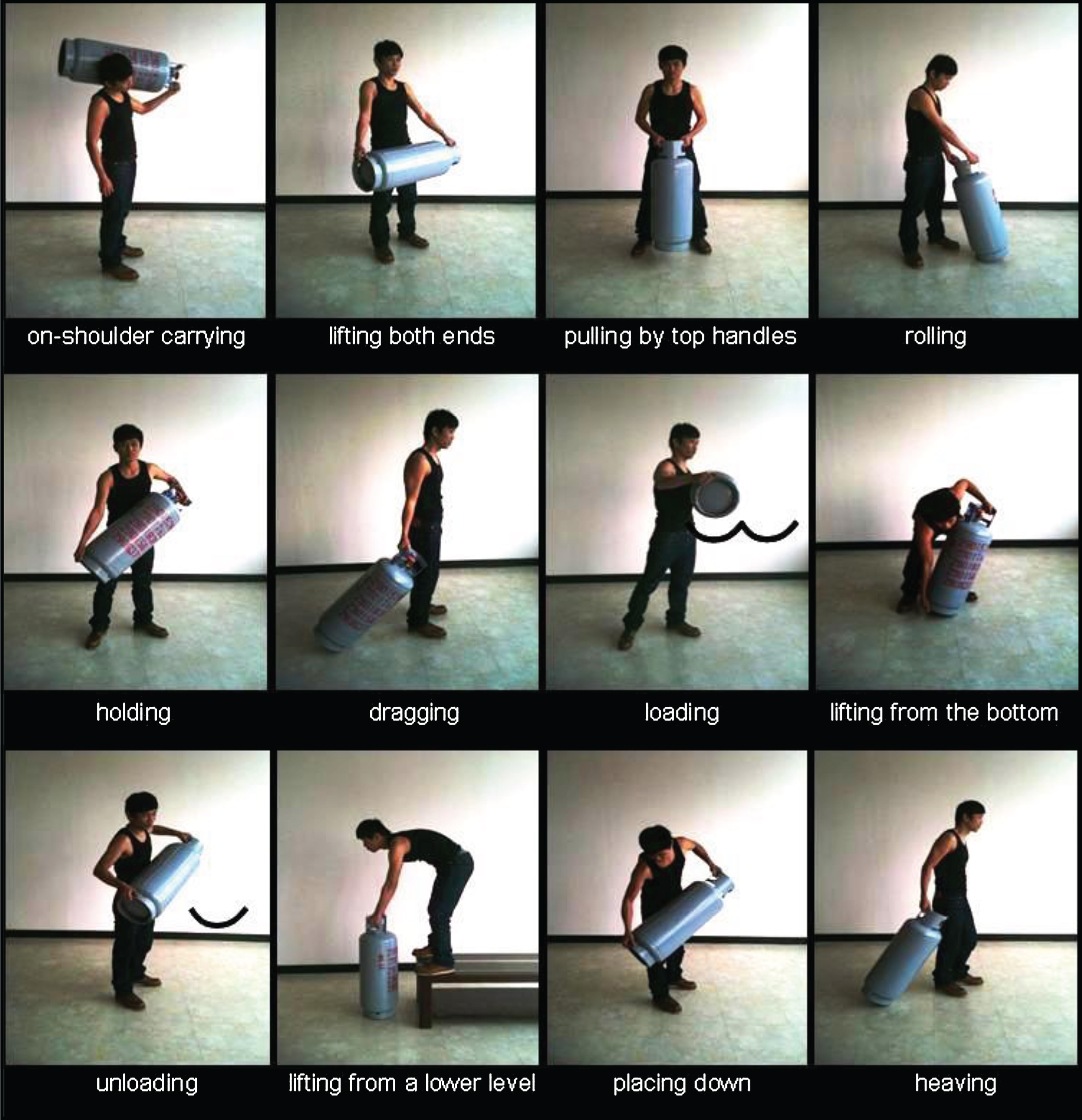
Postures typically adopted when handling gas cylinders.
Most gas consumers live in old apartments, among which only 10% −20% are equipped with elevators. Delivery to the third floor or above entails additional charges of 20−60 TWD. In general, peak hours are 8 : 00−10 : 00, 12 : 00−14 : 00, and 17 : 00−20 : 00, with notable business peaks during dinner preparation and shower times. Approximately 20 gas cylinders can be delivered in 1 h during peak hours for a gas store, and over 100 cylinders per day can be delivered during periods of cold weather and on Chinese New Year. Handling gas cylinders is more dangerous on rainy days than on sunny days because wet roads or shallow tire treads can cause accidents such as collisions. Moreover, skid-proof shoes should be worn when handling gas cylinders to prevent slipping and falling, especially when ascending stairs.
In this study, the NMQ survey was distributed to 100 gas cylinder handlers in Northern Taiwan, and their handling tasks were analyzed. The questionnaire was conducted by personal visit during May 1–June 30, 2014. The NMQ is a general questionnaire that classifies musculoskeletal discomfort and disorders according to nine major symptom sites, enabling researchers to discriminate among sites of discomfort and injury and to closely examine symptoms specific to certain sites. The NMQ can be either general or specific and features a reliability ranging from 77% to 100% and a validity ranging from 80% to 100% [9]. Informed consent was obtained from all participants. This study was approved by the Ethics Committee of Chang Gung Memorial Hospital.
In addition to a general descriptive statistical analysis, a logistic regression analysis was conducted to explore possible risk factors causing discomfort at each symptom site. The factors surveyed by the questionnaire covered the following items: (a) personal details (i.e., age, weight, height, dominant hand, job tenure, education, marital status, exercise habits, tobacco smoking, alcohol use, areca chewing, and health and medical background) and (b) job demands (i.e., daily work hours, daily delivery frequency, monthly workdays, shift). The data collected from the questionnaires were analyzed using the Statistical Package for the Social Sciences Version 19.0; the significance level α was set at 0.05.
Results and discussion
Sample characteristics
One-on-one interviews were conducted, and a total of 100 valid questionnaires were retrieved. All of the 100 respondents were men, with a mean±standard deviation height of 170.7±5.8 cm, weight of 79.9±13.6 kg, and age of 41.8±9.5 years. Of the 100 respondents, 48% were unmarried, 41% were married, 88% never exercised, 40% never smoked, 67% did not chew areca, 12% often consumed alcohol, and 28% abstained from consuming alcohol. In addition, 83% and 8% of the respondents were right-handed and left-handed, respectively; the other respondents did not specify. A considerable proportion of the 100 respondents had previously been diagnosed with scoliosis (29%) and arthritis (24%), and 50% of these respondents had not recovered by the time of the interview. Whether these conditions affect gas cylinder handlers at work and cause physical discomfort or pain is a topic worth investigating.
On average, the respondents had worked 9.4±7.4 years at their current job and the duration of past job tenure was approximately 10.2±8.1 years. Their past job tenures were extremely varied. The respondents’ average total years of job tenure exceeded 22.4 years, indicating that gas cylinder handlers tend to be older than other types of workers. The findings revealed that, considering the work characteristics and social identity evaluations, gas cylinder handling is not the optimal choice for applicants looking for their first job (as claimed by 97% of the respondents) and that gas cylinder handlers are a disadvantaged working group.
NMQ results
The NMQ results showed that the overall prevalence of musculoskeletal disorders was 91% within 1 year. The overall prevalence value was higher than that of other tasks investigated by previous studies (e.g., taxi drivers: 51.0% [10]; beverage bottling workers: 60.0% [2]; nurses: 80.8% [3]; female kitchen workers: 87.0% [11]). The shoulders were the body parts with the highest prevalence of discomfort (62%) among the 100 respondents, followed by the lower back/waist (57%) and neck (47%). In addition, the prevalence of hand and wrist discomfort was 39%, followed by knee (29%), upper back (28%), foot and ankle (21%), elbow (19%), and buttock and thigh (14%) discomfort. The main symptom was aching pain that slightly influenced operation abilities and one-fifth to one-third of the respondents reported that it occurred almost daily. However, most neglected the discomfort. The primary treatment, if sought, was massage (29% – 40%). A high proportion of the respondents considered the discomfort to have been caused completely or partially by work (e.g., neck discomfort: 72%; lower back/waist discomfort: 90%), indicating that most respondents deemed their discomfort to be the result of gas cylinder handling.
In this study, a logistic regression analysis was performed to examine the risk factors affecting each investigated symptom site, as shown in Table 1. The results indicated that the factor of daily work hours (less or more than 10 h) was extremely significant in affecting body discomfort, including upper back, elbow, wrist, buttocks/thighs, knee, and ankle discomfort (odds ratio [OR] ranged from 1 : 2.65 for wrist discomfort to 1 : 6.65 for ankle discomfort, all p < 0.05).
Risk factors significantly associated with the presence of musculoskeletal disorders
Risk factors significantly associated with the presence of musculoskeletal disorders
*p < 0.05, **p < 0.01.
In addition to daily work hours, daily delivery frequency affected the discomfort of the lower limbs. In other words, if workers delivered cylinders outdoors more than 30 times per day, their knees and ankles were significantly perceived as uncomfortable. This may be attributed to the cumulative effect of frequently carrying cylinders. The OR values were 1 : 7.31 for knee discomfort and 1 : 5.83 for ankle discomfort (all p < 0.01). Several individual factors also substantially influenced upper body (i.e., age, job tenure, and exercise), lower back/waist (i.e., age), and knees (i.e., job tenure) discomfort. However, the high prevalence of discomfort observed in the neck (47%) was not affected by any factors of interest in this study. This implied that the discomfort in the neck site generally may exist among gas cylinder handlers, considering the task characteristics of the job.
In summary, from the NMQ results of 100 respondents, the overall prevalence of musculoskeletal disorders among gas cylinder handlers was 91% within 1 year, higher than that among other types of workers investigated by previous studies. The primary body sites experiencing discomfort were the shoulders (62%), lower back/waist (57%), and neck (47%). The job was not the optimal choice for the respondents; furthermore, gas cylinder handlers are a disadvantaged working group. A high proportion of the respondents considered their discomfort to have been caused completely or partially by work, indicating that most respondents deemed their discomfort to be the result of gas cylinder handling. However, most of them neglected their discomfort. The results of the logistic regression analysis showed that when the daily work hours exceeded 10 h and the daily delivery frequency exceeded 30 deliveries, the prevalence of body discomfort was more significant. The findings of this study suggest that the challenging arrangement of tasks involved in gas cylinder handling should be avoided because the body may become overworked.
Conflict of interest
The authors have no conflict of interest to report.
Footnotes
Acknowledgments
This study was partially supported by funding from the Ministry of Science and Technology, Taiwan, grant No. MOST101-2221-E-131-001-MY2. This funding is gratefully acknowledged.