



Abstract
BACKGROUND:
Alternatives are being developed for waste treatment all over the world. Solidary selective collection is a recognized social technology for taking millions of people out of absolute poverty. However, this technology raises crucial questions regarding its nature and development perspective. What can be said of the legitimacy of a social technology that is born from misery and maintains wastepickers in precarious work conditions?
OBJECTIVE:
This article approaches issues based on the analysis of the wastepickers’ work process, highlighting the difficulties and interpersonal conflicts, the strong social bonds and creativity that reveal the potential of efficiency and solidarity of this social technology.
METHODS:
The analyses are founded on empirical descriptions of work situations and organizational arrangements that the wastepickers themselves have developed. The observations were made during the work, followed by interviews focused on significant events and behaviors.
RESULTS:
The contradiction between efficiency and solidarity, which excludes workers from the formal labor market, finds in the associations a solution for people with different capacities. This social technology offers much more than simple survival or exoticism. The wastepickers create a sustainable mode of production, putting together economic, social and environmental criteria in an innovative and fair production technology.
Introduction
Although the environmental issue is a global problem, technologies for the treatment of solid waste (SW) focusing on recycling are being locally developed in peripheral countries. In general, the integrated system of solid waste (ISSW) management associates different treatment processes and trash disposal, from the most conventional, such as landfill or incineration, to various recycling technologies, namely biodigestion and composting. However, in each country, this system assumes a specific configuration of a mix of treatments, adopting different procedures of organization and management of reverse logistics, of population engagement and of accountability of enterprises for the waste resulting from the consumption of the products they place on the market. While first world countries make use of more sophisticated technologies in solid waste (SW) management, collection and treatment, a typical feature in developing countries is the figure of the wastepicker, who occupies a central position in peripheral countries and a peripheral position in developed countries of the center. In Brazil, the wastepickers are formal and informal workers of the recycling production chain that collect from the waste valuable materials (plastic, metals, paper …) and reusable products (clothes, furniture, shoes …). Older and handicapped people, unemployed workers with low qualification, low income retired people, all of them marginalized in the labour market, collect waste either on a temporary or continuous basis. Their formal organizations (wastepickers cooperatives and associations – WAC) are similar to the social firms in Europe [1, 2], but here the wastepickers take over all the business management and the most of them want to remain in this activity.
Around the wastepickers, and thanks to their work, a whole network of relations called “solidary selective collection” (or solidary recycling) is developed, which may be regarded as a social technology 1 characteristic of developing countries, and ensures productive reintegration and the survival of millions of people [3–6]. This technology has gained global recognition (as in the case of ASMARE – Association of Wastepickers of Recyclable Materials – Belo Horizonte, Brazil), but it still faces difficulties regarding its development perspective. For instance, this activity is questioned in many ways, starting from fundamental issues about its own nature, whether it is a decent job or exploitation of precarious work, or still if it is an activity to be maintained by social care or managed as a business. Indeed, what about the legitimacy of a social technology which is born from misery and still keeps most of the pickers in poor living and working conditions, many of whom are still working in open dumpsites? [10] Given the increasing economic value of waste, what social and technical conditions are necessary to support this technology preserving its values of inclusion and solidarity? How can this solidary recycling survive when faced with competition from other organizing agents of parallel systems of reverse logistics, along the lines of the developed capitalist countries, including incineration?
In this article, we will approach these general, macrosocial issues, going through the analysis of the wastepickers work process, highlighting the difficulties found, the interpersonal conflicts, but also the strong social bonds and creativity that reveal the potential of efficiency and solidarity of this social technology. The great social issues, such as technological options of waste treatment or social ways of production and consumption organization, will always be present as background of the empirical analyses carried out in the wastepickers’ workplaces. This option is not an arbitrary clipping, as it deals with macrosocial issues from the perspective of daily work. It reflects an emerging principle of sociability construction based on the work sphere and within it, from its most immediate aspects 2 . The search for increased performances excludes from the labor market those who, for one reason or another, present low performance since competition leaves little room for solidarity. Accordingly, the specificity of solidary recycling lies in the way efficiency and solidarity are combined in each work gesture or in the differentiated use (reappropriation) of tools and machines, such as the sorting conveyor belt. Based on empirical descriptions of work situations and on analyzes of organizational arrangements and operational methods developed by the wastepickers themselves, we herein discuss how the contradiction between efficiency and solidarity, which excluded them from the formal labor market, finds a solution which allows to keep in their organizations people with different physical and labor capacities. Under the obvious precariousness of their working conditions [10–12], it is possible to distinguish positive elements of a métier that supports this social technology and can serve as basis for its development and that of the wastepickers themselves (social recognition, self-respect, well-being, income), taking them out of their current precariousness. It is, in short, the addressing of two questions: what the job of the wastepicker is and how it may develop.
In order to approach these questions, in addition to this introduction, the article is organized in four parts. Initially, we discuss the nature of the wastepickers’ work, explaining the current contradictions and impasses to its development (item 2), justifying why the issues posed must be reconsidered based on their daily work. Among the various phases and dimensions of the work process, we chose to describe the material sorting, emphasizing not only the creative solutions developed by the wastepickers themselves in order to organize their activity, but also the conflicts that remain unsolved, illustrated through excerpts from the interviews with members of the WAC (item 3). Based on these analyzes and empirical elements, we resume the discussion on the economic, social and environmental sustainability of the solidary recycling technology as an alternative organization of SW, concomitantly with the development of the social bonds that support it (item 4). In conclusion, we gather the elements outlined in the text that allow to characterize the picking activities as a profession (in the sense of a true métier, not only from the point of view of the Labor Code), and that serve as the basis for its development, valuing its positive elements that can overcome the current precariousness.
When necessary, we will make some comparisons with other technologies for waste treatment, especially incineration, in order to enhance the specificity of the social technology of solidary recycling and of the wastepickers’ associations as organizations in the solidary economy. In this aspect, the pickers of recyclable materials are a paradigmatic issue for the discussion, briefly done in the end, of the limits and possibilities of solidary economy in general and of sustainable development, still within the scope of market economy.
Nature and ambiguities of the wastepickers’ work
When “waste issues”, a typical problem of the consumer society, are put together with social exclusion in countries which cannot universalize the consumption standard of developed capitalism, they produce their own alternative to protect the environment and partially solve human and social problems generated by misery (alcoholism, hunger, social and family degradation, criminality...). The wastepicker, a typical figure of the third world urban scene, is constituted, paradoxically, in the encounter of social exclusion with waste production in large scale. “We can define a developing country as the country that does not allow its citizens to ‘enjoy a free and healthy life in a safe environment.’ This is indeed a hard reality” [15, p. 399]. At the confluence of two problems caused by a capitalism unable to develop, a possible solution starts to be created for urban waste treatment, based not in the technological solutions of developed countries, but in a sociotechnical arrangement only possible in the Third World.
In developed countries, social pressure has generated regulations that blame consumers and private companies for the trash generated by economic activities and consumption. These systems combine techniques of reverse logistics organization with social control and economic incentives via the market: reduction of product prices when the packaging or obsolete product is returned, reduction of taxes for those who perform selective collection, payment of fees for packaging, environmental certifications (Green Seal), etc. What characterizes this alternative is the combination of high technologies (automated systems for collection and sorting, incineration with strict control of toxins...) with market relations within national, regional (eg European Community) or international regulations. This combination produces differentiated results, with high recycling rates and reduction of landfills (Germany, Austria, the Netherlands, Belgium...), or predominance of incineration systems (Sweden, Japan, Denmark …).
It is precisely this intermediary position of countries that are only partially industrialized, without the integration of all its population in the labor and consumption markets, which creates the conditions for the emergence of wastepickers as a massive social phenomenon. Formal economy, intensive in technology and capital, and informal economy are not separated spaces, but they are integrated in a totality which produces, at the same time, wealth and poverty. In every developing country, a developed first world can be found which benefits from the third world of the marginalized population. Milton Santos [16] had already analyzed these two circuits of the Brazilian economy. More recently, Jessé Souza [17] pictured the “Brazilian rabble”, that adds up to about 1/3 of the population! Part of this “rabble”, with the support of social institutions and NGOs, managed to get organized into social movements with sufficient legitimacy to inflect the elaboration of public policies, such as the recent approval of the National Solid Waste Policy – NSWP, in 2010 [18].
For the wastepickers, these policies have been manifested in a normative framework favorable to the recycling activity, revealing the social recognition gained by the profession. However, as some authors argue, this situation is unsustainable in reality, maintained due to ideological manipulations and actions of pressure groups [19], and serving in reality just to feed the chain of the recycling industry with cheap labor [3]. On the other hand, when the wastepickers’ starting point is considered, it is undeniable that it is a successful experience, able to achieve better economic, environmental and social outcomes than official systems of selective collection or other actions against poverty [20]. Therefore, it is necessary to investigate what actually happens in the routine of the wastepickers and their associations. In fact, although we are referring to wastepickers, we mean only those directly organized into associations and cooperatives (WAC), which are far from being the predominant model in Brazil. Most wastepickers work in the informal sector, selling their materials directly to middlemen, who resell them to the recycling industry. However, in the view of the critics, there is no significant difference between these groups, both of which are equally exploited and maintained in misery conditions. But we will see that the wastepickers’ self-organization makes all the difference. Today it is even a strategy of the organized groups to incorporate non-organized wastepickers, distancing them from the domination of middlemen.
This historical place of the wastepickers organized in WAC, which painstakingly managed to get off the streets and the informality to occupy a socially recognized and valued role, was demarcated from time to time by various laws and regulations conquered by the social movement nationally organized. These legal devices cover a wide range of legal and economic instruments (recognition of the Profession and Bill to grant retirement by the INSS - Brazilian social security withholding system – non-repayable lines of credit, the implementation of selective collection in public agencies and some destination for the wastepickers’ association …) which culminated in the wastepickers’ formal recognition, at NSWP, as social and economic recycling agents. In the solid waste new policy, the wastepickers are recognized as having a privileged role in the productive chain: they have priority in the collective selection; participation of WACs (wastepickers’ associations and cooperatives) in the reverse logistics of post-consumption packaging; participation of WACs in sectorial agreements for reverse logistics; definition of programs and actions for the participation of WACs in municipal Plans of solid waste management. However, due to its historical trajectory, which originated with social assistance actions to homeless people and dumpsite pickers, a dilemma faced by the wastepickers associations specifically refers to the new position they occupy as economic actors. If on the one hand, their organizations are challenged to “professionalize” their management, aiming to develop competitive capabilities to compete with private enterprises and become self-sustainable, on the other hand they still rely on assistance from the State, which grants them resources of non-reimbursable funds. They also receive resources from private enterprises that intend to promote their social responsibility, both through actions aimed at socially vulnerable groups and through environmental protection. Today, with the NSWP, the responsibility shared by reverse logistics increases the enterprises’ interest in supporting the wastepickers as economic actors, but with action limited to the beginning of the recycling chain.
State support is justified by the promotion of social and economic development of the excluded workers, and aims to minimize technical and social weaknesses stemming from historical losses, so as to make the organizations competitive in the formal market. A model advocated by the public administration of some metropolises is the large central sorting system, which keeps the wastepickers solely in the role of sorters, with restrict action inside the recovery centers. Selective collection (and all the subsequent processing) would be carried out by private companies, reportedly more efficient. In order to find solutions to these dilemmas in a sustainable development perspective, but without betraying their identity marked by their solidary origins, it is necessary to go first through the interior of the recovery centers where the wastepickers develop their activity. A detailed analysis of the work situations reveals how the wastepickers articulate efficiency and solidarity, and therefore, what sense may be given to the demands of “professionalization” in management or to performance improvement without contradicting the nature of the wastepicker’s métier.
Material sorting and conflicts of cooperative work
The wastepickers act in the early stages of the recycling chain, which comprises collection, transport, material separation or sorting and commercialization. In these stages, the WAC competes with private or public companies, supposedly more efficient to perform selective collection services and the logistics of transporting materials. As for commercialization, they also face the challenge of increasing the scale and quality of the materials in order to trade directly with the recycling industries, eliminating the middlemen. In these conditions, one of the technical problems faced by the wastepickers’ organizations is the disarticulation of the different stages of the process, not all of them under their control, starting from the quality of the waste separated by the population. On the other hand, the separation of materials at the generating source, the initial stage of the process which influences productivity in the remaining stages, is not necessarily connected to the final stage performed by the wastepickers’ associations: commercialization. That is: not everything that the generators destine to the wastepickers is likely to be marketed by the associations due to the amount of “rejects” (organic and non-recyclable materials present in the material collected), to the lack of buyers or to technical or economic infeasibility. For example, materials with very low market price, such as Styrofoam and some packaging materials.
Internally, one of the WAC’s problems lies in the material sorting, which is one of the main bottlenecks in the recycling productive chain. In this stage of the process, it is also possible to verify complex interrelations among technical and social aspects in the work organization and production process. Sorting, the main operation, is responsible for adding value to the materials and occupies 2/3 of the labor. It consists in (re)establishing classifications for the various discarded materials, considering criteria such as kind of material, level of impurities, recycling potential, market value, price variation, belt speed, available time for separation, among others. We say “establish” and “reestablish” to emphasize the dynamic and situated characteristic of the sorting activity. It is not about just separating materials following a preset classification (which can be done by an automatic machine), but to categorize considering utility criteria (dirt, reusability, recyclability …), and economic criteria (market price, cost of separation, relative value of materials …), which may vary in space and time. All of this is crystallized, with more or less complexity, in each sorting gesture.
The sorting sector occupies most of the manpower of the wastepickers’ organizations, ranging between 50% and 80% depending on how many are out engaged in the collection. As sorting is a manual activity based on human workforce, increasing productivity presents a number of limitations. The WACs seek to deal with this problem, which has direct effects on the wastepickers’ income, acting in the division of tasks, in the objectives, in the disciplinary rules and in the pay systems, besides strengthening social bonds among the associated members. However, each arrangement also generates different conflicts, which are solved at each WAC through different forms of work organization. These arrangements will be analyzed in more details in the topic about conveyor belt sorting, a paradigmatic case in the work organization since Ford’s assembly line. This will help us establish the contrasts between uses or social appropriations of the same technology.
Conveyor belt sorting: imposed cadence and collective regulation of pace
In some wastepickers’ associations and cooperatives (WAC), material sorting is done in a conveyor belt system (Fig. 1), equivalent to the assembly line created by Ford in the beginning of the 20th century, which imposes the same work cadence to all workers and all along the workday (paced work). In the WAC’s case, however, even if the

Schematic representation of the sorting system with a conveyor belt (side view).
At the belt, each sorter takes a different position and gets responsible for separating one, two or even seven kinds of material (Fig. 2). When a worker needs to be absent from her post, she must communicate it to a colleague and ask someone to take her place. There is daily rotation of positions at the belt so that all sorters dump pickers learn to work with all kinds of materials, avoiding overload due to differentiated difficulties according to the post. Thus, the effects of repetitive activity, such as musculoskeletal pain, are partially minimized.
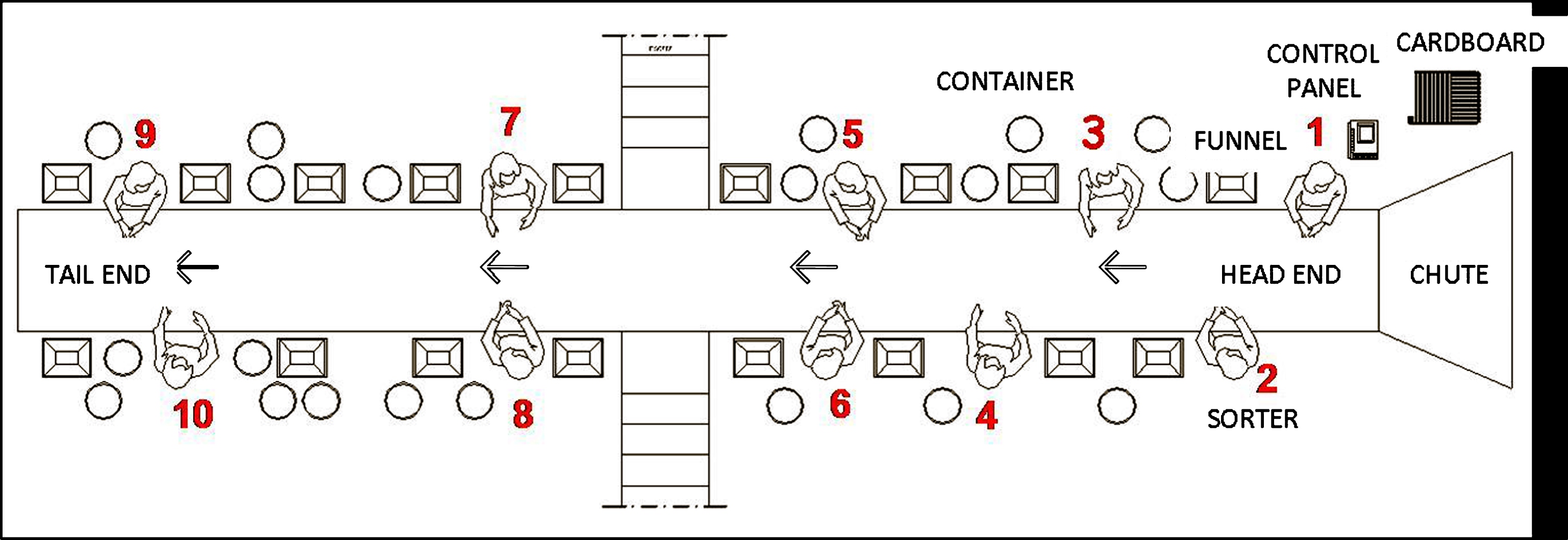
Distribution of work posts at the belt.
The decision to stop the belt or not, although commonplace and almost automatic, actually responds to extremely different circumstances and involves various internal and external determinants: the number of people working at the moment, the quantity of material being processed, the “pressure” to reduce the material stock still not screened and empty the stock area. This way, they avoid complaints of the neighbors, once the accumulation of material increases the number of vectors such as vultures, mice, cockroaches as well as bad smell. These are some of the factors that many times justify the material loss on the belt, accounted for landfills as rejects, even when potentially recyclable. The most experienced sorters know that “when the belt is full”, it is acceptable to let more material pass, and it is not advisable to stop it many times so as not to disturb the process as a whole.
At the end of each work shift, the belt is stopped for “cleaning”. The belt is emptied and the materials that require fine sorting are poured over it so that the sorters can sort them. This is the case of paper pads, books and notebooks whose pages must be detached, and also plastics like PET and polypropylene (PP) that must be separated by color. At this moment, the sorters positioned at the end of the belt, and who were able to get materials “overlooked” by others, throw the “containers” towards the sorters responsible for the overlooking for them to place the materials in the proper funnels. They know that “a little is always overlooked” once “it is impossible to catch everything”, but at this point, the efficiency of individual work gets exposed: “everybody sees what you have missed” – like with plastic, depending on the day, 3 or 4 containers is normal... more than that... you get embarrassed... people look askance at you …we know …! (experienced sorter).
Once the work at the belt is organized in pairs who are in charge for separating the same kind of materials, the sorters develop preferences and affinities with their partners. Besides personal friendship (“some are more silent, others like talking”, “you discuss some subjects with some more than with others”), some prefer to work with “the quieter” and the ones “who really work. Not with the ones who keep stalling, going to the bathroom all the time, overlooking material …” Others, especially the beginners, complain about those who work very fast, therefore making the partner anxious or embarrassed. Others complain of those who pull the material back, forming piles and holes in the belt that disturb the development of the others’ work. This decision of pulling the material causes a lot of conflicts. When it is not possible to catch all the material, some workers pull them back with a sweeping gesture of the arm against the belt movement. By preventing the materials from moving on the belt, one gains time to catch them without the need to request the stop of the belt. This strategy, however, also prevents the passage of other materials that should be caught by the sorters positioned ahead. If pulling avoids pauses and increases separation efficiency at a given post, the holes created on the belt are counterproductive: the heaps prevent the visibility of the piled materials, hindering the work of the partner positioned ahead. Although the request for stopping the belt is an alternative to the pulling back gesture, when it is recurrent, it can compromise the entire team’s productivity. In addition, a person who frequently asks for the halt in conditions when, for example, the belt is not too full or all posts are complete, runs the risk of being seen as “slow” or accused of hindering the group.
After some time of experience, the sorters recognize each one’s operating modes, which allows these collective regulations to work better among them. This also enables the development of affinities within the same group, relationships of affection, trust and exchange of experience about work and beyond, in personal life. That is why many sorters say they do not like to “change teams”. But ex-sorters, who were excluded or asked to leave during the experience period, were also followed, and complained of the “psychological pressure” they faced in cooperative work. One of them expresses such difficulty well:
After I got there...what I thought would be difficult for me was easy …I mean, touching the trash, because I thought …mess with the trash …all that crap …because there are diapers and all you can think of …
This complaint could easily be associated to the moral harassment generalized in conventional enterprises. But when it is reconsidered given the demands of the sorting job, it is a selection process that simultaneously shapes some and excludes those who do not develop the bodily and communicative skills inherent to cooperative work. Therefore, this strong ambivalence at the WAC, where this “psychological pressure” coexists with the best forms of solidarity, usually takes place elsewhere in workspaces other than the conveyor belt.
One of the most remarkable characteristics of the WAC is the alternative arrangements that allow elderly people with functional limitations to keep working. In some cooperatives, for example, elderly people and pregnant women work in a space reserved to better quality materials (usually coming from offices or commercial companies), whose sorting demands less effort. The recognition of each one’s characteristics and history is evidenced in the application of rules and in the regulation of conflicts, including gender. Tolerance with certain workers’ attitudes and behavior (absenteeism, alcohol abuse etc.) creates space for the development of individuals, and seeks to reconcile production needs with the specificities of the associated members, recognized in the spaces of formal and informal communication among the members.
[...] if it did not work here, put it there …there …then time goes by …an association has things like this …you can’t fire …so you have to try somewhere else …offer another chance …some people are like this …you orient them and …suddenly …they become good …it is where meetings help a lot …through the conversation of others we learn to put things into place …there are things that others say that serve for us …(Press operator)
As decisions are taken collectively, work in the cooperative requires the development of competences related to negotiation. Some people report that, after becoming members of the association, they “learned to talk”, to deal better with problems, and became “less ignorant”.
Womanhood is also respected in a space where gender relations can be accommodated in the work environment through differentiated rules. In most associations, women and men have very well defined jobs. Men handle activities that require physical strength (pressing and truck loading) while women undertake manual activities that require finer and more repetitive gestures (sorting). Although sexual division of labor is naturally based on “a man’s job” and “a woman’s job”, the women’s production measure (sorted kg per day) allows those who finish work earlier to have more time for household activities, also attributed exclusively to women. Modern society is characterized by the separation of production from the other spheres of life. In practice, this means that family and personal life are submitted to the universe of production and labor, while the wastepickers come with their personal needs. What legitimizes the consideration of personal and family criteria in work organization is that, in the wastepickers’ associations, reproduction encompasses the production sphere and not otherwise, and development is defined by an “expanded reproduction of life” rather than by an increase in production (for a presentation and discussion of this concept proposed by J.L. Coraggio, see [23]). If what is fair is not defined by the rule that “all are equal before the law”, but for treating each one according to their differences, then in practice the WAC manage to overcome the limitations of formal rights and get closer to a more human kind of justice.
The picking addiction
The associated members consider that the work in the cooperative is socially better recognized than other activities like, for example, the housemaid: “Here we are recognized... we work for the environment”. Some attribute this recognition to the history of struggle and social organization, mainly through the national wastepickers’ movement (National Movement of Wastepickers - MNCR). Besides producing socially valued identities, the cooperatives also reveal the limits of this “alternative” model developed from and in precariousness. In fact, what was observed is that the work done by the wastepickers (re)establishes a classification system that grants a second life to discarded objects, which acquire new value. In addition to the separation of recyclables to be sent to the recycling industry, the sorters reuse objects they find among the discarded materials such as clothes, shoes, costume jewellery, cosmetics, household appliances, toys and even expired medicaments and food. The rule agreed upon among the sorters is that the one who finds the object is entitled to keep it, but they exchange presents when another likes the finding. Some workers get requests from their neighbors, friends and family who ask for skin creams, clothes, shoes... The sorters usually have a bag or backpack reserved to gather the objects they find, but it is necessary to “know how to find the lambanças [reusable items in waste]”, that is, it is also about a competence developed in the picking job. According to the beginners, they have more difficulty in finding the lambanças. As for food, they say they control what may or may not be consumed. What comes in open packages is discarded. The rest, even if expired, is tasted, and if it tastes good, it is consumed. The reusable objects found in the trash are included in the family budget and are considered as another positive aspect of the work, which makes it more attractive in the eyes of the wastepickers:
(...) you get your salary... If you were going to buy clothes, now you can buy other things... because you’ve already found the clothes, the shoes, you’ve found everything... the guys find electrical appliances all the time here... mixer, blender... even a working TV set...they find everything... for them it’s useless... when it gets here it is not... it’s worse when it goes to the sanitary landfill... (association’s sorter)
The wastepickers also develop skills to recognize the contents of the trash bags. Their trained eyes quickly identify the recyclables. Such identification is so intense that the wastepickers refer to their job as an “addiction”. Some attribute to it the cure of their depression and other addictions like alcohol or drug use.
“it seems that it becomes an addiction... when I pass by a trash can, I look and retrieve whatever is recyclable... I don’t leave (...) Like... I can’t explain... but the day I don’t go [collecting in the streets] I don’t feel well, it’s something I like and I’m not ashamed” (association’s wastepicker, who collects in the streets)
You just can’t stand it staying long far from the Association, no... When we are far for 15 days, which is our holidays... there are some who, in these 15 days that they stay at home, come here two or more times... They come... not to work, to see us... They come to talk... I don’t know... it may be because they miss the material too. (association’s wastepicker-sorter)
It may seem strange to miss material which, due to the bad quality of the separation at the source, is little different from the common trash. It is common to find bathroom and hospital residues, kitchen remains and dead animals. On average, rejects amount to 25% of the material that comes from selective collection, even 40% in some wastepickers’ associations [24]. Very bad hygiene conditions certainly characterize the precariousness of the wastepickers’ work, but as we have seen, this is not the main difficulty they face in the cooperative work which, paradoxically, has the principle that “nobody should work for the other”.
Reverse hierarchy as self-management effective practice
In the wastepickers’ associations, like in other solidary economy organizations, it is also reproduced the separation between “we”, the associated members in the production, and “they”, the associated members with direction term of office. However, it is necessary to go beyond admitting this separation, recurrent even in solidarity economy organizations, and investigate what relations of power are therein instituted. A well-known sociological phenomenon is the authoritarianism on the part of those who rise to a position of command: “Whoever reaches the power must exercise it, and they are no longer pleased with the liberties their subordinates may take, even if they are the same that the current leader used to claim before.” [25, p. 131]. Perhaps, these “effects of power” are insuperable and we may always have to live with hierarchies, even in the form of coordinators elected by their peers, with revocable mandates. However, the essential is not in the need of a conductor for the orchestra, but in the meaning of the power relation: “Equalitarian societies are all hierarchical too, but it is a reverse hierarchy, whose flow goes from bottom to top. This democratic situation is more difficult, always very vulnerable, but no less real” [25, p. 130]. The “stateless societies” described by Pierre Clastres are not acephalous societies, but those that create mechanisms and are permanently watchful to prevent their leaders from taking hold of the power and turning it to their own advantage [26]. Closer to us, in the semiautonomous groups of the sociotechnical school of work organization, the boss (or team coordinator) plays the role of the group’s external representative in negotiations with the higher authority rather than that of exercising power within the group. In the case of the WAC, collective property has created similar effects:
“in the cooperative, everyone is an owner... So you can’t be one of those who lower their heads for everything... don’t say anything... accept everything... those don’t stay... They can’t handle it... And here... it is difficult to put up with us... because we really say it... we say it to their faces... you may like it or not... (cooperative’s director of production)
The idea that “everyone is an owner” refers to the notion of equality as a condition to be reached so as to belong to or remain in the group. In the cooperative, approval of new members is obtained in general assembly after an average experience period of three or four months. It is then that “learning to speak up” acquires its sense as an essential action in building associative relations. Only an idealist could imagine that the cooperative’s legal form would avoid this kind of conflict and would put everyone on equal footing. It is true that self-managed organizations have the advantage of not living class antagonism. Desroche said that “the cooperative practice refers to a taste, an appetite, a pleasure of creating” [27, p. 145]. But later he considers,
“Such creativity includes a kind of entrepreneurship that is complicated to the system of free enterprise, but it makes its program complex despite all the difficulties of co-partnership. Creating an enterprise is already difficult. Creating an association is not easy. But creating one in the other is multiplying the first difficulty by the second.” [27, p. 146].
The relative indifference that characterizes the wage earners’ relations in a private enterprise, which puts a limit to participation, works here as a starting point for the acceptance of new associated members, and should be increasingly overcome by each one’s progressive involvement in the collective business.
Becoming a wastepicker
Learning the wastepickers’ activity is basically developed through observation and instructions from more experienced workers. While they work, the sorters closer to the newcomers take charge of guiding their gestures, offering tips and suggestions on what they should do to carry out the work and preserve the body.
“Lean closer to the belt or you’ll get a backache.”
“bend your body further or you won’t be able to reach …you’ve got to move your body …you’re too stiff...”
“you’ve got to move the material from underneath to avoid overlooking”...
All the sorters, especially those who joined the cooperative after its foundation, remember and refer to the colleagues who, at the time, taught them the craft. They say that the beginning is hard, and believe that learning takes willpower, which is at first driven by need: “I stayed out of necessity …how could I let my children face hardship?... those who don’t need to don’t stay...” They consider that many are attracted by the relatively higher income obtained at the cooperative, usually higher than what they could get in other jobs with their schooling level. However, when they start work and realize the difficulties, they give up and never come back.
“there are people who arrive here... they imagine one thing... they know we get a better pay here... they think it’s easy... then... when they realize... they don’t want it any more...” (sorter)
“(...) they come one day... two... and then they disappear... some of them make excuses... they say their husbands didn’t allow them... or that they got another job... or that they felt a lot of pain... that they can’t cope... others don’t even come back” (sorter)
There are situations in which the experienced sorters seem to submit the newcomers (and even the newly-arrived technicians and researchers) to a kind of test, or “initiation ritual”, by exposing them, for example, to rats, cockroaches, smelly objects, or by offering them food found among the material. These situations may be classically analyzed as defensive ideology, which aims to “disguise, refrain and hide some particularly serious anxiety” [28, p. 35] and whose operationalization requires the participation of all those involved. Those who do not contribute or do not share the ideology’s content are sooner or later excluded. However, an experienced sorter’s explanation offers other elements to understand these acts:
“Once, a woman arrived to work here and... wow... she was too delicate.... she was all ouch, ouch, ouch... she picked things with the tip of her fingers... disgusted!... and they placed me to work with her... and I started feeling so impatient... so angry... and then there was a bag full of little insects... those little larvae... I grabbed it and shook it like this... it fell on her... just to make her stop being so silly... she started shrieking... Well... if you don’t want to work... go away... there’s no finesse here... does she think I’m going to do her work for her?” (Sorter)
If on the one hand the experienced sorter’s behavior may seem cruel, on the other her action reveals a straight relationship with the demands of the work activity. In the present conditions of the sorting process, it is not possible to carry out the activity without putting your hands in the material. Besides, as it is cooperative work, if one makes less effort than the other and gets the same pay, they are taking advantage of the other’s work. This is why the associated members have a keen sense of equivalence between effort and pay, and they consider it unfair for some to gain advantage over the others’ work. It does not mean stipulating a uniform performance standard because, as seen above, people with reduced skills are given lighter tasks. What they try to assess is whether each person is giving their best within the rules and values that define the wastepicker’s métier. Unlike the rule that standardizes everybody’s performance regardless of their specificities, the principle here is to organize the work according to individual capabilities, which are defined in relation to certain demands of the craft, which presupposes certain development on the beginners’ part. The more experienced sorters say, for example, that to work at the cooperative, mainly in sorting, it is necessary to “plunge into the trash”. Those who do not want to get dirty cannot develop the work:
“You have to bend your body... touch the material... deep in there... no fear... there are people who arrive here and get all stiff...afraid of getting dirty... it seems they are afraid of the material... like with the bags, you have to get them and open straight away, no fear... There are people who get all careful... and then you see that it’ not going to work out...” (sorter)
The initiation rituals, which may seem cruel when considered isolated, are justified as a qualifying process of a certain use of the body, necessary for performing the sorting task properly, and also including some criteria of justice to avoid that some make less efforts than others.
Social technology of solidary recycling at a crossroads
In the current wastepickers’ working conditions, is it possible to envisage development possibilities of the activity to the point of becoming not only socially recognized, but also socially fair and decent? First of all, it is necessary to recognize that recycling, such as it is practiced in peripheral countries, is developed on the double material poverty of great part of the population, who manages to survive only on what they find in the trash, and the cultural poverty of consumers concerning the recycling practice, who do not separate properly the materials for selective collection. Layrargues [29] is right in warning us about the “cynicism of recycling”, whose environmental effects in Brazil are still inexpressive, as if the aluminum example could be generalized; likewise, Conceição [3] calls the attention to the inefficiency of the wastepickers’ associations and the social exploitation these “trash businesspeople” are submitted to.
On the other hand, some European countries and some spare cities all over the world have already adopted recycling as technology in waste treatment, relying on mechanized sorting centers and implementing other social control mechanisms or economic stimulus for selective collection at the source. This alternative still competes with incineration despite the latter’s disadvantages. In the NSWP’s hierarchy, when compared to alternative technologies of energy recovery, incineration is at the lowest scale, being preferable only to the most outdated form, which is the final destination in sanitary landfills. The same happens when one performs comparative assessments considering economic and energy efficiency criteria. What is attractive in incineration is that it allows “solving” the trash problem in the short term, which pleases political agenda of public managers with limited terms, while recycling requires a relatively longer education process. The advantage of recycling appears at first in terms of balance of mass and energy, considering not only the quantitative but also the qualitative aspects, that is, entropy. The current amount of trash produced is an evident manifestation of the irrationality of production focused on the market, but adopting incineration to solve this problem is an even greater demonstration of irrationality and lack of socio-environmental intelligence. Incineration destroys not only the trash, but turns energy and organized matter (for example, high syntropy organic matter) into unusable states. This directly affects the natural metabolism, which loses the organic matter accumulated by the slow processes of photosynthesis and vegetation development 3 . Waste also includes the human work accumulated in materials already processed in cycles of previous productions. Burning paper or plastic, besides reducing them to unusable matter/energy, destroys all the social effort previously spent in its production. Thus, recycling is the most sustainable technology as it preserves organic matter as organic matter (composting) and preserves the human work accumulated by means of the wastepickers’ work and the population’s gift.
Based on the wastepickers’ stories, they are the main social actors to make this recycling social technology feasible. Not only because they manage to keep their lives and dignity with this work, but because they rebalance the flows of matter, energy and production in a sustainable way. When the wastepickers say that “picking is addictive”, that “they can’t see a trash can without checking it for recyclables”, in objective terms they are creating a bond between past work, accumulated in the form of use value, and future work, thus ensuring a more sustainable form founded on the objects’ sensitive properties, and not only on their economic value. These bonds are extended to the population, creating a vast net of relations based on gift, fed by an effective environmental awareness that is translated into educated gestures of separation.
Co-production of services and solidary recycling
The population’s involvement in different forms of participation has become common in public management to such an extent that the term has worn out and lost its legitimacy. The participatory processes do not open an effective space for the expression of all the interests and viewpoints and are not democratic decision-making processes. In addition, their inefficacy concerning the obtained results generates frustration that ends up affecting their representation and legitimacy. When organized by the State, the participatory processes become simulacra of popular self-management and only legitimize the power structure that has instituted them, which once again shows that self-management is built from social self-organization that institutes its own ways and processes, and not from the State power. In the case of management of urban waste, these two perspectives clash in what refers to the way to put into practice the principle of shared responsibility.
Choices that require popular participation are not solved in abstracto, but in the arena that directly affects our everyday lives. Evidently, solutions for the waste problem presuppose wide social education, which begins in the domestic spaces where the first conflicts between private interests and the common good arise. When waste collection becomes a public service, the individual behavior takes on a collective dimension. The many forms of regulation in which the public-private contradiction is solved may be divided into two types: control via the market and power relations versus development of social and solidary bonds. We know that services are characterized by the joint production between the service renderer and the user [31–33], and the latter’s participation is unavoidable which, however, may happen under several forms, from coercion to voluntary involvement 4 .
Within the market rationality, which reduces individuals to rational economic agents, the solutions are sought in the monetization of the trash problem or in coercion. Along this line, reverse logistics and selective collection may be based on financial stimuli: payment for the return of used packages and products, differentiated taxation for selective and conventional collection, fines for the bad quality of domestic separation, etc. The main problem these regulation mechanisms face is to enhance the limits of this participation fostered by financial stimuli, acting within the same market rationality that generates the trash problem. Thus, the “solution” consists, ultimately, in creating a “social fund” maintained by the consumers themselves, partly supported by refunds when there is return, partly wasted when the consumers, enjoying their sovereign will (or their lack of will when the incentives are not enough to mobilize them), prefer to discard used products and packages through the conventional channels of garbage collection. In this case, the products are burdened and the whole of society pays for the waste (evidently, in the oligopolistic sectors, the company’s profit margin is recomposed and the bill is always paid by the consumers). Recycling cost is determined by the mobilizing force of the financial stimulus, which is directly proportional to the refund value and inversely proportional to the family income. This explains why Brazil holds the world record of aluminum cans recycling since all the poor population (and part of the middle class) becomes “pickers” due to the market value, proving the point of those who see here not an example that demonstrates the viability of recycling, but only a demonstration of “cynicism” [29].
Another way is pointed by the recycling done by wastepickers, based on the solidary coproduction of the selective collection service, which implies the development of social non-market bonds and mutual learning of how to make this public service evolve. Historically, solidary relations have been developed among poverty-stricken wastepickers who struggled to ensure their survival, whose condition and efforts helped to create solidary bonds with the population, who voluntarily begin to separate and save the recyclable material. Where highly organized informal selective collection systems, with routes and schedules, are implemented, collection efficiency is better and less costly as they do not involve financial resources, but gift relations [22]. The population in general donates their time and some effort in separating and keeping the materials, some taking the trouble of washing the food packaging, folding the carton packaging, separating glass and saving cooking oil. In the solidary selective collection, efficiency and efficacy result from mutual help relations rather than from selfish market relations. More recently, the growing environmental awareness includes one more complexity in this relation, generating a conflict that demands a positive solution to expand recycling. If in the market coproduction of services the recycling limits are determined by market values, recycling based on social bonds pushes these limits beyond what the capital system can spontaneously accommodate. Some examples show it in an effective and potential way: there are private collection systems of residual oil that work very well with big generators and very little when one tries to expand it with voluntary delivery points, available at supermarkets and enterprises. The selective collection with wastepickers in the door-to-door system manages to mobilize more people to separate and save frying oil. But here too conflicts may arise when the wastepickers do not want to take materials with little market value, like Styrofoam. Some people threaten not to hand the material if they do not take all of it, generating a problem that must be solved by acting downstream in the recycling chain or upstream by replacing Styrofoam with more easily recyclable materials.
Conclusion
Before these situations full of conflicts and ambivalences, can one finally conclude for the positivity of this social technology that intends to be solidary? What lessons can be learnt from situations which, when seen from the outside, could hardly be considered as decent work? On this final balance, without taking extreme positions that either see pure negativity in the wastepickers’ activity or idealize it by overestimating its environmental effects and disregarding the precariousness of the working conditions, we may go beyond the recognition of such ambivalences.
In relation to the work results, considering the products and services rendered to society, there is no doubt that this is a successful experience. Going against the market rationality, the wastepickers’ associations manage to produce wealth from what is discarded as trash by the capitalist production, include people in situation of social vulnerability, develop environmental awareness and mobilize society for the effective practice of recycling. From the “non-value”, of excluded people and materials, they produce material wealth and human dignity by establishing relations among use values, without mediations by exchange values. Recognizing what has been built from such fragile basis would by itself be enough to show its contribution to social life and preservation of nature. Through this expanded social and environmental accountancy, it is easy to realize how more efficient is this model of “solidary recycling”, based on the wastepickers’ activity, in relation to other systems and technologies of management of urban solid waste, especially incineration, which is today the main threat.
There is also positivity in self-management of work, although learning an authentic communication, devoid of power, is a difficult and conflictual process. One of the fundamental principles of solidary economy is precisely not to repeat the historical error of the real socialism that despised (or even repressed) the effective appropriation of the work process, self-management inside the factories, as if the political property of the means of production would suffice. It is the effective process of this appropriation in the daily production that reveals the emancipating potential of the wastepickers’ associations, which is translated, in fine, into the collective definition of the conveyor belt rhythm.
The experience of the WAC, defending solidary recycling as an alternative technology in the treatment of urban solid waste, is at the same time widening the vital spaces that constitute the basis for new social relations of life production and reproduction. This is manifested in the relations of gender, between the work sphere and family life, in the relations among the associated members and, in management, among the coordinators and other associated members, where the separation between “we” and “they” tends to remain, but here in the form of reverse hierarchy. Solidary recycling implies in the implementation of new standards of sociability, engendered from daily acts. The option for recycling organized by wastepickers does not consist only in an opportunistic defense of a political movement of a socially underprivileged group that struggles for survival, but also in an option for some technology better than incineration in all aspects: environmental adequacy, technical efficiency, economic-financial costs, probity in the management of public resources and, finally, shared social responsibility to solve the trash problem. What is at stake in the option recycling versus incineration is much more than a simple technical option (a choice that is never reduced to simple terms), but social modes of producing and living that cannot solved without a wide social debate and the effective participation of all involved.
Each type of technology goes into complex social relations, each participating in specific life forms to which it contributes to create. Incineration is the technology that best suits the consumerism of the modern world, destroying the residues that upset our ecological sensitivity, but leaving untouched the unbalance caused by the market. Burning trash is like sweeping the dirt under the carpet. Recycling, on the other hand, in recognizing the deeper causes of the unbalance that generates the trash problem, tries to rebuild a new metabolism among productive activities, consume and nature. Therefore, what is at stake is the different modes of regulation of the relations we establish with nature, with broader and deeper repercussions than the simple choice between two techniques of trash treatment. Thus, it is necessary to reopen and instruct the debate on alternative technologies to solve the problem of solid waste, placing the options as structuring elements of our community and individual life.
Finally, what seems to be the central value of this métier is the picking addiction. Paradoxically, the wastepickers rise in the hierarchy of solid waste treatment, predicted in all normative instruments, which place reduction and reuse even before recycling, though they survive on recycling, a contradiction that can be explained by the feeling these professionals developed against any form of waste. They have practiced reuse, still in reduced scale, since before reuse became a current defended by the project’s professionals. Many of their working tools (collection cart, workbenches and containers) are built from trash material; the wastepickers’ houses are commonly equipped with reused utensils; other sorters are proud of the complete baby layettes they set up to offer to “less favored” friends as gifts; some associations are meaningfully nicknamed “shopping”, and the wastepickers even get requests from family and friends. All this “wealth” of the trash and the picking, revealed by the observation of the wastepickers, does not show in studies limited to quantifying the economic value of recycling, understood as a material transformation technique and not as social technology. There is surely a lot left to do to improve the wastepickers’ working conditions 5 , but the basis and direction for this construction have already been given. And they are also good as an example of transformation of other work situations...
Conflict of interest
None to report.
Footnotes
Strictly speaking, every technology is social. In this case, the redundancy is just to emphasize technologies aimed directly at solving social problems (poverty, hunger, sanitation, education …), which resumes and deepens the discussion about the appropriate technologies of the l960s and 1970s 7–9.
One of the lessons that the experience of state socialism has bequeathed us is that the seizure of political power is insufficient to ensure effective transformations in the workplace. But this distance between centralized planning and work reality is a general rule also in private enterprises [ , 13,14].
The formal hiring of the municipal services of selective collection has already started to be practiced by some City Halls, which allows to improve separation quality, to increase the amount of collected material, therefore improving the sorting work conditions and rising the wastepickers’ pay []. The capillarity reached by the wastepickers with their informal nets will also be useful to make effective the reverse logistics which is still in project, or does not go beyond ineffective actions of returning batteries, residual oil and expired medicaments.
Acknowledgments
This work was written during a scholarship term supported by the International Cooperation Program CAPES/COFECUB at the University Lumières-Lyon II, Project 702/11 “Work, Innovation and Sustainable Development” and a doctoral course at the Conservatoire National des Arts et Métiers-Paris, both financed by CAPES-Brazilian Federal Agency for Support and Evaluation of Graduate Education within the Ministry of Education of Brazil.