



Abstract
BACKGROUND:
The sustainability of the workforce is threatened due to working conditions. One of the reasons for this is an imbalance between the working conditions and the capacity of the workers.
OBJECTIVE:
The objective of the paper, based on a literature review, is to explore the relationship between two main concepts, beginning with sustainability, and finished with ergonomics. Based on that relationship, determine if ergonomics could be helpful to improve the sustainability of the workforce.
METHODS:
Literature review was based on two keywords: sustainability and ergonomics. The focus was on create a theoretical path between these two concepts. The literature review draws on 100 journal articles, books, conference proceedings, thesis and reports.
RESULTS:
The results of the literature review highlights that an ergonomics approach is helpful and appropriate to determine the mismatch between people capacity and system demand. In that sense, the literature review reveals that both disciplines, ergonomics and sustainability, share the same principles and that the mix of both has significant potential. However, the literature also shows a lack of empirical information that proves that potential.
CONCLUSION:
The review first posits that sustainability principles could be helpful to improve the working conditions, and second, that an ergonomics approach provides information related with working conditions, organizations’ problems and the needs of workers that would be helpful to create a sustainability workforce.
Keywords
Sustainability, occupational health problems and working conditions
Dyllick et al. [1] define sustainability, from a business perspective, as “Meeting the needs of a firm’s direct and indirect stakeholders (such as shareholders, employees, clients, pressure groups, communities etc), without compromising its ability to meet the needs of future stakeholders as well” (p. 131). Independently of the meaning of sustainability, there are many different interpretations [2–4], thus, two important issues must be distinguished. First, sustainability concept is growing rapidly in the strategies of different companies [5–8]. Second more related to the purpose of this paper is that organisations are trying to achieve the three main aspects of the sustainability principles at the same time, the economic, social, and environmental issues, as against the past when only the economic dimension was the main focus [3, 9].
Sustainability, therefore, should be assessed on the basis of three dimensions: economic, social, and ecological sustainability [10], as organisations that are focused on economic sustainability only will not reach their sustainability aims in the long term [11]. Accordingly, the International Labour Organisation (ILO) in a 2010 report called “The Sustainable Enterprise Programme: STRATEGIC FRAMEWORK” explained that for organisations to advance and preserve sustainability outcomes must maintain a respect for workers and environmental sustainability [12]. To support this idea, Labuschagne et al. [13] explain that organisations have countless reasons to endorse the principles of sustainability from environmental, economic and social perspectives. Table 1, below, illustrates some of the reason mentioned by different authors.
Reasons for organisations to endorse the principles of sustainability
Reasons for organisations to endorse the principles of sustainability
Therefore, organisations are under increasing pressure from multiple directions to incorporate the principles of sustainability into policies and activities [7, 13]. However, the inclusion of the social aspect, defined as the impact of products or operations on human rights, labour, health, safety, regional development and other community concerns [24], has been marginal in both the sustainability debate and in practice when compared to the focus on the other two dimensions of sustainable development – economic and environmental performance – especially from a business perspective [23, 25]. That social aspects are rarely considered is probably the reason the social dimension is commonly recognised as the ‘weakest’ pillar of sustainable development and the reason it has been considered a second actor, behind economic and environmental issues [25–27].
Understanding why the social dimension is the weakest pillar requires that the remaining two pillars be first considered. Economic aspects are the fundamental element which supports our society [4, 12] and which is the basis of organisational decisions [20], making competition with this aspect impossible. Next, it is undeniable that the concept of sustainability is strongly linked with the environmental aspect of sustainability [28]. This concentration on environmental sustainability has not allowed what is happening with other important “resources” such as people, especially in the work environment, to be seen in a similar light [7]. As a simple way of illustrating the previous point, since 2008 Wal-Mart has focused on reducing its energy consumption, but maintains pay rates below its competitors [28] and today the reporting about “human sustainability”, related to employee physical and mental health and wellness, is less common than are ecological and economic reports [28]. In that sense, many organisations have made enormous efforts to reduce the ecological impact of their operation, but not many have attempted to reduce the impact of their operation on their own workers [23].
A positive aspect is that today the social side of sustainability, especially as it relates to the sustainability of the worker, is getting more attention from both the academic level and among practitioners and is gaining more significance in organisations’ sustainability model [29].
The elements of social sustainability are those that have an influence on and could ensure a future relationship with the internal and external stakeholders [30]. As a result, different authors have considered it important to develop a way to evaluate the present status of all the matters that this element considers [13, 31]. Many frameworks and standards have been developed to evaluate the actual level of social elements [13, 31–33]. Most of them are compounds of similar categories and are separated into internal and external social issues [33]. The external issues are related to the impacts of the operational initiative on three different levels of society: the local community, the regional and the national level [30, 34]. On the other hand, internal issues focus on the social responsibility of the company towards its workforce and includes all aspects of employment, like employment stability1, employment practices2, health & safety3 and capacity development4 [19, 35].
Today, organisations recognise that sustainability, from the point of view of working conditions, is a way to influence those objectives related to the sustainability of the workforce, such as attracting and retaining talent, maintaining employee health and safety, investing in the skills of the workforce, supporting employees’ work-life-balance, and managing aging workforces [23, 29]. Specifically in matters related to health and safety, the main topics in this paper, some companies go beyond basic legal requirements, as it has already been recognised that addressing occupational health (OH) issues is crucial for successful business. Accordingly, organisations could reduce the costs related to this issue, increase the productivity of the workforce and add value to reputation and through consumer loyalty and share value [19, 28].
Despite the increased attention that organisations today have given to problems related to OH, the statistics show us that OH problems are still present [36]. Rantanen [37], Kira [38] and Docherty [39], mentioned that despite changes related to the workplace that are meant to build better organisations that are more competitive and at the same time generate a better working place, more people are getting sick because of their work [8, 39–41]. Therefore, despite the huge advances in technology and changes in the labour market, never in history have there been so many reported OH problems as exist in the world currently, and much of this is because of the emerging problems of new jobs and new work methods [42]. This information is consistent with OECD statistics [43], and that organisation states that the figures on work-related health problems may be an underestimation since they estimate that only one in four incidents is reported.
LaDou [44] goes further and states that there is general agreement that if countries continue their current rate of industrial growth, the number of occupational injuries and disease cases will double by the year 2025. This data could be seen as an overstatement, but the “First European Survey on Working Conditions 1990” [45] found that 43% of employees interviewed reported working in painful or tiring positions and 31% reported that they had to handle heavy loads. The “Third European Survey on Working Conditions 2000” (52) found that 47% of employees interviewed reported working in painful or tiring positions and 3% reported that that they had to handle heavy loads. These surveys find that in 10 years, the percentage of workers labouring in painful or tiring positions increased 4% and the percentage of workers handling heavy loads increased 6%. These statistics suggest working conditions are not improving and, in some cases, are deteriorating [38, 46]. At the same time, new types of problems are emerging in changing workplaces, such as burnout and stress, which have emerged in comfortable offices and in jobs with extensive degrees of freedom and variety [38]. Additionally, the third European Survey on working conditions (from 1999 and 2007, showed that more than 41% of the workers reported exposure to factors that affected their physical health. For example, 35% reported working at a very high speed, 50% worked to tight deadlines, more than 34% had no influence on task order, 45% reported having monotonous tasks [46]. The reported OH problems were correspondingly high, with 60% of the respondents reporting musculoskeletal problems, 20% fatigue and 28% stress [46].
The implications of OH problems represent an enormous financial burden for public and private social protection systems [47]. For example, health problems in business are a big issue, since musculoskeletal or mental disorders are the main reason for sick leave, affecting the performance of different organisations, threatening industrial competitiveness due to costs related to labour turnover, absenteeism, reduced productivity and the quality of life of the workers [40, 48]. The European Agency for Safety and Health at Work (EASHW) reports that the economic impact related to working days lost as a result of OH problems is US$550 million every year [22]. The impact that OH problems have on the gross national product (GDP) in countries of the European Community ranges between 0.4% to 4.0% [49]. In countries belonging to the Organisation for Economic Co-operation and Development (OECD) the impact of OH problems is on average 4% [43], with the same figure mentioned by the International Labour Organization [12, 50]. Independently of the impact over GDP that OH problems have, the main issue is that the expenditure on disability and sickness programmes has been increasing as a percentage of GDP between 1999–2009 among the OECD countries [43, 51].
However, beyond the economic problem represented by OH, it is often difficult to determine which health problems can be attributed to work, since different reasons are interwoven in a complex interaction that can develop over time [52]. Smith et al. [53] explained that the factor categories that affect the health of the people in the workplace are: 1) technology factors; 2) environmental factors; 3) organisational factors; 4) task factors; and 5) individual factors [53]. Simplifying this further, Marras [48] and Punnett et al. [54] state that health problems related to work are mainly due to a) individual and b) organisational factors, since technology, aspects of the physical environment, task and workplace psychosocial factors are part of organisational factors.
The individual factors that have been identified in different economic sectors related to the health of the employees in the work environment include: a) ageing [48, 55]; gender [55–58]; lifestyle factors such as being overweight, taking little physical exercise, smoking habits [57, 59]; health conditions [60]; socioeconomic status [54]; previous history [48, 54]; ethnic group/nationality [61]; psychological factors [61] and co-morbidity [54].
For organisational factors, Docherty, et al. [38] and Docherty et al. [8] explain that one of the reasons for the high OH figures is that the traditional goods production approach is still present and it influences the high physical and psychological load. In that sense, increased globalisation and its impact on the pressure to be more competitive is affecting the health of workers [38, 62–64]. Researchers have examined the role of strategies like “downsizing”, “rationalisation”, “lean production” and “business process re-engineering”, which look for improvements in business, in work-related health problems because implementation of these strategies has been linked to OH problems [40, 65]. The organisational factors that have been identified in different economic sectors related to the health of employees in the work environment include, strict deadlines, high-speed pace and the growing volume of information or work to manage [22, 67]. Other factors include: low task autonomy and job design [38], [68], monotonous tasks/no task rotation/repetitive tasks [38, 69–71], high pressure and mental workload [68, 72], long working hours [37, 69]; working/environmental conditions [61, 71], working technique/training [61, 69]; payment system [58, 73] and exposure during working life [61, 74].
Once some of the reasons why workers become ill are exposed, it is clear that part of the responsibility of the health of the workers is a consequence of system design: therefore, it is a consequence of a chain of events which starts with corporate strategic decisions [62, 75], so business strategies are strongly linked with OH problems [40, 76]. Thus, the organisations’ strategies are focused on productivity and quality performance, rather than on the health of their own workers, which certainly makes sense from the point of view of business. However this weakest link between those elements – productivity/quality and the health of the workers – means that the strategies and solutions to solve the health and safety issue are partial [37, 40] and are not often related to an organisation’s business purposes [65]. Consequently, present measures to reduce risk factors affecting workers are not enough to ensure workforce sustainability, with a focus on OH issues, in the long term [40, 77].
Several studies mention that this lack of attention in system design, whether voluntary or involuntary, causes an imbalance between the capacity of workers and system demand [8, 78]. This imbalance is the reason why organisations are “consuming the human resource” [8, 78], as this loss of resources to work occurs when workers that are affected by a disease or illness have less capacity to do his/her job [38]. That loss is the main reason today most systems are not sustainable, at individual, organisational and societal levels [38].
This vision is extremely relevant, because occupational health and safety play an essential role in improving the company’s performance, since it reduces costs of occupational accidents, incidents and diseases, enhances worker motivation, and contributes to workforce sustainability. In that sense, the emphasis must be focused on bridging the gap between the wellbeing of both workers and wellbeing by designing systems that attend to the requirements of both [79]. The idea of promoting the development or, at least, not the consumption of workers’ personal resources, is helpful not only for the workers themselves, but also for the organisations that expect to achieve in an integral way the purpose of the modern view of sustainability [80].
Sustainability, occupational health problems and ergonomics
Kira [41] explained that: “Work manifests the fundamental human need for expression through action and, consequently, for using one’s mental and/or physical resources. Thus, a working individual invests her mental and/or physical resources and those resources are transformed in the work process to work results” (p. 64). As a result of the use of personal resources as expressed in Kira’s definition of work, people’s resources could “grow” or people could experience the “loss” of resources to work [41]. The “growth” concept means that workers are prepared for an adaptation process during their working life. Conversely, the “loss” of their resources means that they are losing their capacity to work and to evolve in an adaptation process during their working life. This concept of growth or loss of capacities or resources is considered to take place at psychological, physical and emotional levels [8, 81].
Kira et al. [81] mention that it is impossible to find one established definition for the concept sustainable work. One conclusion is that the concept scope of sustainable work, could range from being alive at the end of the day [82] to, for example, having a good work-life balance [38]. However, to ensure the sustainability of a working system it is necessary to not diminish the capacity of its components, which in this case are the workers and their physical, cognitive, social, and emotional capacities [38, 83]. This is consistent with the principles of sustainability made by the United Nations (UN) in Agenda 21: “A sustainable system is one that can continue to operate indefinitely without degrading the biophysical basis of its own existence”.
The fundamental idea that the source of OH problems and therefore the sustainability of the workforce is a problem of imbalance between capacity and demand is based on elementary principles of sustainability. These principles established that the maximum sustainable demand is obtained by ensuring that the rate of demand equals the rate of capacity that this resource has [84]. Further, if the system requires bigger demands than the capacity of the system can produce then the quality and/or quantity of system outputs will be adversely affected, and the resource could be damaged temporarily or permanently [84]. Linking the concept of system balance with the objectives of this research, Maslach et al. and Leiter [85] emphasized that stress in workers is caused by a variety of imbalances between work demands and available resources that, if they persist, may lead to burnout characterized by physical and emotional exhaustion and reserved indifference [85]. In this context, the goal for the human-at-work system is the optimisation of the employee-work environment interface to maximise work productivity, quality and safety. Effective approaches for creating a sustainable workforce need to focus on finding the “mismatches” between work demands and available resources, and from these results to act to reduce the intensity of the work and at the same time develop the personal capacities of the workers [86].
Therefore, sustainability, from the point of view of the workforce, means that the resources of the workers (physical, cognitive and emotional) will not be adversely affected by demands that are higher than their capacity to manage them throughout their working life. To ensure the sustainability of the worker, workforce and system as a whole, the concept of workforce sustainability is based on achieving a balance between people’s capacity and system demands, rather than the unsustainable consumption of workers’ personal resources [40, 64]. Thus, the sustainable work systems’ concept presents a vision for organisations in which human resources are regenerated and allowed to grow. The concept addresses four related fields and basic issues [38]: The regeneration and development of human resources: The core concept of sustainable work systems is that the resources deployed are regenerated by the system. Human resources to be fostered include skills, knowledge, co-operation and trust, motivation, employability, constructive industrial relations, and broader institutional/societal prerequisites, such as training systems. The promotion of the quality of working life and competitive performance: Sustainable work systems pay equal attention to improving working conditions and organisational performance and effectiveness. Again, their interdependencies require an integrated approach. The nature of sustainable change processes for renewal and learning: Sustainable work systems should not produce static conditions. Many processes of reorganisation and reengineering are failing or stalled, sustainability therefore has to include the question of how organisational change can be structured and guided. Put differently, since challenges and organisational environments are increasingly volatile, sustainability means creating ‘liberating structures’ and building up internal capabilities to carry through reorganisations and continuous change successfully and to facilitate learning. The provision of employment: Sustainable work systems provide a micro-economic context for increasing employment levels, as well as counteracting current tendencies of labour market segregation. Sustainable work systems could serve as paths of integration of unemployed people into the labour market by reversing processes of exclusion on the micro level.
Those ideas are coincident with Enhert [7], who has offered from a management perspective three ways to manage organisations when they engage the sustainability principle: a normative, an innovation-oriented and a rational understanding of sustainability. The normative method means, under a moral and ethical socially responsible point of view, improving the wellbeing and health of the workers in their workplaces. The innovation-oriented method means reducing the impact on the human resource and decreasing utilisation of human resources. The last way is the rational understanding of sustainability, interpreted as the right balance between “consumption” and “reproduction” of human resources by improving the regeneration of human resources but also by investing in the “origin” of human resources [29].
Therefore sustainable work has to be able to function in any environment and at the same time achieve economic and operational objectives, while also developing a worker’s resources engaged in the worker’s operations. In that sense, worker’s capacity should be grown through concepts of work-based learning, development, and well-being [87].
To achieve this concept necessarily encompasses three levels: the individual, the organisational and the societal, and requires a balance to be found between stakeholder’s needs and goals in these different levels simultaneously [38].
As was mentioned in the paragraphs above, the social view of organisations requires a close look at the principles of work systems to determine whether the joint optimisation of the social and technical systems is adequately performed. Therefore, a broad approach is needed to assist company management to create a healthy enterprise that is capable of adapting to the disruptions in the system because of external and internal factors. In that sense, ergonomics is an influential tool to support business strategies [65]. The definition of ergonomics proposed by the International Ergonomics Association (IEA) states, “Ergonomics is concerned with the understanding of interactions among humans and other elements of a system, in order to optimize human well-being and overall system performance” [88]. Therefore, linking the ergonomics approach to organisational strategies could be a powerful approach, very useful for organisations that are working under the umbrella of sustainability principles [23, 83].
Sustainability and ergonomics: Shared principles
In the special issue of the journal Ergonomics called “Ergonomics and Sustainability” (Volume 56, Issue 3, 2013), Haslam and Waterson [89] mentioned that “C onceptions of sustainability have extended beyond concerns over the use and preservation of the planet’s natural and physical resources, to include the sustainability of organisations and the sustainable use of human resources. Again, ergonomics and these aspects of sustainable development might be expected to be natural bedfellows. Although ergonomics is of its very nature frequently concerned with achieving sustainable outcomes there has, until recently, been little direct connection made with the sustainability movement itself” (p.343).
However, beyond the incremental interest in sustainability for the people who work in the ergonomics field, Martin et al. [94], conclude that “Hitherto, the contribution of ergonomics to sustainability has been limited, despite the congruent goals of sustainability and ergonomics”.
The contributions of ergonomics to sustainability based on shared principles
The definition of ergonomics, mentioned above, could have many interpretations. Ones related with this paper will be taken into consideration, since both ergonomics and sustainability concepts share the same main principles, namely to preserve and improve the resources. Mainly human resources, but without losing sight of the economic and environment element in the case of ergonomics [65, 83] and social, economic and environmental resources in the case of sustainability principles [90].
These ideas are further illustrated in Fig. 1, which was modified by Zink [83] from the model of Dyllick et al. [1]. The model (Fig. 1), show the relationship between ergonomics and sustainability. Ergonomics principles are more related with the theme of work [23], historically and practically speaking, with the ‘economic-social’ side of the sustainability concept, specifically in the “socio-efficiency” topic [83, 90], since the strongest link between ergonomics and sustainability in the business world is in the area related with OH & safety and work system design [83].
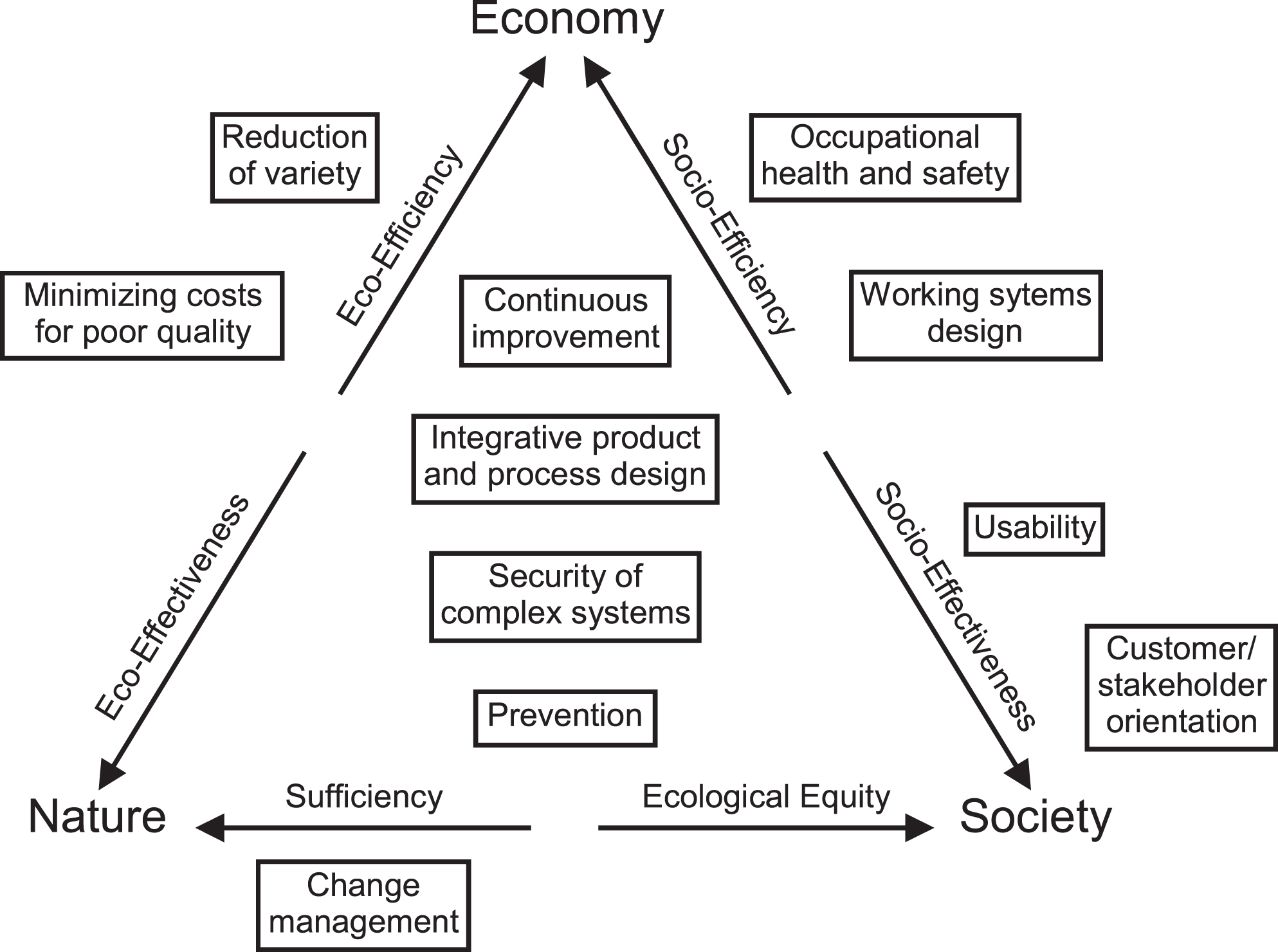
Principles, tools and methods of business excellence and human factors in corporate sustainability – modified by Zink (91) from Dyllick et al. [1].
According to Zink [83], “The sustainability of human resources is based on enduring workability and employability which have been dominant elements in human factors ever since. Social sustainability is realized in concepts such as preventive occupational health and safety, human-centred design of work, empowerment, individual and collective learning, employee participation, or work-life-balance. All these concepts aim to preserve or build up human capital and they represent a conscious way to deal with human resources”(p.457).
Therefore the ergonomics approach could be an influential tool to support business strategies [65] and very useful for organisations that are working under the umbrella of sustainability principles [23, 83]. The social view of organisations requires a close look at the principles of work systems to determine whether the joint optimisation of the social and technical systems is adequately performed [91, 92]. Consequently, the ergonomics approach is needed to assist company management in creating a sustainable enterprise that is capable of adapting to the disruptions in the system because of external and internal factors, since the ergonomics approach determining the optimal balance between workers’ capacity and systems demand [80, 93].
Following on from these ideas, Genaidy et al. [94] explained that it is necessary to incorporate ergonomic approaches for find the root causes of organization problems that are impacting in people performance and the system’s sustainability [80]. Since if the organizations could ensure ideal working conditions for their workers, the organizations at the same time will ensure sustainable growth for themselves [94]. In that sense, organizations can accrue significant advantages from an ergonomics approach [80] since there exists a natural synergy between sustainability and ergonomics, with the aim of understanding and optimizing the outcomes of human system interactions [92]. Furthermore, Zink [7] added that ergonomics can provide supporting evidence on issues of the internal social dimension of corporate sustainability, identifying the factors that lead to an integrated vision of performance and health from a long-term perspective, which goes beyond legal issues and benefits not only management but also workers, and hence, society [27, 89].
According to Bolis et al. [23], the main contributions of the ergonomics in the context of the sustainability in work, is to boost the organization’s performance based on both having healthier working conditions leading to the promotion of well-being at work, and to look for organizational efficiencies. Moreover, if the ergonomics approach is applied to the whole supply chain this could have an enormous impact on improving living and working conditions in industrially developing countries [95].
However, in the discussion of sustainability, ergonomics can also contribute elements and shape transformations that go beyond the previous topics. However, in the discussion of sustainability, ergonomics can also contribute elements and shape transformations that go beyond the previous topics. Since it is believed to promotes professional development as well as workers’ health broadly and positively and well-being. The idea is the development of intelligence and creativity by performing work that has meaning and significance, understanding the profound importance of physical, cognitive and organizational state issues, and above all, the importance of work to the development of culture [96]. This point is strongly related with the objective of sustainable work.
Therefore, the ergonomics contribution to work sustainability could be summarised in two main points; the preservation and development of human and social capital, and the development of a broad systems approach including whole value creation chains.
Ergonomics is a discipline that centred attentions on the understanding of interactions between people and systems, with the objectives of improve worker’s health, safety, comfort, satisfaction, commitment and wellbeing through the improvement of the working conditions. At the same time it has an impact on system performance since it can reduce losses of time, errors, improve reliability, increase productivity and quality, decrease lost work time, reduce sick leave, accidents, injuries, reduce injury costs and labour turnover and increase economy of production [80, 97]. Therefore the ergonomics approach is a good way to understand the problems related with the work environment and second, it is an excellent tool to improve the system performance [23], based on design and manage systems that seek harmony between systems demand and workers capacity and needs [98].
According to Tappin [99] “A systems approach involves considering all elements of the work system, recognising the inter-relationships between system elements, and understanding that these interactions and influences do not occur in isolation from each other”(p.24). In that sense, the ergonomics approach presented in the Fig. 2, could be helpful to showing the elements of a system that are interfering in the different problems related with the work environment, that actually the organization are facing, [99].

Ergonomics approach [99].
For example, Table 2 gives an example between the link of ergonomics and OH issue, since the table shows the root causes for OH problems, interconnected with the elements in the ergonomics approach (see also Fig. 2).
Relationship between an ergonomics approach and potential contributory factors for OH problems
Keywords used in the literature search
The link between ergonomics and sustainability is based on the systemic view that ergonomics aims to design working methods that do not impose excessive demands on workers, based on their knowledge of capabilities, limitations and needs of people. Taking into account, not only the tasks being performed, but also the effect of the physical environment, and agents such as heat, cold, geographic height, etc., can significantly increase the workload and hinder the fluidity of the production process [100].
Finally, the principles to build a sustainable workforce begin with the basic relations between “human capacities” and “system demands”. Therefore, if we could understand the effects of an actual productive model in any sector, over health of the workers using the ergonomics approach, we could probably achieve a sustainable production system, defined here as the joint consideration of competitive performance and working conditions and adopting a long-term perspective [39]. Consequently, the concepts of ergonomics and sustainability, although created in different contexts, share the same principles of understanding and overall aims to improve the relationship between resources and systems.
The concept of sustainability, especially workforce sustainability, is growing; however, the problems related with OH are still present, and organizations need to improve the strategies that are implemented to cope with these problems. Ergonomics and sustainability share many of the same aims, and an ergonomics approach, could contribute to improve the sustainability of the workforce.
Literature search and review methods
The initial search of the literature centred on the two keywords on which this paper is based: sustainability and ergonomics. From these words, other key words and combinations were discovered; these are shown in Table 3. The sources used to find the information included electronic databases and catalogue material in the Massey University library, the University of Concepcion library and the researcher’s own library of materials.
The keywords and their combinations presented in Table 3, were used to search the literature in electronic databases. The search included publications in English and Spanish from all dates.
Conflict of interest
None to report.
Footnotes
Employment stability is related with impacts on work opportunities, within the company, the stability thereof as well as evaluating the fairness of compensation.
Employment practices include disciplinary and Security Practices, Employee Contracts, Equity Labour Sources, Diversity, Discrimination and flexible Working Arrangements.
Health & safety, as the name said is focused on the health and safety of the workforce and evaluates preventive measures as well as the occurrence and handling of health and/or safety incidents. Guarantee that no health and safety risks occur when working in/for the organization. No negative impact of employees’ physical health at any time.
The development of human capital for sustainability related issues through specific programmes such as permanent education, mentoring or training.