




Abstract
BACKGROUND:
Sustainable development requires learning, but the contents of learning are often complex and ambiguous. This requires new integrated approaches from research. It is argued that investigation of people’s learning challenges in every-day work is beneficial for research on sustainable development.
OBJECTIVE:
The aim of the paper is to describe a research method for examining learning challenges in promoting sustainable development. This method is illustrated with a case example from organic vegetable farming in Finland.
METHODS:
The method, based on Activity Theory, combines historical analysis with qualitative analysis of need expressions in discourse data.
RESULTS:
The method linking local and subjective need expressions with general historical analysis is a promising way to overcome the gap between the individual and society, so much needed in research for sustainable development.
CONCLUSIONS:
Dialectically informed historical frameworks have practical value as tools in collaborative negotiations and participatory designs for sustainable development. The simultaneous use of systemic and subjective perspectives allows researchers to manage the complexity of practical work activities and to avoid too simplistic presumptions about sustainable development.
Introduction
The multidisciplinary and contestable nature of the concept of sustainable development is challenging for research. The overwhelming amount of information produced by multiple fields of science may lead to some key points, or even the wider view, being missed. Sustainable development calls for an integrated approach of the social, economic and environmental dimensions, and considerable innovation efforts are needed to achieve this integration [1].
It is generally accepted that sustainable development requires learning [2–4]. The content of learning is inseparable from people’s every-day activities and practices. People are learning because they face challenges and solve problems vital to their activity [5]. Practical work is the arena where different dimensions of sustainability become integrated. Therefore, the learning challenges practitioners face in their work is of interest for research on both sustainability and innovations. The investigation of learning challenges is necessary for being able to focus on the future learning efforts in work, for both researchers and practitioners. It is thus an important step in the learning process. The case example of this paper comes from Finnish agriculture which is constantly changing and it is no longer self-evident that farmers can go on earning their living from farming. This paper takes a methodological perspective to examining learning challenges. The research question of the paper is: How can learning challenges in work be identified and analyzed? As an example, we analyze learning challenges in organic vegetable farming, on one farm in particular. Simultaneously, the paper illustrates how learning challenge issues, as part of sustainable development, are manifested in organic farmers’ everyday work. The paper is based on previous research in organic farming practices [6, 7]. However, the proposed method as an application of the cultural-historical activity theory to the study of sustainable development has not been previously published in detail.
In this paper, the conception of sustainability and learning and the connection between them are first discussed. Secondly, a historical framework, as the theoretical part of the method used, is illustrated. In Section 4, the empirical data and the methods of analysis will be described. In the same section, the family farming enterprise case of the paper is presented. The findings about the learning challenges are shown and discussed in Section 5. Finally, the method used will be outlined and discussed in the context of research on sustainable development.
Sustainability and learning challenges
Sustainability is a key term in the continuing discourse on the future of the planet. Brundtland’s definition of sustainable development is one of those most commonly used: “development that meets the needs of the present without compromising the ability of future generations to meet their own needs” [8].
Sustainability at work, work defined as an intentional value-creating process, pays attention to resources engaged in work processes. Sustainable work, as defined by Docherty and his colleagues [9], not only is able to function in its environment and achieve economic or operational goals, but also has capacity to build on and promote the development of the human, social, ecological and economic resources in its operations. Dealing with resource scarcity and balancing conflicting demands are important capabilities on the way towards sustainable development [10].
Alrøe and Kristensen [11] discuss two paradigms of sustainability: “resource sufficiency” and “functional integrity” in relation to any object of study. The normal research scientific perspective is to look at the system from the outside and concentrate on its inputs and outputs. “Resource sufficiency” conforms to this. “Functional integrity” in turn views things from within, adopting the active perspective of a player. In the former, explicit knowledge is important; in the latter, the system is a goal-directed entity, which involves an openness towards both known and unknown interactions, and an ability to overcome changes, and demonstrate flexibility and resilience. The use of both of these views, that from within and that from without, allows researchers to practice reflexive learning.
In presenting the model of an activity system, Engeström and Miettinen [12] refer to the same idea as Alrøe and Kristensen, which calls for complementarity of the system’s view and the subject’s view, and which brings the researcher into a dialogical relationship with the local activity under investigation. The aim is to connect material and social factors with the cognitive and motivational factors of work.
Due to rising specialization, the division of labor and new technologies, work is becoming increasingly complex, which emphasizes the importance of learning for sustaining productive work [13, 14]. Sustainable development calls for an integrated approach of different dimensions, and considerable innovation efforts, including learning, are needed to achieve this integration [1]. Because of this integration, the contents for learning cannot really be taken for granted in advance. Promoting sustainable development requires suitable research methods. It is argued that examination of learning challenges helps to grasp the integrated nature of sustainable development.
The natural environment-society relationship, so central in the topic of sustainability, can be interpreted in at least two different systemic ways. The first is to see nature as the ground on which society and the economy base themselves. In more general terms, nature, or ecology, forms the limits, or a container, within which human activities can take place. In the second interpretation, nature and society occur together as part of a single bio-social-cultural process. Michael Cole [15] refers to a “context as that which weaves together” as opposed to the “context that surrounds”. “The boundaries between the “task and its context” are not clear-cut and static, but ambiguous and dynamic. As a general rule, that which is taken as the object and that which is taken as that-which-surrounds-the-object are constituted by the very act of naming them” [15 p.135]. This metaphor is not an object within a box, but a rope, the fibers of which are twisted together. The processual nature of activity is seen as a continuous rope, formed of material and social and cultural fibers or dimensions; as moments in a single process. The fibers may not be continuous or sustained, but the rope is [7 p.36]. Learning here is understood as the dynamics between the changes and the permanence of the fibers.
The case example of the paper comes from organic agriculture. Organically produced food can be safer [16], maintain and improve biodiversity [17] and pay more attention to animal welfare as compared to conventional agriculture. The agroecological idea for facing complexity in organic agriculture is ‘system redesign’ instead of using external inputs such as pesticides [18]. Although the ecological and economic benefits of organic agriculture are debated, it is generally accepted that organic farming is one interpretation of sustainable development. Next, we turn to examining the long-term development of our case example, organic vegetable farming.
Historical framework
This section lays the grounds for empirical analysis by giving an account of the historical shifts and changes that potentially cause contradictions in work activities. According to a dialectical view, contradictions are of interest because they may potentially be fruitful sources of development for work. Contradictions deal with systems in movement through time and therefore they need to be traced in their real historical development [19 p.371]. Here, the contradictions are viewed in two dimensions of sustainability: Environmental (the use of natural resources) and social (societal integration). These dimensions are selected because they were found to be empirically relevant [7, 20].
The sustainable use of resources in organic agriculture has traditionally emphasized taking care of living soil. The use of local resources and natural processes is preferred to external inputs. For farmers, therefore, changing from conventional to organic agriculture means learning new farming techniques, which are themselves undergoing a process of development. However, learning new techniques is not enough. The use of local resources means learning to plan and manage the whole farming system in a new way – merely applying given, ready-made directions does not suffice. The emphasis has turned to ecological principles in the management of natural resources and even more, to the “nutrient paradigm” [21], the central issue of which is saving nutrients in order to increase yields and to avoid nutrient leaching. Creating innovations towards more agro-ecological and sustainable use of natural resources has become important in all agriculture.
There has been a historical shift in Finnish agriculture from a previously nationally protected sector to new open European markets [22]. Finland’s integration into the European Union in 1995 enhanced this change. Farmers’ relationship with society became qualitatively different. Earlier, the state carried much of the responsibility for agriculture in the name of national food supply security. Now, farmers are more responsible for building and maintaining their own contacts and societal relations than previously. With entrance to the free markets of the European Union, prices have fallen, which presents entrepreneurial challenges for farmers [23] and causes pressure to make structural changes in production and food systems.
Organic vegetable farming is itself changing from a craft to a more specialized form of production, which means changes in technology, prices and marketing channels. Historically, a farm’s self-sufficiency has been an important goal of organic agriculture. The ecological principles of recycling also support the importance of locality. A shift from the agricultural to the specialized sector of vegetable farming produces challenges, such as the increasing importance of marketing and customer contacts, and the management of labor peaks and hired labor.
As well as opening the markets of agricultural production, the integration of Finland into the European Union brought along new types of subsidies and regulations, which constitute part of societal integration. Regarding farmers’ learning, this means coping with various regulative programs with different aims; organic farming being one of them. Subsidies play a role in the economy of organic vegetable farming, but they are not of crucial importance.
The history above is roughly depicted through two internally contradictory dimensions. The horizontal dimension, drawn from the history of sustainable and organic farming, articulates the contradiction between the short term, intensive and the ecological, sustained use of natural resources. The other dimension, drawn from the history of Finnish agriculture, views the contradiction in social sustainability as independence and self-sufficiency vs. societal integration (Fig. 1). The dimensions of sustainability in resource use and societal integration, in Fig. 1, are interrelated in many ways.
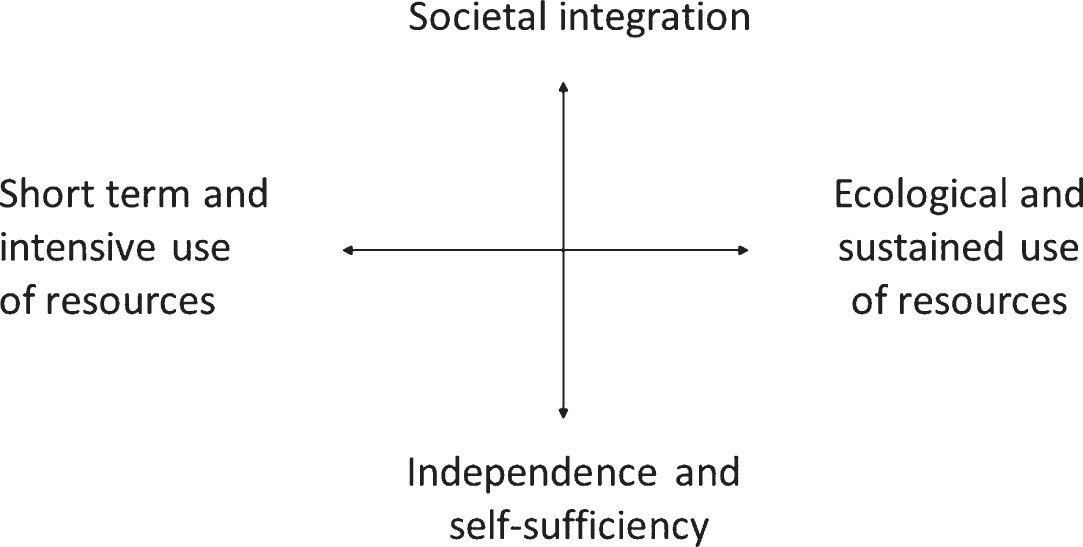
Historical frame for analyzing learning challenges in organic vegetable farming [7].
As said in Section 2, research on sustainability requires that two perspectives, the systemic and the subjective, are put into dialogue with each other. Figure 1 takes the systemic perspective by combining two central dimensions of sustainability in organic vegetable farming. However, we still need a way with which to include the “functional integrity” view of a subjective actor. We assume that the notion of object of activity is of help here. The object has a constitutive significance in a collective human activity system:
“So the object is both something given and something projected and anticipated. This very duality of the meaning of the term indicates that the concept of object carries in it the processual, temporal, historical nature of all objects. Objects are objects by virtue of being constructed in time by human subjects. This in no way diminishes their reality and materiality. But despite its materiality, an unknown particle of a mineral in the rock is not an object for us before we somehow make it our object - by imagining, by hypothesizing, by perceiving and by acting on it.” [24].
In object construction, people constantly reproduce, or alter, the activity. The object of organic vegetable farming is the material process, from soil and other raw materials to the end products and customers. However, it also consists of what individual farmers aim at in their work activities. The framework in (Fig. 1) helps in analyzing how historical and cultural developments are involved when farmers construct the objects of their work.
The Alanen farm
The empirical data of this paper comes from one organic vegetable farm called ‘Alanen’ collected in an ethnographic study in 1997–99. The farm converted to organic farming in 1991 from conventional milk production, and some years later, began vegetable production. It changed from a traditional, relatively closed farm within a village community to a farm with more integrated activity and new, more externally oriented forms of integration. One of these forms of integration was the foundation of a marketing company by a group of organic vegetable farmers. Antti Alanen, the male farmer, was a member of the board of this company. The Alanen farmers sold their potatoes mainly to the municipality’s local markets, and their Chinese leaves were sold to national wholesale markets through the company.
Previous ethnographic work on the Alanen farm suggested that there was ambivalence between directing the farming activity towards the new, network-type of societal integration, and maintaining independence and co-operation within the local village. In other words, the object of farming showed a move towards both ends of the social y-dimension of sustainability. It can be hypothesized that the future sustainability of the Alanen farm was more likely to depend on how it relates to other actors in society, outside the farm and the village.
The empirical data consist of a 45-minute telephone conversation, during which a farmer, Antti Alanen, and the author were planning a new crop rotation for the Alanen farm. Crop rotation is an essential basis for an organic farming system. It means that a multi-year sequence of crops is formed to improve yields and sustain the farming system and. A successful crop rotation plan makes all the elements of the farming activity fit together and therefore it is a central concept with which farmers can manage both ecological and societal complexities. In planning, more or less everything in farming has to be taken into consideration: from soils to demand, and from machinery to the management of labor peaks. Therefore, crop rotation planning provides interesting data for the study of farming activity. In the data, the farmer ponders on different alternatives on how to develop his farm. The data is speech only and not action, but discursive processing of motives and values prepares moving from talk to action [25].
How is the data analyzed?
First, to empirically grasp societal integration in a work activity, contacts outside the farm were identified. A contact is usually a person or group of people. Places and regions outside the farm are considered contacts when they include an agency. This is because, in rural speech, people are often not separated from places: people identify themselves with the place itself [26 p.9]. Children, family, and workers (hired labor) are seen as contacts because they can be considered as coming from outside the productive unit of the farm. Loans, subsidies and demand are also contacts because they represent a human actor outside the farm. Also indirect naming of a demand is categorized as contact.
Second, something related to learning challenges must be found in the data. For this purpose, need expressions were identified. Leont’ev [27] writes that a need is that which directs and regulates concrete activity. But this is possible only when a need meets an object that fulfills it [27 p.54]. From the discussion data, it is difficult or even impossible to define the “real need” of the speakers. Therefore, the concept of “need expression” is used. Here, need expression is something problematic or uncertain that differs from pure neutral description.
Dilemmatic pondering on alternative options, conflicts, questioning or intentions in the data are identified as need expressions. Dilemmas and conflicts have been proposed as discursive manifestations of contradictions [19]. Billig et al. [28] have studied dilemmas, that is, opposing words, evaluations and maxims, as part of social thinking. A dilemma may consist of two or more alternative choices, but also expressions of hesitation and uncertainty. Conflicts, in turn, take the form of resistance, disagreement or criticism [19]: they occur when an individual or group feel negatively affected by others. Intentions and questions indicate that something needs to be done or known. Intentions are need expressions with conscious instructions regarding actions. Questions look for information or assistance. Compared to questions and intentions, dilemmas and conflicts are more premature: the “action plan” is not yet included. In the words of Leont’ev [27], either the need has not yet met the object, or there are two or more alternatives available to meet the need of the object.
Verbs such as ”to need”, ”to try”, or ”to fear” help define need expressions, as well as words like “but”, “although” and “if...then”. The use of the conditional also indicated need expressions. Only the expressions in which the interpreted needs play some functional role in Alanen’s farming activity are singled out.
In the data, need expressions come up as integral parts of the topics in the discussion. The length of these topics varies between five and 245 words. Section 4 below describes selected need expressions with contacts and interprets them in the contexts of their functional topics of the local farming.
Findings
Altogether, the data yielded 17 need expressions within eight topics, all including functional contacts (Table 1).
Contacts and types of need expression
Contacts and types of need expression
In Table 1, the topics (left hand column) are the themes of discussion where need expressions and contacts appear. The need expressions are divided into four categories: dilemmas, conflicts, intentions and questions. Only chose need expressions that contain a contact outside the farm are chosen.
Because the interest is in the initial stage of learning challenges, the dilemmatic and conflict type of need expressions, six altogether, are further analyzed in this paper. With this, the idea is to detect the most relevant contacts from the standpoint of learning challenges in societal integration, and thus in sustainable development, on the Alanen farm. Figure 2 shows how the dilemmatic and conflictual need expressions were involved in the contacts.
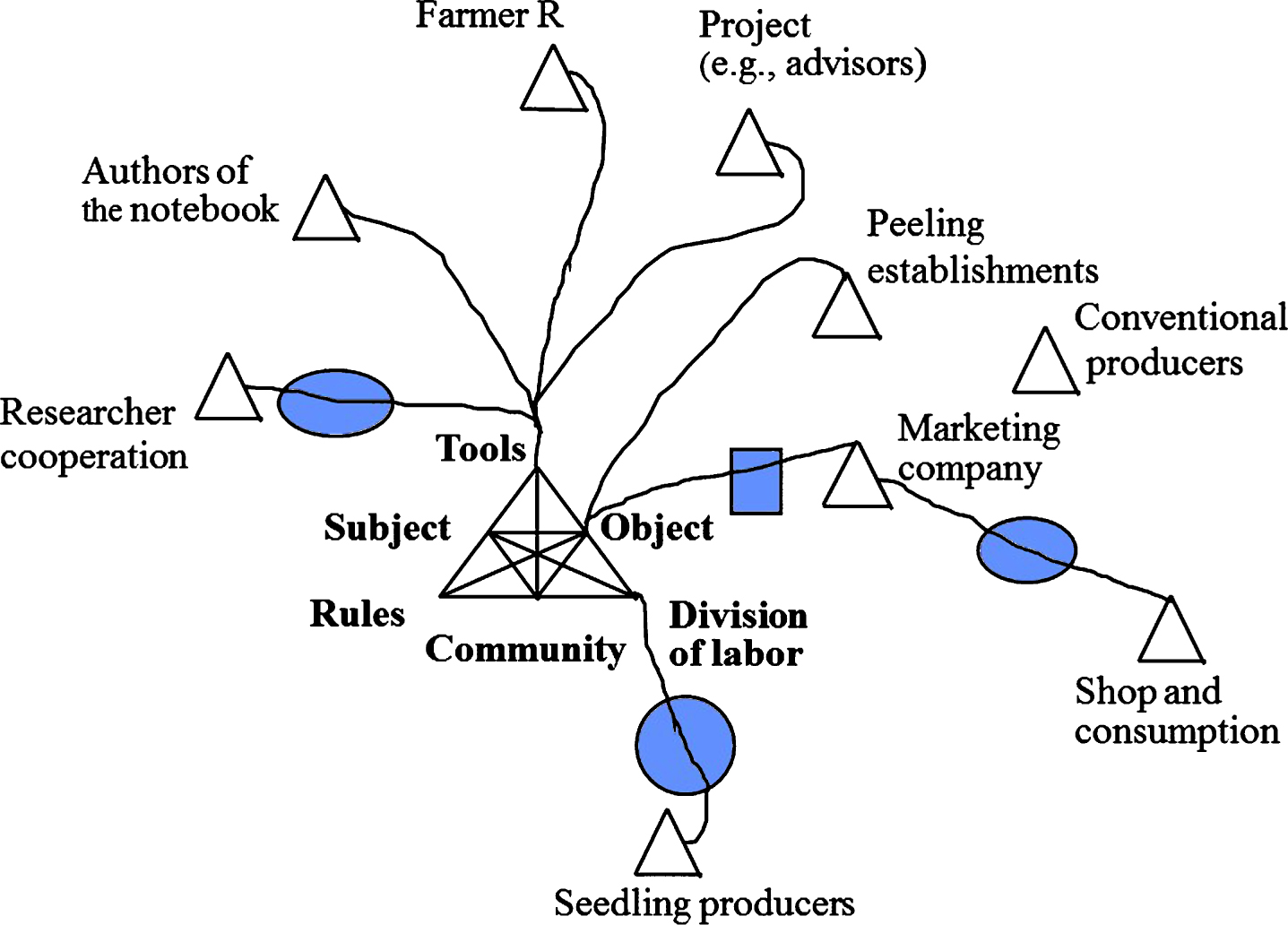
Contacts with dilemmatic and conflictual need expressions in functional links with the Alanen farm.
The dilemmatic topics are represented by shaded ovals, and the conflictual topic by a shaded rectangle in Fig. 2. They are looked at in the frame of farming as an activity system where the subject, actor, and object, are mediated by both material and ideal tools and signs. The activity system also consist of collective elements of rules, community and division of labor [29]. All these elements are interrelated, which means that a change in some of these elements effects all the other elements, as well. The analyzed dilemmas and conflicts are functionally associated with the tools, division of labor and object of the farm. Below, examples of these three types are shown and explained.
The topic A of where to get the Chinese leaves seedlings includes two dilemmatic need expressions. Until now, the family had bought the seedlings from a fellow farmer. In the data, Antti is pondering whether to buy the seedlings or produce them on the farm. The dilemma of producing the seedlings is linked with the division of labor in the farming system. Antti started this topic by “We’re going to be left without seedlings if we don’t start growing them ourselves”. The second part of the dilemmatic need expressions within this topic shows that the acquisition of the seedlings from other farmers is not the main problem: time and money play the main role (Excerpt 1).
Excerpt 1 (Topic A, Contact 3 in Table 1): A: It would be good if we could grow them (the seedlings) ourselves, and made a crop rotation that gave us time to do it. LS: Yes. A: But, then again, I’m lazy, and in that sense, it’s really easy when somebody just brings them to the farm. LS: Mm. A: But, then again, let’s say some 70 000 seedlings, 30 pennies each, means a lot of money.
The option of growing the seedlings on the farm requires that a greenhouse has to be built, and the seedling production method has to be learnt. The time available during seedling production is, correspondingly, dependent on other crops, their cultivation rhythms and the hired labor. At first, Antti was planning to resolve this by growing part of the seedlings on the farm, and buying part of them from a fellow farmer. But even this required investment and labor for building at least a temporal greenhouse.
The second functional type of dilemmatic need expressions are found within the marketing contacts (Topic B, Table 1). The conflictual need expression also belongs here. They are linked to the farming object: producing and selling vegetable products. Dilemmatic need expressions with demand and shop are named under three different topics [yield levels, how the company requirements affects the rotation, and the possibility of crop change]. A dilemma with contacts of shop and demand emerges in the discussion on what constitutes good or normal yield levels (Excerpt 2).
Excerpt 2 (Topic B, contact 6, Table 1): A: It could have been, perhaps, some 20 thousand (kilograms) from that acreage, the marketable yield, if we’d packed it like you sometimes see in the shops. That is, some are wilted and they even have some dirty leaves, and... LS: Yes. A: …but our intention is not to go along that road, because it affects demand... LS: #Uhum. A: Reduces (demand)
On the one hand, with less careful sorting and packing of the products, Antti would have gained a bigger volume of sold products, which is of economic importance in the object of farming. On the other hand, inferior quality of the products would reduce demand – contact with the consumer is abstract and far away but still significantly affects the object of the farm. And between these two, the dilemma finds its expression. Antti preferred long-term demand to the short-term benefit of higher-level yield and income, which shows societal integration in the form of consumer orientation. The “shop” contact here is not an active agency, but the context in which the observation of the quality is made. The latter part of the dilemma can be interpreted independently as an intentional need expression.
The contact in the conflictual need expression is the manager of the marketing company.
Excerpt 3 [Topic C, Contact 8]: LS: Does the company affect this crop rotation plan somehow? A: Not this one, me personally. I’m probably dense enough not to believe the manager [of the company], when he tells me to grow iceberg lettuce next, to forget about Chinese leaves.
This need expression is marked with a shaded rectangle in Fig. 2. Antti had decided not to follow the advice of the manager to change crops. The expression shows his self-ironic reflection. This is immediately followed by the next need expression:
Excerpt 4 [Topic C, Contact 9]: LS: What! The manager is telling you to grow iceberg lettuce? A: Yes, to grow lettuce …cause nobody buys Chinese leaves anymore. Told me last summer. LS Uh-um. A: And I said, thank you, thank you very much for your encouragement, but I’m going to carry on growing this for the time being anyway … LS: Mm, yes, and now [last autumn] it’s sold well? A: Yes, quite well.
The dilemma here is between the advice of the manager, offered as a tool [that the demand for Chinese leaves will decrease, and it would be wiser to grow lettuce], and the Alanen farm’s positive experience as regards the marketing, in the object. Antti had decisively made up his mind to continue cultivating Chinese leaves. In this sense, he was defying the demand forecasts. He immediately remarked that better quality control in packing furthers the continuation of demand. With this, he changed the topic from the overall decrease in the demand for Chinese leaves to the competition between organically and conventionally grown products. By saying this, he was also admitting that demand is volatile. The question of the demand for Chinese leaves came up again later [Excerpt 5].
Excerpt 5 [Topic D, Contact 11]: A:... I don’t know how you feel about it or see it, but it could be possible then [later], if Chinese leaves stop selling, if sales stopped so dramatically, that for instance, lettuce would suddenly become fashionable LS: Mm. A: …which would beat [Chinese leaves] totally, ¤ then you could change [crops, of course] but, for me, it’d be better to have only one crop like that [a labor-intensive vegetable crop] as well as potatoes... LS: Yes, mm. A: And not jump from one thing to another.
This dilemma shows an internal contradiction within the object of vegetable production. The customers prefer buying a large variety of different vegetables. From the perspective of production, the crops all have different technical requirements, which makes it difficult for farmers to successfully manage the cultivation of several vegetable species. Here, Antti showed an openness to react to the marketing problems of Chinese leaves, and linked it to a desire for a reduced, continued selection of crops in his farming.
The last dilemma (In topic E, Table 1), or rather a disturbance [30], is shown within the researcher cooperation. It is linked with the tools of the farm, because the research is expected to produce useful knowledge for the farming activity. Several research projects coordinated their on-farm research activities by means of a common email-list. One research project had sent a notebook [a tool] to farmers in order to help them in plotwise bookkeeping during the growing period. However, another research project wanted the notebooks to be sent to them for data collection. For the Alanen farm, the notebook was both a tool and a rule, which shows the contradictory instructions given to farmers by the different researchers.
Learning challenges
All the need expressions referring to demand are dilemmatic. This shows tension between orienting the farming activity according to the requirements and forecasts of demand, and orienting the activity according to the resources of the farm. In activity theoretical terms, the object is contradictory, heading both upwards and downwards in the vertical dimension in Fig. 1.
As seen in Fig. 2, the contacts of the shop and demand are mediated by the marketing company. Antti, being a member of the board, plays a double role. He has to consider what is beneficial for his farm, as well as what is beneficial for the company. The marketing company is a way with which to solve the internal contradiction in the object of organic vegetable farming that appears between the diversity of the products, required by the customers, and the farm’s specialization in a few crops. On the other hand, the division of labor between production and marketing means that farmers do not, necessarily, have direct contact with their customers, which may inhibit information exchange and hinder farmers’ learning about customer orientation. It has to be remembered that marketing cooperation among agricultural entrepreneurs has long been neglected in Finland. The independence of farms was strong during the “good times” of the 1970s and the 1980s, when there was no need for marketing cooperation [31 p.9]. Now, cooperation is increasingly necessary for the success of vegetable growers’ marketing [32].
One of the learning challenges in societal integration on the Alanen farm concerns the division of labor. This is seen in the dilemma of seedling production, and also in the conflictual need expression (Topics A and C, Table 1). Another learning challenge, shown in the demand-contacts, is customer-orientation. With regard to the Alanen’s farming activity system, the marketing contacts within the object are crucial for the overall sustainability and, especially, the economic viability of the farming activity. Marketing contacts are a key area for farmers’ entrepreneurial identity [33].
Both of these learning challenges of the Alanen farm show that the development of an activity is not linear: in the learning challenges, steps are taken back and forth as well as in other directions. In addition, the findings of this paper suggest that the learning challenges are more collective and do not only pertain to one farm.
Discussion and conclusion
The method applied in this paper follows developmental work research [29] which has its roots in the Vygotskian tradition of activity theory. The method has been elaborated and used in many scientific disciplines and professional domains. Learning is indispensable for sustainability, and therefore analyzing the learning challenges in practical work activities has significance for sustainable development. The finding to be generalized is the research method, which can be applied in many domains of work for supporting sustainable development. In this section, the method of identifying and analyzing the learning challenges is described stepwise and discussed in relation to research on sustainable development. However, in order to better know the method’s potential in investigating and promoting sustainable development, a comparison with other methods would be needed.
A historical analysis of a work activity
Relevant historical and qualitative dimensions of the changes in the general development of a work activity under investigation are depicted as dimensions where a change between old and new features of work reveal internally contradictory qualities. These dimensions, represented in a table or in a four-quadrant framework (Fig. 1), give shape to preliminary working hypotheses about the contradictions of local concrete work activities. The historical analysis corresponds to what Alrøe and Kristensen [11] call the systemic perspective. Historicity helps long temporal location of sustainability issues.
Qualitative analysis of need expressions in a discourse data
Need expressions are analyzed in combination with something that may indicate the hypotheses from the historical analysis. In the example of this paper, the contacts outside the farm were identified as representing societal integration. Need expressions importantly include the subjects’ intentionality, revealing the perspective “from within” the system. Practitioners’ own motivation to change is emphasized in the discussion about learning for sustainable development [34]. The data units combining need expressions and indicators of hypotheses are about work, and the activity system model (in the center of Fig. 2) together with the subjects’ intentionality, is used to depict how they “functionally integrate” [11] into work.
Interpreting need expressions in the historical framework
Dilemmas and conflicts, manifesting contradictions in an activity [19], are taken here as initial or embryonic learning challenges. Linking local and subjective need expressions with general historical contradictions is a way to overcome the gap between the individual and society, so much needed in research for sustainable development. The activity theoretical conceptualization is that needs themselves are socially produced [35]. In our example, the findings seem to confirm the contradictions proposed by historical analysis. But the analysis of actual need expressions may also go against the historical hypotheses [36] which may further advance the understanding about the contradictions and learning challenges.
Contradictions as such do not tell about the preferable direction to find solutions for sustainable development. The historical framework with its contradictions (Fig. 1) suggests a general, historically preferable direction. Thus, challenges for learning can be found by interpreting need expressions in the historical framework. In our example, this would mean enhanced societal integration in the marketing relations and division of labor. The concept of a learning challenge is an intermediary concept between contradiction and those actions or practices that help to further develop the work system. A learning challenge includes awareness that there is a boundary to be crossed and an understanding about what is a good and preferable direction to go forward. However, the framework does not imply a pre-determined normative path of development (note the two-way arrows in Fig. 1). The direction of sustainable development needs to be elaborated for each particular context [3, 13]. Sustainable development remains contestable and practitioners are able to take actions to many different directions.
The main benefit of dialectically informed historical analyses is their practical use in collaborative negotiations and participatory designs for sustainable development. If successfully used, practitioners may turn them into instruments to better understand and act on their work and its objects [13, 37]. In this process, the analyses and frameworks become modified and remodeled.
The subjectivity of the excerpts of this paper provides a complex picture of the developmental possibilities of this farming work, while also being linked to the systemic model. Learning challenges are the sites where actors may invent new solutions in their activities. By simultaneously using the systemic and subjective perspectives, it is possible for a researcher to manage the complexity of practical work activities, and, at the same time, to avoid overly simplistic and disciplinary presumptions regarding sustainability.
Conflict of interest
None to report.