



Abstract
BACKGROUND:
Integrating work activity issues into design process is a broadly discussed theme in ergonomics. Participation is presented as the main means for such integration. However, a late participation can limit the development of both project solutions and future work activity.
OBJECTIVE:
This article presents the concept of construction of experience aiming at the articulated development of future activities and project solutions. It is a non-teleological approach where the initial concepts will be transformed by the experience built up throughout the design process.
METHODS:
The method applied was a case study of an ergonomic participation during the design of a new laboratory complex for biotechnology research. Data was obtained through analysis of records in a simulation process using a Lego scale model and interviews with project participants.
RESULTS:
The simulation process allowed for developing new ways of working and generating changes in the initial design solutions, which enable workers to adopt their own developed strategies for conducting work more safely and efficiently in the future work system.
CONCLUSIONS:
Each project decision either opens or closes a window of opportunities for developing a future activity. Construction of experience in a non-teleological design process allows for understanding the consequences of project solutions for future work.
Introduction
Integrating work activity issues into design process is a broadly discussed theme in ergonomics. Ergonomists have been using participatory methods to involve workers in their own workspace design, which generates benefits such as focusing solutions on user needs, thus improving solutions and increasing project acceptability [1].
Among these participatory methods in ergonomics we can mention studies on the future work approach [2, 3] and simulation techniques [4–7]. In this line of discussion, several studies have shown results by involving workers in design process [8, 9], methods to anticipate future use [10], framework proposals to guide ergonomists [11], and the importance of using supports to these dynamics [12, 13] aiming to engage users in designing artefacts at different levels of abstraction [14].
However, these references are oriented to engage workers in the design process focusing on making them externalize their point of view about the future work conditions. Nevertheless, these references provide a limited response. Studies in instrumental approach [15, 16] have shown that work activity and work conditions are mutual and continuously transformed during daily work. The authors characterize these processes as catachresis, instrumentation, instrumentalization or instrumental genesis. This suggests the need for a non-theological model of design to link the development of work activities and objects instead of only objects [17, 18].
This paper approaches work from the perspective of activity [19], which is the mobilization of individuals in all dimensions (physical, cognitive and psychological) to perform tasks. Work activity at a given moment is a response to a number of determining factors such as production objectives, tasks, rules and equipment available, as well as physical and psychological conditions, values and abilities [19].
The research question motivating this article is how can participatory design help workers mobilizing their past work experience and development of design solutions. Thus, we propose the construction of experience concept, shown as a process articulating the development of design solutions and work activities based on past work experience. This concept is presented here as a non-teleological form to approach the design process, assuming that workspaces and work activity can be developed with mutual interdependency. It means there is no activity model to be used as a basis for project solutions but rather a preparation of possible activity scenarios, which will be constructed together with design solutions. This perspective of construction of experience values the collective learning among workers, designers and ergonomists, regarding both work and project. This learning about future possibilities is a driving force for design solutions and vice-versa.
This paper presents a case study of a biotechnology laboratory project, where a Lego scale model was built to support discussions with researchers from a French research institute. The study used a participative approach of simulations using a scale model, which supported the researchers’ discussion of work and design solutions. Two lines of discussion emerged: to evidence problems in the existing laboratories and to rethink work situations, which meant creating scenarios to avoid these problems and solutions to help improve the researcher’s work. The study demonstrates that learning acquired in discussions can guide both the objective prioritization for the laboratory layout and the collective design solution to achieve project goals. Learning resulting from this articulated construction between project and work activity is only possible in a context where design solutions and activity model are not defined a priori.
Non-teleological design process
In a teleological model, objectives are the cause of action, and plans are preconceived to determine the course of action [20]. This rationality is embodied in project methodologies, were the initial understanding of problems to be solved is determinant for following decisions. A non-teleological model for design assumes that learning during design phases can reorient objectives and decisions.
Conducting this process can be understood as a course of action, which should be articulated between two levels: the desirable and the possible [21]. In one hand, we have the representation “of what is desirable” as project results. On the other hand, there is the reality of the situation and its own possibilities and impossibilities, which should be taken into consideration to implement the desired change. Then, project management can be understood as a process through which what is desirable and what is possible should be converged (Fig. 1).
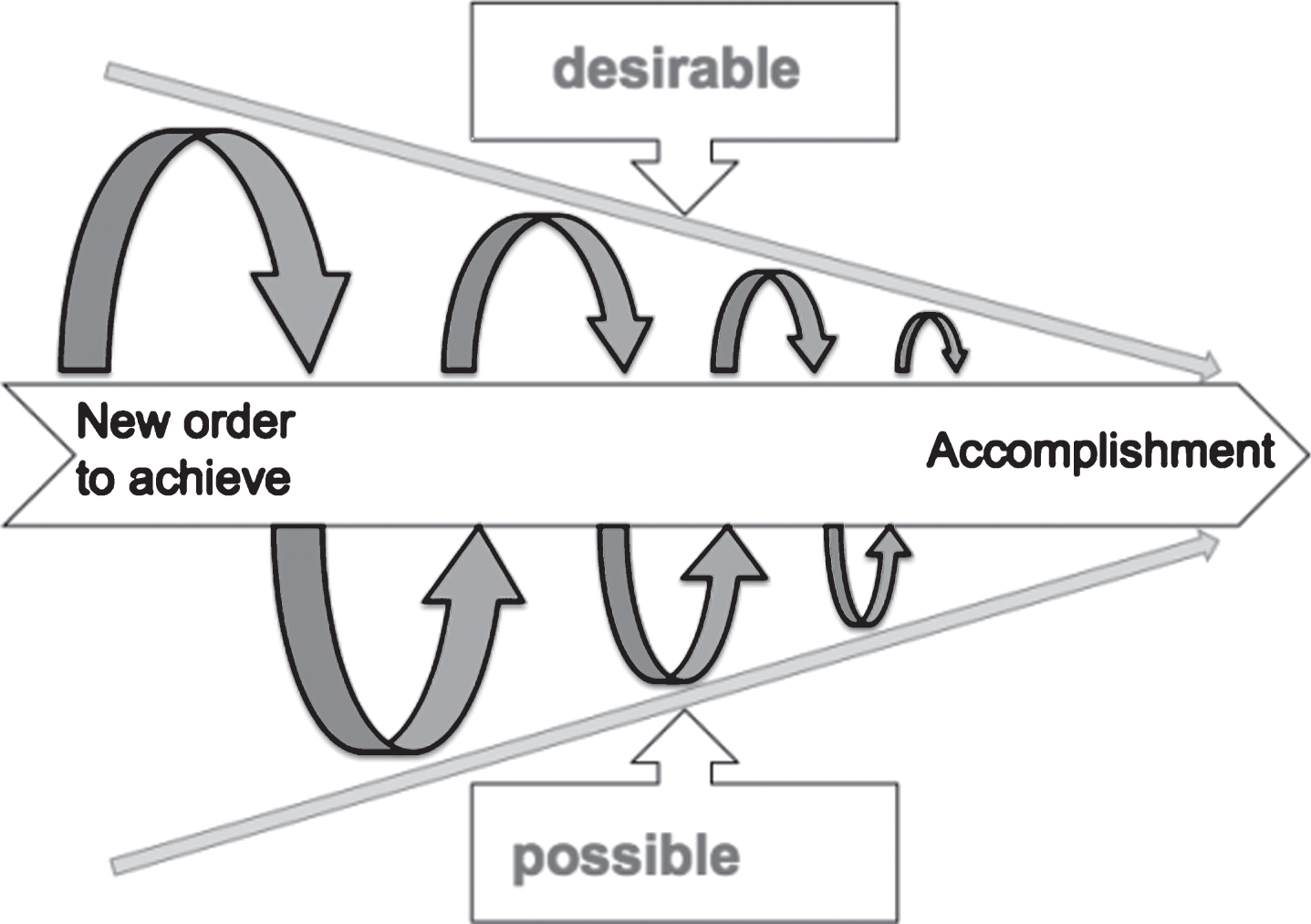
Project management as an articulation process between ‘desirable’ and ‘possible’ [8].
This dynamics can be synthesized in a tension between the poles of Logos (idea, notion) and Praxis (practice) [21], in which intellectual formulations will confront practical possibilities. However, it is necessary to put a proposal and a provisional understanding in tension with their appropriation in singular situations. Donald Schön [22] in his famous metaphor of “reflective conversation with the situation” illustrates this tension: the designer works with an objective mobilizing knowledge and ideas, but the situation “responds” and presents unexpected problems whose previous responses will not be enough. These problems serve as a basis of learning for the designer, who needs to transform his initial ideas and design objectives. It is a dialogical process: as the understanding of a problem is constructed, solutions are designed; as these solutions are tested, more is learnt about the problem. The proposal of a non-teleological design model is to enable this dialogue within the project process so that the learning achieved during the project helps to guide design decisions.
The proposal of the construction of experience is a form of learning this non-teleological construction. The experience analysis is developed under a perspective by Dewey [23], in which experience is not simply an accumulation of memories concerning different life experiences, but a construction that transforms the individual’s perception and knowledge.
During work activities [19], individuals mobilize their knowledge and abilities to achieve strategies and deal with varied situations. However, the situation they face cannot always be solved with a mere reproduction of consolidated strategies. Work situations show several kinds of variability [24], which demand situated responses [25]. It is thus necessary to build new responses during the action, which demand a continuous and attentive interaction of individuals with the situations they encounter. Thus, we can analyse the results of their actions and redirect them according to their results and objectives.
The construction of experience discussed here does not refer to this process, which occurs individually during work activity, but rather to project situations with collective discussions in a participative context. In a project situation, the interest is not just in discussing past experiences but also future work activity. Thus, fragments of individually accumulated experience are put into perspective to enable collective thinking about the design solutions. Discussion on these experiences generates mutual learning about work and project, which helps to build new work scenarios and future experiences that could be lived. This paper presents a construction of experience regarding collective preparation for future work activity.
Method
We conducted a case study in a French state company, where an ergonomist organized a participatory approach in the project of a new biotechnology research complex. The ergonomist worked on the project for six months as a member of the ergonomics unit at the project management department. The purpose of the study was to analyse (1) how workers mobilize past work experience during the development of design solutions and (2) what is elaborated in relation to work activity in the future work situation.
According to Yin [26], a case study is a methodological approach to investigate events in the environment as they occur. This method was adequate since the ergonomist wanted to investigate the efficacy of a non-teleological method for a factual project. As a project can be characterized as a social process [27], where dynamics among people are determinant for the project results, we also need a method to study a phenomenon outside experimental control. This case study also had an inductive nature, as discussion elements were extracted from the results. Data analysis was focused on development of solutions and discussions on the activity during simulations.
Case setting
The company intended to transfer four biotechnology teams to a new laboratory complex. The project coordinator involved user representatives of the future installations in the design process. The simulation media was a scale model made of Lego bricks. Resource choice was due to a previous project described by Turchiarelli et al. [28] in the same company, which also used Lego bricks. The Lego scale model was maintained because the tool proved to be versatile as a representation and communication support. Lego pieces allowed for mounting colored elements, which could be easily handled and fixed to a support. The click fit system enabled correction or insertion of new elements in the scale model during discussion of design solutions. Details of preparation and mounting can be found in another publication [29].
The ergonomist who coordinated the use of scale model and study of work situations is one of the authors of this paper. A company ergonomist with experience in Lego scale modelling also helped in the research work.
We organized the use of scale model in two cycles of simulation meetings. In the preparation cycle, four work teams met separately to discuss their main laboratory project. In four 3-hour meetings, each team used the scale model part representing their own laboratory (Fig. 2). All department researchers were invited to attend these meetings to practise using the model and test the method.
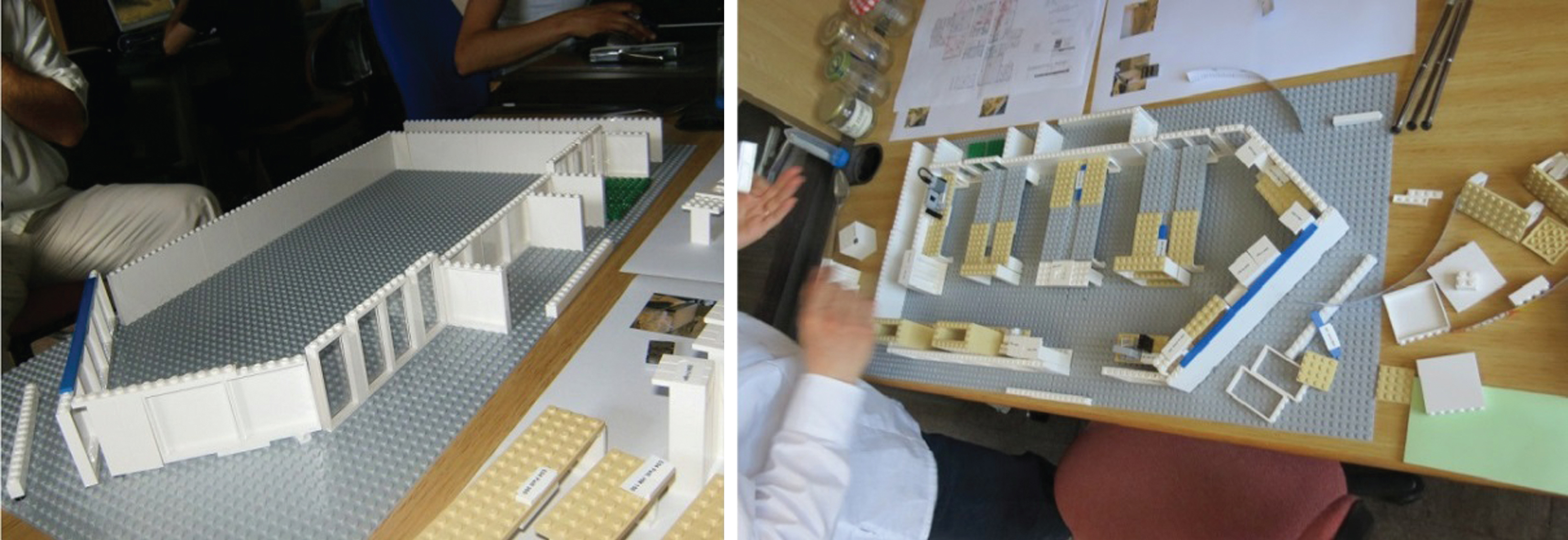
Part of the scale model used in the preparation cycle.
The complete cycle consisted of two 3-hour meetings in consecutive weeks, with the complete scale model (Fig. 3) representing all laboratories and offices. Two or three members of each team presented their points of view to discuss design solutions for all laboratories.
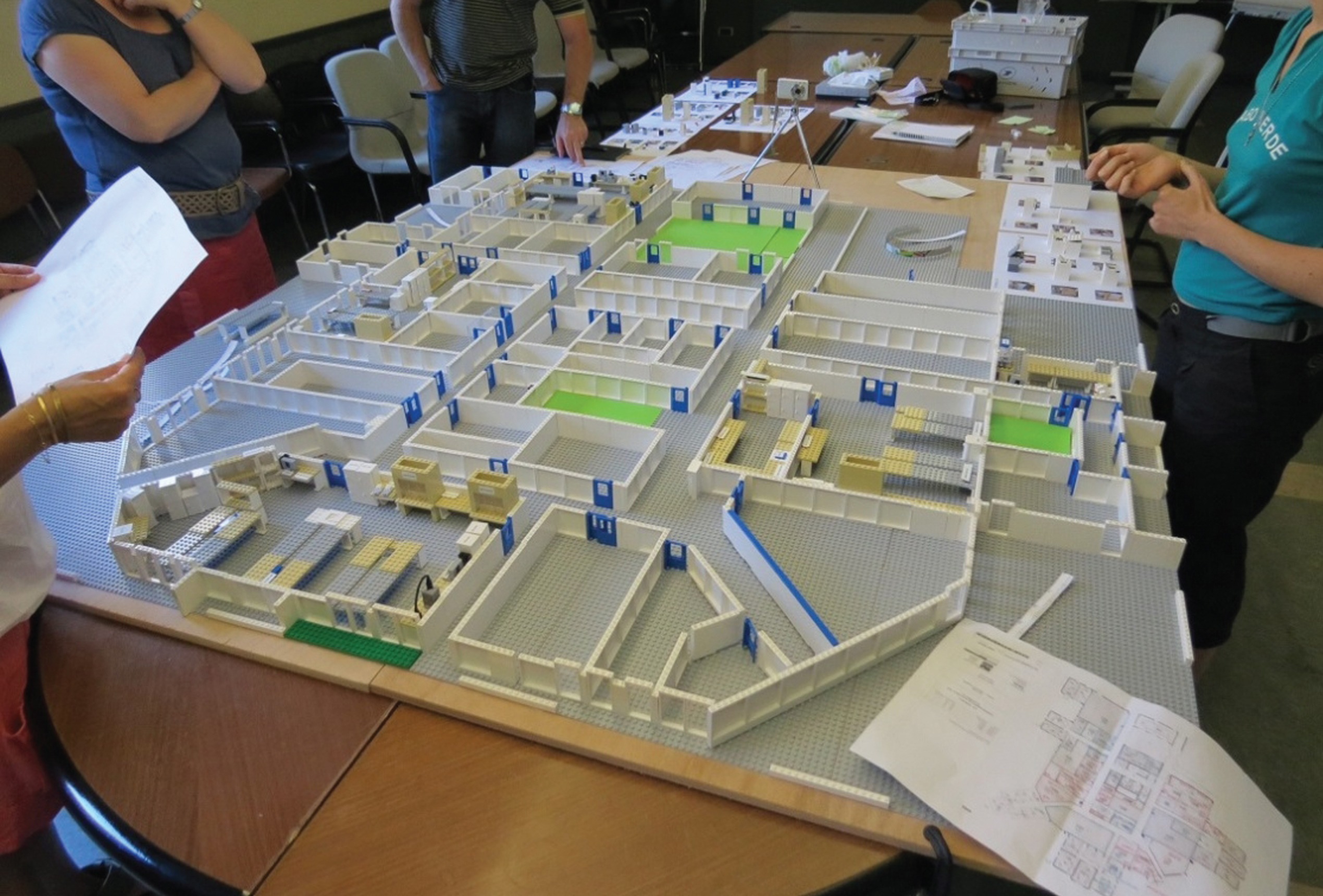
Complete scale model before the beginning of the study.
The scale model was presented to the work group only with its structural building elements (walls, doors and windows), thus the researchers had to place all furniture and pieces of equipment. Each group member was asked to explain the reasoning behind every piece positioning and consequent issues, which raised new questions of colleagues who had other points of view. The ergonomist and researchers’ questioning motivated discussions on work situations, which led to changes in the scale model for design propositions. The ergonomist proposed some typical action situations [2] so that the work team could evaluate solutions based on their own experience.
Scale model results were compiled in digital plans with a photographic collection representing the laboratories and the history of solutions. Project coordination and all department researchers received these compilation files.
The unit of analysis [26] was the development of solutions by researchers using the scale model. By observing solutions built for different work situations, we could realize how workers mobilize their experience to evaluate and propose solutions in the model. Design solutions were selected which enabled relating changes in the model with ideas on ways of working in the future. We first collected data from model handling videos and later through debriefing meetings with the work group.
The development of solutions and discussions were recorded during simulation meetings. Acting as the meeting facilitator, the ergonomist could use the video for further analysis of discussions on research questions.
During video analysis, we selected excerpts referring to construction of specific solutions for various laboratories. In these situations, the discussion of problems experienced by researchers and their work strategies were key points for developing new layouts and strategies. We transcribed the excerpts and analyzed the content of discussions with changes made to the model.
After video analysis, some situations of solution development with the scale model were selected for in-depth study with researchers after the simulations. Debriefing interviews were held with small groups of researchers to delve into their motivations, better detail the strategies formulated while using the model, and confirm the ergonomist’s understanding of the discussed situations.
For this interview, excerpts of videos of simulation meetings were prepared to remind the participants of key discussion points for the ergonomist’s research. Based on these excerpts, questions were presented so that researchers could deepen the discussion on proposal motivations and relationship between solutions and work. In addition, parts of the Lego model representing only the selected laboratories aided the interview process.
Results
In this section, two examples show the development of workspace proposals supported by the scale model, demonstrating how the work team handled project issues on circulation in one of the laboratories and chemicals management among teams.
Developing a laboratory space for a desirable work scenario
A problem identified during laboratory visits was the interruption of researchers’ concentration, which is a major problem for quality of work. Activities in these laboratories demand high levels of concentration, thus people moving close to workbenches can distract and interrupt researchers. During analysis, the ergonomist identified that people passing between benches (Fig. 4) and benches located close to other equipment (ex. fridges) or entrance doors were the main causes.
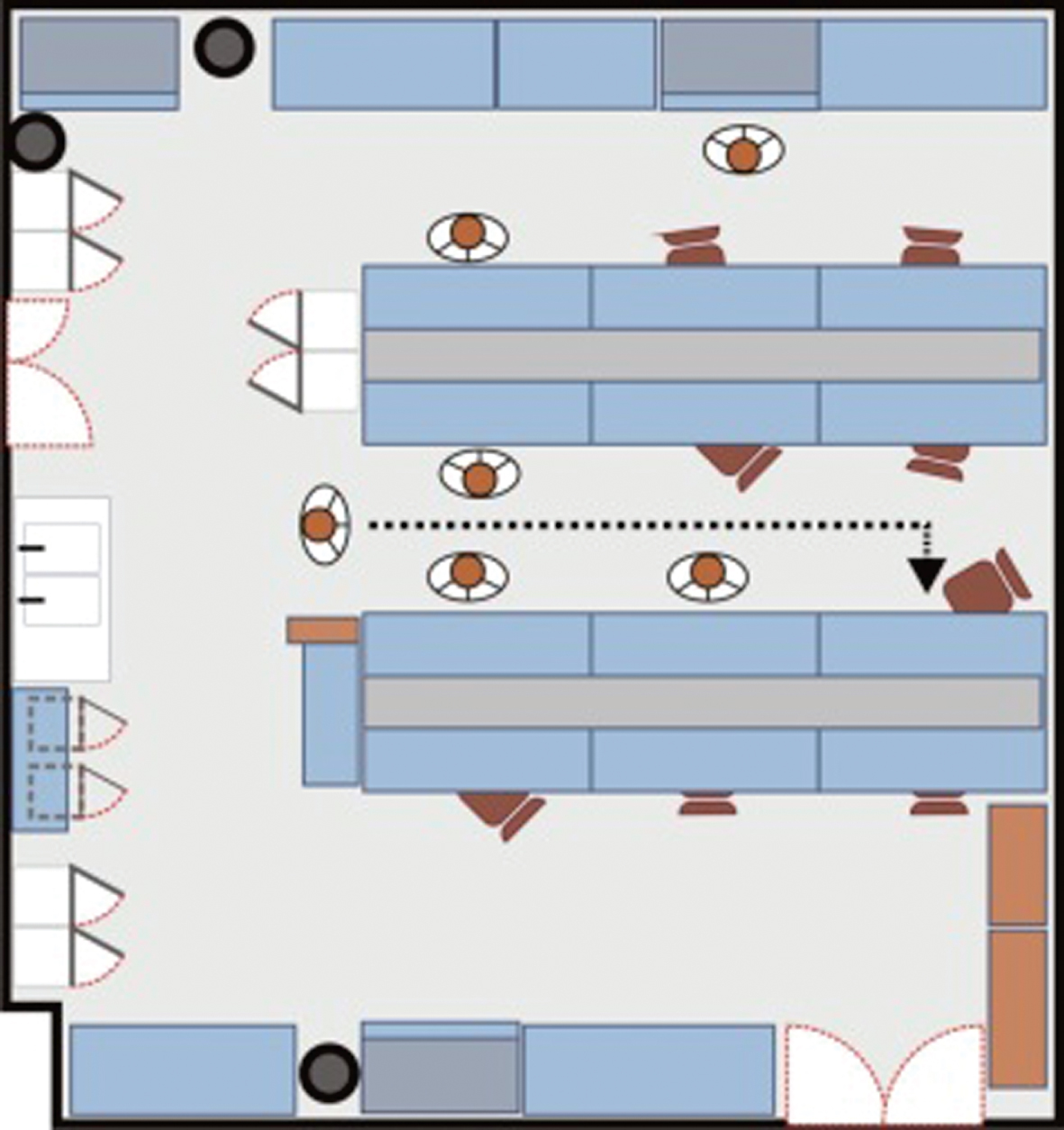
Possible situation of passageway between benches in the first proposal.
During preparation cycle, the work group reproduced the initial proposal for one of the laboratories using the scale model, as shown in Fig. 4. This layout presented two columns of six workbenches surrounded by other devices, such as a fume cupboard. Each bench belonged to a researcher but, in general, they were used for preparations to be manipulated in another laboratory.
After this layout was represented in the scale model, the ergonomist put forward questions about circulation and proposed some situations for the work group to evaluate consequences. The arrangement in two columns was found to cause a lot of movement between benches, which would consequently disturb the colleagues. Additionally, this team frequently used fume cupboards and other equipment, thus movement between workstations was intense. The arrangement would force researchers to walk along “corridors” of benches, which the group considered impractical on a daily basis.
In light of this scenario, the group agreed it would be an undesirable situation. Thus, they formulated a new goal for the laboratory layout whereby the arrangement of elements would change people flow, so that a facilitated circulation would less disturb other researchers.
One of the researchers proposed arranging three groups of four benches instead of two columns of six. By placing the benches in smaller “islands” (Fig. 5), the circulation problem would be minimized. Even with researchers still walking between benches, the new arrangement would probably cause less interruption since the number of opposing benches was lower. Furthermore, the access to other pieces of equipment could be easier.

Main benches organized in smaller ‘islands’.
However, it was necessary to eliminate two workbenches to make the new arrangement feasible, thus reducing the number of fixed pieces of equipment. Yet the group agreed that reducing workstations would be a lesser problem than the circulation issue, which could be solved in the new arrangement. Thus, they preferred to remove benches in order to achieve the main objective.
The second example regards developing a workspace to solve an issue in stock management of chemical products shared in the department. During the ergonomist’s analysis in work situations, the main problem identified in the stockroom was the way people stored and shared products, leading to unnecessary waste. The researchers discussed this issue in meetings around the scale model.
Waste of chemical products affects all teams and occurs partially due to form of usage. When researchers need to use a given product, they should go to the stockroom for it, use what they need in the laboratory and return the material immediately. Following this established rule for shared use, the products would be soon available for others to use. However, the chemicals were not always being taken back promptly.
The user would generally keep the product until finishing procedures, sometimes for several days or weeks. In the meantime, the chemical would not be available for others to use. Then, the researcher would go to the stockroom for a new pot, which resulted in waste of products due to expiration date.
During the first complete cycle meetings, the work team discussed issues concerning the chemical stock area. They decided that the stockroom design should help reduce the problem. The idea guiding the new layout was allowing researchers to use products with no need to take them out of the stockroom. To achieve this scenario, the team proposed to concentrate all chemical products in a small room with cupboards. Next to this room, a dedicated fume cupboard would be installed with measuring equipment (ex. scales and pH meter). Thus, researchers would take the product, measure the amount required in the dedicated fume cupboard then return the pot to the original place. Thus, the product would no longer have to be taken out of the stockroom (Fig. 6).

Proposal for the chemical stockroom.
This example dealt with a proposal which altered both space and work activity. A new form of handling chemical products for shared use was developed to solve a previous waste problem, along with an agreement between teams on to how to use the space. Based on the initial formulation, proposals started to be materialized in the scale model to allow the activity to be undertaken in the new location. Thus, construction of experience led to development of work activity reflecting on space development: the initial project objective.
Proposal for construction of experience should be differentiated from other design approaches based in anticipating problems and future use. Teleological approach resides in developing design solution based on ideas and objectives previously established, as well as on anticipation of problems related to these initial preconceived ideas. In the non-teleological approach here proposed, design solutions are elaborated in parallel with a collective construction of future work. The knowledge of future work will serve to question and redirect objectives and technical project solutions. This dynamics involves a mutual rearrangement between developed solutions and objectives that will be transformed during the project.
Regarding construction of experience, everyday life in the laboratories was determinant to workspace transformation in both examples. All previous real life experiences, difficulties and competencies in undertaking daily activities were rescued to help face a new challenge: to conceive workspaces. One thus reflects on previous work experiences from a different perspective, extracts design ideas and registers them in the scale model.
However, not only the project but also the work activity is transformed. This transformation is revealed at different levels: from elimination of general problems (which improved the overall activity performance) to developing a new way of working. Nevertheless, when one begins to use a scale model, none of dimensions (activity and spaces) is clear. We only have a ‘future aspiration’ expressed in ideas, such as a space allowing for better management of common resources or movement dynamics without disturbing co-workers.
In the effort to develop a space which fulfils the initially formulated desire, one reflects on experiences that could be lived in a new scenario. Construction of experience then takes place: a process articulating a new possibility of performing the activity in the future, which is also related to developing work resources (ex. spaces). It is thus a dialogical development: changes in the scale model revive discussions regarding work activity and ensuing discussions on how to work and transform the scale model. This dual development is characteristic of a non-teleological approach to projects. Possibilities of constructing experience and its implications on artefacts (or workspace) are broader the sooner this approach is inserted in the project conduction, as already mentioned by Maline [4].
From a practical point of view, one can list some conditions so that construction of experience is carried out in work system project. They are: previous analysis of work, users’ engagement, flexible simulation supports and discussion spaces. Prior analysis of work is necessary insofar as it constitutes the basis for building new forms of work. Active participation of users is not an additional or optional feature of the approach, but a necessary condition to ensure the coherence of the system resulting from this double development [30, 31]. Another point mentioned is the need for simulation supports plastic enough to allow for different arrangements of work systems while discussions on work strategies are being developed. In this sense, in the experiment described above, the Lego scale model allowed the workers to engage in the project and reflect on new forms of work. Finally, intervention in the project demands meetings that can be characterized as work debate spaces [32–34].
This study has two limitations. The first one is that, although construction of experience is a way to consider work during design phase, it is not a method itself. Non-teleological design methods to conduct articulation between activity and design solutions are yet to be developed. The second limitation is that both project and tool used in this case focused on building workspaces. However, it does not mean that construction of experience cannot articulate with other activity dimensions such as time or organizational aspects.
Conclusion
Construction of experience shows that anticipating work conditions to support technological decisions provides a limited response. For each technological decision or limitation existing in the project, a window of possibility either opens or closes for performing work activity in the future. Thus, discussing different perspectives of technological options also means putting possible work changes into discussion. However, this articulation is not solved in any given moment during the project. As limitations and project possibilities reveal themselves during development, new work changes could be put in discussion and new possibilities of experience can be developed. Thus, non-teleological models enable thinking about new ways of organizing projects, so that development of work and design solutions occur in parallel form.
Conflict of interest
None to report.
Footnotes
Acknowledgments
This paper has benefited from resources provided by the Franco-Brazilian project Capes-Cofecub 702/11 “Work, Innovation and Sustainable Development”.