



Abstract
BACKGROUND:
Accidents in the construction sector are a cause for concern. The influence of many different factors in construction accidents have been studied (age, company size, length of service, deviation, drugs or alcohol consumption, etc.) but the influence of medicinal substances in specific construction activities has not been evaluated until now.
OBJECTIVE:
The aim of the research presented here is to identify the effect of different medicinal substances on the occupational risk levels of construction activities with formworks.
METHODS:
An expert panel was selected in order to quantify the individual risk of each medication for each individual construction activity.
RESULTS:
Results showed that narcotics, antipsychotics, and hypnotics had the highest risk values, and the use of cranes and cutting materials were considered the most dangerous activities for a medicated worker.
CONCLUSIONS:
Data obtained in this research can help reduce the negative effects of the substances studied on the occupational safety of construction workers. A better knowledge of the risk levels according to the current capabilities of workers under the effects of medication is a powerful tool in planning safer construction activities.
Introduction
Construction is one of the most dangerous industries due to its high accident rates. The sector is responsible for 30–40% of occupational fatalities, although construction workers make up only 7% of the workforce worldwide [1]. Many authors have studied the problem of construction accidents in countries as varied as Canada [2], the United States [3], China [4], the United Kingdom [5], Taiwan [6], Spain [7], Turkey [8], Pakistan [9], Nigeria [10], or Uganda [11].
The influence of several variables such as the age of the worker [12], size of the company [13], length of service [14], organizational factors [15], or equipment and materials [16], have all been examined in different studies. The presence of other “not desired” and dangerous variables such as alcohol and drug consumption in construction accidents have also been evaluated in past research [17]. A study carried out by Minchin et al. [18] concluded that the effects of a drug-related jobsite accident can be catastrophic for the individuals and companies involved, and that drug use among employees can be damaging to morale, productivity and quality even if it does not result in accidents. In spite of it, Gharaie et al. [19] found that many workers admitted to being under the influence of drug or alcohol while at work. Similarly, Gerber & Yacoubian [20] investigated the efficacy of workplace drug-testing programs in the construction sector and concluded that companies with drug-testing programs experienced a 51% reduction in incident rates within 2 years of implementation. Other authors like Camino et al. [21] detected the particular severity of accidents involving alcohol in the sector, and Biggs et al. [22] proposed the development of an industry policy and cultural change management program in order to improve safety levels.
However, alcohol and drugs are not the only dangerous substances consumed by workers. It should be highlighted that the presence of different medications could affect the tasks undertaken by workers under their medical effects.
Authors like Cockburn et al. [23] observed loss of work productivity due to medical treatments, while Gilmore et al. [24] concluded that the use of some medications, or conditions requiring medications, may contribute to the risk of a work-related injury in any sector. Many times, dosage is controlled by medical staff, but many times people adopt self-medication behaviors and management of the dosage is not the best-recommended [25, 26]. Although there exist these previously cited studies about alcohol and drugs in construction, specific research into the influence of medicinal substances in the occupational safety of the construction activities, were not found.
The aim of the current research is to analyze the specific influence of different medicinal substances on the occupational risks of the construction activities with formworks.
Methodology
When an accident is registered in official records, many variables are included on the official form (age, company, length of service, day of the week, deviation, injury, severity, etc.), but in the official forms checked from European Statistics on Accidents at Work (ESAW) there are no variables about the use of medication during working hours. Therefore, quantitative methods based on the analysis of registered accidents were not considered for this research.
To achieve the aim of the study, the researchers used the methodology of staticized groups. According to previous civil construction research based on this method [27], a staticized group can be defined as a systematic and interactive research technique for obtaining the judgment of a panel of independent experts on a specific topic. Panel members are selected according to predefined guidelines. The staticized group technique is very similar to the Delphi method. The only methodological difference is the exclusion of feedback or iterations in the staticized group technique. Many previous researchers have reported different opinions about the accuracy of both methods. Authors such as Erffmeyer and Lane [28] are in favor of using the staticized group approach because panel members are not led to a consensus on a value that could be wrong. Accordingly, the present study was carried out using the method of staticized groups.
A very important factor determining the quality of the study in the staticized group approach is the selection of experts [29]. Aligned with that important factor, they proposed guidelines for a flexible point system for the selection of an expert panel member. A suitable adaptation of the suggested point system to the specific goals of our research project resulted in the requirements listed in Table 1.
Flexible point system for the selection of panel members
Flexible point system for the selection of panel members
The authors contacted 5 hospitals and 15 possible candidates. After a review of the background and availability of the possible candidates, 10 experts were selected. According to the guidelines proposed, all members of the panel met the minimum level of requirements. As can be seen in Table 2, all of the panelists scored a total of at least 21 points in at least five different categories. Two experts selected as panel members did not complete the survey and so were excluded from the final list of panel members and also from the results shown in Table 2.
Panel members’ scores
The qualifications of the selected members of the staticized groups are as follows. As a guarantee of expertise in medicinal substances all members of the panel hold a medical degree. In our opinion, this is the most valuable requirement for our research, because it shows that the person has completed specific courses in pharmacology, that he or she has the expertise to evaluate the risks of the substances under consideration. Between them, the panelists have an average of more than 10 years of experience as a doctor. Experience is another extremely relevant requirement.
The web-survey used to collect the expert responses was developed on a web site and was made available to the experts. In order to improve the quality of the study, certain strategies for study design and the elimination of bias were adopted. For example: The anonymity of each expert was ensured. The order of the questions and the order of the potential safety risk in the survey were randomized for each panel member to reduce the contrast effect and the primacy effect. Independent frequency and severity rates were implemented.
Following the guidelines of Hallowell and Gambatese [29] the experts were provided with a list of formwork construction activity descriptions (Table 3). In addition they were provided with a list with groups of common medicinal substances (Table 4) based in the classification used by Gilmore [24].
Activities
Activities
Groups of medication substances
The panelists were asked to provide their opinion about the level of risk of each construction activity considering that the worker is under the effects of different medications. Possible values were scaled as follow: 1 [Very low risk], 2 [Low risk]. 3 [Moderate risk], 4[High risk] 5 [Very high risk].
The obtained results can be seen in Table 5. To enable a clearer understanding of the results, they were classified according to a proposed scale based on the expert responses (Fig. 1).
Risk scores for each activity and medication group
Risk scores for each activity and medication group
*Risk scores higher than 3.50 were considered as “High risk”.

Expert vs results scale.
Risk scores higher than 3.50 were considered as “High risk” and marked with an asterisk. Values between 3.50 and 2.00 were considered “Medium risk”, and values under the 2.00 were marked “Low risk”. In the opinion of the experts, narcotics, antipsychotic and sedative hypnotics obtained the highest risk scores. In the case of narcotics it was scored with the highest level of risk (5.00) by every panel member in the activities operating a crane and motorized transport. Similarly, cutting materials was considered a very dangerous activity under the effects of narcotics (4.88). The lowest score of any activity under the effects of narcotics was obtained by inspect/plan, but its score is not especially low (3.63). In contrast, non-narcotic analgesics, antibiotics and GI medication obtained the lowest values. Finally, Antihistamines, Antidepressants, and Hypoglycemics obtained intermediate values.
If the effects of medication are considered for all construction tasks globally, a ranking of the global risk of each medication is obtained. According to the risk score ranking in Table 6, medications could be classified in three different groups based on their level of risk. In a first group marked with an asterisk (High Risk Medication) could be included substances with more than 3.5 points (Narcotics, Antipsychotics, Sedative Hypnotics). In a second group (Medium Risk Medication), substances under 3.5 but higher than 2 should be included (Antidepressants, Antihistamines, Hypoglycemics). Finally, in a third group (Low Risk Medication) those substances with a score of less than 2 points (Antibiotics, GI medication) should be classified. It can be observed that differences of global risk between substances from different groups are close to 1 point. Similarly activities were classified according their risk scores in Table 7. In Figs. 2 and 3 were represented graphically scores obtained by medication and activities.
Medication risk scores
*Risk scores higher than 3.50 were considered as “High risk”.
Activities risk scores
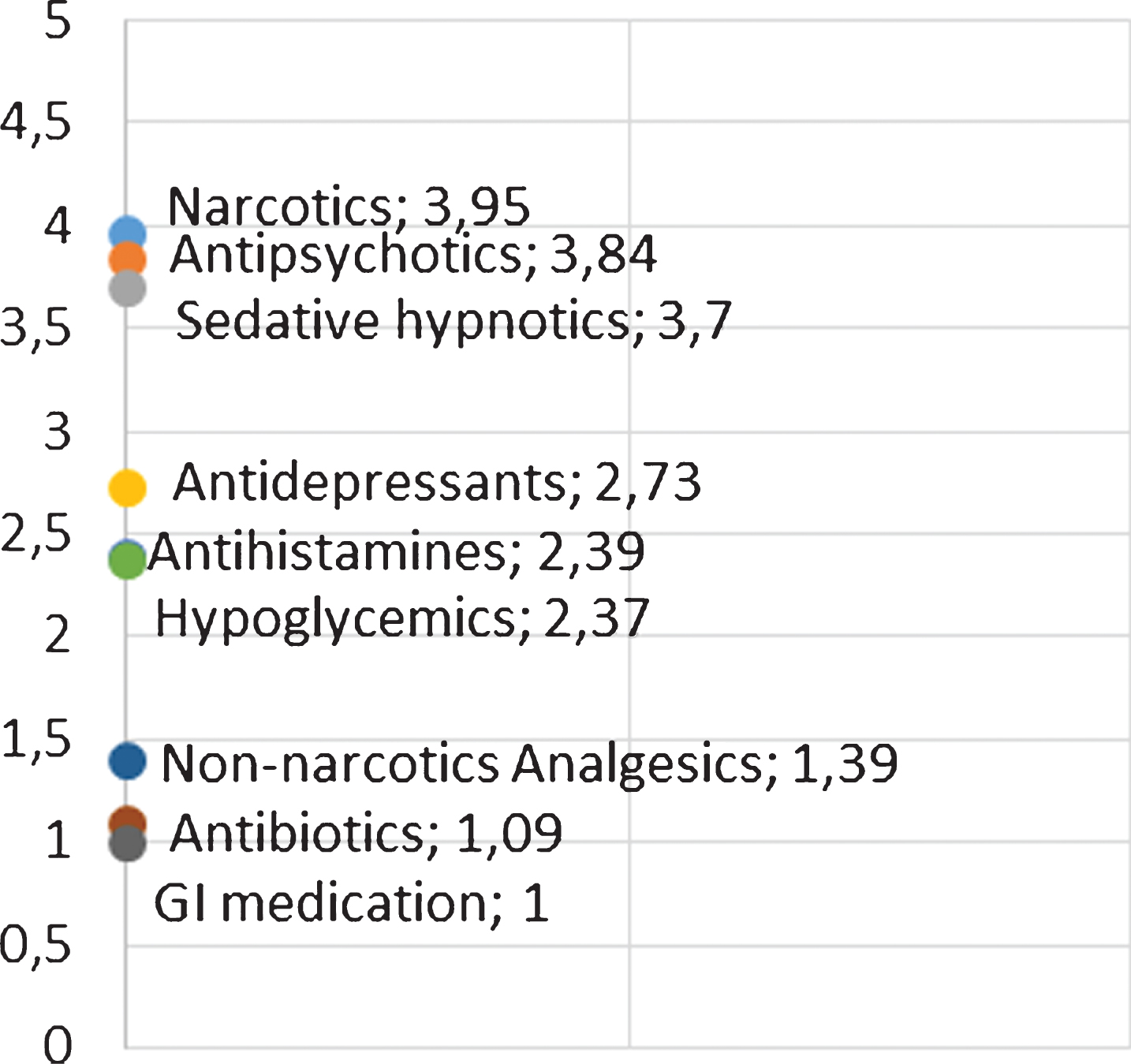
Medication risk ranking.
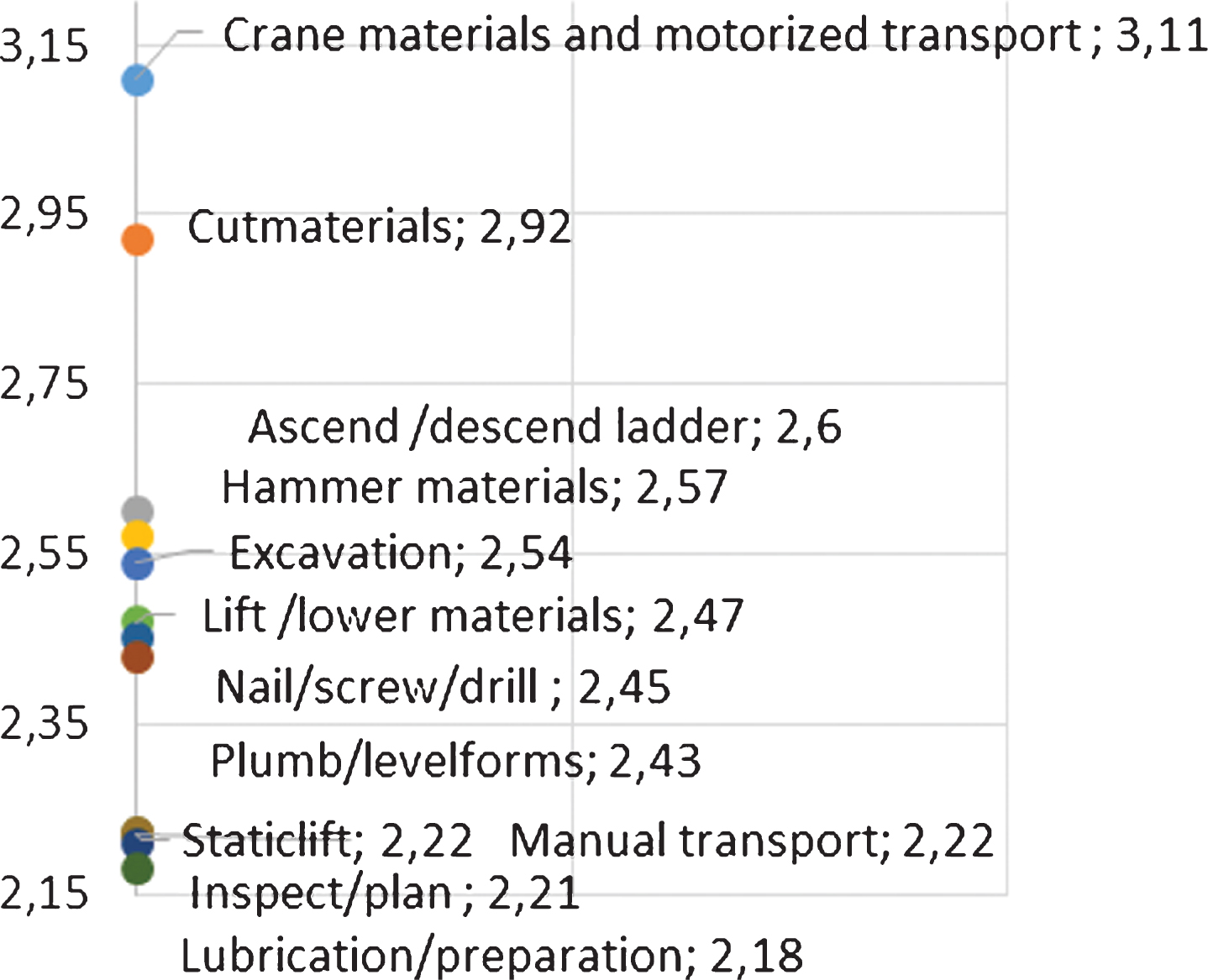
Activities risk ranking.
Operating a crane and motorized transport were identified as the most dangerous activities.
It is remarkable that some selected experts considerate as an important fact that low medication doses are not a total guarantee of absence of negative effects on the workers’ capabilities because sometimes the worker cannot tolerate the prescribed substance in the same way as the majority of the population. Another cause of undesirable effects on the worker could be the combination of narcotics with alcohol or other addictive substances, which could maximize the narcotic effect.
These results about risk activities are aligned with previous results obtained by Hallowell and Gambatese [30] and Lopez-Arquillos et al. [27].
It is notable that the experts pointed out that the effect of narcotics on the skills and capacities of a worker can be comparable with the effect of substances such as alcohol or illegal drugs. Some authors like López et al. [31] or Macedo et al. [32] found that alcohol consumption may play a significant role in the sector’s accident rate. Gerber & Yacoubian [20] identified that alcohol and other drug abuse is as a moderately serious problem affecting construction companies in the United States. In their research, all of the respondents reported that substance abuse in the construction industry was a problem to some degree rate, but no specific studies were found about the influence or effects on a construction site of narcotics with medical prescription.
With respect to antidepressants, their use has been previously associated with accidents and cognitive failures at work [33] According to Haslam et al. [16] the number of people taking prescribed medication for anxiety and depression has increased greatly, but little is known of how this medication impacts on safety at work. The workers found it difficult to distinguish between the effects of the symptoms of depression and the effects of their medication. Although antidepressants were not evaluated by the chosen experts as the most dangerous medication, the increasing number of affected people is an important factor to consider in future research. In addition, research into the relation between depression and accidents at work in the construction sector were not found.
Antihistamines were considered by respondent experts as a medium risk medication. Similarly Gilmore [24] considered that antihistamine use was consistently related to the risk of injury at work. Other authors have identified their negative impact on safety and productivity [34], but no specific studies concerning this issue in the construction sector were found.
Non-narcotic analgesics were ranked as low risk medication, but in the literature these kinds of substances have potential risks associated with over-the-counter service [35]. Although they were not associated with an especially high risk of accident, self-medication without any medical criteria could have negative consequences in combination with other substances.
Conclusions
According to the results obtained in the current research, the influence of some medicinal substances on the levels of occupational risk of construction workers is an important factor to consider in the safety management of construction sites. Narcotics were identified as the most dangerous medication in the workplace, and the use of cranes and motorized transport the most risky activities under the effect of any medication.
Workers under the effects of any medication should communicate this fact to their foreman and managers in order to adapt their tasks to their current capabilities. Additionally, workers should be trained and informed about the different levels of influence of different substances in order to avoid some dangerous tasks when they are affected by some medications.
Specific voluntary healthy controls should be created in construction companies for those workers affected by long term diseases such as depression or rhinitis, to facilitate a better management and control of the different levels of medication that could be necessary.
A new specific variable on accident notification forms about the medication of the worker could be very useful to obtain more accurate results about the negative effects of some medical substances with influence in some construction accidents.
Limitations of the study
The number of construction activities studied was limited. Only the most common activities of the construction sector were evaluated. Other specific activities could possibly obtain different results. The interaction between different medications and substances has not been evaluated. In some cases, the mix of different medications could increase risk levels.
Impact on the industry
A better knowledge of the risk levels according to the current capabilities of workers under the effects of medication is a powerful tool for planning construction actions considering the occupational safety of the workers.
Conflict of interest
None to report.