



Abstract
BACKGROUND:
The traditional design of fabric cutting scissors frequently causes excessive ulnar deviation of the wrist which, together with repetitive and long-term use of the tool, may contribute to the development of musculoskeletal problems, particularly in the upper extremities.
OBJECTIVE:
The aim of this study was to compare a new bent-handle fabric scissors with a traditional one.
METHODS:
The study investigated the effects of a new bent-handle fabric scissors on several hand performance capabilities (hand dexterity, pinch grip strength, wrist postures and hand/finger discomfort) and tool’s usability (using System Usability Scale – SUS) and compared it against the effects of traditional design.
RESULTS:
The results indicated that the bent-handle fabric scissors was superior to the traditional design as it resulted in more neutral wrist deviation, higher usability scores and less hand/finger discomfort ratings. No significant difference was found between the two designs with regard to the hand dexterity and strength exertions.
CONCLUSIONS:
The findings provide evidence that the ergonomic principle of “bending the tool, not the wrist” can perhaps be employed advantageously for the design of fabric cutting scissors to reduce wrist deviations and discomfort and to improve the tool’s usability.
Introduction
Musculoskeletal disorders (MSDs) are a significant health problem with considerable impacts on both individuals and countries worldwide [1, 2]. Evidence suggests that there is a link between the development of MSDs and the use of hand tools [3, 4]. Several factors including repetitive motions, unnatural working postures, forceful muscular exertions and mechanical stresses can contribute to the development of MSDs [1, 6]. One or more of these risk factors are present when working with hand tools [7, 8]. It is, therefore, essential to design ergonomic hand tools to reduce mechanical/physical stresses, discomfort and MSDs [8, 9].
One of the ergonomic principles for designing hand tools is that it is better to bend the tool’s handle rather than to bend the user’s wrist to reduce wrist deviation and subsequent MSDs and injuries [10, 11]. A number of previous studies have therefore applied this principle to design several bent-handle non-powered hand tools such as pliers [12, 13], hammers [14], files [15], hairdressing scissors [16], and paint brushes [17]. However, much less attention has been given to the application of this principle for improving the design of fabric cutting scissors. Handle design of traditional fabric scissors usually do not allow the user to keep his/her wrist in a neutral position which, together with repetitive and long-term use of the tool, imposes high mechanical stresses on the hand/wrist while using the tool. The findings from previous research also suggest that the use of scissors as a work tool may be associated with the increased risk of hand and wrist complaints [18]. In addition, it has been acknowledged that the bent-handle hand tools could not be used under all working conditions but only for limited particular tasks [10]. Therefore, the present study was conducted to investigate if this ergonomic principle is applicable to improve the design of fabric cutting scissors. For this, the bent-handle and traditional scissors were compared in terms of a number of hand performance and usability measures to determine which design is superior.
Methods
Subjects
Twenty-four students, including 12 females and 12 males, from the Tabriz University of Medical Sciences participated in this study. Selection of the subjects was based on their response to posters that were placed on several notice boards in main campus of the Tabriz University of Medical Sciences. The selection criteria for the study subjects were being healthy with no history of upper limb injury or musculoskeletal problems, especially in the upper limbs. The anthropometric data of the study subjects are shown in Table 1.
Anthropometric data of the study participants (n = 24)
Anthropometric data of the study participants (n = 24)
Two prototype designs of scissors evaluated in this study were traditional and bent-handle fabric scissors. The bent-handle scissors was made by modification of a pair of traditional fabric scissors which is commercially available and commonly used for fabric cutting and dress making. The modification was made to the handle of the fabric scissors so that it had an angle of 19 degrees across the palm of the hand, as it has been recommended in the literature for ergonomic tool handle [11]. The appearance and characteristics of the fabric scissors evaluated in the study are shown in Fig. 1 and Table 2, respectively.

Bent-handle scissors (a) and traditional scissors (b) evaluated in the study.
Characteristics of the fabric scissors evaluated in the study
In this experimental study, dependent variables evaluated were: (1) time to complete the simulated fabric cutting task (as a measure of hand dexterity), (2) maximal pinch grip strength, (3) wrist postures, (4) usability and (5) subjective hand and finger discomfort assessments, as described below. Selection of these variables was based on their relevance to the simulated fabric cutting task with scissors. Each study participant evaluated the two models of scissors (using a randomized presentation design) during a single experimental session.
A simulated fabric cutting tasks was designed for the purpose of this study. This task required the study participants to cut out different geometric patterns (e.g. square, rectangle, circle, and star shapes) drawn on a piece of fabric using two design of scissors. Each participant completed equal number of geometric patterns (e.g. four from each pattern with the same size, totally 16 shapes) with each design of scissors. The participants were asked to complete this task with their dominant hand at their own pace and the time (in min) needed to perform the task was recorded using a digital stopwatch. A time penalty of 5 s was added to the test each time that the participant went outside the borders of the geometric patterns [19]. Therefore, the total time taken to complete the simulated fabric cutting task with each fabric scissors (including the task time and possible time penalties) was considered as the measure of hand dexterity with that scissors design. Pinch grip strength (maximal) was measured using a B&L pinch gauge (B&L Engineering, Tustin, CA, USA) in a standard siting posture (e.g. the upper arm aligned to the torso, elbow flexed 90°, and the wrist was in neutral position), following the procedures outlined in previous research [20]. For each test condition, 2 repetitions of pinch strength measurements (with a 2-minute rest break allowed after each exertion) were made, and if there was <10% difference between the two measurements, their average value was used for subsequent analysis [20]. The wrist postures including ulnar/radial (U/R) deviation and flexion/extension (F/E) while working with fabric scissors were also recorded through direct observation of the study participants while they performed the simulated fabric cutting task with each scissors design. Natural and unnatural wrist postures (for both U/R and F/E of the wrist) were considered as angles up to 20° and greater than 20°, respectively [21]. To record the U/R or F/E postures with each scissors design, the investigator made sure to examine the longest adopted wrist posture during the task cycle for each participant. To avoid inter-observer variation, recording of the wrist postures in this study was performed by one trained investigator. The intra-observer reliability of the posture recordings using Kappa coefficients (coefficients between 0.82–0.93) was also acceptable. The system usability scale (SUS) which is a validated and reliable tool [22], was used for evaluation of the usability of scissors. The SUS has been used in similar previous hand tool evaluation studies [8, 24]. This is a 10-item scale (with 5-point response format from strongly disagree (1) to strongly agree (5)), which measures different aspects of usability and gives a total usability score from 0–100. Higher scores in this scale indicate higher usability. A translated and validated Persian version of this tool was used in this present study [23]. Finally, the hand and finger discomfort was assessed subjectively using a hand map (as shown in Fig. 2), together with a rating scale of 0–5 (where No discomfort = 0; Very low discomfort = 1; Low discomfort = 2;Moderate discomfort = 3; High discomfort = 4, and Extreme discomfort = 5) [20]. The study participants were instructed to show any region of discomfort that they felt on the hand map and to rate its severity using the scale immediately after finishing the simulated fabric cutting task with each fabric scissors. The mean (SD) severity of reported discomfort was then calculated for each hand and finger region separately for further analysis.
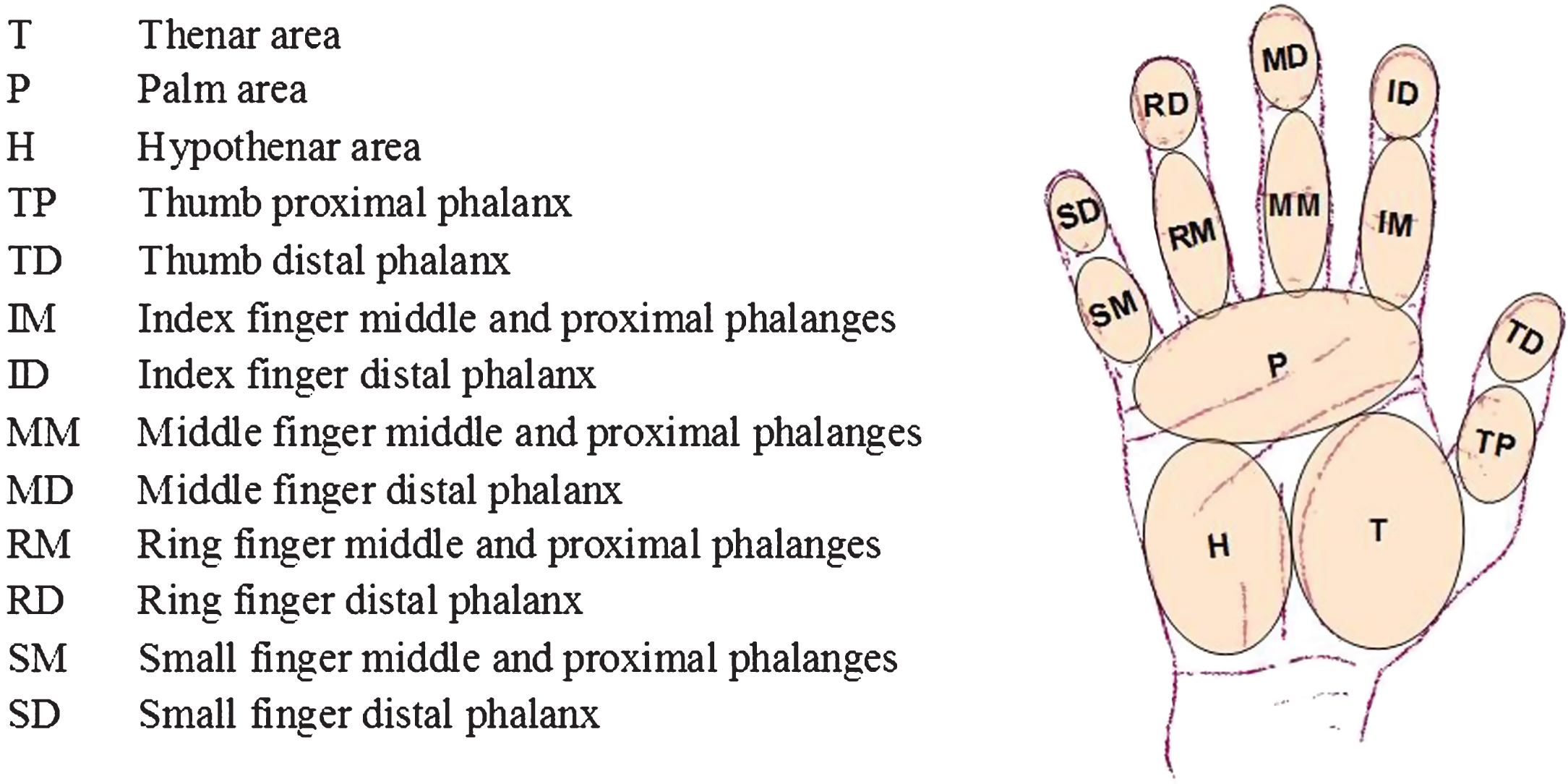
Hand map and different hand and finger regions for the subjective assessment of discomfort (Adapted from Dianat et al. 2014 [20]).
The time to complete the simulated fabric cutting task and wrist posture evaluations were performed while the study subjects were performing the simulated task with each scissors. The pinch strength measurements were carried out before and after finishing the simulated task with scissors designs. Finally, the usability (evaluated by SUS questionnaire) and hand and finger discomfort assessments were performed after finishing the task with each model of scissors.
The study protocol was reviewed and approved by the ethics committee in the Tabriz University of Medical Sciences. All participants were informed about the aim and procedure of the study and signed a written consent form before participation in the experiments. Participation in this present study was voluntary and the study subjects were free to withdraw the study at any stage.
Statistical analysis
Statistical analysis of the data was performed using the SPSS v.17.0 software (SPSS Inc., Chicago, IL). Two-tailed paired sample t-test was used to evaluate the effect of scissors design on the the time to complete the fabric cutting task, pinch grip strength and usability scores. In addition, non-parametric Wilcoxon Signed Rank test was used to analyze the wrist postures hand and finger discomfort ratings. A significant level of P < 0.05 was used for all tests.
Results
The results showed no significant effect of scissors design on the time to complete the simulated fabric cutting task. The results indicated that the mean (SD) time required to completed the simulated fabric cutting task with bent-handle scissors was 14.5 (3.9) min, while it was 15.0 (4.8) min with traditional one. Similarly, the results showed no significant difference between the bent-handle and traditional scissors in terms of pinch grip strength exertions. The mean (SD) of pinch grip strength recorded after finishing the task with the bent-handle scissors were 8.1 (2.5) kg, while it was 8.0 (2.8) kg with the traditional design.
Significantly different usability scores were found between the two designs of scissors (P < 0.001). The mean SUS score recorded for the bent-handle scissors was higher (Mean±SD = 69.8±14.4) than that recorded for the traditional design (Mean±SD = 63.0±8.1).
With regard to the wrist postures, the effect of scissors design was found to be statistically significant on the U/R deviation of the wrist (P < 0.001), but not on the F/E of the wrist. The percentages of natural and unnatural U/R deviation of the wrist while working with the bent-handle scissors were 83.3% (n = 20) and 16.7% (n = 4), respectively. Similarly, the percentages of natural and unnatural wrist U/R deviation for the traditional scissors were 8.3% (n = 2) and 91.7% (n = 22), respectively. It should also be noted that the percentages of natural wrist F/E with the bent-handle and traditional scissors were 58.3% (n = 14) and 45.8 (n = 11), respectively, while the percentages of unnatural wrist F/E with the bent-handle and traditional design were 41.7% (n = 10) and 54.2% (n = 13), accordingly.
Finally, the discomfort ratings in different regions of the hand and fingers while working with scissors were generally low. However, the results showed that the mean rankings of the discomfort ratings in the thenar (P < 0.05), hypothenar (P < 0.001) and thumb proximal phalanx (P < 0.05) were significantly different while working with the bent-handle and traditional scissors. These hand and finger regions are shown in Fig. 3. The mean (SD) severity of reported discomfort in the thenar region, hypothenar region and thumb proximal phalanx while working with the traditional scissors were 0.9 (1.7), 3.3 (1.7) and 1.3 (1.8), respectively, while these values were 0.1 (0.2), 0.1 (0.2) and 0.2 (0.6), accordingly, for the bent-handle scissors.

Areas of discomfort reported when working with fabric scissors.
The present study investigated the various aspects of users’ performance (e.g. hand dexterity, muscular strength, wrist postures and discomfort) and usability of the bent-handle fabric cutting scissors and compared the results with those obtained with the traditional model. The aim was to determine if the ergonomic principle of “bending the tool, not the wrist” is applicable to improve performance and usability of the fabric cutting scissors. The main findings of the study were that the wrist deviation, hand and finger discomfort and usability of the tool were improved with the bent-handle scissors, while there was no significant difference between the two designs of scissors in terms of the time required to complete the fabric cutting task (e.g. hand dexterity) and pinch strength exertions.
As shown in this study, the shape of the tool handle had a significant effect on the usability ratings while completing the simulated fabric cutting task with scissors. This finding showed some improvements in usability with the bent-handle scissors compared to the traditional one. Additionally, the mean SUS score for the bent-handle scissors was 69.8, which shows a relatively good level of usability for this tool. This result is relatively supported by the findings from hand and finger discomfort assessments in our study. The findings from hand and finger discomfort assessments revealed that the study participants experienced a lower level of discomfort in some regions such as the thenar, hypothenar and thumb proximal phalanx with the bent-handle scissors than with the traditional design. These findings may be attributed to the better fit between the users’ hand and the scissors handle and can be considered as an advantage for the bent-handle scissors over the traditional design. Taken together, it seems that an ergonomically designed tool with good level of usability is likely to reduce discomfort experienced during its use. However, it should be taken into account that these results provide a basis for informing the use of fabric cutting scissors, while further validation studies may be needed for other specific contexts of use.
In addition to improved usability and discomfort ratings, the results also showed more neutral wrist postures (in terms of U/R deviation of the wrist) with the bent-handle scissors than with the traditional design. This is also important from the ergonomics point of view, as the repetitive use of the hand and fingers while working with scissors imposes high levels of mechanical stresses on these anatomical regions. On the other hand, the traditional scissors normally do not allow the wrist to be in its neutral position during tool use. This unnatural wrist posture, together with the mechanical/physical stresses on these anatomical structures, could consequently lead to the development of MSDs or injuries. It is, therefore, important to introduce bent-handled hand tools into a job if there is a possibility of reducing the wrist deviation. It seems that the bent-handle fabric scissors tend to reduce the time the wrist is deviated, and in contrast, increase the time the wrist is in its natural position, leading to reduced risk of occurring MSDs. However, it should be noted that before implementing a bent-handled hand tool into a job, users should be instructed about the rationale and aims of using this new tool and the appropriate use of it [10].
Although this study adds to the understanding of the design features for the ergonomic optimization of the fabric scissors, there may be some limitations when applying the findings. First, the findings may not be generalizable to the general working population as the study subjects were non-professional workers and evaluated the prototype scissors in a laboratory condition (as opposed to longer duration of use in actual working situations). In addition, the specific contexts of the job and the type of grip patterns which determine hand/tool interaction may vary considerably while working with different types of scissors. Therefore, other types of scissors with different contexts of use and performance measures may be worth investigating.
Conclusions
In conclusion, the findings of the present study provide evidence that the ergonomic principle of “bending the tool, not the wrist” can perhaps be employed advantageously for the design of fabriccutting scissors to reduce unnatural wrist deviations and discomfort as well as to improve the usability of the tool. The findings present a better insight into the handle design for fabric scissors but further research using different types of scissors, tasks and performance measures may be needed to validate the the effectiveness of the proposed design.
Conflict of interest
None to report.